Quotulatiousness

October 7, 2014

Israel’s “Battlefield Internet” at work

Filed under: Middle East, Military, Technology — Tags: , , , , — Nicholas @ 14:49

Strategy Page talks about the Israeli deployment of the first reliable Battlefield Internet for ground, sea, and air combat:

The July-August 2014 war in Gaza created some very unpleasant surprises for Hamas, which thought it could risk another war with Israel and come out the winner (to the Arab world at least). Hamas knew that Israel had been working at discovering and countering Hamas tactics, but Hamas was confident they had enough new tricks to stay ahead of the Israelis. Hamas quickly discovered that the Israelis were a lot quicker and better coordinated than in the past. This time around the Israelis learned more from their earlier clashes with Hamas and Hezbollah.

This has happened before, to both the Israelis but mainly to the Arabs. It was only after that war ended that Hamas learned details of what they were up against. It turned out that Israel had managed to create an effective and reliable “Battlefield Internet”. This has been the goal of military communications experts for over a decade. The United States was long the leader, but in mid-2014 Israel was the first to demonstrate a Battlefield Internet that consistently worked under combat conditions. This breakthrough development was largely ignored by the media but military leaders worldwide are paying attention.

[…]

What the Israelis have done with the Battlefield Internet is link everyone involved (pilots, UAV operators, tank commanders and infantry unit commander, plus people at C4i Teleprocessing Branch that managed the flow of data) so all can all see was what each other was seeing of the Hamas commandos. These multiple views eliminated the uncertainty often present when only one view was available. It made all the Israelis involved more confident and that led to speedier interpretation of the situation and decisive action to deal with it. This capability also reduces the risk of friendly fire.

October 5, 2014

RCAF deployment to Iraq

Filed under: Cancon, Middle East, Military — Tags: , , , , — Nicholas @ 09:38

In the Toronto Star, Bruce Campion-Smith and Les Whittington report on the debate in the Commons over sending RCAF aircraft to join the coalition against ISIS:

Canadian fighter pilots will be in combat for the second time in three years after Prime Minister Stephen Harper announced CF-18 jets are being dispatched to the region to battle Islamic State militants.

Political lines were quickly drawn over the planned six-month mission, with the New Democrats and Liberals telling the Commons in a dramatic standoff Friday that they would oppose the military operation when MPs debate and vote on it Monday.

But the government’s motion to deploy the Royal Canadian Air Force as part of the United States-led coalition confronting Islamic State fighters is expected to be approved by the Conservative majority in Parliament.

Speaking to a hushed Commons, Harper laid out the case for war against Islamic State — or Islamic State of Iraq and the Levant (ISIL), an Al Qaeda splinter group — for “unspeakable atrocities” and which has threatened Canada.

“Let me be clear on the objectives of this intervention. We intend to significantly degrade the capabilities of ISIL,” Harper said.

Up to six CF-18 fighter jets will be deployed to the region to join in coalition airstrikes against Islamic State targets in Iraq and possibly Syria. As well, Canada will contribute one CC-150 Polaris air-to-air refuelling aircraft and two CP-140 Aurora surveillance aircraft. In all, 320 aircrew and other personnel will take part in the mission.

The opposition NDP and Liberal leaders quickly spoke against the action.

NDP Leader Tom Mulcair said the Conservatives have not given Canadians adequate information on how this war would be conducted.

“Will Canada be stuck a decade from now mired in a war we wisely avoided entering a decade ago?” he asked in the Commons.

“The tragedy in Iraq and Syria will not end with another western-led invasion in that region. . . . Canada, for our part, should not rush into this war.”

Liberal Leader Justin Trudeau said his party — which had backed military action in Afghanistan and Libya — would not support the motion endorsing combat.

Trudeau was dismissive of Canada’s contribution, saying the country could do more than sending what he branded “aging warplanes.”

“Whether they are strategic airlifts, training or medical support, we have the capabilities to meaningfully assist in a non-combat role in a well defined international mission,” Trudeau said.

Update: Lieutenant General Yvan Blondin responds indirectly to Trudeau’s dismissive description of the CF-18 (republished at the Ottawa Citizen).

As the Commander of the Royal Canadian Air Force (RCAF) and CF-18 pilot, I wish to dispel any questions pertaining to the relevance of the CF-18. I am completely confident in the ability of the aircraft and personnel to extend Canadian air power anywhere in the world, such as in support of the current air operations underway in Iraq.

The aircraft we fly today have been continuously upgraded throughout their lifespan, ensuring that our crews can fly into harm’s way with the confidence that they have the equipment they need to complete missions safely. Our RCAF personnel and aircraft have proven that they can fight alongside our Allies — they are battle hardened, and the capabilities of our CF-18s today certainly enable them to effectively serve alongside the fighter aircraft being flown by Allies in the fight against ISIL.

October 1, 2014

German Air Force pushed “to the very limits of its capacities”

Filed under: Europe, Germany, Middle East, Military — Tags: , , , , — Nicholas @ 08:22

German magazine Der Spiegel reports on the sad state of readiness in the German military:

Last week, a single person pushed Germany’s air force to the very limits of its capacities: Ursula von der Leyen, the country’s defense minister. Von der Leyen requested that two Transall military transport aircraft with missile defense systems be transferred to Amman, the Jordanian capital. The defense minister and a pool of reporters then flew for eight hours on Thursday morning in one of the aircraft to Erbil in Iraq’s Kurdish region. Back in Germany, the military had but a single additional Transall at its disposal.

After her arrival in Erbil, von der Leyen proceeded to the palace of the Kurdish regional government’s president. Her visit was to be concurrent with the delivery of German weapons, intended to aid the Kurds in their fight against Islamic State jihadists. Unfortunately, the machine guns and bazookas got stuck in Germany and the trainers in Bulgaria because of a dearth of available aircraft. One had been grounded because of a massive fuel leak. What could have been a shining moment for the minister instead turned into an embarrassing failure underscoring the miserable state of many of the Bundeswehr‘s most important weapons systems.

[…]

Against that backdrop and pressure from the international community, the ramshackle state of the Bundeswehr is no laughing matter in Berlin. At the moment, if Germany’s allies were to ask it to step up its participation in deployments in the Baltic states or Iraq, for example, Chancellor Merkel would likely have to politely pass, creating a highly embarrassing situation for the country. For the moment, though, most pressure related to the Bundeswehr‘s ailments has been directed at von der Leyen. Her critics argue that she has pursued a foreign and security policy vision that goes beyond the Bundeswehr‘s actual capabilities. Now she faces additional criticism that she tried to play down the military’s problems to members of parliament even though senior officials in her ministry were well aware of major shortcomings in the armed forces.

“Contrary to her own list of needed equipment, she created the impression in parliament that anything that could drive, fly or float was capable of full deployment,” said Rainer Arnold, the defense policy spokesman for the center-left Social Democrats (SPD). “But we members of parliament will not be taken for idiots.”

The defense minister hasn’t exactly been blind-sided by the criticism either — she’s known about the problems since before entering office almost a year ago. On Friday, she summoned the heads of the German army, navy and air force as well as the Inspector General of the Bundeswehr to her office for five hours of questioning, much of it centering on events in parliament last Wednesday.

H/T to Mark Collins for the link.

September 30, 2014

“…the outcomes of U.S. military intervention in Iraq and Libya disprove libertarianism”

Filed under: Liberty, Media, Middle East, USA — Tags: , , , , — Nicholas @ 08:30

Nick Gillespie responds to a really dumb argument against libertarianism:

As one of the folks (along with Matt Welch, natch), who started the whole “Libertarian Moment” meme way back in 2008, it’s been interesting to see all the ways in which folks on the right and left get into such a lather at the very notion of expanding freedom and choice in many (though sadly not all) aspects of human activity.

Indeed, the brain freeze can get so intense that it turns occasionally smart people into mental defectives.

To wit, Damon Linker’s recent essay in The Week (a great magazine, by the way), which argues that the outcomes of U.S. military intervention in Iraq and Libya disprove libertarianism, in particular, the Hayekian principle of “spontaneous order.”

No shit. Linker is being super-cereal here, kids:

    Now it just so happens that within the past decade or so the United States has, in effect, run two experiments — one in Iraq, the other in Libya — to test whether the theory of spontaneous order works out as the libertarian tradition would predict.

    In both cases, spontaneity brought the opposite of order. It produced anarchy and civil war, mass death and human suffering.

You got that? An archetypal effort in what Hayek would call “constructivism,” neocon hawks would call “nation building,” and what virtually all libertarians (well, me anyways) called a “non sequitur” in the war on terror that was doomed to failure from the moment of conception is proof positive that libertarianism is, in Linker’s eyes, “a particularly bad idea” whose “pernicious consequences” are plain to see.

In the sort of junior-high-school rhetorical move to which desperate debaters cling, Linker even plays a variation on the reductio ad Hitlerum in building case:

    Some bad ideas inspire world-historical acts of evil. “The Jews are subhuman parasites that deserve to be exterminated” may be the worst idea ever conceived. Compared with such a grotesquely awful idea, other bad ideas may appear trivial. But that doesn’t mean we should ignore them and their pernicious consequences.

    Into this category I would place the extraordinarily influential libertarian idea of “spontaneous order.”

What nuance: Exterminating Jews may be the worst idea…! When a person travels down such a rhetorical path, it’s best to back away quickly, with a wave of the hand and best wishes for the rest of his journey. Who can seriously engage somebody who starts a discussion by saying, “You’re not as bad as the Nazis, I’ll grant you that”…? I’d love to read his review of the recent Teenage Mutant Ninjas movie: “Not as bad as Triumph of the Will, but still a bad film…”

September 28, 2014

Passport revocations for Canadians fighting with ISIS

Filed under: Cancon, Middle East — Tags: , , — Nicholas @ 11:00

It may be little more than a token measure, but the Canadian government is moving to revoke the passports of Canadians known to have gone overseas to join ISIS:

AS WESTERN democracies struggle with how to deal with homegrown terrorists fighting abroad, the Conservative government of Canada has begun revoking the passports of its foreign fighters as well as people still in Canada planning to join them. Chris Alexander, minister for citizenship and immigration, would not say exactly how many passports have been revoked, only that it has been done multiple times against some of the estimated 130 Canadians fighting with extremists, dozens of whom are in Iraq and Syria.

Taking passports away from suspected terrorists is controversial. It gives other countries the incentive to respond in kind, and it severs the route home for those who might be having second thoughts. Human-rights advocates in Canada say the secretive process used to determine whether a person is a threat to national security, one of the criteria for having your passport revoked, allows the government to make arbitrary decisions. These can be challenged in court but only within 30 days of the decision.

[…]

Ever since the attacks on the United States in 2001, Canada has been toughening its terrorism legislation. In 2004 a Liberal government brought in a law allowing it to revoke passports under certain circumstances. This is the power the government is now using. In 2013 the Conservative government made it a crime to leave or attempt to leave the country for the purpose of committing terrorist acts abroad. Earlier this year the government passed a law allowing it to revoke the citizenship — not just the passport — of dual citizens convicted in Canada or abroad of major crimes, including terrorism. Mr Alexander has not yet used this power but says he will do so, despite objections that this creates two-tiered citizenship.

September 23, 2014

“Arab civilization … is all but gone”

Filed under: History, Middle East, Politics — Tags: , , , — Nicholas @ 11:14

In Politico, Hisham Melhem explains why the Middle East is in the current state of chaos:

With his decision to use force against the violent extremists of the Islamic State, President Obama is doing more than to knowingly enter a quagmire. He is doing more than play with the fates of two half-broken countries — Iraq and Syria — whose societies were gutted long before the Americans appeared on the horizon. Obama is stepping once again — and with understandably great reluctance — into the chaos of an entire civilization that has broken down.

Arab civilization, such as we knew it, is all but gone. The Arab world today is more violent, unstable, fragmented and driven by extremism — the extremism of the rulers and those in opposition — than at any time since the collapse of the Ottoman Empire a century ago. Every hope of modern Arab history has been betrayed. The promise of political empowerment, the return of politics, the restoration of human dignity heralded by the season of Arab uprisings in their early heydays — all has given way to civil wars, ethnic, sectarian and regional divisions and the reassertion of absolutism, both in its military and atavistic forms. With the dubious exception of the antiquated monarchies and emirates of the Gulf — which for the moment are holding out against the tide of chaos — and possibly Tunisia, there is no recognizable legitimacy left in the Arab world.

Is it any surprise that, like the vermin that take over a ruined city, the heirs to this self-destroyed civilization should be the nihilistic thugs of the Islamic State? And that there is no one else who can clean up the vast mess we Arabs have made of our world but the Americans and Western countries?

September 17, 2014

QotD: Fun has no place in Islam

Filed under: Middle East, Quotations, Religion — Tags: , — Nicholas @ 00:01

Allah did not create man so that he could have fun. The aim of creation was for mankind to be put to the test through hardship and prayer. An Islamic regime must be serious in every field. There are no jokes in Islam. There is no humor in Islam. There is no fun in Islam. There can be no fun and joy in whatever is serious. Islam does not allow swimming in the sea and is opposed to radio and television serials. Islam, however, allows marksmanship, horseback riding and competition …

Ayatollah Ruhollah Khomeini, meeting in Qom “Broadcast by radio Iran from Qom on 20 August 1979.” quoted in Taheri, The Spirit of Allah (1985) p.259

September 15, 2014

The “semi-war” against ISIS – watch their actions, don’t listen to their words

Filed under: Middle East, Military — Tags: , — Nicholas @ 09:46

Brendan O’Neill notes the huge gap between what western politicians say about ISIS and what actually happens:

Has anyone else noticed the colossal disconnect between Western leaders’ rhetoric on the Islamic State and their proposed action against it?

With their words they tell us IS poses the greatest threat to Western civilisation. This bloody cowboy statelet is an ‘imminent threat to every interest we have’, says US defence secretary Chuck Hagel. This ‘death cult’ is a threat not only to the people of Iraq and Syria but to ‘the whole world’, says Australian PM Tony Abbott. Fighting IS is the ‘greatest struggle of our generation’, says Canada’s foreign affairs minister, adding: ‘[The IS] worldview is a direct challenge to the values of Western civilisation.’ IS is ‘the most serious threat’ the Western world faces right now, says British PM David Cameron.

And how do these leaders of the West, these fretters over the future of Western civilisation, plan to tackle this barbaric pseudo-state that is apparently a challenge to every interest we have? With some airstrikes. And by arming the Kurds. That’s it. There will not, as President Obama emphasised with gusto during his address to the American people last week, be boots on the ground. This great struggle to defend the vales of the West ‘will not involve American combat troops fighting on foreign soil’, he said.

In short, this is a generational struggle that will involve very little struggle, a fight to defend civilisation that will involve next to no fighting. Our leaders ramp up the rhetoric – talking about the need to galvanise the West and its allies against what the Canadian minister calls ‘one of the most barbaric terrorist groups the world has ever known’ — while making clear that no Westerner, not even our soldiers, will be expected to put themselves in harm’s way to guard the gates of civilisation from these ‘barbarians’. We won’t fight them on the beaches (or rather, deserts); we’ll just bomb them from the air and leave the messy business of hand-to-hand combat to the ill-trained, already stretched Kurds. Let the Kurds defend the ‘values of Western civilisation’.

September 11, 2014

Obama’s misunderstanding of both ISIS and Islam

Filed under: Middle East, Religion — Tags: , , — Nicholas @ 10:10

Amy Alkon draws on lots of sources for this post on why President Obama is making serious mistakes in his approach to fighting ISIS:

First, he gets it wrong on Islam. From his speech:

    Now let’s make two things clear: ISIL is not “Islamic.” No religion condones the killing of innocents…

Islam doesn’t just condone it; it commands it:

    So ingrained is violence in the religion that Islam has never really stopped being at war, either with other religions or with itself. Muhammad was a military leader, laying siege to towns, massacring the men, raping their women, enslaving their children, and taking the property of others as his own. On several occasions he rejected offers of surrender from the besieged inhabitants and even butchered captives. He actually inspired his followers to battle when they did not feel it was right to fight, promising them slaves and booty if they did and threatening them with Hell if they did not. Muhammad allowed his men to rape traumatized women captured in battle, usually on the very day their husbands and family members were slaughtered.

    […]

    …Although scholars like Ibn Khaldun, one of Islam’s most respected philosophers, understood that “the holy war is a religious duty, because of the universalism of the Muslim mission and (the obligation to) convert everybody to Islam either by persuasion or by force”, many other Muslims are either unaware or willfully ignorant of the Quran’s near absence of verses that preach universal non-violence. Their understanding of Islam comes from what they are taught by others. In the West, it is typical for believers to think that their religion must be like Christianity – preaching the New Testament virtues of peace, love, and tolerance – because Muslims are taught that Islam is supposed to be superior in every way. They are somewhat surprised and embarrassed to learn that the evidence of the Quran and the bloody history of Islam are very much in contradiction to this.

Islam may be referred to as a “religion,” but I have been reading about Islam since 9/11, and at first, was surprised to find that it is actually a totalitarian political movement dressed up as a religion. I am aware that many Muslims are peaceful and do practice it as a religion, and that many have no idea about the violent overthrow of the “infidel” world that the Quran commands. Unfortunately, there are also many Muslims who practice Islam as the Quran and other major texts command. (This is not “radical” Islam, simply Islam.)

[…]

Islam commands the re-establishment of the Caliphate — and this is what they are trying to do. A bit more on that:

    It becomes obligatory on every single individual to do his best to re-establish the Islamic Caliphate. Every one has to do as much as he can wherever his place is to return our Glory, supremacy and dominance…

In addition to air strikes, Obama says we’ll have American service members acting (in my description) as sort of military soccer coaches to the Iraqis. He wants Congress to okay more of this in Syria. Note that he didn’t ask Congress, but merely “consulted” with a few Congresscritters.

Ugh. Right. This is sustainable. And kind of like trying to close a bursting dam with a tube of Krazy Glue.

September 7, 2014

ISIS and its local and regional enemies

Filed under: Middle East, Religion — Tags: , , , , , — Nicholas @ 11:27

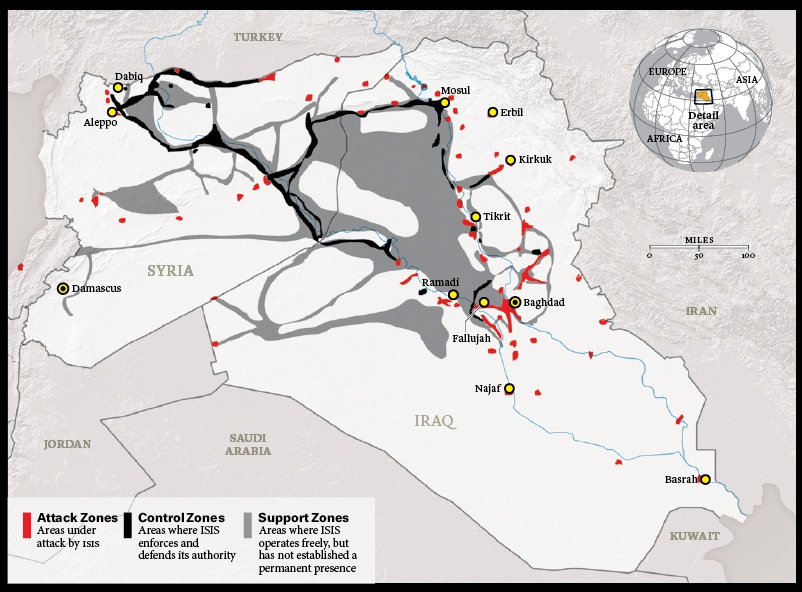
Strategy Page looks at the various forces and factions opposed to the rise of the Caliphate of ISIS:

In the Middle East Islamic radicalism, and its murderous offshoot Islamic terrorism, comes in many different flavors. Most groups are mutually antagonistic and will often kill each other as eagerly as they go after kaffirs (non-Moslems.) Nearly all these radical movements now condemn ISIL (al Qaeda in Iraq and the Levant) and condemn ISIL for being too extreme. To the West these seems absurd, and many Moslems agree. But radical Islam is what Islam began as and to this day there are always Moslems who embrace the concept of extreme Islamic radicalism and Islamic terrorism as being the ultimate form of Islam. Thus while Saudi Arabia bans all other religions in its territories and regularly beheads people accused of sorcery and other religious offenses, the Saudis condemn ISIL. One reason for this is that ISIL considers the Saudi government weak and not Islamic enough and worthy of being replaced (after a righteous bloodbath of the current Saudi royal family) by someone more suitable (like ISIL). Al Qaeda also condemns ISIL, initially for not ignoring al Qaeda orders to tone down the barbaric treatment (mass murder and torture) of the enemy because al Qaeda realized that this eventually triggers a backlash from other Moslems. Iran condemns ISIL because all Shia (meaning all Iranians) are heretics and deserving of summary execution. Iran-backed Hezbollah is now using that ISIL threat to justify Hezbollah grabbing more power in Lebanon, where Shia are a third of the population but far more powerful politically because Iranian cash, weapons and training have made Hezbollah too strong for the elected Lebanese government to suppress or even oppose. In Syria, the minority (more Shia) Assad government, fighting a Sunni rebellion since 2011, now calls on their current Sunni enemies (Saudi Arabia and other Gulf Arabs, plus the Sunni majority in Syria) to join with them in destroying ISIL.

Whatever else ISIL has done it has united many other Sunni faction and the Shia in the region into an uneasy anti-ISIL coalition. But even after ISIL is gone, Islamic radicalism will still be there. For most Moslems this radicalism is like the weather; every Moslem talks about but Moslems cannot seem to do anything to eliminate or even control it.

Islamic terrorism has long been trapped in a self-destructive cycle of its own making. It works like this. Islamic radicals obtain their popularity and power by proclaiming that they are defending Islam from non-believers and sinners (within Islam, often local Moslem dictators). In order to maintain this moral superiority, the Islamic radicals must be better Moslems, and insist that others do as they do. Since Islam is a religion that dictates how one lives, in considerable detail, as well as how one plays, this business of being a “good Moslem” can get tricky. And it is. There’s a race underway by Islamic radicals, and the clergy that provide theological support, to issue, and enforce, more and more rules on how a good Moslem should live.

September 4, 2014

The very essence of government is a monopoly on violence

Filed under: Government, History, Middle East — Tags: , — Nicholas @ 09:19

Matt Ridley on how governments came about historically and how ISIS is trying to do exactly the same thing:

Nobody seems to agree whether Islamic State is best described as a gang of criminals, a terrorist organisation or a religious movement. It clearly has a bit of all three. But don’t forget that it aspires, for better or worse, to be a government. A brutal, bigoted and murderous government, its appeal is at least partly that it seems capable of imposing its version of “order” on the territory it controls, however briefly. It reminds us that the origin and defining characteristic of all government is that it is an organisation with a monopoly on violence.

The deal implicit in being governed is at root a simple one: we allow the people who govern us to have an exclusive right to commit violence, so long as they direct it at other countries and at criminals. In almost every nation, if you go back far enough, government began as a group of thugs who, as Pope Gregory VII put it in 1081, “raised themselves up above their fellows by pride, plunder, treachery, murder — in short by every kind of crime”.

Was Canute, or William the Conqueror, or Oliver Cromwell really much different from the Islamic State? They got to the top by violence and then violently dealt with anybody who rebelled. The American writer Albert Jay Nock in 1939 observed: “The idea that the state originated to serve any kind of social purpose is completely unhistorical. It originated in conquest and confiscation — that is to say, in crime … No state known to history originated in any other manner, or for any other purpose.”

Henry VII, the monarch who managed, after a century of gang warfare, to establish a monopolistic central government in England, funded his administration largely by extorting money from rich merchants with the threat of violence. That is to say, he ran a protection racket as blatant as any mafia don or IRA commander: pay up or lose your kneecaps.

“David Cameron mouths foolish nothings” while “Obama … resembles a spineless invertebrate”

Filed under: Britain, Europe, Middle East, Russia, USA — Tags: , , , — Nicholas @ 07:25

Historian Max Hastings pours out the scorn toward British PM David Cameron and American President Barack Obama for their dithering and unwillingness to grapple with real world problems like the invasion of Ukraine and the rise of ISIS:

Suddenly, the world seems a frightening place. The beheading of a second American hostage by jihadist fanatics and the threat that a British aid worker will suffer the same fate has shocked the peoples of the West, as have few events since the Cold War.

We are uncertain how the Western Powers should respond.

At such moments, we turn to our national leaders for wisdom, reassurance and decision. Instead, we get posturing, dithering and waffle.

David Cameron mouths foolish nothings, proclaiming that Britain would commit ‘all the assets we have’, including our ‘military prowess’ against the Muslim extremists.

More serious, the President of the United States seems supine in the face of the gravest threats to international order in a generation.

Barack Obama boldly strides golf course fairways, while apparently washing his hands of the job the American people — and, by association, the civilised world — pay him for: to strive to lead us into the paths of righteousness.

To borrow P. G. Wodehouse’s phrase, however intelligent Obama may be, he resembles a spineless invertebrate.

Update: Speaking of scorn, here’s Jonah Goldberg yesterday (H/T to Jim Geraghty for the link).

This was always nonsense, but then again so much of the hype about Obama in the early days of his presidency was nonsensical. Still it does contribute to the poignancy of the moment. I’m referring specifically to the Islamic State and their celebration of slavery. MEMRI has excerpts of Facebook chats between British and French supporters of the group as they discuss the great news that you can buy Yazidi women as sex slaves.

[…]

It’s also worth noting that the president has done everything he can to claim that his domestic political opponents are engaged in a “war on women.” He won an election largely because he convinced enough women — and pliant journalists — to take this bilge seriously. Just this week the head of his party went on at great length to claim that the Republican governor of Wisconsin has been “giving women the back of his hand.”

Oh, and let us not forget, the president and his supporters work very hard to paint their domestic political opponents as religious extremists because some private businesses and religious groups don’t want to pay for procedures that violate their conscience.

Now compare this to the people who are celebrating the fact their faith allows them to enslave women.

Just think about it for a moment. The president surely knows about this. His administration surely knows about this. And yet, the president — this modern incarnation of Lincoln, protector of women and opponent of domestic religious extremism — defines his goal for the Islamic State as reducing it to a “manageable problem.” Does this mean that if the group renounces any designs on attacking the U.S. homeland (an impossibility given the tenets of their faith and ambition for a global caliphate) he will stand by as they continue to barter women as sex slaves and breeders? This is the same man who campaigned in Berlin as a “citizen of the world” and champion of global community.

Forgive me, but the term, “Lincolnesque” doesn’t immediately spring to mind.

August 31, 2014

NATO’s assistance for the Kurds – the spirit may be willing, but the military is weak

Filed under: Europe, Germany, Middle East, Military — Tags: , , — Nicholas @ 10:29

Strategy Page explains why NATO aid for the Kurds in northern Iraq may not be sufficient or even timely:

The recent ISIL (al Qaeda in Iraq and Syria) misbehavior (mass murder and so on) in Syria and Iraq has caused a public uproar in Europe and generated demands that NATO send forces to try and stop all the killing. The German government responded on August 20th with a pledge to send weapons to the Kurds who are fighting ISIL in northern Iraq. But Germany was reluctant to send warplanes or troops. A few days later a German Defense Ministry readiness report was leaked and it made it clear why even getting weapons to the Kurds would be difficult. The report showed that only 8 percent of 109 Eurofighter (similar to the U.S. F-15), 11 percent of 67 CH-53 transport helicopters, and 10 percent of 33 NH90 helicopters were fully operational (not sidelined for upgrades, repairs or other problems.) However 38 percent of 56 C-160 twin turboprop transports were available. This made it possible to fly some weapons into northern Iraq, but not much else. Normally a combat ready military has at least half, and more normally over 70 percent of its warplanes ready to go. While this situation shocked many, those who have followed European military trends since the 1980s were not surprised.

The problem is that the European NATO members never spent as heavily on their armed forces as did the United States and Russia, especially after 1991. Britain and France are still heavy spenders, but not enough to make up for what the rest of European NATO members are not doing. European NATO members are aware of this problem, but it has never been a high enough national priority to actually fix.

There was some hope in the decade after September 11, 2001 as the need to deal with international Islamic terrorism changed the armed forces of Europe in unexpected ways. More money was spent on the military and many of the troops got some combat experience. Now the Europeans have more capable and professional forces than they have had for many decades. None of this was expected. But in the last few years these changes have begun to fade. Thus the shocking readiness numbers for German aircraft.

[…]

For example, in 2008 the German parliament was in an uproar over a report depicting German soldiers as physically unfit for military service. It was found that 40 percent of the troops were overweight, compared to 35 percent of their civilian counterparts (of the same gender and age). The investigation also found that the troops exercised less (including participation in sports), and smoked more (70 percent of them) than their civilian counterparts. The military now encourages sports and physical fitness, and discourages smoking, but those efforts did not appear to be working.

When other Europeans looked around they found that it was not just a German problem. It was worse than that. Most European military organizations were basically make-work programs. It’s long been known that many European soldiers are not really fit for action. They are mainly uniformed civil servants. One reason many are not ready for combat, or even peacekeeping, operations, is that they don’t have the equipment or the training. And that’s because up-to-date gear, and training, are expensive. A disproportionate amount of money is spent on payroll. That keeps the unemployment rate down more effectively than buying needed equipment, or paying for the fuel and spare parts needed to support training.

Update: Some supplies and weapons are getting to the Kurdish forces. Here’s the Operation IMPACT page at the Canadian government website:

Operation IMPACT is the Canadian Armed Forces (CAF) provision of strategic airlift to assist in the delivery of critical military supplies to security forces in Iraq fighting the Islamic State of Iraq and the Levant (ISIL).

Hundreds of thousands of Iraqis have been threatened and displaced by the militants of ISIL that began seizing territory in northern Iraq earlier this year. This support will enable security forces in Iraq to provide effective protection to Iraqis faced with ISIL aggression.

Canadian Air Task Force Iraq

One Royal Canadian Air Force (RCAF) CC-130J Hercules transport aircraft and one CC-177 Globemaster III strategic airlifter have been committed to transport military supplies donated by allies. Approximately 100 Canadian Armed Forces personnel are deployed, including air crew, ground crew and logistical support personnel.

The aircraft, along with those of contributing allies, will work from staging locations in the Mediterranean and in Eastern Europe.

The CC-130 aircraft is used for a wide range of missions, including troop transport, tactical airlift and aircrew training. The CC-177 Globemaster III specializes in rapid delivery of troops and cargo for operations taking place in Canada or abroad.

Both aircraft and their personnel will remain deployed as long as the Government of Canada deems necessary.

July 31, 2014

QotD: The cultural family tree of the West

Filed under: Europe, Greece, History, Middle East, Quotations — Tags: , , , — Nicholas @ 06:34

Looking at our own family history, we tend to pay more attention to our grandparents than our cousins. Whatever they did, we have a duty to think well of our grandparents. We often forget our cousins. So far as they are rivals, we may come to despise or hate them. So it has been with Western Europe and the Byzantine Empire. The Barbarians who crossed the Rhine and North Sea in the fifth century are our parents. They founded a new civilisation from which ours is, in terms of blood and culture, the development. Their history is our history. The Greeks and Romans are our grandparents. In the strict sense, our parents were interlopers who dispossessed them. But the classical and Christian influence has been so pervasive that we even look at our early history through their eyes. The Jews also we shoehorn into the family tree. For all they still may find it embarrassing, they gave us the Christian Faith. We have no choice but to know about them down to the burning of the Temple in 70AD. The Egyptians have little to do with us. But we study them because their arts impose on our senses, and because they have been safely irrelevant for a very long time.

Byzantium is different. Though part of the family tree, it is outside the direct line of succession. In our civilisation, the average educated person studies the Greeks till they were conquered by the Romans, and the Romans till the last Western Emperor was deposed in 476AD. After that, we switch to the Germanic kingdoms, with increasing emphasis on the particular kingdom that evolved into our own nation. The continuing Empire, ruled from Constantinople, has no place in this scheme. Educated people know it existed. It must be taken into account in histories of the Crusades. But the record of so many dynasties is passed over in a blur. Its cultural and theological concerns have no place in our thought. We may thank it for preserving and handing on virtually the whole body of Classical Greek literature that survives. But its history is not our history. It seems, in itself, to tell us nothing about ourselves.

Indeed, where not overlooked, the Byzantines have been actively disliked. Our ancestors feared the Eastern Empire. They resented its contempt for their barbarism and poverty, and its ruthless meddling in their affairs. They hated it for its heretical and semi-heretical views about the Liturgy or the Nature of Christ. They were pleased enough to rip the Empire apart in 1204, and lifted barely a finger to save it from the Turks in 1453. After a spasm of interest in the seventeenth century, the balance of scholarly opinion in the eighteenth and nineteenth centuries was to despise it for its conservatism and superstition, and for its alleged falling away from the Classical ideals — and for its ultimate failure to survive. If scholarly opinion since then has become less negative, this has not had any wider cultural effect.

Richard Blake, “The Joys of Writing Byzantine Historical Fiction”, Libertarian Enterprise, 2014-07-27.

July 25, 2014

The eternal refugee problem

Filed under: History, Middle East, Religion — Tags: , , , , , , — Nicholas @ 08:19

Mark Steyn quotes himself extensively about the Palestinian refugees:

I’m often asked why I don’t write more about the Palestinian situation, and the reason I don’t is because the central fact of the dispute — the Palestinians’ Jew hatred — never changes. So I said what I had to say about it many years ago, and there’s very little to add. For example, in The National Post on April 18th 2002 I quoted an old Colonial Office hand:

    “All British officials tend to become pro-Arab, or, perhaps, more accurately anti-Jew,” wrote Sir John Hope-Simpson in the 1920s wrapping up a stint in the British Mandate of Palestine. “Personally, I can quite well understand this trait. The helplessness of the fellah appeals to the British official. The offensive assertion of the Jewish immigrant is, on the other hand, repellent.” Progressive humanitarianism, as much as old-school colonialism, prefers its clientele “helpless,” and, despite Iranian weaponry and Iraqi money and the human sacrifice of its schoolchildren, the Palestinians have been masters at selling their “helplessness” to the West.

In Europe, colonialism may be over, but colonialist condescension endures as progressive activism, and the Palestinians are the perfect cause. Everywhere else, from Nigeria to Nauru, at some point the natives say to the paternalist Europeans, “Thanks very much, but we’ll take it from here.” But the Palestinians? Can you think of any other “people” who’d be content to live as UN “refugees” for four generations? They’re the only “people” with their own dedicated UN agency, and its regime has lasted almost three times as long as Britain’s Palestine mandate did. To quote again from that 2002 Post column:

    This is only the most extreme example of how the less sense the Arabs make the more the debate is framed in their terms. For all the tedious bleating of the Euroninnies, what Israel is doing is perfectly legal. Even if you sincerely believe that “Chairman” Arafat is entirely blameless when it comes to the suicide bombers, when a neighbouring jurisdiction is the base for hostile incursions, a sovereign state has the right of hot pursuit. Britain has certainly availed herself of this internationally recognized principle: In the 19th century, when the Fenians launched raids on Canada from upstate New York, the British thought nothing of infringing American sovereignty to hit back — and Washington accepted they were entitled to do so. But the rights every other sovereign state takes for granted are denied to Israel. “The Jews are a peculiar people: things permitted to other nations are forbidden to the Jews,” wrote America’s great longshoreman philosopher Eric Hoffer after the 1967 war. “Other nations drive out thousands, even millions of people and there is no refugee problem … But everyone insists that Israel must take back every single Arab … Other nations when victorious on the battlefield dictate peace terms. But when Israel is victorious it must sue for peace. Everyone expects the Jews to be the only real Christians in this world.”

    Thus, the massive population displacements in Europe at the end of the Second World War are forever, but those in Palestine a mere three years later must be corrected and reversed. On the Continent, losing wars comes with a territorial price: The Germans aren’t going to be back in Danzig any time soon. But, in the Middle East, no matter how often the Arabs attack Israel and lose, their claims to their lost territory manage to be both inviolable but endlessly transferable.

And so land won in battle from Jordan and Egypt somehow has to be ceded to Fatah and Hamas.

As I said, this is all the stuff that never changes, and the likelihood that it will change lessens with every passing half-decade. I wrote the above column at the time Jenin and the other Palestinian “refugee camps” were celebrating their Golden Jubilee. That’s to say, the “UN Relief and Works Agency for Palestine Refugees” is older than most African, Caribbean or Pacific states. What sort of human capital do you wind up with after four generations have been born as “refugees”? If you’ve ever met a charming, urbane Palestinian doctor or lawyer in London or Paris, you’ll know that anyone who isn’t a total idiot — ie, the kind of people you need to build a nation — got out long ago. The nominal control of the land has passed from Jordan and Egypt to Israel to Arafat to Abbas to Hamas, but the UNRWA is forever, runnning its Mister Magoo ground operation and, during the periodic flare-ups, issuing its usual befuddled statements professing complete shock at discovering that Hamas is operating rocket launchers from the local kindergarten.

« Newer PostsOlder Posts »

Powered by WordPress