
I always love it when some record from the “Sixties folk music boom” comes on the radio, and one can wallow for three minutes in comically twee clean-cut earnestness: the Kingston Trio, Peter, Paul and Mary, the Brothers Four and all the other college boys pretending to be field-hands. As for the songs, I quoted in my Seeger send-off this trenchant analysis of his lyric style by James Lileks:
‘If I Had A Hammer’? Well, what’s stopping you? Go to the hardware store; they’re about a buck-ninety, tops.
Just so. Anyone can have a hammer, and hammer in the morning, hammer in the evening, hammer out danger, hammer out a warning, hammer out love between one’s brothers and one’s sisters all over the land.
But, upon reflection, the fact that the thought is idiotic is, I think, the point. If it made sense, it would sound too polished, too written, too Tin Pan Alley. It can’t be easy sitting in your study and writing brand-new “folk” songs when you’re a long way from the cotton fields. So somehow these guys got it into their heads that, if you sounded like a simpleton, it would come over as raw and authentic. I once spoke to a Vegas pal of Bobby Darin’s, who gave an hilarious account of Darin, coming out of his finger-snappy tuxedo phase, and agonizingly re-writing and re-re-writing his “folk anthem” “A Simple Song Of Freedom” because he was worried it was insufficiently simple.
The legacy of this period is less musical than political: half-a-century back, the self-consciously childlike “folk song” met the civil rights movement and helped permanently infantilize the left. I caught an “anti-war” protest in Vermont a few years ago and the entire repertoire was from the Sixties, starting with “Where Have All The Flowers Gone?”, which as a poignant comment on soldiering was relevant in the Great War but has no useful contribution to make in a discussion on Iraq. And, as I observed of Pete Seeger’s visit to the “mass” protest movement of our own time, the more pertinent question with the Occupy Wall Street crowd is “Where have all the showers gone?”
Mark Steyn, “A Mighty Wind”, Steyn Online, 2014-02-01
September 1, 2014
QotD: 1960s folk music
August 30, 2014
No lose betting – predictions in the media
Back in 2010, Dan Gardner pointed out that the “risky” business of making predictions to the media is actually a no-lose proposition almost all the time:
We’re coming to the end of the year and the pundits are lining up to tell us what’s going to happen in the one to follow. And why not? People want to hear predictions. And for the expert, there’s no way he can lose. If the prediction hits, he can boast about it and reporters will cite it as proof of his wisdom. But if it misses, no one will ever hear about it again.
Heads, I win. Tails, you forget we had a bet.
Of course the rules of the game would be a little different if, at the end of the year, instead of asking for new predictions, we looked back at what was predicted to happen in the year ending. Think of it as holding people to account for the predictions they make.
So let’s get on with the humiliation.
Whoah! Did I write that? I meant “fair and judicious review of past predictions.” Or, as this exercise might more accurately be described, “a bunch of predictions presented in no particular order and selected for no reason other than that they made me smile.”
Another example of the subtle workings of Gell-Mann Amnesia (although a variant of the phenomenon).
H/T to Bryan Caplan for the (retweeted Stephen Pinker) link.
August 27, 2014
35 years later, Kate Bush returns to live performances
BBC News reports on the first live performance by Kate Bush since 1979:
Kate Bush has made her stage comeback to an ecstatic response from fans at her first live concert for 35 years.
Bush received a standing ovation as she closed the show with Cloudbusting, from her 1985 hit album The Hounds of Love.
The 56-year-old British star was appearing at London’s Hammersmith Apollo — the scene of her last live show in 1979.
Tuesday’s three-hour set kicked off a run of 22 shows, titled Before the Dawn, which sold out in minutes.
Afterwards, she thanked fans for their “warm and positive response”.
Backed by seven musicians, Bush opened the show with Lily, from the 1993 album Red Shoes.
There was a huge roar from the crowd as Bush appeared on stage — barefoot and dressed in black — leading her five backing singers.
“It’s so good to be here — thank you so much,” she told the cheering crowd.
She later introduced one of the backing chorus as her teenage son Bertie who, the star said, had given her the “courage” to return to the stage.
The first half of the show included the 1985 single Running Up That Hill and, from the same Hounds of Love album, the song suite The Ninth Wave — which combined video, theatre and dance to tell the story of a woman lost at sea.
After an interval, the second act was dominated by songs from Bush’s 2005 album Aerial.

Reason.tv – P.J. O’Rourke on Millennials and Baby Boomers
Published on 26 Aug 2014
“Just this whole process of going through the baby boom’s history, I began to realize what a nicer society — kinder, more decent society — that we live in today than the society when I was a kid,” says P.J. O’Rourke, best-selling author of Holidays in Hell, Parliament of Whores, and many other titles.
O’Rourke sat down with Reason‘s Nick Gillespie at Freedom Fest 2014 in Las Vegas to discuss his new book, The Baby Boom: How it Got That Way and It Wasn’t My Fault and I’ll Never Do it Again. As the father of three kids born between 1997 and 2004, he also lays down some thoughts about millennials, noting that they live in a much nicer, more tolerant world than the one in which he grew up. “I don’t think my 10-year old boy has ever been in a fist fight,” says O’Rourke, who was born in 1947. “I mean there might be a little scuffling but I don’t think he’s has ever had that kind of violent confrontation that was simply part of the package when I was a kid.”
He also feels that the internet “fragments information” in a way that destroys the sweep of history, at least at first. “You end up with mosaic information,” he says. “Now, I think over time the kids put these mosaics together but I don’t think the internet itself lends itself to the sweep of history.”
The interview also includes a tour of O’Rourke’s long and varied career in journalism, from his humble beginnings writing for an underground alt-weekly to his time as editor of National Lampoon and his incredible work as a foreign correspondent for Rolling Stone to his current position as columnist at the Daily Beast.
A prominent libertarian, O’Rourke also discusses the difficulties in selling a political philosophy devoted to taking power away from politicians.
“If libertarianism were easy to explain and if it weren’t so easy to exaggerate the effects of libertarianism — people walking around with ‘Legalize Heroin!’ buttons and so on — I think it would’ve been done already,” says O’Rourke. “But the problem is, of course, is that libertarianism isn’t political. It’s anti-political, really. It wants to take things out of the political arena.”
August 26, 2014
Echoes of Star Trek in The Last Ship
In his weekly football column, Gregg Easterbrook usually manages to include lots of non-football stuff, like this:
Sir, I Have Applied My Lip Gloss, Sir! On TNT’s summer ratings hit The Last Ship, about a virus apocalypse that kills most of humanity, when the titular vessel stops at a naval base and aerial recon shows everyone ashore is dead, the XO says, “I don’t like the looks of this.” Really! Then the captain goes along with the landing party, just like on Star Trek. Half the plots on the many Star Trek serials boiled down to this formula:
1. Crew notices something interesting.
2. Captain leads away team that investigates.
3. The thing is not what it seemed! Captain is in grave peril.
4. Remainder of the episode is a rescue mission.The Last Ship has followed this formula, with its captain several times leading landing parties. At one point a three-person shore party has walked far into the Nicaraguan jungle in search of a rare monkey; two of the three persons are the captain and XO. In another episode, the captain leads a party checking out a derelict fishing boat that might have a clue about the plague destroying the world. Oh no, it’s a trap — he’s captured by the Russians, and the entire next episode is a rescue mission. Scriptwriters: Captains of ships, whether Earthbound or interstellar, do not lead landing parties. Any captain stupid enough to assign himself to a landing party should be relieved of duty!
The 2012 ABC seagoing potboiler Last Resort took considerable liberties with United States Navy vessels. The submarine that was the show’s focus carried both strategic nuclear missiles and cruise missiles (U.S. subs have one or the other), had commando teams (no strategic submarines are equipped to dispatch Marines) and possessed a Star Trek-style invisibility cloak that made it disappear from radar and sonar. The titular vessel in The Last Ship, a Burke-class destroyer with the fictional name Nathan James — it even gets a fictional designation, DDG-151 — is reasonably similar to actual Burke-class destroyers.
The James is depicted as having emergency sails, able to launch two of these — a real boat type but one found on assault ships, not destroyers — and having a main gun that can hit small moving targets, which would allow the James to clean up in any naval gunnery competition. But mostly the ship is realistic, except in that the entire crew is really good-looking.
Female personnel have served on United States surface combatant vessels for about 20 years and on submarines for about two years, so the show’s depiction of a casually mixed-gender complement is accurate. But the women of the James, on active duty aboard a warship during the apocalypse, wear eye makeup and lipstick. Don’t they know loose lips sink ships?
That was one of the things about all the Star Trek shows that bothered me: the captain, first officer, and often chief medical officer being the default configuration for any kind of work away from the ship (along with a few expendable redshirts for brief, tragic death scenes). I don’t know if it’s a carry-over from historical fiction of the Napoleonic wars, where Captain Hornblower seemed to be spending half his time at sea leading boarding parties or cutting-out expeditions, but even then he usually left his first lieutenant in command of the ship in his absence.
Political labels and low-to-no-information voters
Jim Geraghty discusses why political labelling is so limited in helping get your message across when you’re talking to potential voters who aren’t political junkies:
Liz Sheld, examining some Pew survey results and confirming our worst suspicions, that a significant minority of the electorate walk around believing that certain political terms mean the opposite of what they really do:
Looking just at the first question, which Pew has used to determine whether people who say they are libertarians actually know what the term means, 57% correctly identified the definition of “libertarian” with the proper corresponding ideological label. Looking at the other answers, an astonishing 20% say that someone who emphasizes freedom and less government is a progressive, 6% say that is the definition of an authoritarian and 6% say that is the definition of a communist.
As E. Strobel notes, “The term ‘low-info voter’ is inadequate… More like ‘wrong-info voter’.”
Perhaps when we’re trying to persuade the electorate as a whole, we have to toss out terms like “conservative” or “libertarian.” Not because they’re not accurate, but because they represent obscure hieroglyphics to a chunk of the people we’re trying to persuade.
Neocons! Libertarian Populists! Reform Conservatives! To lots of folks, those might as well be D&D character classes. http://t.co/bHgxPn7C3k
— jimgeraghty (@jimgeraghty) August 26, 2014
August 25, 2014
People (even men) respond rationally to external stimuli, eventually
In the wake of all the media attention given to the “epidemic of rape on campus”, male university students appear to be changing their behaviour:
Thanks to an increased focus on sexual assaults on college campuses – mostly due to an overblown statistic claiming 20 percent of college women have been sexually assaulted – young college men are starting to rethink how they talk to women.
At first glance that might seem like a good thing – men learning to be more respectful of women and not be so rapey – but that’s not what this is.
This is about men actually avoiding contact with women because they’re afraid a simple kiss or date could lead to a sexual assault accusation.
Bloomberg reporters John Lauerman and Jennifer Surane interviewed multiple men from colleges like Harvard and Stanford who expressed concern over what was once known as a “hook-up culture” but is now labeled by feminists as “rape culture.” The change in terminology ensures that all responsibility is placed on men, just because of their gender.
[…]
William Pollack, a Harvard Medical School psychologist, told the Bloomberg reporters about a patient who was kissing a girl during a party and began thinking about what would happen if things went further.
“‘I want to go to law school or medical school after this,’” the student said, according to Pollack. “‘I said to her, it’s been nice seeing you.’”
Pollack also noted that the media attention to campus sexual assault has led to a “witch-hunt” mentality.
“Most males would never do anything to harm a young woman,” Pollack told the Bloomberg reporters. But the current focus is “starting to scare the heck out of the wrong people.”
Like Clark Coey, who will be a freshman at East Carolina University in North Carolina this year. He’s worried that the definition of consent might not be clear exactly what it means.
The constantly changing expectations of what consent means and how it has to be communicated are going to be common issues in university culture going forward. No sensible male student is going to dare follow up on hints or suggestions of interest from a female student without explicit invitation … which most women are culturally disinclined to offer. And even that might not be enough to meet the standards of consent some university activists (and administrators) are demanding.
H/T to Amy Alkon who included a few comments that had been posted:
From the comments:
thewlyno / Isaac T
Remember, when men drink they are predators, when women drink they are unaccountable victimsAnother:
James Dean
I also find it ironic that feminists who fought for female sexual choice, including the right to engage in drunken hookups, would now like to put the responsibility for the mutual drunken hookup entirely onto the male. He must now take into consideration not just what she wants now, but also what is really good for her in the long run, because in his drunken state he is better able to make decisions for her than she is in her drunken state. It is his job to recognize her vulnerability, to save her from her disinhibition, and to guide her with his greater wisdom into proper chastity. This used to be called patriarchy.
Terry Teachout on H.L. Mencken’s Days Trilogy
To clarify, Terry Teachout is talking about a new omnibus edition of H.L. Mencken’s Happy Days, Newspaper Days, and Heathen Days (which I’ll certainly be adding to my various bookstore wish lists):
It happened that I hadn’t looked at any of the Days books since The Skeptic, my Mencken biography, was published in 2002. Nor had I looked at The Skeptic since I last wrote about Mencken. That was four years ago, in a New Criterion essay about the Library of America’s two-volume collection of his Prejudices essays in which I suggested that
Mencken might possibly be a young person’s writer, one who excites the unfinished mind but has less to offer those who have seen more of life. Certainly those who look to literature for a portrait of the human animal that is rich in chiaroscuro will not find it in the Prejudices … If a great essayist is one who succeeds in getting his personality onto the page, then H.L. Mencken qualifies in spades. The problem is that his personality grows more predictable with closer acquaintance, just as the tricks of his prose style grow more familiar. Like most journalists, he is best consumed not in the bulk of a twelve-hundred-page boxed set but in small and carefully chosen doses.
Hence it was a very pleasant surprise to return to the Days books after a long absence and find my original judgment on them to be confirmed anew. I described Happy Days as “one of [Mencken]’s most completely realized achievements … a masterpiece of pure style” in The Skeptic, and went on to say that Newspaper Days was “at least as good … It, too, is a not-so-minor masterpiece of affectionate reminiscence, one that in a better-regulated world would be recognized as a modern classic.”
August 23, 2014
August 22, 2014
Broad, bipartisan support for … conspiracy theories?
In the Washington Post, Alfred Moore, Joseph Parent and Joseph Uscinski show that it’s not just fringe activists on either side of the divide that indulge in conspiracy theorizing: it really is just as common on the left as it is on the right.
Krugman makes a fair point: in moderation conspiracy theories may show healthy skepticism, but in excess they can erode the trust needed for states to fulfill their basic functions and warp the respect for evidence necessary for sound decision making.
Yet Krugman is mostly wrong that nuttiness is found mainly among conservatives, and his misperception actually reveals a great deal about U.S. politics. People of all political persuasions believe their views are objectively right and others hold positions that are arbitrary and asinine. Daniel Kahan finds that partisan commitments make people look for evidence to justify their conclusions. Even when, say, liberals come up with a correct answer, it may not have been because of their high esteem for evidence. They just got lucky. The implication is that people use data like drunks use lampposts: more for support than illumination. Columnist Ezra Klein concurs with Kahan, although he points out the large numbers of Republicans who refuse to accept climate science and wonders whether there is a liberal equivalent to climate change denial.
[…]
In our survey, we also measured respondents’ underlying propensity to believe in conspiracy theories — that is, the general mindset that leads people to accept or reject conspiracy theories. We asked respondents whether they agreed with four statements:
- “Much of our lives are being controlled by plots hatched in secret places,”
- “Even though we live in a democracy, a few people will always run things anyway,”
- “The people who really ‘run’ the country are not known to the voters.”
- “Big events like wars, the current recession, and the outcomes of elections are controlled by small groups of people who are working in secret against the rest of us.”
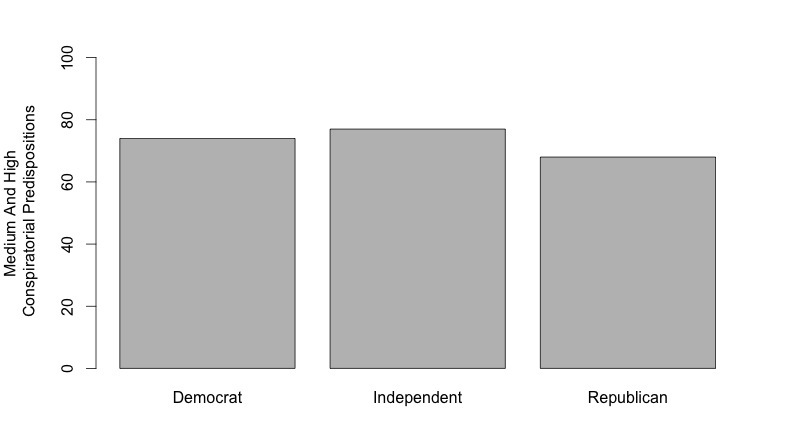
We combined these questions into one summary measure. This graph shows the percentage of Democrats, Republicans, and independents that showed a strong or medium disposition towards thinking conspiratorially.
The upshot: near symmetry between left and right.If Republicans and Democrats are equally prone to believing in conspiracy theories, where then is the liberal equivalent of climate change denial? An obvious possibility is the belief that Big Oil conspires to marginalize unfavorable findings or block alternative energies. Our survey, for example, shows that 52 percent of Democrats believe corporations are conspiring against us.
“Overtime” by Charles Stross
Another short work from the “Laundry” series by Charles Stross:
All bureaucracies obey certain iron laws, and one of the oldest is this: get your seasonal leave booked early, lest you be trampled in the rush.
I broke the rule this year, and now I’m paying the price. It’s not my fault I failed to book my Christmas leave in time — I was in hospital and heavily sedated. But the ruthless cut and thrust of office politics makes no allowance for those who fall in the line of battle: “You should have foreseen your hospitalization and planned around it” said the memo from HR when I complained. They’re quite right, and I’ve made a note to book in advance next time I’m about to be abducted by murderous cultists or enemy spies.
I briefly considered pulling an extended sickie, but Brenda from Admin has a heart of gold; she pointed out that if I volunteered as Night Duty Officer over the seasonal period I could not only claim triple pay and time off in lieu, I’d also be working three grades above my assigned role. For purposes of gaining experience points in the fast-track promotion game they’ve steering me onto, that’s hard to beat. So here I am, in the office on Christmas Eve, playing bureaucratic Pokémon as the chilly rain drums on the roof.
(Oh, you wondered what Mo thinks of this? She’s off visiting her ditz of a mum down in Glastonbury. After last time we agreed it would be a good idea if I kept a low profile. Christmas: the one time of year when you can’t avoid the nuts in your family muesli. But I digress.)
QotD: More similar than different – Rob Ford and Justin Trudeau
Over the last year, as Rob Ford’s stock has fallen and Justin Trudeau’s has soared to new media driven heights, your humble correspondent has been fascinated. These men are not, as they seem, polar opposites. They are in fact quite similar. It’s only the surface features that are different. Let’s review:
Neither man is especially bright. Ford has a BA in political science from Carleton which is, only technically, a university. Trudeau did, in fairness, attempt an engineering degree so we’ll give him the edge when it comes to smarts. Perhaps he is one of those men who is cleverer with numbers than with words. Whatever their actual differences in raw intellectual power both men are surprisingly inarticulate.
This is obvious with Rob Ford who treats the English language like a sailor treats a Marseilles whore. With Justin it’s a bit harder to detect because he doesn’t actually sound dumb, he merely says dumb things. It’s a clever trick managed by many practiced politician; the ability to sound more intelligent than you are while disclosing nothing in particular. He speaks mostly in platitudes and when he is forced off the Buy the World a Coke routine he fumbles badly. This suggests that he has been well rehearsed. By whom is a matter of debate.
Then there is the vision thing, to borrow from the Elder Bush. Rob Ford’s vision is to stop the Gravy Train. What is the Gravy Train? As far as can be made out it’s over the top spending at Toronto’s City Hall. This he has mostly accomplished. Beyond the Gravy Train we get a little lost. There is little in the way of a comprehensive program of reform. It’s a kind of inarticulate rage at government that never coalesces into a clear goal. Once the minor privatizations and ritual sackings are done with, what’s next? What is Rob Ford vision for Toronto? Subways are nice but a big city needs more than tunnels to Scarborough.
If Rob Ford is angry at something he can’t really explain, Justin is optimistic about something he has no clue about. This is one of their few real differences. Rob Rages and Justin Soothes. Neither is saying much of anything, but the latter sounds very nice while doing so. The former rants about Fat Cats and the latter about how cute kittens can save the country. Both men are, in sense, speaking in platitudes. The questions is what kind of platitudes do you prefer? Angry or vapid?
Richard Anderson, “Rob vs The Raccoons”, The Gods of the Copybook Headings, 2014-08-20.
August 21, 2014
QotD: The “Gell-Mann Amnesia” effect
Media carries with it a credibility that is totally undeserved. You have all experienced this, in what I call the Murray Gell-Mann Amnesia effect. (I refer to it by this name because I once discussed it with Murray Gell-Mann, and by dropping a famous name I imply greater importance to myself, and to the effect, than it would otherwise have.)
Briefly stated, the Gell-Mann Amnesia effect is as follows. You open the newspaper to an article on some subject you know well. In Murray’s case, physics. In mine, show business. You read the article and see the journalist has absolutely no understanding of either the facts or the issues. Often, the article is so wrong it actually presents the story backward — reversing cause and effect. I call these the “wet streets cause rain” stories. Paper’s full of them.
In any case, you read with exasperation or amusement the multiple errors in a story, and then turn the page to national or international affairs, and read as if the rest of the newspaper was somehow more accurate about Palestine than the baloney you just read. You turn the page, and forget what you know.
That is the Gell-Mann Amnesia effect. I’d point out it does not operate in other arenas of life. In ordinary life, if somebody consistently exaggerates or lies to you, you soon discount everything they say. In court, there is the legal doctrine of falsus in uno, falsus in omnibus, which means untruthful in one part, untruthful in all. But when it comes to the media, we believe against evidence that it is probably worth our time to read other parts of the paper. When, in fact, it almost certainly isn’t. The only possible explanation for our behavior is amnesia.
Michael Crichton, quoted in “The Gell-Mann Amnesia Effect”, Stephen Bodio’s Querencia, 2012-02-21.
August 19, 2014
Academic criticism kills everything it touches
In the LA Review of Books, Daniel Marc Janes explains why so much academic writing — especially literary criticism — is so tediously dust-dry and boring:
IN THE COURSE of this essay, I want to examine Geoff Dyer and his relationship with the academic establishment. The aforementioned relationship, I will go on to argue, has heretofore been an uneasy one, but the occurrence of a significant, apparently paradoxical event has provided the ideal research opportunity with which to conduct said examination. As I will reveal, this event — the organization of an academic conference in his honor — lays bare the manifest tensions in his work between a hostility to what he considers deadening academic analysis and a profound desire to get closer to his subject. The organization of my essay is as follows.
I cannot blame you if you have stopped reading by now; Geoff Dyer certainly would have. To Dyer, this kind of prose — with its pathological signposting and life-sucking verbosity — exemplifies all that is wrong with the academic world. In a 2011 New York Times column, he eviscerates a work of criticism for precisely these reasons: the art historian Michael Fried’s Why Photography Matters as Art as Never Before, whose long-windedness trickles down from its title.
But it is in 1998’s Out of Sheer Rage that Dyer truly gets his knives out. The book describes his failed attempts to write a scholarly study of D. H. Lawrence. As he drudges through a Longman Critical Reader on the author, he finds himself increasingly angered by its contents: trendy theoretical titles like “Lawrence, Foucault and the Language of Sexuality” and “Radical Indeterminacy: a post-modern Lawrence.” He wonders:
How could these people with no feeling for literature have ended up teaching it, writing about it? […] writing like that kills everything it touches. That is the hallmark of academic criticism: it kills everything it touches. Walk around a university campus and there is an almost palpable smell of death about the place because hundreds of academics are busy killing everything they touch.
In Dyer’s mind, the academic conference may be the worst offender of all. He goes on to describe his horror on meeting an academic who specialises in Rainer Maria Rilke:
You don’t teach Rilke, I wanted to say, you kill Rilke! You turn him to dust and then you go off to conferences where dozens of other academic-morticians gather with the express intention of killing Rilke and turning him to dust. Then, as part of the cover-up, the conference papers are published, the dust is embalmed and before you know it literature is a vast graveyard of dust, a dustyard of graves.
August 18, 2014
“It’s strange that the oldest literature becomes the model for the digital age”
Harvard University Press is putting all 520 volumes of the Loeb Classical Library online beginning in September:
When James Loeb designed his soon-to-be-launched series of Greek and Roman texts at the turn of the twentieth century, he envisioned the production of volumes that could easily fit in readers’ coat pockets. A century later, that compact format is still one of the collection’s hallmarks. Beginning in September, however, the iconic books will be far handier than Loeb had hoped: users of the Loeb Classical Library (LCL) will have the entire collection at their fingertips. After five years of dedicated work on the part of the library’s trustees and Harvard University Press (HUP), which has overseen LCL since its creator’s death in 1933, the more than 520 volumes of literature that make up the series will be accessible online. Besides allowing users to browse the digitized volumes, which retain the unique side-by-side view of the original text and its English translation, the Digital Loeb Classical Library will enable readers to search for words and phrases across the entire corpus, to annotate content, to share notes and reading lists with others, and to create their own libraries using personal workspaces.
LCL managing editor Michael Sullivan, whose position was created earlier this year to supervise the virtual library, said that the digitization project is “a major leap forward in the history of the Loeb.” According to HUP executive editor-at-large Sharmila Sen, the launch of the digital LCL marks “a moment of rebirth” for the historic collection. She explained that in the years preceding the library’s 2011 centenary, the trustees and HUP administrators began to think about how to make the LCL “relevant to the twenty-first century.” Even though online databases of Greek and Latin literature have existed for years, said the library’s general editor, Jeffrey Henderson, a classics professor at Boston University, the digital Loeb will be unprecedented in its accessibility and scope: for the first time, readers without knowledge of Greek and Latin will be able to explore a vast range of the classical literary heritage online through high-quality, modern translations. He added that the project, which cost the LCL foundation more than $1 million, will serve as a model for the digitization of other HUP series, noting, “It’s strange that the oldest literature becomes the model for the digital age.”
Consolidating a vast literary corpus involving two different alphabets into an interconnected, elegant, and easy-to-use website required much behind-the-scenes work, Sen said. Designing the software for the digital library and transferring the data have concluded, she noted, but the project overseers view the current product — which will be available by subscription to institutions and individuals — as only a 1.0 version. The website will be a dynamic workspace, Henderson pointed out, adding that user feedback will help the editors increase its functionality.
H/T to Colby Cosh for the link.


