
In keeping with all millenarian movements, the extinction-obsessed green cult reserves its priestly fury for ordinary people. Even when it is putting pressure on the government, it is really asking it to punish us. It wants tighter controls on car-driving, restrictions on flying, green taxes on meat. That these things would severely hit the pockets of ordinary people – but not the deep pockets of Emma Thompson and the double-barrelled eco-snobs who run Extinction Rebellion – is immaterial to the angry bourgeoisie. So convinced are they of their own goodness, and of our wickedness, that they think it is utterly acceptable for officialdom to make our lives harder in order to strongarm us into being more “green”. People complaining about Extinction Rebellion disrupting people’s lives in London over the past few days are missing the point – the entire point of the green movement is to disrupt ordinary people’s lives, and even to immiserate them. All in the jumped-up name of “saving the planet”.
And now the green cult has pushed Ms [Greta] Thunberg into the position of its global leader, its child-like saviour, the messiah of their miserabilist political creed. What they have done to Ms Thunberg is unforgivable. They have pumped her – and millions of other children – with the politics of fear. They have convinced the next generation that the planet is on the cusp of doom. They have injected dread into the youth. “I want you to panic”, said Ms Thunberg at Davos, and the billionaires and celebs and marauding NGOs that were in attendance all lapped it up. Because adult society loves nothing more than having its own fear and confusions obediently parroted back to it by teenagers. They celebrate Thunberg because she tells them how horrible they are: it is an entirely S&M relationship, speaking to the deep self-loathing of the 21st-century elites.
Brendan O’Neill, “The cult of Greta Thunberg: This young woman sounds increasingly like a millenarian weirdo”, Spiked, 2019-04-22.
May 27, 2019
QotD: The Green death cult
May 26, 2019
HBO’s Chernobyl reviewed by Slava Malamud
Colby Cosh linked to Slava Malamud’s thread, rolled up here courtesy of Thread reader:
May 25, 2019
May 24, 2019
“No Bullets Fly” – Charlie Brown and Franz Stigler – Sabaton History 016
Sabaton History
Published on 23 May 2019Heroism isn’t always measured in blood or danger. Sometimes, to spare your foe is the honourable thing to do. A dramatic example comes in the shape of the American Charlie Brown and German Franz Stigler. Brown was flying his heavily damaged B17 “Flying Fortress” bomber home after a demanding bombing run on Bremen when Franz Stigler in his fighter plane caught sight of its tail. This story is about the encounter between the two enemies and the song that Sabaton wrote about it, called “No Bullets Fly” (on the Heroes album).
Support Sabaton History on Patreon: https://www.patreon.com/sabatonhistory
Find A Higher Call, the book that inspired “No Bullets Fly” here: https://www.valorstudios.com/a-higher…
Check out the trailer for Sabaton’s new album The Great War right here: https://www.youtube.com/watch?v=HCZP1…
Listen to Sabaton on Spotify: http://smarturl.it/SabatonSpotify
Official Sabaton Merchandise Shop: http://bit.ly/SabatonOfficialShopHosted by: Indy Neidell
Written by: Markus Linke and Indy Neidell
Directed by: Astrid Deinhard and Wieke Kapteijns
Produced by: Pär Sundström, Astrid Deinhard and Spartacus Olsson
Creative Producer: Joram Appel
Executive Producers: Pär Sundström, Joakim Broden, Tomas Sunmo, Indy Neidell, Astrid Deinhard, and Spartacus Olsson
Maps by: Eastory
Edited by: Iryna Dulka
Sound Editing by: Marek Kaminski
Eastory YouTube Channel: https://www.youtube.com/channel/UCEly…
Archive by: Reuters/Screenocean https://www.screenocean.com
Music by Sabaton.Sources:
IWM: CL 3395
Plane drawing by EmoscopesAn OnLion Entertainment GmbH and Raging Beaver Publishing AB co-Production.
© Raging Beaver Publishing AB, 2019 – all rights reserved.
QotD: Politics and culture
… sometimes Mark Steyn seems like the only conservative you can discuss these issues with, because most Republicans think popular culture is beside the point, if not downright dangerous. Steyn, on the other hand, has performed “Kung Fu Fighting” before thousands of people in civic auditoria more accustomed to Mary Kay Cosmetics conventions, so he gets it.
“Social conservatives are always editing pop culture,” says Steyn, “and it’s completely pathetic. Conservatives play to the caricature. Mention a French movie and the crowd turns on you. It’s a reductive view of the world. There are ideological enforcers casting aside works of art because they contain bad words or uncomfortable associations. It’s one of the biggest abdications of the American right. Who gives a crap about who gets elected to the Congressional district in Ohio? — that’s not going to change the culture. It’s movies that move the culture. And if you abdicate that space, you lose. Jeb Bush spent a billion dollars to get 2.8 per cent of the vote in Iowa. Mitt Romney and people like him who have a billion dollars — don’t spend it on politics, buy a TV network! Theatre, movies, music, that’s where the battles are fought. They’ve abdicated that space in the schools. As a result, my kid had to sit through Al Gore’s lousy movie three times. All effective storytelling is inherently conservative — because your choices have consequences. For the Left, nothing has consequences. But the trends are all in the Left’s direction, because the Right got out of the game — they chose to make themselves culturally irrelevant. If you’re not in the same room, having the conversation, there’s not gonna be a solution.”
Mark Steyn, interviewed by John Bloom, “Mark Steyn, Cole Porter and Free Speech”, Quadrant, 2017-05-11.
May 23, 2019
QotD: “Prestige” TV shows
Just a bugaboo of mine: These “Prestige” TV show seem to think that a bore-you-to-tears pacing is a de facto marker of “quality writing and deep characterization,” and most TV critics aren’t hip enough to get the con. A lot of these shows’ very slow pace suggests to me they are being written with a target audience of people “multitasking” on the computer as they half-watch in mind. I guess when you’re mostly reading Instagram while the TV is on, you maybe don’t notice that nothing has happened in the past three minutes. And I guess if you’re one of the one-eye-on-tv-one-eye-on-twitter crowd, you need nothing to happen for long stretches, or else you’ll be missing important stuff.
Ace, “Does ‘Prestige TV’ Just Mean Slow, Tedious, Unpleasant and Dimly-Lit?”, Ace of Spades H.Q., 2017-05-15.
May 22, 2019
May 17, 2019
The Red Baron – The Great War – Sabaton History 015
Sabaton History
Published on 16 May 2019The Red Baron is one of the, if not THE MOST iconic heroes of The Great War. He simultaneously embodies the mechanisation of modern war and a romanticised version of war with his individual skill and heroism. Indy goes beyond the legend to tell the history of Manfred von Richthofen, a.k.a The Red Baron, the latter of which also is the name of a Sabaton song that will feature on their upcoming album The Great War.
You can find the eight points of the Dicta Boelcke in the pinned comment.
Support Sabaton History on Patreon (and possibly get a History Channel special edition): https://www.patreon.com/sabatonhistory
Pre-order The Great War here: https://www.sabaton.net/pre-order-of-…
Check out the trailer for Sabaton’s new album ‘The Great War’ right here: https://www.youtube.com/watch?v=HCZP1…
Watch more videos on the Sabaton YouTube channel: https://www.youtube.com/user/Sabaton?…
Listen to Sabaton on Spotify: http://smarturl.it/SabatonSpotify
Official Sabaton Merchandise Shop: http://bit.ly/SabatonOfficialShopHosted by: Indy Neidell
Written by: Markus Linke and Indy Neidell
Directed by: Astrid Deinhard and Wieke Kapteijns
Produced by: Pär Sundström, Astrid Deinhard and Spartacus Olsson
Creative Producer: Joram Appel
Executive Producers: Pär Sundström, Joakim Broden, Tomas Sunmo, Indy Neidell, Astrid Deinhard, and Spartacus Olsson
Maps by: Eastory
Edited by: Iryna Dulka
Sound Editing by: Marek KaminskiEastory YouTube Channel: https://www.youtube.com/channel/UCEly…
Archive by: Reuters/Screenocean https://www.screenocean.com
Music by Sabaton.Sources:
– © IWM: Q 66959, Q 105717, Q 73533, Q 67598, Q 50329, Q 50328, Q 42284, Q 111872, Q 54397, Q 63148, Q 63122, Q 3140, Q 57513 Q 58028, Q 52781, Q 63822, Q 50673, Q 72919, Q 12044, IWM 187, EPH 9001, Q 67832, IWM 1004, Q 63162, Q 67780, Q 58034, Q 63137, Q 63160
– © IWM Art: IWM ART 517, 1488, 517, 3071, 2659, 2660, 3199, 2754, 654
– Bendigo Soldiers Memorial Institute Military Museum: 2075P
– Klimbim Colorization
– James Miller ColorizationAn OnLion Entertainment GmbH and Raging Beaver Publishing AB co-Production.
© Raging Beaver Publishing AB, 2019 – all rights reserved.
From the comments:
Sabaton History
This is the second episode of Sabaton History about one of the songs of the upcoming Sabaton album The Great War. By supporting us on Patreon, you can help us continue making these YouTube videos. You will also get some exclusive content – like a full version of Indy and Joakim talking about The Red Baron, which is live on our Patreon site right here: https://www.patreon.com/posts/full-length-red-26854763Indy mentions the Dicta Boelcke in the video. These are the eight points that Boelcke and von Richthofen used in the skies (source: Werner, Johannes von, 1932):
1. Try to secure advantages before attacking. If possible, keep the sun behind you.
2. Always carry through an attack when you have started it.
3. Fire only at close range, and only when your opponent is properly in your sights.
4. Always keep your eye on your opponent, and never let yourself be deceived by ruses.
5. In any form of attack it is essential to assail your enemy from behind.
6. If your opponent dives on you, do not try to evade his onslaught, but fly to meet it.
7. When over the enemy’s lines never forget your own line of retreat.
8. For the Staffel (squadron): Attack on principle in groups of four or six. When the fight breaks up into a series of single combats, take care that several do not go for the same opponent.
Was Shakespeare really an illiterate illegal immigrant disabled asexual woman of colour?
Oliver Kamm discusses the most recent “Was Shakespeare really …?” article, this one published in The Atlantic by Elizabeth Winkler:
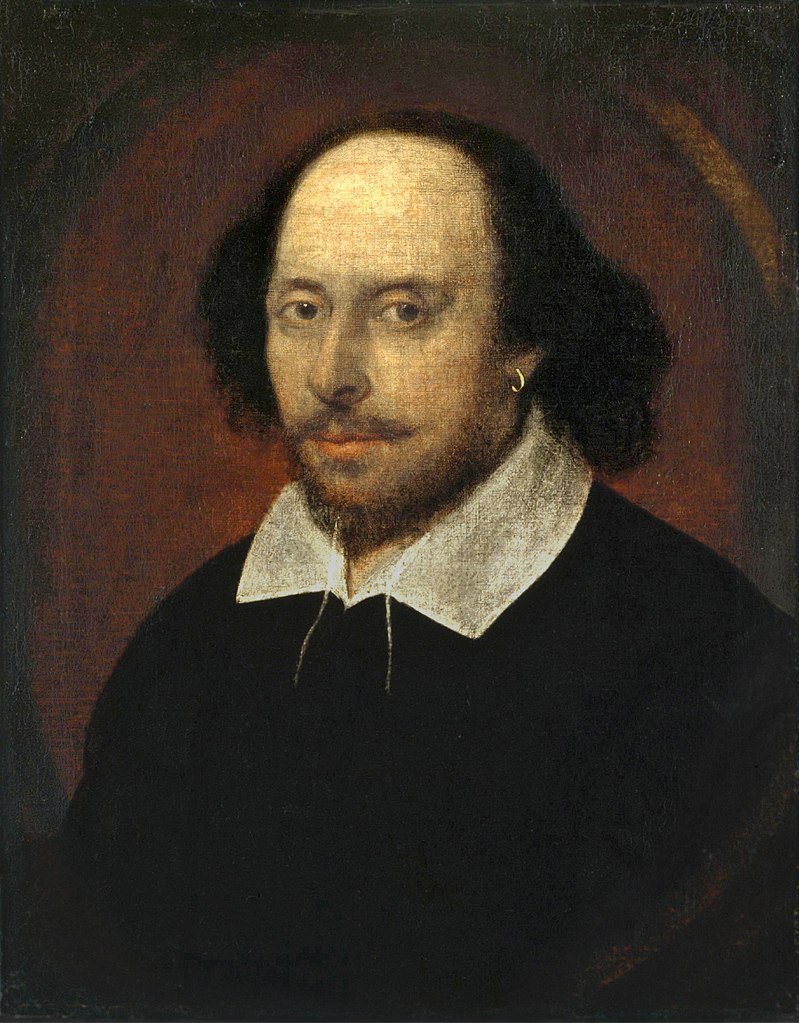
This was long thought to be the only portrait of William Shakespeare that had any claim to have been painted from life, until another possible life portrait, the Cobbe portrait, was revealed in 2009. The portrait is known as the “Chandos portrait” after a previous owner, James Brydges, 1st Duke of Chandos. It was the first portrait to be acquired by the National Portrait Gallery in 1856. The artist may be by a painter called John Taylor who was an important member of the Painter-Stainers’ Company.
National Portrait Gallery image via Wikimedia Commons.
[Winkler] accuses what she calls orthodox Shakespeare scholars of “a dogmatism of their own” on the issue, whereby “even to dabble in authorship questions is considered a sign of bad faith, a blinkered failure to countenance genius in a glover’s son.” Armed with this tendentious premise, along with the less contentious one that Shakespeare depicts female characters with unrivalled sympathy and insight, Winkler spins a hypothesis that Emilia Bassano, born in London in 1569 to Venetian immigrants, is a viable candidate for the true author.
Even as I read Winkler’s piece, I expected a denouement that it was all a piece of fiction, analogous to the enjoyable 2009 caper St Trinian’s 2: The Legend of Fritton’s Gold, which ends with buried treasure under the Globe Theatre and the discovery of Shakespeare’s true identity. It never came. The article was presented as a serious contribution to a debate in which Winkler has made a potentially historic discovery.
In British newspapers, there is a longstanding technique of obscuring a paucity of evidence in support of a preposterous thesis by posing it as a question. It’s been dubbed by the political commentator John Rentoul “Questions to Which the Answer is No” (QTWAIN). Winkler’s article employs the stratagem liberally. “Was Shakespeare’s name useful camouflage, allowing [Bassano] to publish what she otherwise couldn’t?” “Could Bassano have contributed [to literature] even more widely and directly?” In a moment of self-knowledge, Winkler asks: “Was I getting carried away, reinventing Shakespeare in the image of our age?” Yet she immediately supplies not the correct answer but yet another QTWAIN: “Or was I seeing past gendered assumptions to the woman who — like Shakespeare’s heroines — had fashioned herself a clever disguise?”
Feminist readings of Shakespeare have enriched literary criticism and scholarship in, among other areas, reconsidering genre distinctions and examining the effects of patriarchal structures on relations between the sexes. There is no decorous way of saying that Winkler’s article, by contrast, is a farrago that should never have been conceived, pitched, commissioned or published. Winkler credulously retails a series of purported mysteries about Shakespeare’s authorship that are no mystery at all, and repeats claims derived from Shakespeare denialists that any capable scholar would have been able to correct. She places particular stress on the work of a “meticulous scholar” Diana Price, who claims: “Writers in Elizabethan and Jacobean England left behind records of their professional activities. Shakespeare left behind documentation of his professional activities, but none is literary… He is the only alleged [emphasis added] writer of any consequence from the time period who left behind no personal evidence of his career as a professional writer.”
Price is neither meticulous nor a scholar (she designates herself “an independent scholar,” which should have caused Winkler greater wariness). As Alan Nelson of Berkeley University has put it, Price knows how to put a sentence together but she doesn’t know how to put an argument together.
We in fact have unimpeachable evidence of Shakespeare’s activities as a writer, far more than we do for, say, his fellow-dramatists John Webster or Cyril Tourneur, but by a series of rhetorical sleights-of-hand Price rules it all inadmissible. To give a single but weighty example: Shakespeare’s fellow actors John Heminge and Henry Condell assembled the First Folio of Shakespeare’s works, published in 1623, with Shakespeare’s name on the title page and his engraved image in the frontispiece, and with a laudatory poem by Ben Jonson referring to the author as “Sweet Swan of Avon.” Price dismisses this as evidence of authorship because it’s posthumous, coming seven years after Shakespeare’s death, even though the planning and publishing of the book must have taken years, and Heminge, Condell and Jonson all knew Shakespeare personally. This isn’t scholarship but sophistry.
A noteworthy example of Betteridge’s Law of Headlines. (As is, of course, the headline on this post.)
May 16, 2019
QotD: Reacting appropriately to criticism
Ich sitze in dem kleinsten Zimmer in meinem Hause. Ich habe Ihre Kritik vor mir. Im nächsten Augenblick wird sie hinter mir sein! (“I am sitting in the smallest room of my house. I have your review before me. In a moment it will be behind me!”).
Max Reger, responding to a review of his work by Rudolf Louis in the Münchener Neueste Nachrichten, 1906-02-07, as reported by Nicolas Slonimsky, Lexicon of Musical Invective, 1965.
May 15, 2019
1984 – Dystopias and Apocalypses – Extra Sci Fi
Extra Credits
Published on 14 May 2019What makes 1984 still relevant to modern readers is that it serves as a warning against fascism in all its possible forms. George Orwell’s service fighting in the Spanish Civil War led him to see that the heart of totalitarianism is about xenophobia and nationalism no matter which kind of government it came from.
The idea that Orwell presents us in 1984 is that people subtle enough and brutal enough can take the undirected dissatisfaction and anger of a society and point it at whatever they will, using us to damn ourselves.
May 14, 2019
The Broad Fourteens – Royal Navy Motor Torpedo Boats In WWII
PeriscopeFilm
Published on 20 Sep 2017Support Our Channel : https://www.patreon.com/PeriscopeFilm
Made in 1945, THE BROAD FOURTEENS is one of the excellent, dramatized accounts of WWII made by the Ministry of Information for morale purposes. The film shows the first posting, and eventual first action, of a newly-trained motor torpedo boat (MTB) crew. (‘The Broad Fourteens’ is the name given to a patrol area of the North Sea off the Dutch coast.) The film joins the boat and crew at the end of their training (probably HMS Bee, the Coastal Force working up base at Weymouth). The boats featured include 70’ Vosper 1942 class boats, 70’ British Power Boat motor gunboats and MTB 210 — a J Samuel White-built 70’ Vosper which later joined the 13th MTB Flotilla at Dover. The fictional MTB 181 is probably MTB 352, commanded by Lieutenant John M Moore RNVR which joined the 11th MTB Flotilla at Felixstowe after completing her work up. Also featured is MTB 354, commanded by Lieutenant Roland Plugge RN which was the SO’s boat, 5th MTB Flotilla, at Dover. The German flak trawler is in fact an RN Isles Class trawler standing in.
(0:48) Introduces the viewer to how the “broad fourteens” came to exist. Navy training is depicted (2:15). At the training commander’s office (2:25) the film shows the commander and the captain conversing about torpedo and battle experiences and strategies. [Note that they emphasize that Lieutenant Howard is Canadian, although clearly serving in the Royal Navy, as he doesn’t have a “Canada” patch on the shoulder of his uniform.] The crew is shown going through their regular activities. They discuss the previous battles as they are called together. The commander and the captain (5:10) discuss the boat’s impending departure. 5:40 shows the operational base as crews and the commander busily arrive the base. (6:48) operation room as a crew brings a report to the commander. The captain talks about his crew alongside another (7:28). At mark 8:00 the film shows the crew’s residential life. The crew are shown prepping for the first operation as their boats head offshore (9:15) and into the deep sea. The captain is shown calculating the boat’s navigation on his map (10:20). A communication link is established (11:18) and the captain discusses how much longer it is till they get to the operation site. Back at the base (12:20) the crews left converse. The crews are seen at the starmouth arms (14:30), they enjoyed listening to their music at (15:00). The crew takes care of their ship (16:05).
The commander converses with the captain (16:45). The crew are shown in their rooms (17:18). (17:27) is the Starmouth Arms where the crew talk among themselves. The Starmouth Arms manager receives a call which got all crews back to their base (18:40). The commander gives a report (19:20) on the mission and key targets. The meeting closes (20:00) as all crew member are set as they start their engine and move on (21:15). On the deep sea is the navigation map (21:50). At mark 22:20, the crews stops for awhile and takes a break. They move on (22:53). The key target is seen (23:10) and the troops get ready for firing. All crew on set as they wait on the captain to give the go ahead to shoot (23:50). The captain makes the key calculations as the crew stands by for the torpedo release. He gives the go (24:47) and the torpedo is launched out. The torpedo engages the target (25:06). Reports about the operation are documented (25:30) as they proceed to rendezvous point. Two German gun boats are sighted (25:47) as they appear and fire at the crew (26:03). Firing continues till 26:45. There is alarm about fire at the cargo base as a crew is injured (27:00). The fire is attended to as firing continues (27:50). The report about the casualty and the op is documented (28:30). Explosives are launched across the sea towards the enemy gun boats (29:15) as they cool down the heat on them.
Meanwhile back at the base, the film shows the commander (30:00) receiving a visit from his superior, who asks about the mission report as he looks towards the map (30:40). At the battle front, the captain asks about news on the gun boats (31:11) as his underlings all wait in anxiety. The gun boats are sighted (31:38) as they closes on fast towards the crew. At mark 31:53, they opened fire against the boat. A crew is hit (32:15). A gun boat comes in their rescue (33:00) and defeats the enemy boat. Gregory and Johnny are shown wounded. The gun boat (34:00) makes reports and request the course as they depart for home port.
This film is part of the Periscope Film LLC archive, one of the largest historic military, transportation, and aviation stock footage collections in the USA. Entirely film backed, this material is available for licensing in 24p HD, 2k and 4k. For more information visit http://www.PeriscopeFilm.com
Bullshit in science
An older article by Brian D Earp looks at the problem of bullshit in scientific publications:
… if you love science, you had better question it, and question it well, so it can live up to its potential.
And it is with that in mind that I bring up the subject of bullshit.
There is a veritable truckload of bullshit in science. When I say bullshit, I mean arguments, data, publications, or even the official policies of scientific organizations that give every impression of being perfectly reasonable — of being well-supported by the highest quality of evidence, and so forth — but which don’t hold up when you scrutinize the details. Bullshit has the veneer of truth-like plausibility. It looks good. It sounds right. But when you get right down to it, it stinks.
There are many ways to produce scientific bullshit. One way is to assert that something has been “proven,” “shown,” or “found” and then cite, in support of this assertion, a study that has actually been heavily critiqued (fairly and in good faith, let us say, although that is not always the case, as we soon shall see) without acknowledging any of the published criticisms of the study or otherwise grappling with its inherent limitations.
Another way is to refer to evidence as being of “high quality” simply because it comes from an in-principle relatively strong study design, like a randomized control trial, without checking the specific materials that were used in the study to confirm that they were fit for purpose. There is also the problem of taking data that were generated in one environment and applying them to a completely different environment (without showing, or in some cases even attempting to show, that the two environments are analogous in the right way). There are other examples I have explored in other contexts, and many of them are fairly well-known.
But there is one example I have only recently come across, and of which I have not yet seen any serious discussion. I am referring to a certain sustained, long-term publication strategy, apparently deliberately carried out (although motivations can be hard to pin down), that results in a stupefying, and in my view dangerous, paper-pile of scientific bullshit. It can be hard to detect, at first, with an untrained eye — you have to know your specific area of research extremely well to begin to see it — but once you do catch on, it becomes impossible to un-see.
May 13, 2019
“[T]he most famous Zulu word on the planet was invented by a New York socialist in 1951”
I had no idea there was so much back-story to the song “The Lion Sleeps Tonight” aka “Wimoweh” aka “Mbube”, which had managed to be a hit for groups as diverse as Tight Fit, Robert John, the Tokens, the Weavers, Ilonka David-Biluska, Henri Salvador, and others:
Those words about “the jungle, the mighty jungle” sit so perfectly and indivisibly on those notes they sound like they’ve belonged to each other for all time. We know the lyric is George Weiss’, but where did the tune come from?
Well, it’s obvious, isn’t it? It was a “Zulu chant” — ie, “traditional – ie, “anonymous” — ie, out of copyright. Which meant someone else could put it back in copyright. In the Fifties and early Sixties, public demand for “authentic” “traditional” music created a huge windfall for savvy Tin Pan Alleymen. You take some half-forgotten folk dirge, tweak it here and there, and then copyright your version as a full-blown composition in its own right. Everyone was doing it: in the Fifties, “Frankie And Johnny”, “Auld Lang Syne”, “Greensleeves” and a bunch of other things that had been around forever were being copyrighted as brand new songs. Huge and Luge had done it with “Can’t Help Falling In Love”, né “Plaisir d’Amour“. So the first thing they wondered, when the Tokens showed up and began doing their Zulu impressions, was where did this “Wimoweh” thing come from anyway? They looked at the song credits: “Paul Campbell” and “Albert Stanton”.
Bingo! There was no such “Paul” and no such “Albert”. Mr “Campbell” was the name Pete Seeger and the Weavers would put on the sheet music when they’d recorded a folk tune and decided they’d like to cut themselves a piece of the songwriting action. And Mr “Stanton” was the name Al Brackman at the Richmond publishing house put on the music when he wanted to do the same for his bank account. Messrs “Campbell” and “Stanton” thus became successful mid-20th century songwriters who apparently hadn’t written anything since the mid-19th century. So the minute Huge and Luge saw those names on “Wimoweh” they knew it was a plum just ripe for a second picking. If it ever came to court, Huge, Luge and George Weiss’ defense would be yes, they’d plagiarized it not from Campbell & Stanton but from the same 19th century Zulu natives Campbell & Stanton had plagiarized it from. And, because Pete Seeger, the Weavers and the Richmond organization well understood that, they never did bring it to court. So there are two entirely separate mid-20th century pop songs by two entirely separate writing teams, one called “The Lion Sleeps Tonight”, the other called “Wimoweh“.
[…]
In South Africa, it was huge. “Mbube” became not just the name of a hit record but of an entire vocal style — a high-voiced lead over four-part bass-heavy harmony. That, in turn, evolved into “isicathamiya“, a smoother vocal style that descended to Ladysmith Black Mambazo and others, taking its cue from the injunction “Cothoza, bafana” — or “tread carefully, boys”. That’s to say, Zulu stomping is fine in the bush, but when you’re singing in dancehalls and restaurants in you’ve got to be a little more choreographically restrained, if only for the sake of the floorboards.
“Tread carefully, boys” is good advice for anyone in the music business. A few years after Solomon Linda and the Evening Birds made their hit record, it came to the notice of Pete Seeger, on the prowl for yet more “authentic” “traditional” “vernacular” “folk music” for the Weavers to make a killing with. He misheard “Mbube” and transcribed it as “Wimoweh“. That’s a great insight into the “authenticity” of the folk boom: the most famous Zulu word on the planet was invented by a New York socialist in 1951


