
I am an equal opportunity feminist. That is, I demand the removal of all barriers to women’s advance in the political and professional realms. However, I oppose special protections for women, such as workplace quotas or campus procedures that favor women during sexual assault complaints. I want total equality before the law.
In my view, special protections of any kind infantilize women. My code of Amazon feminism is based on the empowerment of the individual: Women must not regress to a pre-feminist past to become passive wards of the state.
Camille Paglia, interviewed in “Feminist critic Camille Paglia: ‘Merkel is an important role model for mature women'”, DW, 2017-06-01.
October 29, 2022
QotD: Camille Paglia’s “Amazon” Feminism
Comments Off on QotD: Camille Paglia’s “Amazon” Feminism
October 26, 2022
QotD: Protectionism forces buyers to take worse deals
[…] too often when buyers shift some of their patronage from domestic producers to foreign producers, domestic producers – both firm owners and workers – insist that the state is morally obliged to force buyers to continue to purchase their products and their labor without any reduction in the prices and wages charged by sellers. These producers greedily and falsely insist that it’s bad policy for the state to allow buyers to shift their patronage to other sellers. Because those other sellers happen to be located abroad – or in the case of immigrants happen not to have passports issued by the domestic sovereign – such greedy and false insistence by domestic producers and workers is remarkably seen as legitimate, despite the fact that there’s nothing remotely legitimate about such insistence.
Tariffs and other forms of “protectionism” are means of forcing buyers to act and to pay as if they agreed to terms of contracts with sellers that these buyers never agreed to and that the sellers who benefit from the protectionism were unwilling to pay for in their contractual dealings with their customers.
Protectionism is akin to changing the rules of a game in the middle of a game. It’s unfair. It’s unproductive. It’s theft wrapped in flags, and too-often faux-sanctified by specious theorizing.
Don Boudreaux, “Protectionism Is a Means of Stealing That Which Suppliers Are Unwilling to Purchase”, Café Hayek, 2016-09-10.
Comments Off on QotD: Protectionism forces buyers to take worse deals
October 23, 2022
“It’s starting to be noteworthy how often people in government record their important conversations”
From the kindness of his heart, Paul Wells decided to make this column available to cheapskate non-paying subscribers like me because he feels it needs to be seen by a wider audience. The topic is the ongoing inquiry into the Trudeau government’s invocation of the Emergencies Act and it’s certainly promising to stay entertaining for a while (unlike the vast majority of such inquiries):

A screenshot from a YouTube video showing the protest in front of Parliament in Ottawa on 30 January, 2022.
Photo via Wikimedia Commons.
The goal of it all is to permit Rouleau to decide whether the Emergencies Act was used properly when it was invoked, for the first time in its 34-year existence, by the Trudeau government to end the mess in Ottawa’s Centretown. But it’s also a deep dive into conflicting ideas of police doctrine, the best look we’ve had at the stressed and dysfunctional city administration in Ottawa. And while we haven’t yet heard much about the Trudeau government’s processes, that’s coming. The prime minister and seven of his senior cabinet ministers, with their deputies, will testify soon.
Nobody can keep up with it. For Ottawa reporters it’s as though we’ve dragged ourselves for a decade through a desert of talking points and euphemisms into an oasis of unbelievable information bounty. The temptation is to gorge. I took Wednesday off, only to learn that Diane Deans, the city councillor who was heading the Ottawa Police Service Board when the mess began, secretly recorded the call in which she informed Mayor Jim Watson that she’d gone ahead and negotiated the hiring of an interim police chief Watson had never heard of. […]
Aaron Sorkin couldn’t have written it better. Deans tells Watson she’s found a new police chief for him in the middle of the worst public-security crises of their lives. He tells her it’s a terrible plan. She asks whether he’ll vote to remove her from her post and he won’t say, which of course is the same as saying. They talk about what to do next, in a way that leaves room for each to have an understanding of what they agreed that’s incompatible with the other’s. It’s gold. The consensus on Thursday among Parliament Hill people I talked to who’d heard the tape was that conversations like this happen all the time in workplaces across the capital, as of course they happen around the world. It’s just that usually in governments, as in most large organizations, any sign of their existence is buried under lakes of Novocaine.
It’s starting to be noteworthy how often people in government record their important conversations. Almost as though people were increasingly worried they might be lied about. When Jody Wilson-Raybould did such a thing three years ago, it was possible for her ex-colleagues to clutch their pearls and protest that such a thing just isn’t done. But after months of claims and assertions about what RCMP commissioner Brenda Lucki told the RCMP detachment in Nova Scotia, nine days after the worst mass murder in Canadian history, it’s handy to have a recording, isn’t it.
By this emerging standard, Patricia Ferguson is old-fashioned. As far as we know she didn’t record her meetings. But she did break open a notebook methodically, like clockwork, to write detailed longhand notes after her conversations. Those notes are hard to reconcile with the portrait Deans painted in her testimony a day earlier, of Peter Sloly as a lone good man, standing up for proper policing in the face of heckling and even racism from the city’s old guard.
In Ferguson’s version, it sounds like Ottawa’s cops were all reasonably good but they were cracking and colliding under immense pressure.
Ferguson described an Ottawa Police Service already worn down by the beginning of this year. There had been retirements, resignations, a high-level suspension and a suicide before and during the COVID lockdowns, followed by Black Lives Matter protests with the attendant internal soul-searching and external scrutiny every North American police corps faced.
And then the convoy hit. And then it stayed. This last was more of a surprise than it should have been.
The late stories out of Wednesday’s testimony were from Pat Morris, an Ontario Provincial Police superintendent in charge of intelligence-gathering. He dumped a bunch of old OPP “Project Hendon” reports, a term of art for the force’s intelligence-gathering operations, onto the commission server. Those reports were sent regularly to the Ottawa police as the various truck convoys approached the capital. Ferguson testified that she didn’t become aware of them until just before the trucks arrived. Which is too bad. What the OPP had found was a very large group of protesters from all over. They did not pose an organized threat of violence, though the Hendon reports acknowledged that confrontation can always escalate and that “lone wolf” extremists could well be tempted to join the crowd. But all the trucks represented a huge problem anyway, because they had rapidly growing funding — and no plans to go home at any point.
Comments Off on “It’s starting to be noteworthy how often people in government record their important conversations”
October 8, 2022
Faint glimmers of hope for Canadians’ “right to repair”?
Michael Geist on the state of play in modifying Canada’s digital lock rules to allow consumers a tiny bit more flexibility in how they can get their electronic devices repaired:

“The Self-Repair Manifesto from ifixit.com ‘If you can’t fix it, you don’t own it’. Hear, hear!” by dullhunk is licensed under CC BY 2.0 
 .
.
Canadian anti-circumvention laws (also known as digital lock rules) are among the strictest in the world, creating unnecessary barriers to innovation and consumer rights. The rules are required under the World Intellectual Property Organization’s Internet Treaties, but those treaties leave considerable flexibility in how they should be implemented. This is reflected in the countless examples around the world of countries adopting flexible anti-circumvention rules that seek to maintain the copyright balance. Canada was pressured into following the restrictive U.S. approach in 2012, establishing a framework is not only more restrictive than required under the WIPO treaties, but even more restrictive than the U.S. system.
One of the biggest differences between Canada and the U.S. is that the U.S. conducts a review every three years to determine whether new exceptions to a general prohibition on circumventing a digital locks are needed. This has led to the adoption of several exceptions to TPMs for innovative activities such as automotive security research, repairs and maintenance, archiving and preserving video games, and for remixing from DVDs and Blu-Ray sources. Canada has no such system as the government instead provided assurances that it could address new exceptions through a regulation-making power. In the decade since the law has been in effect, successive Canadian governments have never done so. This is particularly problematic where the rules restrict basic property rights by limiting the ability to repair products or ensure full interoperability between systems.
The best policy would be to clarify that the anti-circumvention rules do not apply to non-infringing uses. This would enable the anti-circumvention rules to work alongside the user rights in the Copyright Act (also known as limitations and exceptions) without restricting their lawful exercise. This approach was endorsed by the 2019 Canadian copyright review, which unanimously concluded:
it agrees that the circumvention of TPMs should be allowed for non-infringing purposes, especially given the fact that the Nintendo case provided such a broad interpretation of TPMs. In other words, while anti-circumvention rules should support the use of TPMs to enable the remuneration of rights-holders and prevent copyright infringement, they should generally not prevent someone from committing an act otherwise authorized under the Act.
The government has not acted on this recommendation, but two private members bills are working their way through the House of Commons that provide some hope of change. First, Bill S-244 on the right of repair. Introduced by Liberal MP Wilson Miao in February, the bill this week passed second reading unanimously and has been referred to the Industry committee for further study. The lack of a right of repair exception in Canadian digital lock rules has hindered both consumers and Canadian innovation significantly, leaving consumers unable to repair their electronic devices and farmers often locked out of their farm equipment. After farmers protested against similar copyright restrictions, the U.S. established specific exceptions permitting digital locks to be circumvented to allow repair of software-enabled devices.
Given the impact on consumers, the agricultural sector, and the environment, a provision that explicitly permits circumvention for purposes of the right of repair in Canada is long overdue. Indeed, such an approach is consistent with the 2019 copyright review recommendation:
Recommendation 19
That the Government of Canada examine measures to modernize copyright policy with digital technologies affecting Canadians and Canadian institutions, including the relevance of technological protection measures within copyright law, notably to facilitate the maintenance, repair or adaptation of a lawfully-acquired device for non-infringing purposes.
Comments Off on Faint glimmers of hope for Canadians’ “right to repair”?
October 6, 2022
The pendulum swings back toward institutionalization
During the 1950s and 60s, many mental institutions were shut down due to concerns about the way the patients in those institutions were being treated. Those suffering from mental health issues were, to a large degree, just discharged into the larger community with few supports to help them re-integrate. Today, the concerns about severely mentally ill peoples’ actions may be pushing the system back toward some form of formal re-institutionalization, as Michael Shellenberger reports for Common Sense:
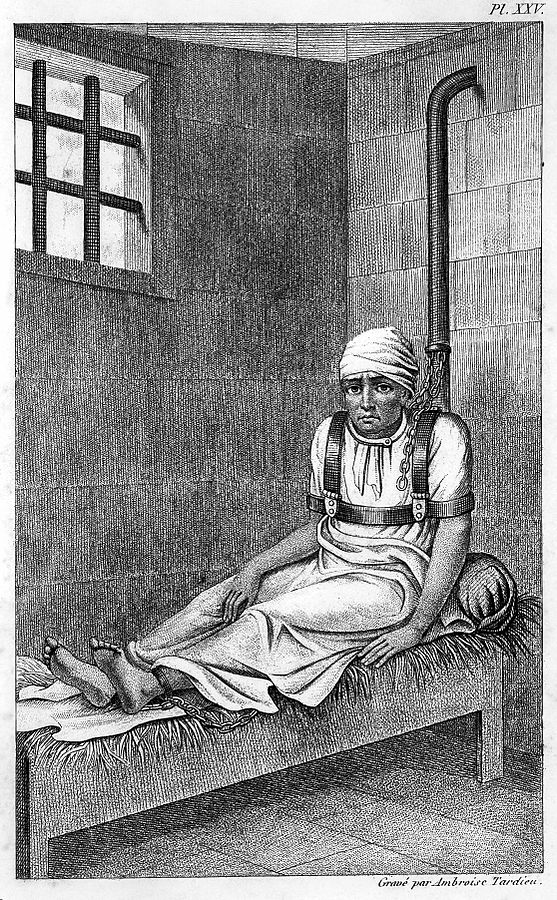
William Norris, shackled sitting upright on his bed at Bedlam, 1838.
Engraving by Ambroise Tardieu, Des maladies mentales Esquirol via Wikimedia Commons.
Though it is difficult to get an exact estimate, a large body of research makes clear that people like Zisopoulos, Mesa, and Simon are just three among hundreds of cases of people in New York alone — to say nothing of cities like Los Angeles, Seattle, San Francisco and others — in which mentally ill people off their medication have assaulted or killed people. And if you think the problem is getting worse, you are right.
In 2021, felony assaults in New York’s subway were almost 25 percent higher compared to 2019, despite a lower ridership because of the pandemic. The number of people pushed onto tracks rose from 9 in 2017 to 20 in 2019 to 30 in 2021. Psychiatrists and emergency department workers in San Francisco and Los Angeles tell me that they have seen a significant increase in homeless patients in psychotic states over the last few years.
How have we arrived at the point where we leave people with psychosis to their demons, and leave the public to take their chances? How have we allowed so many of our cities to have no decent plans or places for the burgeoning number of the violent mentally ill on the streets?
There are two major forces at work. The first is that the U.S. never created a functioning mental health care system. The second is that powerful groups have effectively prevented dangerously mentally ill people from getting treatment.
Starting in the late 19th century, the U.S. created large psychiatric hospitals, often in the countryside, known as asylums, for the mentally ill. Asylums were a major progressive achievement because they delivered, for many decades, significantly more humane, evidence-based care to people who, until then, had often been neglected, abused, or even killed.
But by the middle of the 20th century, the reputation of psychiatric hospitals was in tatters — and deservedly so. Conditions in many of them were appalling, even barbaric. People who were not severely mentally ill were sometimes subjected to years of involuntary hospitalization.
Many reformers just wanted better funding and oversight, but other reformers were more radical, and proposed shutting the hospitals down entirely and replacing them with community-based clinics. Some reformers claimed that serious mental illnesses were the result of poverty and inequality, not biology, and argued that they could be cured through radical social change.
The reformers largely won. State hospitals were shut down in droves before sufficient community centers could be built to treat the suffering. Over the next two decades, as state mental hospitals emptied out, many released patients ended up on the street, or incarcerated. Those community clinics that did start operating tended to treat “the worried well” — those suffering from comparatively low-level anxiety and depression, rather than psychosis.
Decades later, governments were still cutting funding for the treatment of the mentally ill. New York State in 2010 reduced Medicaid reimbursement for inpatient stays of the mentally ill in hospitals beyond 12 days. As a result, New York hospitals released the mentally ill earlier than they should have. From 2012 to 2019, the number of mentally ill adults in inpatient psychiatric care in hospitals and mental institutions in New York City declined from 4,100 to just 3,000. Meanwhile, the number of seriously mentally ill homeless people rose from 11,500 to 13,200.
The story is similar in California. Between 2012 and 2019, more than one-third of the group homes in San Francisco that served mentally ill and disabled people under the age of sixty closed their doors. Why? The measly Medi-Cal and Medicare reimbursement of $1,058 per person per month, and rising estate prices, made it more valuable for the private owners of group homes to sell than to keep operating them.
At the national level, the same dynamic was in play. The U.S. as a whole lost 15,000 board and care beds for the mentally ill and disabled between 2010 and 2016. Today, approximately 121,000 mentally ill people are conservatively estimated to be living on America’s streets.
Comments Off on The pendulum swings back toward institutionalization
September 24, 2022
PayPal shuts down the Free Speech Union’s account for some reason
Ellie Wheatley on PayPal’s arbitrary decision to cut off the Free Speech Union’s account without notice:
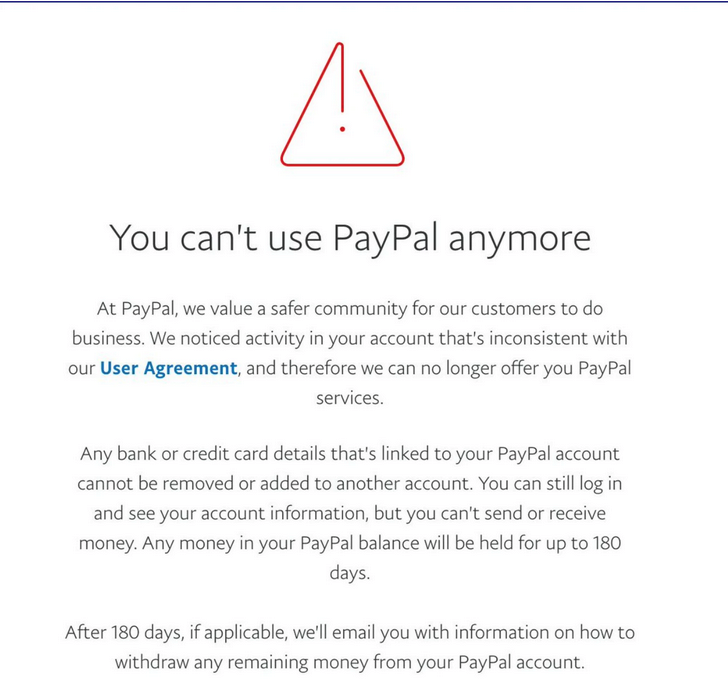
The irony of the Free Speech Union’s PayPal account being shut down is that it proves we are in need of the union more than ever.
The online payment company shut down the FSU’s account (thus making it more difficult for people to donate) without any clear explanation as to why it did so. The same was done to its founder, Toby Young, and his online newspaper, the Daily Sceptic.
The shame is, PayPal is an innovative tech company that has made transferring money almost seamless for millions across the world. You can donate money to an organisation within seconds; there’s no faff trying to find your credit card, or having to re-type your details for the twentieth time that week. It’s a brilliant service that has made life easier for many people, businesses and charities. PayPal is not a political company, it’s a tech company worth over $102bn, so why have they been banning other organisations from using their services?
Although PayPal said they couldn’t comment on the decision, they did proclaim that they “weren’t discriminatory”, but is this really true?
Is it unclear whether they shut down these accounts simply because they disagreed with what the FSU and Toby Young stand for. Although PayPal hasn’t clarified what exactly FSU and Toby Young did wrong, it appears that they must have breached their acceptable use policy. This includes myriad of things but the most prominent are hate speech and “misinformation” on topics such as the COVID vaccine.
Hate speech is one thing (although it seems that anything can be deemed offensive and hateful now) but “misinformation” about topics being a breach of policy takes us down a dark and sinister path.
Misinformation is a term that is often used to label content that goes against the elite or prevailing “groupthink” point of view. Questioning mainstream thought is unacceptable, and it breaches Big Tech’s policy, thus you can (and often will) be shut out.
Comments Off on PayPal shuts down the Free Speech Union’s account for some reason
September 17, 2022
A royal assault on free speech | The spiked podcast
spiked
Published 16 Sep 2022Tom, Fraser and Ella discuss the clampdown on republican protesters. Plus: the Ukrainian counteroffensive and the madness of Mermaids.
(more…)
Comments Off on A royal assault on free speech | The spiked podcast
August 26, 2022
It’s now apparently illegal to tell a Californian elected official that they’re “not God”
Chris Bray discusses the recently signed California law intended to prevent proles from “bullying” elected officials from now on:
The Romper Roomification of the American political class continues apace.
I’ve written several times about SB 1100, a tedious bill written by tedious people to stop the “bullying” of tedious elected officials at the tedious public meetings of tedious local legislative bodies. Hold on a moment while I see if I can work the word tedious into that sentence one more ti— nope, we’re good.
This week, California’s tedious governor signed the tedious thing, so everybody has to be nice from now on and not hurt anybody’s tedious widdle feewings. The tedious California legislature spews out so many tedious bills that Newsom doesn’t usually offer signing statements on the things, group-signing them in box lots and paying about as much attention to them as anybody else does. So.
For a look at what the state has supposedly just prohibited, do yourself the very mild favor of reading this piece of tedious pearl-clutching from some television news idiots in San Francisco:
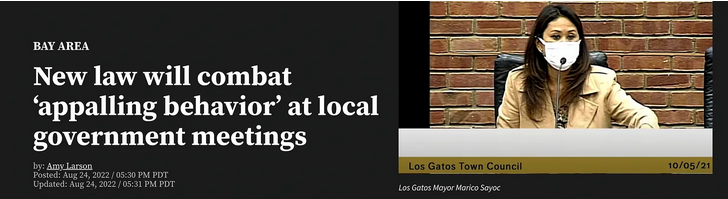
Here’s the example of “bullying”, using the tedious example of the tedious Los Gatos politician Marico “Tedious” Sayoc as the tedious designated martyr:
Last year, anti-vaccine and anti-LGBTQ groups targeted Los Gatos Mayor Marico Sayoc during town council meetings.
One Los Gatos resident spoke at the podium during an October meeting to say, “Madam Sayoc, you are not God! How dare you force your ideologies on our children! We the people of Los Gatos do not consent to the forced mutilation of our bodies, mind, and sovereignty.”
They targeted her! For example, they spoke during the public comment section of a public meeting and told an elected official — loudly and angrily, but still — that they disagreed with her. The public spoke at … public comment.
Taking the story at face value, telling a member of a suburban city council that she isn’t God is bullying, and state law now prohibits the bullying of the members of city councils, so you can no longer tell the members of California city councils that they aren’t God, because that’s being mean. If I’m reading the theological implications correctly, I believe this means that the members of California city councils have now been legislatively elevated to the status of actual gods, and will therefore no longer know death or suffering, and so we’ll have to sacrifice livestock to propitiate them or they’ll destroy our crops. But we may have to wait for the courts to weigh in on all of that.
In practical terms, the bill means literally nothing at all. After amendments that removed some even dumber stuff, the version passed by the legislature and signed by Newsom just says — I am not making this up — that city councils may remove individuals who are disruptive, which the law defines as people who engage in disruption. Free tautology lessons in the senate chamber, stop by anytime.
Comments Off on It’s now apparently illegal to tell a Californian elected official that they’re “not God”
August 8, 2022
The British left briefly rediscovers an interest in free speech … no, wait, they’re back to loving Big Brother again
In Spiked, Tom Slater recounts the brief moment last week that the great and good of British left wingers found nice things to say about freedom of speech. A very brief moment:
The British left – or what passes for it today – briefly pretended to care about free speech this week. Which was kind of cute. It was all sparked by Tory leadership no-hoper Rishi Sunak’s bonkers suggestion that people who “vilify” Britain should be put on the Prevent anti-radicalisation programme, alongside all the Islamists and fascists. “Who are the real snowflakes?”, thundered one left-wing commentator. “Fascism creeps ever closer”, warned Richard Murphy, a one-time adviser to Jeremy Corbyn, as he wondered out loud if he might soon end up in “some camp of Sunak’s choosing for ‘re-education'”.
This is probably the meme that Darren Brady posted which drew the attention of Hampshire Police’s crack “hurty words and pictures” squad last week.
Such principled expressions of horror, over an insanely authoritarian policy that almost certainly will never be implemented, might have had a bit more weight had the exact same people not studiously ignored a very real incident of state censorship – and attempted re-education – that went viral last week. I’m referring, of course, to Hampshire Police’s arrest of 51-year-old army veteran Darren Brady, all because he posted an offensive meme, which arranged four “Progress Pride” flags to resemble a swastika – a clumsy commentary on the authoritarianism of the contemporary LGBT movement.
The details chillingly echo Richard Murphy’s tweeted fever dream. Reportedly, the police had visited Brady 10 days before they tried to arrest him, informing him that he had committed an offence by posting the flag meme. They offered him a deal: pay for a £60 “community-resolution course” and they’d downgrade his offence to a “non-crime hate incident”, which would still appear on an advanced background check. Brady refused and contacted Harry Miller, leading campaigner against thoughtpolicing, who was present at the arrest and spent a night in the cells himself for trying to obstruct the cops. Going by the footage, now seen around the world, the (several) officers who attended Brady’s home had no idea what offence he was supposed to have committed, saying only that he had “caused anxiety”.
So, state censorship? Yep. Threats of re-education? Yep. The police showing up at someone’s door for no other crime than expressing an opinion? Big yep. Just because it was done in a Keystone Cops sort of fashion doesn’t make the treatment of Brady any less sinister. And yet there hasn’t been a peep of protest from the left-leaning intelligentsia. The armed wing of the state is going about harassing and arresting people purely for upsetting someone on the internet. And yet the people who pass themselves off as liberal, progressive, radical even, are clearly not the tiniest bit bothered about it.
Brady isn’t an isolated case, either. Britain is fast becoming a warning to the Western world about “caring” censorship, about trying to quite literally police “hurtful” speech. According to one investigation, nine people a day are arrested in the UK over offensive things they post on the internet. On top of that, more than 120,000 people have had so-called non-crime hate incidents recorded against their name. These alleged incidents needn’t be investigated or even be credible to be recorded. So much so that an Oxford professor once managed to get a hate incident recorded against then home secretary Amber Rudd, for a speech she gave about immigration that he later admitted he hadn’t even listened to, let alone witnessed in person.

Comments Off on The British left briefly rediscovers an interest in free speech … no, wait, they’re back to loving Big Brother again
August 6, 2022
Britain’s woke Stasi | The spiked podcast
spiked
Published 5 Aug 2022The spiked team discusses the rise of Britain’s thoughtpolice, Nancy Pelosi’s Taiwan trip and Beyoncé’s act of self-censorship.
(more…)
Comments Off on Britain’s woke Stasi | The spiked podcast
July 30, 2022
Alexis de Tocqueville
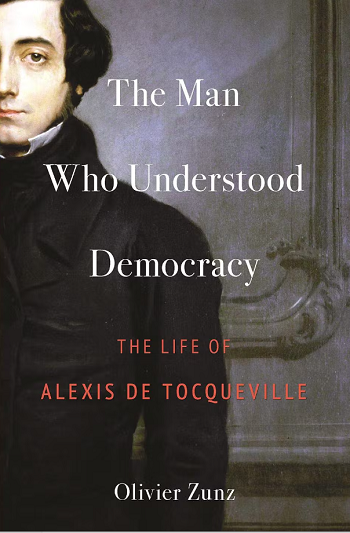
In The Critic, Paul Sagar reviews a new biography of Alexis de Tocqueville by Olivier Zunz:
Alexis de Tocqueville came perilously close to never existing at all. His parents, married in 1793, spent 10 of their first 18 months of matrimony in jail — arrested for the crime of being aristocrats during the height of the French revolutionary Terror. Tocqueville’s great-grandfather was guillotined in April 1794, after being forced to watch the beheadings of his daughter and grandchildren. His newlywed parents were in the queue, awaiting the same fate, but the fall of Robespierre in July meant they were spared.
Alexis, the third son of the family, would be born in 1805, and go on to write not one, but two, of the most influential works in the history of ideas. His two-volume Democracy in America (published in 1835 and 1840) has been hailed as, variously, the first work of political science, a founding text of sociological analysis, and a landmark in the history of political philosophy.
It remains a touchstone for those attempting to understand both democracy and the United States, as well as post-Revolutionary France (Tocqueville’s animating point of comparison). His later The Ancien Régime and the Revolution (1856) attempted to locate the long-term causes of the events of 1789, and inaugurated a school of French Revolution historiography that remains alive and influential to this day.
He also enjoyed a moderately successful career as a practising politician, directly involved in France’s tumultuous political upheavals from the 1830s to the early 1850s. Constitutionally frail, and wracked by tuberculosis for the final nine years of his life before dying at just 54, he nonetheless packed a lot in.
As a narrative biography, Olivier Zunz’s The Man Who Understood Democracy succeeds tremendously. The details of Tocqueville’s life — and the events he lived through — are rendered with engaging clarity. The detailed reconstruction of Tocqueville’s nine-month trip to America in 1831–32 is especially valuable, shedding a great deal of light on what Tocqueville saw and, crucially, who he spoke to and took his lead from. Zunz does not shy away from dissolving the myth to reveal the man. Sometimes treated as though he were a gimlet-eyed sage who saw through to the very soul of the fledgling United States, Zunz shows instead the extent to which Tocqueville tended to take too much at face value, especially regarding what he was told by less than impartial interlocutors, frequently failing to scratch below the surface on his whirlwind tour.
Thus, for example, he went on to write in Democracy in America that the liberty of the United States meant that secret societies were unknown there, entirely failing to recognise not only the extent of Masonic influence in local politics, but also how objections to Masonic influence were a core feature of contestation. A young man, dazzled by the hustle and bustle of the New World, he tended to see what he wanted to see — or what others hoped he would.
Comments Off on Alexis de Tocqueville
July 26, 2022
Is Trudeau channelling Caligula? – “Let them hate me as long as they fear me”
Spencer Fernando, writing for the National Citizens Coalition:
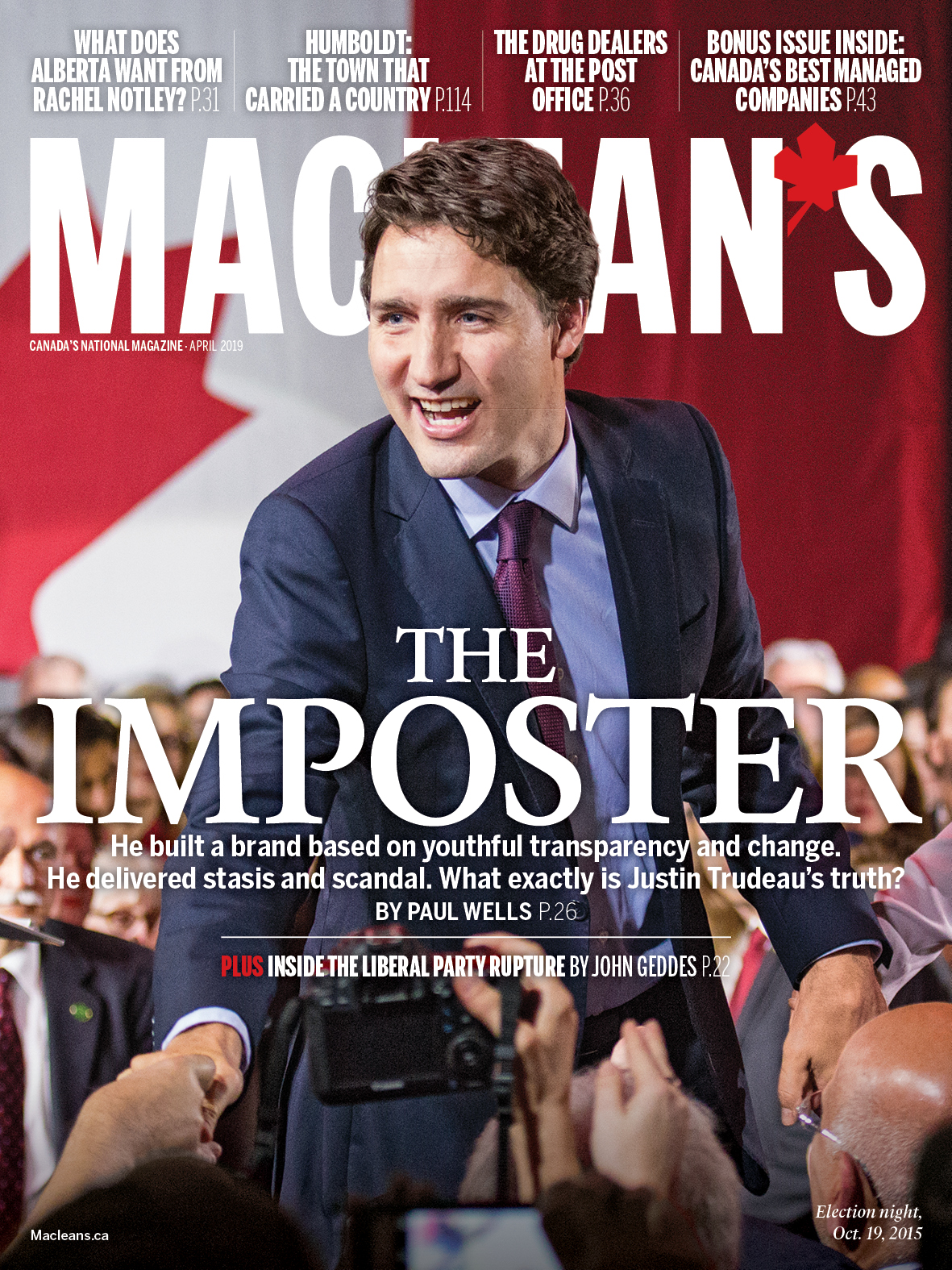
When trying to ascertain where the Trudeau Liberals are trying to take the country, it’s important to look at the foundations of Justin Trudeau’s worldview.
Clearly, he was heavily influenced by his father, someone who continuously expanded the power of the state.
Justin Trudeau’s father was well known as a Communist-sympathizer, being a big fan of both Fidel Castro and Communist China.
Note, the version of the CCP that existed in Pierre Trudeau’s era was even more brutal than the CCP as it exists today. At the time, it was not far removed from the time of Mao’s Great Leap Forward, a government-imposed “reshaping of society” that led to roughly 45 million deaths.
To look at that, and still be a fan of the Chinese Communist Party, is to show a deep ideological commitment to authoritarian socialism and a deep aversion to human freedom.
The apple clearly didn’t fall far from the tree, as Justin Trudeau praised China’s “basic dictatorship” (AKA the centralized power structure that enables horrific crimes).
Trudeau also sought to move Canada closer to China’s orbit, only giving up on that when public opinion – and a subtle revolt among some backbench Liberals – rendered it politically unfeasible.
We can see how the authoritarian socialism that Trudeau praised in China (and let’s not forget his fawning eulogy for Fidel Castro), lines up with the fear and contempt he and the Liberals have for many Canadians.
Now, let’s also note this essential point:
The Liberals continuously target the same individuals that authoritarian socialists and communists have targeted:
Rural Conservatives.
Private Enterprise.
Religious Groups.
Freethinkers.
Individualists.
Private Farmers.
Rural Gun Owners.
Independent Press Outlets.
Historically, those are all groups that the far-left has targeted when given the opportunity.
We only need to look at how the Liberal approach to Covid was modelled after the approach taken by Communist China, and how both the Liberals and the CCP have been largely unwilling to move on.
While the Liberals are more constrained than the CCP by the fact that Canada maintains some freedoms, do we have any doubt that they would be far more severe if they could get away with it?
Remember, the moment he feared losing the 2021 election, Justin Trudeau used very divisive and disturbing rhetoric (especially disturbing when seen in a historical context), and purposely sought to direct hatred and blame towards those who resisted draconian state orders.
Since then, the Trudeau Liberals – even in the face of criticism by a few courageous Liberal MPs who were quickly “put back in their place” – have almost gleefully abused their power, purposely creating an “Us vs Them” narrative designed to pit Canadians against each other.
At the same time, they’ve continued their efforts to gain control over social media, silence dissenting views, and turn the establishment media into an extension of the state propaganda apparatus.
This is all being done because they fear those who have the intelligence and strength of character to see through their agenda.
They fear you, and have contempt for you.
Comments Off on Is Trudeau channelling Caligula? – “Let them hate me as long as they fear me”
July 22, 2022
Sexual liberation to sexual revolution to … today’s sexual desert
Chris Bray thinks that the sexual revolution “missed a turn, somewhere out in the desert”:
The discussion of what we didn’t mean to do is becoming an interesting one:
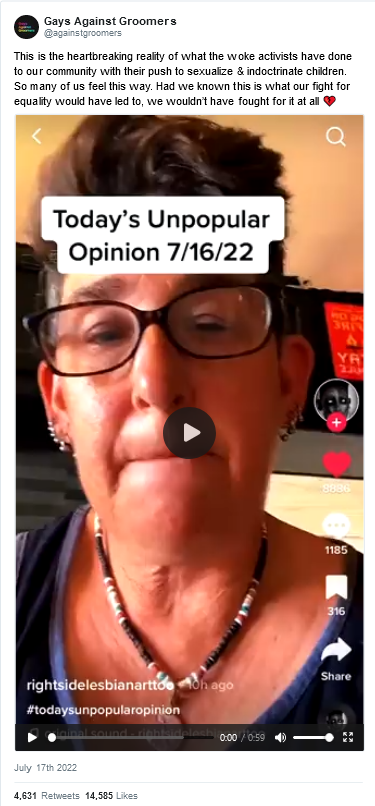
After decades of sexual liberation — Mattachine, Stonewall, Loving v. Virginia, Griswold v. Connecticut, Second Wave feminism and the Sexual Revolution, Lawrence v. Texas, Obergefell v. Hodges, and whatever else I’m missing in there (and I’m not sure Roe belongs on the list, but maybe) — we somehow arrive at a moment in which we merge a sexualized display of childhood and a relentless media-driven commodification of sexuality with the very clear reality that nobody’s having any sex:
One of the most comprehensive sex studies to date — the National Survey of Sexual Health and Behavior — found evidence of declines in all types of partnered sexual activity in the U.S. Over the course of the study from 2009 to 2018, those surveyed reported declines in penile-vaginal intercourse, anal sex and partnered masturbation …
Over the last 22 years, Herbenick has co-authored several studies about our sexual activity. Her most recent research finds that all of us, regardless of age, are having less sex, with the most dramatic decline among teenagers.
At the start of the study in 2009, 79% of those ages 14 to 17, revealed they were not having sex. By 2018, that number rose to 89%.
Liberation stabbed pleasure in the heart; we emptied sex. Hypersexualization turns out to be desexualization. The unrelenting joylessness and death odor of contemporary sexual culture emerges from seventy years of growing openness and freedom. How?
There’s no way to fully cover a question of that scope in a single post — but I refer, as a start, to the earlier posts I wrote about the sexualization of childhood and the way Jim Jones used sex as a weapon. Breaking barriers and repressive anchors broke connections and reference points: Yes, some people were trapped in oppressive societal norms, and it’s not at all my view that all the sexual liberation in our past wasn’t really liberating. But we broke marriage to set people free, and whoops. Some people experienced bourgeois heteronormativity as a prison, and so set out to release everybody from their cages, which seem to have not been cages for a whole lot of people. Congratulations, we’ve freed you from being part of a family.
Comments Off on Sexual liberation to sexual revolution to … today’s sexual desert
July 6, 2022
“The Great Charter of the Liberties” was signed on June 15, 1215 at Runnymede
Ed West on the connections between England’s Magna Carta and the American system (at least before the “Imperial Presidency” and the modern administrative state overwhelmed the Republic’s traditional division of powers):
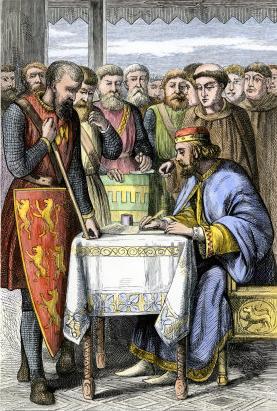
King John signs Magna Carta on June 15, 1215 at Runnymede; coloured wood engraving, 19th century.
Original artist unknown, held by the Granger Collection, New York. Image via Wikimedia Commons.
England does not really go in for national monuments, and when it does they are often eccentric. There is no great shrine to Alfred the Great, for example, the great founder of our nation, but we do have, right in the middle of London, a large marble memorial to the animals that gave their lives in the fight against fascism. And Runnymede, which you could say is the birthplace of English liberty, would be a deserted lay-by were it not for the Americans.
Beside the Thames, some 10 miles outside London’s western suburbs, this place “between Windsor and Staines”, as it is called in the original document, is a rather subdued spot, with the sound of constant traffic close by. Once there you might not know it was such a momentous place were it not for an enclosure with a small Romanesque circus, paid for by the American Association of Lawyers in 1957.
American lawyers are possibly not the most beloved group on earth, but it would be an awful world without them, and for that we must thank the men who on June 15, 1215 forced the king of England to agree to a document, “The Great Charter of the Liberties”.
Although John went back on the agreement almost immediately, and the country fell into civil war, by the end of the century Magna Carta had been written into English law; today, 800 years later, it is considered the most important legal document in history. As the great 18th-century statesman William Pitt the Elder put it, Magna Carta is “the Bible of the English Constitution”.
It was also, perhaps more importantly to the world, a huge influence on the United States. That is why today the doors to America’s Supreme Court feature eight panels showing great moments in legal history, one with an angry-looking King John facing a baron in 1215.
Magna Carta failed as a peace treaty, but after John’s death in 1216 the charter was reissued the following year, an act of desperation by the guardians of the new boy king Henry III. In 1300 his son Edward I reconfirmed the Charter when there was further discontent among the aristocracy; the monarch may have been lying to everyone in doing so, but he at least helped establish the precedent that kings were supposed to pretend to be bound by rules.
From then on Parliament often reaffirmed Magna Carta to the monarch, with 40 such announcements by 1400. Clause 39 heavily influenced the so-called “six statutes” of Edward III, which declared, among other things, that “no man, of whatever estate or condition he may be … could be dispossessed, imprisoned, or executed without due process of law”, the first time that phrase was used.
Magna Carta was last issued in 1423 and then barely referenced in the later 15th or 16th centuries, with the country going through periods of dynastic fighting followed by Tudor despotism and religious conflict. By Elizabeth I’s time, Magna Carta was so little cared about that Shakespeare’s play King John didn’t even mention it.
Comments Off on “The Great Charter of the Liberties” was signed on June 15, 1215 at Runnymede
July 5, 2022
QotD: The Great Enrichment
In particular, it is ideas that people have for commercially tested betterment that matter. Consider alternating-current electricity, cardboard boxes, the little black dress, The Pill, cheap food, literacy, antibiotics, airplanes, steam engines, screw-making machines, railways, universities, cheap steel, sewers, plate glass, forward markets, universal literacy, running water, science, reinforced concrete, secret voting, bicycles, automobiles, limited access highways, free speech, washing machines, detergents, air conditioning, containerization, free trade, computers, the cloud, smart phones, and Bob Gordon’s favorite, window screens. …
And the Great Enrichment depended on the less famous [but] crucial multitudes of free lunches prepared by the alert worker and the liberated shopkeeper rushing about, each with her own little project for profit and pleasure. Sometimes, unexpectedly, the little projects became big projects, such as John Mackey’s one Whole Foods store in Austin, Texas resulting in 479 stores in the U.S. and the U.K., or Jim Walton’s one Walmart in Bentonville, Arkansas resulting in 11,718 stores worldwide.
Letting people “have a go” to implement such ideas for commercially tested betterment is the crux. It comes, in turn, from liberalism, Adam Smith’s “obvious and simple system of natural liberty”, “the liberal plan of [social] equality, [economic] liberty, and [legal] justice”. Liberalism permitted, encouraged, honored an ideology of “innovism” — a word preferable to the highly misleading word “capitalism,” with its erroneous suggestion that the modern world was and is initiated by piling up bricks and bachelors’ degrees.
Dierdre McCloskey, “How Growth Happens: Liberalism, Innovism, and the Great Enrichment (Preliminary version)” [PDF], 2018-11-29.
Comments Off on QotD: The Great Enrichment


