
Throughout the 20th century and into the 21st there have been, largely, two staff systems:
- The continental system ~ which is used by most European armies and also used by the American and many, many Asian armies;
- The imperial, or British staff system which was used by the Canadian Army throughout most of the 20th century.
The two are fundamentally different.
The continental system is based on the great and impressive German General Staff system which grew up in the 19th century based on lessons learned in the Napoleonic Wars and then relearned in inter alia the Franco-Prussian Wars. The imperial system came later and reflected British thinking about what the Germans had formalized.
The best way to see the difference is to look at how the commanders and staff relate. In a French or German battalion ~ at least this was the case a few years ago ~ a company (100 to 150 soldiers) is commanded by a captain; there are only two or three officers in the company. The battalion, three, for or five companies, is commander by a lieutenant colonel, and there is a major deputy commander. The battalion staff consists of:
- S1 – personnel officer – a captain
- S2 – intelligence officer – a captain, sometimes a major
- S3 – operations officer – a major
- S4 – logistics officer – a major
- S5 – plans officer – a captain, often a major
For the German captain, company commander, looking “up the chain,” all he sees is higher ranks and he will never be blamed for being unsure if the commanding officer or the operations officer is the real “boss.” Ditto for French and American officers whose command-staff relationships are very, very similar. One of the great strengths of the German General Staff system was it “coherence.” The staff, at every level, was part of a single, coherent whole that stretched top to bottom from Berlin to the smallest battalion in the field. It is part of what made the German General Staff so famous and so feared by enemy armies. But the British, especially in 1914-18, saw a flaw in the continental system. The soldiers and commanders in the battalions and brigades in the trenches saw the general staff as being too remote, and even comfortable ~ removed from the horrors of combat and, consequently, many felt, making poor staff decisions. The system of the staff out-ranking subordinate commanders extends all the way to the top of the US Army and most European armies. Higher rank staff officers tend to build bigger and bigger HQs, too.
The British adapted the imperial system so that is was always crystal clear that commanders, from company up, always outranked and “out-appointed” the staff. Consider a British or Canadian battalion, also with, say, five companies. Like the US or European battalion the commanding officer is a lieutenant colonel, but each company commander is a major and the staff are:
- Adjutant (S1/personnel) – a captain
- Intelligence officer (S2) – a lieutenant, maybe a captain
- Operations officer (S3 and S5) – a captain, but, after about 1944 usually a major by “misemploying” the HQ Company commander
- Quartermaster (s4) – a captain
So a British or Australian or Canadian or Indian major, company commander, looking “up the chain” saw that there was no one between him (or her) and the CO except officers of equal or lower rank. The same applied, top to bottom: Field Marshal Montgomery’s (famously able) chief of staff was a major general … but you can be 100% certain that when Major-General Sir Francis Wilfred “Freddie” de Guingand, a two star level officer, phoned General (four stars) Henry Duncan Graham “Harry” Crerar, commander of the 1st Canadian Army in 1944/45 was wakened up and took the call because Monty’s chief-of-staff only dealt with important people and important matters. Rank didn’t really matter: de Guingand didn’t need any more stars ~ his appointment and ability both spoke (loudly) for themselves.
One result was that imperial (Commonwealth) armies tended to have smaller and lower ranked HQs, top to bottom.
There is no empirical proof that the continental staff system is better than the imperial one. The German General Staff was, indeed, superb, but that didn’t help, in 1944/45 when the German divisions and regiments and battalions were being defeated in detail on the front lines. Ditto in Korea and Vietnam: large numbers of excellent staff officers and superior communications systems didn’t help (and may have hindered) when the (first French and then) American brigades and battalions were being beaten in the jungles and rice paddies. The British, too, were defeated in battle ~ Dunkirk, Hong Kong, Singapore ~ but there is no evidence that bad operational staff work was to blame.
Ted Campbell, “The foundation (2)”, Ted Campbell’s Point of View, 2017-02-21.
June 6, 2017
QotD: Comparing general staff “systems”
June 5, 2017
What is Maskirovka? Russian Military Deception #Military 101
Published on 5 May 2017
A short introduction into Russian Military Deception – called Maskirovka. “Maskirovka is most simply defined as a set of processes designed to mislead, confuse, and interfere with accurate data collection regarding all areas of Soviet plans, objectives, and strengths or weaknesses.” (Smith, Charles L.: Soviet Maskirovka, in: Airpower Journal – Spring 1988)
Military History Visualized provides a series of short narrative and visual presentations like documentaries based on academic literature or sometimes primary sources. Videos are intended as introduction to military history, but also contain a lot of details for history buffs. Since the aim is to keep the episodes short and comprehensive some details are often cut.
» SOURCES «
Maier, Morgan: A Little Masquerade: Russia’s Evolving Employment of Maskirovka
http://cgsc.contentdm.oclc.org/cdm/singleitem/collection/p4013coll3/id/3507/rec/1Smith, Charles L.: Soviet Maskirovko, in: Airpower Journal – Spring 1988
http://www.airpower.maxwell.af.mil/airchronicles/apj/apj88/spr88/smith.htmlLindley-French, Julian: NATO: Countering Strategic Maskirovka. Canadian Defence & Foreign Affairs Institute. (2015)
Glantz: The Red Mask: The Nature and Legacy of Soviet Military Deception in the Second World War
https://en.wikipedia.org/wiki/Russian_military_deception
Keating, Kenneth: The Soviet System of Camouflage
http://www.dtic.mil/dtic/tr/fulltext/u2/a112903.pdfKrueger, Daniel: Maskirovka – What’s in it for us?
http://www.dtic.mil/dtic/tr/fulltext/u2/a190836.pdf
June 4, 2017
Exploring the Romagne 14-18 Museum in France I THE GREAT WAR Special
Published on 3 Jun 2017
Check out Jean-Paul’s museum or book him as a guide if you want to explore the Verdun or Meuse-Argonnes region: http://www.romagne14-18.com/index.php/de/
This winter we went to the Meuse region in France and explored the battlefield of Verdun and the Meuse-Argonne Offensive. Jean-Paul was our guide there and also showed us his impressive collection of WW1 relics that he all found in the area over the last decades.
Emperor Claudius
Victor Davis Hanson outlines the career of the fourth Roman Emperor and makes an unusual comparison:
The Roman Emperor Claudius, who reigned from 41 to 54 AD, was never supposed to be emperor. He came to office at age 50, an old man in Roman times. Claudius succeeded the charismatic, youthful heartthrob Caligula — son of the beloved Germanicus and the “little boot” who turned out to be a narcissist monster before being assassinated in office.
Claudius was an unusual emperor, the first to be born outside Italy, in Roman Gaul. Under the Augustan Principate, new Caesars — who claimed direct lineage from the “divine” Augustus — were usually rubber-stamped by the toadyish Senate. However, the outsider Claudius (who had no political training and was prevented by his uncle Tiberius from entering the cursus honorum), was brought into power by the Roman Praetorian Guard, who wanted a change from the status quo apparat of the Augustan dynasty.
The Roman aristocracy — most claiming some sort of descent from Julius Caesar and his grandnephew Octavian (Caesar Augustus) — had long written Claudius off as a hopeless dolt. Claudius limped, the result of a childhood disease or genetic impairment. His mother Antonia, ashamed of his habits and appearance, called the youthful Claudius “a monster of man.” He was likely almost deaf and purportedly stuttered.
That lifelong disparagement of his appearance and mannerisms probably saved Claudius’s life in the dynastic struggles during the last years of the Emperor Augustus and the subsequent reigns of the emperors Tiberius and Caligula.
The stereotyped impression of Claudius was that of a simpleton not to be taken seriously — and so no one did. Claudius himself claimed that he feigned acting differently in part so that he would not be targeted by enemies before he assumed power, and to unnerve them afterwards.
Contemporary critics laughed at his apparent lack of eloquence and rhetorical mastery, leading some scholars to conjecture that he may have suffered from Tourette syndrome or a form of autism. The court biographer Suetonius wrote that Claudius “was now careful and shrewd, sometimes hasty and inconsiderate, occasionally silly and like a crazy man.”
Sound familiar?
The Battle of Midway, 4-7 June 1942
Last month, Victor Davis Hanson recounted the American side of the Battle of Midway, which many historians see as the turning point of the Pacific War:
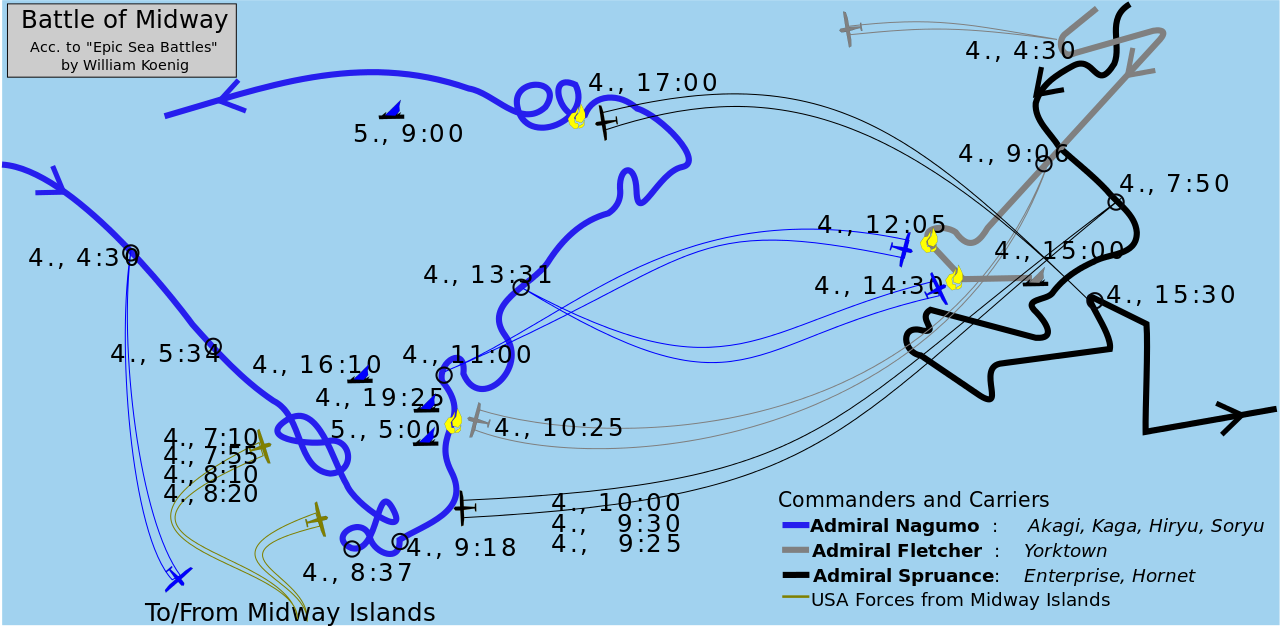
Battle of Midway deployment map, according to Seeschlachten der Weltgeschichte by William Koenig (German version of Epic Sea Battles) via Wikimedia
Seventy-five years ago (June 4-7, 1942), the astonishing American victory at the Battle of Midway changed the course of the Pacific War.
Just six months after the catastrophic Japanese surprise attack on Pearl Harbor, the U.S. crushed the Imperial Japanese Navy off Midway Island (about 1,300 miles northwest of Honolulu), sinking four of its aircraft carriers.
“Midway” referred to the small atoll roughly halfway between North America and Asia. But to Americans, “Midway” became a barometer of military progress. Just half a year after being surprised at Pearl Harbor, the U.S. Navy had already destroyed almost half of Japan’s existing carrier strength (after achieving a standoff at the Battle of the Coral Sea a month earlier).
The odds at the June 1942 battle favored the Japanese. The imperial fleet had four carriers to the Americans’ three, backed up by scores of battleships, cruisers and light carriers as part of the largest armada that had ever steamed from Japan.
No military had ever won more territory in six months than had Japan. Its Pacific Empire ranged from the Indian Ocean to the coast of the Aleutian Islands, and from the Russian-Manchurian border to Wake Island in the Pacific.
Yet the Japanese Navy was roundly defeated by an outnumbered and inexperienced American fleet at Midway. Why and how?
QotD: The Empire of the Cow
Whatever you might say against European imperialism and colonialism, it was good for the dairy industry. Ditto the railways which, beginning with the Great Western, made a fortune delivering rural milk supplies to the Great Wen of London, using methods soon copied by entrepreneurs in Paris, New York, Bombay. We forget, don’t we, that before 1860 or so, almost all dairy farming for urban consumption was done within the cities; to say nothing of other animal feedlot operations, including poultry and eggs; market gardening, horticulture and so forth. I’m with the hipsters for bringing it all back.
I cast no aspersions on the milkers of buffalo, goats, sheep, camels, donkeys, horses, reindeer, yaks, when I recognize that the Holstein/Frisian cow was the great cause and inspiration for the rise of what Max Weber murkily called the Protestant Ethic and the Spirit of Capitalism, emanating from the north-west of Europe. Instead, as will be seen, I champion them.
Neil Cameron interviewed the learned Professor Gerhard Fleischkopf, in a cover piece for the Idler magazine, more than a quarter-century ago, to publicize a thesis that still hasn’t been taken seriously enough by the historians. Contra Weber, Fleischkopf showed that it wasn’t the Germans, Dutchmen, Normans, English who launched this cultural revolution. Rather it was their cows, who forced them to rise very early every morning, lest they be kicked upon finally approaching the engorged teats with their milk-stools and pails; forced them otherwise to adopt patterns of behaviour entirely in the interest of the cows. Their philosophical and theological outlook — a dramatic break from the mediaeval scholastic synthesis — was not in any sense original to them, but instead an artefact of their cultural and intellectual manipulation, by cows. And so, too, their adaptive pushiness towards those of other lands — those lesser breeds without modern dairying techniques — whom they subjugated in turn, as agents of the cow.
David Warren, “A new model for society”, Essays in Idleness, 2015-07-20.
June 3, 2017
Ned Kelly – Lies – Extra History
Published on Apr 29, 2017
We know so much about Ned Kelly’s life through documents recorded at the time, and yet disputes over those details remind us how much different people’s perspectives shapes our understanding of events. James Portnow interviews series writer Soraya Een Hajji about Ned Kelly!
June 2, 2017
French Mutinies – Tunnels Under Messines Ridge I THE GREAT WAR Week 149
Published on 1 Jun 2017
The casualties and lack of success during the Nivelle Offensive were too much for the French Army and now the breaking point was reached. While parts of the French Army are in open mutiny, British Commander Douglas Haig is already planning the next offensive at Ypres. This time he wants to combine it with an amphibious landing along the Belgian coast.
May 31, 2017
“JFK before the speechwriters got to him is far more interesting”
Mark Steyn celebrates what would have been JFK’s 100th birthday by looking at the pre-Camelot JFK’s life:
Jack’s early life was certainly privileged but not idyllic. The family patriarch, Joe, is an easy target: an enthusiastic adulterer at home, and abroad, as US Ambassador to the Court of St James’s, an equally enthusiastic appeaser. His wife, Rose, reacted to his infidelities by retreating into her social life. The distance she put between her and her husband also left her nine children (four of whom she would outlive) beached on the other side of the divide. She regarded them, as one biographer put it, as “a management exercise”, and she believed in mostly hands-off management. Jack was a sickly child who spent months in hospital, but his mother was too far away to visit. Maternal affection was confined to a postcard from Paris, a ship-to-shore telegram from the Queen Mary. For the rest of his life, Kennedy disliked being touched or hugged even in the course of his many fleeting, transient sexual encounters.
Sex was fine. Anything more he found awkward and difficult. He showered up to five times a day. You can do your own analysis; everybody else does. “If he were my son,” declared a master at Choate, “I should take him to a gland specialist.” “He has never eaten enough vegetables,” decided Rose.
Duty is more easily borne when the the world’s eminences are your dinner companions. You meet the seigneurs, and you get to enjoy a little of their droit de, too. A former lover of Prince George, Duke of Kent introduced herself to young Jack as “a member of the British Royal Family by injection”. The line seemed fresh to him, as it might not have a quarter-century later were random showgirls and mob molls running around Vegas and Malibu introducing themselves as members of the Kennedy family by injection. He signed his letters from Harvard, “Stout-hearted Kennedy, despoiler of women.”
On the other hand, not many 24-year-olds get to shoot the breeze with Lord Halifax, British Ambassador in Washington, at the height of the Second World War about where the man he served as prime minister had gone wrong. “Halifax believed,” wrote young Kennedy after their conversation, “that Chamberlain was misled and defeated by his phrases, which he did not really believe in, such as ‘Peace in our time’.” By the time Kennedy got into the phrase-making business, he left it to the professionals to craft all that sing-songy seesawing jingles people seem to think meets the definition of powerful rhetoric: Ask not what your country can do for you, ask what you can do for your country. Mankind must put an end to war or war will put an end to mankind. Let us never negotiate out of fear, but let us never fear to negotiate. Mankind must put an end to cheap applause lines, but let us never fear to invert them formulaically yet portentously.
The JFK before the speechwriters got to him is far more interesting. “We are at a great disadvantage,” Kennedy the gunboat skipper writes from the Pacific. “The Russians could see their country invaded, the Chinese the same. The British were bombed, but we are fighting on some islands belonging to the Lever Company, a British concern making soap… I suppose if we were stockholders we would perhaps be doing better, but to see that by dying at Munda you are helping to ensure peace in our time takes a larger imagination than most men possess.”
QotD: Capitalism
Queen Elizabeth owned silk stockings. The capitalist achievement does not typically consist in providing more silk stockings for queens but in bringing them within the reach of factory girls in return for steadily decreasing amounts of effort…. [T]he capitalist process, not by coincidence but by virtue of its mechanism, progressively raises the standard of life of the masses.
Joseph Schumpeter, Capitalism, Socialism, and Democracy, 1942.
May 30, 2017
Croatia in World War 1 I THE GREAT WAR Special
Published on 29 May 2017
Croatia was part of the Austro-Hungarian Empire during World War 1 and Croats were just one of the many ethnicities within the Habsburg Empire that went to to war in 1914. Croats served in Galicia, on the Isonzo Front or in the Navy and it was a Croat who built up the Austro-Hungarian Air Force. Still towards the end of the war, more and more Croats thought about independence.
The Belisarius fixation in SF&F
Jo Walton wonders why an otherwise obscure general of an otherwise obscure empire appears so often in fantasy and science fiction:
I once wrote jokingly here that there are only three plots, and they are Hamlet, Pride and Prejudice, and Belisarius, because those are the ones everyone keeps on reusing.
There is a conference in Uppsala in Sweden the weekend before the Helsinki Worldcon called “Reception Histories of the Future” which is about the use of Byzantium in science fiction. The moment I heard of it, I immediately started thinking about our obsessive reuse of the story of Belisarius. (I’m going. Lots of other writers are going. If you’re heading to Helsinki, it’s on your way, and you should come too!)
It’s strange that science fiction and fantasy are obsessed with retelling the story of Belisarius, when the mainstream world isn’t particularly interested. Robert Graves wrote a historical novel about him in 1938, Count Belisarius, and there’s Gillian Bradshaw’s The Bearkeeper’s Daughter (1987), but not much else. Whereas in genre, we’ve had the story of Belisarius retold by Guy Gavriel Kay, David Drake (twice) and Chelsea Quinn Yarbro, and used by L. Sprague de Camp, John M. Ford, Jerry Pournelle, Robert Silverberg, and Isaac Asimov. So what is it about this bit of history that makes everyone from Asimov to Yarbro use it? And how is it that the only place you’re likely to have come across it is SF?
First, let’s briefly review the story. First Rome was a huge unstoppable powerful indivisible empire. Then Rome divided into East and West, with the Eastern capital at Constantinople. Then the Western half fell to barbarians, while the Eastern half limped on for another millennium before falling to the Ottoman conqueror Mehmed II in 1453. We call the eastern half Byzantium, but they went right on calling themselves the Roman Empire, right up to the last minute. But long before that, in the sixth century, at the exact same time as the historical Arthur (if there was an Arthur) was trying to save something from the shreds of Roman civilization in Britain, Justinian (482-565) became emperor in Constantinople and tried to reunite the Roman Empire. He put his uncle on the throne, then followed him. He married an actress, the daughter of an animal trainer, some say a prostitute, called Theodora. He has a loyal general called Belisarius. He built the great church of Hagia Sophia. He withstood a giant city riot in the hippodrome, the great chariot-racing stadium, by having Belisarius’s soldiers massacre a huge number of people. He wrote a law code that remained the standard law code everywhere in Europe until Napoleon. And Belisarius reconquered really quite large chunks of the Roman Empire for him, including Rome itself. At the height of his success he was recalled to Rome and fired because Justinian was jealous. Belisarius had a huge army and could have taken the throne for himself, which was typical of both the Roman and the Byzantine empires, but he was loyal and let Justinian fire him. This is all happening at a time of Christian schism and squabbling about heresy between different sects.
While I’d quibble about her thumbnail sketch a bit, there’s more than enough there to fuel dozens of alt-history, fantasy, or science fiction novels … the fiction couldn’t be much more difficult to swallow than the reality. My first contact with the story of Belisarius was indeed the Robert Graves novel (which I still heartily recommend). I imagine that was true for most of the authors listed above.
The Disgusting Contents of Worcestershire Sauce (and Why It s Called That)
Published on 27 Mar 2017
In this video:
Worcestershire sauce, sometimes known as “Worcester sauce” is a savoury sauce that is often added to meat and fish dishes or, if you like your alcoholic beverages, the Bloody Mary cocktail. It may (or may not depending on how much you research your sauce choices) surprise you to learn that it’s literally made from fermented fish and spices.
Want the text version?: http://www.todayifoundout.com/index.php/2013/10/worcestershire-sauce-called/
May 29, 2017
On this day in 1453
In the Smithsonian Magazine in 2008, Fergus M. Bordewich described the events of 29 May, 1453:
In the 11th century, the Byzantines suffered the first in a series of devastating defeats at the hands of Turkish armies, who surged westward across Anatolia, steadily whittling away at the empire. The realm was further weakened in 1204 when western European crusaders en route to the Holy Land, overtaken by greed, captured and looted Constantinople. The city never fully recovered.
By the mid-15th century, Constantinople was hemmed in by Ottoman-controlled territories. On May 29, 1453, after a seven-week siege, the Turks launched a final assault. Bursting through the city’s defenses and overwhelming its outnumbered defenders, the invaders poured into the streets, sacking churches and palaces, and cutting down anyone who stood in their way. Terrified citizens flocked to Hagia Sophia, hoping that its sacred precincts would protect them, praying desperately that, as an ancient prophesied, an avenging angel would hurtle down to smite the invaders before they reached the great church.
Instead, the sultan’s janissaries battered through the great wood-and-bronze doors, bloody swords in hand, bringing an end to an empire that had endured for 1,123 years. “The scene must have been horrific, like the Devil entering heaven,” says Crowley. “The church was meant to embody heaven on earth, and here were these aliens in turbans and robes, smashing tombs, scattering bones, hacking up icons for their golden frames. Imagine appalling mayhem, screaming wives being ripped from the arms of their husbands, children torn from parents, and then chained and sold into slavery. For the Byzantines, it was the end of the world.” Memory of the catastrophe haunted the Greeks for centuries. Many clung to the legend that the priests who were performing services that day had disappeared into Hagia Sophia’s walls and would someday reappear, restored to life in a reborn Greek empire.
That same afternoon, Constantinople’s new overlord, Sultan Mehmet II, rode triumphantly to the shattered doors of Hagia Sophia. Mehmet was one of the great figures of his age. As ruthless as he was cultivated, the 21-year-old conqueror spoke at least four languages, including Greek, Turkish, Persian and Arabic, as well as some Latin. He was an admirer of European culture and patronized Italian artists, such as the Venetian master Gentile Bellini, who painted him as a bearded, introspective figure swathed in an enormous robe, his small eyes gazing reflectively over an aristocratically arched nose. “He was ambitious, superstitious, very cruel, very intelligent, paranoid and obsessed with world domination,” says Crowley. “His role models were Alexander the Great and Julius Caesar. He saw himself as coming not to destroy the empire, but to become the new Roman emperor.” Later, he would cast medallions that proclaimed him, in Latin, “Imperator Mundi” — “Emperor of the World.”
Before entering the church, Mehmet bent down to scoop up a fistful of earth, pouring it over his head to symbolize his abasement before God. Hagia Sophia was the physical embodiment of imperial power: now it was his. He declared that it was to be protected and was immediately to become a mosque. Calling for an imam to recite the call to prayer, he strode through the handful of terrified Greeks who had not already been carted off to slavery, offering mercy to some. Mehmet then climbed onto the altar and bowed down to pray.
Among Christians elsewhere, reports that Byzantium had fallen sparked widespread anxiety that Europe would be overrun by a wave of militant Islam. “It was a 9/11 moment,” says Crowley. “People wept in the streets of Rome. There was mass panic. People long afterward remembered exactly where they were when they heard the news.” The “terrible Turk,” a slur popularized in diatribes disseminated across Europe by the newly invented printing press, soon became a synonym for savagery.
Falklands War – Argentine Perspective – An Inevitable Defeat? (Guerra de las Malvinas)
Published on 12 Apr 2016
The Falklands War (Guerra de las Malvinas) in 1982 as seen by many as an inevitable defeat for Argentina, but taking a closer look at the preparations or better the lack of preparation on the Argentine side reveals that the British could have faced a far stronger opposition and might even had been defeated at least in their initial attacks. This video could also be seen as a how NOT to guide.


