
Forgotten Weapons
Published on 24 Aug 2015http://www.patreon.com/ForgottenWeapons
Hammer Price: $3,750
Pretty much every major military had an antitank rifle in service when WW2 kicked off, and the British example was the Boys rifle, named after the Captain Boys who designed it. It was a bolt action .55 caliber rifle with 5-round detachable magazines. If was obsolete by 1943 and replaced by the more effective but equally unpleasant PIAT.
October 4, 2017
British Boys Anti-Tank Rifle
Comments Off on British Boys Anti-Tank Rifle
QotD: Transnational progressivism
The Soviets didn’t invent [transnational progressivism], but they promoted it heavily in a deliberate — and appallingly successful — attempt to weaken the Lockean, individualist tradition that underlies classical liberalism and the U.S. Constitution. The reduction of Western politics to a bitter war for government favor between ascriptive identity groups is exactly the outcome the Soviets wanted and worked hard to arrange.
Call it what you will — various other commentators have favored ‘volk-Marxism’ or ‘postmodern leftism’. I’ve called it suicidalism. It was designed to paralyze the West against one enemy, but it’s now being used against us by another. It is no accident that Osama bin Laden so often sounds like he’s reading from back issues of Z magazine, and no accident that both constantly echo the hoariest old cliches of Soviet propaganda in the 1930s and ’40s.
Another consequence of Stalin’s meme war is that today’s left-wing antiwar demonstrators wear kaffiyehs without any sense of how grotesque it is for ostensible Marxists to cuddle up to religious absolutists who want to restore the power relations of the 7th century CE. In Stalin’s hands, even Marxism itself was hollowed out to serve as a memetic weapon — it became increasingly nihilist, hatred-focused and destructive. The postmodern left is now defined not by what it’s for but by what it’s against: classical-liberal individualism, free markets, dead white males, America, and the idea of objective reality itself.
The first step to recovery is understanding the problem. Knowing that suicidalist memes were launched at us as war weapons by the espionage apparatus of the most evil despotism in human history is in itself liberating. Liberating, too, it is to realize that the Noam Chomskys and Michael Moores and Robert Fisks of the world (and their thousands of lesser imitators in faculty lounges everywhere) are not brave transgressive forward-thinkers but pathetic memebots running the program of a dead tyrant.
Brittingham and other have worried that postmodern leftism may yet win. If so, the victory would be short-lived. One of the clearest lessons of recent times (exemplified not just by kaffiyeh-wearing western leftists but by Hamas’s recent clobbering of al-Fatah in the first Palestinian elections) is that po-mo leftism is weaker than liberal individualism in one important respect; it has only the weakest defenses against absolutist fervor. Brittingham tellingly notes po-mo philosopher Richard Rorty’s realization that when the babble of conflicting tribal narratives collapses in exhaustion, the only thing left is the will to power.
Again, this is by design. Lenin and Stalin wanted classical-liberal individualism replaced with something less able to resist totalitarianism, not more. Volk-Marxist fantasy and postmodern nihilism served their purposes; the emergence of an adhesive counter-ideology would not have. Thus, the Chomskys and Moores and Fisks are running a program carefully designed to dead-end at nothing.
Eric S. Raymond, “Gramscian damage”, Armed and Dangerous, 2006-02-11.
Comments Off on QotD: Transnational progressivism
October 3, 2017
Between Gulasch Barons and Defending Neutrality – Denmark in WW1 I THE GREAT WAR Special
The Great War
Published on 2 Oct 2017Denmark, Germany’s northern neighbour, declared neutrality when World War 1 broke out. But after the defeat against Germany in the 19th century, they were still worried and readied their defences. At the same time Germany’s hunger for supplies created a new rich elite which were called Gulasch Barons. 30,000 Danes also fought for Germany since they lived in a territory previously belonging to Denmark.
Comments Off on Between Gulasch Barons and Defending Neutrality – Denmark in WW1 I THE GREAT WAR Special
Viking warrior women?
ESR posted a link to this article by Julia Dent on the much ballyhoo’d “discovery” of the grave of a Viking woman warrior:
You may have heard of L’Anse aux Meadows, the discovered Viking site in Canada (because I repeat, Vikings actually settled in North America, even if it didn’t last long), but did you know that they uncovered another Viking site only last year? If you listen to Dan Snow’s History Hit podcast (which I highly recommend), you may have heard about it, but I only saw a couple of articles about the discovery. This finding is further proof that Leif Eriksson and his fellow Vikings actually settled in North America years before Christopher Columbus was even born, so it isn’t insignificant in the least.
But Leif Eriksson was overshadowed once again—this time by an unknown woman’s grave. However, there’s more to the story than meets the eye. I’ve written about the danger of people leaping to conclusions before, and it appears that it’s happened again. While there may have been female Viking warriors, there isn’t strong evidence that this Viking woman was actually a “high-ranking officer” or even a warrior. University of Nottingham professor of Viking studies Judith Jesch burst everyone’s bubbles with an article going through the “evidence” from the grave site and contesting it all. I highly encourage you to read her analysis in full, but here’s a quick summary of some of her points about the authors who published the “evidence” that the grave site was for a female Viking military officer:
The authors listed on the article don’t include a language specialist, even though it starts with referencing “’narratives about fierce female Vikings fighting alongside men’, and concludes with a quotation from an Eddic poem in translation.” The authors even referenced one of Jesch’s books but not the book where she actually writes about women. The authors also make a lot of references to “historical records” without specifying which ones they’re talking about.
The authors pretty much decide that this Viking woman is a high-ranking officer based on what she was buried with. The grave contained “’a full set of gaming pieces’ which apparently ‘indicates knowledge of tactics and strategy’” and “’the exclusive grave goods and two horses are worthy of an individual with responsibilities concerning strategy and battle tactics.’” There isn’t even any conclusive evidence that men buried with those items were military leaders.
This gravesite was actually excavated over a century ago and things weren’t labeled well, so the female Viking bones may not have even been buried with all those items. Someone even commented on Jesch’s article that there was a third femur found with this woman’s bones, but the authors just ignored it. There were also no signs of harm to the bones, which means she was either one heck of a warrior who never got injured, or that she wasn’t a warrior at all.
So the authors assumed this female Viking was a military leader without any actual evidence and they ignored evidence that didn’t go along with their theory. Like many people today, they leapt to conclusions, and everyone was eager to agree that this woman was definitely a military leader because that suited a contemporary narrative, not a historical fact. This doesn’t mean that people in the future won’t find hard evidence that female Vikings could be military leaders, but you can’t “confirm” that this Viking was a military leader quite yet. Even if there weren’t female Viking warriors, women in Viking times were actually well-respected and enjoyed many rights and freedoms; they could divorce their husbands, own land, and could even have government representation. Women like Freydis and Gudrun had a significant impact on their societies, even if they didn’t lead troops into battle.
ESR also commented on the more direct physiological arguments against the “warrior woman” theory:
Accessible treatment of why to be skeptical of the recent media buzz about female Viking warriors.
My wife Cathy and I are subject-matter experts on this. We’ve trained to use period weapons and have studied both the archeological and saga evidence. And we can tell there’s a lot of PC horse exhaust being emitted on this topic.
On average, men are so much faster and stronger than women that what would happen to women using using lethal contact weapons on a pre-modern battlefield is highly predictable. They’d die. They’d die quickly.
The mean difference in physical ability (especially at burst exertion and upper-body strength) is so great that it takes a woman way over in the right tail of the Gaussian to stand against an average male. My wife is one of those exceptions, but we don’t fool ourselves that this is the typical case.
See also the U.S. Olympic women’s soccer team being defeated by a squad of 15-year-old boys. That is what’s normal for humans.
Comments Off on Viking warrior women?
Primitive Technology: Mud Bricks
Primitive Technology
Published on 22 Sep 2017(Turn on captions [CC] in the lower right corner for more information while viewing.)
I made a brick mold that makes bricks 25 x 12.5 x 7.5 cm from wood. A log was split and mortise and tenon joints were carved using a stone chisel and sharp rocks. The mold was lashed together with cane to prevent it from coming apart when used.Next, I made a mixture of mud and palm fiber to make the bricks. This was then placed into the mold to be shaped and taken to a drying area. 140 bricks were made.
When dry, the bricks were then assembled into a kiln. 32 roof tiles were then made of mud and fired in the kiln. It only took 3 hours to fire the tiles sufficiently. The mud bricks and tiles were a bit weaker than objects made from my regular clay source because of the silt, sand and gravel content of the soil. Because of this, I will look at refining mud into clay in future projects instead of just using mud.
Interestingly, the kiln got hot enough so that iron oxide containing stones began to melt out of the tiles. This is not metallic iron, but only slag (iron oxide and silica) and the temperature was probably not very high, but only enough to slowly melt or soften the stones when heated for 3 hours.
The kiln performed as well as the monolithic ones I’ve built in the past and has a good volume. It can also be taken down and transported to other areas. But the bricks are very brittle and next time I’d use better clay devoid of sand/silt, and use grog instead of temper made of plant fiber which burns out in firing. The mold works satisfactorily. I aim to make better quality bricks for use in furnaces and buildings in future.
WordPress: https://primitivetechnology.wordpress.com
Patreon page: https://www.patreon.com/user?u=2945881
I have no face book page, instagram, twitter etc. Beware of fake pages.
Comments Off on Primitive Technology: Mud Bricks
October 2, 2017
The Collapse of the Carolingian Empire – Echoes of History – Extra History
Extra Credits
Published on 30 Sep 2017The empire built by Charlemagne would end up divided by his grandsons, all of whom wanted to rule their own piece of it. But the division worked poorly, and may have set a precedent that shaped wars in Western Europe for centuries to come.
Comments Off on The Collapse of the Carolingian Empire – Echoes of History – Extra History
October 1, 2017
Recap Of Our Trip To Italy and Slovenia I THE GREAT WAR
The Great War
Published on 30 Sep 2017Kobarid Museum: http://kobariski-muzej.si
Walk of Peace: http://www.potmiru.si/eng/
Lagazuoi: https://www.altabadia.org/en/summer-holidays/trekking-hiking/open-air-museum-lagazuoi-5-torri-1.html
Vittorio Veneto: http://www.museivittorioveneto.gov.it/en/museo_della_battaglia.html
La Baita: http://bit.ly/LaBaitaColDiLana
Indy and Flo make you jealous by telling you what you missed when we all went to Slovenia and Italy last week.
Comments Off on Recap Of Our Trip To Italy and Slovenia I THE GREAT WAR
Deirdre McCloskey on the rise of economic liberty
Samizdata‘s Johnathan Pearce linked to this Deirdre McCloskey article I hadn’t seen yet:
Since the rise during the late 1800s of socialism, New Liberalism, and Progressivism it has been conventional to scorn economic liberty as vulgar and optional — something only fat cats care about. But the original liberalism during the 1700s of Voltaire, Adam Smith, Tom Paine, and Mary Wollstonecraft recommended an economic liberty for rich and poor understood as not messing with other peoples’ stuff.
Indeed, economic liberty is the liberty about which most ordinary people care.
Adam Smith spoke of “the liberal plan of [social] equality, [economic] liberty, and [legal] justice.” It was a good idea, new in 1776. And in the next two centuries, the liberal idea proved to be astonishingly productive of good and rich people, formerly desperate and poor. Let’s not lose it.
Well into the 1800s most thinking people, such as Henry David Thoreau, were economic liberals. Thoreau around 1840 invented procedures for his father’s little factory making pencils, which elevated Thoreau and Son for a decade or so to the leading maker of pencils in America. He was a businessman as much as an environmentalist and civil disobeyer. When imports of high-quality pencils finally overtook the head start, Thoreau and Son graciously gave way, turning instead to making graphite for the printing of engravings.
That’s the economic liberal deal. You get to offer in the first act a betterment to customers, but you don’t get to arrange for protection later from competitors. After making your bundle in the first act, you suffer from competition in the second. Too bad.
In On Liberty (1859) the economist and philosopher John Stuart Mill declared that “society admits no right, either legal or moral, in the disappointed competitors to immunity from this kind of suffering; and feels called on to interfere only when means of success have been employed which it is contrary to the general interest to permit — namely, fraud or treachery, and force.” No protectionism. No economic nationalism. The customers, prominent among them the poor, are enabled in the first through third acts to buy better and cheaper pencils.
[…]
Indeed, economic liberty is the liberty about which most ordinary people care. True, liberty of speech, the press, assembly, petitioning the government, and voting for a new government are in the long run essential protections for all liberty, including the economic right to buy and sell. But the lofty liberties are cherished mainly by an educated minority. Most people — in the long run foolishly, true — don’t give a fig about liberty of speech, so long as they can open a shop when they want and drive to a job paying decent wages. A majority of Turks voted in favour of the rapid slide of Turkey after 2013 into neo-fascism under Erdoğan. Mussolini and Hitler won elections and were popular, while vigorously abridging liberties. Even a few communist governments have been elected — witness Venezuela under Chavez.
Comments Off on Deirdre McCloskey on the rise of economic liberty
September 29, 2017
Battle of Polygon Wood – Betrayal At The Italian Front I THE GREAT WAR Week 166
The Great War
Published on 28 Sep 2017The British and Australian forces under Sir Herbert Plumer continue to advance at Passchendaele. Plumer’s new tactic comes with a high price in men and material but it also gets results. German flying ace Werner Voss fights his last legendary fight and on the Italian Front, some Austro-Hungarian officers want to end the war sooner than later – and not in their countries’ favour.
Comments Off on Battle of Polygon Wood – Betrayal At The Italian Front I THE GREAT WAR Week 166
Blockchain primer – blockchain as a ledger
At Catallaxy Files, Sinclair Davidson provides some background knowledge of blockchain technology as a modern evolution of the simple ledger:
The blockchain is a digital, decentralised, distributed ledger.
Most explanations for the importance of the blockchain start with Bitcoin and the history of money. But money is just the first use case of the blockchain. And it is unlikely to be the most important.
It might seem strange that a ledger — a dull and practical document associated mainly with accounting — would be described as a revolutionary technology. But the blockchain matters because ledgers matter.
Ledgers all the way down
Ledgers are everywhere. Ledgers do more than just record accounting transactions. A ledger consists simply of data structured by rules. Any time we need a consensus about facts, we use a ledger. Ledgers record the facts underpinning the modern economy.
Ledgers confirm ownership. Property title registers map who owns what and whether their land is subject to any caveats or encumbrances. Hernando de Soto has documented how the poor suffer when they own property that has not been confirmed in a ledger. The firm is a ledger, as a network of ownership, employment and production relationships with a single purpose. A club is a ledger, structuring who benefits and who does not.
Ledgers confirm identity. Businesses have identities recorded on government ledgers to track their existence and their status under tax law. The register of Births Deaths and Marriages records the existence of individuals at key moments, and uses that information to confirm identities when those individuals are interacting with the world.
Ledgers confirm status. Citizenship is a ledger, recording who has the rights and is subject to obligations due to national membership. The electoral roll is a ledger, allowing (and, in Australia, obliging) those who are on that roll a vote. Employment is a ledger, giving those employed a contractual claim on payment in return for work.
Ledgers confirm authority. Ledgers identify who can validly sit in parliament, who can access what bank account, who can work with children, who can enter restricted areas.
At their most fundamental level, ledgers map economic and social relationships.
Agreement about the facts and when they change — that is, a consensus about what is in the ledger, and a trust that the ledger is accurate — is one of the fundamental bases of market capitalism.
[…]
The evolution of the ledger
For all its importance, ledger technology has been mostly unchanged … until now.
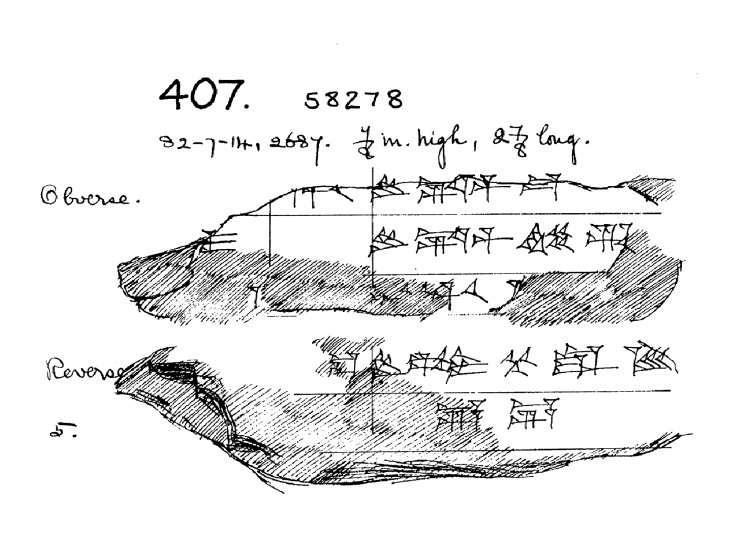
Ledgers appear at the dawn of written communication. Ledgers and writing developed simultaneously in the Ancient Near East to record production, trade, and debt. Clay tablets baked with cuneiform script detailed units of rations, taxes, workers and so forth. The first international ‘community’ was arranged through a structured network of alliances that functioned a lot like a distributed ledger.
A fragment of a late Babylonian cuneiform ledger, held by the British Museum, 58278
The first major change to ledgers appeared in the fourteenth century with the invention of double entry bookkeeping. By recording both debits and credits, double entry bookkeeping conserved data across multiple (distributed) ledgers, and allowed for the reconciliation of information between ledgers.
The nineteenth century saw the next advance in ledger technology with the rise of large corporate firms and large bureaucracies. These centralised ledgers enabled dramatic increases in organisational size and scope, but relied entirely on trust in the centralised institutions.
In the late twentieth century ledgers moved from analog to digital ledgers. For example, in the 1970s the Australian passport ledger was digitised and centralised. A database allows for more complex distribution, calculation, analysis and tracking. A database is computable and searchable.
But a database still relies on trust; a digitised ledger is only as reliable as the organisation that maintains it (and the individuals they employ). It is this problem that the blockchain solves. The blockchain is a distributed ledgers that does not rely on a trusted central authority to maintain and validate the ledger.
Comments Off on Blockchain primer – blockchain as a ledger
September 28, 2017
A very different kind of “hockey stick” – everything sucked until the industrial revolution
Steve Kates linked to this post at Luke Muehlhauser’s blog, showing another graph with a hockey stick pattern, but it isn’t one of the IPCC’s misleading bits of propaganda:
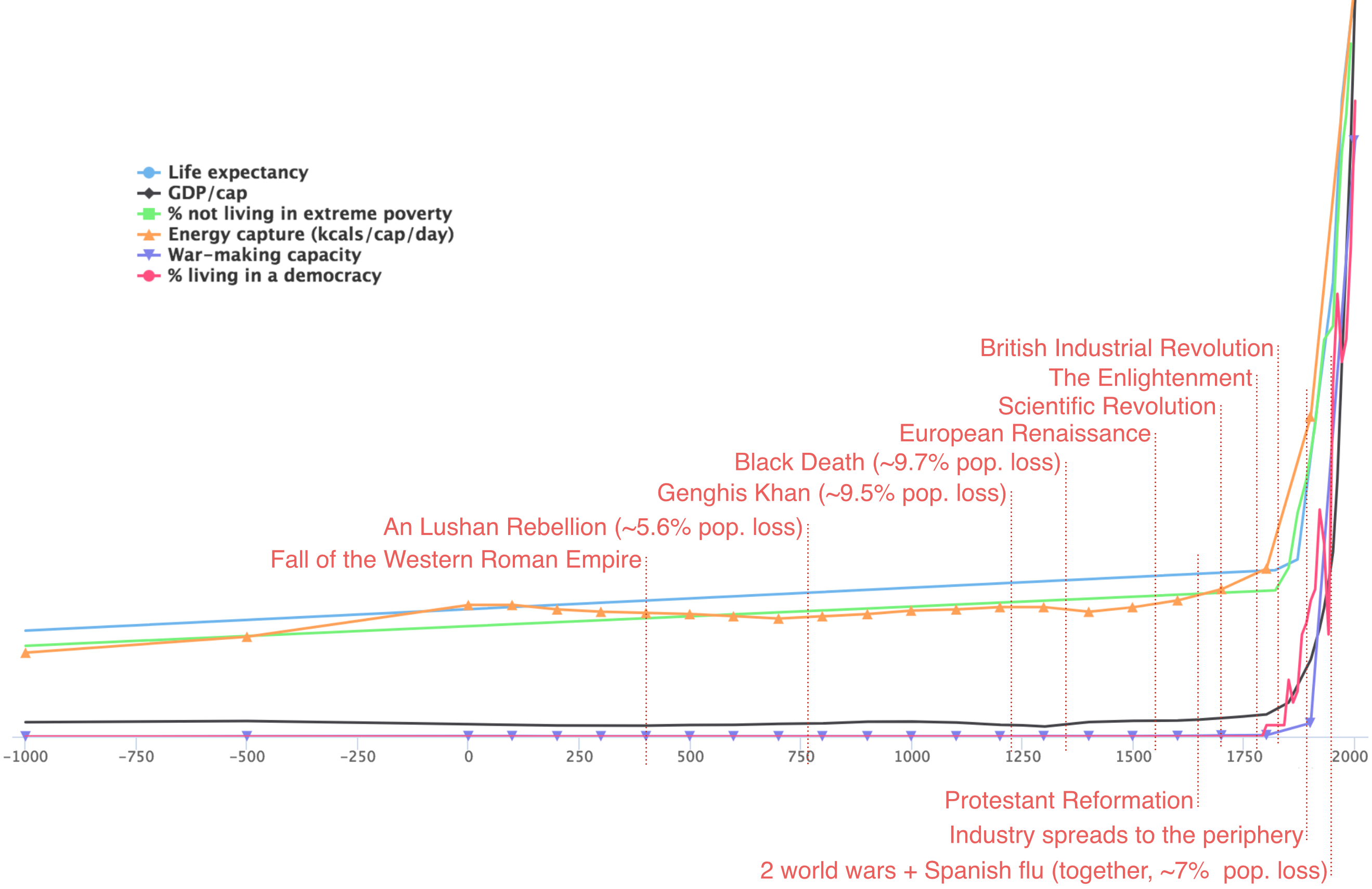
In How big a deal was the Industrial Revolution?, I looked for measures (or proxy measures) of human well-being / empowerment for which we have “decent” scholarly estimates of the global average going back thousands of years. For reasons elaborated at some length in the full report, I ended up going with:
- Physical health, as measured by life expectancy at birth.
- Economic well-being, as measured by GDP per capita (PPP) and percent of people living in extreme poverty.
- Energy capture, in kilocalories per person per day.
- Technological empowerment, as measured by war-making capacity.
- Political freedom to live the kind of life one wants to live, as measured by percent of people living in a democracy.
- (I also especially wanted measures of subjective well-being and social well-being, and also of political freedom as measured by global rates of slavery, but these data aren’t available; see the report.)
Anyway, the punchline of the report is that when you chart these six measures over the past few millennia (data; zoomable), you get a chart like this (axes removed for space reasons):
Click to embiggen
(And yes, there’s still a sharp jump around 1800-1870 if you chart this on a log scale.)
Basically, if I help myself to the common (but certainly debatable) assumption that “the industrial revolution” is the primary cause of the dramatic trajectory change in human welfare around 1800-1870, then my one-sentence summary of recorded human history is this:
Everything was awful for a very long time, and then the industrial revolution happened.
Comments Off on A very different kind of “hockey stick” – everything sucked until the industrial revolution
More than you want to know about the Panzer III
Lindybeige
Published on 8 Jun 2017Panzer IIIs were common German tanks in WW2, and here I talk about them, and make a few general points.
Another video (there will be more) from ‘The Tank Museum’ at Bovington. Why they changed the name is beyond me. I’d like to meet the branding guru who came up with that idea and administer several hard slaps. It’s like changing ‘Wimbledon’ to ‘The Tennis Competition’.
Anyway, here, in its particular shade of beige, is the tank (with a brief shot of one of its cousins), and I ramble on about various bits of it. It’s all right for you – you just have to watch it once, but I had to edit this, which involves seeing each bit several times, and wading through all the footage of me droning on and on.
I use the word ‘burn’ to describe a H.E.A.T. round’s penetrating a tank, and as several people have pointed out, this is not technically the correct word. They are right, although the word is often used in this context, and the temperatures involved are very high, but yes, I admit it: I should not have used the word ‘burn’.
Yes, I am aware that the links on the end plate come in late. This is because YouTube has changed the system, which used to be flexible, to one that relies on limited templates. It doesn’t enable the user to put picture links in except in the last twenty seconds of a video, and so because I added a little shot at the end, the links all start late. Possibly the new system is supposed to be more idiot-resistant than the old one. Unfortunately, this makes it an obstacle for the intelligent.
Here’s a link to the tank museum’s site: http://www.tankmuseum.org/home
Comments Off on More than you want to know about the Panzer III
September 27, 2017
Stalin’s Great Purge – Effects on the Red Army 1936-1938
Military History Visualized
Published on 25 Aug 2017The Great Purge had a massive effect on Soviet Society and the Red Army. This video gives various insights in the numbers, effects and other aspects.
Comments Off on Stalin’s Great Purge – Effects on the Red Army 1936-1938
September 26, 2017
Serbian Uniforms of World War 1 I THE GREAT WAR Special
The Great War
Published on 25 Sep 2017Serbia was already fighting in World War 1 before it actually spiralled into a global conflict, it had even already seen two wars in 1912 and 1913, so equipping the Serbian Army was a challenge right from the start.
Comments Off on Serbian Uniforms of World War 1 I THE GREAT WAR Special
To mark the 100th anniversary of the Russian Revolution … sorta #TheDeathOfStalin
Entertainment One UK
Published on 11 Aug 2017In Cinemas Oct 20.
The internal political landscape of 1950’s Soviet Russia takes on darkly comic form in a new film by Emmy award-winning and Oscar-nominated writer/director Armando Iannucci.
In the days following Stalin’s collapse, his core team of ministers tussle for control; some want positive change in the Soviet Union, others have more sinister motives. Their one common trait? They’re all just desperately trying to remain alive.
A film that combines comedy, drama, pathos and political manoeuvring, The Death of Stalin is a Quad and Main Journey production, directed by Armando Iannucci, and produced by Yann Zenou, Kevin Loader, Nicolas Duval Assakovsky, and Laurent Zeitoun. The script is written by Iannucci, David Schneider and Ian Martin, with additional material by Peter Fellows.
#TheDeathOfStalin
www.deathofstalin.co.uk
Comments Off on To mark the 100th anniversary of the Russian Revolution … sorta #TheDeathOfStalin


