
In past centuries, the greatest killer of women was fever following childbirth. One woman in six died of this fever. In 1795, Alexander Gordon of Aberdeen suggested that the fevers were infectious processes, and he was able to cure them. The consensus said no. In 1843, Oliver Wendell Holmes claimed puerperal fever was contagious, and presented compelling evidence. The consensus said no. In 1849, Semmelweiss demonstrated that sanitary techniques virtually eliminated puerperal fever in hospitals under his management. The consensus said he was a Jew, ignored him, and dismissed him from his post. There was in fact no agreement on puerperal fever until the start of the twentieth century. Thus the consensus took one hundred and twenty five years to arrive at the right conclusion despite the efforts of the prominent “skeptics” around the world, skeptics who were demeaned and ignored. And despite the constant ongoing deaths of women.
There is no shortage of other examples. In the 1920s in America, tens of thousands of people, mostly poor, were dying of a disease called pellagra. The consensus of scientists said it was infectious, and what was necessary was to find the “pellagra germ.” The US government asked a brilliant young investigator, Dr. Joseph Goldberger, to find the cause. Goldberger concluded that diet was the crucial factor. The consensus remained wedded to the germ theory. Goldberger demonstrated that he could induce the disease through diet. He demonstrated that the disease was not infectious by injecting the blood of a pellagra patient into himself, and his assistant. They and other volunteers swabbed their noses with swabs from pellagra patients, and swallowed capsules containing scabs from pellagra rashes in what were called “Goldberger’s filth parties.” Nobody contracted pellagra. The consensus continued to disagree with him. There was, in addition, a social factor — southern States disliked the idea of poor diet as the cause, because it meant that social reform was required. They continued to deny it until the 1920s. Result — despite a twentieth century epidemic, the consensus took years to see the light.
Probably every schoolchild notices that South America and Africa seem to fit together rather snugly, and Alfred Wegener proposed, in 1912, that the continents had in fact drifted apart. The consensus sneered at continental drift for fifty years. The theory was most vigorously denied by the great names of geology — until 1961, when it began to seem as if the sea floors were spreading. The result: it took the consensus fifty years to acknowledge what any schoolchild sees.
And shall we go on? The examples can be multiplied endlessly. Jenner and smallpox, Pasteur and germ theory. Saccharine, margarine, repressed memory, fiber and colon cancer, hormone replacement therapy. The list of consensus errors goes on and on.
Finally, I would remind you to notice where the claim of consensus is invoked. Consensus is invoked only in situations where the science is not solid enough. Nobody says the consensus of scientists agrees that E=mc2. Nobody says the consensus is that the sun is 93 million miles away. It would never occur to anyone to speak that way.
Michael Crichton, “Aliens Cause Global Warming”: the Caltech Michelin Lecture, 2003-01-17.
December 10, 2017
QotD: Failures of scientific consensus
December 9, 2017
Berlin Airlift: The Cold War Begins – Extra History
Extra Credits
Published on 7 Dec 2017Tension between the Soviet Union and their former World War 2 Allies escalated into a hostile blockade of Berlin. All sides wanted to avoid another war, but the United States, Great Britain, and France refused to bend to Stalin’s pressure. They came up with a daring plan to supply Berlin by air.
History of the Gun Part-11: Semi-Auto Pistols
RugerFirearms
Published on 7 Apr 2010The “History of the Gun” online video series produced by Ruger is a unique look at the progression of firearms technology throughout the years, hosted by Senior Editor of Guns & Ammo Garry James. Part 11 examines semi-automatic pistols.
December 8, 2017
Halifax Explosion – Peace in the East? | THE GREAT WAR Week 176
The Great War
Published on 7 Dec 2017This week in the Great War, we see some action in Italy and none at all in Russia – the peace negotiations are well underway. The Allied Supreme War Council meets for the first time as the Battle of Cambrai comes to a close. Two ships collide in Nova Scotia resulting in a deadly explosion.
History of the Gun Part-10: Revolvers
RugerFirearms
Published on 24 Mar 2010The “History of the Gun” online video series produced by Ruger is a unique look at the progression of firearms technology throughout the years, hosted by Senior Editor of Guns & Ammo Garry James. Part 10 examines revolvers.
QotD: Why mid-20th century Americans ate what they did – 7
Entertaining was mandatory [in the 1950s]. Because people didn’t go to restaurants so much, they spent time having people over, or eating at someone else’s house. If someone had you over, you had to have them over. This meant people had to have “company dinners” they could make, or at least a stock of canapés they could throw together for a cocktail party, even if they weren’t very good at it. Cue the weird focus on prettying everything up, more than occasionally to the detriment of the food itself: if you can’t make it good, you can at least make it pretty, to show people you made an effort.
Megan McArdle, “Friday Food Post: The Economics Behind Grandma’s Tuna Casseroles”, Bloomberg View, 2015-10-30.
December 7, 2017
The battleships of Pearl Harbour
Last month Naval Gazing ran a three-part series on the US Navy battleships at Pearl Harbour on the morning of 7 December, 1941, their post-attack fates, and later careers in World War 2. Part 1 was about the initial Japanese attack:
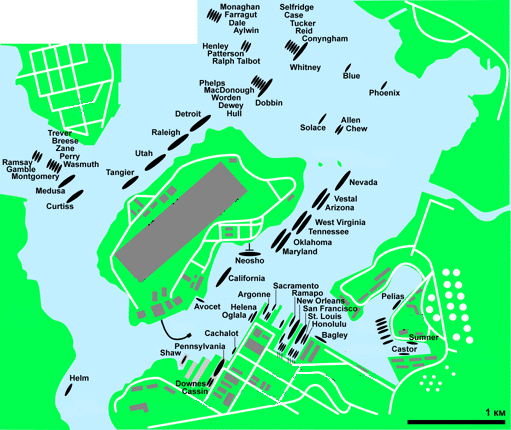
In Pearl Harbor on December 7th were eight battleships: Nevada, Oklahoma, Pennsylvania, Arizona, Tennessee, California, West Virginia and Maryland. All of them were of First World War vintage, representatives of what was known as the Standard Type. These were ships commissioned between 1914 and 1923, all of broadly the same size, and the first ships designed for long-range combat using an all-or-nothing armor scheme. All had four turrets, and all but West Virginia and Maryland mounting 14” guns. (They had 16” guns instead.)
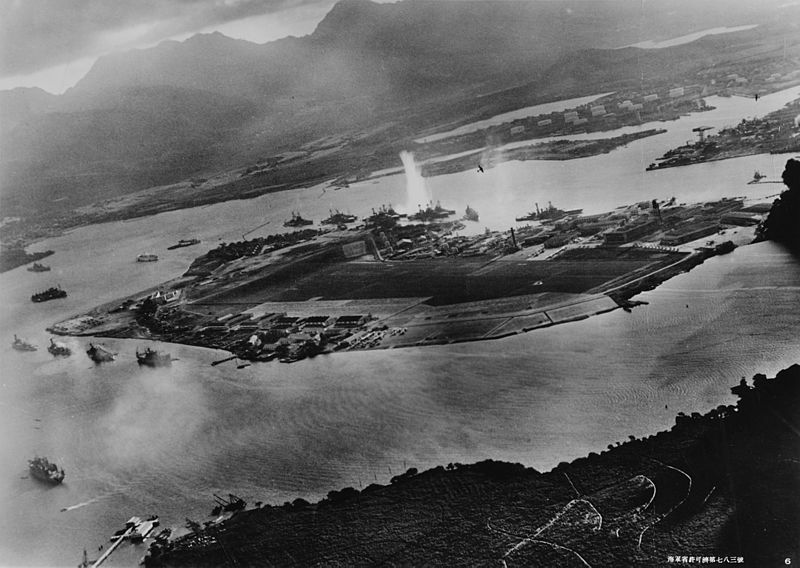
Pearl Harbour at the beginning of the attack, Battleship Row at the top (the waterspout is the first torpedo hit on the USS West Virginia)
All of the ships except Pennsylvania (which was in drydock) were moored along Ford Island in the famous ‘battleship row’. I’m going to focus on the stories of the individual ships during the attack, moving north to south. The attack began at 0748 on Sunday, December 7th, and a total of 353 Japanese aircraft were involved, in two waves.
A map of Pearl Harbour before the attack
The second post in the series covered the salvage of the damaged US Navy battleships:
When we left Pearl Harbor, it was the evening of December 7th, and most of Battle Force was on the bottom of the harbor. But what happened to the ships afterwards? We’ll go through the ships in the order which they returned to service (if they did) and then look more broadly at the use of the survivors during the war.
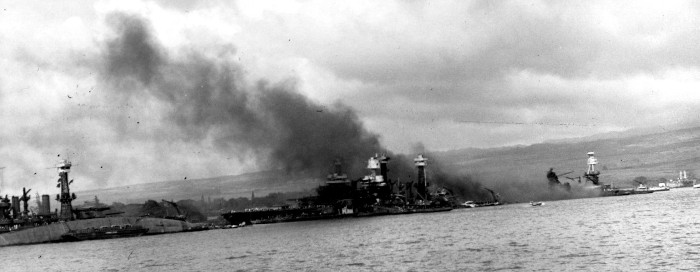
Battleship Row, 8 December 1941. Left-to-right: Maryland, Oklahoma, Tennesee, West Virginia, Arizona.
Maryland was the first ship ready to go to sea again, albeit with some damage. Tennessee was slightly behind her, as she was wedged by the West Virginia. Both ships were sent to Puget Sound at the end of the year, and repairs were completed in February. Pennsylvania was sent to San Francisco at the same time, returning to duty in March. All three ships (along with Colorado, New Mexico, Mississippi, and Idaho) served as part of TF 1, the backup to the carrier fleet until after Midway. Tennessee and Pennsylvania were sent to the states for comprehensive refit, running 8/42-5/43 and 10/42-2/43 respectively. Both received the standard upgrade, a reconstructed superstructure resembling those on the fast battleships (although there was less work done on Pennsylvania than the others), 5”/38 secondary guns in place of the former mixed secondary battery and upgraded fire control. Tennessee was also blistered against torpedoes, restricting her to the Pacific or a long journey around South America. Maryland was never refitted.
Part 3 discussed the Pearl Harbour survivors at the battle of Leyte Gulf:
The invasion began on Leyte Island in October of 1944, and triggered the largest naval battle in history, the battle of Leyte Gulf. The Japanese, who had long planned for the ‘Decisive Battle’ between their battleships and those of the US, planned a counterattack on the US landings in three main groups. Their carriers would come in from the north and draw off the US carriers covering the invasion, while two groups of battleships would sneak up on the invasion fleet from the east, passing through the Philippines and pincering the US transports from the north and south.
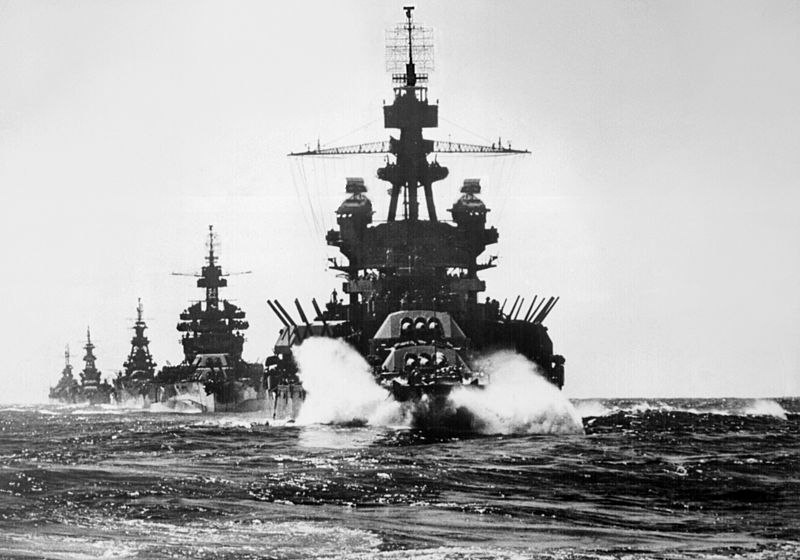
USS Pennsylvania leads a column of battleships into Lingayen Gulf.
The northern group (basically without planes after severe losses in June during the Battle of the Philippine Sea) managed to draw off Admiral Halsey. He’s often criticized for this, but in fairness, he was tasked with destroying the Japanese fleet, and the US didn’t realize how badly the carrier air groups had been hammered. The center group (with the faster battleships) had been detected, and appeared to have turned back after Musashi, Yamato’s sister ship, was sunk. They in fact resumed their course, and their encounter with escort carrier group Taffy 3 is the stuff of legend, but also a matter for another time.
Fifty years since the end of the 20th Century
In early December 1967, the New York Central finally had to give up on their famous passenger train, the 20th Century Limited between New York City and Chicago. Kevin Keefe tells the sad story:
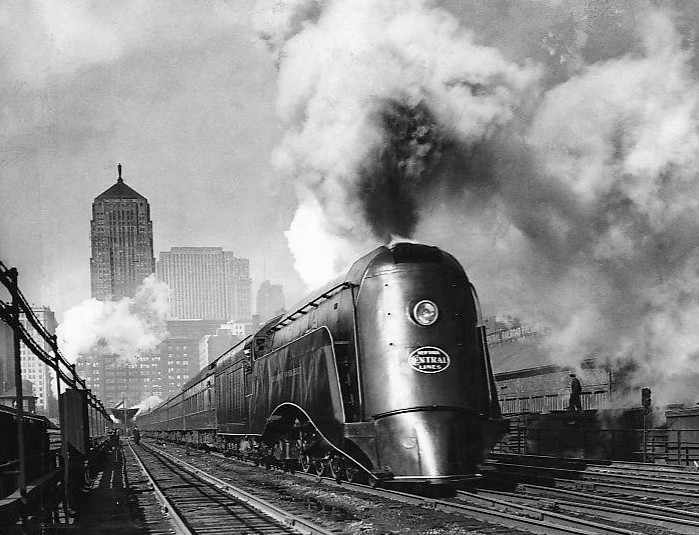
The streamlined steam locomotive New York Central Hudson No.5344 “Commodore Vanderbilt”, as it left Chicago’s LaSalle Street station pulling the 20th Century Limited.
Photo via Wikimedia
I don’t know what I was doing on the afternoon of December 3, 1967, but I know where I should have been: on the platform of Union Station in South Bend, Ind., awaiting the passage of the last westbound edition of New York Central’s legendary 20th Century Limited. That’s right, it’s been 50 years since NYC pulled the plug on what was generally considered the “world’s most famous train.” The final runs of trains 25 and 26 were unceremonious, as depicted in various photos that ran in the March 1968 issue of Trains. But “unceremonious” doesn’t begin to do justice to the westbound edition: it arrived in Chicago’s La Salle Street Station hours late due to a freight derailment the night before in eastern Ohio. Just looking at these sad images from December 2-3, 1967, you can image how relieved NYC and its president, Al Perlman, must have been to be done with the train once and for all.
The economics that drove NYC’s decision were brutal. As author Fred Frailey reported in his terrific book Twilight of the Great Trains, the Century’s traditional patrons deserted the train. “On May 20, 1967,” wrote Frailey, “the westbound Century carried but 18 people in coach, 34 in the sleepercoach (budget sleeper) and 40 in sleeping cars; its eastbound counterpart had 31 in coach, 42 in sleepercoach and 20 in the sleepers. In other words, you could have seated almost everyone in one seating in the twin-unit dining car.”
Editor David P. Morgan understood the passenger-train economics that drove Perlman to kill the Century, but in that March ’68 issue of Trains he couldn’t suppress his disgust at NYC’s cavalier behavior for the last runs: “Such a train deserved better than the noiseless euthanasia it received. Kansas doodlebugs have been lopped off with as much ceremony.”
The most poignant images of that day are images of both trains 25 and 26 pausing alongside a wet platform at Buffalo’s Central Terminal, their two observation cars that night, Wingate Brook and Hickory Creek, headed in opposite directions to die forever.
Photos of the 20th Century Limited on the final run at the link.
Frankenstein: Radical Alienation – Extra Sci Fi – #6
Extra Credits
Published on 5 Dec 2017What draws us to Frankenstein, and to sci fi as a whole? As the novel wraps up and our time with its characters draws to an end, Mary Shelley lays out the final theme which shaped the identity of science fiction as a genre: radical alienation and the search for a place to belong.
History of the Gun Part-9: Repeating Rifles
RugerFirearms
Published on 10 Mar 2010The “History of the Gun” online video series produced by Ruger is a unique look at the progression of firearms technology throughout the years, hosted by Senior Editor of Guns & Ammo Garry James. Part 9 examines Repeating Rifles.
QotD: Why mid-20th century Americans ate what they did – 6
Look at the sources of our immigrants. Immigration is still the major way that countries get new foods (if you don’t believe me, go out for Mexican food in any European country and report back). With the notable exception of the Italians, in the 19th century, most immigrants were from places with short growing seasons and bland cuisines, heavy on the cream and carbohydrates. After we restricted immigration in the 1920s, that’s what we were left with until immigrants started coming again in the 1960s. Of course, Louisiana had good French food, California and Texas had a Mexican influence, but by and large what we ate in 1960 was about what you’d expect from a German/English/Irish/Eastern European culinary heritage, adapted for modern convenience foods. And people liked it for the same reason I like jello salad: It’s what they were used to.
Megan McArdle, “Friday Food Post: The Economics Behind Grandma’s Tuna Casseroles”, Bloomberg View, 2015-10-30.
December 6, 2017
History of the Gun Part-8: Breechloaders
RugerFirearms
Published on 3 Mar 2010The “History of the Gun” online video series produced by Ruger is a unique look at the progression of firearms technology throughout the years, hosted by Senior Editor of Guns & Ammo Garry James. Part 8 examines Breechloaders.
QotD: Why mid-20th century Americans ate what they did – 5
There were a lot of bad cooks around. These days, people who don’t like to cook, or aren’t good at it, mostly don’t. They can serve a rich variety of prepared foods, and enjoy takeout and restaurants. Why would you labor over something you hate, when someone else will sell you something better for only slightly more than it would cost you to make something bad?
In 1950, the answer was “because we’re not made of money.” A restaurant meal was a special treat, not a nightly event, and prepared foods were not so widely available, in part because women tended not to work, but also because food processing technology was so advanced. So women had to cook whether they liked it or not. Many of them didn’t like it, so they looked for ways to reduce the labor involved. And it’s far from obvious that what they did with those shortcuts was worse than what they would have done without them. Think of the kind of casserole a bad cook might have made without canned soup and frozen vegetables. She’d probably have boiled the vegetables, because that’s the easiest way to prepare them, and boiled them to death, because she wasn’t too fussy about timing. (Out of season, those vegetables would have been limited to a few hearty root vegetables.) If there was a sauce, it probably would have been horrible. Let’s not even start on what she might have done with the meat. Canned soup and frozen vegetables start sounding pretty good.
That was the baseline most people were working off. They were not comparing what they ate to what they might have gotten at a good restaurant; they were comparing it to what they would have gotten without the shortcuts, because, to reiterate, most of them rarely ate at a good restaurant.
Modern food writing has an enormous selection bias. The median cookbook reader is a much better cook, and much more interested in food, than the median audience of recipes from decades past. The bad cooks, the indifferent cooks, the folks with the cast iron palates and Teflon stomachs, are all off doing something else. And since good cooks tend to raise good cooks, the median food writer waxing lyrical about Grandma’s homemade beef stew doesn’t realize just how many bad cooks were around. Or that recipes needed to be written for them, because however limited their talents or interest, they still had to put a meal on the table every night. A lot of terribly mediocre recipes are floating around from the era, and that’s exactly what most of the terribly mediocre cooks were looking for.
Megan McArdle, “Friday Food Post: The Economics Behind Grandma’s Tuna Casseroles”, Bloomberg View, 2015-10-30.
December 5, 2017
Origins Of The German Alpenkorps I THE GREAT WAR On The Road
The Great War
Published on 4 Dec 2017Get Immanuel’s book about the Alpenkorps in English: https://www.zeit-lupen.de/alpinecorps
When World War 1 broke out, the German Army didn’t really have troops specialised in mountain warfare. But by 1915, they brought together the first parts of the Alpenkorps. To train them, the troops were sent – in secrecy – to the new Italian front to learn from their Austrian counterparts. From May to October 1915 the Alpenkorps was forged in the Dolomites on the peaks with names like Lagazuoi, Col di Lana or Marmolata.
Happy Repeal Day!
Eighty-four years ago today, the US repealed Prohibition. Baltimore’s own H.L. Mencken was among the first to publicly celebrate the demise of the hated legislation:
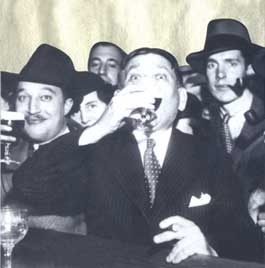
Reason‘s Baylen Linnekin celebrates the federal anniversary, but points out that devolving powers to the various states hasn’t been quite a libertarian panacea:
[December 5th] will mark the 84th anniversary of the ratification of the Twenty-First Amendment, which repealed alcohol Prohibition. The repeal of Prohibition is worth celebrating, even if the amendment was (and remains) a deeply flawed vehicle.
The chief flaw with the Amendment is, as I wrote earlier this year, that it “simply shifted much of the power to prohibit and incessantly regulate alcohol from the federal government to the states.”
States have truly made the most of their teetotalitarian authority for decades, to the detriment of both alcohol producers and—much more so—consumers.
Much of the negative impacts of states’ approach to alcohol regulation can be tied to what’s known as the three-tier system, a Prohibition relic under which states generally prohibit direct alcohol sales from a brewer, vintner, or distiller to a consumer. The three-tier system mandates these alcohol producers first sell to a distributor or retailer — a mandatory middleman — who can then sell to actual drinkers.
Laws that require this approach create a host of problems, including, for one, that they drive up consumer costs dramatically and needlessly. States’ plenary control over alcohol has been controversial for decades, as this 1987 article in the Journal of Public Health Policy makes clear, noting that “the idea of a government monopoly of a consumer product seems odd and even bizarre[.]”
Great arguments in favor of scrapping the dreaded three-tier system are often countered by those who claim doing so will bring about the end of days, or worse.
Reposted from 2013:
ReasonTV
Published on 5 Dec 2012In honor of Repeal Day, which celebrates the end of America’s “noble experiment” in banning alcoholic beverages, Reason TV is happy to introduce you to George Cassiday, a man whose life and work should be taught to every schoolkid — and to every member of Congress hell-bent on legislating the nation’s morals.
From 1920 through 1930 — the thick of the Prohibition era — Cassiday supplied illegal liquor throughout the halls of Congress. Known as “The Man in the Green Hat,” Cassiday was the Capitol’s highest-profile bootlegger, with a client list that included senior members of the Republican and Democratic Parties. How instrumental was he to the D.C. power elite? He even had his own office in the House and Senate office buildings.
Cassiday gave up the liquor trade after his arrest in 1930, but gained notoriety by penning a series of front-page articles for The Washington Post about his days as Congress’ top bottle man.
Though he never named names, Cassiday’s stories detailed every aspect of his former business — and the depths of hypocrisy in Washington. By his own estimation, “four out of five senators and congressmen consume liquor either at their offices or their homes.” Appearing days before the 1930 mid-term elections, Cassiday’s revelations caused a national stir and helped sweep pro-Prohibitionist — and ostensibly tee-totaling — congressmen and senators out of power.
Today, with the rise of cocktail culture and prohibition-vogue in full swing, Cassiday’s life and legacy are being re-discovered. Through books such as Garrett Peck’s Prohibition in Washington, D.C.: How Dry We Weren’t to New Columbia Distillery’s Green Hat Gin, the remarkable story of George Cassiday — “The Man in the Green Hat” — is again being told.
Reason TV spoke with Cassiday’s son, Fred, author Garrett Peck, and New Columbia Distillery’s John Uselton to discuss George Cassiday and the end of Prohibition.


