Forgotten Weapons
Published 13 Jun 2017The Model 1886 was the first Winchester repeating rifle to improve on the original toggle locking system of the 1860 Henry, and it is also the first of John Moses Browning’s lever action designs. Browning met with Winchester executives to sell them his design for the Winchester 1885 single shot rifle, and mentioned that he was also working on a lever action repeating rifle that would be much stronger than the existing Model 1876. This was very interesting to Winchester, and they agreed to buy that design as well.
The new rifle used a pair of vertically sliding blocks to lock the bolt into the receiver upon firing, and allowed the weapon to safely chamber much more powerful rounds, up to and including the .50-100 Express. This rifle superseded the Model 1876 almost overnight, as it finally allowed a single rifle to have the power of the single shot buffalo rifles and the rapid firepower of the smaller caliber Winchesters.
Cool Forgotten Weapons merchandise! http://shop.bbtv.com/collections/forg…
http://www.patreon.com/ForgottenWeapons
If you enjoy Forgotten Weapons, check out its sister channel, InRangeTV! http://www.youtube.com/InRangeTVShow
October 14, 2020
Winchester Lever Action Development: Model 1886
QotD: The frenetic pace of cancel culture
Today’s revolutionaries aren’t very good students of history, to say the least. They are full of zeal, have the requisite urge to destroy, the obligatory faith in their ability to remake humankind, the belief that widespread property destruction is good PR, and so on. What they lack is pacing.
You want to say: Slow down, young’uns! First you seize power and send all your class enemies to the camps or the grave. Then you turn on your own to purge the ideologically wobbly or those who are insufficiently zealous.
But these idiots are eating their own before they have power. Harry Potter author J. K. Rowling? Off to the gulag for believing in biological sex. The New York Times editorial-page editor earned defenestration for believing in free speech. Day after day on Twitter there’s a frenzy of witch-burning and heretic-stoning; the entire platform is like a self-lubricating guillotine.
Then again, it might be seen as a new, efficient model. After you’ve overthrown the tyrants and set up the People’s Committee, you have a new world to build. Even if you devote the morning to inventing a postcapitalist paradigm and spend the afternoon figuring out how to get fresh water and sanitation to your typhus-infested camp, that means you have to spend the evening drawing up proscription lists. Purging is necessary, but who has the time?
So they’re getting it out of the way now, purging the culture and the Twitter lists of people and things that need to be extirpated for the good of all.
Perhaps this is what happens when people who have been bingeing on TV shows for three months with no place to go decide to have a revolution. Instead of watching the shows once a week and pacing themselves, it’s a whole season in one day.
James Lileks, “Twinkling’s Canceled, Little Star”, National Review, 2020-07-06.
October 13, 2020
A Single Spice Blend For Your Entire Kitchen – Kitchen Pepper From 1777
Townsends
Published 8 Jul 2020Visit Our Website! ➧ http://www.townsends.us/ ➧➧
Help support the channel with Patreon ➧ https://www.patreon.com/townsend ➧➧
Instagram ➧ townsends_official
October 11, 2020
Winchester Lever Action Development: Model 1876
Forgotten Weapons
Published 11 Jun 2017While the Model 1873 was a very popular rifle, its pistol caliber cartridge did leave a segment of the market unaddressed. Winchester wanted a rifle that could chamber the larger and more powerful cartridges popular with long range hunters, and the Model 1876 would be that rifle.
Early attempts to enlarge the 1873 action to use the .45-70 Government cartridge were unsuccessful, for two reasons. First, the cartridge in its 45-70-500 infantry configuration was simply too powerful for the toggle lock design that had been the core of all Winchester’s rifles back to the 1860 Henry. In addition, the elevator mechanism used to feed the rifle had to be sized to a specific (and fairly precise) overall cartridge length. The variety of different bullet weights used in the .45-70 did not affect use in single shot weapons, but did cause problems for Winchester’s repeater.
The solution was for Winchester to design a new round for its scaled-up Model 1876. This was the .45-75, and it used a relatively light bullet and a bottlenecked case similar to the general design of the .44 WCF from the Model 1873. This bottleneck improved obturation, preventing powder fouling from leaking around the cartridge case and into the working parts of the rifle. This was not strictly necessary though, as new chambering of the 1876 would be quickly added, including the .45-60; a straight-wall shortened version of the .45-70 Government round.
While it did not blow the doors off the factory like the 1873 had, the Model 1876 was a popular rifle with its intended audience, with tens of thousands of rifles sold to men including Theodore Roosevelt.
Cool Forgotten Weapons merchandise! http://shop.bbtv.com/collections/forg…
http://www.patreon.com/ForgottenWeapons
If you enjoy Forgotten Weapons, check out its sister channel, InRangeTV! http://www.youtube.com/InRangeTVShow
October 10, 2020
Miscellaneous Myths: The Minotaur
Overly Sarcastic Productions
Published 9 Oct 2020Ah, Theseus. Athens’ favorite trash man. Let’s talk about someone a little more interesting — literally anyone involved in this story will do.
Good news, I found the 1080P button! Bad news, the minute differences in image resolution are now threatening my sanity.
Our content is intended for teenage audiences and up.
PATREON: https://www.Patreon.com/OSP
DISCORD: https://discord.gg/kguuvvq
MERCH LINKS: http://rdbl.co/osp
OUR WEBSITE: https://www.OverlySarcasticProductions.com
Find us on Twitter https://www.Twitter.com/OSPYouTube
Find us on Reddit https://www.Reddit.com/r/OSP/
China’s national memories are oddly inconsistent
At UnHerd, Bill Hayton looks at the one conflict between China and a western nation that bulks disproportionally large in the current Chinese government’s historical grievance-bank:

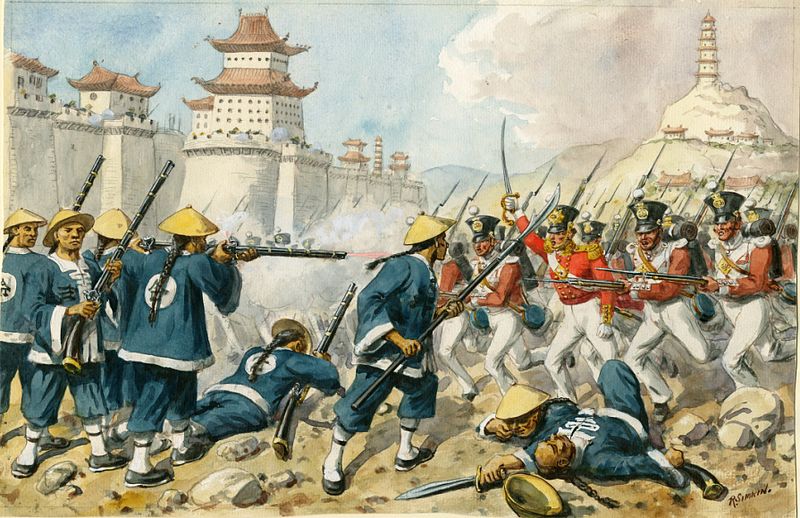
“The 98th Regiment of Foot at the attack on Chin-Kiang-Foo, 21 July 1842.”
Painting by Richard Simkin (1840-1926) via Wikimedia Commons.
Take three mid-19th century Asian conflicts: one killed 20 million people, one killed well over 100,000 and a third killed 20,000. Which one, despite being barely noticed by the Chinese government at the time, is the most discussed today and has become emblematic of an historic clash between East and West?
The immensely deadly Taiping Rebellion between 1850 and 1864 and the vicious conflict between “Hakka” and “Cantonese” peoples between 1855 and 1867 are barely known outside China, despite their far bloodier impacts on human lives. We know vastly more about the “First Opium War” of 1840 because it has played a totemic role in two political arenas: one in China and one in the UK. And in both places, the origins of the war have been obscured and distorted to suit political agendas.
In China, the “Opium War” marks the beginning of what the Communist Party currently calls the “century of national humiliation” — a period of unrelenting misery that only ended in 1949 with the Party’s victory in the Chinese Civil War. It is a narrative that underpins both the Party’s right to rule China and its increasingly assertive foreign policy. In Britain, the narrative of the war has been a weapon wielded variously by Liberal critics of a Whig government, puritan campaigners against drugs, leftist opponents of British foreign policy and Twitter-users claiming that white people are inherently racist. All these critiques and narratives caricature the evidence.
In the comic-book version, the British Empire went to war in 1840 to force an illegal and immoral drug, opium, down the respiratory passages of the Chinese people, purely for its own ill-gotten ends. This narrative is oddly patronising. It assumes that the Chinese side were merely naïve dupes, hapless victims to imperial power. It is time to recognise that there were several protagonists in the First Opium War.
On one side were the British free-traders, men who wanted an end to Chinese restrictions on commerce, whether of cotton or opium. There was also an East India Company anxious to maintain its good relations with local officials, and a London government and its critics with their own agendas. On the other was an imperial court in Beijing split between reformers and a clique of Chinese conservative “scholar-officials” intent on keeping foreign influence at bay. In the middle was an Asian financial problem triggered by a European war.
When Vikings Met Native Americans: The Voyage of Thorvald Erikson
Atun-Shei Films
Published 9 Oct 2020Happy Leif Erikson Day! After Leif’s discovery of unknown lands to the west of Greenland, his brother Thorvald set off on an expedition of his own. Thorvald’s voyage, as related in the medieval Icelandic text The Saga of the Greenlanders, marks the first time in recorded history that Europeans came face-to-face with Native Americans. In this video, I regale you with this tale of adventure, exploration, and cultural collision. And for some reason, I spend about a third of the video talking about a bowl, a coin, and some yarn made of goat hair.
Support Atun-Shei Films on Patreon ► https://www.patreon.com/atunsheifilms
Leave a Tip via Paypal ► https://www.paypal.me/atunsheifilms (All donations made here will go toward the production of The Sudbury Devil, our historical feature film)
Buy Merch ► teespring.com/stores/atun-shei-films
#LeifErikson #Vinland #History
Original Music by Dillon DeRosa ► http://dillonderosa.com/
Reddit ► https://www.reddit.com/r/atunsheifilms
Twitter ► https://twitter.com/atun_shei~REFERENCES~
[1] Magnus Magnusson & Hermann Pálsson. The Vinland Sagas: The Norse Discovery of America (1965). Penguin Books, Page 59-61
[2] Sîan Grønlie. The Book of the Icelanders / The Story of the Conversion (2006). Viking Society for Northern Research, Page 4
[3] Ingeborg Marshall. “Beothuk Transportation” (1998). Heritage Newfoundland and Labrador https://www.heritage.nf.ca/articles/a…
[4] Patricia Sutherland. Dorset-Norse Interactions in the Canadian Arctic (2000). Canadian Museum of Civilization, Page 2-9
A century on, Greece and Turkey are back at daggers drawn
John Psaropoulos on the ever-more-heightened tension in the Aegean Sea as Turkey looks to muscle in on Greek-claimed waters in search of natural gas (or a fight):
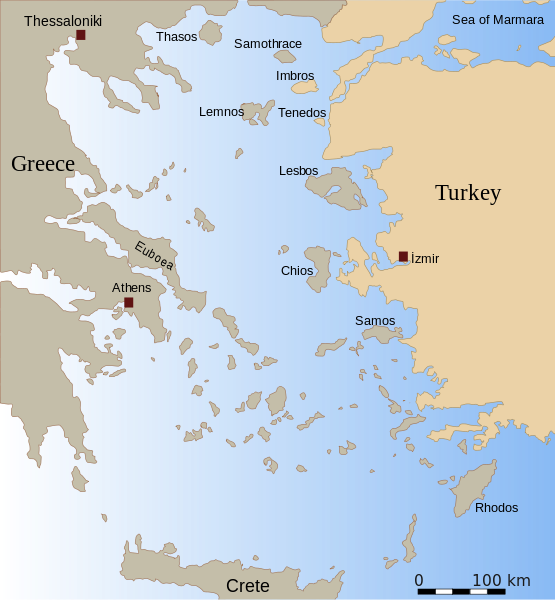
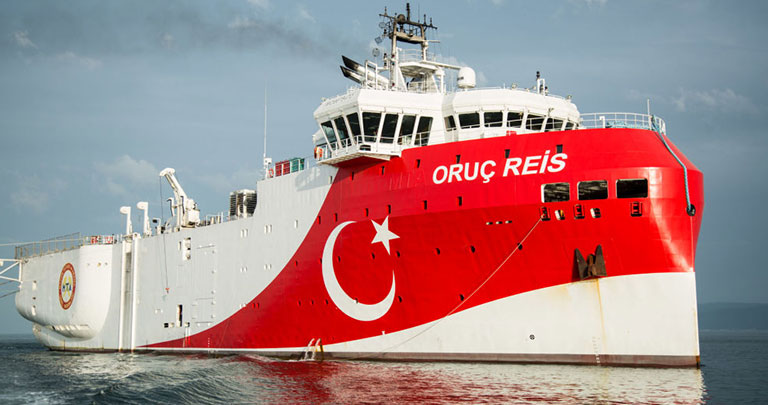
Last summer, Greece and Turkey came closer to war than they have done since 1974, when Turkey invaded Cyprus. The drama began to unfold on 21 July, when Turkey announced it was sending a seismic survey ship, the Oruc Reis, to look for oil and gas in areas the UN Law of the Sea awards to Greece.
Within hours, the Greek and Turkish navies had deployed throughout the Aegean and east of Crete. They remained so for two months. Greek helicopters pinned down Turkish submarines off the island of Evia. Frigates shadowed each other so closely, that on 12 August two of them collided when a Turkish frigate performed a manoeuvre across the bows of a Greek one. Greek and Turkish F-16s intercepted each other between Crete and Cyprus. Greece came close to invoking the European Union’s mutual defence clause.
On 13 September, Turkey withdrew the Oruc Reis, ostensibly for maintenance, and redeployed its navy. In the coming days, Greece and Turkey are to resume talks abandoned four and a half years ago on carving out their continental shelves – vast swathes of the east Mediterranean where they may exercise exclusive commercial rights to exploit undersea resources.
For now, there is de-escalation, but expectations for the outcome of these talks are low.
“Right now, Turkey doesn’t consider itself an extension of the West. It doesn’t consider that it has commitments and responsibilities towards the West,” says Konstantinos Filis, who directs the Institute of International Relations in Athens. “It believes it is an autonomous power in the region, that it is very potent, and that all its neighbours should respect it. The Turkish leadership doesn’t appear to be prepared for compromises with neighbours it considers inferior.”
The east Mediterranean is where the world’s most significant natural gas discoveries have occurred since the turn of the millennium. Israel and Egypt are now energy independent. Cyprus soon hopes to be. But Greece potentially dwarfs them all.
Seismic explorations it conducted six years ago suggest that Greece has natural gas reserves of 70-90 trillion cubic feet – as much as Israel, Egypt and Cyprus have discovered combined, with a pre-Covid-19 market value of about $200 billion. Assuming gas is viable for the next 25 years, Greece’s reserves, if proven, would cover its energy needs and turn gas into a lucrative export to the European Union. As much as a third of the value of the gas would go to the Greek state in taxes and royalties, allowing it to pay off a fifth of its external debt, now approaching twice its GDP.
This is clearly a future Turkey, with eight times Greece’s population and four times its economy, would rather claim for itself. Legally, it cannot do so. Under the rules of the UN’s Law of the Sea (UNCLOS), the lion’s share of east Mediterranean waters goes to Greece and Cyprus. Recep Tayyip Erdogan, Turkey’s leader for the past 18 years, feels that the Greeks are hemming him in.
I AM Julius Caesar
The Study of Antiquity and the Middle Ages
Published 2 Jul 2020Politician, warrior, priest, lover.
My name is Gaius Julius Caesar and I led one of the most extraordinary lives in recorded history.
My victories over foes both foreign and domestic are still studied today. I upended the Roman Republic and became its first dictator.
I loved Cleopatra.
My brutal assassination has been synonymous with bitter betrayal for 2000 years.
New videos from The Study of Antiquity and the Middle Ages, the I AM series allows the great figures of history to introduce themselves in brief, compelling, historically-accurate episodes. Look for more I AM videos of your favorites!
I AM Julius Caesar! Welcome to the first episode of the I AM series where you live history itself through the mind, viewpoints and lives of a historical character!
See and experience the world they lived and celebrate their triumphs and feel their defeats.
This first episode is on Julius Caesar, the revolutionary who set into place the foundations of what would become the Roman Empire.
This was written, directed and created by the extraordinary professional DW Draffin! He is an audio book narrator, stage actor, and independent author.
AUDIOBOOK NARRATOR
https://www.audible.com/search?search…STAGE ACTOR
https://www.youtube.com/watch?v=xTept…INDEPENDENT AUTHOR
https://www.amazon.com/DW-Draffin/s?k…If you need a professional then contact him!
To support the channel, become a Patron and make history matter!
Patreon: https://www.patreon.com/The_Study_of_…
Donate directly to PayPal: https://paypal.me/NickBarksdale
Check out our newly opened store!
teespring.com/stores/antiquity-and-th…Get your SPQR Face Masks today!
https://spqr-emporium.com/collections…Enjoy history merchandise? Check out affiliate link to SPQR Emporium!
http://spqr-emporium.com?aff=3*Dislaimer, the link above is an affiliate link which means we will earn a generous commission from your magnificent purchase, just another way to help out the channel!
Join our community!
October 9, 2020
Yugoslav Resistance and Serb Collaboration in 1941 – WW2 Special
World War Two
Published 8 Oct 2020Resistance has been brewing since the Axis invasion in April 1941. Multiple resistance groups fight for very different reasons and with different methods. When they launch a big offensive against the occupier, lines between friend and foe become blurry.
Join us on Patreon: https://www.patreon.com/TimeGhostHistory
Or join The TimeGhost Army directly at: https://timeghost.tvFollow WW2 day by day on Instagram @ww2_day_by_day – https://www.instagram.com/ww2_day_by_day
Between 2 Wars: https://www.youtube.com/playlist?list…
Source list: http://bit.ly/WW2sourcesHosted by: Spartacus Olsson
Written by: Joram Appel
Director: Astrid Deinhard
Producers: Astrid Deinhard and Spartacus Olsson
Executive Producers: Astrid Deinhard, Indy Neidell, Spartacus Olsson, Bodo Rittenauer
Creative Producer: Maria Kyhle
Post-Production Director: Wieke Kapteijns
Research by: Joram Appel
Edited by: Miki Cackowski
Sound design: Marek Kamiński
Map animations: Eastory (https://www.youtube.com/c/eastory)Colorizations by:
Mikolaj Uchman
Carlos Ortega Pereira – BlauColorizations, https://www.instagram.com/blaucolorizations
Dememorabilia – https://www.instagram.com/dememorabilia/Sources:
Bundesarchiv
Museum of Yugoslavia
FORTEPAN / Konok Tamás ID 27502
Narodowe Archiwum Cyfrowe
from the Noun Project: Skull by Muhamad Ulum, Dead Soldier by Gan Khoon Lay, Helmet by Daniel Turner, Injury by Adriano Emerick, person by Adrien CoquetSoundtracks from the Epidemic Sound:
Johan Hynynen – “Dark Beginning”
Johannes Bornlof – “Deviation In Time”
Johannes Bornlof – “The Inspector 4”
Reynard Seidel – “Deflection”
Andreas Jamsheree – “Guilty Shadows 4”Archive by Screenocean/Reuters https://www.screenocean.com.
A TimeGhost chronological documentary produced by OnLion Entertainment GmbH.
“Ruina Imperii” – End of an Empire – Sabaton History 088 [Official]
Sabaton History
Published 8 Oct 2020The death of Charles XII was followed by the rapid decline of the Swedish Empire. The Swedish nation had suffered much in the last ten years of his reign. The constant state of war had brought famine and poverty and ruined the state in many ways. Charles XII fought Sweden’s numerous enemies in the vain hope of restoring the empire to its old glory. He was the King who most strongly believed that Sweden was destined for imperial greatness, no matter the cost. What can be said about his reign? How would history judge his character or his decisions as a King?
Support Sabaton History on Patreon: https://www.patreon.com/sabatonhistory
Listen to “Ruina Imperii” on the album Carolus Rex:
Carolus Rex (English Version) – https://music.sabaton.net/CarolusRexEN
Carolus Rex (Swedish Version) – https://music.sabaton.net/CarolusRexSEListen to Sabaton on Spotify: http://smarturl.it/SabatonSpotify
Official Sabaton Merchandise Shop: http://bit.ly/SabatonOfficialShopHosted by: Indy Neidell
Written by: Markus Linke and Indy Neidell
Directed by: Astrid Deinhard and Wieke Kapteijns
Produced by: Pär Sundström, Astrid Deinhard and Spartacus Olsson
Creative Producer: Maria Kyhle
Executive Producers: Pär Sundström, Joakim Brodén, Tomas Sunmo, Indy Neidell, Astrid Deinhard, and Spartacus Olsson
Community Manager: Maria Kyhle
Post-Production Director: Wieke Kapteijns
Editor: Karolina Dołęga
Sound Editor: Marek Kaminski
Archive: Reuters/Screenocean – https://www.screenocean.comVisual Sources:
– Nationalmuseum
– Carl Andreas Dahlström – httpruneberg.org dcateckn0126
– Icons form The Noun Project: Farm by Laymik, Fruit by Eucalyp, Vegetable by Eucalyp, treasure by dDara, treasure by Eucalyp, Wheat Grain Bag by Symbolon & Wine by Vladimir Belochkin.All music by: Sabaton
An OnLion Entertainment GmbH and Raging Beaver Publishing AB co-Production.
© Raging Beaver Publishing AB, 2019 – all rights reserved.
October 8, 2020
DicKtionary – K is for Killer – Elizabeth Báthory
TimeGhost History
Published 7 Oct 2020Elizabeth Bathory was a Hungarian noblewoman who holds the world record as the most prolific female murderer. This is her gruesome life story.
Join us on Patreon: https://www.patreon.com/TimeGhostHistory
Hosted & Written by Indy Neidell
Director: Astrid Deinhard
Producers: Astrid Deinhard and Spartacus Olsson
Executive Producers: Astrid Deinhard, Indy Neidell, Spartacus Olsson, Bodo Rittenauer
Creative Producer: Joram Appel
Post-Production Director: Wieke Kapteijns
Research by: Indy Neidell
Image Research by Karolina Dołęga
Edited by: Karolina Dołęga
Sound design: Marek KamińskiVisual Sources:
– Wellcome Images
– Paul K from Flickr https://cutt.ly/Paul_K_Flickr
– Andreone93 from Wikimedia https://cutt.ly/Andreone93_Bathory
– Cleveland Museum of Art
– Metropolitan Museum of Art
– Lluís Ribes Mateu from Flickr https://www.flickr.com/photos/lluisri…
– Yvette Hoitink from Flickr https://www.flickr.com/photos/yhoitink/
– Civertan from Wikimedia https://cutt.ly/Civertan
– Jean Louis Mazieres https://www.flickr.com/photos/mazanto/
– Icons from The Noun Project: anti trust by Angelo Troiano, Castle by Vicons Design, Waiter by ProSymbols, Nun by Wolf Böse, Priest by Luis Prado, reject by Alice Design, User by Round Pixel, Zoo by Eugene Dobrik, User by Round Pixel.“The Wedding March” – Traditional
“Stranger Days” – Alexandra Woodward
“Rise Of The Titan” – FormantXArchive by Screenocean/Reuters https://www.screenocean.com.
A TimeGhost chronological documentary produced by OnLion Entertainment GmbH.
Fallen Flag — The Pacific Electric Railway
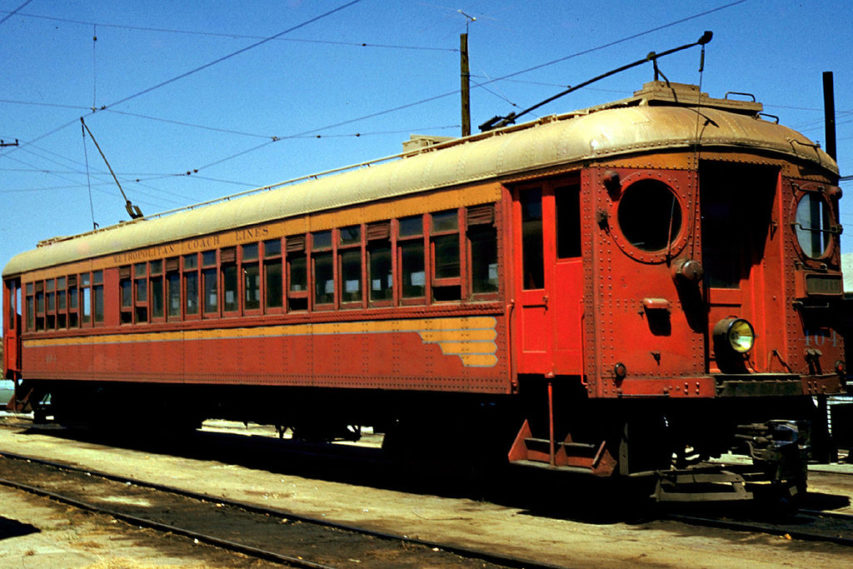
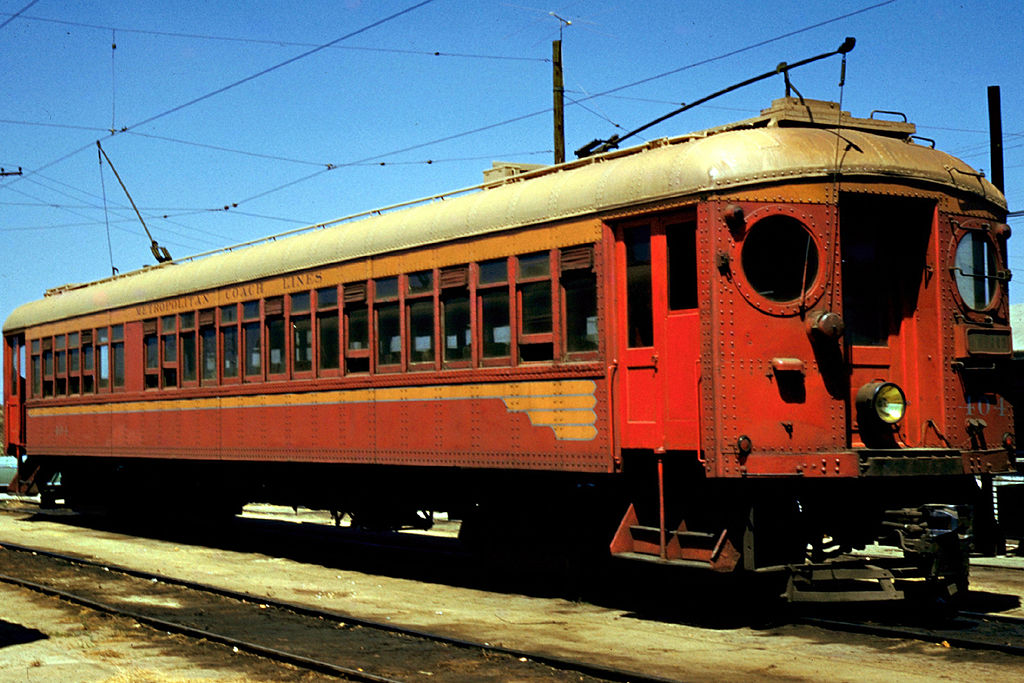
This month’s Classic Trains featured fallen flag is southern California’s iconic Pacific Electric Railway Company, whose streetcars, interurbans, and buses served the vast area in and around Los Angeles and San Bernardino from 1901 until the passenger services were sold off in 1953. The electric service was converted to bus and the last electric rail line was discontinued in 1961. At its peak in the 1920s the “Red Cars” service was said to be the largest electric railway system in the entire world.
G. Mac Sebree covers the origins of the line in the late nineteenth century:
The story begins in 1895, when a line was completed from Los Angeles to Pasadena; a mere 10 years later, the system was virtually complete. To a great degree, PE was the brainchild of Henry Huntington, nephew of one of the Central Pacific’s “Big Four,” Collis P. Huntington. An active real-estate promoter, Henry needed the Big Red Cars and the transportation they provided to help sell lots and homes in the hinterlands.
His uncle’s Southern Pacific took control of the PE in 1911 in a deal that left the Los Angeles Railway, the narrow-gauge intracity system, in the nephew’s hands. The PE was built to standard gauge, and SP saw a brilliant future in freight for the interurban.
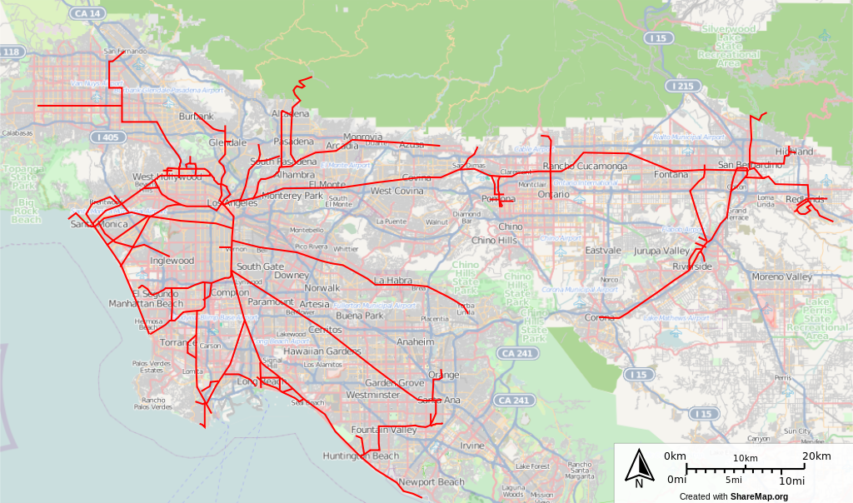
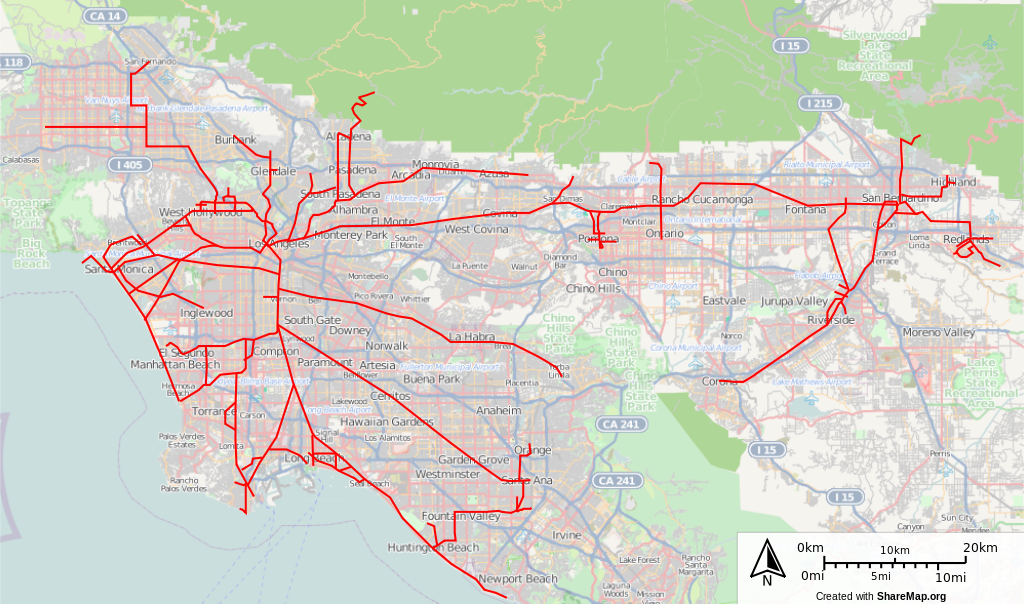
Pacific Electric route map.
Original data from http://sharemap.org/public/Los_Angeles_Pacific_Electric_Railways_(Red_Cars) via Wikimedia Commons.Interurbans were not considered Class I railroads (or any other class — they were not “steam railroads”), but from the very start, PE was big business. The California Railroad Commission said the property was worth $100 million in Depression dollars. Atypically for an interurban, the system served as a gathering network for carload freight shipments from citrus groves, manufacturing plants, oil refineries, warehouses, and the harbor at San Pedro. The three line-haul railroads serving southern California — Santa Fe, Union Pacific, and especially SP — depended on the Pacific Electric to some degree.
Yet in its heyday, PE carried huge numbers of passengers. As late as 1953, 50 percent of its revenue came from riders — but absolutely none of its profit. An all-time list shows that PE operated 143 distinct passenger routes. Despite the so-called “Great Merger of 1911,” in which local and interurban services were supposedly separated, the heaviest PE passenger lines largely served the L.A. urban area. An example was the street-running L.A.–Hollywood–Beverly Hills line, in which two-car trains rumbled down Hollywood Boulevard at 10-minute intervals.
At one time or another, PE single-truck Birney cars plied local lines in Pasadena, Long Beach, Santa Monica, Redlands, Santa Ana, and San Pedro, although the 1920s were not far along before management sought to sell off or abandon these albatrosses.
After World War 2, the writing was on the wall for the Red Cars, as urban expansion and greatly increased car ownership cut at the economic basis for rail passenger service in southern California, especially as the new freeways were built.
After the war, though, things went downhill rapidly. As soon as buses were available, Pacific Electric began wholesale rail passenger-service abandonments. The new freeways were regarded as the rapid transit of the future. PE President Oscar Smith saw one possibility for saving rail service — if the state would pay. Just before the war, a short section of freeway between Hollywood and the San Fernando Valley had been built, with the PE tracks relocated to the center of the new highway.
Why not replicate this all over the basin? The PE would cooperate, but public officials turned a deaf ear, and that was that. Freight service, meanwhile, prospered, but by the mid-1950s, PE began replacing its electric locomotives and box motors with diesels (a few steam locomotives also had been used during the war). Over the years, PE rostered about 100 electric locomotives and at least 75 box motors — big business, indeed.
In 1953, PE sold its passenger service (four rail lines out of the 6th and Main station, two out of Subway Terminal, and many bus lines) to Metropolitan Coach Lines. The Metropolitan Transit Authority, first formed in 1951, bought MCL on March 3, 1958, and the end for electric passenger service came in 1961. SP continued the freight work with diesels, and merged PE away on August 13, 1965. Today under the Union Pacific shield, a good bit of the old PE freight lines remain in service, unique survivors, busier than ever.