[The version of this film I originally scheduled has been taken down, but included a much more informative description, which I’m retaining below:]
capspread
Published 11 Oct 2020
#LookatLife #Tugboats #MerchantNavy #QueenMary #QueenElizabeth
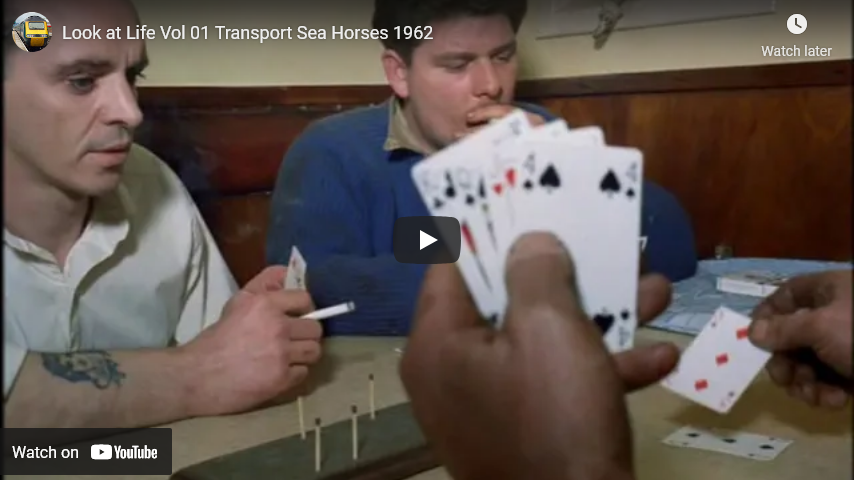
Look at Life – Sea Horses – Tugboats from the 1960s
The video is the latest Look at Life, Volume One – Transport called Sea Horses – Little Tugs, without which any big port would come to a standstill, are featured made in May 1962.
Several Tugs are featured in the video along with several ships, including Ocean Liners. Those with names that are recognisable are below. There are others which are not shown below because their names are not known.
Tugboats
William Ryan
Built 1908 – Re-engined 1956 – Sold in 2000 for £1 as a “non-commercial worker”. In 2005, spotted at Hoo Marina converted to a houseboat. In 2009 for sale priced £33k In 2010 – Engine Removed.
Sun.X
Built in 1920 in Selby in Yorkshire. 196grt. Disposed 1969 and scrapped in 1969.
Effleton Hall
Paddlewheel Tugboat built in 1914. In service until 1967 where she was sold to shipbreakers for scrap. She was left sitting on a mudbank in Dunston. As part of the scrapping process her wooden afterdeck and interior were destroyed by fire prior to being broken up. The tug remained there for 2 years, deck frames warped, wood burned or rotted, hull part flooded and engines rusty but intact. But she was bought by an American and rebuilt on the River Tyne during 1969, modified to enable her to cross the Atlantic Ocean under her own steam, requiring fitting of modern navigational aids, radio, an enclosed wheelhouse and conversion from coal to diesel oil firing. She set sail on 18 September 1969 and arrived late March 1970 at San Francisco. She was donated to the National Park Service in 1979 and is now berthed at Hyde Street Pier, San Francisco. She has been restored to resemble her condition post-War 1946. 166grt – Length – 100 feet; Beam 21 feet; Depth of hold 10.8 feet.
Gladstone – Registered at Liverpool
Formby – Built 1951 Registered at Liverpool – 237grt Steam Engine
Canada – Registered at Liverpool
Marinia – Ocean going Tugboat
Poolzee – Dutch Smit Tug – Built 1942
Hestor – Could be Dutch
Ocean Liners
Queen Mary – 81,000 grt
In service between 1936 and 1967. She is now permanently moored as a tourist attraction, hotel, museum and event facility in Long Beach California.
Queen Elizabeth – Largest Ocean Liner at the time at 83,000 grt. In service between 1939 and 1968. Caught fire in Hong Kong in 1972 and completely destroyed.
Cargo Ships
Northern Clipper – No info
Toula – Built in 1937 as Westralia as a passenger-cargo ship. Renamed Toula in 1959 and in 1970 broken up in Shanghai.
Allegrity – Built 1945 as a coastal tanker. In 1946 renamed Sobat. In 1951 renamed Allegrity and purchased by FT Everard. On 22 December 1961 she capsized after grounding near Falmouth. She was a total loss
798grt Length – 183 feet; Breadth – 28 feet; Depth – 13 feet
Speed – 9 knots.
Comments Off on Look at Life – Sea Horses – Tugboats from the 1960s
The worship of Napoleon has always been a French mystery. Is it spontaneous, reflecting nostalgia for empire, or something organized by the state, which has inherited from that period a matchless taste for authority? French schoolchildren are taught only the benefits of the emperor’s reign. According to our textbooks, Napoleon is supposed to have endowed France with a perfect legal system that still governs us today and to have caused the winds of freedom to blow across Europe. Each year, a dozen more books are published in France touting Napoleon’s glory. He has been represented more often than Christ on film, always as a positive hero.
Other Europeans see him very differently. While French historians amplify the myth that Napoleon himself created by dictating his idealized Memoires on St. Helena, English, German, Russian and Spanish authors count up the massacres and the destruction of their cities and their civilization.
Napoleon began shaping his reputation while he was still alive. He commonly wrote reports of his victories before the battles had even begun, which makes him the founding father of fake news. Certain disasters, such as the Battle of Eylau (now in Poland) against the Russians and Prussians, for example, are still inscribed in the walls of the Arc de Triomphe in Paris as if they were victories, since that is how they were first announced.
Since France is now part of Europe — rather than Europe becoming part of France, as Napoleon wished — what should we commemorate? French victories, such as Austerlitz, were defeats for the Russians and Austrians. Waterloo, a day of mourning for the French, is a symbol of liberation for the British, Germans, and Dutch. In any case, since the return of Napoleon’s ashes, our view of history has changed; the fate of people concerns us more than the fate of armies. Napoleon’s stature does not benefit from this change of perspective. To finance his wars, he ruined Europe, banning international commerce (only smugglers got rich), conscripting peasants, ravaging harvests, and confiscating horses. How should we commemorate the Russian and German campaigns of 1812 and 1813, when the Grand Army left in its wake not the liberation of peoples, but famine and epidemic? Worst still, how should we commemorate the restoration of slavery in the French Antilles, Guadeloupe, and Santo Domingo (Haiti), where the deputies of France’s Revolutionary Convention had abolished it in 1794?
Here’s an extra weekly episode for you. The suburbs of Stalingrad have fallen and the fight for the city proper is about to begin, but before it does, three conferences take place that will decide the scope, the tactics, and the strategy of this battle. (more…)
Comments Off on Stalingrad, Hitler’s Obsession – WW2 – 159B – September 13, 1942
The Sturmgewehr was the result of a German intermediate cartridge development program that began in the mid-1930s. It was sidelined for a period as the focus of German Ordnance shifted to full-power rifles in 8x57mm with telescopic sights, but as the German fighting in Russia became more desperate, many Ordnance officers realized that the greater firepower offered by the Sturmgewehr concept was one of the few options that might be able to allow depleted German units to effectively hold ground against Russian attacks.
To this end, the guns were issued primarily in the East, with whole companies being equipped in order to focus a maximum amount of firepower, rather than spreading the new rifles piecemeal across all units. Ultimately, of course, this was insufficient to prevent the growing Soviet advance — but for the individual German soldier, an MP-43/44/StG-44 would have been a much more comforting weapon than a Kar98k Mauser!
… the Kaiser’s armies behaved abysmally on the battlefields of the Great War fighting foreigners. As soon as the Germany Army crossed the border into Belgium, the atrocities began. If the sensational stories of German soldiers eating Belgian babies can be discounted as Allied propaganda, the painstaking research of Alan Kramer and John Horne, in German Atrocities, 1914: A History of Denial (2001), demonstrates beyond reasonable doubt that Germany engaged in a systematic programme of civilian executions with the purpose of striking terror into the heart of the Belgian population. On 23 August, 1914, in the city of Dinant, the German army burned down a thousand buildings and executed some 674 civilians. The oldest among them was in his 90s; the youngest was barely a month old.
On and on the German outrages went: the sinking of the Lusitania, the execution of Nurse Cavell. Of course, the Allies were not saints, but the fashionable fallacy of moral equivalence — that all sides in the Great War were as bad as each other — founders on the rocks of Germany’s treatment of prisoners of war, who became slave labourers.
This was the main substance of the British agenda at Leipzig. Almost 165,000 British soldiers were taken prisoner on the Western Front between 1914-18; by the end of 1916, almost 80% were forced into labour for the Second Reich. Prisoners were literally worked to death in salt mines. And conditions in many camps were inhuman: in Wittenberg, two water taps served 17,000 Allied PoWs. When typhus struck the camp, the German staff abandoned it and left the prisoners to die. Some 13,000 Brits perished in the Kaiser’s camps — the vast majority because of brutality, disease, malnutrition or exhaustion. But 500 British soldiers were summarily shot or beaten to death at the Kaiser’s pleasure during their detention.
Of all the German PoWs held in Britain during the Great War, 3% died; of the British PoWs held in Germany, more than 10% perished. In 1918 it was statistically safer for a British soldier to fight in the trenches of the Western Front than be a prisoner in Germany. That year, 5.8% of British PoWs in Germany died, compared to 4% of British soldiers on the battlefield.
Comments Off on QotD: “In 1918 it was statistically safer for a British soldier to fight in the trenches of the Western Front than be a prisoner in Germany”
In this video, we look at how the philosopher Plutarch dealt with early Rome when he covered the life and times of Numa Pompilius, the most significant of Rome’s cultural heroes.
Worcestershire Sauce was invented in 1835 when a posh army officer went to India to help run the British Empire. He fell in love, not with a woman, but with a fish sauce. DCODE how the iconic sauce is made in England today.
#DCODE, #HowDoTheyDoIt, #WorcestershireSauce
Comments Off on How Is Worcestershire Sauce Made? | How Do They Do It?
England, some time in the first half of the last century. Night.
In a boarding school near the Kentish coast, a ruffian sneaks along the corridor, hunting for the rare stamp that will make him rich. In a Home Counties village, a tousled-haired schoolboy lies awake, putting the finishing touches to his scheme that will win the war for the Allies. Many miles to the north, a boat pulls away from Wildcat Island, bound for fortune and glory. And far across the oceans, a group of schoolboys tremble in terror, as their South Sea captors prepare to sacrifice them to their idol …
Such is the world of the classic British children’s story: the world of Billy Bunter and his Greyfriars chums, William Brown and his fellow Outlaws, Titty, Roger and the rest of the Swallows and Amazons, Jennings, Molesworth and the Secret Seven. For more than half a century, such stories dominated the imagination of millions of readers. You can still buy second-hand editions of Richmal Crompton’s Guillermo el Detective, and wonder what on earth readers in General Franco’s Spain made of them.
When I was growing up, the books of Frank Richards, Arthur Ransome and Richmal Crompton were still everywhere, just about. Our local library groaned with stories in which middle-class British children spent their weekends in the barn across the fields and their weeknights sneaking out of the dormitory for some stolen tuck. Raised on the virtues of teamwork and courage, the boys grew up to become hunters, naval commanders and Spitfire pilots. I never found out what happened to the girls. For a boy in the early Eighties, to have been caught reading Mallory Towers would have been social suicide.
Adolf Hitler sacks Wilhelm List, Army Group Commander in the Caucasus. His replacement does not have military command experience. The fighting there is still successful this week, though, as is the advance through the suburbs of Stalingrad. The Japanese are advancing along the Kokoda Trail and on Guadalcanal, but the Axis attacks in North Africa have failed badly. (more…)
Comments Off on Hitler Finally Fed Up with his Army – WW2 – 159 – September 11, 1942
In the most recent Age of Invention newsletter, Anton Howes discusses the scurvy dogs of the Spanish Main, or any other ocean before Europeans discovered how to fight off scurvy:
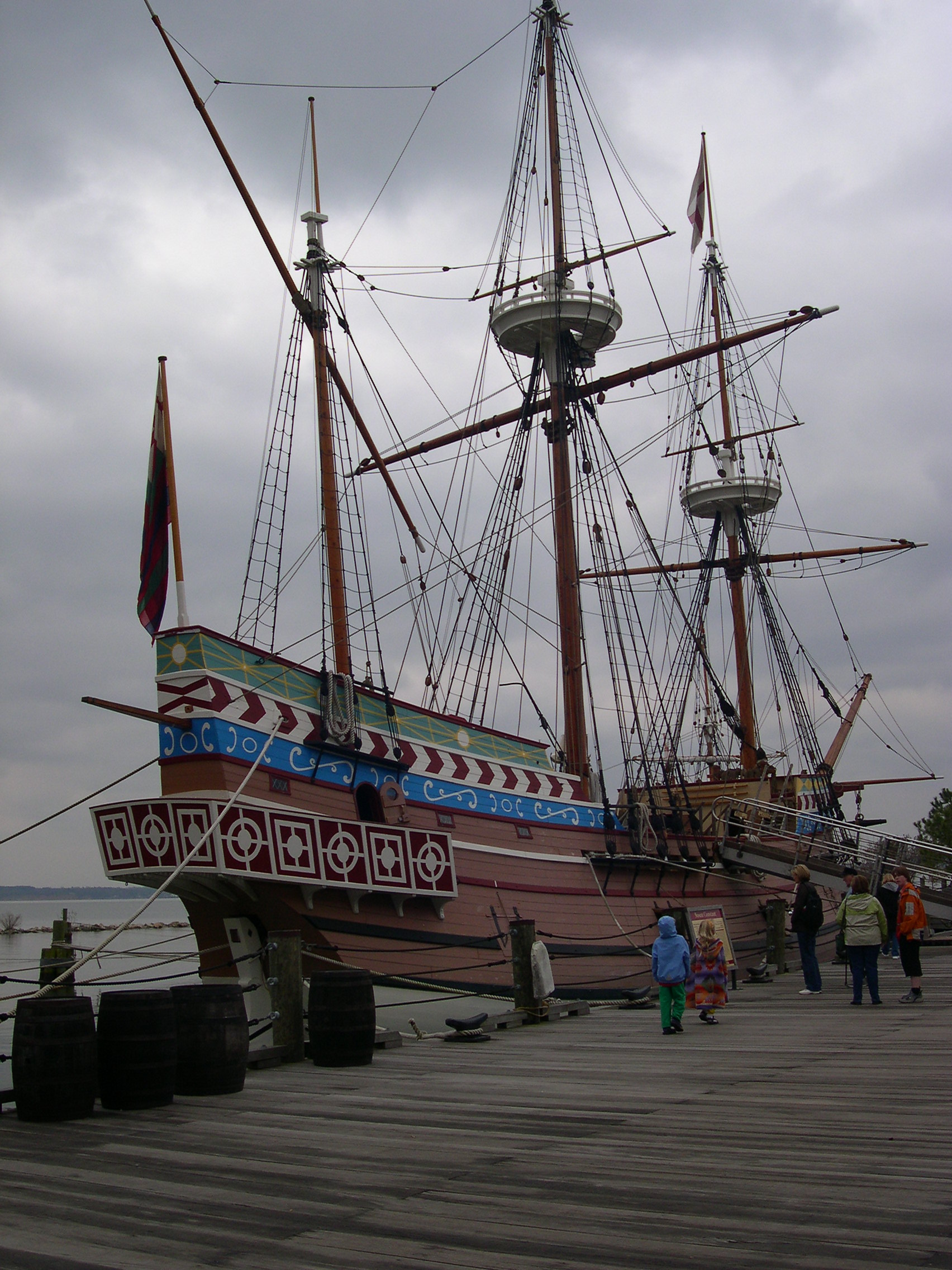
An English ship of the late 16th/early 17th century: this is a replica of the Susan Constant at the Jamestown Settlement in Virginia. The original ship was built sometime before 1607 and rented by the Virginia Company of London to transport the original settlers to Jamestown. Photo by Nicholas Russon, March 2004.
For as long as humans have suffered severe food shortages, scurvy has been known. The first record of it appears to date to ancient Egypt, in 1550BC, and it was especially familiar to the inhabitants of northern climates, with fresh vegetation every winter becoming scarce. Our word for scurvy almost certainly comes from the old Norse skyrbjugr — the skyr being a sort of soured cow’s milk that was thought to have caused the disease by going bad. In mid-sixteenth-century sources, scurvy was often referred to as though it was endemic to the Netherlands — a flat land assailed by the North Sea each winter, that had suffered long sieges and devastation thanks to the Dutch Revolt, and where fishing and merchant shipping employed an especially large proportion of the workforce. The Dutch thus had a perfect storm of factors to make vitamin C deficiencies more common, even though they abounded in fresh-caught fish and imported Baltic grain.
And so, over the centuries, the people of the northern climes had discovered the cure. Or rather, cures. The Iroquois ate the bark, needles or sap of evergreen trees — most likely white cedar, or some other kind of spruce, fir, juniper or pine, all rich in vitamin C. Their remedy saved the lives of Jacques Cartier’s colonists based near modern-day Quebec City in the winter of 1536. It’s the reason white cedar is known as arborvitae, the tree of life. And the Saami of northern Scandinavia prized cabbages and other leafy greens, in the summertime filling up casks of reindeer milk with crowberries and cloudberries, to be ready for winter.
[…]
Still more remedies were discovered by accident, as European ships began to range farther and farther abroad. The very first Portuguese voyagers around the Cape of Good Hope almost immediately discovered the value of orange and lemons — especially effective sources of vitamin C, as their acidity helps to preserve it. The voyage of Vasco da Gama, having been the first to round the Cape and reach the eastern coast of Africa, was then stricken with scurvy. They were only inadvertently saved when they traded with some Arabian ships laden with oranges, before landing at Mombasa. There, the ruler sent them a sheep and some sugar-cane, the gift also happening to include some oranges and lemons. Although the Portuguese couldn’t stay there long — they learned of a conspiracy to capture their ship — one of the voyagers later reported in wonder how the climate there must have been especially healthful to have cured them all.
Fortunately, at least some of the crew suspected the citrus instead. On the return journey from India, after a fatally slow three-month crossing of the Indian Ocean, some of the newly scurvy-ridden sailors asked their captain to procure them some oranges at Malindi. At least a few of the crew must certainly have been saved by this request, though perhaps the excitement of their imminent deliverance induced a few fatal aneurysms: “our sick did not profit”, was the report, “for the climate affected them in such a way that many of them died here.” By the time the fleet limped home back to Lisbon in 1499, scurvy had still managed to claim the lives of over two thirds of the original crew.
Nonetheless, the status of oranges as a scurvy wonder-cure had entered sailors’ lore. When Pedro Alvares Cabral repeated da Gama’s feat of rounding the Cape of Good Hope in 1500, his crew purposefully treated their scurvy using oranges. And by the 1560s, if not earlier, the news of the cure had spread beyond the Portuguese. Sailors from the Low Countries, on the eve of the Dutch Revolt from Spain, were said to be staving off scurvy by eating oranges in large quantities, skins and all. (Orange peel is in fact especially rich in vitamin C, so they were onto something.) Their value was certainly appreciated by the Dutch explorer Jacob Corneliszoon van Neck by the time of his second expedition to the Indian Ocean in 1598. Not long after setting out, he purchased 10,000 oranges from a passing ship off the coast of Spain, rationing them out to all his crew. And on the return journey via St Helena they were dismayed when initially “we found no oranges, whereof we had most need, for those that were troubled with the scurvy disease.”
The account of van Neck’s journey was translated into English for the first voyage of the East India Company in 1601, which may be why its commander, James Lancaster, directed his crew to drink three spoonfuls of lemon juice every morning. Lancaster doesn’t appear to have paid any special attention to oranges and lemons ten years earlier, when he first attempted the voyage, although other English mariners like the privateer Sir Richard Hawkins had in the 1590s already been extolling their virtues. We don’t know many of the details of Lancaster’s lemon juice trial, but his flagship’s crew was not entirely saved. Contrary to common report, at least a third of them had died by the time they left their first landing at Table Bay, South Africa — a proportion similar those on the other ships of his fleet, though we don’t know how many actually died of scurvy or of other causes. But upon the expedition’s return, the experience placed lemon juice firmly on the list of known scurvy cures — “the most precious help that ever was discovered against the scurvy” as the East India Company’s surgeon-general put it.
Comments Off on Ocean travel without losing half the crew to scurvy
Scott was a slave who claimed to be free because his owners had taken him to U.S. states where slavery was outlawed; in ruling on the case, Chief Justice Roger Taney, writing for a 7-2 majority, found that Blacks were “beings of an inferior order” who, under the constitution, “had no rights which the white man was bound to respect.”
The Scott decision is now considered an important contributing cause of the U.S. Civil War, which began four years later. It proved, beyond anyone’s doubt, President Abraham Lincoln’s maxim that a sovereign nation could not survive half-slave and half-free. Northern states might be capable of abolishing slavery locally, but this “abolition” would never apply to imported slaves from elsewhere considered as property. One cannot fully understand U.S. history, never mind the progress of its law, without studying and appreciating Taney’s cruel language.
And, indeed, for the world at large, Dred Scott is an unsurpassed reminder of the distinction between law and justice, and of the limitations of a highly reverenced written constitution. Taney not only accepted the (irrefutable) argument that the constitution explicitly countenanced slavery: he wrote fawningly of the Founding Fathers as great men, “high in their sense of honour,” who could never have upheld absolute equality before the law on one hand while hypocritically denying it to Blacks in practice. The Declaration of Independence’s claim that “all men are created equal,” the ex-slaveowner Taney wrote, was never understood by anyone to include inferior races.
Abolitionists of the time saw the innate hypocrisy: the contemporary newspaper editor William Lloyd Garrison risked his life by calling the constitution “a league with hell.” But [University of Buffalo law professor Matthew] Steilen thinks it is better not to expose Black students to the details of that debate. Reading Taney’s “gratuitously insulting and demeaning” words and arguments, he tweeted, is likely to, and there is no other way to put this, injure their feelings. To inquire too deeply into the detail of slavery, and of the law that shielded it, would require Black students to “relive the humiliation” of Dred Scott.
We shall not resume our anniversary observances today. The war is lost, at home and abroad. On the domestic front, we doubled the rate of Muslim immigration to the west and began assimilating ourselves with Islam’s strictures on freedom of expression and the like. The decade-and-a-half since the Danish Mohammed cartoons has been one long remorseless surrender on core western liberties. When a school teacher gets beheaded in the street, there is no outrage at the act, just a mild regret that he should have been foolish enough to provoke his own fate. Even the milder jests from the immediate post-9/11 era — the cartoon of the woman trying on new burqas in the changing room and wondering, “Does my bomb look big in this?” — would not be published today.
In the broader society, our rulers quickly determined that it was easier to punish us than our enemies. The post-9/11 security state surely helped soften up western populations for the Chi-Com-19 lockdowns, in which entire nations have been reduced to TSA-administered airports.
As for the war overseas, it ended with a military that can do everything except win handing the keys to Afghanistan back to the guys who pulled off 9/11 — and apologizing for the two-decade inconvenience by gifting the mullahs with some of the most expensive infrastructure on the planet plus an air force, approximately five assault rifles for every Taliban fighter, and express check-in for the forty-seven per cent of the Afghan population that apparently served as US translators.
The position of the United States is far weaker than it was twenty years ago. Around the planet, the assumption of friends and enemies alike is that the American moment is over and the future belongs elsewhere. They are making their dispositions accordingly. It is not a question of wishing “the post-American world”, but of accepting the known facts.
David Warren reposted his thoughts from the fifteenth anniversary:
A generation or more is necessary to see any large event in some historical perspective. That the fall of the Berlin Wall was a “large event” we could see immediately, but not what it portended. The political world would be transformed, but the New World Order that George Bush Senior foresaw was a mirage. Ditto with events since 9/11.
Several thousand were killed on that day in 2001 — the anniversary of the Ottoman defeat at the Gates of Vienna. This was a comparatively small number, by modern standards. The rich symbolism of this Islamist operation was lost on the West, which no longer cares for history or legend. A brilliant assault of “asymmetric warfare”, it fulfilled all of its objectives. The torch has since been passed from the more moderate al-Qaeda to the more fanatic Daesh, and will be passed again in due course. Osama bin-Laden personally lost face by being hunted down and killed like a rat, but his vision of a restored Islamic Caliphate survives him. It inspires still the young in heart and mind.
The immediate intention was to humiliate the “Great Satan”; to awaken the sleeping giant and make him blindly thrash; to goad him into self-destructive behaviour as he struck against an enemy he could neither locate nor understand. Beyond this: to expose him as a paper tiger, tilting a balance of power, and transferring initiative from the mightily-armed “Crusader” to the nimble “Jihadi”. Within the Muslim world: to show that only the radical Salafist faction could get results, could change the direction of history and, as it were, “make Arabia great again”.
As I suggested above, we are still too close to this event to grasp its full significance; but after fifteen years we in the West are in a much worse position than we were on the 10th of September, 2001. We showed, as the Islamists predicted, that we did not have the stamina to prevail, even against weak adversaries; that America and allies could only fight “Vietnams”. Our will is shaken, and to Salafist delight, we have by now expressed contrition for fourteen centuries of Christian defence against Islamic aggression. We bow respectfully, as our culture is insulted, and as versions of Shariah are imposed. In disregard of our own security, we have thrown our borders open to massive Muslim immigration. We follow, at every junction, the course of sentimentality, and adapt to the certainty of defeat. After each hit we call for grief counsellors.
On MeWe, Byron Clark reposted a transcript of the call Todd Beamer made from United Airlines flight 93 that morning:
Todd: Hello … Operator … listen to me … I can’t speak very loud. – This is an emergency. I’m a passenger on a United flight to San Francisco. We have a situation here … Our plane has been hijacked … can you understand me?
Lisa: (exhaling a deep breath to herself) I understand … Can the hijackers see you talking on the phone?
Todd: No
Lisa: Can you tell me how many hijackers are on the plane?
Todd: There are three that we know of.
Lisa: Can you see any weapons? What kind of weapons do they have?
Todd: Yes … they don’t have guns … they have knives – they took over the plane with knives.
Lisa: Do you mean … like steak knives?
Todd: No, these are razor knives … like box cutters.
Lisa: Can you tell what country these people are from?
Todd: No … I don’t know. They sound like they’re from the mid-east.
Lisa: Have they said what they want?
Todd: Someone announced from the cockpit that there was a bomb on board. He said he was the captain and to stay in our seats and stay quiet.
He said that they were meeting these men’s demands and returning to the airport… It was very broken English, and… I’m telling you…it sounded fake!
Lisa: Ok sir, please give me your name.
Todd: My name is Todd Beamer.
Lisa: Ok Todd … my name is Lisa … Do you know your flight number? If you can’t remember, it’s on your ticket.
Todd: It’s United Flight 93.
Lisa: Now Todd, can you try to tell me exactly what happened?
Todd: Two of the hijackers were sitting in first class near the cockpit. A third one was sitting near the back of the coach section. The two up front got into the cockpit somehow; there was shouting. The third hijacker said he had a bomb. It looks like a bomb. He’s got it tied to his waist with a red belt of some kind.
Lisa: So is the door to the cockpit open?
Todd: No, the hijackers shut it behind them.
Lisa: Has anyone been injured?
Todd: Yes, they … they killed one passenger sitting in first class. There’s been lots of shouting. We don’t know if the pilots are dead or alive. A flight attendant told me that the pilot and copilot had been forced from the cockpit and may have been wounded.
Lisa: Where is the 3rd hijacker now Todd?
Todd: He’s near the back of the plane. They forced most of the passengers into first class. There are fourteen of us here in the back. Five are flight attendants. He hasn’t noticed that I slipped into this pantry to get the phone. The guy with the bomb ordered us to sit on the floor in the rear of the plane … oh Jesus. Help!
Lisa: Todd … are you ok? Tell me what’s happening!
Todd: Hello … We’re going down … I think we’re going to crash … Wait – wait a minute. No, we’re leveling off … we’re ok. I think we may be turning around … That’s it – we changed directions. Do you hear me … we’re flying east again.
Lisa: Ok Todd … What’s going on with the other passengers?
Todd: Everyone is … really scared. A few passengers with cell phones have made calls to relatives. A guy, Jeremy, was talking to his wife just before the hijacking started. She told him that hijackers had crashed two planes into the World Trade Center … Lisa is that true??
Lisa: Todd … I have to tell you the truth … it’s very bad. The World Trade Center is gone. Both of the towers have been destroyed.
Todd: Oh God — help us!
Lisa: A third plane was taken over by terrorists. It crashed into the Pentagon in Washington DC. Our country is under attack … and I’m afraid that your plane may be part of their plan.
Todd: Oh dear God. Dear God … Lisa, will you do something for me?
Lisa: I’ll try … if I can … Yes.
Todd: I want you to call my wife and my kids for me and tell them what’s happened. Promise me you’ll call.
Lisa: I promise – I’ll call.
Todd: Our home number is 201 353-1073 … You have the same name as my wife … Lisa … We’ve been married for 10 years. She’s pregnant with our 3rd child. Tell her that I love her … (choking up) … I’ll always love her … (clearing throat) We have two boys … David, he’s 3 and Andrew, he’s 1 … Tell them … (choking) tell them that their daddy loves them and that he is so proud of them. (clearing throat again) Our baby is due January 12th … I saw an ultra sound … it was great … we still don’t know if it’s a girl or a boy … Lisa?
Lisa: (barely able to speak) I’ll tell them, I promise Todd.
Todd: I’m going back to the group — if I can get back I will …
Lisa: Todd, leave this line open … are you still there?
Lisa: (dials the phone) Hello, FBI, my name is Lisa Jefferson, I’m a telephone supervisor for GTE. I need to report a terrorist hijacking of a United Airlines Flight 93 … Yes I’ll hold.
Goodwin: Hello, this is Agent Goodwin … I understand you have a hijacking situation?
Lisa: Yes sir, I’ve been talking with a passenger, a Todd Beamer, on Flight 93 who managed to get to an air phone unnoticed.
Goodwin: Where did this flight originate, and what was its destination?
Lisa: The flight left Newark New Jersey at 8 A.M. departing for San Francisco. The hijackers took over the plane shortly after takeoff, and several minutes later the plane changed course – it is now flying east.
Goodwin: Ms. Jefferson … I need to talk to someone aboard that plane. Can you get me thru to the planes phone?
Lisa: I still have that line open sir, I can patch you through on a conference call … hold a mo …
Todd: Hello Lisa, Lisa are you there?
Lisa: Yes, I’m here. Todd, I made a call to the FBI, Agent Goodwin is on the line and will be talking to you as well.
Todd: The others all know that this isn’t your normal hijacking. Jeremy called his wife again on his cell phone. She told him more about the World Trade Center and all.
Goodwin: Hello Todd. This is Agent Goodwin with the FBI. We have been monitoring your flight. Your plane is on a course for Washington, DC. These terrorists sent two planes into the World Trade Center and one plane into the Pentagon. Our best guess is that they plan to fly your plane into either the White House or the United States Capital Building.
Todd: I understand … hold on … I’ll … I’ll be back …
Lisa: Mr. Goodwin, how much time do they have before they get to Washington?
Goodwin: Not long ma’am. They changed course over Cleveland; they’re approaching Pittsburgh now. Washington may be twenty minutes away.
Todd: (breathing a little heavier) The plane seems to be changing directions just a little. It’s getting pretty rough up here. The plane is flying real erratic … We’re not going to make it out of here. Listen to me … I want you to hear this … I have talked with the others … we have decided we would not be pawns in these hijackers suicidal plot.
Lisa: Todd, what are you going to do?
Todd: We’ve hatched a plan. Four of us are going to rush the hijacker with the bomb. After we take him out, we’ll break into the cockpit. A stewardess is getting some boiling water to throw on the hijackers at the controls. We’ll get them … and we’ll take them out. Lisa … will you do one last thing for me?
Lisa: Yes … What is it?
Todd: Would you pray with me?
They pray: Our father which art in Heaven
Hallowed be thy name,
Thy kingdom come, thy will be done
on earth as it is in heaven.
Give us this day our daily bread,
And forgive us our trespasses
As we forgive our trespassers,
And lead us not into temptation
But deliver us from evil
For thine is the kingdom, and the power, and the glory
Forever … Amen
The Lord is my shepherd, I shall not want …
He makes me to lie down in green pastures
He leads me beside the still waters
He restores my soul
He leads me in paths of righteousness
for His name’s sake
Yea, though I walk through the valley of the shadow of death
I will fear no evil, for thou art with me …
Todd: (softer) God help me … Jesus help me … (clears throat and louder)
Are you guys ready? …
Let’s Roll …
The MP-43 (which is mechanically identical to the MP-44 and StG-44; the differences are the subject for another video later) is a tilting bolt rifle with a long stroke gas piston. It was manufactured primarily from complex sheet steel stampings, as a way to minimize the amount of high-quality and thus difficult to acquire steels needed for its construction. The rifle is heavy by today’s standards, but remarkably ergonomic (except for the metal handguard, when heats up quickly). Its sights come right up to the eye when shouldering the rifle, and it disassembles quickly and easily.
It really is one of the best small arms developed during World War II.
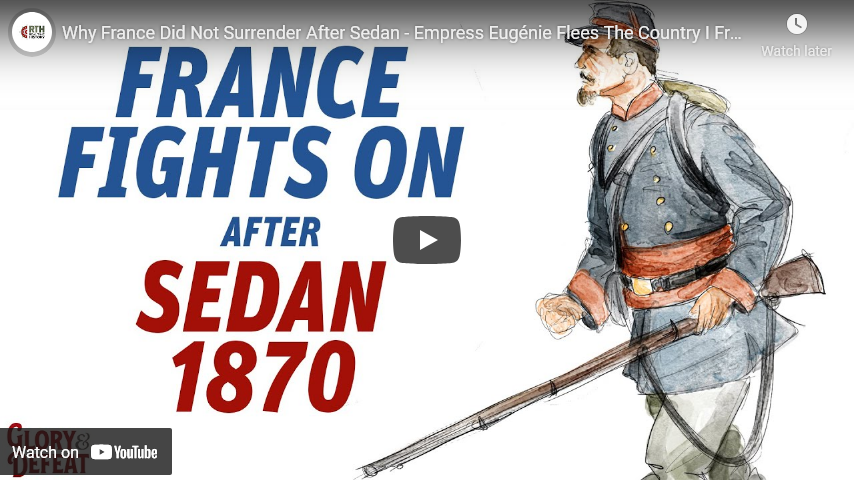
After the French defeat at Sedan, the German states expect peace negotiations. But instead the new French republic declares an early form of “total war” and continues the fight. Meanwhile Empress Eugénie flees the country for Britain.
» THANK YOU TO OUR CO-PRODUCERS
John Ozment
James Darcangelo
Jacob Carter Landt
Thomas Brendan
» LITERATURE
Arand, Tobias: 1870/71. Der Deutsch-Französische Krieg erzählt in Einzelschicksalen. Hamburg 2018
Arand, Tobias/Bunnenberg, Christian (Hrsg.): Karl Klein. Die Fröschweiler Chronik. Hamburg 2021
Herre, Franz: Eugénie. Kaiserin der Franzosen. München 2000
Howard, Michael: The Franco-Prussian War. London 1961
Milza, Pierre: L’année terrible. La guerre franco-prussienne. Septembre 1870 – mars 1871. Paris 2009
» SOURCES
Braun, Lily (Hrsg.): Kriegsbriefe aus den Jahren 1870/71 von Hans v. Kretschman. Berlin 1911
Hérisson, Maurice Graf d’: Journal d’un officier d’ordonannce. Juillet 1870 – Février 1871. Paris 1885
Goncourt, Edmond de: Journal des Goncourt. Memoire de la vie litteraire. 2.1. 1870-1871. Paris 1890
Russell, William Howard: Meine sieben Kriege. Die ersten Reportagen von den Schlachtfeldern des 19. Jahrhunderts. Frankfurt a. M. 2000
»CREDITS
Presented by: Jesse Alexander
Written by: Cathérine Pfauth, Prof. Dr. Tobias Arand, Jesse Alexander
Director: Toni Steller & Florian Wittig
Director of Photography: Toni Steller
Sound: Above Zero
Editing: Toni Steller
Motion Design: Philipp Appelt
Mixing, Mastering & Sound Design: http://above-zero.com
Maps: Battlefield Design
Research by: Cathérine Pfauth, Prof. Dr. Tobias Arand
Fact checking: Cathérine Pfauth, Prof. Dr. Tobias Arand
Channel Design: Battlefield Design
Contains licensed material by getty images
All rights reserved – Real Time History GmbH 2021
Comments Off on Why France Did Not Surrender After Sedan – Empress Eugénie Flees The Country I Franco-Prussian War