Quotulatiousness

September 13, 2014

Ukraine’s PM – “We are still in a stage of war and the key aggressor is the Russian Federation”

Filed under: Europe, Military, Russia — Tags: , — Nicholas @ 11:26

In the Guardian, Martin Williams reports on the situation in eastern Ukraine:

The Russian president, Vladimir Putin, wants to destroy Ukraine as an independent country and resurrect the Soviet Union, the Ukrainian prime minister Arseny Yatseniuk has said.

Yatseniuk told a conference of European politicians his country was “in a stage of war” with Russia, as renewed clashes broke out between the Ukrainian army and pro-Russian rebels in the east and Moscow sent a second convoy of trucks into Ukraine without Kiev’s consent.

Continuous rocketfire could be heard overnight in the eastern city of Donetsk. The city council said shells had hit residential buildings near the airport, although no casualties were reported.

Ukraine’s military said it had successfully repelled a rebel attack on the government-held Donetsk airport. But a column of three Russian multiple rocket launchers was seen moving freely through the rebel-held city on Saturday morning.

Speaking at a conference in Kiev attended by European and Ukrainian politicians and business leaders, Yatseniuk praised the economic sanctions imposed on Moscow. He said: “We are still in a stage of war and the key aggressor is the Russian Federation … Putin wants another frozen conflict [in eastern Ukraine].

“His aim is not just to take Donetsk and Lugansk. His goal is to take the entire Ukraine … Russia is a threat to the global order and to the security of Europe.”

September 9, 2014

Russian FSB lured Estonian official into a trap

Filed under: Europe, Military, Russia — Tags: , , — Nicholas @ 08:26

In the Guardian, Julian Borger updates the situation in Estonia after the kidnapping of Eston Kohver by Russian forces:

The Estonian intelligence official seized by Russia thought he was going to meet an informant in a secluded spot on the border as part of an organised crime investigation but instead walked into an FSB trap, according to Estonian security sources.

Eston Kohver went to the arranged meeting at 9am on Friday in woodland near the village of Miikse, about five miles north of the official Luhamaa border post. He had armed backup in the form of Estonian security officers nearby but they were unable to react in time because of the use of flash grenades and because their communications were jammed.

By the time they realised what has happening, Kohver had been dragged into the woods on the Russian side of the border by a group of gunmen.

Kohver is now in Moscow where he is awaiting formal charges. Russian media have suggested he could be accused of spying; a pistol, a recording device and €5,000 in cash were displayed on Russian television as evidence.

Estonian security sources confirmed that all the items were Kohver’s but said it was entirely routine for him to be carrying them. The recording device and the cash were intended for the informant he thought he would be meeting.

The Russian-Ukrainian War

Filed under: Europe, Military, Russia — Tags: , , , — Nicholas @ 08:16

Paul Goble summarizes Konstantin Gaaze’s ten questions and answers about the war between Russia and Ukraine:

Gaaze’s first question is “Why did we (they) act as we (they) did with them (us)?” His answer: “President Putin considers that the Ukrainian state exists only because he agrees to its existence.” Consequently, “Moscow has acted from the false hypothesis that ‘Ukraine is not a state,’” something for which several thousand people have already paid with their lives.

But Kiev, the Moscow writer says, has also operated from a false hypothesis.” Ukrainian leaders believed that “Russia will not provide essential assistance to the local uprising in the east of Ukraine because it is intimidated by Western sanctions.” But Moscow isn’t, and it has intervened. Consequently, Ukraine has had to fight, and many have suffered as well.

His second question is “What has been obtained and how did the war end?” In Gaaze’s view, “the east of Ukraine belongs to people whose names we in fact do not know. Kiev has lost part of its territory but forever have been marginalized the future of the non-existence Novorossiya.”

“It will never become part of Russia,” Gaaze says, but “in the near term, it will not be part of Ukraine either. Millions of people thus are condemned to live in an enormous Transdniestria, to live between two armies, one of which (the Russian) is committed to destroy the other (the Ukrainian).” The first is only waiting for the order to do so.

Gaaze’s third question is this: “Was Putin fighting with Ukraine or with the West?” the answer is with both, but the results are different. “Kiev did not lose the war, but it did not win it either. The West,” in contrast, “lost the first round of the new Cold War. Moscow did what it wanted,” while the West did not act decisively because of various fears about the future.

“But the first round of the cold war is not the entire war,” Gaaze says. The West can recover. NATO can rearm. “There will be other rounds,” and Russia “will not be able to win them.”

September 7, 2014

Combat situation in Ukraine

Filed under: Europe, Military, Russia — Tags: — Nicholas @ 11:13

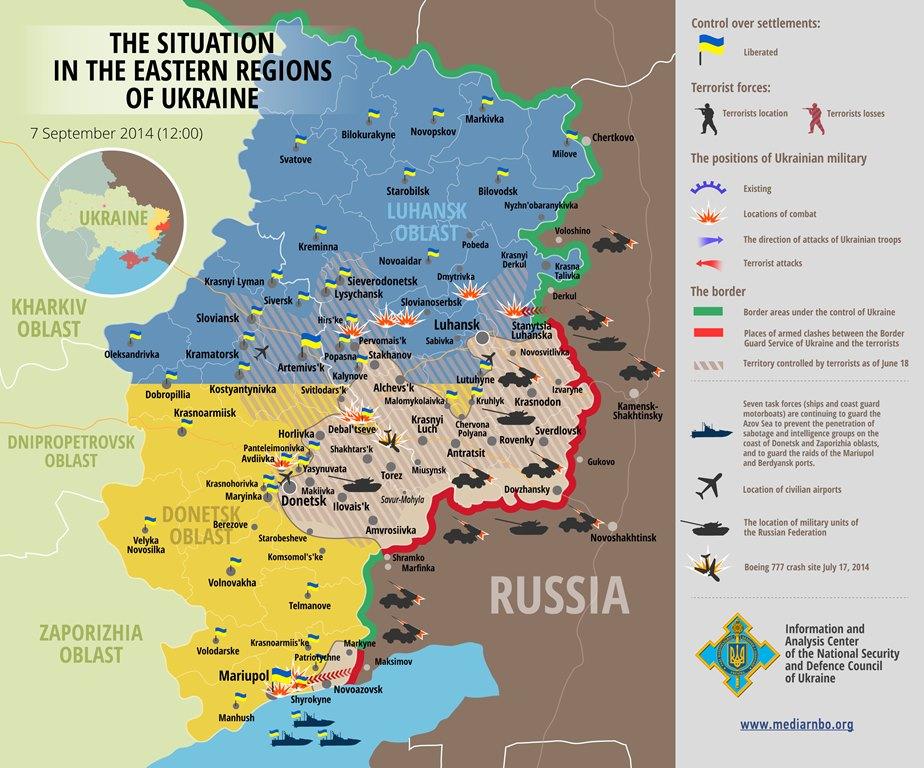
Current situation map released on Twitter by the Ministry of Foreign Affairs of Ukraine:

Ukraine situation 20140907

September 6, 2014

Estonian intelligence official kidnapped by Russian FSB

Filed under: Europe, Military, Russia — Tags: , , — Nicholas @ 11:14

Russia appears to be willing to test the patience of all of its European neighbours, as Estonia lodges a formal complaint that one of their intelligence officers has been captured by Russian FSB troops on Estonian territory:

A strange incident near the Russian-Estonian border on Friday ended with an Estonian intelligence officer in Russian custody and the two countries trading sharply contradictory allegations about what happened.

Estonia’s president and prime minister, among other officials, said the officer had been kidnapped at gunpoint from their territory and forced across the border in a blatant violation of sovereignty. The Russian Federal Security Service said the officer was in Russia and engaged in a clandestine operation when he was detained.

The episode threatened to heighten tensions between Russia and the NATO alliance, to which Estonia belongs, at a time when relations are already severely strained over the conflict in Ukraine. It came just two days after President Obama gave a speech in Tallinn, the Estonian capital, pledging that NATO would defend the Baltics against Russian aggression and suggesting that any attack on them would lead to war with the West.

Although the intelligence officer was apparently detained around 9 a.m., the Russian security service, known as the F.S.B., did not acknowledge the incident until Friday evening, when it issued a statement to three Russian news agencies.

Senior Estonian officials, including the director of the country’s Internal Security Service, held a news conference in the late afternoon, saying the officer had been abducted after unknown assailants set off a stun grenade and jammed communication signals. At the time of his capture, the officer was investigating a criminal case in the area of Luhamaa, Estonia, a little more than a mile from the border with Russia, officials said, according to Estonian news reports.

Update, 7 September: The Interpreter‘s Ukraine Liveblog included this information today.

Eston Kohver, an Estonian intelligence officer who was, according to Estonia, abducted and taken across the border to Russia yesterday, has appeared in Moscow, where he is being detained. The Estonian authorities reported that smoke grenades were used and that there were signs of a violent struggle. In addition, it was reported that communications signals in the area were jammed at the time of the reported abduction.

Meanwhile the FSB claimed yesterday that Kohver had been arrested on Russian territory, in the Pskov region.

Interfax reports that Russia’s state-owned Channel One announced today that the Lefortovo Court has approved Kohver’s detention on suspicion of espionage.

Here is video from Russia’s Ruptly news agency showing Kohver being taken out of a car and into a pre-trial detention centre (known in Russia as SIZO). The footage also shows a display of the items that the FSB has claimed that were found on Kohver including 5,000 euros in cash and a Taurus pistol.

September 5, 2014

In international affairs, perceptions matter a lot

Filed under: Europe, Russia, USA — Tags: , , — Nicholas @ 14:07

In today’s Goldberg File email (update: now available online here), Jonah Goldberg talks about the problem President Obama faces on the international stage:

… the Obama administration has wittingly or unwittingly sent the signal that our reign as the enforcer of the Pax Americana is over. Or, less starkly, we have sent the signal that it might be over. This is an important distinction. When it comes to power politics, perception matters as much as reality. Vladimir Putin, the Chinese Politburo, the Islamic State, Assad, the Iranians, Solomon Grundy, the stinking Diaz Brothers, Simon Bar Sinister, and that sweet-smelling cloud that steals your hemoglobin are all going to test America and the system around it to see how much they can get away with. It’s like Gandhi’s famous advice about going to prison. “On the first day, find the biggest, meanest-looking MoFo you can and beat the crap out of him. That will send the signal no one should mess with you.” (“Um, are you sure that was Gandhi? Remember Aristotle’s warning: ‘Some quotations on the Internet are unreliable.'” — The Couch).

The reason this is such a dangerous moment is that the mere act of testing the system encourages others to test it as well. In prison, when you’re a pushover for one guy, everyone gets the idea that they can take the apple brown betty off your lunch tray. It’s also how riots and lootings start. One person smashes a window on the hunch he can get away with it. Others watch. When nothing happens to the smasher, the idea becomes contagious.

This gets us to the heart of the damage Barack Obama has done. A superpower can cruise on perception for a very long time. Perception is relatively inexpensive. Sure, you gotta float some ships around. Yeah, you might have to run some military exercises. But as long as people think you’re sustaining a Pax Americana you are, in fact, sustaining a Pax Americana. But once you let that perception waver, you’re suddenly faced with a terrible set of choices. You can’t tell the world you’re still in charge, you have to show them. If you just talk about red lines and then do nothing to enforce them, further talk becomes worse than useless, it becomes provocative. If you opt to demonstrate your power, you risk failing and confirming weakness. You also risk a horrible escalation as the bad actors respond not with surrender but with even more testing. Does anyone think Putin would be the first to blink at this point if Obama sent troops to Ukraine?

Obama could do everything right starting today (Stop laughing!) and in a sense it would still be too late. It’s always more expensive to put down a riot than to prevent it. And it’s not entirely clear to me that the American people are willing to pay that price right now. It’s much clearer that this president has no interest in asking them to.

NATO – “they spent all their money on buying Ferraris and now they have no gas money”

Filed under: Europe, Military, Russia, USA — Tags: , , — Nicholas @ 08:34

Philip Ewing reports on the chances of improved military “readiness” among the NATO allies:

With President Barack Obama in Europe this week for a major NATO summit, the White House hopes the growl of the Russian bear on Europe’s eastern flank means the moment is right for some long-sought reforms to the alliance. But the outlook appears dim for anything beyond incremental steps at best.

The major reason is one that has frustrated policymakers over the past several administrations: Most European nations would love a stouter defense structure — so long as they don’t have to pay for it.

The North Atlantic Treaty Organization requires that member nations devote at least 2 percent of their economies to defense spending, yet today only four do: the U.S., Britain, Greece and Estonia. Although this week’s summit in Wales appears likely to yield a “pledge” in support of increased spending in the wake of Russia’s invasion of Ukraine, no one expects a serious effort from members other than those most directly threatened, including Latvia, Lithuania and Poland.

[…]

Obama and U.S. officials also are focused on bolstering European military “readiness,” particularly as U.S. spending declines. NATO relies on the U.S. for critical military capabilities such as surveillance, in-flight refueling and transportation. European militaries field top-rate troops, ships and aircraft but keep only weeks’ or even days’ worth of munitions on hand. In NATO’s 2011 campaign against Libya, many nations ran out of munitions and the French began dropping concrete bombs.

“It’s sort of like they spent all their money on buying Ferraris and now they have no gas money,” Benitez said. “There are many allies that literally aren’t flying their planes because they can’t afford to. They have very advanced fleets, but their fleets aren’t leaving port because they can’t afford to.”

September 4, 2014

“David Cameron mouths foolish nothings” while “Obama … resembles a spineless invertebrate”

Filed under: Britain, Europe, Middle East, Russia, USA — Tags: , , , — Nicholas @ 07:25

Historian Max Hastings pours out the scorn toward British PM David Cameron and American President Barack Obama for their dithering and unwillingness to grapple with real world problems like the invasion of Ukraine and the rise of ISIS:

Suddenly, the world seems a frightening place. The beheading of a second American hostage by jihadist fanatics and the threat that a British aid worker will suffer the same fate has shocked the peoples of the West, as have few events since the Cold War.

We are uncertain how the Western Powers should respond.

At such moments, we turn to our national leaders for wisdom, reassurance and decision. Instead, we get posturing, dithering and waffle.

David Cameron mouths foolish nothings, proclaiming that Britain would commit ‘all the assets we have’, including our ‘military prowess’ against the Muslim extremists.

More serious, the President of the United States seems supine in the face of the gravest threats to international order in a generation.

Barack Obama boldly strides golf course fairways, while apparently washing his hands of the job the American people — and, by association, the civilised world — pay him for: to strive to lead us into the paths of righteousness.

To borrow P. G. Wodehouse’s phrase, however intelligent Obama may be, he resembles a spineless invertebrate.

Update: Speaking of scorn, here’s Jonah Goldberg yesterday (H/T to Jim Geraghty for the link).

This was always nonsense, but then again so much of the hype about Obama in the early days of his presidency was nonsensical. Still it does contribute to the poignancy of the moment. I’m referring specifically to the Islamic State and their celebration of slavery. MEMRI has excerpts of Facebook chats between British and French supporters of the group as they discuss the great news that you can buy Yazidi women as sex slaves.

[…]

It’s also worth noting that the president has done everything he can to claim that his domestic political opponents are engaged in a “war on women.” He won an election largely because he convinced enough women — and pliant journalists — to take this bilge seriously. Just this week the head of his party went on at great length to claim that the Republican governor of Wisconsin has been “giving women the back of his hand.”

Oh, and let us not forget, the president and his supporters work very hard to paint their domestic political opponents as religious extremists because some private businesses and religious groups don’t want to pay for procedures that violate their conscience.

Now compare this to the people who are celebrating the fact their faith allows them to enslave women.

Just think about it for a moment. The president surely knows about this. His administration surely knows about this. And yet, the president — this modern incarnation of Lincoln, protector of women and opponent of domestic religious extremism — defines his goal for the Islamic State as reducing it to a “manageable problem.” Does this mean that if the group renounces any designs on attacking the U.S. homeland (an impossibility given the tenets of their faith and ambition for a global caliphate) he will stand by as they continue to barter women as sex slaves and breeders? This is the same man who campaigned in Berlin as a “citizen of the world” and champion of global community.

Forgive me, but the term, “Lincolnesque” doesn’t immediately spring to mind.

September 3, 2014

A full agenda at this weekend’s NATO summit

Filed under: Britain, Cancon, Europe, Military, Russia — Tags: , , , — Nicholas @ 08:58

In the Guardian, Patrick Wintour says that the upcoming NATO summit is a sign that with all the tension around the world, this is the most relevant the organization has been in decades:

The last time the UK hosted a Nato summit was in 1990, when Margaret Thatcher was prime minister, the cold war was coming to an end, and the alliance was questioning its relevance in a multipolar world where soft power might count more than hard power. The old chestnut about Nato’s purpose voiced by the first Nato secretary general, Lord Ismay — “to keep the Russians out, the Americans in” — looked hopelessly anachronistic. Russia famously had become a country with which the west felt it could do business.

A quarter of a century later, Putin’s actions, and the ever more grisly new threats posed by Islamic militants, has given Nato a new lease of life. Indeed, Nato is now so relevant that David Cameron’s chief task as host to this week’s summit in Wales has been to ensure that the agenda does not burst at the seams. Discussions will range across the Russian advance in Ukraine and expansionist threat to the Baltics, the Nato withdrawal from Afghanistan next year, the possibility of wider alliance air strikes in northern Iraq against Islamic State (Isis), the need for Nato to produce a viable rapid reaction force in Europe as well as respond to the threats of hybrid warfare and terrorism.

Cameron has ensured that the crisis posed by Isis — made even more pertinent by the latest beheading and the threat to a British citizen — will be discussed both at a working dinner on Thursday evening, and then again on Friday as the 28 members discuss asymmetric warfare, and how to respond to threat of terrorism.

Diplomatic efforts in advance of the summit may help the Canadian government save a bit of face, too:

A face-saving compromise may be on the way for reluctant allies, including Canada, who are unwilling to boost defence spending to meet the NATO standard.

A spokesman for Prime Minister Stephen Harper says the final statement at the Wales Summit later this week will describe the long-standing expectation that members nations spend at least two per cent of their gross domestic product on defence as an “aspirational target.”

That seems enough to satisfy the Harper government, which has balked at pressure from both the United States and Britain to substantially boost the military’s budget slashed in the drive towards next year’s balanced budget and anticipated election.

Jason MacDonald, the prime minister’s director of communications, said late Tuesday that the government is willing to spend more “on measures that meet actual operational needs, in response to global issues.”

He says Canada is not prepared to meet “an arbitrary target.”

The language not only puts out an embarrassing political fire, given the prime minister’s harsh condemnation of Russia, but it may also be enough to placate the Americans.

Canada has taken a tough rhetorical line toward the Soviets Russians lately, but Stephen Harper’s government has reduced military spending to such a degree that he risks being seen as “All hat and no cattle” as the Texan saying has it.

September 2, 2014

Tsar Vladimir I

Filed under: Europe, Russia — Tags: , , — Nicholas @ 15:44

One of the problems that Western politicians have in dealing with Vladimir Putin is that they can’t decide what he wants or even why he wants them. They’re struggling because they keep misreading individual actions as being either nationalistic or ethnic, when they should really be described as “imperialistic”. Putin is trying to recreate the old USSR, but without the Communist Party running things — he’s trying to recreate Imperial Russia:

Americans have been grasping to find explanations for Russian President Vladimir Putin’s serial aggressions in Europe. We keep searching for bumper stickers we can understand, so we gravitate to simple explanations like “geopolitics” or “nationalism,” not least because such notions promise solutions. (If it’s about geopolitics, cutting a deal with Putin will stop this; if it’s about nationalism, it’ll burn itself out when Putin has recaptured enough ethnic Russians around his borders.)

And, of course, there’s always “realism.” In this month’s Foreign Affairs, John Mearsheimer argues the Russo-Ukraine war is basically the West’s fault. (We expanded NATO, we supported the Maidan protesters, we were generally just mean to Russia, etc.) It’s a classic Mearsheimer piece: a beautifully-written, attention-seeking exercise that insists on the brilliance of realists while bucking the innate moral sense of most normal human beings. (Consider, for example, his 1993 Deep Thoughts about how maybe it would be good for Ukraine and Germany to develop active nuclear weapons programs.)

That doesn’t mean I disagree with the overall evaluation that America’s Russia policy since 1992 — insofar as we’ve had one — has been remarkably obtuse. (That pretty much describes most of our foreign policy since the end of the Cold War, but I will not digress here.) I, too, objected to expanding NATO, deplored the arrogance of people like Madeleine Albright, and lamented the repeated lost opportunities to bring Moscow closer to the Western family to which it belongs by both heritage and history.

Very little of what’s happened in the past 20 years, however, has much to do with what’s going on in Ukraine right now. And nothing excuses Russia’s war against a peaceful neighbor, especially not arid theories of realism or flawed historical analogies.

Putin is not a realist: very few national leaders are. Realism is much loved by political scientists, but actual nations almost never practice it. Nor is Putin a nationalist: indeed, he hardly seems to understand the concept, or he would not have embarked on his current path.

August 31, 2014

Combat situation in Ukraine

Filed under: Europe, Military, Russia — Tags: — Nicholas @ 10:41

Current situation map released on Twitter by the Ministry of Foreign Affairs of Ukraine:

Ukraine situation 20140831

August 28, 2014

None dare call it an invasion

Filed under: Europe, Military, Russia — Tags: , , — Nicholas @ 09:49

The battles between Ukraine forces and Russian-backed rebels were one thing: you could make a case for it being a “local” issue if you didn’t want to draw attention to it (for fear the Russians might cut off your natural gas supply). It’s quite a different thing when the Ukrainians are fighting Russian soldiers rather than irregulars and paramilitaries:

Russian forces in two armored columns captured a key southeastern coastal town near the Russian border Thursday after Ukrainian forces retreated in the face of superior firepower, a Ukrainian military spokesman said.

The two Russian columns, including tanks and armored fighting vehicles, entered the town of Novoazovsk on the Sea of Azov after a battle in which Ukrainian army positions came under fire from Grad rockets launched from Russian territory, according to the spokesman, Col. Andriy Lysenko.

“Our border servicemen and guardsmen retreated as they did not have heavy equipment,” Lysenko said in a statement.

Ukrainian authorities have denounced the latest fighting as a Russian invasion of their territory, intended to prop up pro-Moscow separatists who have been losing ground to Ukrainian forces and to open a new front in the southeastern corner of Ukraine.

Ukrainian officials said earlier that Ukrainian troops were battling combined Russian and separatist forces on the new southern front around Novoazovsk, about eight miles west of the Russian border. The Ukrainian military also said Russian troops were increasing surveillance from northern Crimea, the autonomous Ukrainian peninsula annexed by Moscow in March.

Among western countries, Canada (of all places) has become snarky about the situation:

August 27, 2014

The Congress System, the Holy Alliance and the re-ordering of Europe in the nineteenth century

Filed under: Europe, History, Russia — Tags: , , , , — Nicholas @ 09:37

In my ongoing origins of World War 1 series, I took a bit of time to discuss the Congress of Vienna and the diplomatic and political system it created for nearly one hundred years of (by European standards) peaceful co-existence. Not that it completely prevented wars (see the rest of the series for a partial accounting of them), but that it provided a framework within which the great powers could attempt to order affairs without needing to go to war quite as often. In the current issue of History Today, Stella Ghervas goes into more detail about the congress itself and the system it gave birth to:

Emperor Napoleon was defeated in May 1814 and Cossacks marched along the Champs-Elysées into Paris. The victorious Great Powers (Russia, Great Britain, Austria and Prussia) invited the other states of Europe to send plenipotentiaries to Vienna for a peace conference. At the end of the summer, emperors, kings, princes, ministers and representatives converged on the Austrian capital, crowding the walled city. The first priority of the Congress of Vienna was to deal with territorial issues: a new configuration of German states, the reorganisation of central Europe, the borders of central Italy and territorial transfers in Scandinavia. Though the allies came close to blows over the partition of Poland, by February 1815 they had averted a new war thanks to a series of adroit compromises. There had been other pressing matters to settle: the rights of German Jews, the abolition of the slave trade and navigation on European rivers, not to mention the restoration of the Bourbon royal family in France, Spain and Naples, the constitution of Switzerland, issues of diplomatic precedence and, last but not least, the foundation of a new German confederation to replace the defunct Holy Roman Empire.

[…]

Surprisingly, the Russian view on peace in Europe proved by far the most elaborate. Three months after the final act of the Congress, Tsar Alexander proposed a treaty to his partners, the Holy Alliance. This short and unusual document, with Christian overtones, was signed in Paris on September 1815 by the monarchs of Austria, Prussia and Russia. There is a polarised interpretation, especially in France, that the ‘Holy Alliance’ (in a broad sense) had only been a regression, both social and political. Castlereagh joked that it was a ‘piece of sublime mysticism and nonsense’, even though he recommended Britain to undersign it. Correctly interpreting this document is key to understanding the European order after 1815.

While there was undoubtedly a mystical air to the zeitgeist, we should not stop at the religious resonances of the treaty of the Holy Alliance, because it also contained some realpolitik. The three signatory monarchs (the tsar of Russia, the emperor of Austria and the king of Prussia) were putting their respective Orthodox, Protestant and Catholic faiths on an equal footing. This was nothing short of a backstage revolution, since they relieved de facto the pope from his political role of arbiter of the Continent, which he had held since the Middle Ages. It is thus ironic that the ‘religious’ treaty of the Holy Alliance liberated European politics from ecclesiastical influence, making it a founding act of the secular era of ‘international relations’.

There was, furthermore, a second twist to the idea of ‘Christian’ Europe. Since the sultan of the Ottoman Empire was a Muslim, the tsar could conveniently have it both ways: either he could consider the sultan as a legitimate monarch and be his friend; or else think of him as a non-Christian and become his enemy. As a matter of course, Russia still had territorial ambitions south, in the direction of Constantinople. In this ambiguity lies the prelude to the Eastern Question, the struggle between the Great Powers over the fate of the Ottoman Empire (the ‘sick man of Europe’), as well as the control of the straits connecting the Black Sea to the Mediterranean. Much to his credit, Tsar Alexander did not profit from that ambiguity, but his brother and successor Nicholas soon started a new Russo-Turkish war (1828-29).

August 23, 2014

Defining the “best tank of World War 2”

Filed under: Britain, France, Germany, History, Military, Russia, Technology, USA, WW2 — Tags: , , — Nicholas @ 11:14

Nigel Davies revisits one of the perpetual debates among amateur WW2 historians:

Let us start with the issue of tanks from the perspective of propaganda. More rubbish has been written about who had the best tanks during the Second World War than about any other topic to do with that war. Again and again you get supposedly serious historians talking about how the Germans started the Second World War with overwhelming tank superiority; that the Allies were only brought back into the race by the arrival of the Sherman tank; and how German technology leapt ahead again at the end of the Second World War to give them unrivalled vehicles. All these statements are of course completely incorrect.

One of the problems of course, is ‘best tank when, and for what?’

Comparing what was available in 1939/40 to what was being produced in 1945 (say a Panzer III or Matilda II with a Centurion or Stalin), is worse than useless. There is no comparison. Only the Panzer IV was actually produced throughout the war: and the heavily armoured final version of the tank — with a long barrelled 75mm gun capable of taking on almost every tank yet operational in mid 1945 — bore only a passing resemblance to the lightly armoured tank with a short barrelled infantry support gun — of with minimal ability to do more than scratch the paint of a CharB in 1939/40.

SOMUA 35 tank at Bovington Tank Museum (via Wikipedia)

SOMUA 35 tank at Bovington Tank Museum (via Wikipedia)

It’s relatively easy to do a quick measurables test comparing one tank against another: thickness and location of the armour, size and muzzle velocity of the main gun, engine horsepower, road speed, etc., but the very best tank on all of those measurements could still be beaten by an enemy using better combat tactics: the French SOMUA 35 and the British Matilda II were the best tanks in the world in 1939 and 1940 respectively (according to Davies). In spite of the superior measurables, the SOMUA 35 was incredibly limited by having the tank commander also be the gunner and loader and it lacked a radio for communication (and even if they had been so equipped, the already overworked tank commander would have had to be the radio operator, too). The Matilda was designed as an infantry tank, so it was very heavily armoured, but relatively slow and somewhat undergunned (the 40mm main gun only had solid shot for anti-armour use: there was no high explosive round for softer targets).

Matilda II at Yad la-Shiryon Museum (via Wikipedia)

Matilda II at Yad la-Shiryon Museum (via Wikipedia)

The Matilda and its successor the Valentine would probably still the best Allied tanks in the world in early 1941, when they swept Italian forces before them, and several times fought the German African corps to a standstill. The German response to their shocking failures in 1940, had been to upgrade the Panzer III and IV with slightly improved armour, and the short barreled 50 mm gun. But they were still on a losing wicket engaging the British infantry tanks in any sort of close terrain, such as in the siege of Tobruk. Fortunately for Rommel, out in the open terrain of the desert he could deploy his tanks behind screens of high-powered anti-tank guns, which the British tanks lacked the long-range high explosive shells to engage effectively.

It also helped that too many British cavalry officers in the desert war still had a “tally ho!” attitude and were frequently drawn into unsupported tank charges against German or Italian tanks who were able to draw the fast but lightly armoured British cruisers into easy killing range of their anti-tank guns.

M4A1 Sherman tank at Canadian Forces Base Borden (via Wikipedia)

M4A1 Sherman tank at Canadian Forces Base Borden (via Wikipedia)

This is where the myth of the value of the Sherman tank comes from. The Sherman arrived at a time when it’s armour and weapon were on a par with the Panzer III and IV tanks that it was facing. Despite the fact that its 75 mm gun was greatly inferior as an anti-tank weapon to the new British six pounder guns that were starting to equip British tanks, the high explosive shell that the Sherman could fire was incredibly useful for engaging Rommel’s 88 mm guns at long-distance in the flat desert terrain.

For several months, it seemed as though the mechanically reliable Sherman would be a war winner, despite its notable tendency to explode in flames whenever it was hit. (Allied troops refer to it as a Ronson — “lights first time every time”. German troops just referred to it as a “Tommy Cooker”.) But this concept was fantasy, which could be easily demonstrated within a few months, though it took the US government another two years to admit it.

[…]

T-34/85 at musée des blindés de Saumur (via Wikipedia)

T-34/85 at musée des blindés de Saumur (via Wikipedia)

In all of this so far, I have barely mentioned the Russians at all. Their T34 tank was possibly the single most effective of the war, and was the breakthrough that forced everyone else to rethink their designs. So we can say without a shadow of a doubt that the T34 was the best tank of the war for almost two years — from the time of Barbarossa (June 22, 1941) until the appearance of the Panther at Kursk (July 5, 1943). It certainly held this title unchallenged by the Sherman and Churchill tanks that appeared during its reign, and probably by the Tiger as well.

The Tiger is a problem for this sort of discussion, because it re-introduces the concept of ‘what for’ into the debate. The Tiger was a far superior heavy infantry support or assault tank to the T34, but a far inferior battlefield manoeuvre or pursuit tank. In fact the Tiger was so slow and limited in cross country ability, that it was actually more effective as a defensive weapon once the Germans were thrown back on that approach, than it had been for re-igniting their Blitzkreig glory days.

He sums up the post with a league table of “best tanks” for given years and purposes:

Having noted the necessary division between medium cruisers and heavy assault/infantry support tanks however, we can still make a fair summary.

So, in contrast to what many history books and documentaries will tell you, the French had the best tanks in 1939, and the British had the best tanks of 1940 and 1945. Also in contrast to what many history books will tell you, the Shermans effective front-line role can best be defined as the few months between the battle of Alamein, and the arrival of Tiger tanks in Tunisia. All attempts to use it after that in Italy or northern France just demonstrated how pathetic it was in modern engagements. Even the British Firefly version with the 17 pounder, was extremely vulnerable to any German tank. In fact it is amusing to note, that they came into their own for the blitzkrieg across open country in pursuit of the defeated German armies across France; which has a direct parallel to the inferior German tanks pursuing the defeated French in 1940. (The equally inadequate British Cromwell tanks, being significantly faster, were actually still better at this pursuit than the Shermans.) The best tank of the Sherman’s period of functional use, of course being the T34.

So our list of ‘best tanks’ could go something like this.
1939 — Best cruiser – Somua 35, Best support – CharB.
1940 — Best support becomes Matilda II.
1941 — Best cruiser initially Panzer III/IV with short 50mm guns, becomes T34 when Russia enters the war.
1942 — Best support is Tiger.
1943 — Best cruiser is Panther.
1944 — Best support is Tiger II.
1945 — Best ‘all purpose’ is Centurion.

August 18, 2014

Who is to blame for the outbreak of World War One? (Part eleven of a series)

Filed under: Europe, Germany, History, Russia, WW1 — Tags: , , , , — Nicholas @ 00:01

You can catch up on the earlier posts in this series here (now with hopefully helpful descriptions):

  1. Why it’s so difficult to answer the question “Who is to blame?”
  2. Looking back to 1814
  3. Bismarck, his life and works
  4. France isolated, Britain’s global responsibilities
  5. Austria, Austria-Hungary, and the Balkan quagmire
  6. The Anglo-German naval race, Jackie Fisher, and HMS Dreadnought
  7. War with Japan, revolution at home: Russia’s self-inflicted miseries
  8. The First Balkan War
  9. The Second Balkan War
  10. The Entente Cordiale, Moroccan crises, and the influence of public opinion

We left the Austro-Hungarian Empire in a state of ferment back in part five, having undergone a near-death constitutional stroke in 1867, resulting in a bi-polar domestic and even world outlook to accommodate the newly redefined Dual Monarchy, and dangerously inconsistent treatment of their respective ethnic, linguistic, and religious minorities in the Cisleithanic (Austrian) and Transleithanic (Hungarian) “halves” of the empire. This might not have mattered much in the long run if the empire hadn’t been summarily extended in 1908 with the addition of new territory on the southern border of the empire.

Administration turns into annexation

Under the terms of the 1878 Treaty of Berlin, Austria-Hungary had been administering the Ottoman provinces of Bosnia and Herzegovina, with the provision that they would be returned at some future date when the stability of the occupied territories had been re-established. In 1908, however, something happened which drove the Austro-Hungarians into a panic: the somnolent Ottoman government was faced with a revolutionary movement called the Young Turks.

Since 1878, the Sultan had ruled without a parliament, having suspended the General Assembly and ending the short-lived First Constitutional Era. The Young Turks were an unlikely alliance of Turkish nationalists, reformers, pro-Western modernizers, and certain national minorities including Armenians and Greeks: in short, anyone with a grievance against the Sultan, the administration, or the general state of life in the empire. The Young Turks forced the Sultan to restore the 1876 constitution and recall the general assembly. They also announced plans to call elections throughout the empire, including the Austrian-occupied territories.

Map of South-Eastern Europe after the Congress of Berlin, 1878 (via Wikipedia)

Map of South-Eastern Europe after the Congress of Berlin, 1878 (via Wikipedia)

Austro-Hungarian foreign minister Count Alois von Aehrenthal (via Wikipedia)

Austro-Hungarian foreign minister Count Alois von Aehrenthal (via Wikipedia)

Bosnia and Herzegovina had no existing representation of any sort — with the Ottomans or with the Austrians — and it was feared that the Young Turks, having created representation in the two vilayets would then demand their return to Ottoman control. Austria’s foreign minister, Count Alois von Aehrenthal began to make urgent plans to annex Bosnia and Herzegovina. In The Sleepwalkers, Christopher Clark outlines Aehrenthal’s actions:

In order to forestall any such complications [a push by the Young Turks to reclaim the provinces], Aehrenthal moved quickly to prepare the ground for annexation. The Ottomans were bought out of their nominal sovereignty with a handsome indemnity. Much more important were the Russians, upon whose acquiescence the whole project depended. Aehrenthal was a firm believer in the importance of good relations with Russia — as Austrian ambassador in St. Petersburg during the years 1899-1906, he had helped to consolidate the Austro-Russian rapprochement. Securing the agreement of the Russian foreign minister, Alexandr Izvolsky, was easy. The Russians had no objection to the formalization of Austria-Hungary’s status in Bosnia-Herzegovina, provided St. Petersburg received something in return. Indeed it was Izvolsky, with the support of Tsar Nicholas II, who proposed that the annexation of Bosnia-Herzegovina be exchanged for Austrian support for improved Russian access to the Turkish Straits.

Russian foreign minister Count Alexandr Petrovich Izvolsky (via Wikipedia)

Russian foreign minister Count Alexandr Petrovich Izvolsky (via Wikipedia)

In 1908, having successfully negotiated Russian support for the move, Austria-Hungary swallowed the two provinces and added them to the empire. Then things went horribly, horribly wrong for Aehrenthal and Austria-Hungary. The reaction to annexation was far more angry and widespread than Aehrenthal had expected, the other Treaty signatories demanded answers … and Izvolsky bolted for cover:

Despite these preparations, Aehrenthal’s announcement of the annexation on 5 October 1908 triggered a major European crisis. Izvolsky denied having reached any agreement with Aehrenthal. He subsequently even denied that he had been advised in advance of Aehrenthal’s intentions, and demanded that an international conference be convened to clarify the status of Bosnia-Herzegovina.

In his recent article in History Today, Vernon Bogdanor explains the reaction to this less-than-legal Austro-Hungarian swallowing act:

The annexation […] was a breach of the treaty and of international law. It would have significant consequences. The first was that it made non-Slav rule in Bosnia appear permanent, since the Austro-Hungarian Empire was far more durable than the Ottoman Empire. The annexation was a particular blow to the independent south Slav state of Serbia, which objected. Second, the annexation made the southern Slav issue an international problem, since it involved Serbia’s ally, Russia, which saw itself as the protector of the Slavs. In March 1909 Austria demanded, under threat of war, that Serbia accept the annexation, while Germany told Russia that, in case of war, it would take Austria’s side.

Britain helped persuade Serbia and Russia to back down. The great powers accepted the annexation. The Kaiser, unwisely perhaps, boasted in Vienna in 1910 that he had come to Austria’s side as a ‘knight in shining armour’.

The deciding factor in settling the issue of annexation turned out to be the active involvement of the German government in providing diplomatic pressure on Russia, as Christopher Clark explains:

The issue was resolved only by the “St. Petersburg note” of March 1909, in which the Germans demanded that the Russians at last recognize the annexation and urge Serbia to do likewise. If they did not, Chancellor Bülow warned, then things would “take their course”. This formulation hinted not just at the possibility of an Austrian war on Serbia, but, more importantly, at the possibility that the Germans would release the documents proving Izvolsky’s complicity in the original annexation deal. Izvolsky immediately backed down.

At the time, Aehrenthal took the blame for this fiasco, at least to some degree for his preference for secret deals and understandings. He may have been correct that there was no chance that the other signatories to the Treaty of Berlin would accept the Austrian proposal, but when it all became public, it tarnished his reputation directly and Austria-Hungary’s reputation generally.

Russia hardly came out improved in standing either. As Christopher Clark put it, “the evidence suggests that the crisis took the course that it did because Izvolsky lied in the most extravagant fashion in order to save his job and reputation.” This embarrassing incident at least partially explains why Russia became far more concerned about the fate of the south Slavic populations — having signally failed them once in 1908, Russia could not afford to look like they were going to fail them in future conflicts without forfeiting any influence or control over events in the Balkans. Clark explains the toxic combination of official misinformation, rising political awareness of the Russian middle classes, and the indirect power of the newspapers:

Intense public emotions were invested in Russia’s status as protector of the lesser Slavic peoples, and underlying these in the minds of the key decision-makers was a deepening preoccupation with the question of access to the Turkish Straits. Misled by Izvolksy and fired up by chauvinist popular emotion, the Russian government and public opinion interpreted the annexation as a brutal betrayal of the understanding between the two powers, an unforgivable humiliation and an unacceptable provocation in a sphere of vital interest. In the years that followed the Bosnian crisis, the Russians launched a programme of military investment so substantial that it triggered a European arms race.

Another important question in the wake of the annexation crisis was how Austria-Hungary would placate Serbia. Margaret MacMillan, in The War That Ended Peace outlines the rather small pickings Serbia was offered:

The most difficult issue to settle in the aftermath of the annexation was the question of compensation for Serbia, complicated by the fact that Russia was backing Serbia’s demands and Germany was supporting Austria-Hungary. The most Aehrenthal was prepared to offer Serbia was some economic concessions such as access to a port on the Adriatic, but only if Serbia recognized the annexation and agreed to live on peaceful terms with Austria-Hungary. The Serbian government remained intransigent and, as spring melted the snows in the Balkans, the talk of war mounted again around Europe’s capitals. […] In St. Petersburg, Stolypin, who remained opposed to war, told the British ambassador at the start of March that Russian public opinion was so firmly in support of Serbia that the government would not be able to resist coming to its defense: “Russia would have, in that case, to mobilise, and a general conflagration would then be imminent.”

War was averted in 1908, but the issues that arose (or were exacerbated) during the Bosnian crisis were almost all still significant in 1914. As a dress rehearsal, 1908 went down fairly well: only diplomatic force was exerted, but it showed some of the limits of mere diplomacy and foreshadowed the crisis of July 1914.

« Newer PostsOlder Posts »

Powered by WordPress