At Instapundit, Ed Driscoll links Jakub Grygiel’s review of a new look at World War 2 in Europe, Stalin’s War by Sean McMeekin, which includes a bit of debunking about the relationship between Hitler and Stalin from 1939 to 1941:
![]()
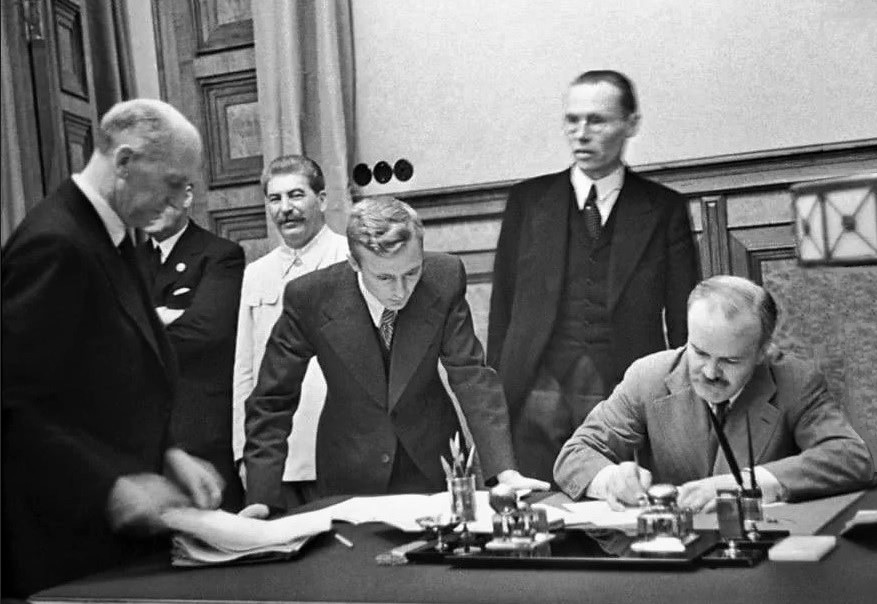
Translation of the Russian caption for this image:
People’s Commissar of Foreign Affairs of the USSR V.M. Molotov signs a friendship and border treaty between the USSR and Germany. Among those present: I.V. Stalin, translator of the Ministry of Foreign Affairs V.N. Pavlov, German diplomat G. Hilger (“truncated” version of the photograph of M. Kalashnikov distributed on the net)
Photograph attributed to Mikhail Mikhaylovich Kalashnikov (1906-1944) via Wikimedia Commons.
Stalin was always interested in a war, especially one that would pit the other powers against each other. The expansion of Soviet influence and control required the weakening of the other powers, in particular the Western ones that were opposed to the Communist virus. For Stalin, therefore, the growth of Nazi Germany was a great opportunity: a violent and expansionistic power in the middle of Europe that could take the first swing against the polities standing on his path. Unsurprisingly, the Soviet tyrant was deeply disappointed when France and Britain signed the Munich Agreement with Nazi Germany in 1938 postponing the great European war that he desired. The 1939 Ribbentrop-Molotov Pact coordinated the efforts of Hitler and Stalin, but it benefited the latter more, allowing him to conquer a large swath of Polish territory with minimal effort, eliminating one of the staunchest opponents to Russian westward expansion. A year later, by murdering almost 22,000 Polish officers in Soviet captivity, Stalin further weakened the Polish obstacle to his expansion. “Nations which had been ruled by powerful aristocracies,” Stalin told once to the Yugoslav Milovan Djilas, “like the Hungarians and the Poles, were strong nations” — and, fearing them, he sought to eliminate them. Then, while Germany invaded France, Stalin took over the three Baltic states in a further step westward.
Hitler’s decision to invade Russia in mid-1941 was a surprise to Stalin, but not because he was expecting a lasting peace on his western frontier. Rather, as McMeekin documents, Stalin had ordered very rapid and large military preparations, building airbases and placing forces near the border with the Third Reich in the first half of 1941. None of them were in a defensive posture, and presented a vulnerable high value target to Nazi attacks. When Hitler decided to attack the USSR in June 1941, these Soviet forces were easy pickings for the well-organized, trained, and war tested German army. McMeekin here expands and amends a bold thesis offered in 1990 by Viktor Suvorov, a pseudonym for a GRU agent who defected to the West in the late ’70s and became a historian, that argued that Stalin was actively planning an attack on Germany but was preempted by Hitler. While Suvorov was excessive in his claim that the Red Army was ready for an offensive campaign in 1941 (because, among other reasons, the officer corps was still in shambles after Stalin’s purges) and that Stalin had plans to conquer Europe, he argued that the USSR was never a status quo power satisfied in its borders. After all Soviet Russia had already attempted to march westward in 1920 and was stopped only by the Poles in a desperate battle near Warsaw (the “Miracle on the Vistula”). This westward vector and ambition of Moscow did not abate, and had to pause because of Hitler’s rise and the might of Nazi Germany. As McMeekin points out, the Soviet military posture in 1941 makes no sense if the goal was to defend Soviet-held lands, suggesting that Stalin was thinking of pouncing on Berlin, now the last remaining continental power in Europe. As the Soviet tyrant himself put it, the USSR no longer needed to be locked in a defensive posture, and was “a rapacious predator, coiled in tense anticipation, waiting for the chance to ambush its prey.”
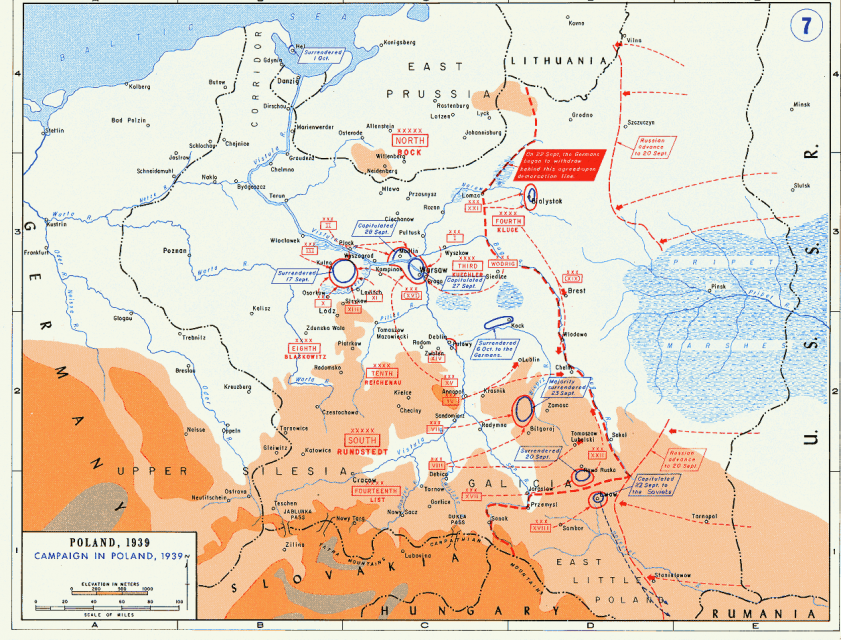
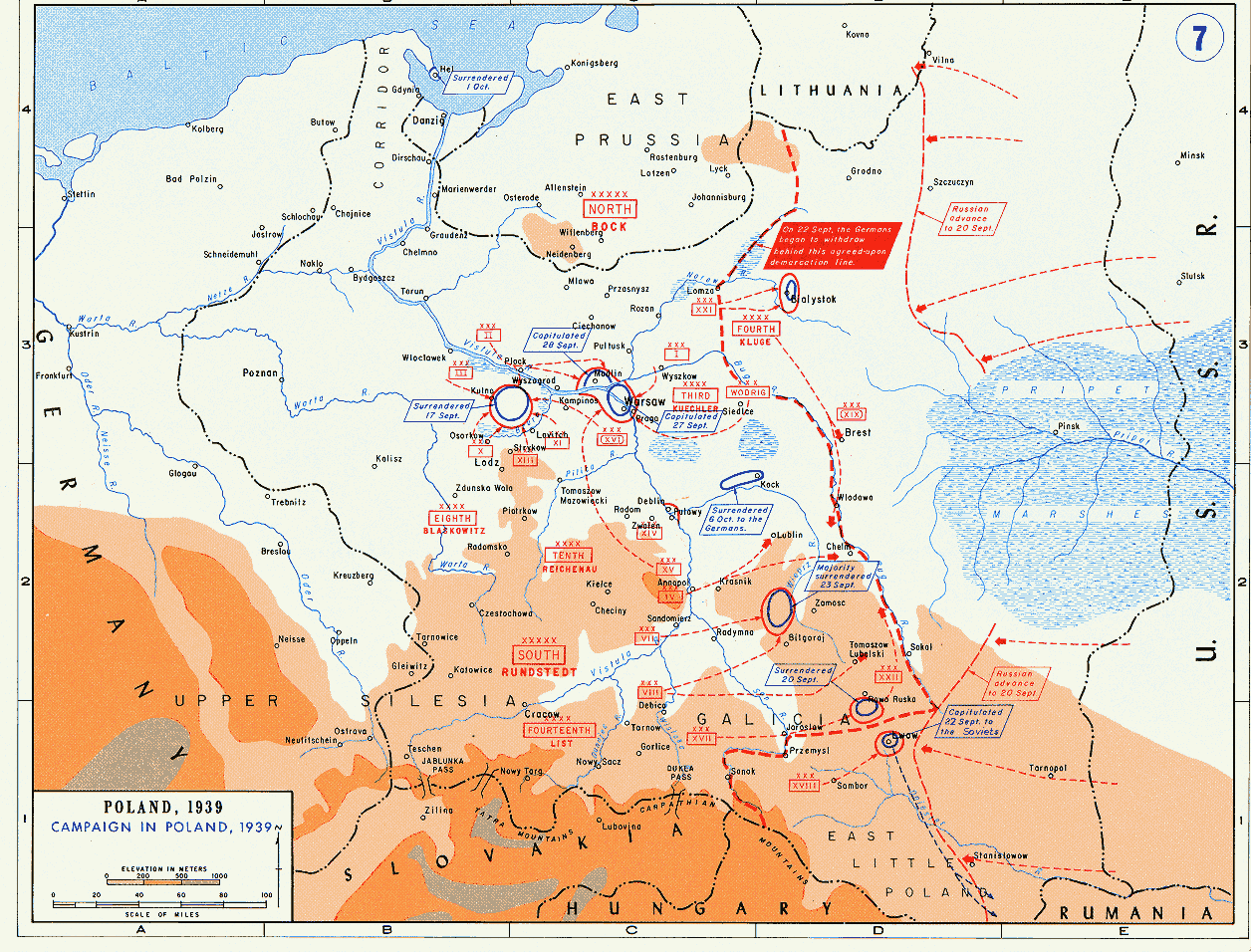
Military situation in Poland, 14 September 1939 (map does not show Slovak Army activity in southern Poland).
United States Military Academy, Department of History via Wikimedia Commons.
Stalin, that is, was not an innocent victim of Hitler. Not only he was an active partner from 1938 until 1941, but also he had geopolitical aspirations that were more ambitious than those held by Hitler. And he pursued them methodically and ruthlessly, leaving a trail of death that dwarfed the one produced by the Nazis.
McMeekin then focuses on how the Western allies, Churchill but especially FDR, abetted Stalin’s ambitions. This part of the book is fascinating and depressing at the same time. In a nutshell, Stalin obtained from FDR more than he expected: territory, influence, and materiel. And he did not give anything in exchange for it because FDR and his advisors never asked him for it. For instance, FDR supported the Lend-Lease program, putting his friend Harry Hopkins in charge. Under this program of military aid, the United States supplied a massive amount of weapons, trucks, airplanes, tanks, foodstuff to the Soviet Union in the months of its greatest need, as German troops were driving deep into Russia while the vaunted Soviet armies were melting away. Without such aid, the USSR would have likely been unable to stop the German onslaught and certainly would have been incapable of mustering the resources necessary to push westward. Hence, in this moment there was a good strategic rationale for the American support of Stalin’s defensive efforts against Nazi Germany.
Prior to the launch of Operation Barbarossa, you’d have been hard-pressed to find a more anti-Soviet leader than Winston Churchill, but he immediately recognized that Stalin was more useful to the British as an ally than as a passive enemy. Earlier this year, McMeekin wrote that Stalin “could not have asked for a friendlier British government” than Churchill’s wartime coalition. As Connor Daniels wrote in response at The Churchill Project:
![]()
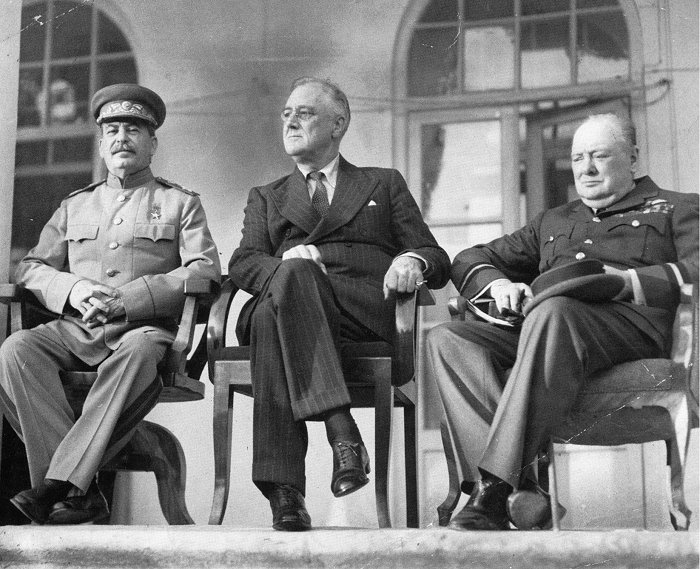
The “Big Three” meet at Tehran, 28 November-1 December, 1943.
Photo attributed to US Army photographer, via Wikimedia Commons.
Churchill’s support for Stalin during the Second World War followed from a simple calculus of the lesser of two evils. Britain could only take on one evil empire at a time, and, of the two, Churchill believed that Nazi Germany posed the greater threat to liberty. He famously remarked, “If Hitler invaded Hell I would make at least a favourable reference to the Devil in the House of Commons.” McMeekin attempts to sidestep this harsh reality, writing: “Whether or not the payoff was worth the price is a question well worth debating.” Churchill’s alliance with the Soviets stands or falls on this question: was Nazi Germany or the Soviet Union the greater danger in 1939?
With hindsight, one can easily marshal facts that portray Soviet communism as the greater evil. According to the best available estimates, the Stalin regime killed 20 millions of its own citizens. Nearly six million of those deaths occurred during the 1932–33 famine brought about by Stalin’s collectivization policies. While Nazi Germany also killed 17 million civilians, most of those deaths occurred after Hitler’s invasion of the Soviet Union in 1941. Thus, on the eve of the Second World War, one could argue — as Chamberlain and the appeasers did — that Nazi Germany served as a useful bulwark against a greater danger: the Soviet Union.
This analysis, however, misses a crucial point — one that Churchill recognized. Until 1939, the horrors of the Soviet regime had been primarily restricted to its own borders, while Nazi Germany had already made its expansionist ambition clear. In 1938, Germany annexed Austria. Later that year, Germany seized the Sudetenland. In 1939, the rest of Czechoslovakia passed under Hitler’s control. The Nazi doctrine of Lebensraum dictated even greater expansion. By contrast, Stalin’s doctrine of “socialism in one country” had kept the Soviet Union relatively peaceful until the Second World War began.