
World War Two
Published 22 Dec 2022Two escapes, one from the Nazis in Kovno (Kaunas) Lithuania, from the prison at Fort IX, and one from Japanese terror on Panay in the Philippines this week, will help to document the crimes of the Axis powers.
(more…)
December 23, 2022
A Jungle Miracle – War Against Humanity 092
December 22, 2022
It may have taken most of the year, but Canada finally figured out its Ukraine position
In The Line, Andrew Potter theorizes that the Canadian government finally “got it right” on Ukraine, but only after having exhausted all the other possibilities:
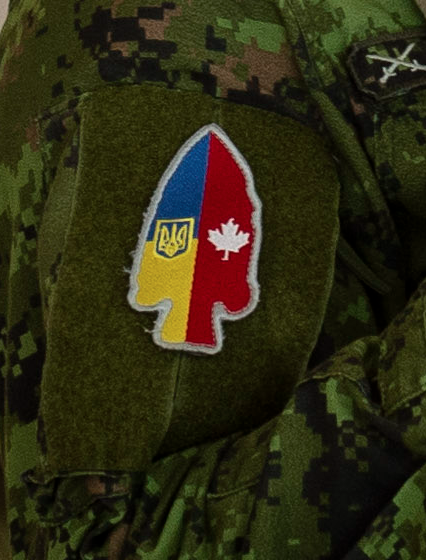
Operation Unifier shoulder patch for Canadian troops in Ukraine.
Detail from a photo in the Operation Unifier image gallery.
When Russia started massing troops on the border in Ukraine this time last year, Canada was one of the first Western countries to close its embassy in Kyiv, moving everyone to Lviv on February 12. Hours after Russia launched its illegal, insane, nihilistic, genocidal full invasion of Ukraine on February 24, all non-Ukrainian employees of our embassy scooted across the border into Poland.
For months after the invasion, that highly risk-averse attitude infected every aspect of Canada’s approach to helping Ukraine. Whether it was diplomacy (hesitant), military aid (slow and limited), financial support (inadequate) or straight-up moral fortitude (lacking), the Trudeau government made it clear that it would do the least amount necessary, while taking the most credit possible, in supporting Ukraine.
[…]
The weird thing about Canada’s foot-draggy-as-she-goes approach to helping Ukraine is how little sense it made politically, for both domestic and international audiences. Canada has one of the largest Ukrainian diaspora populations in the world. We were the first Western country to recognize Ukrainian independence in 1991. The deputy prime minister of Canada is half Ukrainian and has been a loud supporter of the country for years. Privately and publicly, our allies were pleading for us to do more.
Who knows what it was that finally shook some sense into the Trudeau government. Maybe it was Freeland, maybe it was a call from Uncle Joe Biden, maybe it was just a sense in the PMO that, having exhausted all other options, the only thing left to do was the right thing. Whatever it was, over the last three or four months, Canada is finally punching its weight on the global stage on the Ukraine file. In particular, we seem to have finally figured out that the best way to help is to provide the sorts of support that draws on our strengths.
So for example, while the handful of M777 howitzers we sent were certainly useful (and the ammunition we’re continuing to supply will be well spent) we’re never going to compete with the Americans or Brits when it comes to heavy arms supplies. That’s why, back in October, it was probably more helpful for us to send 400,000 pieces of winter gear and to provide a few million dollars worth of satellite communications to the Ukrainians through Telesat. And it was great to see Canada re-engage with its training commitments to the Ukrainian armed forces through the deployment of 40 combat engineers to train Ukrainian sappers in Poland, to complement our ongoing training of recruits in the U.K.
December 19, 2022
Napoleon’s Downfall: German Wars of Liberation 1813
Real Time History
Published 16 Dec 2022After Napoleon’s defeat in Russia in 1812, the situation on the European continent is rapidly shifting. Prussia and Austria are leaving their unhappy alliance with the French. Prussian general Yorck even pledges his support to the Russian Army which is on the move towards Berlin. At Lützen and Bautzen Napoleon still manages to beat the new coalition, but his losses from Russia put him on the backfoot.
(more…)
December 18, 2022
A Super Bomber to Break Japan – WW2 – 225 – December 17, 1943
World War Two
Published 17 Dec 2022This war has now lasted as long as the Great War did, but there’s no signs of it slowing. The Soviets have three offensives going on on the Eastern Front, in Italy the Allies are attacking at San Pietro and over the Moro River, in the Pacific there are Allied landings on New Britain, but in Pacific Command, the big talk is all about a new super bomber.
(more…)
December 17, 2022
The RAF’s Worst Day of the War – War Against Humanity 091
World War Two
Published 15 Dec 2022The United Nations Allies has some success bombing the Nazi German Reich, but it comes at a heavy price. In the village Kalavryta in Greece, the Wehrmacht massacre hundreds of men and boys.
(more…)
December 14, 2022
The Polish Armed Forces in Exile
World War Two
Published 13 Dec 2022The Polish state was the first to fall in this war, yet across the globe Polish soldiers are fighting on land, air, and sea as part of the United Nations alliance. The story of the tens of thousands of men and women fighting for Polish liberation is equal parts hope and hardship as they battle the enemy and even sometimes their own allies.
(more…)
December 11, 2022
An Amphibious Landing to take Rome? – 224 – December 10, 1943
World War Two
Published 10 Dec 2022There are plans afoot to hit the enemy from behind in Italy. Allied leaders are meeting again in Cairo to go over other plans, notably what to do about China and Burma. There is active fighting on two fronts in Italy too, though this week it doesn’t go particularly well for the Allies. Attacks in the USSR are unsuccessful for the Soviets, but do go well for the Germans, and there are Allied attacks by air in the Marshall Islands and over France.
(more…)
December 8, 2022
Is the Luftwaffe Defeated in 1943? – WW2 Documentary Special

World War Two
Published 7 Dec 2022Outnumbered and outproduced, the once mighty Luftwaffe is battling to hold its own across three fronts. Every month brings new pain for the force. But the Luftwaffe still has a few tricks up its sleeves and can make the Allies bleed heavily. If only Hitler and the Nazi leadership weren’t sabotaging its chances …
(more…)
December 6, 2022
The coming of the Korean War
In Quillette, Niranjan Shankar outlines the world situation that led to the outbreak of the Korean War in 1950:

Initial phase of the Korean War, 25 June through 5 August, 1950.
Map from the West Point Military Atlas — https://www.westpoint.edu/academics/academic-departments/history/korean-war
The Korean War was among the deadliest of the Cold War’s battlegrounds. Yet despite yielding millions of civilian deaths, over 40,000 US casualties, and destruction that left scars which persist on the peninsula today, the conflict has never received the attention (aside from being featured in the sitcom M*A*S*H) devoted to World War II, Vietnam, and other 20th-century clashes.
But like other neglected Cold War front-lines, the “Forgotten War” has fallen victim to several politicized and one-sided “anti-imperialist” narratives that focus almost exclusively on the atrocities of the United States and its allies. The most recent example of this tendency was a Jacobin column by James Greig, who omits the brutal conduct of North Korean and Chinese forces, misrepresents the underlying cause of the war, justifies North Korea’s belligerence as an “anti-colonial” enterprise, and even praises the regime’s “revolutionary” initiatives. Greig’s article was preceded by several others, which also framed the war as an instance of US imperialism and North Korea’s anti-Americanism as a rational response to Washington’s prosecution of the war. Left-wing foreign-policy thinker Daniel Bessner also alluded to the Korean War as one of many “American-led fiascos” in his essay for Harper’s magazine earlier this summer. Even (somewhat) more balanced assessments of the war, such as those by Owen Miller, tend to overemphasize American and South Korean transgressions, and don’t do justice to the long-term consequences of Washington’s decision to send troops to the peninsula in the summer of 1950. By giving short shrift to — or simply failing to mention — the communist powers’ leading role in instigating the conflict, and the violence and suffering they unleashed throughout it, these depictions of the Korean tragedy distort its legacy and do a disservice to the millions who suffered, and continue to suffer, under the North Korean regime.
Determining “who started” a military confrontation, especially an “internal” conflict that became entangled in great-power politics, can be a herculean task. Nevertheless, post-revisionist scholarship (such as John Lewis Gaddis’s The Cold War: A New History) that draws upon Soviet archives declassified in 1991 has made it clear that the communist leaders, principally Joseph Stalin and North Korean leader Kim Il-Sung, were primarily to blame for the outbreak of the war.
After Korea, a Japanese imperial holding, was jointly occupied by the United States and the Soviet Union in 1945, Washington and Moscow agreed to divide the peninsula at the 38th parallel. In the North, the Soviets worked with the Korean communist and former Red Army officer Kim Il-Sung to form a provisional “People’s Committee”, while the Americans turned to the well-known Korean nationalist and independence activist Syngman Rhee to establish a military government in the South. Neither the US nor the USSR intended the division to be permanent, and until 1947, both experimented with proposals for a united Korean government under an international trusteeship. But Kim and Rhee’s mutual rejection of any plan that didn’t leave the entire peninsula under their control hindered these efforts. When Rhee declared the Republic of Korea (ROK) in 1948, and Kim declared the Democratic People’s Republic of Korea (DPRK) later that year, the division was cemented. Each nation threatened to invade the other and began preparing to do so.
What initially prevented a full-scale attack by either side was Washington’s and Moscow’s refusal to provide their respective partners with support for the military reunification of the peninsula. Both superpowers had withdrawn their troops by 1949 to avoid being dragged into an unnecessary war, and the Americans deliberately withheld weapons from the ROK that could be used to launch an invasion.
However, Stalin began to have other ideas. Emboldened by Mao Zedong’s victory in the Chinese Civil War and frustrated by strategic setbacks in Europe, the Soviet premier saw an opportunity to open a “second-front” for communist expansion in East Asia with Beijing’s help. Convinced that Washington was unlikely to respond, Stalin gave Kim Il-Sung his long-sought “green-light” to reunify the Korean peninsula under communist rule in April 1950, provided that Mao agreed to support the operation. After Mao convinced his advisers (despite some initial difficulty) of the need to back their Korean counterparts, Red Army military advisers began working extensively with the Korean People’s Army (KPA) to prepare for an attack on the South. When Kim’s forces invaded on June 25th, 1950, the US and the international community were caught completely off-guard.
Commentators like Greig, who contest the communists’ culpability in starting the war, often rely on the work of revisionist historian Bruce Cumings, who highlights the perpetual state of conflict between the two Korean states before 1950. It is certainly true that there were several border skirmishes over the 38th parallel after the Soviet and American occupation governments were established in 1945. But this in no way absolves Kim and his foreign patrons for their role in unleashing an all-out assault on the South. Firstly, despite Rhee’s threats and aggressive posturing, the North clearly had the upper hand militarily, and was much better positioned than the South to launch an invasion. Whereas Washington stripped Rhee’s forces of much of their offensive capabilities, Moscow was more than happy to arm its Korean partners with heavy tanks, artillery, and aircraft. Many KPA soldiers also had prior military experience from fighting alongside the Chinese communists during the Chinese Civil War.
Moreover, as scholar William Stueck eloquently maintains, the “civil” aspect of the Korean War fails to obviate the conflict’s underlying international dimensions. Of course, Rhee’s and Kim’s stubborn desire to see the country fully “liberated” thwarted numerous efforts to establish a unified Korean government, and played a role in prolonging the war after it started. It is unlikely that Stalin would have agreed to support Pyongyang’s campaign to reunify Korea had it not been for Kim’s persistent requests and repeated assurances that the war would be won quickly. Nevertheless, the extensive economic and military assistance provided to the North Koreans by the Soviets and Chinese (the latter of which later entered the war directly), the subsequent expansion of Sino-Soviet cooperation, the Stalinist nature of the regime in Pyongyang, Kim’s role in both the CCP and the Red Army, and the close relationship between the Chinese and Korean communists all strongly suggest that without the blessing of his ideological inspirators and military supporters, Kim could not have embarked on his crusade to “liberate” the South.
Likewise, Rhee’s education in the US and desire to emulate the American capitalist model in Korea were important international components of the conflict. More to the point, all the participants saw the war as a confrontation between communism and its opponents worldwide, which led to the intensification of the Cold War in other theaters as well. The broader, global context of the buildup to the war, along with the UN’s authorization for military action, legitimized America’s intervention as a struggle against international communist expansionism, rather than an unwelcome intrusion into a civil dispute among Koreans.
December 4, 2022
Operation Overlord Confirmed at Teheran – WW2 – 223 – December 3, 1943
World War Two
Published 3 Dec 2022The Teheran Conference is in full swing and the Allied leadership and plan for a cross channel invasion of Europe is agreed upon by Stalin, Churchill, and Roosevelt. There are new Allied attacks across Italy, but at Bari a German air raid releases deadly poison gas.
(more…)
December 1, 2022
Crisis? Which crisis?
In The Line, Matt Gurney makes the case that was NATO (and western governments in general) needs is something called “deliverology”:
I couldn’t have asked for a more topical example of exactly what I’m talking about here: the lull between realization and reaction. There were no problems with “expectations” at the top of the federal government in February [during the Freedom Convoy 2022 protests]. Everyone in a position of authority was seized with the urgency of the situation and the need for rapid action. There wasn’t any denial, doubt or incomprehension, which are the usual enemies when I write about our expectations being a problem.
February was an example of a different issue: realizing there was a crisis but not really knowing what to do about it, or whose job it was to do it, and wasting a lot of precious time trying to figure it all out. When days and even hours count, governments can’t spend weeks or months figuring out what to do. But that’s what happened during the convoys, and during COVID, and other incidents I could rattle off. Does anyone think it won’t happen again next time, whatever that threat may be?
And some version of that concern came up over and over in Halifax [at the Halifax International Security Forum]. And not just among Canadians. The world is changing very quickly and even when we recognize a problem, we aren’t moving fast enough to keep up. So on top of our expectations, we’ve got another challenge: response times. They’re just too damned long.
I hope the readers will forgive me for being a little vague in this next section; some of the conversations I’m thinking of here were in off-the-record sessions. Rather than trying to splice together any specific quote or anecdote, I’ll just wrap it all up under the theme of “There are things we should be doing now that we weren’t, and things we should have been doing a long time ago that we only started on way too late.”
An obvious example? The rush to get Europe off of Russian fossil fuels and on to either locally generated renewables or energy imports from allies and friendly nations. (If only there was a “business case” for Canada doing more. Sigh.) Another fascinating example that came up was air defences. Two decades of post-Cold-War-style thinking among the allies has led to widespread neglect among the NATO countries of air-defence weapons. Why bother? The Taliban didn’t have an air force, right?
Most countries have fighter jets and inventories of air-to-air missiles suitable for their planes. However, across the alliance, there are very few ground-based air-defence systems suited to shooting down not just attacking aircraft, but incoming cruise missiles and drones.
Drones pose a particular challenge. They fly slow and low and are highly manoeuvrable, plus they are so cheap that they can be a true asymmetrical weapon: you’ll go broke real quick firing million-dollar missiles at a drone that costs your enemy $50,000 or so. And your enemy may send a few hundred at once in a swarm that simply overwhelms your defences. It’s not that drones are unbeatable. The opposite is true: drones are easily destroyed, if you have the right defences available.
We don’t, though. Oops.
The NATO powers actually had a preview of this element of the ongoing war between Ukraine and Russia during the 2020 conflict between Azerbaijan and Armenia, where drones were used to devastating effect. Every military affairs watcher I know sat up a bit straighter after watching what the Azeris did to Armenia, with shocking speed. Swarms of drones first killed Armenia’s air defences and then went to work on Armenian ground forces. The U.S. and NATO allies have been studying that conflict, and considering how to adapt our own strategies, for both offence and defence. But right now, nine months into the Ukraine war and two years after the conflict in the Caucasus, there still aren’t enough NATO systems available even for our own needs, let alone to share with Ukraine. Russia keeps hammering away at critical Ukrainian civilian infrastructure and the Ukrainians keep begging for help, but we have nothing to send. To be clear, a few systems have been sent to Ukraine, which include not just the weapons but the radars and computers necessary to detect and engage targets. But they can only be delivered as fast as they can be built. There is no real production pipeline here, and certainly no pre-stocked inventories in NATO armouries.
November 29, 2022
Near Peer: Russia
Army University Press
Published 25 Nov 2022AUP’s Near Peer film series continues with a timely discussion of Russia and its military. Subject matter experts discuss Russian history, current affairs, and military doctrine. Putin’s declarations, advances in military technology, and Russia’s remembrance of the Great Patriotic War are also addressed. “Near Peer: Russia” is the second film in a four-part series exploring America’s global competitors.
November 27, 2022
The Costliest Day in US Marine History – WW2 – 222 – November 26, 1943
World War Two
Published 26 Nov 2022The Americans attack the Gilbert Islands this week, and though they successfully take Tarawa and Makin Atolls, it is VERY costly in lives, and show that the Japanese are not going to be defeated easily. They also have a naval battle in the Solomons. Fighting continues in the Soviet Union and Italy, and an Allied conference takes place in Cairo, a prelude for a major one in Teheran next week.
(more…)
Aleksandr Solzhenitsyn and One Day in the Life of Ivan Denisovich
In Quillette, Robin Ashenden discusses the life experiences of Aleksandr Slozhenitsyn that informed the novel that made him famous:
The book was published less than 10 years after the death of Joseph Stalin, the dictator who had frozen his country in fear for nearly three decades and subjected his people to widespread deportation, imprisonment, and death. His successor Nikita Khrushchev — a man who, by his own admission, came to the job “elbow deep in blood” — had set out on a redemptive mission to liberalise the country. The Gulags had been opened and a swathe of prisoners freed; Khrushchev had denounced his predecessor publicly as a tyrant and a criminal and, at the 22nd Party Congress in October 1961, a full programme of de-Stalinisation had been announced. As for the Arts, previously neutered by the Kremlin’s policy of “Socialist Realism” — in which the values of Communism had to be resoundingly affirmed — they too were changing. Now, a new openness and a new realism was called for by Khrushchev’s supporters: books must tell the truth, even the uncomfortable truth about Communist reality … up to a point. That this point advanced or retreated as Khrushchev’s power ebbed and flowed was something no writer or publisher could afford to miss.
Solzhenitsyn’s book told the story of a single day in the 10-year prison-camp sentence of a Gulag inmate (or zek) named Ivan Denisovich Shukhov. Following decades of silence about Stalin’s prison-camp system and the innocent citizens languishing within it, the book’s appearance seemed to make the ground shake and fissure beneath people’s feet. “My face was smothered in tears,” one woman wrote to the author after she read it. “I didn’t wipe them away or feel ashamed because all this, packed into a small number of pages … was mine, intimately mine, mine for every day of the fifteen years I spent in the camps.” Another compared his book to an “atomic bomb”. For such a slender volume — about 180 pages — the seismic wave it created was a freak event.
As was the story of its publication. By the time it came out, there was virtually no trauma its author — a 44-year-old married maths teacher working in the provincial city of Ryazan — had not survived. After a youth spent in Rostov during the High Terror of Stalin’s 1930s, Solzhenitsyn had gone on to serve eagerly in the Red Army at the East Prussian front, before disaster struck in 1945. Arrested for some ill-considered words about Stalin in a letter to a friend, he was handed an eight-year Gulag sentence. In 1953, he was sent into Central Asian exile, only to be diagnosed with cancer and given three weeks to live. After a miraculous recovery, he vowed to dedicate this “second life” to a higher purpose. His writing, honed in the camps, now took on the ruthless character of a holy mission. In this, he was fortified by the Russian Orthodox faith he’d rediscovered during his sentence, and which had replaced his once-beloved, now abandoned Marxism.
Solzhenitsyn had, since his youth, wanted to make his mark as a Russian writer. In the Gulag, he’d written cantos of poetry in his head, memorized with the help of matchsticks and rosary beads to hide it from the authorities. During his Uzbekistan exile, he’d follow a full day’s work with hours of secret nocturnal writing about the darker realities of Soviet life, burying his tightly rolled manuscripts in a champagne bottle in the garden. Later, reunited with the wife he’d married before the war, he warned her to expect no more than an hour of his company a day — “I must not swerve from my purpose.” No friendships — especially close ones — were allowed to develop with his fellow Ryazan teachers, lest they take up valuable writing time, discover his perilous obsession, or blow his cover. Subterfuge became second nature: “The pig that keeps its head down grubs up the tastiest root.” Yet throughout it all, he was sceptical that his work would ever be available to the general public: “Publication in my lifetime I must put out of my mind.”
After the 22nd Party Congress, however, Solzhenitsyn recognised that the circumstances were at last propitious, if all too fleeting. “I read and reread those speeches,” he wrote later, “and the walls of my secret world swayed like curtains in the theatre … had it arrived, then, the long-awaited moment of terrible joy, the moment when my head must break water?” It seemed that it had. He got out one of his eccentric-looking manuscripts — double-sided, typed without margins, and showing all the signs of its concealment — and sent it to the literary journal of his choice. That publication was the widely read, epoch-making Novy Mir (“New World”), a magazine whose progressive staff hoped to drag society away from Stalinism. They had kept up a steady backwards-forwards dance with the Khrushchev regime throughout the 1950s, invigorated by the thought that each new issue might be their last.



