
Tasting History with Max Miller
Published 2 Sept 2025Large, gingery loaf of bread
City/Region: England
Time Period: 1857In order to make expensive wheat flour go further, Victorian bakers added things to it of varying edibility. While potato, corn, and pea flour were used, so was ground up plaster of paris, chalk dust, and a powder called alum. Alum made the flour very white, but is also toxic in large quantities.
This loaf, made only with wholesome, edible ingredients, would have been on the fancier side of a bakery’s offerings with the addition of lots and lots of powdered ginger. This bread really surprised me, as it tastes like a normal loaf of bread at first, but then the heat and the flavor of the ginger comes through afterwards.
Ginger Loaf, or Rolls.
Mix intimately two ounces of good powdered ginger, — called in the shops prepared ginger, — and a little salt, with two pounds of flour, and make it into a firm but perfectly light dough with German or brewer’s yeast, [and 1 pint milk] in the usual manner; [to rise one hour or until quite light: to be kneaded down and left again to rise until light]. Bake it either in one loaf, or divide it into six or eight small ones.
The proportion of ginger can be much increased if desired; but the bread should not then be habitually eaten for a long continuance, as the excess of any stimulating condiment is often in many ways injurious.
— The English Bread-Book by Eliza Acton, 1857
March 3, 2026
The Deadly Job of a Victorian Baker
QotD: The rise of archives-based history in the late Middle Ages
Along with this, you see a growing respect for numbers [in the 15th century]. Medieval statistics are Rachel Maddowesque — whatever they felt they needed to say to get the job done. “We were opposed by fifty thousand Saracens” could mean anything from “bad guys as far as the eye could see” to “we were slightly outnumbered” to “it just wasn’t our day, so we ran”. 15th century numbers aren’t what you’d call real factually accurate, but they’re getting there. 16th century numbers are usually in the ballpark, and you can usually cross-check them in various ways. There’s just a hell of a lot more paper in general, and that paper is a lot more scrupulous.
All of this, I suggest, is because people increasingly thought factual accuracy was important. And that only comes with the increasing sense of linear time. The chronicles of the first two or three Crusades, for instance, are filled with wild exaggerations and impossible claims … but they’re not lies. They just serve a different purpose. They’re called “histories”, but that’s a misleading translation (of the word historia, I’ll admit). What they really are is much closer to exempla — saints’ lives, that kind of thing. Their point isn’t “This and that actually happened”; it’s more like “Let us all praise God, for the wondrous things he allowed us to do!”
Gesta Francorum means “deeds of the French”, but in the sense of “The wonders done in God’s name,” not “a list of battles and their outcomes”.
Severian, “The Ghosts (II)”, Founding Questions, 2022-05-18.
March 2, 2026
QotD: King Stephen and “the anarchy”
At this point, I ought to mention that the year is 1120; the young man is William Adelin, heir to the throne of England; and the “ferry” is the infamous White Ship.
Anyway, back to the story: the wine keeps flowing and, before long, the crew are drunk too. Not far out of port, the ship hits a submerged rock and rapidly sinks.
In all, hundreds are drowned — and yet that is just the start of the tragedy.
William’s father, King Henry I, had gone to great lengths to proclaim an heir. As the son of William the Conqueror, he knew just how messy succession could get. He had himself inherited the throne from his brother, William Rufus. This second William had died of a chest complaint — specifically, an arrow in the lungs (the result of a hunting “accident”). Henry was determined that his son would inherit the throne without mishap — and so carefully prepared the ground for a smooth transfer. Indeed, the name “Adelin” signified that the third William was the heir apparent.
The sinking of the White Ship left Henry with one remaining legitimate heir, his daughter Matilda. She was a formidable character, also known as Empress Maud (by virtue of her first marriage to the Holy Roman Emperor). She was, nevertheless, a woman — a big problem in an age when monarchs were expected to lead their men in battle. When Henry died in 1135, Maud’s cousin — Stephen of Blois — seized the throne. This was widely welcomed by the English nobility, but Maud wasn’t giving up easily, and she had powerful allies. Her second husband was Geoffrey, Count of Anjou; her illegitimate half-brother, Robert of Gloucester, was a wealthy baron; and her uncle was King David I of Scotland.
Stephen was assailed on all sides — by Geoffrey in Normandy, by Robert in England, by invading Scots and rebellious Welshmen. The civil war (if that’s what you can call this multi-sided free-for-all) dragged on for almost 20 years. There weren’t many set-piece battles, but there was lots of looting and pillaging in which countless nameless peasants perished.
In the end it was the death of another heir — Stephen’s son, Eustace — that opened the way to peace. The war-weary king agreed that Maud’s son (the future Henry II) would succeed him. And thus “The Anarchy” came to end: two decades of pointless devastation — and all because some young fool got pissed on a boat.
Peter Franklin, “Why Boris needs an heir apparent”, UnHerd, 2020-08-17.
March 1, 2026
The American Revolutionaries – when you don’t want a king, but you do want someone king-ish
On Substack Notes, John Carter shared this post by Theophilus Chilton, saying:
Fascinating. The American founders were explicitly trying to revive a stronger form of monarchical executive authority with the presidency, as a deliberate corrective to the relatively powerless Crown of the British Constitution, which had been effectively neutered by the doctrine of parliamentary supremacy.
Along similar lines, the American Bill of Rights was in most ways simply a restatement of the ancient rights of Englishmen.
So, of course, I had to go read the post:
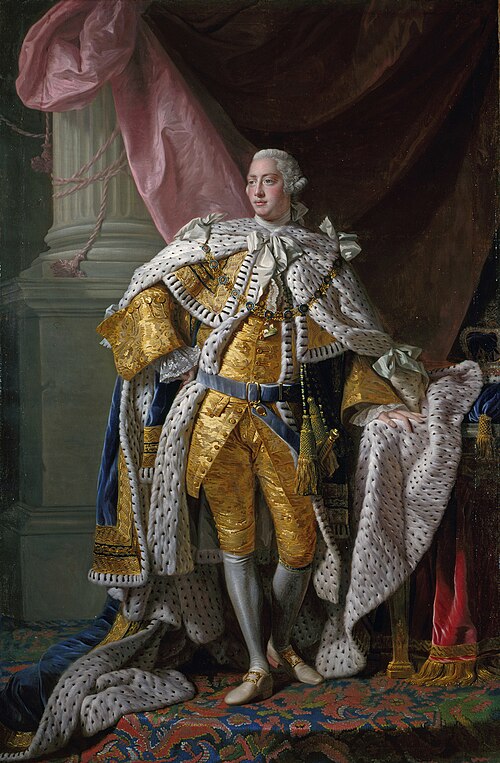
Too “kingly” but also not “kingly” enough for America’s Founding Fathers.
King George III in his Coronation robes.
Oil painting by Allan Ramsay (1713-1784) circa 1761-1762. From the Royal Collection (RCIN 405307) via Wikimedia Commons.
Recently, I’ve been reading an interesting book about 18th century political philosophy entitled The Royalist Revolution: Monarchy and the American Founding. In this work the author, Eric Nelson, guides the reader through the various aspects of the great inter-whiggish debates that roiled the American colonies prior to independence, and which then continued afterwards. One of the main premises is that a major faction within this debate — and indeed the one which ended up prevailing in the end — understood the relationship between colonies and mother country to be founded upon the king of Britain’s personal proprietorship over the colonies. This Patriot position was opposed by the Loyalist position which saw the colonies as existing under the laws and rule of Parliament.
Now this might seem strange to generations of Americans who grew up learning in school that the American revolutionaries fought against the great tyrant King George III who was set upon grinding the American colonies under his bootheel of oppression. That view would be quite surprising to many of the participants on the Patriot side, many of whom actually appealed to King George, both publicly and in private correspondence, to exercise kingly prerogative and overturn the various duties, laws, and taxes which Parliament had laid upon the colonies. This, indeed, was the crux of the Patriot argument, which is that because the colonies were originally founded under the personal demesne of the British King, they remained so even despite the temporary abolishment of the monarchy after the execution of Charles I in 1649. In the interregnum between that and the Glorious Revolution and restoration of a stable monarchy that was accepted by all classes as legitimate in 1688, Parliament had illegitimately usurped authority over the colonies. Because it was Parliament which was laying the Intolerable Acts and all the other complaints which the Americans had, it was Parliament against whom they wished to be protected.
But these Patriots were pining after a situation which no longer existed. In point of fact, the British kings since the Glorious Revolution had left whatever prerogative powers they might still have had unused. So it was with George III, who rejected the American colonists’ calls for him to intervene, knowing that doing so would have provoked a constitutional crisis in Britain which he would not have won. As a result, the American colonists chose to make their final break with the British monarchy and throw in their lot for independence, buttressed by Thomas Paine’s fleetingly persuasive but ultimately ineffectual pamphlet Common Sense.
However, after independence, the colonists were faced with providing their own governance. Initially, this was attempted under the Articles of Confederation, as well as their state constitutions, all of which were very whiggish in principle. They were also inadequate to the task. As every student who took high school civics knows, the solution to this was the Constitution of 1789.
Typically, students are taught that the new Constitution was designed to strengthen the ability of the federal government to handle the various issues that applied to the confederation of states as a whole. What we don’t generally hear, however, is that much of this included strengthening the roles and powers of the president to include several areas of prerogative powers which exceeded even the powers then available to the kings of Britain. The stock view of the Constitution is that it “was created to prevent anyone from getting too much power!” The actuality is that the Constitution was crafted, in part, to expand presidential power and create what was viewed at the time as a literally monarchical chief executive. Opponents of this described the proposed executive as “the foetus of monarchy”. Supporters often defended it on the basis that parliaments and congresses, if left unchecked by a strong executive whose interest was drawn from the body of the whole people, would themselves become the greatest threats to the liberties of the people.
The Founders who proposed this enhancement of the executive didn’t do this in a vacuum. Indeed, they had a century and a half of history about this very subject to draw from first-hand. Fresh in the collective mind of every Englishmen, both in the home country and in the colonies, were the English Civil Wars of the previous century. Beginning with the revolt of the parliamentarian army in 1642 through the regicide of Charles I in 1649, the protectorate of Oliver Cromwell, the attempted restoration of the House of Stuart under James II, until the final deposition of James and his replacement with William, Prince of Orange in the Glorious Revolution of 1688, Englishmen had a long series of examples from which to draw various conclusions.
So yes, they could see the parliamentarian excesses that took place during the Protectorate. Current in the collective national mind were the overreaches (whether real or imagined) of Parliament both during the interregnum and in the century since the acquisition of the throne by the House of Hanover. As noted above, among these overreaches, at least as viewed by many in the American colonies, was parliamentary interference in the affairs of the colonies, viewed as transgressions into the rightful domain of the king’s purview. Hence, by a strange twist, the Loyalists who opposed American independence before and during the Revolution were generally the more whiggish of the two sides, throwing in their lot with the parliamentary oligarchies. The Patriots, on the other hand, were desperately trying to get the king to reassert his royal prerogatives and intervene by reasserting his perceived rights to directly rule the colonies, something of a modified “high/low vs. the middle” type of scenario.
How to Serve the Oligarchs for Power – Death of Democracy 05 – Q1 1934
World War Two and Spartacus Olsson
Published 28 Feb 2026In Q1 1934, Nazi Germany reaches a breaking point. In this episode of Death of Democracy, Hitler codifies central control with the Law for the Reconstruction of the Reich, crushing what remains of federalism. Abroad, the German–Polish Non‑Aggression Pact (January 26, 1934) shocks Europe while rearmament continues behind a diplomatic mask.
Inside the Reich, the real story is the power struggle: SA chief Ernst Röhm demands a “people’s militia”, forcing Hitler to choose the Reichswehr over the stormtroopers — setting the stage for the Night of the Long Knives. As Himmler expands SS power and Goebbels tightens the propaganda screws, even historic liberal papers like the Vossische Zeitung disappear. Meanwhile, unemployment falls toward three million amid manipulated statistics, wage freezes, shortages, and a looming foreign‑currency crisis.
Watch, then comment: what warning signs do you see when “order” is used to justify permanent power?
(more…)
Demythologizing the Windrush story
The Empire Windrush was a British ship that brought the first batch of many, many Caribbean people to Britain in 1948. This has been hailed as the foundation of a modern, multicultural Britain by many pop historians and, weirdly, also the moral equivalent of the Jim Crow era of US racial relations. It’s a Two-fer, allowing progressives to celebrate the multicultural aspects and also to declaim and performatively protest against the racist aspects. Celina101 discusses the Windrush myths:
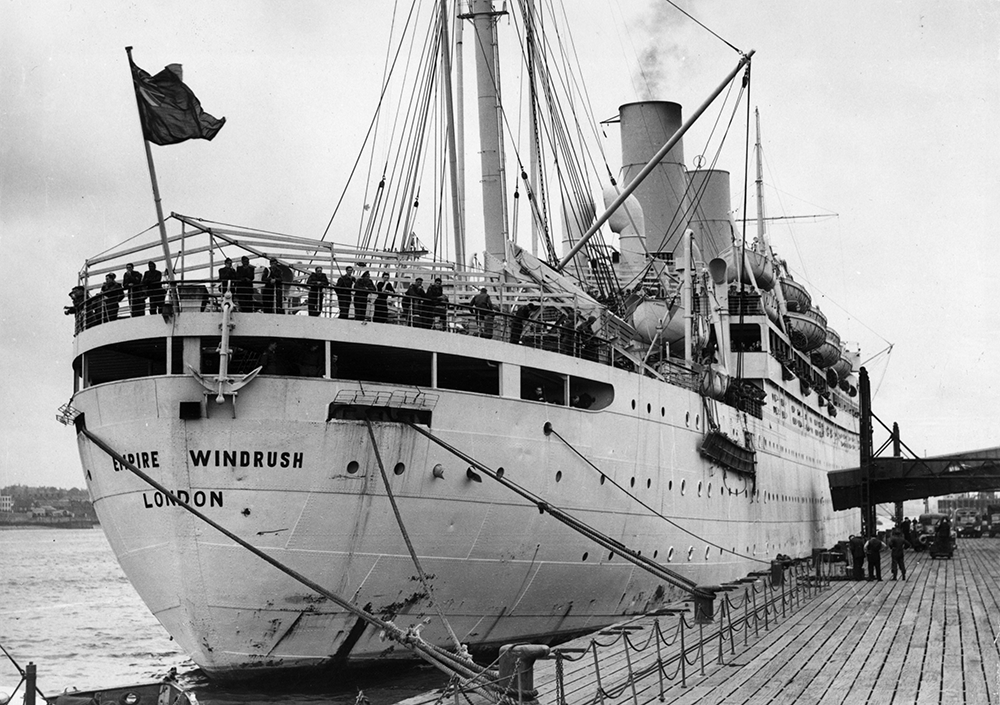
HMT Empire Windrush in harbour. Originally launched as the Hamburg Süd line’s Monte Rosa in 1930, seized for use as a British troopship in 1947 after WW2. She was lost after an engine room explosion and catastrophic fire in 1954 and sank in the Mediterranean.
In June 1948 the HMT Empire Windrush arrived at Tilbury carrying over 800 Caribbean passengers. Today this moment is often hailed beginning of modern multicultural Britain, the founding “origin story” of a tolerant, diverse cosmopolitan nation. Yet a deep dive into the archives shows a very different picture. The British Nationality Act of 1948 (passed just weeks after Windrush set sail) did create a universal status (“Citizen of the UK and Colonies”) that legally allowed colonial subjects to live in Britain. But as one colonial minister emphasised, this was meant to reaffirm an older imperial principle, that a subject could declare Civis Britannicus sum (“I am a British citizen”) regardless of colour and was not expected to trigger mass non-white immigration.1 In fact, Attlee’s government and senior civil servants were privately anxious about non-white migration, seeing Windrush as an “incursion” to be managed. Contemporary cabinet papers and correspondence reveal that Windrush was essentially an accident of imperial law and circumstance.
Imperial Citizenship and the 1948 Act
The post-war British state’s conception of citizenship was still shaped by empire. In theory, as Lord Palmerston had put it, every British subject “in whatever land he may be” could count on England’s protection.2 The 1948 British Nationality Act (BNA) codified this idea by creating two categories: Citizens of the UK & Colonies (CUKC) for the “non white” Commonwealth and Citizens of Independent Commonwealth Countries (CICC) for the white Dominions. As a Home Office historian notes, the Act was largely a reaction to Canada’s new Citizenship Act and was intended to preserve loyalty to the Crown and the Commonwealth.3 In practice, BNA 1948 did not fundamentally alter migration rules: colonial subjects remained British subjects with the right to enter the UK, as they had before. Critics at the time even pointed out that this laid the groundwork for subjects of a newly independent non-white India, Pakistan and African colonies to become CUKCs, but that eventuality was not central to the legislators’ intent.4 As David Olusoga and others have observed, no one in 1948 “imagined that black and brown people from Asia, Africa and the West Indies would use their rights under this act to come and settle in Britain”. The law was conceived primarily for white Commonwealth citizens like the populations of Canada and Australia, with the assumption that the British Empire’s non-white subjects, without the resources or need would not make the journey.5 In short, the legal framework of imperial citizenship was nominally open, but the political expectation was that few colonials would exercise the right to relocate.
[…]
Inventing the Myth: Windrush in National Memory
How, then, did Windrush attain the status of a proud national genesis myth? Over the ensuing decades the episode was reimagined and commemorated in ways that the original participants surely did not anticipate. As historian Simon Peplow notes, “the arrival of the Empire Windrush in 1948 has been cemented as a mythical central symbol for immigration in histories of modern Britain”.6 Newspaper narratives and politics in the 21st century cast the Windrush as the symbolic genesis of multicultural Britain. For example, literature and media (like Andrea Levy’s Small Island, 2004) linked the founding of a “shared history” to 1948, treating the Windrush landing as the first wave of a mass migration that made Britain what it is today.7 Over time this narrative was bolstered by public ceremonies: 50th- and 60th-anniversary events, the 1998 renaming of Brixton’s Windrush Square, and in 2018 the formal creation of a national Windrush Day (22 June) to “pay tribute” to the generation. Politicians and curriculum materials alike have repeated the line that Windrush marked the inception of modern Britain’s diversity.8
This retrospective framing treats the Windrush episode as a foundational myth, an origin story, and invoked to legitimise contemporary values of tolerance and diversity. In this constructed memory, loyal Caribbean war veterans returned to Mother Country to rebuild Britain, and British society (in hindsight) embraced them with open arms. Newsreel footage from 1948, often screened today, reinforces this sentimental image, the smiling Windrush passengers, calypso music, and patriotic commentary suggest an organised welcome.9 The reality was much, much more ambivalent.
- https://www.gov.uk/government/publications/the-historical-roots-of-the-windrush-scandal/the-historical-roots-of-the-windrush-scandal-independent-research-report-accessible#about-this-report
- Ibid
- Ibid
- Ibid
- https://www.theguardian.com/tv-and-radio/2019/jun/24/the-unwanted-the-secret-windrush-files-review-who-could-feel-proud-of-britain-after-this
- https://wrap.warwick.ac.uk/id/eprint/139720/1/WRAP-1997-Windrush-newspapers-Peplow-2020.pdf#:~:text=Abstract%3A%20The%20arrival%20of%20the,the%20manufactured%20centrality%20of%20this
- Ibid
- Ibid
- https://www.theguardian.com/commentisfree/2018/apr/22/windrush-story-not-a-rosy-one-even-before-ship-arrived
February 28, 2026
Corruption and red tape rise in lockstep
J.D. Tuccille notes that corruption — at least corruption being brought to our attention — is rising at the same rate as bureaucratic red tape. It’s almost as though there’s a correlation between making things harder to do and officials accepting “sweeteners” to make things easier to do …

At the moment, corruption investigations and trials of political figures are taking place in jurisdictions around the U.S. including Hawaii, Mississippi, and Washington, D.C. These aren’t isolated scandals; the latest edition of an international corruption index finds corruption worsening globally, with the United States earning its worst score to date. Given that corruption involves government officials peddling favors for compensation, it shouldn’t be surprising that evidence suggests the solution lies in reducing the power and role of the state.
[…]
Regulation Breeds Corruption
“EU regulation is not only becoming more cumbersome but it is also pilling in”, Oscar Guinea and Oscar du Roy of the European Centre for Political Economy wrote in 2024. “The amount of new regulation accumulated during the last years has been staggering.”
That matters. In its advice for reducing corruption, Transparency International emphasizes, “there is a broad consensus that unnecessary and excessive administrative requirements for complying with regulations create both incentives and opportunities for bribery and corruption”.
The means by which this occurs is logical enough. Government-imposed permitting and licensing requirements, administrative procedures, prolonged decision-making, and contract awards create a temptation to shorten delays and reduce costs by padding officials’ pockets. In many cases, selling exceptions becomes the real reason for red tape. That phenomenon applies to the entire world, including the United States.
In the U.S., the More Regulations, the More Bribery
In a paper published in the European Journal of Political Economy in 2020, Oguzhan Dincer of the Department of Economics at Illinois State University and Burak Gunalp of the Department of Economics at Turkey’s Cankaya University looked at the relative effects of federal regulations on the corruption levels in U.S. states.
“Power to enforce the regulations gives government officials power to extort bribes”, they wrote. “Government officials have an opportunity to extort bribes from the firms trying to enter an industry because they have the power to issue the industry licenses. They also have an opportunity to extort bribes from the incumbent firms by simply colluding with them and keeping the regulations unchanged and/or strengthening the regulations to increase the costs of entry for new firms. Finally, regulations and the discretionary power given to government officials to extract bribes create incentives for firms to operate in the unofficial economy.”
Specific to the U.S., they examined two decades of data to see how red tape affected the honesty of public officials.
What they found shouldn’t be surprising: “Using the U.S. Justice Department’s data on the number of federal convictions for the crimes related to corruption, and controlling for several economic and demographic variables, we find a positive and statistically significant relationship between federal regulations and corruption.”
The by-election in the British riding of Gorton and Denton
A few surprises in the outcome, although the expected winner — the Green Party — did manage to pick up the seat by pandering harder than anyone else for the Muslim vote (according to multiple sources). And, as Francis Turner points out, this may be a problem:
The Gorton and Denton by-election has happened, and as I predicted, Labour came third.
Though more people voted Labour than I expected (25% actual vs 10-15% prediction) and sadly not enough people were convinced to vote Reform so the Greens won. But, while turnout was lower than one might have hoped, there’s a real humdinger of an allegation that makes the Green victory very iffy.
Today we have seen concerningly high levels of family voting in Gorton and Denton. Based on our assessment of today’s observations, we have seen the highest levels of family voting at any election in our 10 year history of observing elections in the UK.
Family voting is not a term I’ve heard of before, but it is the situation where two voters either confer, collude or direct each other on voting. And obviously cases where one voter oversees the votes of more than one other person as well.
Democracy Volunteers, the organization making the allegation, is a reputable decade plus old organization and not a partisan one.
Democracy Volunteers is run by Dr John Ault, a former Liberal Democrat politician who has observed elections in countries including Britain, Sweden, Norway and Finland.
They give more detail on their webpage
2023 saw the enactment of the Ballot Secrecy Act, which made the practice of family voting more clearly a breach of the secret ballot, making it more enforceable by staff in polling stations. Signage is now available to discourage the practice. Signage was only seen in 45% of the polling stations observed.
The observer team saw family voting in 15 of the 22 polling stations observed, some 32 cases in total, nine cases in one polling station alone. The team observed a sample of 545 voters casting their vote – meaning 12% of those voters observed either caused or were affected by family voting.
Commenting John Ault, Director of Democracy Volunteers said;
“Today we have seen concerningly high levels of family voting in Gorton and Denton. Based on our assessment of today’s observations, we have seen the highest levels of family voting at any election in our 10 year history of observing elections in the UK.”
“We rarely issue a report on the night of an election, but the data we have collected today on family voting, when compared to other recent by-elections, is extremely high.”
“In the other recent Westminster parliamentary by-election in Runcorn and Helsby we saw family voting in 12% of polling stations, affecting 1% of voters. In Gorton and Denton, we observed family voting in 68% of polling stations, affecting 12% of those voters observed.”
[…]
The team also saw a number of voters taking photographs of their ballot papers and one voter being authorised to vote despite them already having been marked as voted earlier in the day.
What they do not say, unfortunately, is which polling stations they observed this in. We can guess. In fact the Torygraph reports that Reform has explicitly made the obvious accusation:
Nigel Farage, the Reform leader, said allegations of family voting raised “serious questions about the integrity of the democratic process in predominantly Muslim areas”.

I would imagine such things are happening all over the Anglosphere with the large increase in Muslim voters in recent years — many of whom may be voting for the first time, depending on their national origin. In the free-to-cheapskates portion of this post, Ed West considers the evolution of the UK Green Party from granola-eating no-nukes freaks into a consciously sectarian party aiming to leverage the rising Muslim vote:
A good pub quiz question in the year 2050 will go something like this: “True or false, the ‘green’ in the ‘Green Party’ originally referred to the environment”. By this point, the etymological origins of Britain’s sectional Islamic party will be as obscure as the relationship between British Conservatives and 17th century Irish bandits.
A key milestone, our mid-century quiz regular will inform his teammates, was the 2026 Gorton and Denton by-election in which the Greens stood neck and neck in a three-way race with Labour and Reform.
Eagle-eyed observers these past weeks will have noted how the once environment-focused party have been pitching at particular sections of “the community”, with campaign leaflets featuring candidate Hannah Spencer wearing a red and black keffiyeh while posing in front of a mosque.
Written in Urdu, the pamphlet calls for voters to: “Push the falling walls one more time. Labour must be punished for Gaza. Reform must be defeated and Green must be voted for. Vote for the Green Party for a strong Muslims voice.” Then it adds, in English, “Stop Islamophobia. Stop Reform.”
There was also an Urdu-language video linking Reform Party candidate Matt Goodwin and leader Nigel Farage with Donald Trump and ICE deportation raids. The video then cuts to Gaza, before showing Keir Starmer beside India’s Narendra Modi. Subtle stuff.
The video states in Urdu: “A cruel politician can win if we don’t vote Green to stop the Reforms … Workers, cleaners, drivers, mothers – it’s us who keep this area running. But the politicians are not working for us … The Reforms want to break up our communities. They want to deport families who have lived here for years, and they want to tax people born abroad even more. They give air to Islamophobia, and they put our safety and dignity at risk.”
[…]
Britain’s Green Party has historically been a thing of amusement to many, a bunch of harmless hippies and Quakers with wacky beliefs; at the time of their first breakthrough in the early 1990s their most high-profile figure was David Icke, then seen as an amusing crank with interests in new age mysticism and alternative medicine.
As traditional politics fractured, the Greens came to fill the space inhabited by high-education, low-income graduates, the group who most favour redistributive economics and highly progressive social policies. Yet political parties have no souls, as such, being merely vote-seeking businesses, and they go where the market is — and now they find the lowest hanging fruit in appealing to sectarian interests.
If decades of generous immigration policies have created constituencies where people vote along religious lines, and are more comfortable with the national language of Pakistan than English, there is nothing to stop someone appealing to that market. It’s within the rules of democracy, if not the spirit.
Gorton and Denton is among the increasing number of constituencies in which a candidate can win by appealing overtly to the Islamic vote; “Gaza independents” won 5 seats in 2024 and could win 10 or 12 by 2029 and 20 or 30 by the election that follows; after that, the ceiling is limited by high levels of segregation. This could be good news for the Green Party, if that’s the path they want to go down, and they certainly don’t seem to shy away from the prospect.
Polanski has welcomed the endorsement of the Muslim Vote, an organisation which instructs people how to cast their ballot along religious lines, even if adding the caveat that people should vote as individuals. In February he told PoliticsHome that “I think any organisation that wants to back the Green Party because they align with our values is something that I applaud and welcome”.

Lauri Torni Biography Part 1: Soldier of Three Armies
Forgotten Weapons
Published 3 Oct 2025Today is the first of a two-part biography on Finnish legend Lauri Törni, later known as Larry Thorne. He fought in the Winter War and Continuation War, and was awarded the Mannerheim Cross for his actions in the Continuation War. He also travelled to Germany between the two (and again after the Continuation War), spending some time with the German army. In the early 1950s he emigrated to the United States, joining the US Army and eventually serving several tours in Vietnam.
My guest today is Finnish writer and researcher Kari Kallonen, who has written several books on Törni and was kind enough to join me to share the man’s story …
(more…)
QotD: The “Balance of Terror” in the missile age
This also meant that a devastating nuclear “first strike” could now be delivered before an opponent would know it was coming, or at least on extremely short notice. A nuclear power could no longer count on having enough warning to get its nuclear weapons off before the enemy’s nuclear strike had arrived. Bernard Brodie grappled with these problems in Strategy in the Missile Age (1959) but let’s focus on a different theorist, Albert Wohlstetter, also with the RAND Corporation, who wrote The Delicate Balance of Terror (1958) the year prior.
Wohlstetter argued that deterrence was not assured, but was in fact fragile: any development which allowed one party to break the other’s nuclear strike capability (e.g. the ability to deliver your strike so powerfully that the enemy’s retaliation was impossible) would encourage that power to strike in the window of vulnerability. Wohstetter, writing in the post-Sputnik shock, saw the likelihood that the USSR’s momentary advantage in missile technology would create such a moment of vulnerability for the United States.
Like Brodie, Wohlstetter concluded that the only way to avoid being the victim of a nuclear first strike (that having the enemy hit you with their nukes) was being able to credibly deliver a second strike. This is an important distinction that is often misunderstood; there is a tendency to read these theorists (Dr. Strangelove does this to a degree and influences public perception on this point) as planning for a “winnable” nuclear war (and some did, just not these fellows here), but indeed the point is quite the opposite: they assume nuclear war is fundamentally unwinnable and to be avoided, but that the only way to avoid it successfully is through deterrence and deterrence can only be maintained if the second strike (that is, your retaliation after your opponent’s nuclear weapons have already gone off) can be assured. Consequently, planning for nuclear war is the only way to avoid nuclear war – a point we’ll come back to.
Wohlstetter identifies six hurdles that must be overcome in order to provide a durable, credible second strike system – and remember, it is the perception of the system, not its reality that matters (though reality may be the best way to create perception). Such systems need to be stable in peacetime (and Wohlstetter notes that stability is both in the sense of being able to work in the event after a period of peace, but also such that they do not cause unintended escalation; he thus warns against, for instance, just keeping lots of nuclear-armed bombers in the air all of the time), they must be able to survive the enemy’s initial nuclear strikes, it must be possible to decide to retaliate and communicate that to the units with the nuclear weapons, then they must be able to reach enemy territory, then they have to penetrate enemy defenses, and finally they have to be powerful enough to guarantee that whatever fraction do penetrate those defenses are powerful enough to inflict irrecoverable damage.
You can think of these hurdles as a series of filters. You start a conflict with a certain number of systems and then each hurdle filters some of them out. Some may not work in the event, some may be destroyed by the enemy attack, some may be out of communication, some may be intercepted by enemy defenses. You need enough at the end to do so much damage that it would never be worth it to sustain such damage.
This is the logic behind the otherwise preposterously large nuclear arsenals of the United States and the Russian Federation (inherited from the USSR). In order to sustain your nuclear deterrent, you need more weapons than you would need in the event because you are planning for scenarios in which some large number of weapons are lost in the enemy’s first strike. At the same time, as you overbuild nuclear weapons to counter this, you both look more like you are planning a first strike and your opponent has to estimate that a larger portion of their nuclear arsenal may be destroyed in that (theoretical) first strike, which means they too need more missiles.
What I want to note about this logic is that it neatly explains why nuclear disarmament is so hard: nuclear weapons are, in a deterrence scenario, both necessary and useless. Necessary, because your nuclear arsenal is the only thing which can deter an enemy with nuclear weapons, but that very deterrence renders the weapons useless in the sense that you are trying to avoid any scenario in which you use them. If one side unilaterally disarmed, nuclear weapons would suddenly become useful – if only one side has them, well, they are the “absolute” weapon, able to make up for essentially any deficiency in conventional strength – and once useful, they would be used. Humanity has never once developed a useful weapon they would not use in extremis; and war is the land of in extremis.
Thus the absurd-sounding conclusion to fairly solid chain of logic: to avoid the use of nuclear weapons, you have to build so many nuclear weapons that it is impossible for a nuclear-armed opponent to destroy them all in a first strike, ensuring your second-strike lands. You build extra missiles for the purpose of not having to fire them.
(I should note here that these concerns were not the only things driving the US and USSR’s buildup of nuclear weapons. Often politics and a lack of clear information contributed as well. In the 1960s, US fears of a “missile gap” – which were unfounded and which many of the politicians pushing them knew were unfounded – were used to push for more investment in the US’s nuclear arsenal despite the United States already having at that time a stronger position in terms of nuclear weapons. In the 1970s and 1980s, the push for the development of precision guidance systems – partly driven by inter-agency rivalry in the USA and not designed to make a first strike possible – played a role in the massive Soviet nuclear buildup in that period; the USSR feared that precision systems might be designed for a “counter-force” first strike (that is a first strike targeting Soviet nuclear weapons themselves) and so built up to try to have enough missiles to ensure survivable second strike capability. This buildup, driven by concerns beyond even deterrence did lead to absurdities: when the SIOP (“Single Integrated Operational Plan”) for a nuclear war was assessed by General George Lee Butler in 1991, he declared it, “the single most absurd and irresponsible document I had ever reviewed in my life”. Having more warheads than targets had lead to the assignment of absurd amounts of nuclear firepower on increasingly trivial targets.)
All of this theory eventually filtered into American policy making in the form of “mutually assured destruction” (initially phrased as “assured destruction” by Secretary of Defense Robert McNamara in 1964). The idea here was, as we have laid out, that US nuclear forces would be designed to withstand a first nuclear strike still able to launch a retaliatory second strike of such scale that the attacker would be utterly destroyed; by doing so it was hoped that one would avoid nuclear war in general. Because different kinds of systems would have different survivability capabilities, it also led to procurement focused on a nuclear “triad” with nuclear systems split between land-based ICBMs in hardened silos, forward-deployed long-range bombers operating from bases in Europe and nuclear-armed missiles launched from submarines which could lurk off an enemy coast undetected. The idea here is that with a triad it would be impossible for an enemy to assure themselves that they could neutralize all of these systems, which assures the second strike, which assures the destruction, which deters the nuclear war you don’t want to have in the first place.
It is worth noting that while the United States and the USSR both developed such a nuclear triad, other nuclear powers have often seen this sort of secure, absolute second-strike capability as not being essential to create deterrence. The People’s Republic of China, for instance, has generally focused their resources on a fewer number of systems, confident that even with a smaller number of bombs, the risk of any of them striking an enemy city (typically an American city) would be enough to deter an enemy. As I’ve heard it phrased informally by one western observer, a strategy of, “one bomb and we’ll be sure to get it to L.A.” though of course that requires more than one bomb and one doubts the PRC phrases their doctrine so glibly (note that China is, in theory committed to developing a triad, they just haven’t bothered to actually really do so).
Bret Devereaux, “Collections: Nuclear Deterrence 101”, A Collection of Unmitigated Pedantry, 2022-03-11.
February 27, 2026
The British Are Coming! – British Fighter Aces – WW2 Gallery 09
World War Two
Published 26 Feb 2026In this gallery special, we examine five of Britain’s leading fighter aces: Archie McKellar, James MacLachlan, Robert Stanford Tuck, John Braham, and James Edgar Johnson. From the Battle of Britain to night fighting, Intruder missions, and offensive sweeps over occupied Europe, their careers reflect the RAF’s transformation from desperate air defense to sustained air superiority.
These pilots did more than accumulate victory claims. Their experiences illuminate the evolution of air combat, showing how individual skill, technology, and strategy intersected in the broader history of the Second World War.
Which of these careers best captures the changing nature of air power in World War Two?
(more…)
February 26, 2026
The Decline and Fall of Sparta
toldinstone
Published 25 Feb 2026How Sparta, the most powerful Greek city-state, collapsed in only 20 years.
0:00 Introduction
0:38 Classical Sparta
1:29 Spartan politics
2:22 Helots
3:24 Population decline
4:37 Hubris
5:25 The Battle of Leuctra
6:42 Messenia liberated
7:35 Enter Macedon
8:08 Attempts at reform
9:08 Irrelevance
9:37 Roman Sparta
(more…)
QotD: “Naming of Parts” by Henry Reed
We had daily cleaning. And tomorrow morning,
We shall have what to do after firing. But today,
Today we have naming of parts. Japonica
Glistens like coral in all the neighboring gardens,
And today we have naming of parts.This is the lower sling swivel. And this
Is the upper sling swivel, whose use you will see,
When you are given your slings. And this is the piling swivel,
Which in your case you have not got. The branches
Hold in the gardens their silent, eloquent gestures,
Which in our case we have not got.This is the safety-catch, which is always released
With an easy flick of the thumb. And please do not let me
See anyone using his finger. You can do it quite easy
If you have any strength in your thumb. The blossoms
Are fragile and motionless, never letting anyone see
Any of them using their finger.And this you can see is the bolt. The purpose of this
Is to open the breech, as you see. We can slide it
Rapidly backwards and forwards: we call this
Easing the spring. And rapidly backwards and forwards
The early bees are assaulting and fumbling the flowers:
They call it easing the Spring.They call it easing the Spring: it is perfectly easy
If you have any strength in your thumb: like the bolt,
And the breech, the cocking-piece, and the point of balance,
Which in our case we have not got; and the almond blossom
Silent in all of the gardens and the bees going backwards and forwards,
For today we have the naming of parts.Henry Reed, 1942.
February 25, 2026
“Allyness” in the British military
I suspect anyone who has spent time in uniform out in the field (peacetime or wartime) would recognize these traits, but so far as I know only the British army and Royal Marines have a specific term for it:
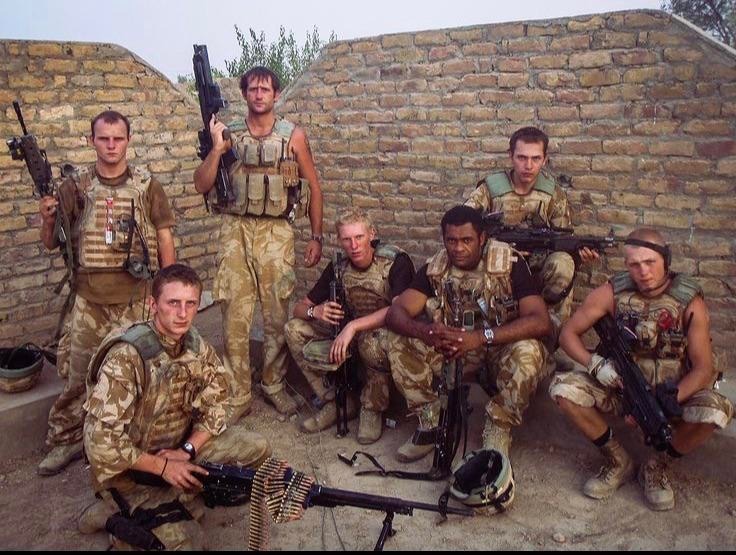
(British troops in Afghanistan, 2008, looking very ‘ally’)
Photo and caption from Combat Threads
Professor Andrew Groves is one of the few true academic experts on menswear. In fact, it was his work as the Director of the Westminster Menswear Archive that inspired me to pursue my Costume Studies MA. Recently, he has started a weekly Substack that is well worth checking out. Last week, he wrote an essay on “Ally“, a British military slang term. What exactly “Ally” is can be hard to nail down, as it has no comparable terms in the US military or civilian cultures. Broadly, it can be described as a language of visual signifiers that denote a soldier as “having been there”, or at the very least, wanting to come across that way, usually by modifying pieces of kit, or wearing it in a particular fashion.
As Groves puts it, “The quiet discipline of looking ready. It is a system that emerges precisely when regulation lags and consequences move faster than command … Allyness was awarded horizontally, not issued from above. It was recognition from peers who knew what to look for.” Groves continues:
That recognition lived in detail, but it was never a checklist. Allyness was built through small, cumulative acts, field-smart adjustments passed down through units, not rulebooks: cutting down webbing to reduce snagging, taping over buckles to kill shine, shaping berets tight to the temple, sewing in map pockets, blacking out brass, marking kit discreetly. None of this was required. All of it mattered, because it signalled experience rather than purchase.
While the origins of “ally” definitely had roots in field-wise functionality and competence (the widespread adoption of Bundeswehr boots by British Paras or the “norgi” baselayer adopted by RM Commandos come to mind), by the time the GWOT generation were forming their own sense of “allyness”, much had devolved to style. I am going to quote from Simon Akam’s wonderful book The Changing of the Guard: The British Army Since 9/11, on the evolution of “ally” in the 21st Century:
“Ally” is rifle magazines taped together — it draws inspiration from films as well as finding exhibition through the same medium. Ally is beards. Ally is non-regulation scarves and shemagh cloths. Ally is belts of 7.62mm link machine-gun ammunition draped over shirtless muscled torsos. Ally is liberal use of sniper tape on bits of kit, scrim netting pulled taut over the issued helmet, or “hero sleeves” — sleeves rolled only halfway up the forearm. A strong influence, ironically given the outcome of that conflict, is Vietnam … Of course, the two quantities of violence and ally are entwined. Fighting is ally. It seeps into Iraq, too: Major Stuart Nicholson, a Fusiliers officer serving on an exchange post with the Anglians in Basra in 2006, sees one sub-unit who keep one set of totemic combats [field uniform] to wear every time they go out on patrol, regardless of how dirty and disgusting they become. Nicholson catches one of this crew deliberately driving a Warrior armoured vehicle over a helmet cover to make it look already battered.
Later in the book, Akam recounts the “ally” origins of the British Army’s adoption of a Crye designed variant MultiCam (named Operation Peacock). The need for a new camouflage pattern was practical: British troops in Afghanistan found their DPM uniforms coming up short, and it was also based on seeing American SOF using MultiCam. I think that best illustrates the push and pull of what makes something “ally”. Some “allyness” traits can be seen as battlewise modifications to equipment, like taping down loose straps or added helmet scrim to help break up the silhouette, while others can be affectations that soldiers think look cool. And often, a bit of both.
Like anything to do with the infantry, of course, it can be taken too far and rather than improving effectiveness in the field, it can lead in very unwelcome directions:
These kinds of regulation-flouting practices can be interpreted as signs of a breakdown in unit discipline, which, in turn, can lead to more serious issues. It isn’t exactly “broken windows” theory for military units, but it also kind of is. It’s why, when Akam tells a story of an American officer who visited a British base in Afghanistan in 2006 and remarked that the British soldiers “look like our army at the end of Vietnam”, It was not meant as a compliment. Elsewhere, the desire to be “ally” led to armored vehicles flying English flags (despite its local connotations to the Crusades being an issue) and SS decals on other vehicles. “Allyness” can be a sign of the unit culture going rogue.
The result was a crackdown on the excesses of “allyness”. As Akam writes, “the ally clampdown is also a knee-jerk response to a realisation that something had got out of control. Some elements of ally survive, in particular the Paras’ interest in taping up bits of their gear. That is harder to stamp down on.”
QotD: The notion of “history”
We are closer in time to them than they were to the men who built the Pyramids — by a long shot — and think about that for a second. That’s the vast scope of merely literate human history. Human settlement itself goes back at least another 6,000 years before that, and probably a lot longer.
So far as we can tell, well into historical time men had no real conception of “the past”. Even those men who had recently died weren’t really gone, and again I find Jaynes useful here, but he’s not necessary; it’s obvious by funeral customs alone. They had a basic notion of change, but it was by definition cyclical — the sun rises and sets, the moon goes through its phases, the stars move, the seasons change, but always in an ordered procession. What once was will always return; what is will pass away, but always to return again.
Linear time — the sense of time as a stream, rather than a cycle; the idea that the “past” forecloses possibilities that will never return — only shows up comparatively late in literate history. Hesiod wrote somewhere between 750 and 650 BC; his was the first work to describe a Golden Age as something that might’ve actually existed (as opposed to the Flood narratives of the ancient Middle East).
Note that this is not yet History — that would have to wait another 300 years or so. Whereas a Thucydides could say, with every freshman that has ever taken a history class, that “We study the past so that we don’t make the same mistakes”, that would’ve been meaningless to Hesiod — we can’t imitate the men of the Golden Age, because they were a different species of man.
Note also that Thucydides could say “Don’t make the mistakes of the past” because “the past” he was describing was “the past” of currently living men — he was himself a participant in the events he was describing “historically”.
The notion that the Golden Age could return, or a new era begin, within the lifetime of a living man is newer still. That’s the eschaton proper, and for our purposes it’s explicitly Christian — that is, it’s at most 2000 years old. Christ explicitly promised that some of the men in the crowd at his execution would live to see the end of the world (hence the fun medieval tradition of the Wandering Jew). And since that didn’t happen, you get the old-school, capital-G Gnostics, who interpreted that failure to mean that it was up to us to bring about our own salvation via secret knowledge …
… or, in Europe starting about 1000 AD, you get the notion that it’s up to us to somehow force Jesus to return by killing off all the sinners. I can’t recommend enough Norman Cohn’s classic study The Pursuit of the Millennium if you want the gory details. Cohn served with the American forces denazifying Europe, so he has some interesting speculations along Vogelin’s lines, but for our purposes it doesn’t matter. All we need to do is note that this was in many ways The Last Idea.
Severian, “The Ghosts”, Founding Questions, 2022-05-17.


