
No one would claim for I Commit to the Flames ([Ivor] Brown’s flames, I should add, were meant in an entirely metaphoric sense) that it is a great work, seminal as some critics might put it — nowadays, perhaps, ovular. But, published eighty-six years ago, it is particularly interesting at the present conjuncture. I am not sure whether it is reassuring or depressing that our problems recur, not in precisely the same form of course, and our reactions to them are similar though not identical. It is also worth noticing what has changed.
Let me just quote a couple of passages that might be written with very slight alterations today:
My object is to relate all the follies of the day to their common origin. The committers of folly, the authors of the rubbish which I commit to my symbolical flames, have not, in all probability, the wit to understand any general principles of puerility. It needs reason to understand that the source of the trouble is a general flight from reason and from the legacy of civilised opinion in which past reason has been embodied. The world increasingly substitutes fisticuffs for argument, flags and symbols for facts and realities, belief in the omnipotence of the sub-conscious for faith in self-determination of the will by reason guided … it teaches its children that impulse is divine. Consequently it has no standards.
Brown asked a question nearly a century ago now that has surely occurred to many of us:
Why should all acquired knowledge, all human experience, all civilisation be cast aside? It needs sifting, that is acknowledged; but why scrap it? The passion for such root-and-branch abolition invades the arts as well as the schools.
Later, he provides the sketch of an explanation for the radical iconoclasm that he sees in his own time:
It is a commonplace that the person most easy to deceive is the recipient of a higher education that has failed to be high enough. The schooling system of Europe and America had just reached the stage at which it was creating the pseudo-intellectual in very considerable numbers.
This seems more than ever applicable now: the contemporary pullers-down of statues are educated enough to formulate simplistic generalisations, but not educated enough to appreciate the complexities and ironies of existence.
Theodore Dalrymple, “Sufficiently Educated to Embrace the Simplistic”, The Iconoclast, 2020-09-24.
May 16, 2026
May 15, 2026
Sweden – “We’re actually trying to get rid of screens as much as possible”
Back in the early days of the internet, a lot of us were enthusiastic about schools adopting digital technology, as it seemed to be the way of the future for kids to be fully immersed in the online world as part of their education. Reality has harshed the mellow for a lot of us misguided techno-fossils, as there seems to be a very strong correlation between childrens’ (computer) screen use and lower educational achievements. Sweden is trying to reverse this pattern:

“student_ipad_school – 038” by flickingerbrad is licensed under CC BY 2.0 
 .
.
According to primary school teachers, many children shamble through the doors today zombified and crying out for their iPads.
Their parents, lined at the school gates, barely say goodbye, what with the hypnotic drivel spewing from their iPhones.
The kids greet their teachers with the YouTube vernacular: “Hi, guys!” When handed a book, they swipe and tear at the unfamiliar paper. They greet each other with: “Welcome to my channel!”
Finally, when they leave, they don’t say goodbye. They say: “Remember to like and subscribe!”
I’m not taking the piss. A friend of mine, tasked with civilising these screen-addled sprogs, confirms what one reads in the newspapers. These chirpy little addicts ransack classrooms crying out for more iPad with the fanatical calculation of tweaking crackheads.
Wherever you may sit on the political spectrum, I hope you agree that a functioning democracy might one day need citizens who can read and write, and who can concentrate beyond a ten-second video clip.
At least one functioning democracy agrees. Recently, Swedish politicians reversed their digital-first obsession by announcing a return to paper and pen. The sensible Swedes have gone analogue. Why? Literacy rates in the cosy Nordic social democracy have collapsed.
“We’re actually trying to get rid of screens as much as possible,” said the Liberal party’s Joar Forsell.
Since 2025, pre-schools are no longer obliged to employ digital ‘tools’ and teachers no longer dole out tablets to kids under two. According to Mr Forsell, reading real books on paper does what schools have for decades avoided: it teaches kids to think. Tablets for toddlers is now från skärm till pärm (from screen to paper.)
High school students now drag their textbooks and notepads to classrooms stripped of screens.
The evidence piles up. Researchers found that hyper-digital tablets-for-toddlers eroded basic skills. Writing by hand, Swedish students learned more and retained more. Wiping away digital mandates, Swedish lawmakers promise more handwriting and books, fewer devices, and quiet reading time.
But it’s not just the Swedes.
Psychologists Pam A. Mueller (Princeton University) and Daniel M. Oppenheimer (UCLA) found handwriting beats typing — at least if learning something is your thing. Students who pecked down verbatim notes on their laptops wrote twice as many words as their pen-and-paper classmates. Who learned and remembered more? Take a guess.
How could this be? Writing by hand is slower. You’re forced to process and reframe information in your own words — the art of thinking. Screens hamper this essential process. When we write by hand, there’s a greater connection between the brain and the finger. This act, they say, cements the information in one’s brain. Essentially, the typists transcribed much. They absorbed little. It’s like paying someone else to have sex for you.
Researchers claim that writing on paper improves everything from recalling a random series of words to grasping and understanding complicated or conceptual ideas. Writing by hand ties down the balloons of motor, visual, and sensory memory.
When studying from their notes, the longhand writers did better on tests. This persisted even when the typists were told to rephrase the material into their own words. They didn’t absorb the material. They parroted it, much like ChatGPT doesn’t know that flipping a glass spills water. It merely knows that the words “flip” and “glass of water” are statistically related to the word “spill”.
And yet, British schools continue marching to the drumbeat of post-literate doom.
Bloodier Than Verdun? Winter Battles on the Eastern Front 1915
The Great War
Published 16 Jan 2026The first four months of 1915 witnessed a titanic struggle on the Eastern Front, in East Prussia, the Carpathians, Bukovina, and at Przemysl. Both sides suffered staggering casualties that surpass those of the Somme or Verdun the following year. Ironically, the Austro-Hungarians lost far more men trying to save Przemysl than there were in the fortress.
(more…)
May 14, 2026
Why did the Romans defeat the Macedonians and Seleucids so easily?
Adrian Goldsworthy. Historian and Novelist
Published 19 Nov 2025Today I try to answer several questions about the confrontation between Rome and the Hellenistic Kingdoms of the Eastern Mediterranean — espcially the Macedonians and Seleucids. In contrast to the monumental struggle between Rome and Carthage, where Hannibal in particular inflicted very costly defeats on the Romans, the wars with the “sophisticated” military powers of the east seem much more one sided — brief and decided by a single pitched battle. How fair is the sense that these conflicts were “easier” for the Romans to win, and if they were — why was this?
May 13, 2026
“Electoral authoritarian” regimes
eugyppius points out that the reflexive descriptions of the former Hungarian prime minister Viktor Orbán’s government as “electoral authoritarian” fail to note just how authoritarian the rest of the EU’s national governments have become:
this description of an “electoral authoritarian” regime applies far more aptly to Germany than to Hungary. What did Orbán do, defund a few NGOs? meanwhile our police, intelligence agencies & state media have all collaborated for years to keep the opposition out of power.
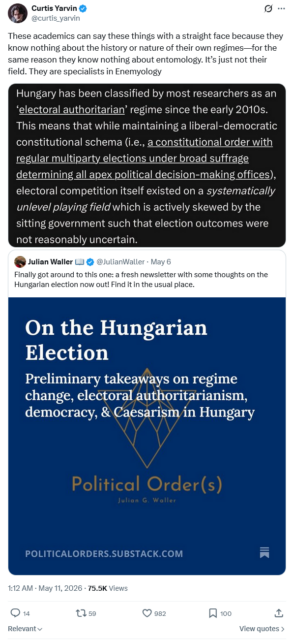
And after some harumphing from the cheap seats, he followed up with:
Various people are clapping back at this, so let me tell you what is happen in liberal democratic non-authoritarian Germany:
– Getting raided by police, charged with speech crimes, etc. because you post online is a professional risk, I personally know various people to whom this has happened and I live my life with a bunch of opsec annoyances for the day it happens to me.
– State media coordinates with intelligence agencies to smear and harass not only the political opposition but their prominent supporters, for example by doxxing them, getting them fired, subjecting them to harassment.
– The state funds a vast “civil society” network of violent street thugs to intimidate the political opposition and also anybody identified by state-sanctioned ops like those detailed in the above item. Opposition party congresses, other events routinely disrupted by coordinated civil society protests, where the local population is sympathetic (as in many east German venues) they bus in protesters from the west and the big cities to create the necessary atmosphere.
– Domestic intelligence agencies use espionage methods to surveil and compromise the political opposition; among other things they pay informants, tap telephones, read emails, and so on. We’ve had various indications that materials gathered in these operations are then used for state media smear campaigns.
– Yes, domestic intelligence openly coordinates with state media and certain private media elements too. Various aspects of political coverage in Germany are staged by secretive unelected bureaucrats.
– Procedural rules, other laws are routinely changed in ad hoc ways to disadvantage political opposition, though we haven’t had any outright gerrymandering like in the US so that means Our Democracy is safe. 👍
And:
I’m sure I’m forgetting some things. I’ve spent years documenting this shit on my blog and literally none of the present Hungary hyperventilators have ever given the slightest shit. Orbán was a guy who observed the Euro freak show as it is manifested in countries like Germany and tried in a kind of inept half-hearted way to imitate this machine from the right, the results were ridiculous and transparent and like 25% as effective as what the German state gets up to but nevertheless all these clowns confronted with a hint of their own methods started shrieking about FaSciSm.
“The dark genius of bureaucracy”
Auto-translation on the social media site formerly known as Twitter has brought some posts from Brivael Le Pogam to my attention, like this one:
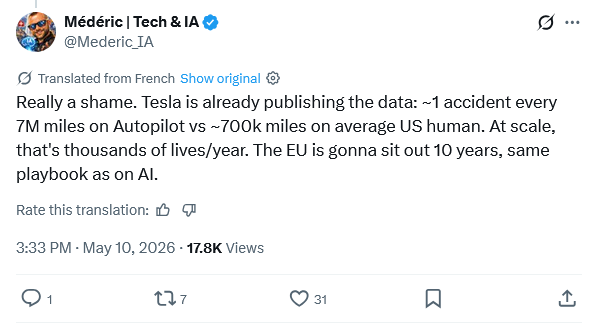
The Invisible Cemetery
Milton Friedman said a phrase that should haunt every European legislator for the rest of their life. On the FDA, he said this: there is overwhelming evidence that they have caused more deaths through delayed approvals than they have saved through early approvals.
Read it twice. More deaths from excessive caution than lives saved by caution.
And no one sees it. That’s the dark genius of bureaucracy.
Bastiat theorized the principle 175 years ago. “What is seen and what is not seen.” The economist, he said, is not distinguished from the bad economist by the ability to see the immediate effect of a decision. Everyone sees that. He is distinguished by the ability to see the invisible effects, the delayed ones, the ones diffused across the entire population.
The self-driving car is the perfect example. And it’s playing out right before our eyes.
Tesla publishes the numbers. One accident every 7 million miles in Autopilot. One accident every 700,000 miles in the average American human. Autopilot is, at this stage, ten times safer than a human. And it’s only getting better, with every release.
Now France. 3,200 deaths on the roads in 2024. 91% involve human error. Speed, alcohol, fatigue, distraction. If we deployed a self-driving car ten times safer tomorrow, we’d divide the carnage by ten. We’re talking about 2,800 lives a year. Over ten years, 28,000 people. The equivalent of an average French town that disappears, because no one pressed the right button in Brussels.
You’ll never see them. No newspaper will headline: “Today, 8 people died because the self-driving car is banned in Europe”. No parliamentary commission will investigate. No bureaucrat will be fired. Those deaths will go in the “road fatality” box. We’ll run moving campaigns with their photos on 4×3 billboards. We’ll say it’s sad, that’s life.
Meanwhile, the first accident of a self-driving car will be front-page news in every paper for three weeks. The regulator will summon the manufacturers. NGOs will call for preventive bans. Deputies will write op-eds. The minister will decree a moratorium.
Five visible deaths will outweigh, in the media and political balance, five thousand invisible deaths. That’s the iron law of bureaucracy. The bureaucrat who authorizes something that goes wrong loses their career. The bureaucrat who bans something that would have saved thousands of lives is never troubled. No one holds them accountable for the deaths they could have prevented. They don’t exist in their statistics. They don’t exist in their trial.
Friedman had identified the exact mechanism: when a regulator errs on the side of laxity, their victims have names, faces, families, lawyers. When they err on the side of caution, their victims are anonymous, scattered, statistical, ghosts. The structure of incentives makes over-regulation rationally inevitable. And the invisible cemetery grows, generation after generation.
Europe is going to sit out 10 years on the self-driving car, just as it sat out on AI, as it sat out on genetic engineering, as it sat out on fourth-generation nuclear. Every time, the same playbook. Precaution, moratorium, ethics committee, white paper, directive, transposition. And every time, behind the curtain of words, deaths that appear in no official statistics.
These are deaths. Not opportunity costs. Not “economic losses”. Human beings who were alive and who died because an innovation that could have saved them was delayed by people whose literal job it is.
That’s what needs to be built, and it’s probably the most important political project of the century that’s opening. A system for accounting for invisible deaths. A registry of the cemetery that no one sees.
For every regulation, every moratorium, every preventive ban, we should be able to produce a signed, dated, quantified estimate of the human cost in lives of the decision. Not direct effects. Delayed effects, indirect ones, statistical ones. How many deaths per year caused by banning a technology that works elsewhere.
Imagine. On the desk of the European commissioner about to sign a moratorium on the self-driving car, a document: “Central estimate, 2,800 deaths per year for the duration of the moratorium. High-end range, 4,100. Low-end range, 1,900. Source: comparative analysis Tesla Autopilot vs. human average, NHTSA and ONISR data, public and audited method.”
On the desk of the European deputy who will vote on the AI Act: “Central estimate, 38 billion euros in lost GDP, 240,000 jobs not created, X deaths per year due to delays in AI medical diagnostics, Y deaths per year due to delays in deploying autonomous drones for medical delivery in rural areas.”
Today, we sign blindly. We sign without cost. We sign with a clear conscience because the deaths we cause are anonymous and the lives we protect have faces. That’s what needs to be broken.
A bureaucracy is an institution that operates without being held accountable for the invisible consequences of its decisions. As long as invisible deaths are not counted, bureaucracy is mechanically, structurally, inevitably a machine for producing deaths it will never see.
Europe isn’t losing a technological battle. It’s filling a cemetery. Year after year. And no one wears mourning. No one lays flowers. No one knows they’re there.
Friedman saw them before everyone else. Bastiat before him. Williams after him. And each posed the same question, which echoes like an accusation through the centuries: who weeps for the deaths we didn’t see coming?
That’s the work ahead of us. Making the invisible cemetery visible. Accounting for it. Auditing it. Publishing it. Confronting every bureaucrat, every day, with the exact list of lives that their signature takes with it.
Before the list becomes ours.
Between SMG and PDW: Sweden’s CBJ-MS
Forgotten Weapons
Published 20 Dec 2025The CBJ-MS is a submachine gun designed by Swedish arms developed Carl Bertil Johansson, perhaps better known for his remarkable armor-piercing 6.5x25mm CBJ cartridge. He developed the gun at about the same time as the cartridge, on his own time while working at the Carl Gustafs factory in Eskilstuna. While it bears a lot of visual similarities to the Uzi, and it is an open-bolt simple blowback action, it has a unique and clever fire control system — and several other creative features as well.
(more…)
May 11, 2026
Were the Nazis socialists?
If you’re ever bored and want to kick off an argument online, you can take either side of this statement and watch the signal-to-noise ratio drop precipitously. The NSDAP, the Nazis, began as one of the many, many groups of angry young Germans in the days after the end of the First World War. The full name of the party — the National Socialist German Worker’s Party — indicates who the original party founders thought would be the engine of their political rise. They were explicitly anti-communist, as the spectre of the Russian Revolution terrified many Germans, but German socialism was still within the Overton Window of political debate.
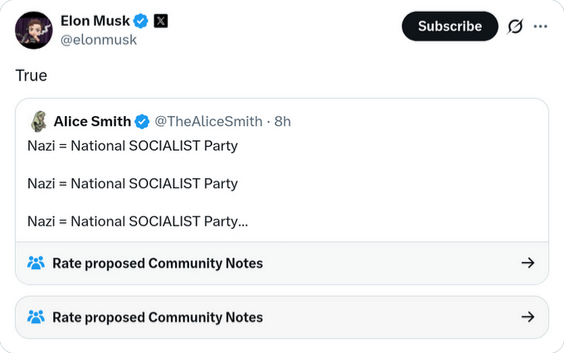
Lots of arguments about this one.
Many people assume Nazis could not have been socialists, despite all the time and energy they devoted to jumping up and down screaming “We are socialists!”, because they were “right-wing” and socialism is supposed to be “left-wing”.
Except “right-wing” and “left-wing” don’t have rigid definitions outside the context of the French revolution. In any other context, they’re just a metaphor.
So why did the NATIONAL Socialist German Workers’ Party and the INTERNATIONAL Marxist-Leninist Socialist Workers’ Movement hate each other so much?
It’s pretty obvious when you look at the names.
National.
International.
To Nazis, the race and culture of a people are everything. They are what the state is supposed to represent. Ein Volk, as they would say. The purpose of Nazi socialism is to control capital assets, subordinating them to the will and welfare of the ethnostate.
But Marxist-Leninists seek to abolish all ethnostates. They are a globalist movement, seeking to place all capital assets under the control of a universal proletariat in theory, which is in practice represented by one world government.
Thus, Nazis sought to use socialist policies for the welfare of the German people and Marxist-Leninists seek to abolish “German” as a meaningful distinction, along with all other cultures.
The antipathy between Nazis and communists was a sectarian struggle within socialism. Same methods, but different sacred groups.
Since the defeat of National Socialism by International Socialism in WW2, all modern socialism is pretty much of the international variety.
This does, however, suggest that there is a contrast between National Capitalism and International Capitalism as well.
Which is the source of the current sectarian struggle between elements of the American right wing.
Update, 12 May: Welcome, Instapundit readers! Have a look around at some of my other posts you may find of interest. I send out a daily summary of posts here through my Substack – https://substack.com/@nicholasrusson that you can subscribe to if you’d like to be informed of new posts in the future.
“We’ve entered the pre-violence rhetorical phase of the classic communist cycle”
You have to have noticed that progressives all seem to have recently decide en masse that we need to liquidate eliminate expropriate the billionaire class. It’s been done in the past, and modern progressives seem to be unable to spot the pattern, even as they work hard to bring it back to life by constantly scapegoating the wealthy (machine translated from Brivael Le Pogam’s original French post):
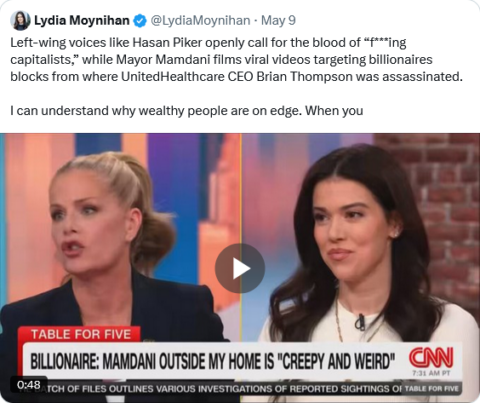
Lydia is putting her finger on something that no one wants to name clearly: we’ve entered the pre-violence rhetorical phase of the classic communist cycle.
The script is documented, archived, and it repeats itself identically for a century. Before every mass massacre carried out in the name of Marxism, there are always 5 to 15 years of public designation of a category of people as “the enemy to be taken down”. Not a debate on public policies. Not a critique of inequalities. A methodical dehumanization of an entire class.
In the USSR in the 1920s, it was the kulaks. Lenin wrote as early as 1918 that it was necessary to “exterminate the kulaks as a class”, an expression repeated word for word by Stalin ten years later. Result: 4 million peasants deported, several million dead in the Holodomor.
In Maoist China, it was the landlords and “class enemies”. Mao orchestrates public “struggle sessions” where neighbors, children, former employees are forced to denounce, humiliate, and beat. Tally from the land reform alone: 1 to 2 million executions, not counting what follows.
In Cambodia, it was the “new people”: city dwellers, intellectuals, people wearing glasses. Khmer Rouge propaganda designated them for years as parasites before massacring them. 1.7 million dead in 4 years.
Now look at what’s happening in the United States in 2026.
Hasan Piker, who reaches millions of young men on Twitch, speaks openly of the “blood of f***ing capitalists”. Not in 1968 in a Trotskyist cell, in 2026 on the platform most watched by 18-25 year olds.
Zohran Mamdani, elected mayor of New York, films viral videos in front of billionaires’ buildings, exactly where Brian Thompson, CEO of UnitedHealthcare, was assassinated last year by Luigi Mangione. The latter was turned into a pop icon by a part of the American left in less than 48 hours. T-shirts, fan art, romanticization of the murderer.
This isn’t “political passion”. It’s phase 1 of the protocol. The public designation of a category of humans as legitimately hateable, followed by the valorization of those who take action.
The “normal” reaction of a healthy democracy should be the immediate social and professional isolation of these voices. What’s happening: they top podcast charts, they’re elected officials, and they get favorable media coverage.
History doesn’t stutter. It copy-pastes. And the first victims are always surprised to discover, too late, that the speech they found “a bit excessive but oh well” was actually the clear warning that a pit was being dug for them.
Lydia is right to say it. And she’ll be even more right in five years when we reread these tweets.
And more:
And if you’re reading this thinking, “This doesn’t concern me, I’m not a billionaire”, stop for two seconds and really think about it.
Because that’s exactly what the Russian peasants told themselves in 1918 when people started talking about the “bourgeois”. They applauded, or they looked the other way. It wasn’t their problem. They weren’t rich.
Ten years later, they were called kulaks. And “kulak“, in Stalinist practice, meant any peasant who owned one more cow than his neighbor, who had dared to hire a seasonal worker, who had a slightly better-kept barn. 4 million deported. Several million dead.
That’s exactly what the small Chinese shopkeepers told themselves in 1949, when Mao went after the “great landowners”. Not their problem. They just ran a little store. Five years later, they too were classified as “class enemies”, stripped of everything, publicly humiliated, sometimes beaten to death by their own neighbors.
That’s exactly what the Cambodian schoolteachers told themselves in 1970, when the Khmer Rouge talked about “urban exploiters”. Not their problem. They barely earned enough to live on. In 1975, knowing how to read was enough to sign your death warrant.
The communist mechanism NEVER stops at the ultra-rich. Never. It’s a historical law as solid as gravity.
Why? Because fundamentally, the communist doesn’t hate wealth. He hates individual emancipation. He hates the very idea that a man can build something that belongs to him, decide his own life, refuse the collective. Private property isn’t an economic detail to him — it’s the metaphysical enemy. Because someone who owns something is someone who can say no.
So if you have an apartment you spent 15 years paying off, you’re concerned. If you have a small business, a shop, a sole proprietorship, you’re concerned. If you have a savings plan, a bank book, stocks, you’re concerned. If you have a family home in the provinces, you’re concerned. If you work hard to pass something on to your kids, you’re at the top of the next lists.
Billionaires are just the first course. Always. Because there are few of them and they’re easy to point out. They’re the appetizers for the machine. The main course, historically, is you.
And meanwhile, a lot of people read threads like this, nod their heads, and don’t share. Don’t comment. Don’t take a stand. Out of fear of being labeled “right-wing”, “reactionary”, “too political on LinkedIn”. Out of comfort. Out of social cowardice.
Know that this silence has a precise historical cost. Every time a society has tipped into this madness, it did so because the reasonable majority stayed silent too long, thinking it would all blow over on its own.
It never blows over on its own.
QotD: The cultural importance of the church in early Medieval Europe
The very first thing to note is that the Church (in this case, both the Latin West and the Greek East) pre-dated the Middle Ages themselves. The Church arrived in the Middle Ages as relic of the Roman Imperial past. It inherited Roman Imperial organization – the diocese, for instance, derived from the boundaries of Roman super-provinces called dioceses (Greek: διοίκησις). Unlike the new medieval aristocracy, which tended to rule from fortified estates in the countryside, the Church remained centered in towns and cities, many of which had been major centers under the Romans. As the Roman provincial administration collapsed, it largely fell to the Church – as one of the few surviving literate institutions – to replace some of the core functions, like record keeping and the preservation of literature and learning. This was less true [in] Scandinavia and Eastern Europe, places where the Church was a relative late-comer, but for most of Western Europe, the Church was not some new institution grafted on to a pre-existing society (as it had been under the Romans), but rather part of the bedrock cultural foundation upon which that new society was constructed (fellow pedants! – please note carefully the phrase part of in the previous sentence; I am aware there were other things).
That said, the institutional power of the Church (and here we really do mean what would be the Roman Catholic Church) begins to change dramatically in the 11th century, right as we enter the High Middle Ages, and continues for the next several centuries (keeping in mind that Game of Thrones and A Song of Ice and Fire really evoke the High and Late Middle Ages, rather than the Early period). In short, the institutional heft of the Church grows dramatically. Quite a few things begin happening which are linked together: the Popes begin trying to wrest control over the Church’s hierarchy (specifically, the investiture of bishops) from secular rulers. Clerical celibacy was more stringently enforced. The Church intruded into warfare (as we’ve discussed with the Peace of God / Truce of God movements). It began to more directly attempt to regulate marriage, especially among the powerful (marriage was a made a sacrament in 1184). By the 1300s, this included keeping detailed records in many parts of France about births, deaths and marriages, in part to ensure no one married a close relative.
(And, of course, for those of you thinking, “wait, isn’t this also the period of the Crusades – military expeditions called by and at least nominally (but not in practice) under the auspices of the Pope?” Yes, it is, and that’s not an accident either).
In my experience teaching this, it is the next step that baffles my students the most. This vast increase in the institutional power of the Church was made possible, not by armies or shrewd real-politic (though both were involved), but by belief. The primary weapon wielded by Popes in this effort was the threat of excommunication, which (under Catholic doctrine) cut off the excommunicated individual or community from salvation, potentially damning them for all eternity. But of course that threat is only real if you believe the Pope has that power. And therein is the key point: most of Europe did believe. As I tell my students, it is safe to assume, as a general matter, that people in the past believed their own religion. Of course there are exceptions, but the general rule remains.
In the conflicts that arose – because, as you might imagine, secular rulers were unwilling to give up their prerogatives – it did not actually much matter if the king or emperor believed in the power of excommunication, because no one rules alone. Thus when the Holy Roman Emperor Henry IV was excommunicated by Pope Gregory VII in 1076, the audience for this act wasn’t Henry himself (who had already declared Gregory illegitimate anyway). It was directed at all of Henry’s vassals and supporters, releasing them from their oaths of allegiance and essentially saying, “stick with this guy, and he’ll take you to hell with him”. It worked, sparking a major rebellion and forcing Henry to humiliatingly apologize the following year.
(History note: this would be “round 1” in a multi-round fight that wasn’t settled until 1122 with the Concordat of Worms; in the end the Papacy mostly won, sharply limiting the Holy Roman Emperors’ power over their bishops).
Bret Devereaux, “New Acquisitions: How It Wasn’t: Game of Thrones and the Middle Ages, Part II”, A Collection of Unmitigated Pedantry, 2019-06-04.
May 10, 2026
The state of Britain – “Where did it all go wrong?”
Reposted from Samizdata with Patrick Crozier’s kind permission. Parallels to the same period of history here in Canada or in Australia or New Zealand should be fully evident to my fellow former colonials:
The Britain of the mid-19th Century was the greatest civilisation that has ever existed. It had a mighty empire, a mighty navy, it had wiped out the slave trade and it was at the forefront of the Industrial Revolution, the greatest improvement in living standards in history. And now, as I write, it is hanging on by a thread: divided, debt-ridden and weak.
So, where did it all go wrong? Here – in reverse chronological order – is my list of the key dates:
2008. Reaction to the Financial Crisis.
Had the banks just been allowed to go bust and the banking regulation that reduced their numbers abolished we would not be looking at 20 lost years.1997. Opening the borders.
Allowing the establishment of hostile communities in your country is not a good idea.1987. Leaving the NHS untouched.
By 1987, the Thatcher government had privatised just about everything. Only the NHS and education were left. And they flunked it. Mind you it would probably have been electoral suicide.1969. Failure to defeat the IRA.
If you reward terrorism you get more of it.
[NR: Canada did defeat the FLQ‘s campaign of terrorism and murder … and then basically conceded everything short of full independence that the FLQ had demanded. This is a classic example of winning the war but losing the peace.]1965. Race Relations Act.
Keir Starmer is wrong. Britain does not have a “proud tradition of free speech”. But it did have some free speech. This act along with various successors outlawed some forms of speech. Those successors progressively outlawed freedom of association which might have gone a long way to taking the sting out of the Integration Crisis.
[NR: Enoch Powell’s “Rivers of Blood” speech seems ever more relevant to the daily lives of everyone in the west …]1964. Abolition of the Death Penalty.
I appreciate libertarians tended to be divided on this issue. We may have a lot to say about what the law should be but very little about what should happen when it is broken. But if you are going to end a long-standing tradition it had better work. It didn’t.
[NR: I used to be fully against capital punishment. I’m much less doctrinaire about it now. Some people cannot be rehabilitated, and capital punishment is a better solution than life in prison.]1963. Robbins Committee.
This led to the subsidisation of higher education and the subsidisation of student living costs. Where you get subsidy you get communism.
[NR: Universities have always been hotbeds of progressive thought. From the 1920s onward, they’ve been taken over by ideologues who want to utterly destroy western civilization … and we’ve been handing them ever more money to indoctrinate our young in their beliefs.]c.1948. Ending of the right to defend oneself with a firearm.
I got this from the late Brian Micklethwait but I haven’t been able to confirm it. Brian’s point was that if you couldn’t use guns to defend yourself there was very little point in having one and so it became easy for the state to ban them.
[NR: Canada is in the middle of yet another spasm of anti-gun hysteria triggered (you saw what I did there) by events in the United States. There are hopeful signs that Canadian gun owners may yet indulge in peaceful civil disobedience over the the latest attempts to disarm us.]1948. Nationalisation of rail.
Along with coal, steel and many others along the way. Losses, strikes, decline, waste, unemployment.
[NR: Patrick and I began communicating a few years ago when I asked him for additional information about both the 1920s forced consolidation of British railway companies into the “Big Four” and the subsequent full nationalization into British Railways. We clearly agree that this was, whatever its intentions, a bad move for both the railway companies and the nation at large.]1947. Town & Country Planning Act.
Pretty much stopped building anywhere where people might want to live. A huge contributor to putting home ownership out of the reach of millions.
[NR: I heard much more about the zoning issue from American libertarians, but the Town and Country Planning Act was a major leap in bringing government regulation into everyday life in Britain.]1931. Abandoning the Gold Standard.
Inflation and boom and bust became the order of the day.
[NR: In retrospect, this may have been Winston Churchill’s biggest blunder: putting Britain back on the Gold standard at the pre-WW1 rate of exchange.]1920s. Abolition of the Poor Law.
I mean to write about this one day but TL;DR while the Poor Law had many shortcomings it did at least keep people alive while keeping the costs down.
[NR: Orwell’s eloquent writing about the plight of the poor between the wars illustrate a lot of the negatives for the jobless poor of the interwar era. Far be it from me to claim Orwell was wrong … but he didn’t show the entire picture.]1922. Creation of the BBC.
A monopoly communist propaganda organisation using the most powerful media then in existence which non-communists were forced to pay for. What could go wrong?
[NR: The BBC was for a long time constrained in its advocacy for socialist ends, but they kicked off the traces at some point. Canadians will be more familiar with the power of state-sponsored media now that the Canadian government will be paying one-third of the salaries of all the mainstream print and broadcast media outlets … and the media have already transformed into sad parodies of Nazi German or North Korean state media.]1920. Beginning of the War on Drugs.
Other than the crime and changes to the drugs themselves (making them more dangerous than ever), the persistent failure of the War on Drugs gave the state the excuse for ever greater assaults on civil liberties.1918. Universal Adult Male Franchise.
This meant that people could vote themselves other people’s money. It very quickly led to the replacement of the (not very) Liberal Party by the (not-at-all liberal) Labour Party. Mind you, it should be pointed out that a lot of the damage was done well before.1910. People’s Budget et al.
In introducing the state pension, a state GP service and unemployment benefit this laid the foundations of the Welfare State that is currently doing such a good job of bankrupting the country.1910. Payment of MPs.
I put this one in tentatively. I would like to say it meant Members of Parliament no longer had to have made something of themselves but given that a large number of them came from rich families that is not quite true.1906. Taff Vale Judgement.
This effectively put trade unions above the law leading to endless strikes, uncompetitiveness, industrial decline and unemployment.
[NR: This was an understandable concession when unions were all in the private sector. Now that the plurality, if not outright majority of union members are government workers …]1890s. Death Duties.
Bit by bit this destroyed the aristocracy by forcing a fire sale every time the head of the household died. [And that did what exactly, Patrick? Summat! It did summat!]1875. Trade Union Act.
This allowed picketting or the intimidation of non-striking workers by trade unionists. I have to thank Paul Marks for bringing this one to my attention.1870. Forster Act.
This established state education along with all that went along with it such as indoctrination, poor quality education and the opportunity costs involved in children not being able to earn money or learn a trade.1845. Banking Act.
This began the extension of the Bank of England’s monopoly to the whole of the country.Anything I’ve missed?
How to Make Nazi Germany Look Normal – Death of Democracy 15 – Q4 1936
World War Two and Spartacus Olsson
Published 9 May 2026How did Hitler use the 1936 Berlin Olympics to make Nazi Germany look peaceful — while preparing the country for war?
Berlin, September 30, 1936. Under the Olympic flame, Nazi Germany staged one of the most successful propaganda spectacles of the twentieth century. Foreign visitors saw order, ceremony, technology, pageantry, and athletic triumph. But behind the facade, the regime hid antisemitic persecution, rounded up Sinti and Roma, intensified police repression, intervened in the Spanish Civil War, and moved toward a massive new war economy.
In this episode, Spartacus Olsson looks back at the third quarter of 1936: the Berlin Olympics, Jesse Owens’ victories, Hitler’s secret war memorandum, the Four-Year Plan, Nazi propaganda, Germany’s growing involvement in Spain, and the dictatorship’s attempt to sell peace to the world while preparing for conquest.
The Olympics gave Hitler international validation. The Four-Year Plan revealed what he truly intended.
In this episode:
– How Nazi Germany sanitized Berlin before the Olympic Games
– How the regime temporarily hid antisemitic violence from foreign visitors
– How Sinti and Roma were forced out of sight before the Games
– How Jesse Owens challenged Nazi racial mythology on the track
– How Hitler moved Germany toward a war economy
– How the Four-Year Plan tied German recovery to rearmament
– How Germany’s intervention in Spain marked a new stage of escalation
– How propaganda, spectacle, and controlled media helped normalize dictatorshipThis is not just a story about the 1936 Olympics. It is a story about how authoritarian regimes use spectacle, national pride, media control, and international complacency to hide what they are becoming.
Never Forget.
The Ancient Greeks: 01 – What Made Them Special? (b) Slavery, Violence, and the Reality of Greek Life
seangabb
Published 31 Jan 2026This section confronts the social realities of Greek civilisation that are often ignored or idealised.
It examines the position of women, the central role of slavery, ritualised violence against children, infant exposure, and what we would now describe as widespread paedophilia. Drawing on ancient sources such as Plutarch, Demosthenes, and Aristotle, it shows that these practices were not marginal, but embedded in Greek social norms and justified as rational policy.
Victorian and modern idealisations of Greece are critically dismantled in favour of historical evidence.
The aim is not moral condemnation, but historical clarity.
QotD: The cavalry
Combat Boot, “So, ‘capbadges’, what’s that all about then?”, combatboot.co.uk, 2020-11-13.
May 9, 2026
Like the Roman. The Life of Enoch Powell, by Simon Heffer
I think it’s fair to say that Enoch Powell is having a moment, nearly sixty years after he shocked the establishment with his 1968 “Rivers of Blood” speech. He became a pariah even in his own party, and his political career never recovered … but his warnings have more than been fulfilled over the intervening decades. In The Critic, Jeremy Black reviews the recently reprinted 1998 biography of Enoch Powell by Simon Heffer:
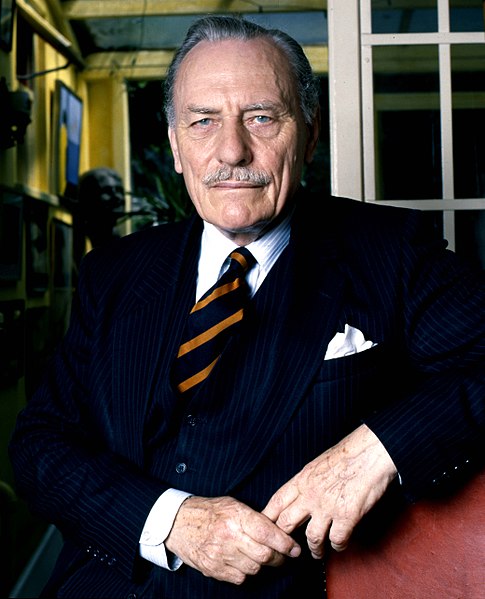
Enoch Powell in a 1987 portrait by Allan Warren.
Wikimedia Commons.
The new imprint of this important biography provides an opportunity to reread one of the most skilful works on British political history published over the last half century. As with Heffer’s other books, it is also very well written — although might I offer a plea for leaving aside sentences such as “He still saw no reason to lay off Heath”?
Before turning to the substance, it is worth considering the Foreword. Written this January, it underlines Powell’s significance to many issues, notably: “His deep scepticism about the confluence of America’s interest with those of Britain”. I am, however, dubious about the proposition that “Powell was, quite simply, one of the foremost Conservative thinkers in living memory, possibly the greatest since Burke”. Leaving aside the question of whether Burke can be described as Conservative or even, prior to the 1790s, as conservative, and, separately, the implicit dig at claims for Disraeli whom Heffer is on the record as describing as a Charlatan, I myself would make the case for Salisbury, while agreeing that Macmillan, Hailsham and MacLeod did not measure up to Powell. He returned the damage done him by Macmillan with “bilious” reviews of his Memoirs.
While I am sceptical of the claim that Powell was a great Conservative thinker in the cosmic sense, he was an impressive critic of many of the shibboleths of establishment Conservatism from the 1960s to the 1980s, including on immigration, the nuclear deterrent, the Common Market, the American alliance, Northern Ireland, and economic policy.
A significant aspect of the intellectual character of Powell was the return of this one-time atheist to the Church in the late 1940s, the subject of the “Interlude” “Powell and God” in the book. There is, as Salisbury and Cowling among others underlined, a significant link between Conservatism and the Church of England, and Powell, like Thatcher, can be profitably discussed in these terms, with Thatcher far less convincing.
The discussion of Powell’s elision from public debate is also interesting. Published by Weidenfeld and Nicolson in 1998, the biography was kept on print-on-demand until cancelled in the aftermath of the Black Lives Matter movement. Heffer compares the treatment of Powell to that of Orwell in facing difficulties in publishing Animal Farm and Nineteen Eighty-Four. For several years, Heffer found it impossible to persuade a publisher to republish the book and suggests that this was due to a craven fear of public opinion “real or perceived”, one about which Orwell had warned not least when referring to “intellectual cowardice”. The publisher he has found, it has to be said, is another instance of the very valuable work being done by non-metropolitan concerns.


