
World War Two
Published 20 May 2023In Italy, the Allies finally overcome Monte Cassino and break through the Gustav Line; in Burma Merrill’s Marauders surprise the Japanese and take Myitkyina Airfield; in China, it’s the Japanese who are playing offense, as Operation Ichi Go and the siege of Luoyang continue. That’s the field action, but there’s big planning behind the scenes for major June offensives going on by both the Western Allies and the Soviets.
(more…)
May 21, 2023
The Fall of Monte Cassino – WW2 – Week 247 – May 20, 1944
Comments Off on The Fall of Monte Cassino – WW2 – Week 247 – May 20, 1944
May 14, 2023
Victory at Sevastopol! – WW2 – Week 246 – May 13, 1944
World War Two
Published 13 May 2023The Soviets push the Axis out of the Crimea this week once and for all. In Italy, the Allies launch a major offensive, and the French make a breakthrough there by week’s end. In China, the Japanese are aiming at Luoyang, but in India at Kohima they’re slowly being pushed back.
(more…)
Comments Off on Victory at Sevastopol! – WW2 – Week 246 – May 13, 1944
May 9, 2023
QotD: Changing German Panzer tactics in 1943
Report of the Commanding General of the 17th Armored Division, 24 April, 1943
The following report, though obviously written in haste with little regard for elegance of expression, gives a good view of the changes in tank tactics which took place on the Eastern Front. This translation was made from a typed copy of the original and thus bears no signature. Nonetheless, there is good reason to believe that the author was the famous Fridolin von Senger und Etterlin, who commanded the 17th Armored Division at this time.
1. The tank tactics which led to the great successes of the years 1939, 1940, and 1941 must now be considered obsolete. Even if it were possible today to breakthrough an antitank front by means of the massive employment of concentrated waves of tanks, we would not be able to make use of these methods, which would once more lead to considerable losses, because of our [tank] production situation. These methods, often employed in rapid succession, would lead to such a quick reduction in tank strength that the character of an armored division would be fundamentally altered. This would lead to difficulties for the higher leadership.
The change in tank tactics is logical. The beginning successes of the weapon, the shock effect of which rested upon the technical achievement and overwhelming invincibility of the attacker, found at last its end in the development of appropriate defenses. From the point of view of production, the building of tanks could not keep pace with the building of antitank weapons. Apparently, a thousand antitank rifles, or dozens of antitank guns, can roll off the production lines for every tank.
The following are drawn from these insights.
2. The new tank tactics, which have already gained inevitable acceptance in the divisions, are outlined below.
The tank group no longer forms the nucleus of the armored division, about which other weapons are grouped as auxiliaries. The tank is a new arm acting in concert with and equal to the old arms. In cooperation with other weapons, it retains its power, even though its numbers are far below those called for by tables of organization.
Its meaning as a new arm is a function of the fact that it combines in itself a goodly portion of the two elements important to the attack: fire and maneuver. It derives these qualities from the fact that it is invulnerable, or less vulnerable, because of its armor.
Because the tank arm combines in itself firepower and mobility to a greater degree than other arms, it is the appropriate weapon for forming the main effort [Schwerpunkt].
The combat of the armored division is characterized by the fact that it is a mobile unit in all its parts and, as a result, the division commander is in a position, in the course of a battle, to chose and form a main effort [Schwerpunkt]. This principle excludes an irrevocable commitment of the tank group before an attack. Rigid employment within the framework of an already established battle plan is replaced by division commander himself holding [the tank group] in readiness and the flexibly employing it in the course of fighting against the required, or known to be appropriate, position.
The battle will begin with the infantry attack. The infantry attack provides the required foundation for the strength of the antitank front, for its length and depth. If the antitank front is known, then the tank attack can be ordered according to the classical principles for leading mobile units against the flanks or, if possible the rear, of an enemy defensive position. This attack should only be carried out exclusively by tanks when they can gain complete surprise. If surprise cannot be gained, then in this flank attack fire superiority must be fought for through the employment of artillery and, for the time being and to a certain extent the fire of the tanks themselves, until the enemy antitank front can be shaken or at least split up. If surprise can be gained, then a break-in against the flank of an antitank front can succeed without preparatory fire.
The attack against an enemy antitank front by means of a successful move against its flanks and rear cannot be carried out by tanks alone. It requires the support of artillery. In our experience, however, tank attacks carried out against the flanks and rear have outrun the artillery groups in direct support. Shifting fires by means of forward observers alone is not enough to ensure the shooting up of defensive fronts. What is needed here is thus the self-propelled batteries, which in the same manner as tanks themselves can quickly change their firing positions and thus attain the same mobility as the tank groups.
3. Now that these principles of the new tactics have been laid out, their use in practice will be explained.
a. The use of tanks as the first attack wave against a strongly fortified, deeply organized defensive position leads always to great losses and is thus false.
b. The use of tanks against deeply organized antitank positions is possible with the stipulation that it be commanded by an all-arms leader in close cooperation with other weapons after the formation of a main effort on the spot and that the further prosecution of the battle be steered by the same all-arms leader.
c. The employment of tanks leads to the greatest success when, sent into action and controlled by the all-arms leader, when they are used to strike the enemy in the flank, soon after the latter has begun an attack and before his antitank weapons have established firm antitank positions. Also in this last case, the attack must, with a view to direction and timing, be ordered by the all-arms leader on the spot. (With this last method the weak forces of the worn out 17th Armored Division annihilated one enemy division at Kuteinikowskaja on the 5th of January 1943 and another at Talowaja on the 27th of January, 1943.)
4. These new tactics are based upon the cooperation of the three main arms (infantry, tanks, and artillery) during the entire course of a battle. This cooperation can only be assured when the leader, that is to say, in all cases where the mass of the division is employed, the division commander himself, controls the cooperation of the arms on the spot throughout the entire battle. If, under the press of circumstance, as generally was the case during the battles between the Don and the Volga, widely separated battle groups [Kampfgruppen] of infantry, tanks and artillery had to be formed, it is essential that each of these battle groups be commanded by an all-arms leader, who is neither the commander of the tank element nor the infantry element of the battlegroup.
The all-arms leader’s means of command is the 10-watt radio built into a tank. With this equipment the leader is connected with the tank leaders as well as the leader of the infantry group, who, in case the proper radios are lacking, is provided with a tank. The all-arms commander is also in contact, by means of his armored personnel carrier, with battlegroups not forming part of the main effort and with his first general staff officer (Ia) working far to the rear.
The leader of the artillery group locates himself, according to the ordinary rules of command and control, with the all-arms leader. He is able, as was explained above, to give effective support only as the leader of an artillery group made up of self-propelled batteries. If he does not have access to some of these, there is always the danger the leader of the tank group would find his mobility limited by being bound to the less mobile towed artillery supporting him.
The place of the leader in combat is far forward, so that he can easily see the tank combat and, on the basis of these observations, can steer the course of the battle. He is sufficiently separated from the forward wave of tanks that he does not get involved in the tank-versus-tank and tank-versus-antitank battles, for this combat will focus his attention on the tanks fighting in the forward lines, to the point where tactical decisions which derive from the cooperation of all arms, can no longer be made.
The place of the leader can, however, rarely be chosen outside of the zone of enemy artillery fire. He can nevertheless remain mobile, thanks to the peculiar virtues of his means of command, namely voice radio. In the course of an attack in progress, he should be far enough forward to allow contact with the infantry group. Through it he can exert the leadership of a combined arms combat.
an armored personnel carrier used as a mobile command post in Russia in 1941From his location the leader should be in a position to himself assemble, according to the development of the situation and the requirements of the cooperation of arms, discrete tank groups.
Cooperation between discrete tank groups and infantry groups is possible if the all-arms leader remains in voice radio contact with the tank group in question. The attachment of tank groups to infantry groups is, as a matter of principle, always to be avoided. The infantry is not in a position to ensure the cooperation of infantry, heavy infantry weapons, and artillery as well as tanks because it is fully occupied with the conduct of the combat of other weapons. On this basis, the attachment of tanks to infantry divisions, which cannot be trained in the cooperation of the three arms, is, as a matter of principle, to be avoided.
The requirement to achieve success by the cooperation of all three arms does not exclude the concentration of all tanks in a single attack. This is still to be striven for. The concentration of tank power in the main effort [Schwerpunkt] will, however, not to striven for through systematic employment on the basis of an established plan, but rather in the course of the battle through the assembling of certain tank groups, in short, through the flexible combat leadership and formation of the main effort [Schwerpunkt] in the course of the battle through the all-arms leader himself.
This battle method, which aims at the close cooperation of the three main arms, cannot function without the formation of a special infantry group mounted in armored personnel carriers. Because it is essentially different, this group does not belong with the wheeled-vehicle mounted infantry of the division. They form, rather, an integrated part of the tank group. They can be attached to the later or will be employed according to the decision of the all-arms leader in accordance with the same principles that apply to the employment of tank waves.
The armored personnel carrier group of the infantry which is attached to the tank group corresponds closely to the self-propelled artillery. Both are special branches of their main arm, which work within the tank group itself and without which the cooperation of the tank group with the mass of the truck-mounted infantry and the towed artillery would not be possible.
5. The following deductions for the construction of tanks can be drawn from the aforementioned portrayal of the tactics and command techniques of the armored division. Because the race between tanks and anti-tank defenses can only be won by even heavier types and thus can not be guaranteed, the focus of effort [Schwerpunkt] in construction must be towards mobility and firepower.
The cooperation of arms can never be so close that artillery-infantry attacks alone can prepare an antitank front so that the tank attack can break through it in a rapid rollover. Instead, tanks must be an a position to use long-range fire to put anti-tank fronts out of action or at least so suppress them so as to make possible the further prosecution of the attack. They are only in a position to do this when they possess weapons of such a caliber that they can win superiority over immobile antitank weapons by means of fire and mobility.
According to this line of reasoning, great things can be expected from the creation of self-propelled artillery batteries. As unarmored fire units with greater range than tanks themselves they are in a position to attain that fire superiority which is necessary to gain the upper hand against the antitank defense.
During this winter’s fighting the best results were gained from assault gun battalions which, because of their great mobility and firepower, were employed and led in the same way as tanks. From the point of view of mobility, they outdid the tanks. Self- propelled guns were likewise successfully employed according to the same principles, to augment tank and assault gun groups, particularly by fire.
In contrast, the Tiger tanks, which were supposed to have fulfilled all three requirements, namely firepower, mobility, and heavy armor, were less successful, for their mobility was not sufficient for the elastic battle leadership outlined above. (In this experience it is important to take into account that the units sent fresh into battle were not at the height of their powers, especially where the use of radio was concerned. The impression of their lack of mobility, especially in rolling country with hard-frozen ground, however, would have been the same, even if the training of the personnel had been completed.)
These lessons of the more and more similar tactics of tanks, assault guns, and self-propelled artillery, which in more or less ad hoc arrangements establish the principle of fast-moving heavy firepower, causes one to wish that these weapons could be organized under a single leader with the goal of combining under him standardized training and well-schooled cooperation. This commander is the commander of the division’s tank group, that is to say, all more or less armored weapons mounted on tracked vehicles that are used for the fire battle. He must also have attached as an essential part an infantry group mounted in armored personnel carriers which should be made available according to a ratio of at least one infantry company for each three tank companies of whatever type.
The self-propelled artillery battalion should not be made an organic part of the tank group because of artillery training and the proposed design that will allow the guns to be dismounted. It should remain an organic part of the artillery regiment and be as- signed, on a case by case basis, to the commander of the tank group.
Unsigned report, probably authored by Fridolin von Senger und Etterlin, who commanded 17th Panzer Division at that time, via Bruce Gudmundsson’s Tactical Notebook, 2023-02-06.
Comments Off on QotD: Changing German Panzer tactics in 1943
May 7, 2023
Total Chaos on the Chinese Front! – WW2 – Week 245 – May 6, 1944
World War Two
Published 6 May 2023A command crisis in the Chinese Nationalist Army benefits the Japanese invaders, in Italy, Mark Clark spends his birthday planning new offensives, the Japanese are pushing for Imphal, and the Soviets for Sevastopol — another busy week of the war!
(more…)
Comments Off on Total Chaos on the Chinese Front! – WW2 – Week 245 – May 6, 1944
May 1, 2023
QotD: The Netherlands under Nazi occupation
On the whole, the Dutch reacted to the German occupation, including the persecution of the Jews, with a high degree of cooperation, following their reputed tradition of deference to authority. This did not change when the deportations started, and it lasted until the beginning of 1943. … [T]here was for a long time little doubt that the bureaucracy would not sabotage German-imposed measures, and in fact these were thoroughly implemented.
As Croes observed, “the Dutch bureaucracy assisted the Germans, primarily through population registration; the Dutch police helped, and Dutch bounty hunters, lured by blood money, tracked down Jews in hiding”.
Theodore Dalrymple, “The Cheapest Insult: The reductio ad Hitlerum: a refuge of tired minds”, City Journal, 2017-06-19.
Comments Off on QotD: The Netherlands under Nazi occupation
April 30, 2023
Germany’s Existential Crisis – WW2 – Week 244 – April 29, 1944
World War Two
Published 29 Apr 2023The fighting at Kohima is up close, personal, and vicious, as it is at Imphal. The Allies consolidate their gains at Hollandia, the Japanese are advancing in Central China, and it seems like the Chinese Nationalist Army has lost the support of the civilian population. This might not surprise you when we take a closer look.
(more…)
Comments Off on Germany’s Existential Crisis – WW2 – Week 244 – April 29, 1944
April 29, 2023
What Was the Deadliest Day of the First World War?
The Great War
Published 28 Apr 2023What was the deadliest day of any nation in WW1? There are multiple candidates for that, but why should we even care? Well, the answer to this question highlights a challenge with popular memory that is often focused on the biggest battles of the war like the Somme or Verdun.
(more…)
Comments Off on What Was the Deadliest Day of the First World War?
April 28, 2023
QotD: The high-water mark of the Panzerarmee Afrika
Even here, however, let us be honest. Smashing 8th Army at Gazala and taking tens of thousands of prisoners at Tobruk did little to solve the strategic problem. Unless the British were destroyed altogether, they would reinforce to a level the Axis could not match. Many later analysts argue that the Panzerarmee should have paused now, waited until some sort of combined airborne-naval operation had been launched against Malta to improve the logistics, and only then acted. Such arguments ignore the dynamic of the desert battle, however; they ignore the morale imperative of keeping a victorious army in motion; above all they ignore the personality of Rommel himself.
Pause? Halt? Wait? Anyone who expected Rommel to ease up on the throttle clearly hadn’t been paying attention. Instead, the Panzerarmee vaulted across the border into Egypt with virtually no preparation. To Rommel, to his men, and even to Hitler and Mussolini, it must have looked like a great victory lay just over the next horizon: Cairo, Alexandria, the Suez Canal, the British Empire itself.
In reality, it is possible today to see what the great Prussian philosopher of war Karl von Clausewitz once called the “culmination point” — that moment in every campaign when the offensive begins to lose steam, run down, and eventually stop altogether. The Panzerarmee was exhausted, its equipment was worn out and in desperate need of repair. Captured British stores and vehicles had become its life-blood, Canadian Ford trucks in particular. The manpower was breaking down. A chronic shortage of potable water had put thousands of soldiers on the sick rolls. Colonel Siegfried Westphal, the Panzerarmee‘s operations chief (the “Ia”, in German parlance), was yellow with jaundice. The army’s intelligence chief (the “Ic”), Colonel Friedrich Wilhelm von Mellenthin, was wasting away with amoebic dysentery. Rommel had a little of both, as well as a serious blood-pressure problem (no doubt stress-induced) and a chronic and bothersome sinusitis condition. While it would be easy to view all these illnesses as simple bad luck, they were, in fact, the price Rommel and all the rest of them were paying for fighting an overseas expeditionary campaign with inadequate resources.
The same might be said for the rest of the campaign. The Panzerarmee made an ad hoc attempt to break thought the British bottleneck at El Alamein in July. It failed, coming to grief against British defenses on the Ruweisat ridge. There was a second, more deliberate, attempt in August. After an initial breakthrough, it crashed into strong British defenses at Alam Halfa ridge and it, too, failed. After yet another long pause, a “third battle of El Alamein” began in late October. This time, it was the well supplied British on the attack, however, and they managed to smash through the Panzerarmee and drive Rommel and company back, not hundreds of miles, but more than a thousand, out of the desert altogether and into Tunisia. There was still fighting to be done in Africa, but the “desert war” was over.
Robert Citino, “Drive to Nowhere: The Myth of the Afrika Korps, 1941-43″, The National WWII Museum, 2012. (Originally published in MHQ, Summer 2012).
Comments Off on QotD: The high-water mark of the Panzerarmee Afrika
April 27, 2023
M1908 Mondragon Semiauto Rifle
Forgotten Weapons
Published 24 Nov 2014The M1908 Mondragon is widely acknowledged to have been the first self-loading rifle adopted as a standard infantry arm by a national military force. There are a couple of earlier designs used by military forces, but the Mondragon was the first really mass-produced example and deserves its place in firearms history.
Designed by Mexican general Manuel Mondragon (who had a number of other arms development successes under his belt by this time), the rifles were manufactured by SIG in Switzerland. They are very high quality guns, if a bit clunky in their handling.
The design used a long-action gas piston and a rotating bolt to lock. Interestingly, the bolt had two full sets of locking lugs; one at the front and one at the rear as well as two set of cams for the operating rod and bolt handle to rotate the bolt with. The standard rifle used a 10-round internal magazine fed by stripper clips, but they were also adapted for larger detachable magazines and drums.
Unfortunately, the rifle required relatively high-quality ammunition to function reliably, and Mexico’s domestic production was not up to par. This led to the rifles having many problems in Mexican service, and Mexico refused to pay for them after the first thousand of their 4,000-unit order arrived. The remaining guns were kept by SIG, and ultimately sold to Germany for use as aircraft observer weapons.
(more…)
Comments Off on M1908 Mondragon Semiauto Rifle
April 24, 2023
Even fighter pilots and gunners have love lives
In The Critic, John Sturgis reviews a new book by Luke Turner titled Men at War: Loving, Lusting, Fighting, Remembering 1939-1945, which considers the myths and reality of wartime relationships during the Second World War:

Spitfire pilot Ian Gleed shot down five enemy aircraft in just a week in May 1940 — the fastest time in which this had ever been done, making him an official “ace” who would be quickly promoted to Wing Commander.
Gleed had become a poster boy for “the few”, the hero pilots of the Battle of Britain to whom so many would owe so much. He lived up to the popular image with his talk of “a bloody good show” and shooting down “damned Huns”, after which he’d sink a few warm beers and spend some “wizard” free time recuperating with his girlfriend Pam, whom he “loved now more than ever”.
Gleed’s luck finally ran out over Tunisia in April 1943 when his plane was hit by a German fighter and crashed into dunes. Gleed was killed. He was just 26.
It would only emerge decades later that much of the popular image he had cultivated simply wasn’t true. Gleed was gay. Pam was an imaginary character he had invented as a cover to keep his double life as a sexually active homosexual firmly secret.
Gleed’s story is one of many similar vignettes in this alternative history of the Second World War. Its author Luke Turner’s previous book was a memoir about his own grappling with issues around his identity as a bisexual. Here he takes up the question of how this would have played out for him and other sexual non-conformists in 1939–45.
Turner grew up obsessed with the war — everything from Airfix kits and Dad’s Army to Stalingrad and the Berlin bunker — and here he examines what it was to live through that period as a sexually active person of whatever hue. It proves a particularly rich subject matter as sex seems to have been everywhere in war time: everyone was sleeping with everyone else, apparently. It’s a perennial truth that you or I might be hit by a bus tomorrow — but make that bus a bomb, and suddenly this seems to create a sense of urgency which frequently manifests itself sexually, lending daily life what Turner calls “an aphrodisiac quality”. As Quentin Crisp put it when describing the shenanigans in blacked-out, Blitz London: “As soon as the bombs started to fall, the city became like a paved double bed.”
Whilst war may see an explosion of sex of all kinds, the establishment was not always comfortable with this. A Home Office report on public behaviour in London during the Blitz noted, “In several districts cases of blatant immorality in shelters are reported; this upsets other occupants of the shelters.”
One contemporary account suggests, “In wartime a uniform, whether of the Army, Navy or Air Force, to the average girl ranks as a fetish.” This had consequences in the field: Dear John letters from home could be a real problem in this regard. As an Army report in 1942 put it, morale is often damaged by “the suspicion, very frequently justified, of fickleness on behalf of wives and girls”.
Amongst all this sex was, of course, sex with Americans. Turner cites George Formby who captured this mood in the song “Our Fanny’s Gone All Yankee”: “She don’t wait for the dark when she wants to have a lark/In a bus or train she does her hanky panky.”
Then in a dark reversal of this two-nations-colliding-sexually motif, we get the horror of the Red Army’s organised rape of as many as 1.4 milllion German women during the Russian advance on Berlin, whose residents would later refer to the city’s grandiose monument to Soviet war dead as “the tomb of the unknown rapist”.
Comments Off on Even fighter pilots and gunners have love lives
April 23, 2023
The Biggest Offensive in Japanese History – WW2 – Week 243 – April 22, 1944
World War Two
Published 22 Apr 2023Japan Launches Operation Ichigo in China, their largest offensive of the war … or ever, but over in India things are not going well for the Japanese at Imphal and Kohima. The Allies also launch attacks on the Japanese at Hollandia, while over in the Crimea, the German defenses at Sevastopol are cracking under Soviet pressure.
(more…)
Comments Off on The Biggest Offensive in Japanese History – WW2 – Week 243 – April 22, 1944
April 22, 2023
Hitler’s Revenge on the Italian People – War Against Humanity 101
World War Two
Published 21 Apr 2023As the RAF closes in on Berlin and the German Army is running dangerously low on men, the Nazi leadership is determined to use their resources to spread their crimes deeper into Hungary and Italy.
(more…)
Comments Off on Hitler’s Revenge on the Italian People – War Against Humanity 101
April 19, 2023
Time to remove US nuclear weapons from Europe?
CDR Salamander has long advocated getting the final few American “tactical” nuclear weapons off European soil and makes the case for doing it now:
It may seem like a strange thing to propose while there is the largest land war in Europe since 1945 going on, but as it is something I’ve been a supporter of for a few decades I might as well be consistent: we are long overdue to remove American nuclear weapons from Europe.
It is 2023. Just look at this map.
[…]
The Soviet Union stopped existing over three decades ago.
Even though we’ve decreased from 7,000 warheads down to 100 … there really is no reason to keep what remains in Europe.
- Gravity bombs on continental Europe – that require tactical aircraft to deliver them – are the least survivable, reliable, or timely way to deliver a nuclear weapon.
- There is no such thing as a tactical nuclear weapon. I don’t care what some theorist proposes to defend their pet theories, you lob one nuke an order of magnitude larger than the Hiroshima bomb and only a foolish nation would let their strategic nuclear forces stay unused and in danger.
- Gravity bombs are not a first strike weapon and are a poor second strike weapon. As such, you have to consider that the the time gap from approval to flash-boom would be so long the war would be over before your F-XX pickled their nuke over their target – even if the aircraft made it off the ground.
- If they are NATO weapons, you not only have to get NATO to approve their use, but host nation to as well … in addition to the USA. Do you really think the Russians would not leverage their influence with the useful idiots in the Euro-Green parties, former communists, and general black-block anti-nuke activists to politically of physically stop the use of the nukes, especially in BEL, NLD, DEU, and ITA? Add that to point 3 above.
- Especially with the weapons in Turkey – the risk of these bombs having a bad day due to human or natural causes is non-zero. In the days of mutually assured destruction, those non-zero odds were manageable, but there is no reasonable person in the third decade of the 21st Century who can with a straight face explain to you why any tactical, operational, or strategic use justify their presence. They deter no enemy, but puts every friend in danger.
- Look again at the map above. Exactly what target set are you going to “service” at that range (non-refueled)?
- If things go nuclear in Europe then the right weapons are either British, French, and if they must be American are sitting in a silo in CONUS, a SSBN in the Atlantic, or a B-2 in Missouri.
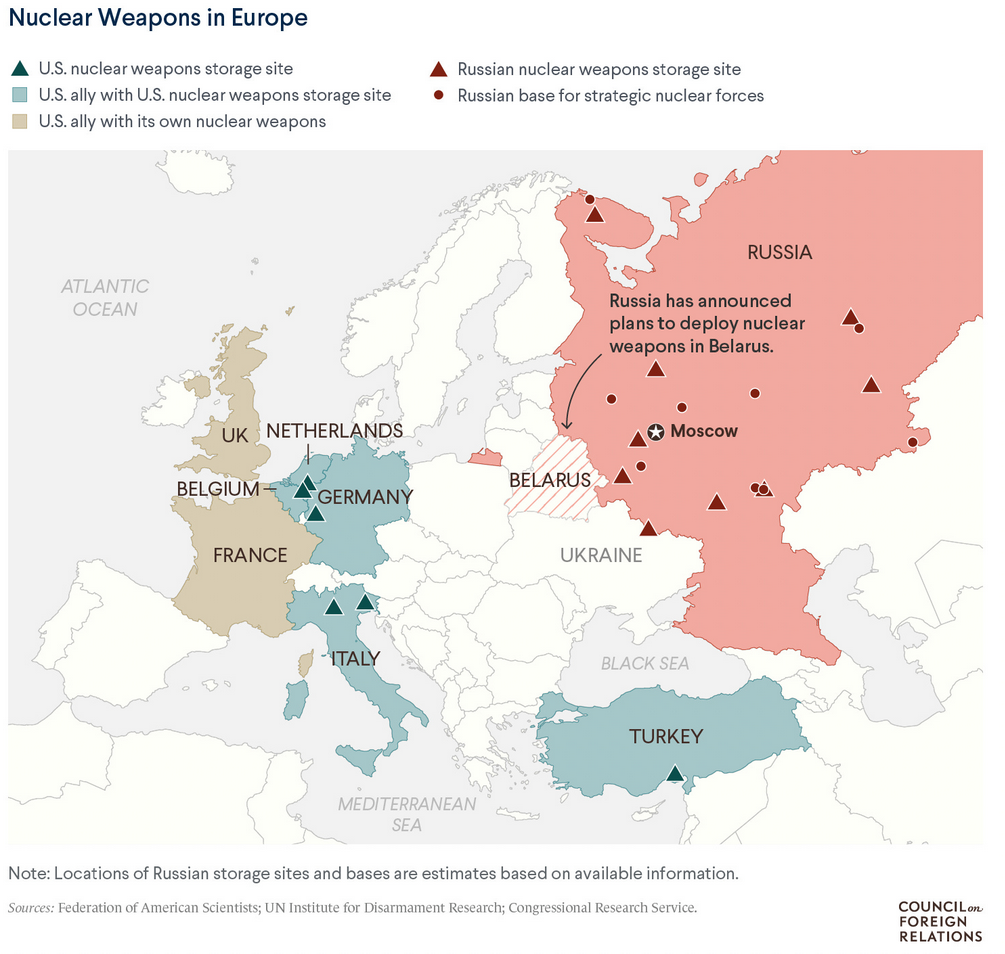
Comments Off on Time to remove US nuclear weapons from Europe?
April 17, 2023
Tank Chats Reloaded | Panzer IV | The Tank Museum
The Tank Museum
Published 30 Dec 2022Let’s go inside Panzer IV with another episode of Tank Chats Reloaded. Chris Copson takes a detailed look inside the tank which was considered the backbone of the Wehrmacht‘s Panzer force, uncovering the reality of what it might’ve been like to serve as a Panzer crew member in WW2.
(more…)
Comments Off on Tank Chats Reloaded | Panzer IV | The Tank Museum
April 16, 2023
4,000 German teens trapped in Tarnopol – WW2 – Week 242 – April 15, 1944
World War Two
Published 15 Apr 2023Thousands of German soldiers, mostly new teenage recruits, are obeying Hitler’s “Fortress Directive” and are surrounded in Tarnopol; it does not go well for them. German forces in Ukraine manage to all pull back across the Dniester, but they are under serious pressure in the Crimea. Meanwhile, in India, the Japanese siege of Kohima continues, and in China they are poised to launch a gigantic offensive.
(more…)
Comments Off on 4,000 German teens trapped in Tarnopol – WW2 – Week 242 – April 15, 1944


