
From the French Revolution in 1789 to the ascension of Charles de Gaulle in 1958, France had an absolute monarchy, three constitutional monarchies, a directory, a consulate, two empires with one restoration, four republics, two provisional governments, a government in exile, and the hobnailed jackboot of Nazi occupation: 17 distinct regimes in 169 years.
De Gaulle, with his Fifth Republic, appeared to have settled the ancient argument between the monarchists and the republicans by creating a monarchy and calling it a republic. But the presidents of that republic — de Gaulle, Pompidou, Giscard d’Estaing, Mitterand, Chirac, Sarkozy, Hollande — have been a downward sequence. Each was at least slightly, and sometimes sharply, less talented than his predecessor.
In 2017, in utter exasperation, France embraced a 39-year old former banker and senior financial civil servant who had no more sought elective office than had Donald Trump before running for president, Emmanuel Macron. He achieved the office not by gaining control of a political party; French political parties are very fluid and rise and disappear and change their names every few years, but by standing as an independent and setting up a new party of rank political amateurs as legislators. It was magnificent in the country of Jean-Jacques Rousseau and other triumphant theorists. It ran on a euphoric platform: a green revolution, lower taxes, a better social benefit system, completed unification of Europe, stronger armed forces, everything that was desirable and the quick elimination of all that was not.
The predictable happened and Macron is now diminished by the incoherent rioting every weekend of mobs of angry bourgeois crabbing about taxes, reinforced by outright hooligans, all wearing the silly yellow vests all French drivers are required to have in their automobiles so they can put them on to signify an emergency. It is that splendid French combination of the perfect goal and the absurd result.
Conrad Black, “What’s the Matter With Europe?”, New English Review, 2019-05-06.
June 7, 2019
QotD: Ruling France
June 6, 2019
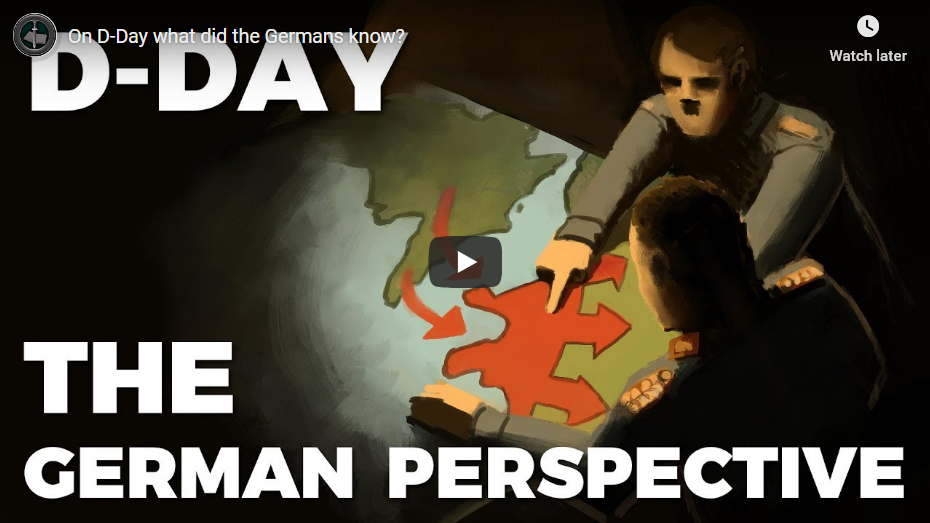
On D-Day what did the Germans know?
Military History Visualized
Published on 28 May 2019When it comes to D-Day and the German perspective there are a few bits out there, but the sources are sometimes lacking. So, for this, we will be looking at some proper sources namely, the situation report of Operations Staff of the Wehrmacht and the war diary of the 7th German Army.
Cover design by vonKickass.
»» SUPPORT MHV ««
» paypal donation – https://paypal.me/mhvis
» patreon – https://www.patreon.com/mhv» SOURCES «
Mehner, Kurt (Hrsg.): Die geheimen Tagesberichte der Deutschen Wehrmachtführung im Zweiten Weltkrieg 1939-1945. Band 10: 1. März 1944 – 31. August 1944, Biblio Verlag: Osnabrück, 1985.
Schramm, Percy E.: (Hrsg.): Kriegstagebuch des OKW 1944-1945. Teilband I. Eine Dokumentation. Bechtermünz: 2005.
Lieb, Peter: Unternehmen Overlord. Die Invasion in der Normandie und die Befreiung Westeuropas. C.H. Beck: München, 2014.
Horst Boog, Gerhard Krebs, Detlef Vogel: Das Deutsche Reich und der Zweite Weltkrieg. Band 7. Das Deutsche Reich in der Defensive – Strategischer Luftkrieg in Europa, Krieg im Westen und in Ostasien 1943 bis 1944/45, Deutsche Verlags-Anstalt, Stuttgart 2001.
Germany and the Second World War. Volume 7. The Strategic Air War in Europe and the War in the West and East Asia 1943–1944/5. 2006.
Citino, Robert M.: The Wehrmacht’s Last Stand. The German Campaigns of 1944-1945. University Press of Kansas: USA, 2017.
Fennell, Jonathan: Fighting the People’s War. The British and Commonwealth Armies and the Second World War. Cambridge University Press: Cambridge, UK, 2019
Harrison, Gordon A.: Cross-Channel Attack. United States army in World War II. Center of Military History, United States Army, Washington D.C., 1993
Blumenson, Martin: Breakout and Pursuit. United States army in World War II. Center of Military History, United States Army, Washington D.C., 1993
Messenger, Charles: The D-Day Atlas. Anatomy of the Normandy Campaign, Thames & Hudson: London, 2014 (2004).
Penrose, Jane (ed.): The D-Day Companion. Leading Historians explore history’s greatest amphibious assault. Osprey Publishing: Oxford 2009 (2004).
Töppel, Roman: Kursk 1943. The Greatest Battle of the Second World War. Helion: Warwick, UK: 2018.
Document for June 6th: D-day statement to soldiers, sailor, and airmen of the Allied Expeditionary Force, 6/44 https://www.archives.gov/global-pages…
The Invasion of France, June 6, 1944, House of Commons https://winstonchurchill.org/resource…
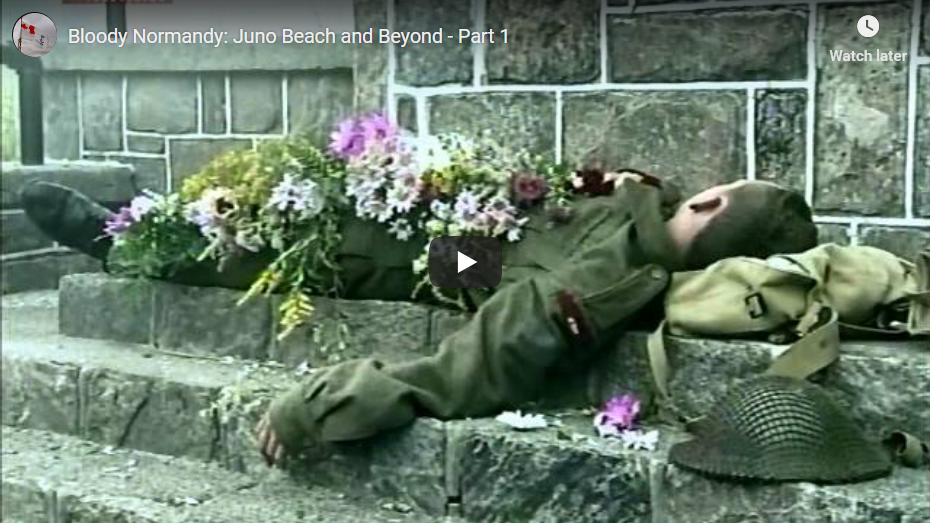
Bloody Normandy: Juno Beach and Beyond – Part 1
canmildoc
Published on 17 Sep 2011Part 1 of 5
Documentary “Stories from the Second World War: Bloody Normany”.
Juno or Juno Beach was one of five sectors of the Allied invasion of German-occupied France in the Normandy landings on 6 June 1944, during the Second World War. The sector spanned from Saint-Aubin, a village just east of the British Gold sector, to Courseulles, just west of the British Sword sector. The Juno landings were judged necessary to provide flanking support to the British drive on Caen from Sword, as well as to capture the German airfield at Carpiquet west of Caen. Taking Juno was the responsibility of the 3rd Canadian Infantry Division and commandos of the Royal Marines, with support from Naval Force J, the Juno contingent of the invasion fleet, including ships of the Royal Canadian Navy (RCN). The beach was defended by two battalions of the German 716th Infantry Division, with elements of the 21st Panzer Division held in reserve near Caen.
The invasion plan called for two brigades of the 3rd Canadian Division to land in two subsectors — Mike and Nan — focusing on Courseulles, Bernières, and Saint-Aubin. It was hoped that preliminary naval and air bombardment would soften up the beach defences and destroy coastal strongpoints. Close support on the beaches was to be provided by amphibious tanks of the 2nd Canadian Armoured Brigade. Once the landing zones were secured, the plan called for the 9th Canadian Infantry Brigade to land reserve battalions and deploy inland, the Royal Marine commandos to establish contact with the British 3rd Infantry Division on Sword, and the 7th Canadian Infantry Brigade to link up with the British 50th (Northumbrian) Infantry Division on Gold. The 3rd Canadian Division’s D-Day objectives were to capture Carpiquet Airfield and reach the Caen-Bayeux railway line by nightfall.
The landings initially encountered heavy resistance from the German 716th Division; the preliminary bombardment proved less effective than had been hoped, and rough weather forced the first wave to be delayed until 07:35. Several assault companies — notably those of the Royal Winnipeg Rifles and The Queen’s Own Rifles of Canada — took heavy casualties in the opening minutes of the first wave. Strength of numbers, as well as coordinated fire support from artillery and armoured squadrons, cleared most of the coastal defences within two hours of landing. The reserves of the 7th and 8th brigades began deploying at 08:30 (along with the Royal Marines), while the 9th Brigade began its deployment at 11:40.
The subsequent push inland towards Carpiquet and the Caen-Bayeux railway line achieved mixed results. The sheer numbers of men and vehicles on the beaches created lengthy delays between the landing of the 9th Brigade and the beginning of substantive attacks to the south. The 7th Brigade encountered heavy initial opposition before pushing south and making contact with the 50th Infantry Division at Creully. The 8th Brigade encountered heavy resistance from a battalion of the 716th at Tailleville, while the 9th Brigade deployed towards Carpiquet early in the evening. Resistance in Saint-Aubin prevented the Royal Marines from establishing contact with the British 3rd Division on Sword. When all operations on the Anglo-Canadian front were ordered to halt at 21:00, only one unit had reached its D-Day objective, but the 3rd Canadian Infantry Division had succeeded in pushing farther inland than any other landing force on D-Day. – http://en.wikipedia.org/wiki/Juno_beach
June 2, 2019
History of England – Fire and Swords – Extra History – #2
Extra Credits
Published on 1 Jun 2019On the 26th of August,1346, Philip’s army drew near the English force. The French were strung out for miles. Phillip’s best commanders advised caution: put on those comfy jim-jams the Queen gave you last Christmas, don the royal slippers, get a goodnight’s snooze, and let everyone catch up, then drown the English in a river of their own blood after a light breakfast. But Phillip looked upon the current puny size of the English army, and ordered the attack anyway…
Thanks again to David Crowther for writing AND narrating this series! https://thehistoryofengland.co.uk/pod…
Join us on Patreon! http://bit.ly/EHPatreon
Experiment 2 for social media thumbnails:

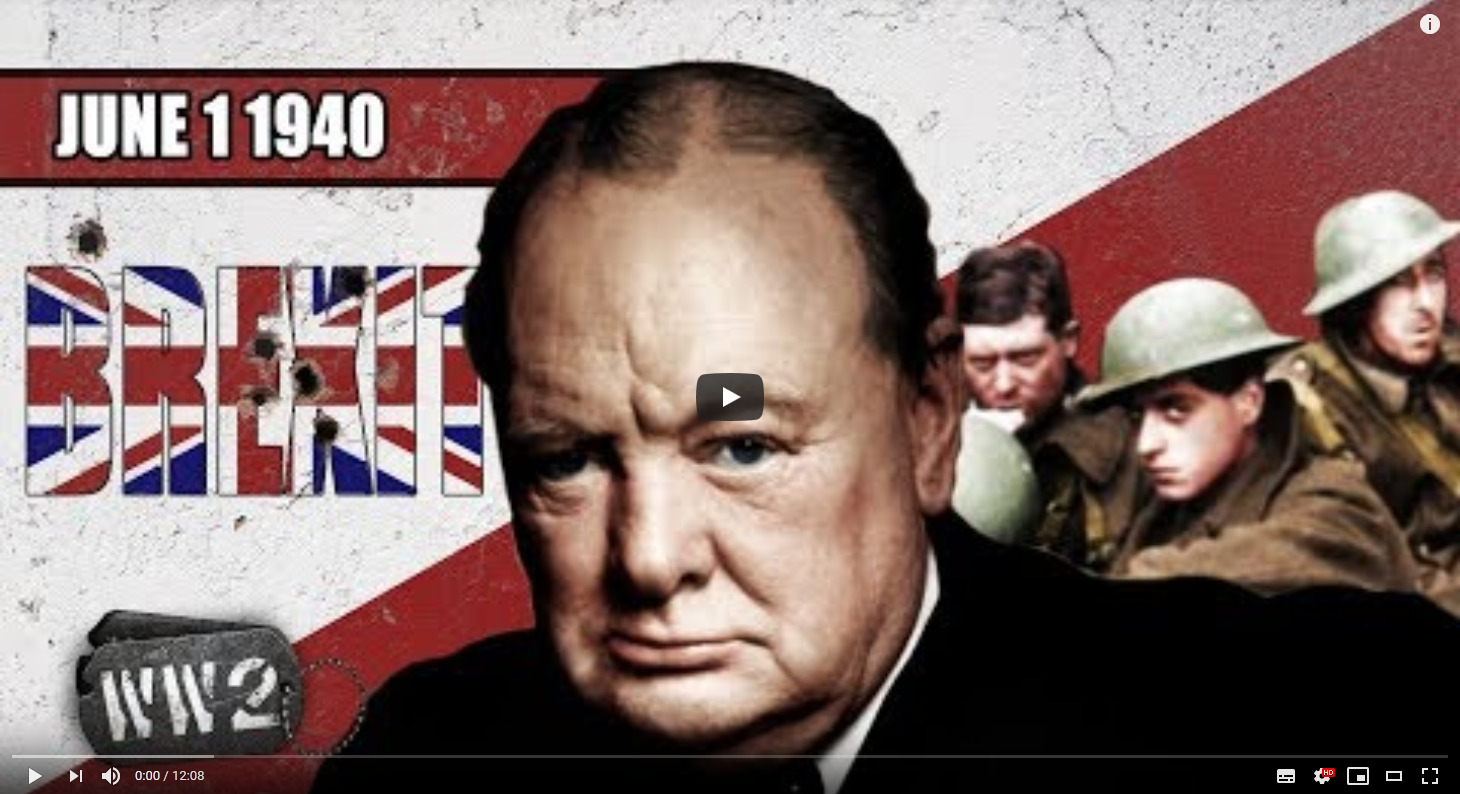
Brexit at Dunkirk – WW2 – 040 – June 1 1940
World War Two
Published on 1 Jun 2019When the Germans Panzers move north from Calais, the British Expeditionary Force and France’s soldiers still fighting in Belgium and Northern France are trapped between a numerically superior German army. A big operation codenamed “Dynamo” is set up to evacuate as many as possible from Dunkirk.
Join us on Patreon: https://www.patreon.com/TimeGhostHistory
Or join The TimeGhost Army directly at: https://timeghost.tvFollow WW2 day by day on Instagram @World_war_two_realtime https://www.instagram.com/world_war_t…
Join our Discord Server: https://discord.gg/D6D2aYN.
Between 2 Wars: https://www.youtube.com/playlist?list…
Source list: http://bit.ly/WW2sourcesWritten and Hosted by: Indy Neidell
Produced and Directed by: Spartacus Olsson and Astrid Deinhard
Executive Producers: Bodo Rittenauer, Astrid Deinhard, Indy Neidell, Spartacus Olsson
Creative Producer: Joram Appel
Post-Production Director: Wieke Kapteijns
Research by: Indy Neidell
Edited by: Daniel Weiss
Map animations: EastoryColorisations by Joram Appel, Spartacus Olsson and Norman Stewart.
Eastory’s channel: https://www.youtube.com/channel/UCEly…
Archive by Screenocean/Reuters https://www.screenocean.com.Sources:
A TimeGhost chronological documentary produced by OnLion Entertainment GmbH.
From the comments:
World War Two
3 days ago (edited)
As many of you already know, people who support us on Patreon get three days early access to our content – which explains why some comments have been made before the video is published. We are very grateful to those who financially support us, because (as Indy mentions a lot) we really wouldn’t be able to do any of this without your support. This project is fully funded by our community and viewers. Right now, we are still very much working at the max of our capacity. That is partly because we take on new tasks whenever some time frees itself – we just can’t help making more and better content, but also because we still need more financial stability to hire more editors and researchers. Only then will we be able to deliver a steady flow of specials, Out of the Foxholes episodes and War Against Humanity videos at the quality that we would like them to be. You can support us on Patreon https://www.patreon.com/timeghosthistory or on our website http://www.timeghost.tv.Thanks a lot!!
Cheers,
Joram
And, experimental image as fodder for social media link thumbnail:
June 1, 2019
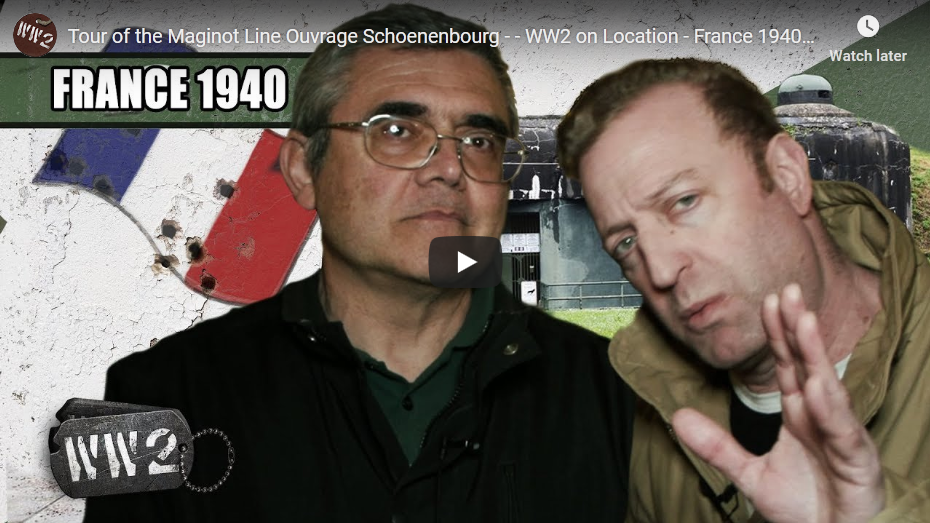
Tour of the Maginot Line Ouvrage Schoenenbourg – WW2 on Location – France 1940 – 02
World War Two
Published on 30 May 2019Marc Halter takes Indy and all of us on a tour through the fort at Schoenenbourg on the Maginot Line.
The website of the fort: http://www.lignemaginot.com
Join us on Patreon: https://www.patreon.com/TimeGhostHistory
Or join The TimeGhost Army directly at: https://timeghost.tvFollow WW2 day by day on Instagram @World_war_two_realtime https://www.instagram.com/world_war_t…
Join our Discord Server: https://discord.gg/D6D2aYN.
Between 2 Wars: https://www.youtube.com/playlist?list…
Source list: http://bit.ly/WW2sourcesWritten and Hosted by: Indy Neidell
Produced and Directed by: Spartacus Olsson and Astrid Deinhard
Executive Producers: Bodo Rittenauer, Astrid Deinhard, Indy Neidell, Spartacus Olsson
Creative Producer: Joram Appel
Research by: Indy Neidell
Edited by: Iryna Dulka
Map animations: EastoryArchive by Screenocean/Reuters https://www.screenocean.com.
A TimeGhost chronological documentary produced by OnLion Entertainment GmbH.
From the comments:
World War Two
36 minutes ago
You will have seen some of this material in our previous videos about the Maginot Line, but here is the full walk-though that Indy made with Marc, the President of the volunteer organisation that maintains the fort and keeps it in memory for all of us.
Experimental screen shot for social media thumbnail:
May 31, 2019
History Buffs: Master and Commander
History Buffs
Published on 18 Sep 2016History Buffs is back! To thank you all for your patience while I’ve been away on holiday, I’m starting off with Master and Commander!
SUPPORT HISTORY BUFFS ON PATREON
https://www.patreon.com/HistoryBuffs● Follow us on Twitter: https://twitter.com/HistoryBuffsNH
_________________________________________________________________________
Master and Commander: The Far Side of the World is a 2003 American epic historical drama film written, produced and directed by Peter Weir. The film stars Russell Crowe as Captain Jack Aubrey and Paul Bettany as Dr. Stephen Maturin. The film, which cost $150 million to make, was a co-production of 20th Century Fox, Miramax Films, Universal Pictures, and Samuel Goldwyn Films, and released on November 14, 2003 to critical acclaim. The film’s plot and characters are adapted from three novels in author Patrick O’Brian’s Aubrey–Maturin series, which includes 20 completed novels of Jack Aubrey’s naval career.
At the 76th Academy Awards, the film was nominated for 10 Oscars, including Best Picture. It won in two categories, Best Cinematography and Best Sound Editing and lost in all other categories to The Lord of the Rings: The Return of the King.
May 26, 2019
History of England – The 100 Years War – Extra History – #1
Extra Credits
Published on 25 May 2019At stake on the English side was trade, the English role in Christendom, the king’s lands in France held by right for 150 years, and the reputation and honor of the king. On the French side, a unified country, national prestige, and the right of their monarch to his own throne.
Thanks again to David Crowther for writing AND narrating this series! https://thehistoryofengland.co.uk/pod…
Join us on Patreon! http://bit.ly/EHPatreon
The Allied Clusterf**k in France – WW2 – 039 – May 25 1940
World War Two
Published on 25 May 2019While the massive invasion of the Benelux countries and France was going down last week, things were also developing on the fronts in Norway and China. But this week, the German beast is let loose. After breaking through its cage at Sedan last week, nothing seems strong enough to block its way to the English Channel. And if one thing becomes clear, it is that the Allied command structure and the way they communicate is one big smoking mess…
Join us on Patreon: https://www.patreon.com/TimeGhostHistory
Or join The TimeGhost Army directly at: https://timeghost.tvFollow WW2 day by day on Instagram @World_war_two_realtime https://www.instagram.com/world_war_t…
Join our Discord Server: https://discord.gg/D6D2aYN.
Between 2 Wars: https://www.youtube.com/playlist?list…
Source list: http://bit.ly/WW2sourcesWritten and Hosted by: Indy Neidell
Produced and Directed by: Spartacus Olsson and Astrid Deinhard
Executive Producers: Bodo Rittenauer, Astrid Deinhard, Indy Neidell, Spartacus Olsson
Creative Producer: Joram Appel
Post-Production Director: Wieke Kapteijns
Research by: Indy Neidell
Edited by: Iryna Dulka
Map animations: EastoryColorisations by Joram Appel, Spartacus Olsson and Norman Stewart.
Eastory’s channel: https://www.youtube.com/channel/UCEly…
Archive by Screenocean/Reuters https://www.screenocean.com.Sources:
FDR Presidential Library & Museum
National Portrait Gallery
IWM: H 9218, F 4484, F 4613, F 4578, F 4743б (F 4339
MUSÉE DES ETOILES
Nationaal Archief
Sound effect: LittleRobotSoundFactoryA TimeGhost chronological documentary produced by OnLion Entertainment GmbH.
May 25, 2019
107 Abandoned French Soldiers Killed for Propaganda – WW2 on Location – France 1940 – 02
World War Two
Published on 23 May 2019After the German army breaks through the French lines at Sedan, the left flank of the moving army has to be secured. The French Ouvrage la Ferté, part of the Maginot Line defense works, is subject to this consolidation. But the Germans move with ulterior motives, as them capturing a Maginot Line fort in the first week of the offensive has a huge propaganda value. Tour guide Richard Tucker shows Indy the grounds of a modern tragedy, where 107 French soldiers gave their lives.
Check out (and book!) Richard Tucker here: https://www.tripadvisor.nl/Attraction…
Join us on Patreon: https://www.patreon.com/TimeGhostHistory
Or join The TimeGhost Army directly at: https://timeghost.tvFollow WW2 day by day on Instagram @World_war_two_realtime https://www.instagram.com/world_war_t…
Join our Discord Server: https://discord.gg/D6D2aYN.
Between 2 Wars: https://www.youtube.com/playlist?list…
Source list: http://bit.ly/WW2sourcesWritten and Hosted by: Indy Neidell
Produced and Directed by: Spartacus Olsson and Astrid Deinhard
Executive Producers: Bodo Rittenauer, Astrid Deinhard, Indy Neidell, Spartacus Olsson
Creative Producer: Joram Appel
Research by: Indy Neidell
Edited by: Wieke KapteijnsThumbnail Colorisation by Joram Appel
Eastory’s channel: https://www.youtube.com/channel/UCEly…
Archive by Screenocean/Reuters https://www.screenocean.com.A TimeGhost chronological documentary produced by OnLion Entertainment GmbH.
May 22, 2019
Hotchkiss 1914: A French and American WWI Heavy MG
Forgotten Weapons
Published on 19 Apr 2019This Hotchkiss machine gun and its tripod are lot #2027 in the upcoming April 2019 Morphy auction:
https://www.forgottenweapons.com/hotc…
The gun that became the Hotchkiss 1914 and served as the bulwark of French and American forces in World War One was actually first designed and patented by an Austrian officer; Adolph von Odkolek. He took his idea to the Hotchkiss company in Paris hoping to arrange for them to produce it under license. The design was inspected by Laurence Benet (chief engineer at Hotchkiss) and Henri Mercie (Benet’s assistant), and they concluded that the gun was not suitable for production. However, the core concept in the patent – Odkolek’s gas piston system – was a worthy one and would allow production of machine guns to compete with Maxim and Colt without violating their existing patents. So Benet arranged to simply buy the patent outright for a flat fee, and then Hotchkiss set about redesigning the gun to be much better.
The result was the model 1897, an air-cooled, strip-fed heavy machine gun that was sold to many different nations. It was improved in 1900, and between the two models sales were made to Japan, Mexico, Chile, Brazil, China, Spain, Ethiopia, Finland, Greece, Guatemala, Luxembough, Norway, Sweden, Turkey, Portugal, and Venezuela in a variety of calibers. The French government also purchased some Hotchkiss guns, primarily for colonial use. For the bulk of the metropolitan army, France opted to design its own gun in the state arsenals (which was the Modele 1907 St Etienne gun; which is suspiciously like a Hotchkiss with the operating direction of the parts reversed to avoid patent infringement).
When World War One broke out, and the need for vast quantities of machine guns became apparent, the Hotchkiss was finally adopted on a large scale by France. The commercial 1900 pattern was revised slightly (a better barrel-locking system and replacement of the shoulder stock with a D-ring rear handle) and some 45,000 would be produced by 1918. The Hotchkiss would supplant the 1907 St Etienne over the course of the war, as it was a more reliable and less expensive design. It would go on to serve the French military through the end of World War Two, gaining a reputation as a gun of unparalleled simplicity and reliability.
http://www.patreon.com/ForgottenWeapons
Cool Forgotten Weapons merch! http://shop.bbtv.com/collections/forg…
Contact:
Forgotten Weapons
PO Box 87647
Tucson, AZ 85754
May 21, 2019
Armoured Vehicles of the Invasion of France 1940, by The Chieftain – WW2 Special
World War Two
Published on 20 May 2019The Chieftain takes you on an extensive walkthrough of the armoured vehicles used by both sides during the German invasion of France in 1940.
The Chieftain’s channel: https://www.youtube.com/user/TheChief…
May 19, 2019
The German Breakthrough in the West – WW2 – 038 – May 18 1940
World War Two
Published on 18 May 2019The German invasion of Western Europe has been going for over a week now, and the Neutral and Allied countries are in disarray. The Netherlands, despite putting up fierce resistance on some occasions, faces overwhelming powers while Belgium, France and the British feel the pressure from an organised and armoured assault from the Ardennes. And still, the German tanks, soldiers and aircraft are not all the Allies have to fear, as many of their losses are caused by their own command.
Join us on Patreon: https://www.patreon.com/TimeGhostHistory
Or join The TimeGhost Army directly at: https://timeghost.tvChurchills ‘Blood, toil, tears and sweat’ speech: https://winstonchurchill.org/resource…
Follow WW2 day by day on Instagram @World_war_two_realtime https://www.instagram.com/world_war_t…
Join our Discord Server: https://discord.gg/D6D2aYN.
Between 2 Wars: https://www.youtube.com/playlist?list…
Source list: http://bit.ly/WW2sourcesWritten and Hosted by: Indy Neidell
Produced and Directed by: Spartacus Olsson and Astrid Deinhard
Executive Producers: Bodo Rittenauer, Astrid Deinhard, Indy Neidell, Spartacus Olsson
Creative Producer: Joram Appel
Research by: Indy Neidell
Post-Production Director: Wieke Kapteijns
Edited by: Iryna Dulka
Map animations: EastoryColorisations by Norman Stewart and Julius Jääskeläinen https://www.facebook.com/JJcolorization/
Eastory’s channel: https://www.youtube.com/channel/UCEly…
Archive by Screenocean/Reuters https://www.screenocean.com.Sources:
– © IWM (C 1666)A TimeGhost chronological documentary produced by OnLion Entertainment GmbH.
From the comments:
World War Two
This is the longest weekly episode of our World War Two series to this date, and boy are we proud. We made sure to make this the absolute best it could possibly be. After last week’s episode of WW2, it was hard to imagine that Eastory could surpass his efforts for that episode anytime soon, but it took him one week. Iryna, our editor in Warsaw, did an amazing job with putting together this episode. We hope you like it as much as we do. Thanks for your ongoing support and if you don’t already, please consider supporting us on Patreon.By the way, we have an Instagram feed where we dedicate one post per day of the war, which allows us to give some topics a little more attention, like the invasion of the Netherlands. You can check them out here:
11 May 1940 – Germans attack Dutch positions on the Grebbeberg and the Grebbeline: https://www.instagram.com/p/BxVBQcwnHAs/
12 May 1940 – Three German Panzer divisions approach Sedan to Force a breakthrough into France: https://www.instagram.com/p/BxYS8XqHdTh/
13 May 1940 – The Battle of the Grebbeberg ends in a German victory, allowing them to push into Holland: https://www.instagram.com/p/Bxauq9HnqOW/
14 May 1940 – German bombers destroy the inner city of Rotterdam while peace talks are going on: https://www.instagram.com/p/Bxc7zreiXo8/
15 May 1940 – The French fight a successful but practically meaningless battle at Gembloux: https://www.instagram.com/p/BxfGP1qCzV9/
16 May 1940 – Guderian rapidly moves westward, showing the full potential of tank-warfare: https://www.instagram.com/p/BxhxvyDClbY/
May 18, 2019
The Maginot Line – WW2 on Location – France 1940 – 01
World War Two
Published on 16 May 2019The Maginot Line was not the failure many think — in fact it was quite a remarkable feat — find out more in this video.
Guest Experts in order of appearance:
Mark Halter – Fortress Schoenenbourg http://www.lignemaginot.com/accueil/i…
Richard Tucker – Maginot Line Tours http://maginotlinetours.co.uk or https://www.tripadvisor.nl/Attraction…
Roland Müller – L’Abri de Hatten http://www.abrihatten.fr/index-en.htmlJoin us on Patreon: https://www.patreon.com/TimeGhostHistory
Or join The TimeGhost Army directly at: https://timeghost.tvFollow WW2 day by day on Instagram @World_war_two_realtime https://www.instagram.com/world_war_t…
Join our Discord Server: https://discord.gg/D6D2aYN.
Between 2 Wars: https://www.youtube.com/playlist?list…
Source list: http://bit.ly/WW2sourcesHosted by: Indy Neidell
Written and Directed by: Spartacus Olsson
Produced by: Astrid Deinhard
Executive Producers: Bodo Rittenauer, Astrid Deinhard, Indy Neidell, Spartacus Olsson
Creative Producer: Joram Appel
Research by: Spartacus Olsson
Edited by: Wieke KapteijnsEastory’s channel: https://www.youtube.com/channel/UCEly…
Archive by Screenocean/Reuters https://www.screenocean.com.A TimeGhost chronological documentary produced by OnLion Entertainment GmbH.
From the comments:
World War Two
In April, with the help of many of you fantastic people we went to France to visit some of the sites of the German invasion in 1940. This is the first of a series of specials that we recorded there. More will follow in May and June as the war in France proceeds. On Saturday we will come out with a double length episode about the German breakthrough in the West — we are exceedingly proud of that episode and we hope that you will enjoy it as much as we do. This video gives you some great background to that event. For us it was a revelation to visit the sites and talk to the experts you will meet in the video. Mark Halter of the amazingly well preserved Schoenenburg Fortress, Richard Tucker who gives fantastic tours around the Sedan area, and Roland Müller who has worked for decades to keep alive the memory of the men who served on the front. If you happen to be in the Alsace or Ardennes area, you need to go visit these places. Most of the Maginot museums are private initiatives that depend on their visitor income and financial contributions to continue existing — links are in the description.
May 15, 2019
Modern architecture as a generations-long art crime spree
Theodore Dalrymple is clearly quite a fan of Making Dystopia: The Strange Rise and Survival of Architectural Barbarism by James Stevens Curl, as this is at least the third review of the book I’ve seen by him (and you can probably tell I agree with much of his viewpoint that I’m blogging it yet again…)

In a recent debate in Prospect magazine on the question of whether modern architecture has ruined British towns and cities, Professor James Stevens Curl, one of Britain’s most distinguished architectural historians, wrote as his opening salvo:
Visitors to these islands who have eyes to see will observe that there is hardly a town or city that has not had its streets — and skyline — wrecked by insensitive, crude, post-1945 additions which ignore established geometries, urban grain, scale, materials, and emphases.
This is so self-evidently true that I find it hard to understand how anyone could deny it, but modern architects and hangers-on such as architectural journalists do deny it, like war criminals who, for obvious reasons, continue to deny their crimes in the face of overwhelming evidence.
This is true not only of Britain but of many, perhaps most, other countries that have or had any towns or cities to ruin. Anyone who rides into the center of Paris from Charles de Gaulle Airport, for example, will be appalled at the modernist visual hell that scours his eyes as he goes.
Nor is this visual hell the consequence of the need to build cheaply. Where money is no object, contemporary architects, like the sleep of reason in Goya’s etching, bring forth monsters. The Tour Montparnasse (said to be the most hated building in Paris), the Centre Pompidou, the Opéra Bastille, the Musée du quai Branly, the new Philharmonie, do not owe their preternatural ugliness to lack of funds, but rather to the incapacity, one might say the ferocious unwillingness, of architects to build anything beautiful, and to their determination to leave their mark on the city as a dog leaves its mark on a tree.
Professor Curl’s magnum opus is both scholarly and polemical. He has been observing the onward march of modernism and its effects for sixty years and is justifiably outraged by it. British architects have managed to reverse the terms of the anarchist Bakunin’s dictum that the urge to destroy is also a creative urge: Their urge to create is also a destructive urge. I could give many concrete examples (no pun intended).
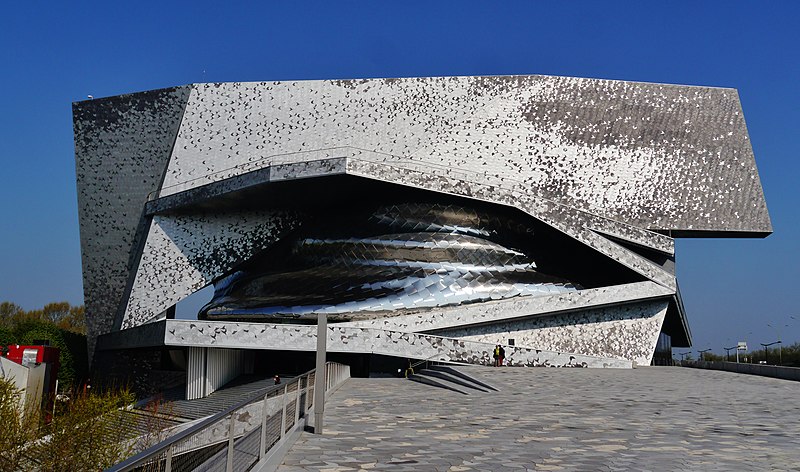
Philharmonie at the Parc de la Villette, Paris.
Photo by Zairon via Wikimedia Commons.
Curl knows that he is arguing not against an aesthetic, but against an ironclad ideology. The architectural Leninists have been determined so to indoctrinate the public that they hope and expect a generation will grow up knowing nothing but modernism, and therefore will be unable to judge it. (All judgment is comparative, as Doctor Johnson said.) In Paris recently, I saw an advertisement on the Métro (a few days before the fire in Notre-Dame) to the effect that Paris would not be Paris without the Centre Pompidou — which, of course, has a good claim to be the ugliest building in the world. In the face of such an advertisement promoted by the cultural elite, what ordinary person would dare demur?
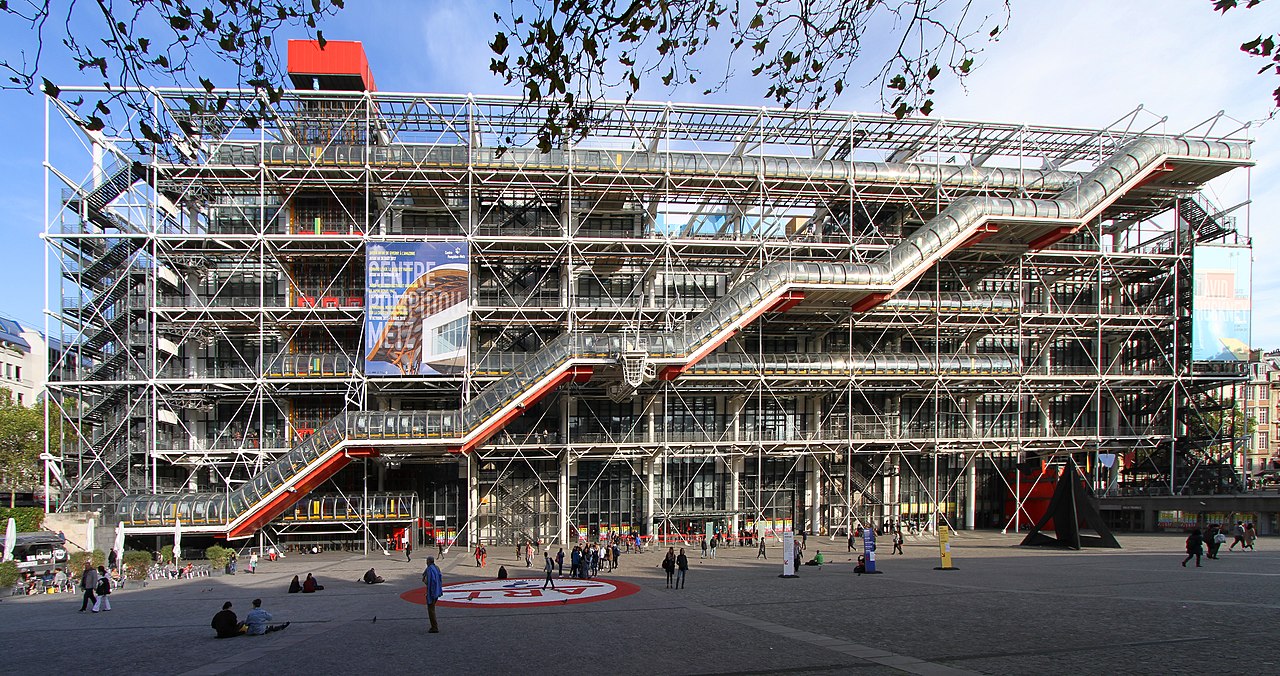
Centre Georges-Pompidou (no, this isn’t an under construction image … it’s from 2017 and the construction was technically complete in 1977)
Gerd Eichmann photo via Wikimedia Commons.
Could anyone imagine a worldwide outpouring of genuine and heartfelt grief, such as that which greeted the burning of Notre-Dame de Paris, if any building of the last seventy years burnt down? Indeed, the destruction of many would be a cause almost for rejoicing. Modernist buildings will never age as Notre-Dame aged; they will merely deteriorate, and usually do deteriorate even before completion.


