
Forgotten Weapons
Published on 9 Apr 2019This Hotchkiss cannon and its accessories are lot #1116 in the upcoming April 2019 Morphy auction:
https://www.forgottenweapons.com/hotc…
Benjamin Hotchkiss was an American artillery designer who moved to Paris in 1867 in hopes of building a business for his improvements in artillery shells. He experienced the Franco-Prussian War in 1870, and understood the failure of the French Mitrailleuse multi-barrel volley guns. In his opinion, an effective rapid-fire weapon needed to fire explosive projectiles to have a real effect at extended range (unlike the Mitrailleuse which fired simple rifle bullets). So being the inventive sort, he went ahead and designed just such a gun. His revolving cannon was sized for 1-pound (450g) 37mm explosive shells (although he would also produce armor-piercing and canister ammunition). The gun looks like a Gatling gun at first glance, but its mechanical operation is quite different.
The Hotchkiss cannon would become quite popular, with major purchases by the French and American navies as well as many other nations. They would serve into World War One, including some use repurposed as antiaircraft weapons. This particular example was captured by American forces in Cuba during the Spanish-American War, most likely from San Juan Hill. It is a magnificent example of the type, and with a fantastic historical provenance to match.
http://www.patreon.com/ForgottenWeapons
Cool Forgotten Weapons merch! http://shop.bbtv.com/collections/forg…
Contact:
Forgotten Weapons
PO Box 87647
Tucson, AZ 85754
May 14, 2019
Hotchkiss Revolving Cannon from San Juan Hill
May 12, 2019
Hitler Strikes in the West – WW2 – 037 – May 11 1940
World War Two
Published on 11 May 2019As the Allied troops in central Norway are evacuated and the Norwegian troops there surrender to the Germans, the Allied position around Narvik is still quite strong. With the addition of roughly 5000 Polish soldiers, the French, British and Norwegian force will prove to be a formidable foe for the Germans up North. This week however, the war drastically changes as not three but four Neutral countries are invaded. The Phoney War is ultimately over.
Join us on Patreon: https://www.patreon.com/TimeGhostHistory
Or join The TimeGhost Army directly at: https://timeghost.tvFollow WW2 day by day on Instagram @World_war_two_realtime https://www.instagram.com/world_war_t…
Join our Discord Server: https://discord.gg/D6D2aYN.
Between 2 Wars: https://www.youtube.com/playlist?list…
Source list: http://bit.ly/WW2sourcesWritten and Hosted by: Indy Neidell
Produced and Directed by: Spartacus Olsson and Astrid Deinhard
Executive Producers: Bodo Rittenauer, Astrid Deinhard, Indy Neidell, Spartacus Olsson
Creative Producer: Joram Appel
Research by: Indy Neidell
Edited by: Ben Ollerenshaw and Wieke Kapteijns
Map animations: EastoryColorisations by Norman Stewart and Julius Jääskeläinen https://www.facebook.com/JJcolorization/
Sources: IWM (A 7644), IWM (A 7637), IWM HU 55505, Bundesarchiv, Photos from the Jonatan Myhre Barlien photo collection.
Eastory’s channel: https://www.youtube.com/channel/UCEly…
Archive by Screenocean/Reuters https://www.screenocean.com.A TimeGhost chronological documentary produced by OnLion Entertainment GmbH.
From the comments:
World War Two
The Phoney War is over. This is the week that many have been anxiously waiting for (how did they know something big was going to happen). We have some great episodes coming up, which are like this one only as great as they are because of the amazing effort that our team puts in creating them. As is very apparent in this episode, Eastory’s maps take these videos to the next level. Every week we’re stunned by his level of detail and the amazing value that is added by these maps. As the war enters a new phase, so do we. Next week will see the first of our roadtrip to France specials going live as well as the longest weekly episode we have written up until now.Cheers,
Joram
May 7, 2019
The Suez Crisis reconsidered
Jordan Chandler Hirsch reviews a new book on what is now a somewhat forgotten international crisis that shook the Atlantic alliance, Philip Zelikow’s Suez Deconstructed:
Zelikow encourages readers to assess Suez by examining three kinds of judgments made by the statesmen during the crisis: value judgments (“What do we care about?”), reality judgments (“What is really going on?”), and action judgments (“What can we do about it?”). Asking these questions, Zelikow argues, is the best means of evaluating the protagonists. Through this structure, Suez Deconstructed hopes to provide “a personal sense, even a checklist, of matters to consider” when confronting questions of statecraft.
The book begins this task by describing the world of 1956. The Cold War’s impermeable borders had not yet solidified, and the superpowers sought the favor of the so-called Third World. Among non-aligned nations, Cold War ideology mattered less than anti-colonialism. In the Middle East, its champion was Egyptian President Gamal Abdel Nasser, who wielded influence by exploiting several festering regional disputes. He rhetorically — and, the French suspected, materially — supported the Algerian revolt against French rule. He competed with Iraq, Egypt’s pro-British and anti-communist rival. He threatened to destroy the State of Israel. And through Egypt ran the Suez Canal, which Europe depended on for oil.
Egypt’s conflict with Israel precipitated the Suez crisis. In September 1955, Nasser struck a stunning and mammoth arms deal with the Soviet Union. The infusion of weaponry threatened Israel’s strategic superiority, undermined Iraq, and vaulted the Soviet Union into the Middle East. From that point forward, Zelikow argues, the question for all the countries in the crisis (aside from Egypt, of course) became “What to do next about Nasser?”
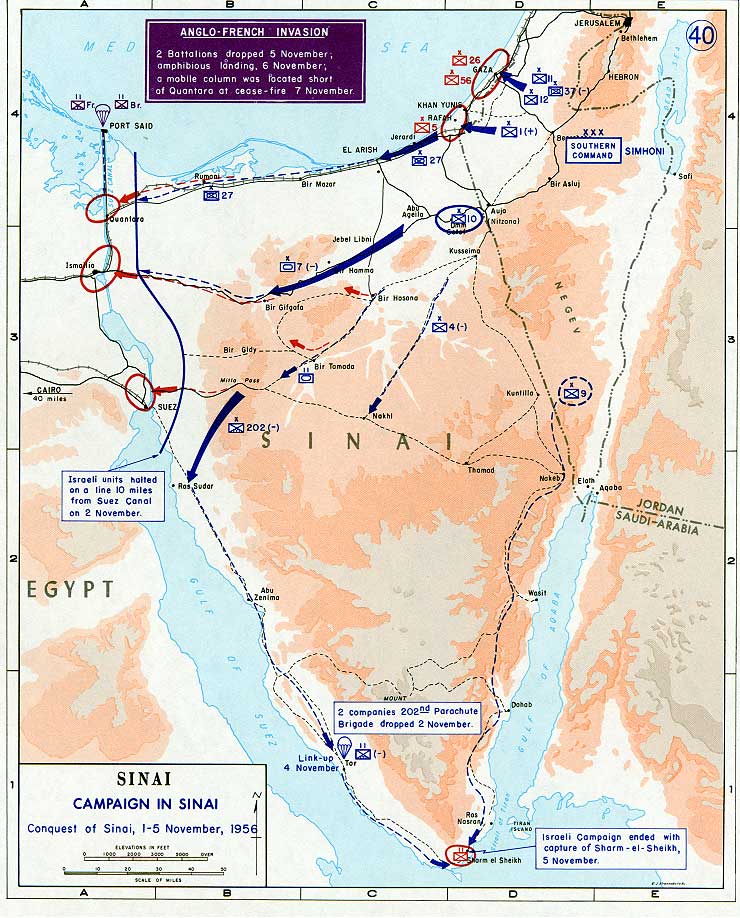
Israel responded with dread, while, Britain, France, and the United States alternated between confrontation and conciliation. Eventually, the United States abandoned Nasser, but he doubled down by nationalizing the Suez Canal. This was too much for France. Hoping to unseat Nasser to halt Egyptian aid to Algeria, it concocted a plan with Israel and, eventually, Britain for Israel to invade Egypt and for British and French troops to seize the Canal Zone on the pretense of separating Israeli and Egyptian forces. The attack began just before the upcoming U.S. presidential election and alongside a revolution in Hungary that triggered a Soviet invasion. The book highlights the Eisenhower administration’s anger at the tripartite plot. Despite having turned on Nasser, Eisenhower seethed at not having been told about the assault, bitterly opposed it, and threatened to ruin the British and French economies by withholding oil shipments.
Throughout, Suez Deconstructed disorients. As the story crisscrosses from terror raids into Israel to covert summits in French villas, from Turtle Bay to the Suez Canal, names and places, thoughts and actions blur. Venerable policymakers scramble to comprehend the latest maneuvers as they struggle with the weight of history: Was Suez another Munich? Could Britain and France still project power abroad? Would a young Israel survive?
If you’re not familiar with the Suez Crisis and want more than just the Wikipedia article for background, here’s the coverage of the military side of things from the British perspective (Operation Musketeer) from Naval History Homepage.
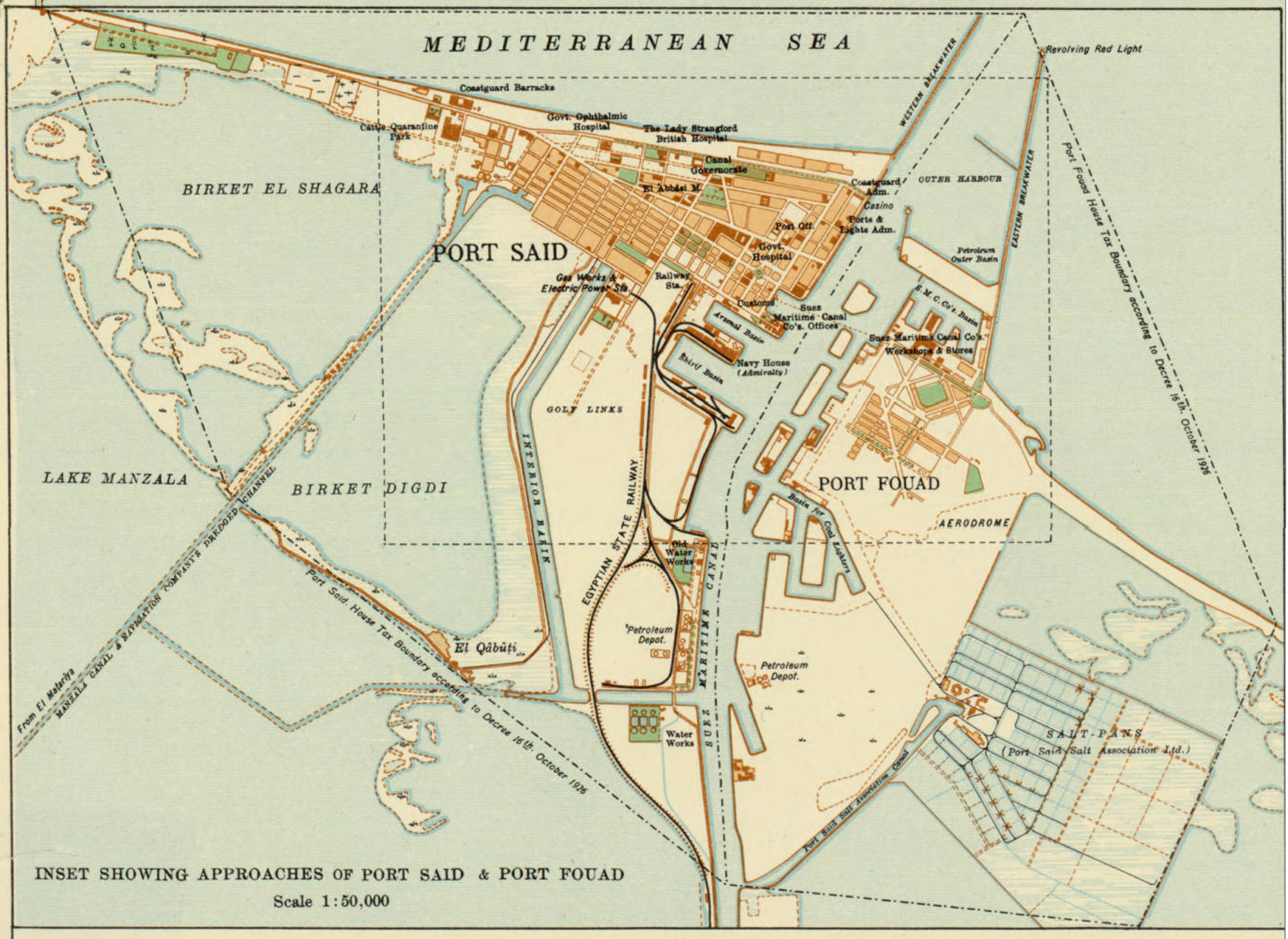
A detailed map of Port Said in 1936 (American Geographical Society Library). Changes by 1956 are not known.
Map via Naval History Homepage.
May 6, 2019
Mers El Kebir: When The British Blew Up the French Fleet
Historigraph
Published on 4 May 2019Join us in #WarThunder for free using this link and get a premium tank or aircraft and three days of premium time as a bonus: https://gjn.link/Historigraph/190504
If you enjoyed this video and want to see more made, consider supporting my efforts on Patreon: https://www.patreon.com/historigraph
To chat history, join my discord: https://discord.gg/vAFTK2D
#WarThunder #MersElKebir #Historigraph
► Twitter: https://twitter.com/historigraph
►Patreon: https://www.patreon.com/historigraph
►Discord: https://discord.gg/vAFTK2DSources:
Colin Smith, England’s Last War Against France: Fighting Vichy 1940-42
Stephen Roskill, Churchill and the Admirals
Correli Barnett, Engage the enemy more closely
http://avalon.law.yale.edu/wwii/frgea…
Music:
Rynos Theme, Incompetech https://incompetech.com
Malicious, Incompetech https://incompetech.com
Crypto, Incompetech https://incompetech.com
May 5, 2019
QotD: A growing French industry
The French, I think, must be world champions in the production of books lamenting the state of their economy (they are also good at taking antidepressants). Occasionally, it is true, someone writes a book to the effect that things are not so very bad in France, in fact that they are really quite good, at least by comparison with everywhere else; but this is so contrary to the majority of what is written that it has the quality of whistling in the wind. If the French economy had grown at the rate at which books are published predicting its imminent collapse, it would be flourishing indeed.
Theodore Dalrymple, “Beneath Paris”, Taki’s Magazine, 2017-01-07.
May 3, 2019
“The Lost Battalion” – The Meuse-Argonne Offensive – Sabaton History 013
Sabaton History
Published on 2 May 2019In the last months of the Great War, the Americans join the fighting on the Western Front in an effort to break through the German Lines for once and for all. The Americans launch their Meuse-Argonne Offensive in the fall of 1918. As part of the offensive, nine companies of the United States 77th Division under command of Major Charles White Whittlesey pushes through the German lines with remarkable ease. Little did they know that the German lines were not abandoned, but that they simply found a hole. The Lost Battalion was surrounded and the men had to fight for days, awaiting their rescue.
Support Sabaton History on Patreon (and possibly get a special edition of The Great War): https://www.patreon.com/sabatonhistory
Watch the Official Lyric Video of “The Lost Battalion” here: https://www.youtube.com/watch?v=oSZtV…
Check out the trailer for Sabaton’s new album The Great War right here: https://www.youtube.com/watch?v=HCZP1…
Listen to Sabaton on Spotify: http://smarturl.it/SabatonSpotify
Official Sabaton Merchandise Shop: http://bit.ly/SabatonOfficialShopHosted by: Indy Neidell
Written by: Markus Linke and Indy Neidell
Directed by: Astrid Deinhard and Wieke Kapteijns
Produced by: Pär Sundström, Astrid Deinhard and Spartacus Olsson
Creative Producer: Joram Appel
Executive Producers: Pär Sundström, Joakim Broden, Tomas Sunmo, Indy Neidell, Astrid Deinhard, and Spartacus Olsson
Maps by: Eastory
Edited by: Iryna Dulka
Sound Editing by: Marek KaminskiEastory YouTube Channel: https://www.youtube.com/channel/UCEly…
Archive by: Reuters/Screenocean https://www.screenocean.com
Music by Sabaton.Sources:
© IWM (Q 8986), IWM (Q 10317), IWM (Q 8842), IWM (Q 9080), IWM (Q 87923), IWM (Q 61038), IWM (Q 53524), © IWM (Q 45553), IWM (Q 81616), IWM (Q 9078), IWM (Q 9079), IWM (Q 8844), IWM (Q 56607), IWM (Q 55559), IWM (Q 55558), IWM (Q 87940), IWM (Q 85383), IWM (Q 23719), IWM (Q 23709), IWM (Q 42057), IWM (Q 115198), IWM (Q 8161), IWM (Q 10316), IWM (Q 7928) IWM (Q 61481), IWM (Q 57695), IWM (Q 9088), IWM (Q 9083), IWM (Q 47997), IWM (Q 79595)
USMC Archives through Flickr: https://www.flickr.com/photos/6086806…An OnLion Entertainment GmbH and Raging Beaver Publishing AB co-Production.
© Raging Beaver Publishing AB, 2019 – all rights reserved.
From the comments:
Sabaton History
1 day ago
We met up with Indy in the Argonne to film Sabaton History’s episode for “The Lost Battalion”. As it happens, our new album is about the First World War as well. We have published a video earlier today presenting the “History Channel Edition” for the upcoming Sabaton Album The Great War. This is a special edition of the new album that is an exclusive reward for people who generously support us on Patreon as a Hussar or higher. If you want to check out the video in which Joakim and Indy explain the contents of the special edition, click here: https://youtu.be/Nk-VN_PjZyg If you want to support this channel on Patreon, go here: https://www.patreon.com/sabatonhistoryThanks for your time and cheers! 🤘
May 2, 2019
The French Char B Tank – WORLD WAR TWO Special
World War Two
Published on 30 Apr 2019After the Great War was over, the French reconsidered their army’s function and the role that tanks would play in future warfare. On the brink of World War Two, the Char B tank is deeply embedded in the structure of the French armoured defences. David Willey from the Tank Museum in Bovington (UK) tells how French politics influenced how the Char B will be used if the Germans attack. To learn more about the technical details of the Char B, check out the Tank Chat that David Fletcher from the Tank Museum has done about the Char B-1 Bis: https://www.youtube.com/watch?v=tz8L1…
Check out the Tank Museum YouTube Channel right here: https://www.youtube.com/user/TheTankM…
Join us on Patreon: https://www.patreon.com/TimeGhostHistory
Or join The TimeGhost Army directly at: https://timeghost.tvFollow WW2 day by day on Instagram @World_war_two_realtime https://www.instagram.com/world_war_t…
Source list: http://bit.ly/WW2sourcesWritten and Hosted by: David Willey and Indy Neidell
Produced and Directed by: Astrid Deinhard
Executive Producers: Bodo Rittenauer, Astrid Deinhard, Indy Neidell, Spartacus Olsson
Creative Producer: Joram Appel
Post Production Director: Wieke Kapteijns
Research by: David Willey
Edited by: Wieke KapteijnsArchive by Screenocean/Reuters https://www.screenocean.com.
A TimeGhost chronological documentary produced by OnLion Entertainment GmbH.
From the comments:
World War Two
44 minutes ago (edited)
David Willey from the Tank Museum in Bovington (UK) explains brilliantly what impact French politics in the 1920s and 1930s had on the development and use of French tanks leading up to World War Two. On their own channel, the Tank Museums own David Flecher dives into the technical ins and outs of the Char B-1 tank. You can find that right here: https://www.youtube.com/watch?v=tz8L1FU74Rs Make sure to subscribe to their YouTube channel too, as it perfectly compliments the content that we show here. Cheers!
May 1, 2019
Bavarian Soviet Republic – 1919 Economy and Reconstruction I BEYOND THE GREAT WAR
The Great War
Published on 30 Apr 2019» SUPPORT THE CHANNEL
Patreon: https://www.patreon.com/thegreatwar
Merchandise: https://shop.spreadshirt.de/thegreatwar/Jesse Alexander takes a look at the short lived but historically important Bavarian Soviet Republic that existed for 3 weeks in April 1919. He also takes a look at the post armistice economy and reconstruction in the west.
» SOURCES
Deperchin, Annie. “Des destructions aux reconstructions,” in Stéphane Audoin-Rouzeau and Jean-Jacques Becker, eds. Encyclopédie de la Grande guerre 1914-1918 (Paris : Bayard, 2013): 1063-1074.Gerwarth, Robert. The Vanquished. Why the First World War Failed to End, 1917-1923 (Penguin, 2017).
Jones, Mark. Am Anfang war Gewalt. Die Deutsche Revolution 1918/19 und der Beginn der Weimarer Republik (Berlin: Propyläen, 2017). English edition: Founding Weimar. Violence and the German Revolution of 1918-19 (Cambridge University Press, 2016).
» SOCIAL MEDIA
Twitter: https://twitter.com/WW1_Series
Reddit: https://reddit.com/r/TheGreatWarChannel»CREDITS
Presented by: Jesse Alexander
Written by: Jesse Alexander
Director: Toni Steller & Florian Wittig
Director of Photography: Toni Steller
Sound: Toni Steller
Editing: Toni Steller
Mixing, Mastering & Sound Design: http://above-zero.com
Motion Design: Christian Graef – GRAEFX
Maps: Daniel Kogosov (https://www.patreon.com/Zalezsky)
Research by: Jesse Alexander
Fact checking: Florian Wittig
Channel Design: Alexander Clark
Original Logo: David van StepholdA Mediakraft Networks Original Channel Contains licensed material by getty images
All rights reserved – Real Time History GmbH 2019
From the comments:
The Great War
28 minutes ago
As a small production announcement: This was the last episode in the classical format where we answer questions directly. From May onward, every video we publish every other week will have one main topic: an important event from exactly 100 years ago. This will make it much easier to follow the channel and it will be more in line with our mission statement to cover the war in real time 100 years later. Of course, you can still ask questions. We will answer some of the directly in our Patreon podcast and we will use them as inspiration for our episodes. As an example: A lot of fans asked if we will cover the American “Polar Bear Expedition” and so that will be exactly what we will cover in our episode in late May. On top of that, we will do a small “time jump” and starting with our episode in June we will have a synchronized timeline again meaning: The episodes coming out in June 2019 will cover June 1919 and so forth.
The Wine Lover Meltdown that Changed the Wine World Forever
Today I Found Out
Published on 26 Mar 2019Check out my other channel TopTenz! https://www.youtube.com/user/toptenznet
Follow Simon on social media:
https://twitter.com/SimonWhistler
https://www.instagram.com/simonwhistler/Never run out of things to say at the water cooler with TodayIFoundOut! Brand new videos 7 days a week!
More from TodayIFoundOut:
Why Does the Yolk of an Overcooked Hard Boiled Egg Turn Green
https://youtu.be/ytqpeHcFT3YWhat’s the Difference Between Brown Eggs and White Eggs?
https://youtu.be/je44qy-_MHYIn this video:
Outside of wine snobs, I think we can all agree that wine snobs are just the worst. This is not because virtually every study ever conducted into the field of wine tasting as a whole has concluded that it’s ridiculously easy to convince even the top sommeliers that $5 boxed white wine is the finest red wine ever bottled. Nor is it because wines they would happily sacrifice their first born to have a glass of and would have otherwise raved about, when told the glass contains a variety of some cheap wine they are to identify, are more than likely to claim it tastes akin to horse piss.
Want the text version? http://www.todayifoundout.com/index.p…
QotD: Standardized measurements, feudalism, and revolution
The pint in eighteenth-century Paris was equivalent to 0.93 liters, whereas in Seine-en-Montane it was 1.99 liters and in Precy-sous-Thil, an astounding 3.33 liters. The aune, a measure of length used for cloth, varied depending on the material (the unit for silk, for instance, was smaller than that for linen) and across France there were at least seventeen different aunes. […]
Virtually everywhere in early modern Europe were endless micropolitics about how baskets might be adjusted through wear, bulging, tricks of weaving, moisture, the thickness of the rim, and so on. In some areas the local standards for the bushel and other units of measurement were kept in metallic form and placed in the care of a trusted official or else literally carved into the stone of a church or the town hall. Nor did it end there. How the grain was to be poured (from shoulder height, which packed it somewhat, or from waist height?), how damp it could be, whether the container could be shaken down, and finally, if and how it was to be leveled off when full were subjects of long and bitter controversy. […]
Thus far, this account of local measurement practices risks giving the impression that, although local conceptions of distance, area, volume, and so on were different from and more varied than the unitary abstract standards a state might favor, they were nevertheless aiming at objective accuracy. This impression would be false. […]
A good part of the politics of measurement sprang from what a contemporary economist might call the “stickiness” of feudal rents. Noble and clerical claimants often found it difficult to increase feudal dues directly; the levels set for various charges were the result of long struggle, and even a small increase above the customary level was viewed as a threatening breach of tradition. Adjusting the measure, however, represented a roundabout way of achieving the same end.
The local lord might, for example, lend grain to peasants in smaller baskets and insist on repayment in larger baskets. He might surreptitiously or even boldly enlarge the size of the grain sacks accepted for milling (a monopoly of the domain lord) and reduce the size of the sacks used for measuring out flour; he might also collect feudal dues in larger baskets and pay wages in kind in smaller baskets. While the formal custom governing feudal dues and wages would thus remain intact (requiring, for example, the same number of sacks of wheat from the harvest of a given holding), the actual transaction might increasingly favor the lord. The results of such fiddling were far from trivial. Kula estimates that the size of the bushel (boisseau) used to collect the main feudal rent (taille) increased by one-third between 1674 and 1716 as part of what was called the reaction feodale. […]
This sense of victimization [over changing units of measure] was evident in the cahiers of grievances prepared for the meeting of the Estates General just before the Revolution. […] In an unprecedented revolutionary context where an entirely new political system was being created from first principles, it was surely no great matter to legislate uniform weights and measures. As the revolutionary decree read “The centuries old dream of the masses of only one just measure has come true! The Revolution has given the people the meter!”
James C. Scott, Seeing Like A State: How Certain Schemes to Improve the Human Condition Have Failed, 1998.
April 30, 2019
QotD: Successful “democracies” in history have usually been disguised oligarchies
Thus we get the “Revolutions” in America and France, where educated and newly politicised chattering classes try to find a simplistic solution to all the world’s problems. Their solution being to adopt a system which fits their preferred world order, and seems to give them an advantage that will allow them to force people into their way of thinking.
Humans being what they are, it didn’t work of course.
The American Revolution, supposedly about ‘equality for all’ – if you want to fall for idealistic propaganda – was actually a tax rebellion by Northern states (who also wanted to get rid of the English government’s treaties that kept them out of Indian land), and the Southern states (who wanted to block the English anti-slavery legislation from spreading to their nice comfy system). It was never really about equality, and all the exclusions of people from voting on the basis of colour, race, sex, religion, immigration status, etc., should have made it clear to anyone that what was being considered was really an Oligarchy. Similar in fact to the Ancient Greek and Roman slave-based societies, where some special and limited classes shared rights no one else had.
Actually all “successful” democracies in history have always been Oligarchies. The 1,000 year old “Sublime Republic of Venice” – on which large parts of the US constitution were based – for instance, being limited to a certain number of families that had the vote. Similarly the “Republics” of Ancient Greece or Rome, and modern Switzerland or Israel, being based on vote by military service – another way of ensuring the voters might put national interests above selfish ones.
The first few French republics (those squeezed in around the inevitable dictatorships and emperors that are the result of such systems) were also based on a limited franchise. In their case not a race or religion or sex one like the US, but a straight property qualification that saw a small percentage of both sexes as voters.
Unsurprisingly the Oligarchical Republics of the 18th and 19th centuries were some of the most internally violent (US Slavery, Civil War, Indian Wars, the Terror, multiple revolts and “communes”, Lynchings, Jim Crow laws, etc), and externally aggressive (Napoleonic Wars, Spanish–American Wars, “Interventions” in Central America, Occupations of Hawaii, Philippines, etc.) governments in history. Rivaling the Greek and Roman republics for their aggressive expansionism by land and sea, and certainly being no less effective than more traditional military (Russia and Germany) or trade (Britain and Netherlands) expansionist states.
(And here I would note that the one of the mitigating factors in the idea that German Nationalism was a problem in WWI, was that the populist Navy Leagues and Colonial Leagues of the newly enfranchised voting classes did in fact push Nationalism to dangerous extremes. The Kaiser was a dangerous loon, but he was a dangerous loon responding to the fervor of the dregs of the petit bourgeois who had been enfranchised in his nation, not a man with Napoleonic capabilities in his own right.)
Nigel Davies, “The Solution is… European Union/Multiculturalism/Communism… Name your poison!”, rethinking history, 2015-12-26.
April 29, 2019
QotD: Prostitution
I had a few patients who were prostitutes. I remember one well-dressed lady in her 40s, whose profession I asked in the course of my history-taking.
“Dominatrix,” she said.
She was obviously very good at it because she had an international clientele, including, for example, a judge in Alabama. She told me that she never went anywhere in her car without her kit, for she might receive an emergency call at any time from Hong Kong or South Africa. You might have thought that being whipped by one woman in black fishnet stockings was as good as being whipped by another, but apparently this was (and I presume still is) not so: It’s the words and gestures that go with the whipping that count as well.
This activity of hers gave her a very good living (her car was far better than mine); she was sending her daughter to private school. I admired her enterprise and thought of Sor Juana Inés de la Cruz. Was she or the judge in Alabama to blame? Was either of them to blame at all?
Of course, she wasn’t typical of the profession, and hard cases, as they say, make bad law. But I am not at all sure that I saw the poor prostitutes in my street as merely victims, as the new French law would have them. Not everyone with their life history becomes a crack-taking prostitute. This does not mean that I did not pity them for what they had become. If we can truly sympathize only with those who have done nothing to contribute to their own fate, we shall have very restricted sympathies indeed.
Theodore Dalrymple, “Turning Tricks Into Sympathy”, Taki’s Magazine, 2016-04-09.
April 28, 2019
QotD: Innovations in taxation
The door-and-window tax established in France [in the 18th century] is a striking case in point. Its originator must have reasoned that the number of windows and doors in a dwelling was proportional to the dwelling’s size. Thus a tax assessor need not enter the house or measure it, but merely count the doors and windows.
As a simple, workable formula, it was a brilliant stroke, but it was not without consequences. Peasant dwellings were subsequently designed or renovated with the formula in mind so as to have as few openings as possible. While the fiscal losses could be recouped by raising the tax per opening, the long-term effects on the health of the population lasted for more than a century.
James C. Scott, Seeing Like A State: How Certain Schemes to Improve the Human Condition Have Failed, 1998.
April 26, 2019
QotD: European jokes about the neighbours
… it is also the Finns who snicker at overbearing Swedes (“What’s the difference between the Swedes and the Finns? The Swedes have got nice neighbours”); and the Portuguese, who mock Spanish arrogance (“In a recent survey, 11 out of 10 Spaniards said they felt superior to the others”).
There are the Irish, who joke about buttoned-up Brits (“What’s the English definition of a thrill? Having an After Eight at 7.30”); and the Poles, who have a go at the Germans for pretty much anything (“German footballers are like German food: if they’re not imported from Poland they’re no good”).
Making fun of our best enemies, said Romain Seignovert, who has just published a book on the jokes Europeans tell about their neighbours, is a great European tradition. “We are a big, diverse community with a centuries-long common history of highs and lows, and our humour reflects that,” he says.
[…]
There is a deeper point. Ultimately, Seignovert said, laughing at our neighbours is “recognising, even celebrating, our particularities. It shows we’re not indifferent. Europe isn’t just political and economic, it’s also cultural – about all these nations, living together. The EU hasn’t made enough of that.”
That may be true. But Seignovert, remember, is French, so what he says should clearly not be taken too seriously. In the words of one particularly fine Belgian quip: “How does a Frenchman commit suicide? By shooting 15cm above his head, right in the middle of his superiority complex.”
Jon Henley, “‘Crude, but rarely nasty’: The jokes Europeans tell about their neighbours”, The Guardian, 2016-05-08.


