
Tasting History with Max Miller
Published 29 Oct 2024Crescent-shaped bread rolls, from before the croissant was a flaky pastry
City/Region: France
Time Period: 1853Croissants weren’t always the buttery, flaky pastries that we know and love. While today, that flakiness is what defines a croissant, in the past, it was the crescent shape that was most important.
This recipe from the mid-19th century, a good 50 years before the croissant got its flakes, is a wonderfully soft bread. It doesn’t bear much resemblance to a modern croissant besides the shape, but it is much easier to make. The bread is a little plain, but would be lovely with some butter and jam.
In luxury bakeries, small loaves called croissants are prepared, usually in the semi-circular shape of a roll curved and tapered at the ends. The liquid is used to form the dough with one kilogram of flour consists of one or two eggs beaten and mixed with about five hundred grams of water. Moreover, the choice of flour, the dose of yeast, as well as the working of the dough, require the same care as when it comes to the other luxury breads mentioned.
— Des substances alimentaire et des moyens de les améliorer by Anselme Payen, 1853.
March 11, 2025
The Myth and Truth behind Croissants – A Recipe from 1850
March 5, 2025
QotD: British and French Enlightenments
In 2005, [Gertrude Himmelfarb] published The Roads to Modernity: The British, French, and American Enlightenments. It is a provocative revision of the typical story of the intellectual era of the late eighteenth century that made the modern world. In particular, it explains the source of the fundamental division that still doggedly grips Western political life: that between Left and Right, or progressives and conservatives. From the outset, each side had its own philosophical assumptions and its own view of the human condition. Roads to Modernity shows why one of these sides has generated a steady progeny of historical successes while its rival has consistently lurched from one disaster to the next.
By the time she wrote, a number of historians had accepted that the Enlightenment, once characterized as the “Age of Reason”, came in two versions, the radical and the skeptical. The former was identified with France, the latter with Scotland. Historians of the period also acknowledged that the anti-clericalism that obsessed the French philosophes was not reciprocated in Britain or America. Indeed, in both the latter countries many Enlightenment concepts — human rights, liberty, equality, tolerance, science, progress — complemented rather than opposed church thinking.
Himmelfarb joined this revisionist process and accelerated its pace dramatically. She argued that, central though many Scots were to the movement, there were also so many original English contributors that a more accurate name than the “Scottish Enlightenment” would be the “British Enlightenment”.
Moreover, unlike the French who elevated reason to a primary role in human affairs, British thinkers gave reason a secondary, instrumental role. In Britain it was virtue that trumped all other qualities. This was not personal virtue but the “social virtues” — compassion, benevolence, sympathy — which British philosophers believed naturally, instinctively, and habitually bound people to one another. This amounted to a moral reformation.
In making her case, Himmelfarb included people in the British Enlightenment who until then had been assumed to be part of the Counter-Enlightenment, especially John Wesley and Edmund Burke. She assigned prominent roles to the social movements of Methodism and Evangelical philanthropy. Despite the fact that the American colonists rebelled from Britain to found a republic, Himmelfarb demonstrated how very close they were to the British Enlightenment and how distant from French republicans.
In France, the ideology of reason challenged not only religion and the church, but also all the institutions dependent upon them. Reason was inherently subversive. But British moral philosophy was reformist rather than radical, respectful of both the past and present, even while looking forward to a more enlightened future. It was optimistic and had no quarrel with religion, which was why in both Britain and the United States, the church itself could become a principal source for the spread of enlightened ideas.
In Britain, the elevation of the social virtues derived from both academic philosophy and religious practice. In the eighteenth century, Adam Smith, the professor of moral philosophy at Glasgow University, was more celebrated for his Theory of Moral Sentiments (1759) than for his later thesis about the wealth of nations. He argued that sympathy and benevolence were moral virtues that sprang directly from the human condition. In being virtuous, especially towards those who could not help themselves, man rewarded himself by fulfilling his human nature.
Edmund Burke began public life as a disciple of Smith. He wrote an early pamphlet on scarcity which endorsed Smith’s laissez-faire approach as the best way to serve not only economic activity in general but the lower orders in particular. His Counter-Enlightenment status is usually assigned for his critique of the French Revolution, but Burke was at the same time a supporter of American independence. While his own government was pursuing its military campaign in America, Burke was urging it to respect the liberty of both Americans and Englishmen.
Some historians have been led by this apparent paradox to claim that at different stages of his life there were two different Edmund Burkes, one liberal and the other conservative. Himmelfarb disagreed. She argued that his views were always consistent with the ideas about moral virtue that permeated the whole of the British Enlightenment. Indeed, Burke took this philosophy a step further by making the “sentiments, manners, and moral opinion” of the people the basis not only of social relations but also of politics.
Keith Windschuttle, “Gertrude Himmelfarb and the Enlightenment”, New Criterion, 2020-02.
March 3, 2025
Europe’s Imperial Giants: On the Brink of Collapse? – W2W 09 Q4 1946
TimeGhost History
Published 2 Mar 2025In 1946, Britain, France, and the Netherlands fight to regain control over shattered colonies — from Indonesia’s revolt to Vietnam’s war with France. Meanwhile, the U.S. and USSR maneuver to shape these emerging nations for their own global interests. Will independence spark true liberation, or will it simply swap one master for another?
(more…)
March 1, 2025
Spoils of War: French Occupation-Production Mauser K98k svwMB
Forgotten Weapons
Published 11 Nov 2024Allied troops occupied the Mauser factory complex in Oberndorf in April of 1945, right at the end of the war. The factory was put under French administration and by May that same year production lines were restarted to supply French forces (who needed as many arms as they could get). In total, just under 52,000 new K98k rifles were made for the French between May 1945 and June 1946, when the factory shut back down (and much of it was dynamited by the departing French forces).
The rifles made under French control were all marked with the receiver code svwMB. German production had switched to this code early in 1945 after producing an “a” block of svw45 rifles and about 5,500 guns in the svw45 “b” block. The factory shutdown came midway through svwMB “c” block, and the first French-property rifles had been assembled under German control and were waiting for final inspection when the factory was occupied. Mauser production was non-linear, and some “c” block receivers had been finished and shipped to German forces before the shutdown, while others remained at the factory. There is no specific transition point between French and German rifles because of this. Production of the “c” block ran into the 29,000 range, and was followed by three suffixes of entirely French-production guns; “d”, “h”, and “k”.
The K98k being produced by this point — and what was continued under the French — was the Kriegsmodell, the last-ditch simplified model of the K98k. It had many stamped and welded parts, no barrel band springs (screws were used instead) and no bayonet lug. The French produced the guns in exactly the same configuration as the Germans had, simply substituting a five-pointed star as a final inspection stamp in front of the receiver serial number. At some point later, the French rebuilt many of these rifles and added two distinctive features that are often thought to have been original factory production elements. These are the hexagonal stacking rod under the muzzle and the left-side sling bar on the stock. When these rebuilds were done, the bolts were also scrubbed and renumbered with just the last 3 digits of the receiver serial number.
(more…)
February 21, 2025
Berlin ’45: City of Spies
World War Two
Published 20 Feb 2025In 1945, Berlin is a city in ruins — but for the world’s spies, it’s a goldmine. As the Soviets, Americans, British, and French carve up the capital, they scramble to seize Nazi secrets, recruit informants, and outmaneuver each other in an intelligence war that will define the Cold War. From stolen blueprints to fabricated reports, Berlin becomes the world’s first battleground of espionage.
(more…)
February 19, 2025
The Korean War 035 – The Battle of Chipyong-ni – February 18th, 1951
The Korean War by Indy Neidell
Published 18 Feb 2025Chinese Commander Peng Dehuai has launched his 4th Phase Offensive, pushing the UN forces back in the center of Korea, and should his forces take Chipyong-ni, they will compromise the entire UN position. Chipyong-ni must hold!
Chapters
00:00 Intro
00:50 Recap
01:21 4th Phase Offensive
03:07 Retreat from Hoengsong
06:27 Chipyong-Ni Must Hold!
08:50 First Relief Attempt
10:22 The Battle of Chipyong-Ni
15:34 Battle Side Notes
17:36 29th Brigade
19:36 Summary
19:59 Conclusion
(more…)
February 17, 2025
France Starts the Vietnam War – W2W 005
TimeGhost History
Published 16 Feb 2025In 1946, tensions in Indochina explode into full-scale war. As France struggles to reclaim its empire, Ho Chi Minh’s Viet Minh fight for independence, setting the stage for a brutal conflict that will shape the next three decades. With international powers pulling the strings, Vietnam becomes the first battleground of the post-war era’s colonial struggles.
(more…)
February 13, 2025
From Ruins to Recovery: The Fight to Rebuild – W2W 004
TimeGhost History
Published 12 Feb 2025In 1946, the world is struggling to rebuild from the devastation of WWII. Cities lie in ruins, economies are shattered, and millions are displaced. As the old powers of Britain and France weaken, the rising superpowers — the U.S. and USSR — compete to shape the new world order. Will reconstruction lead to stability, or is the world heading for another conflict?
(more…)
February 11, 2025
The End of Empire? Colonialism in Crisis – W2W 003
TimeGhost History
Published 9 Feb 2025In 1946, the old colonial empires of Britain and France struggle to maintain control as nationalist movements rise and their economies crumble. Meanwhile, two new superpowers — the U.S. and the USSR — seek to reshape the world in their image, using decolonization as both an ideal and a tool for influence. As the colonial order fractures, global power shifts, and the battle for dominance begins.
(more…)
February 7, 2025
Justice for WW2?! – W2W News 1945
TimeGhost History
Published 6 Feb 2025Join SPARTACUS and INDY on the War2War 1945 Newscast as we explore a world tumbling from war to war. European colonies face fresh conflicts and groundbreaking polymer innovations spark industrial revolutions. All the while Nazi war criminals are brought to justice at the Nuremberg Trials.
(more…)
January 24, 2025
Was WW1 Pointless? – War Goals Of Every Major Nation
The Great War
Published 13 Sept 2024The First World War is often seen as futile and pointless. Millions of men fought and died for years, but no one was satisfied with the outcome, which did not bring a lasting peace. But that is not how governments and many people saw the war as it was being fought. So what did the countries fighting actually want to achieve? In other words, what was the purpose of the First World War?
(more…)
January 23, 2025
Guycot 40-shot Chain Pistol
Forgotten Weapons
Published 19 Dec 2016The Guycot chain pistol was the development of two Frenchmen, Henri Guenot and Paulin Gay in 1879. It is chambered for a unique 6.5mm caseless rocket ball type cartridge in which the base of the projectile is hollowed out and contains the propellant powder and a primer. Upon firing, the entirely of the projectile exits, leaving nothing to be extracted or ejected from the chamber. Unfortunately for the Guycot’s military aspirations, this cartridge was far too small and underpowered to attract and serious interest and only a few hundred at most were made. These were divided between several models, including a 25-shot pistol, a 40-shot pistol like this one, and an 80-shot carbine.
January 15, 2025
Desert Storm: The Gulf War 1990-1991
Real Time History
Published 6 Sept 2024When Saddam Hussein invaded Kuwait in the summer of 1990, he didn’t anticipate a massive international backslash and unanimous Security Council response. Soon a broad military Coalition under leadership of the United States assembled and kicked the Iraqi Army out of Kuwait. In the aftermath several Iraqi groups rose up against Saddam but the Coalition didn’t support a regime change.
CHAPTERS:
00:00 Intro
00:29 Saddam Hussein Victorious (but Broke)
03:49 Iraqi Invasion of Kuwait
06:02 The Coalition Against Iraq Forms
08:37 Operation Desert Shield
10:55 Operation Desert Storm
20:26 Iraqi Highway of Death
21:39 Iraqi Uprisings
(more…)
January 12, 2025
Quebec within the British Empire after 1760
Fortissax, in response to a question about the historical situation of Quebec within Canada, outlines the history from before the Seven Years’ War (aka the “French and Indian War” to Americans) through the American Revolution, the 1837-38 rebellions, the Durham Report, and Confederation:
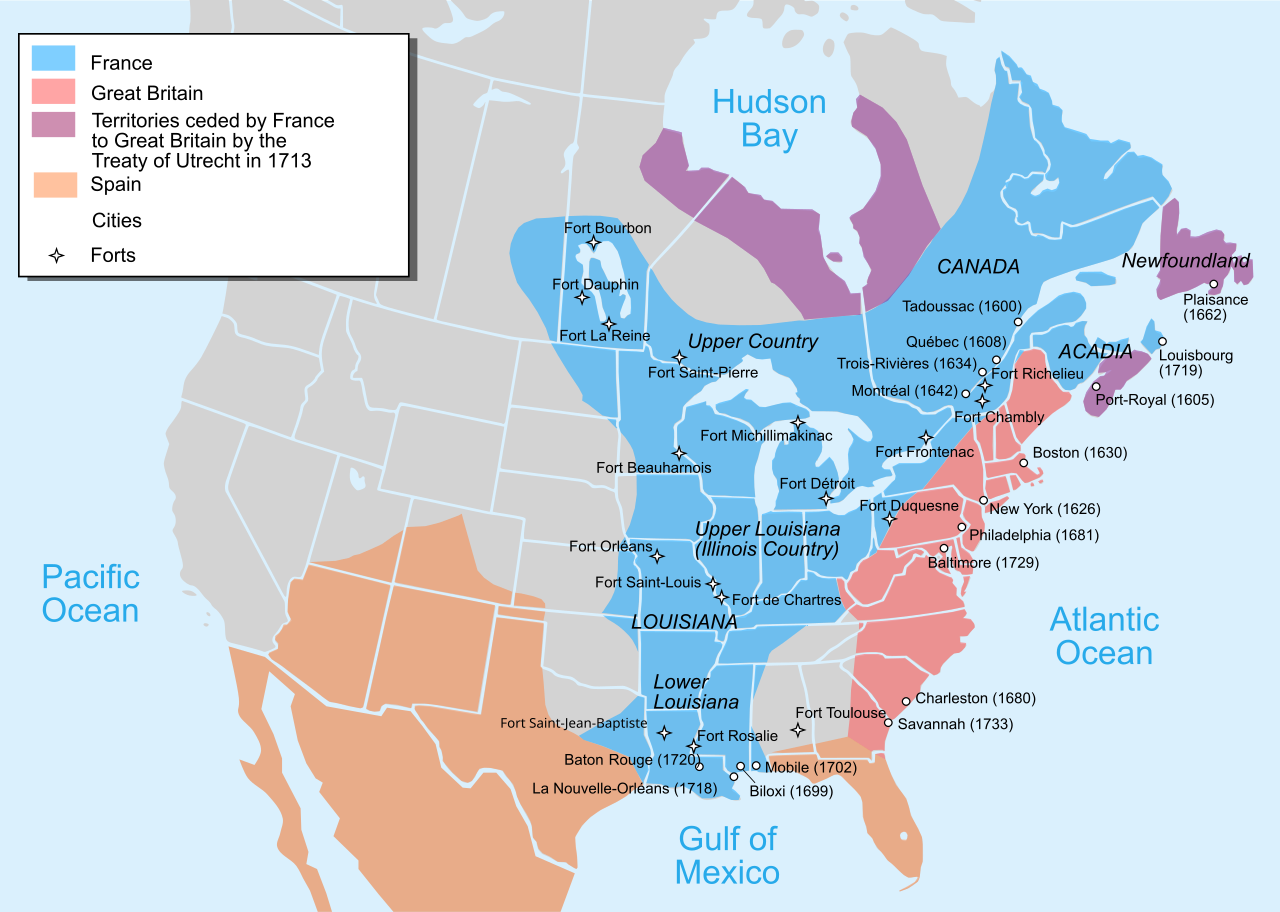
First and foremost, Canada itself, as a state — an administrative body, if you will — was originally founded by France. Jacques Cartier named the region in 1535, and Samuel de Champlain established the first permanent French settlement in North America in Quebec City in 1608. This settlement would become the largest and most populous administrative hub for the entire territory. Canada was a colony within the broader territory of New France, which stretched from as far north as Tadoussac all the way down to Louisiana. It included multiple hereditary land-owning noblemen of Norman extraction.
Much of the original territory of New France
During the Seven Years’ War, on 8 September 1760, General Lévis and Pierre de Vaudreuil surrendered the colony of Canada to the British after the capitulation of Montreal. Though the British had effectively won the war, the Conquest’s details still had to be negotiated between Great Britain and France. In the interim, the region was placed under a military regime. As per the Old World’s “rules of war”, Britain assured the 60,000 to 70,000 French inhabitants freedom from deportation and confiscation of property, freedom of religion, the right to migrate to France, and equal treatment in the fur trade. These assurances were formalized in the 55 Articles of the Capitulation of Montreal, which granted most of the French demands, including the rights to practice Roman Catholicism, protections for Seigneurs and clergymen, and amnesty for soldiers. Indigenous allies of the French were also assured that their rights and privileges would be respected.
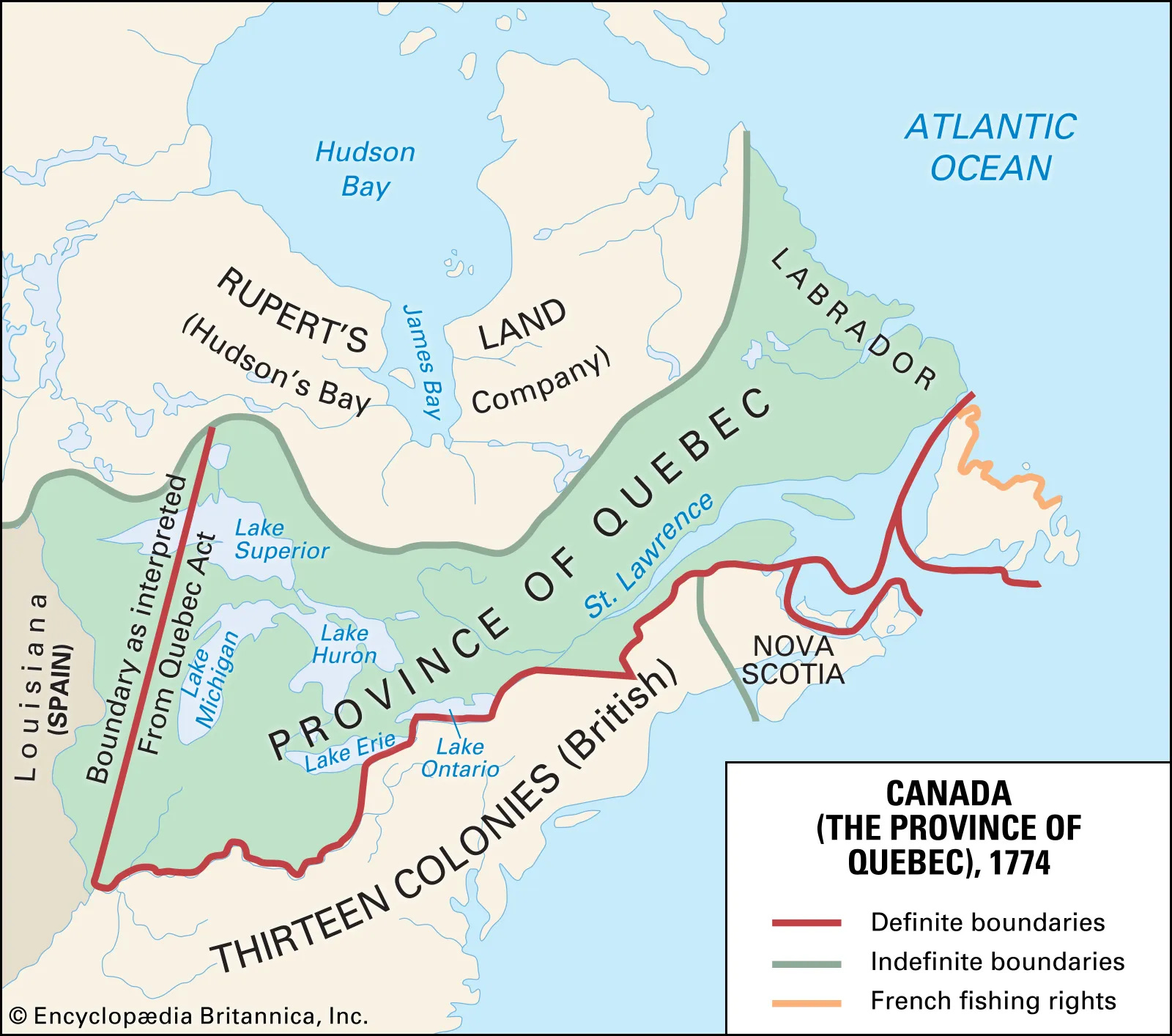
The Treaty of Paris in 1763 officially ended the war and renamed the French colony of “Canada” as “the Province of Quebec”. Initially, its borders included parts of present-day Ontario and Michigan. To address growing tensions between Britain and the Thirteen Colonies and to maintain peace in Quebec, the British Parliament passed the Quebec Act in 1774. This act solidified the French-speaking Catholic population’s rights, such as the free practice of Catholicism, restoration of French civil law, and exemption from oaths referencing Protestant Christianity. These provisions satisfied the Québécois Seigneurs (land-owning nobleman), and clergy by preserving their traditional rights and influence. However, some Anglo settlers in America resented the Act, viewing it as favoring the French Catholic majority. Despite this, the Act helped maintain stability in Quebec, ensuring it remained loyal to Britain during the American Revolutionary War and Quebec was fiercely opposed to liberal French revolutionaries.
British concessions, from the terms of the 1763 Treaty of Paris to the Quebec Act of 1774, safeguarded the cultural and religious identity of Quebec’s French-speaking Catholic population, fostering their loyalty during a period of significant upheaval in North America. Following this period, merchant families such as the Molsons began establishing themselves in Montreal, alongside early Loyalist settlers who trickled into areas now known as the Eastern Townships. These merchant families quickly ingratiated themselves with the local Norman lords and seigneurs.
The Lower Canada Rebellion arose in 1837-1838 due to the Château Clique oligarchy (an alliance of Anglo-Scottish industrialists and French noble landowners), in Quebec refusing to grant legislative power to the French Canadian majority. The rebellion was not solely a French Canadian effort; to the chagrin of both chauvinistic Anglo-Canadians and French Canadians, who in recent years believed it was either a brutal crackdown on French degeneracy, or a heroic class struggle of French peasants against an oppressive Anglo elite. It included figures like Wolfred Nelson, an Anglo-Quebecer who personally led troops into battle.
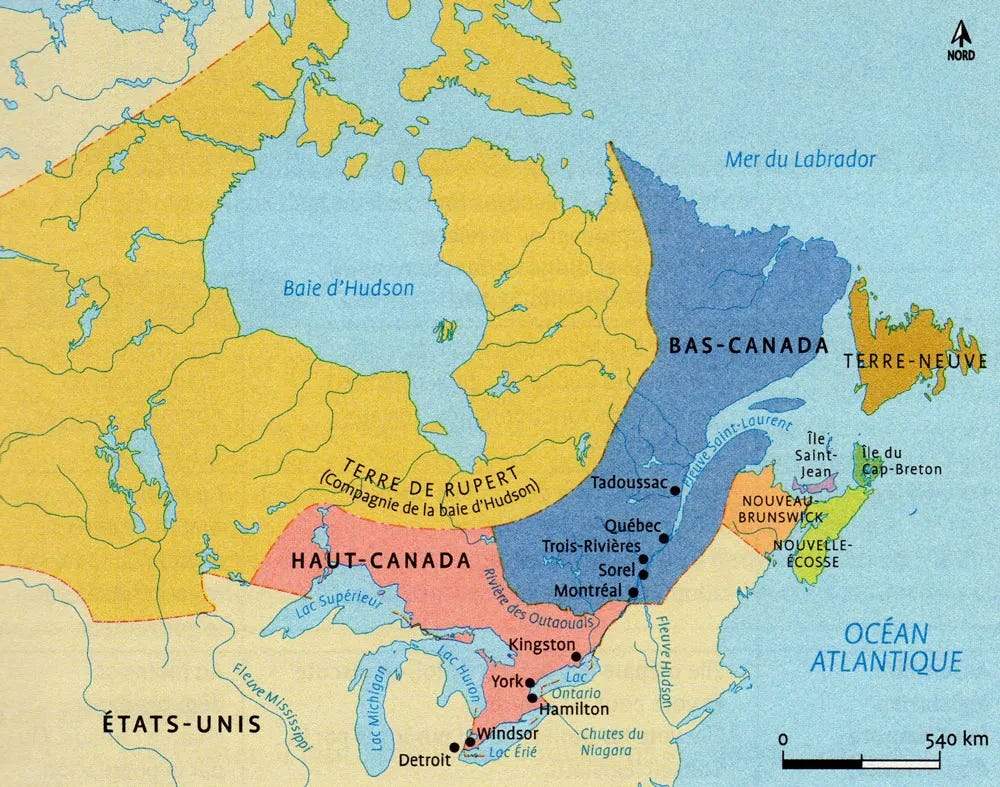
In response to the unrest following the rebellions of 1837-1838, Lord Durham, a British noble, was sent to Canada to investigate and propose solutions. His controversial recommendation, outlined in the Durham Report of 1839, was to abolish the separate legislatures of Upper Canada (Ontario) and Lower Canada (Quebec) and merge them into a single entity: the Province of Canada. This unification aimed to demographically and culturally assimilate the French Canadian population by creating an English-speaking majority.
However, the strategy failed for multiple reasons, and was given up shortly after. Lord Durham, having neither been born nor raised in the New World, underestimated the complexities of Canadian society, which was a unique fusion of Old World ideas in a New World setting. His assumption that French Canadians could be assimilated ignored their strong cultural identity, rooted in large families, which encouraged high birth rates as a means of survival. While Durham hoped unification would erode divisions, the old grievances between the British and French began to dissipate naturally.
The Province of Canada, whose unofficial capital was Montreal, where the two groups mixed
Despite Lord Durham’s intentions, French Canadians maintained their dominance in Quebec. Families averaged five children per household for over 230 years, a trend actively encouraged by the Catholic Church’s policy of La Revanche des Berceaux (the Revenge of the Cradles). This strategy aimed to preserve French Canadian culture and identity amidst the British short-lived attempts at assimilation. In Montreal, British industrialists expanded their influence by forging alliances with French landowning nobles through business partnerships and intermarriage. This blending of elites produced a bilingual Anglo-French upper class that became historically influential.
Such alliances drew on long-standing connections established as early as 1763 and later exemplified by the North West Company (NWC). The NWC in particular is interesting as a prominent fur trading enterprise of the late 18th and early 19th centuries, in that it embodied this fusion of cultures. Led primarily by Anglo-Scots, the company’s leaders frequently formed unions or marriages with French Canadian women, fostering vital ties with the French Canadian communities crucial to their trade. Simon McTavish, known as the “father” of the NWC, maintained alliances with French Canadian families, while his nephew, William McGillivray, and other leaders like Duncan McGillivray followed similar paths. Explorers such as Alexander MacKenzie and David Thompson married French women. These unions strengthened familial and cultural bonds, shaping the broader Anglo-French collaboration that defined this period.
This relative harmony between Anglo and French Canadians continued with the formation of the modern Canadian state in 1867 during Confederation. Sir John A. Macdonald deliberately chose George-Étienne Cartier as his second-in-command. This collaboration contributed to the emergence of Canada’s ethnically Anglo-French elite, who have historically been bilingual. This legacy is evident in the backgrounds of many Canadian politicians, such as the Trudeaus, Mulroneys, Martins, Cartiers, and countless others who have both Anglo-Canadian and French-Canadian roots.
In more recent history, this dynamic has been further solidified by the federal government, where higher-paid positions often require bilingual proficiency. Interestingly, about 20% of Canada’s population is bilingual, reflecting the ongoing influence of this historical coexistence.
The last cannon which is shot on this continent in defence of Great Britain will be fired by the hand of a French Canadian.
~ George Etienne Cartier
December 3, 2024
Evolution of Airborne Armour
The Tank Museum
Published Jul 19, 2024Lightly armed airborne troops are at a huge disadvantage when faced with regular troops with heavy weapons and armour. In World War II this led to huge losses for paratroops on Crete and at Arnhem. Since then, many attempts have been made to level the playing field, to give airborne soldiers a fighting chance.
From the Hamilcar gliders of World War II to the C17 Globemaster, we look at how to make a tank fly.
00:00 | Intro
00:47 | The Origins of Airbourne Operations
02:34 | Gliders
07:20 | A Tank Light Enough to Fly?
09:02 | Success & Failure
14:24 | Post-War Solutions
17:41 | Better Aircraft – Better Tanks?
20:15 | Strategic Deployment
21:39 | ConclusionThis video features archive footage courtesy of British Pathé. This video features imagery courtesy of http://www.hamilcar.co.uk/
#tankmuseum


