
Published on 1 Jun 2015
Winston Churchill’s life is actually too big for just one video. Even before World War 1, some biographies about him were published. His career during the Great War saw sheer brilliance like the modernisation of the Royal Navy and utter failure like the Gallipoli Landings. Find out all about Winston Churchill in our portrait.
June 3, 2015
Winston Churchill I WHO DID WHAT IN WW1?
Comments Off on Winston Churchill I WHO DID WHAT IN WW1?
Re-examining the history of “the Raj”
In The Diplomat, Nigel Collett reviews a new book by Ferdinand Mount called The Tears of the Rajas: Mutiny, Money and Marriage in India 1805-1905:
It was the discovery of a book by his aunt, Ursula Low, published in 1936 and entitled Fifty Years with John Company, which opened Mount’s eyes to his family’s history and led to the writing of The Tears of the Rajas.
His aunt’s book, a work long ignored and derided as an eccentricity by her family, was a biography of her grandfather, General Sir John Low. What staggered Mount about his aunt’s account was her matter-of-fact recording of the massacres, mutinies and mayhem in which her grandfather and many of her relatives had been involved during their colonial careers. For General Sir John Low had, during a career in India that lasted from 1804 to 1858, seen the brutal suppression of the mutiny of his own regiment at Vellore a year after his arrival in India, the “White Mutiny” of European soldiers in the East India Company’s Forces in 1808 (which resulted in the massacre not of the European mutineers but of the Indian soldiers they led) and finally, in 1857, of the Indian Mutiny itself, which erupted at a time when Low was the Military Member of the Governor General’s Council.
More than this, Low, in a largely political career up until the outbreak of the Mutiny, had been intimately involved in policies which led directly to it, including the removal from power of three Indian potentates to whom he was attached as Resident (the Peshwa of Poona, the Raja of Nagpur and the King of Oudh) and the annexation of their lands. He was at one point, in yet another posting as Resident, personally involved in detaching a large chunk of Hyderabad from the lands of the Nizam.
During his service, Low had watched, and other members of his family had been involved in, the British annexations of Sind and the Punjab, the conquest of Gwalior and the disastrous attempt to depose Dost Mohammed, the Shah of Afghanistan, which led to the catastrophe of the 1st Afghan War. Mount’s title is well chosen: Low literally reduced several of his Rajas to tears.
[…]
Perhaps more stomach-turning than this, especially to a British reader, are Mount’s revelations of the dishonest policies followed by almost every Governor General of India towards India’s native princes, policies driven by pure greed, conducted with cold ruthlessness in utter disregard of treaties, promises or any code of honor, and hidden beneath layers of hypocritical cant. Much of this has not been made generally known. Few, for instance, in the Far East, will know that as the First Opium War in China ended in 1842, another began in India, for the British conquest of Gwalior was aimed at the control of the opium it grew independently of the East India Company.
The removal of misgovernment was all too frequently the fraudulent public excuse for the imposition of direct rule and the canard of the protection of the peasantry from their own rulers was little more than a front for taxing them more efficiently. Add to this noxious behavior insulting racial pride, ignorance of culture and tradition, and a religious evangelism that persuaded army officers that it made sense to tell their Hindu and Muslim soldiers that they would go to Hell if the wars into which they were leading them resulted in their unconverted deaths, and there seems little need for further explanation of why it all ended in disaster in 1857.
While I can’t claim to have read deeply in Indian history during this period, I still think the best introduction to the at-best-ambivalent legacy of British rule is the fictional exploits of Sir Harry Flashman by George MacDonald Fraser (especially the original Flashman, Flashman and the Mountain of Light, and Flashman in the Great Game). How many other novels have extensive footnotes about all the historical characters and situations the fictional hero encounters? Oh, right … for the younger set: trigger warning in all the Flashman novels for racism, sexism, imperialism, militarism, violence, and pretty much anything that would offend the ears of a young Victorian lady modern university student.
Comments Off on Re-examining the history of “the Raj”
June 1, 2015
The place of “The Marys” in feminist and literary history
In the June issue of Reason, Amy Sturgis reviews a new book by Charlotte Gordon, Romantic Outlaws: The Extraordinary Lives of Mary Wollstonecraft and Her Daughter Mary Shelley:
Mary Wollstonecraft and her daughter, Mary Shelley, shared life on earth for a mere 11 days. But though fate kept them apart, the two women together managed to change the Western world’s conception of women’s rights, human reason, education theory, and romantic love. Not to mention invent modern science fiction. In Romantic Outlaws, biographer Charlotte Gordon makes a compelling case that each woman’s intellectual legacy has been underappreciated. She also argues persuasively that the two were linked by more than just blood: Wollstonecraft’s life and principles had a profound impact on her daughter, an influence critics largely have ignored.
Both Marys led lives that captured the public imagination at least as much as their path-breaking writings did. Their dramatic personal stories, coupled with well-meaning family members’ attempts to manage their reputations after their deaths, help explain how their ideas got lost in the sensationalist shuffle. But Gordon sees the Marys’ private lives not as obstacles to be overcome but as extensions of their philosophies. Mother and daughter, she argues, tried to craft independent and meaningful lives of the mind in times when a self-supporting, freethinking woman wasn’t just an oddity but a scandal.
“Without knowing the history of the era, the difficulties Wollstonecraft and Shelley faced are largely invisible, their bravery incomprehensible,” Gordon writes. “Even those who revere mother and daughter do not fully realize how profoundly they challenged the moral code of the day. Yet both women were what Wollstonecraft termed ‘outlaws.’ Not only did they write world-changing books, they broke from the strictures that governed women’s conduct, not once but time and again. Their refusal to bow down, to be quiet and subservient, to apologize and hide, makes their lives as memorable as the words they left behind.” Gordon’s admiration for the two is clear and contagious.
Comments Off on The place of “The Marys” in feminist and literary history
Royal Navy 1960s Promotional Film 1400 ZULU
Published on 26 Feb 2015
Created in 1965, 1400 Zulu is a classic British propaganda and recruiting film that profiles the Royal Navy’s operations around the world: from the Caribbean to Aden to the Suez Canal and beyond. It’s a job that involves hundreds of ships and tens of thousands of men both above, on and below the water of all the world’s oceans. The film shows some of the newest weapons in the RN’s arsenal including nuclear submarines, missile systems and the Guided Missile Destroyer HMS Hampshire, Harrier Jump Jets and carrier-based Buccaneers, and helicopters. The Royal Marines including frogmen are shown performing maneuvers, and various military exercises are shown and activities demonstrated.
HMS Hampshire was a County-class destroyer of the Royal Navy. Laid down, in March 1959 a couple of weeks behind the class leader Devonshire, she was classified as a guided missile destroyer, as the Sea Lords regarded the concept of the cruiser and big gun ship as discredited by the perceived failure of the Tiger class and the obsolescence of the heavy gun. The description of guided missile destroyer seemed more likely to win approval from the Treasury and Government for an adequate number of warships the size of small cruisers which could play many traditional cruiser flagship and command functions but had armour around neither its gun or missile magazine.
The Blackburn Buccaneer originated in the early 1950s as a design for a carrier-borne attack aircraft able to carry a nuclear bomb below radar coverage. It was a British low-level subsonic strike aircraft that served with the Royal Navy (RN) and later the Royal Air Force (RAF), retiring from service in 1994. Designed and initially produced by Blackburn Aircraft at Brough, it was later known as the Hawker Siddeley Buccaneer when Blackburn became a part of the Hawker Siddeley group.
The Royal Navy originally procured the Buccaneer as a naval strike aircraft capable of operating from their aircraft carriers, introducing the type to service in 1962 to counterbalance advances made in the Soviet Navy. The Buccaneer was capable of delivering nuclear weapons as well as conventional munitions for anti-shipping warfare, and was typically active in the North Sea area during its service. Early on the initial production aircraft suffered a series of accidents due to insufficient engine power, thus the Buccaneer S.2, equipped with more powerful Rolls-Royce Spey engines, was soon introduced.
Although they originally rejected it in favour of the supersonic BAC TSR-2, the RAF later procured the Buccaneer as a substitute following the cancellation of both the TSR-2 and its planned replacement, the F-111K. When the RN retired the last of its large aircraft carriers, its Buccaneers were transferred to the RAF. The South African Air Force also procured the type. Buccaneers saw combat action in the Gulf War and the South African Border War. In RN service, the Buccaneer was replaced with the V/STOL British Aerospace Sea Harrier. In RAF service, they were replaced by the Panavia Tornado.
H/T to @NavyLookout for the link.
Comments Off on Royal Navy 1960s Promotional Film 1400 ZULU
May 31, 2015
Alice’s sesquicentennial
In Maclean’s, Brian Bethune talks about the 150th anniversary of the publication of Lewis Carroll’s Alice in Wonderland:
On July 4, 1862, Rev. Charles Dodgson, an Oxford lecturer in mathematics better known now as Lewis Carroll, author of Alice’s Adventures in Wonderland and Through the Looking-Glass, rowed up the Thames to a picnic spot. He had with him four of his favourite people: his friend Robinson Duckworth and the three young Liddell girls — Lorina, 13, Edith, 8, and 10-year-old Alice. From the sparse evidence of Carroll’s diary, it was hardly a memorable occasion; perhaps it was the weather that July day: cloudy and damp, with a high of 20° C.
The embellishments began 10 months later — when Carroll went back to the entry and added, “On which occasion, I told them the fairy tale of Alice’s Adventures Under Ground, which I undertook to write out for Alice” — and didn’t stop for decades. By the time 80-year-old Alice Hargreaves (nee Liddell) was telling the tale on her triumphant visit to New York — the “original Alice” was greeted at the dock by more than 30 reporters — her recollection of a “blazing summer afternoon with heat haze shimmering over the meadows” was already established fact.
It is the perfect creation myth for a singular event in English literature — and yes: historians, recognizing it as such, have pored over the meteorological records. It’s a story that involves Carroll’s crucial place in a continuum stretching from the Victorian era to modernity, encompassing the earlier era’s near-incomprehensible — to modern eyes — concepts of childhood and of sexuality, and the birth of photography. But whatever its particulars, when Carroll finally got his story down on paper 150 years ago and published it under its now familiar title, Wonderland — a shape-shifting tale that is both a love letter to the English language and an extended metaphor for childhood — changed children’s literature forever.
Alice’s sesquicentennial — how Lewis Carroll would have loved that word — will be marked globally by events large and small. She has been published in 7,600 editions in 174 languages, including Tajik and Esperanto; many will be on display in London and New York. The popular ballet will be staged around the world, a marionette theatre in Austria will recreate the story, Vancouver Playhouse promises Alice flamenco, and on and on.
And there will be books, of course, including a catalogue raisonné of Carroll’s 1,000 surviving photographs (out of 3,000 taken). With the notable exception of Canadian writer David Day’s eagerly awaited Alice’s Adventures in Wonderland Decoded, out in September, few are liable to be as compulsively readable as Robert Douglas-Fairhurst’s The Story of Alice. The latter is informative on what went into the making of Wonderland, from the Victorians’ intense focus on the underground — both literal (the tube) and fantastic (Jules Verne’s Journey to the Centre of the Earth) — to Carroll’s anxiety about rapid change (like the Red Queen, he always thought he had to run faster and faster, just to stay where he was). And it’s brilliant in the way it mirrors Carroll’s own protean nature, offering no overarching theme, except to establish that its subject was not a man to provide two possible meanings for all he did and said, not so long as he could stuff in three or more.
Speaking from Oxford, where he is an English professor at Magdalen College, Douglas-Fairhurst makes it clear that was his aim. “I’m trying to restore a kind of innocence to biography. I don’t have strong opinions about Carroll, a man whose details are fragmentary. There is no one story, or even genre, that can give us all the answers about Alice and him. What we have are the books, masterpieces in their complexity, serious and funny, with a playful surface lying over a desperate yearning for logic and order. For 150 years, Alice has been a blank screen onto which we project all we want to throw at her.”
Comments Off on Alice’s sesquicentennial
May 30, 2015
Waterloo, 1815
The Economist reviews some of the recent books published to co-incide with the two-hundredth anniversary of the Battle of Waterloo:
WITH the bicentenary of the battle of Waterloo fast approaching, the publishing industry has already fired volley after volley of weighty ordnance at what is indeed one of the defining events of European history. About that, there can be no argument. Waterloo not only brought to an end the extraordinary career of Napoleon Bonaparte, whose ambitions had led directly to the deaths of up to 6m people. It also redrew the map of Europe and was the climax of what has become known as the second Hundred Years War, a bitter commercial and colonial rivalry between Britain and France that had begun during the reign of Louis XIV. Through its dogged resistance to France’s hegemonic ambitions in the preceding 20 years, Britain helped create the conditions for the security system known as the Concert of Europe, established in 1815. The peace dividend Britain enjoyed for the next 40 years allowed it to emerge as the dominant global power of the 19th century.
If the consequences of the battle were both profound and mostly benign, certainly for Britain, the scale of the slaughter and suffering that took place in fields 10 miles (16km) south of Brussels on that long June day in 1815 remains shocking. The Duke of Wellington never uttered the epigram attributed to him: “Next to a battle lost, the greatest misery is a battle gained.” What he did say in the small hours after the battle was: “Thank God, I don’t know what it is like to lose a battle; but certainly nothing can be more painful than to gain one with the loss of so many of one’s friends.” Nearly all his staff had been killed or wounded. Around 200,000 men had fought each other, compressed into an area of five square miles (13 square kilometres).
When darkness finally fell, up to 50,000 men were lying dead or seriously wounded — it is impossible to say how many exactly, because the French losses were only estimates — and 10,000 horses were dead or dying. Johnny Kincaid, an officer of the 95th Rifles who survived the onslaught by the French on Wellington’s centre near La Haie Sainte farm, coolly declared: “I had never yet heard of a battle in which everybody was killed; but this seemed likely to be an exception, as all were going by turns.”
[…]
Four errors, partly the result of poor staff work, helped doom Napoleon. The first, entirely self-inflicted, was to deprive himself of his two most effective generals: Marshal Davout, left behind to guard Paris, and Marshal Suchet, put in charge of defending the eastern border against possible attack by the Austrians. The second was Ney’s almost inexplicable hesitation in taking the strategic crossroads of Quatre Bras, the key to dividing the coalition armies. The third was the aimless wandering in the pouring rain of the Compte d’Erlon and his 20,000 troops between the battle at Quatre Bras against the Anglo-Dutch and the battle at Ligny that the Prussians were losing. Had he intervened in either, the impact could have been decisive. The fourth was the failure of initiative by Grouchy that allowed the regrouped Prussians to outflank him and arrive at the critical moment to save Wellington at Waterloo.
That said, nothing should be taken away from Napoleon’s conquerors. Both commanders were talented professionals — Wellington was unmatched in the art of defence — who had experienced and competent subordinates and staffs. The British infantry and the King’s German Legion (a British army unit) were hardened veterans of the highest quality. Above all, both commanders trusted each other and never wavered in their mutual support, a factor that Napoleon almost certainly underestimated in his strategic calculus.
Comments Off on Waterloo, 1815
May 28, 2015
The copyright fight over Sherlock Holmes … again
At Techdirt, Mike Masnick explains why the estate of Sir Arthur Conan Doyle is still trying to fight the public domain availability of anything Sherlock Holmes, even though they’ve lost at each stage of the legal proceedings:
And thus, Sherlock Holmes is considered to be mostly in the public domain. One might argue that a US federal court outside of the 7th Circuit might find otherwise, but it appears that the Estate has given up the fight and now will readily admit that the earlier works are in the public domain. That does not mean, however, that it is done suing. Not at all. The Estate has now sued over a book and movie that purport to tell the story of Holmes’ retirement. The author, Mitch Cullin, wrote the book A Slight Trick of the Mind about a decade ago, and that’s now been adapted into a film called Mr. Holmes, being released by Miramax.
First, the Conan Doyle Estate at least seems willing to admit that the earlier works are now fully in the public domain:
The first fifty of Conan Doyle’s Sherlock Holmes short stories and novels are in the public domain. But the last ten of his original Sherlock Holmes stories, published between 1923 and 1927 (the Ten Stories), remain protected by copyright in the United States. These copyrighted ten stories develop the details of Holmes’s fictional retirement and change and develop the character of Holmes himself.
And that’s where the trouble comes in. The Conan Doyle Estate makes some reasonable claims that Cullin used a few details from the stories that are still under copyright in developing the ideas for his book and the subsequent movie (where he worked on the screenplay). As the complaint notes, the public domain works mention Sherlock Holmes’ retirement just twice, without that much detail. The works still under copyright delve into it much more. The complaint also notes some pretty clear similarities in certain scenes. For example, it points to this passage from the (still under copyright) Holmes story “Blanched Soldier”:
It is my habit to sit with my back to the window and to place my visitors in the opposite chair, where the light falls full upon them. Mr. James M. Dodd seemed somewhat at a loss how to begin the interview. I did not attempt to help him, for his silence gave me more time for observation. I have found it wise to impress clients with a sense of power, and so I gave him some of my conclusions.
“From South Africa, sir, I perceive.”
“Yes, sir,” he answered, with some surprise.
And contrasts it with the following from Cullin’s work:
As was my usual custom, I sat with my back to the window and invited my visitor into the opposite armchair, where — from his vantage point — I became obscured by the brightness of the outside light, and he — from mine — was illuminated with perfect clarity. Initially, Mr. Keller appeared uncomfortable in my presence, and he seemed at a loss for words. I made no effort to ease his discomfort, but used his awkward silence instead as an opportunity to observe him more closely. I believe that it is always to my advantage to give clients a sense of their own vulnerability, and so, having reached my conclusions regarding his visit, I was quick to instill such a feeling in him.
“There is a great deal of concern, I see, about your wife.”
“That is correct, sir,” he replied, visibly taken aback.
Certainly a similar setup, but is it infringing? That’s where things get pretty tricky, and why I still have trouble with the idea of using copyright to cover “a character.” After all, copyright is supposed to only protect the specific expression, rather than the idea. That’s why it’s never made sense to see courts accept the idea that someone writing a different story using the same characters should be seen as infringing. The courts here seem to handle different cases differently, allowing something like The Wind Done Gone (a retelling of Gone With The Wind from another character’s perspective) but not allowing Coming Through the Rye, an unauthorized sequel to Catcher in the Rye. For reasons that are not entirely clear, judges seemed to feel that The Wind Done Gone was more acceptable as a commentary on the original, rather than just a new work building off of the original.
Comments Off on The copyright fight over Sherlock Holmes … again
May 27, 2015
The dis-United Kingdom
Mark Steyn on the result of the British general election:
It would be churlish to deny oneself the pleasure of hooting at the politico-media establishment, but, when that’s done, this is a deeply unhealthy electoral result. The Conservatives won because Labour got wiped out in Scotland and the Liberals got wiped out in England. But the reality is that, for a supposedly United Kingdom, the country no longer has any national political party. England and Scotland have taken on the characteristics of Northern Ireland — hermetically sealed polities full of weird, unlovely regional parties (“SNP”, “Conservative”, “Labour”) that have no meaning once you cross the border, and whose internal disputes are of no relevance to the other three-quarters of the kingdom: Nobody outside Ulster cares about “official” Unionists vs the more red-blooded Democratic Unionists. And so it goes with the Scots Nats and Labour in Scotland: nationalist socialists vs unionist socialists; Likewise, with the Tories and UKIP in England: transnationalist conservatives vs nationalist conservatives.
Wales is the exception that proves the rule, where UKIP outpolled Plaid Cymru, albeit with no seats to show for it. The Scottish National Party got 4.7 per cent of the UK vote, and 56 seats. UKIP had nearly thrice as many voters — 12.6 per cent — but only one seat. That discrepancy is because there is no longer any such thing as “the UK vote”. I far prefer the Westminster first-past-the-post system to European “proportional representation”, but it only works if you have genuinely national parties. If the system decays into four groups of regional parties, the House of Commons will look less and less like a genuine national parliament, and more and more like some surly conditional arrangement — Scottish Kurds, Tory Shia and seething Labour Sunni triangles.
The composition of the new house would strike any mid-20th century Briton as freakish and unsettling. It’s a bit like Canada in the Nineties — where Reform couldn’t break out of the west, the Bloc Québécois dominated Quebec, the rump Tories clung on in the Atlantic provinces, and Ontario and a few seats hither and yon gave the Liberals their majority. The difference is that the Bloquistes are pretend separatists; the Scottish National Party are not.
And that’s before you take into account the competing nationalist dynamics of the Anglo-Scottish victors: secession from the UK north of the border and detachment from the EU south. Cameron is a wily operator and one notices he uses the words “United Kingdom” far more than his predecessors. But saying will not make it so.
Comments Off on The dis-United Kingdom
Sir Arthur Wellesley, before the fame and fortune
At The Diplomat, Francis P. Sempa looks at the early commands of Sir Arthur Wellesley (later the Duke of Wellington) as formative experiences:
Before Waterloo, Wellington had brilliantly commanded armies on the Iberian Peninsula, where they wore down and drained French forces, causing Napoleon to refer to it as “the Spanish ulcer.” But Wellington learned how to command, supply, and lead soldiers to victory not in Europe, where he is most remembered, but in India. Wellington in India, wrote biographer Elizabeth Longford, was “a great commander in embryo.”
Wellington, then Colonel Arthur Wesley (the last name was later changed to Wellesley) of the 33rd regiment, arrived in Calcutta at the age of 28 in February 1797, after a journey of more than three months. His most recent biographer, Rory Muir, described Colonel Wesley as “an unusually ambitious, intelligent and well-read officer who looked far beyond the horizons of his regiment … and who was already comfortable assembling his thoughts into coherent arguments …” In all, he spent eight years in India, where for much of the time his brother was Governor-General. Wellington’s time in India, writes Muir, “were crucial years in which he developed his skills as a commander of men, a tactician, a strategic planner and a civil governor.” It was in India that the future victor of Waterloo and future prime minister of Great Britain first dealt with questions of war and peace and civil government.
On March 26, 1799, troops under Wellington’s command came under attack by forces of Muslim ruler Tipu Sultan, the Tiger of Mysore. As the French-trained enemy forces approached, wrote Elizabeth Longford, Wellington’s men held their fire “with the utmost steadiness until the enemy were sixty yards away.” British infantry then decimated the columns of enemy attackers, spreading confusion, while cavalry forces scattered the remnants of the attacking force. Then, during April and May 1799, Wellington participated in the siege of Seringapatam in Mysore, and led an attack on the entrenchments of the fortress there. After Seringapatam was taken, Wellington was made civil governor and remained there until 1802.
During his time in Seringapatam, Wellington was ordered to suppress a rebellion in north Mysore led by Dhoondiah Waugh. For the first time, Wellington exercised independent command in battle. During this operation, Rory Muir explains, Wellington “displayed all the characteristics of his subsequent campaigns, …” which included attention to logistics and “unremitting aggression.” He fought a battle at Conaghul and won a complete victory. Muir writes that Wellington exhibited a remarkable flexibility on the field of battle. A British officer commented on Wellington’s “alacrity and determination” during battle.
Comments Off on Sir Arthur Wellesley, before the fame and fortune
May 23, 2015
The Hitch
H/T to Open Culture.
A quick note: Kristoffer Seland Hellesmark was looking for a documentary on Christopher Hitchens to watch, but could never find one. So, after waiting a while, he said to himself, “Why don’t I just make one?” The result is the 80-minute documentary about Hitchens, lovingly entitled The Hitch, which features clips from his speeches and interviews.
Comments Off on The Hitch
May 22, 2015
Przemyśl Falls Again – Winston Churchill Gets Fired I THE GREAT WAR Week 43
Published on 21 May 2015
The big success of the Gallipoli Campaign never came, thousands of soldiers died and so Winston Churchill is forced to resign. At the same time August von Mackensen is pushing back the Russians and forcing them to hide in Przemyśl fortress – the same fortress they just conquered from the Austro-Hungarians a few weeks earlier.
Comments Off on Przemyśl Falls Again – Winston Churchill Gets Fired I THE GREAT WAR Week 43
Al Stewart – “Trains”
Published on 19 Mar 2013
In the sapling years of the post-war world in an English market town
I do believe we travelled in schoolboy blue, the cap upon the crown
Books on knee; our faces pressed against the dusty railway carriage panes
As all our lives went rolling on the clicking wheels of trainsThe school years passed like eternity and at last were left behind
And it seemed the city was calling me to see what I might find
Almost grown, I stood before horizons made of dreams
I think I stole a kiss or two, while rolling on the clicking wheels of trainsTrains…
All our lives were a whistle stop affair; no ties or chains
Throwing words like fireworks in the air, not much remains
A photograph in your memory, through the colored lens of time
All our lives were just a smudge of smoke against the skyThe silver rails spread far and wide through the nineteenth century
Some straight and true, some serpentine, from the cities to the sea
And out of sight of those who rode in style, there worked the military mind
On through the night to plot and chart the twisting paths of trainsOn the day they buried Jean Jaures, World War One broke free
Like an angry river overflowing its banks impatiently
While mile on mile the soldiers filled the railway stations’ arteries and veins
I see them now go laughing on the clicking wheels of trainsTrains…
Rolling off to the front across the narrow Russian gauge
Weeks turn into months and the enthusiasm wanes
Sacrifices in seas of mud, and still you don’t know why
All their lives are just a puff of smoke against the skyThen came surrender; then came the peace
Then revolution out of the east
Then came the crash; then came the tears
Then came the thirties, the nightmare years
Then came the same thing over again
Mad as the moon, that watches over the plain
Oh, driven insaneBut oh, what kind of trains are these, that I never saw before
Snatching up the refugees from the ghettoes of the war
To stand confused, with all their worldly goods, beneath the watching guards’ disdain
As young and old go rolling on the clicking wheels of trainsAnd the driver only does this job with vodka in his coat
And he turns around and he makes a sign with his hand across his throat
For days on end, through sun and snow, the destination still remains the same
For those who ride with death above the clicking wheels of trainsTrains…
What became of the innocence they had in childhood games
Painted red or blue, when I was young they all had names
Who’ll remember the ones who only rode in them to die
All their lives are just a smudge of smoke against the skyNow forty years have come and gone and I’m far away from there
And I ride the Amtrak from New York City to Philadelphia
And there’s a man to bring you food and drink
And sometimes passengers exchange a smile or two rolling on the humming wheels
But I can’t tell you if it’s them or if it’s only me
But I believe when they look outside they don’t see what I see
Over there, beyond the trees, it seems that I can just make out the stained
Fields of Poland calling out to all the passing trainsTrains…
I suppose that there’s nothing in this life remains the same
Everything is governed by the losses and the gains
Still sometimes I get caught up in the past, I can’t say why
All our lives are just a smudge of smoke, or just a breath of wind against the sky
Comments Off on Al Stewart – “Trains”
May 21, 2015
This year will be the last in the air for XH558, the last of the Avro Vulcan bombers
At The Register, Lester Haines explains why the trust that operates XH558 is having to ground the aircraft permanently:
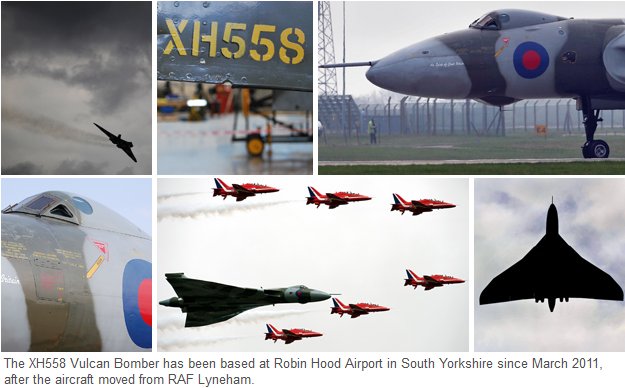
The Vulcan To The Sky Trust has announced “with considerable sadness” that this summer will be the public’s last chance to catch Avro Vulcan XH558 thundering through British skies, as the legendary V-bomber will be permanently grounded at the end of this flying season.
The trust explains that the axe will fall because “three expert companies on whom we depend – known as the ‘technical authorities’ – have together decided to cease their support at the end of this flying season”.
It elaborates:
At the heart of their decision are two factors. First, although we are all confident that XH558 is currently as safe as any aircraft flying today, her structure and systems are already more than ten percent beyond the flying hours of any other Vulcan, so knowing where to look for any possible failure is becoming more difficult. These can be thought of as the ‘unknown unknown’ issues, which can be impossible to predict with any accuracy. Second, maintaining her superb safety record requires expertise that is increasingly difficult to find.
Keeping XH558 in the air has been an epic undertaking, and not without wing-and-a-prayer moments involving last-minute injections of cash.
Comments Off on This year will be the last in the air for XH558, the last of the Avro Vulcan bombers
The Brunel Museum
Brid-Aine Parnell talks about the Brunels — father, son, and grandson — and their impact on Britain during the industrial revolution:
When you mention Brunel to most people, they think of the one with the funny name – Isambard Kingdom Brunel. A few folks will know that his father Marc Isambard Brunel was the first famous engineering Brunel, but not many will know that Isambard’s own son, Henry Marc Brunel, was also an engineer and finished some of Isambard’s projects after his death.
Between the three of them, the Brunels created landmarks all over the UK; perhaps most famously the Clifton Suspension Bridge, which spans the Avon Gorge, linking Clifton in Bristol to Leigh Woods in Somerset.
That bridge, which Isambard Kingdom Brunel designed and often called his “first child,” wasn’t actually completed until after his death and only came about at all because Isambard was nearly drowned in an accident at the massive project he was working on in London with his father: the Thames Tunnel.
It is this masterpiece of engineering, which invented new methods of tunnelling underground and is why the Brunels are credited with creating underground transportation – and by extension, the modern city itself – that you see if you go along to the Brunel Museum in Rotherhithe, London.
The museum itself is in Marc Brunel’s Engine House, built in 1842, the year before the Thames Tunnel was opened, for the engines that pumped to keep the Tunnel dry. The small exhibition tells the story of the design and construction of the 396-metre-long tunnel, the first to have been successfully built underneath a navigable river. The display panels also detail the innovative tunnelling shield technique invented by Marc and Isambard that’s still used to build tunnels today, although these days it’s machines doing the hard work instead of men. Back then, labourers would spent two hours at a time digging, often while also being gassed and showered with shit.
The River Thames at that time was the sewer of London and the tunnel was constantly waterlogged, leading to a build up of effluent and methane gas. The result was that not only would miners pass out from the gas – even if they didn’t, men who re-surfaced were left senseless after their two-hour shift – but there were also explosions as the gas was set alight by the miners’ candles.
Although it’s a tidy and well-kept little exhibition, it is not really why you come to the museum. You come for the underground chamber below, which was only opened up to the public in 2010 after 150 years of being closed off by the London transportation system. This is the Grand Entrance Hall to the Thames Tunnel, used in Brunel’s day as a concert hall and fairground and now in the process of being turned into a permanent exhibition.
May 19, 2015
The 1982 amphibious landings at San Carlos Water
Think Defence looks back at the successful amphibious landings in the Falkland Islands by a less-than-fully-prepared British military:
If the amphibious operations in Normandy were unprecedented because of the scale those in 1982 in the Falkland Islands were equally remarkable, nor for scale but for the huge distance involved. Another breathtaking feature of Operation Corporate was the speed in which it was mounted and the degree of improvisation that would in the end, be needed.
One might argue that even taking into account Inchon and Suez it was the worlds most complex and demanding amphibious operation since D-Day.
Since VE day and Suez the UK’s amphibious capabilities had dwindled both in scale and capability, the Royal Marines concentrating on their Northern Europe role.
When Argentina invaded the Falkland Islands in 1982 the scale of the challenge had many echoes of D-Day; a need for joint service cooperation and a number of technical challenges to overcome for example. What we did not have was the luxury of time, no time to develop new and novel solutions, no time for testing and no time for practice beyond what was available on the journey south.
Due to the short timescales British Rail could not reposition their rolling stock to get the War Material Reserve (about 9,000 tonnes just for 3CDO, 30 days combat supplies and 60 days of general stores) to the ships so instead, a fleet of RCT and civilian trucks were used.
More or less, we went with what we had.
In little over a month from the invasion, the first ships had departed the UK on their 8,000 mile journey South.
There is no need to recount the general history of the campaign but from a ship to shore logistics perspective there were a number of equipment and capabilities available to Commodore Clapp and Brigadier Thompson worth describing.
Earlier posts on the Falklands War can be found here.
Comments Off on The 1982 amphibious landings at San Carlos Water


