
The Great War
Published on 25 May 2018In our first episode filmed on the former Gallipoli battlefields, Indy and our guide Can Balcioglu explore the naval campaign that preceded the landings at Gallipoli in early 1915.
May 28, 2018
Naval Operations In The Dardanelles Campaign 1915 I THE GREAT WAR On The Road
Comments Off on Naval Operations In The Dardanelles Campaign 1915 I THE GREAT WAR On The Road
May 26, 2018
Sir Humphrey debunks the notion of maintaining a “reserve fleet”
The US Navy keeps a lot of ships around after they’ve been retired from active service (sometimes for decades), and some in the UK are asking if the Royal Navy should do something like that with the soon-to-be-retired Type 23 frigates. Sir Humphrey explains in great detail why this shouldn’t happen:

HMS Westminster (foreground) and HMS Iron Duke, Type 23 frigates of the Royal Navy, in the naval base of Portsmouth, August, 2000.
Image via Wikimedia Commons.
The subject of ‘Reserve Fleets’ is something that often comes up across the internet whenever naval forces are discussed. To many casual observers there is an innate draw to the idea of holding ships back as a contingency against a potential threat. No matter how appealing this idea seems on the surface though, there are a multitude of good reasons why keeping complex warships in reserve at the end of their life is usually a very bad idea.
In broad terms these reasons boil down to four key areas – Maintenance & Material and People & Training. Each of these areas poses a challenge which brought together makes it extremely difficult to consider keeping a ship credible once she has paid off.
Maintenance & Material
The Royal Navy has historically not maintained a large reserve fleet since the 1950s, when the combination of the loss of conscript manpower, the increasing complexity of warships adding to reactivation times and the reality that any global conflict would go nuclear quickly meant that reserve fleets were relatively worthless.After the late 1950s the RN maintained a ‘Standby Squadron’ that usually comprised several vessels that while not fully active, were kept in reasonable running order. For many years Chatham dockyard functioned as the home of the Squadron, which usually comprised ships drawn from classes still in service, that could be brought up to readiness quickly to replace other vessels at sea. This occurred during both the Cod War and the 1982 Falklands War.
It is not clear when the Standby Squadron was formally discontinued, but it played a key part in the RN force structure into the 1980s. For instance, the 1981 defence review foresaw a number of escorts (possibly 7-8 out of 50) being held in quasi-active status. The RN also maintained other ships in full reserve – such as during the lifetime of the Invincible class when usually one of the three was placed into reserve for a year or two ahead of deep refits.
The key distinction here is that this sort of set up required a heavy investment of resources and manpower to keep the ships maintained and fit for sea. A modern warship is never truly alone during her active life – there are always people onboard to maintain systems and keep watch over her. By contrast ships that decommission and pay off will progressively see less and less people onboard until one day they have been stripped down and become ‘dead ships’, and they will be left to rot until the scrappers take them.
To keep a ship in a salvageable condition, able to be made ready for sea requires a significant amount of maintenance and upkeep. This is something that is costly, requiring regular dockings, inspections and repairs, as well as the cost of keeping the ship preserved and vaguely usable. To put a ship into Reserve with the intention of using her again does not mean she can be forgotten about – quite the contrary, they require regular care and maintenance.
To put a ship into reserve at the end of her life and be certain of using her again would require an additional refit to rectify defects. It would also require regular inspections, support and attention throughout the period in reserve.
For a ship that is likely to be used again, it makes reasonable sense to do this as every pound spent on preventative maintenance is likely to save many more in reactivation costs. For a ship likely to pay off, this makes far less sense – you are spending a lot of money to park a ship and wait for it to be scrapped.
Comments Off on Sir Humphrey debunks the notion of maintaining a “reserve fleet”
May 25, 2018
QotD: Muggeridge’s Law
While Malcolm Muggeridge was the editor of Punch, it was announced that Khrushchev and Bulganin were coming to England. Muggeridge hit upon the idea of a mock itinerary, a lineup of the most ludicrous places the two paunchy pear-shaped little Soviet leaders could possibly be paraded through during the solemn process of a state visit. Shortly before press time, half the feature had to be scrapped. It coincided exactly with the official itinerary, just released, prompting Muggeridge to observe: We live in an age in which it is no longer possible to be funny. There is nothing you can imagine, no matter how ludicrous, that will not promptly be enacted before your very eyes, probably by someone well known.
Tom Wolfe, “Stalking the Billion-Footed Beast: A literary manifesto for the new social novel”, Harpers, 1989-11.
Comments Off on QotD: Muggeridge’s Law
May 23, 2018
“Red Ken” leaves the Labour Party
The former Lord Mayor of London resigned from the British Labour Party earlier this week:
Ken Livingstone resigned from the Labour Party yesterday. Allegations of anti-Semitism, following his comments about Hitler supporting Zionism, had, he said, become a distraction. Indeed, his ongoing membership of the party had become a particular problem for Labour leader Jeremy Corbyn, his friend and ally, whose leadership has been dogged by the suggestion that he is soft on left anti-Semitism. Nevertheless, Livingstone’s resignation is a cruel end to a career that saw him twice govern London as mayor, earn a reputation for radicalism, and play a decisive part in the development of the policy of ‘equal opportunities’ at work.
He was elected to represent Norwood on the Greater London Council (GLC) in 1973. He became head of the GLC in 1981, until it was abolished by the Conservative government in 1986. In 2000, when the Labour government created the Greater London Authority, and a new elected mayoral position, Livingstone was blocked by the party hierarchy from standing. Instead he ran as an independent and won. Later he was re-elected as a Labour candidate and held the position until he was defeated by Boris Johnson in 2008.
In the 1980s, Livingstone was one of the left-wingers who took control of London boroughs after Labour lost control of central government. Seeing that the old alliance of trade unions and Labour was no longer successful in rallying voters, Livingstone set about mobilising other constituencies. As had been trialled in Lambeth council by Ted Knight and Herman Ouseley, Livingstone set up a race-relations unit at the GLC, with a special remit to address discrimination in the recruitment of its workforce.
With similar policies extended to women’s employment, and later to the employment of lesbian and gay employees and those with disabilities, the GLC policy formed the archetype for the equal-opportunities policies that are today ubiquitous.
[…]
Livingstone has certainly given his opponents a lot of ammunition. He defends a view of Zionism as a collaboration with Nazism that loses sight of the difference between the two. He could claim that it is not his historical thesis, but one supported by such writers as Lenni Brenner. Still, more than a few people have noticed that Livingstone seems a bit stuck on this claim, in a way that suggests he might relish provoking Jewish activists and journalists.
Nevertheless, there is a lot of bitter resentment held by more moderate Labour supporters about the way that the left of the party has berated them over questions of racial justice over the years. And so the issue of anti-Semitism has become a means for some of them to get some payback by denouncing Livingstone’s supposed anti-Semitism.
Many of those denouncing Livingstone today are seeking to paint him – and, by connection, Corbyn’s team – as hopelessly anti-Semitic. In doing so they appear indifferent to the debt they owe to Livingstone for the development of equal-opportunities policies, whose very logic they are using to denounce an enemy for his improper expressions.
Comments Off on “Red Ken” leaves the Labour Party
May 22, 2018
Feature History – Opium Wars
Feature History
Published on 19 Oct 2016Welcome to Feature History, featuring the Opium Wars, western imperialism, and this fancy new intro and vignette.
The super sexy stuff like animation, voice, and script are all by the super sexy me.
The music is Anamalie and Clash Defiant, both by Kevin MacLeod
Twitter: https://twitter.com/Feature_History
Comments Off on Feature History – Opium Wars
May 21, 2018
The five tribes of the Scottish Nationalist Party
Stephen Daisley explains the five main groupings within the overall SNP and why they aren’t getting along:

Fractiousness is nothing new in Scottish Nationalism. For most of its history, the only thing SNP members could agree on was the merit of a good rammy. Gradualists declared sovereignty would come in increments; while fundamentalists insisted independence yesterday would still be independence too late. Conference was an annual pitched battle where each faction schemed, cajoled and manoeuvred against the other. The gradualists came to dominate the leadership and party machine, but the fundies consoled themselves that the members were really with them.
After 11 years in government, a lost independence referendum and an explosion in membership, the battle lines in Scottish nationalism have been redrawn into five main camps. These are the Deciders, the New Establishment, the Separatist Spoilers, the Social Media Chauvinists and the Reluctant Reformers.
At the top sit the Deciders – First Minister Nicola Sturgeon, husband Peter Murrell and select advisers. This is the most exclusive club and it runs the party (and the country) almost singlehandedly. Consultation outwith the clique is rare and once a course of action has been decided, the chances of an outsider successfully challenging it are next to none. The Deciders decide; everyone else exists to nod along and applaud as instructed.
The New Establishment is the nomenklatura of SNP Scotland; dutiful courtiers, stenographers and political enforcers for the Nationalist elite. Among them are financially canny third sector executives, on-message opinion formers and the professional class who were conscientious Labour until the polls told their conscience to back the other horse.
The New Establishment rates itself highly and bristles when shown insufficient deference – a daily hazard when the rest of the movement sees them as useful idiots.
One such impatient class is the Separatist Spoilers. Many have arrived at the doors of the SNP megachurch after September 2014, emptying their pockets into the collection box and singing the hymns one syllable behind everyone else.
Others will be regular attendees and even elders, who are heartened by the new congregants and their fervour, even if they are a little brash, a bit Central Belt, a touch too socially and culturally Labour.
What unites the Separatist Spoilers is unwavering devotion to the catechism of independence. Separation is their chiefest joy. Nothing – no biased BBC reporting, no Unionist-infiltrated GERS office, no ‘facts’ from the London-based IFS – will dissuade them from the path of righteousness.
They are spoilers insofar as the ruination of Scotland’s schools, hospitals, and economy are deemed a price worth paying for her freedom.
Beyond these lie the Social Media Chauvinists, who combine belligerent nationalism with online invective and intimidation. The category is not limited to obscure keyboard warriors; it includes elected Nationalists for whom abusing the enemy – they do not see mere opponents – is intrinsic to their politics.
Social Media Chauvinists whip up cybernat pile-ons, keep the worst of the grassroots ginned up and target journalists and critics sceptical of the regime. They have constructed their own reality from an echo chamber of antagonistic bloggers and unhinged conspiracy theorists. Their indoor voice is a howl and paranoia their idea of equanimity; they are often to be found in a tizz over British-branded foodstuffs and unpatriotic weather maps.
[…]
Most pitiful of all are the Reluctant Reformers. They are no less committed to independence but accept the constraints of economics and public opinion. They are willing to make a go of devolution but alarmed by how quickly colleagues tire of discussing the attainment gap and NHS performance. Opponents are to be engaged with and compromise found in the common interest. Reluctant Reformers are in tune with SNP voters but treacherously off-key to the rest of the movement.
Separatist Spoilers hate the New Establishment; Reluctant Reformers hate the Social Media Chauvinists; everybody hates the Deciders.
H/T to Colby Cosh for the link.
Comments Off on The five tribes of the Scottish Nationalist Party
May 18, 2018
Missing the entire point of the capitalist system
At the Continental Telegraph, Tim Worstall tried to explain why the UK Commons committee looking into the Carillion collapse appear to misunderstand the current economic system in a big way:
Frank Field and his mates on the Commons work and pensions committee really do have some ‘splainin’ to do here. For they’ve entirely missed the structure of our current society and the reasons why that structure both exists and works. They go on about the greed at Carillion, the corporate vanity, the bad management. Then they complain that it’s gone bust. Finally, that we need a management system to prevent corporate greed and vanity from bankrupting companies.
No you fools, that Carillion went bust is the very point and purpose of the system. This is how we leach corporate vanity and greed out of the system, those who practise it leave the system.
[…]
What’s being missed is that this is good. Not the greed, obviously, for that’s something ever present in human nature. But what happens to those who act it out, bankruptcy.
[…]
And haven’t they come up with a likely candidate for making things worse? That a committee of bureaucrats should be making commercial decisions for companies instead of the directors and management. Really, that’ll work wonders, won’t it?
[…]
People who screw up, for whatever reason, disappear from the economic stage. Which is what we want of course, those who screw up to leave said economic stage. We have actually tried bureaucracy as a method of managing this and as the persistence of the National Coal Board, the very existence of British Leyland, show, that’s a system which doesn’t work. Either of those organisations would have disappeared at least a decade before they did without bureaucratic interference. Indeed, that’s how the bureaucracy’s actions were justified, to “save” them. That is, markets are more ruthless at weeding out failures than bureaucracies are.
What have we here? A complaint that markets weeded out a failure and to stop this we must have bureaucracy?
Carillion going bust is the very point of our having a market based economic system. Sure, they screwed up – bye bye Carillion. See, it works!
So why the hell are Frank Field and friends complaining? We already have a system which ensures that failures go kablooie – bankruptcy in our market economy.
Comments Off on Missing the entire point of the capitalist system
May 16, 2018
Crusader Tank | Animated History
The Armchair Historian
Published on 25 Jun 2016
Comments Off on Crusader Tank | Animated History
May 15, 2018
French protests over new British submarine in three, two, one…
Gareth Corfield helpfully sums up the reasons for the French to take offence after the Royal Navy chose to name the next Astute-class nuclear submarine HMS Agincourt:
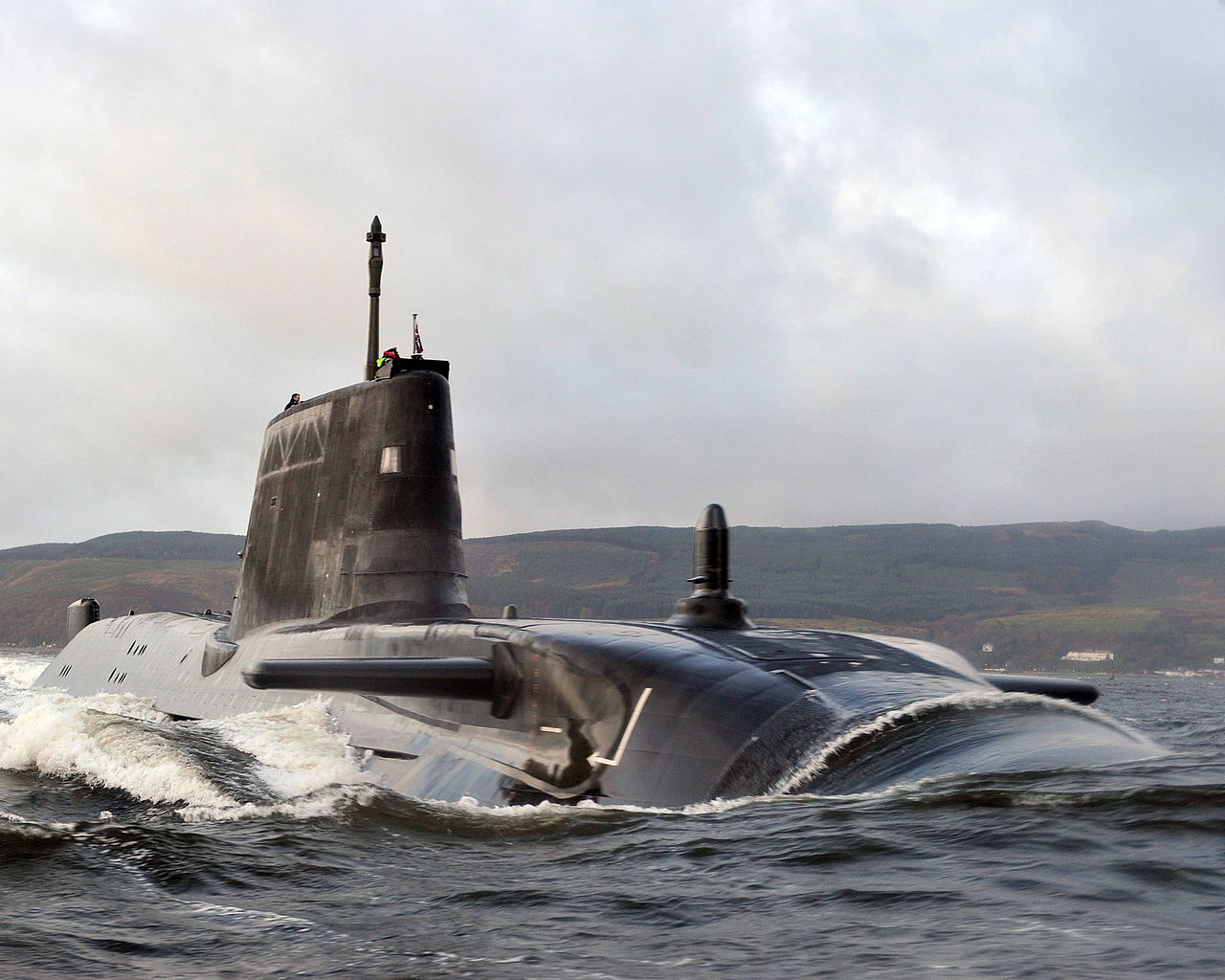
HMS Astute (S119), lead ship of her class, sails up the Clyde estuary into her home port of Faslane, Scotland.
MOD photo, via Wikimedia Commons.
The Royal Navy, always keeping up with the times, has named its newest attack submarine HMS Agincourt, after the 1415 battle where an English army beat French troops led by its nobility.
Agincourt the boat is the seventh and final Astute-class attack sub. The nuclear-powered vessels are used primarily to defend British interests from underwater, including seeing off marauding Russian vessels near British waters and also for sneaky-beaky missions of their own into foreign waters.
The £1.5bn submarine is under construction at BAE Systems’ yard in Barrow-in-Furness, Cumbria. Defence equipment minister Guto Bebb joyously declared: “Today’s announcement includes a £60m contract for Rolls-Royce, supporting over 700 jobs here in Derby as the factory continues to make the reactors that will power our state-of-the-art Dreadnought subs into the 2060s.”
And just to rile up any sensitive French souls, he also gives a thumbnail history of the battle the ship will be named for:
The name Agincourt is mildly controversial, inasmuch as it brings to mind the famous victory of King Henry V over France at a time where the English army, which was blundering around the Pas-de-Calais countryside, was largely thought to be on its last legs and cut off from its chances to retreat back home. In the words of the king’s (fictional, thanks to Shakespeare) eve-of-battle speech, it was “we few, we happy few, we band of brothers” up against the very best France had to offer.
Through “yew bow and cloth yard shaft”, as the chroniclers of the day put it, the English and Welsh longbowmen shot a torrent of arrows into the heavily armoured French knights. The arrows’ steel points penetrated the plate armour of the French nobles and the lightly equipped English then set about the bogged-in Frenchmen, whose weighty suits of armour were totally unsuited to the heavy mud of the battlefield.
In today’s world, where the UK and France are close allies and England has given way to the United Kingdom, naming the submarine Agincourt may be seen by some as a bit of an unintentional snub, bringing to mind Henry V’s slaughter of French prisoners of war and the failed negotiations that preceded the battle over Henry’s disputed claim to the title of King of France.
Comments Off on French protests over new British submarine in three, two, one…
May 11, 2018
The Ostende Raid – Peace of Bucharest I THE GREAT WAR Week 198
The Great War
Published on 10 May 2018Even though the first raid on Ostende and the Raid on Zeebrugge were not entirely successful, the Royal Navy is still determined to block access to the German submarine ports in Belgium. And this week they attack Ostende again. Meanwhile, the Germans are planning their next offensives for late May 1918 even though ten percent of the Western Front army has become a casualty in the offensives this year alone.
Comments Off on The Ostende Raid – Peace of Bucharest I THE GREAT WAR Week 198
May 9, 2018
Royal Navy buys the Terminator … of mines
At The Register Gareth Corfield updates us on the latest step towards Skynet, uh, Seanet:
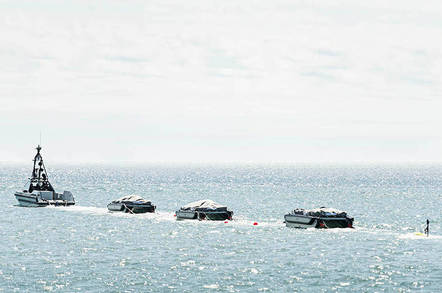
The Navy’s latest robot minesweeper. It’ll blow things up but leave your pint alone, thankfully
The Royal Navy has acquired a search-and-destroy robot boat intended for destroying mines.
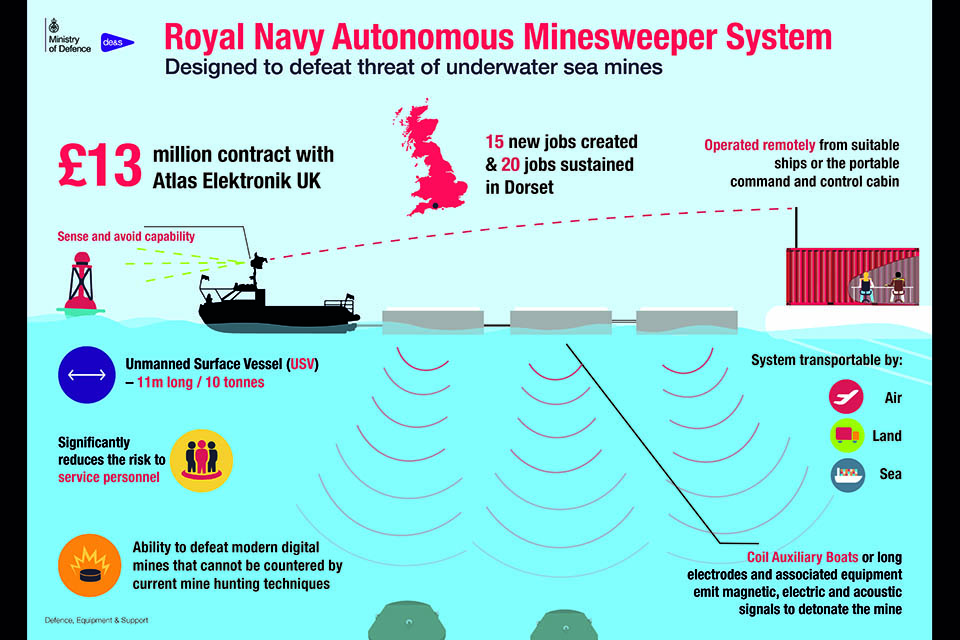
A first for Britain’s naval service, the roboat, built by German firm Atlas Elektronik’s UK subsidiary, drives itself around the high seas towing three auxiliary boats fitted with electro-acoustic transmitters. The transmitters generate pings that trigger modern digital mines at a safe distance from either the roboat flotilla or actual human-carrying shipping.
So far the MoD’s £13m contract with Atlas has netted it one complete boat-with-gear system on an R&D basis, with options available to buy more. The trials boat has just been handed over to the RN following proving of the design’s detect-and-avoid algorithms in what appears to be a live training data-versus-AI comparison exercise.
In maritime terms, the roboats comply with the International Regulations for the Prevention of Collisions at Sea (known as the Colregs – they’re the seagoing version of the Highway Code), though The Register would be most intrigued to see how they cope with scenarios that end up invoking rule 2(b).*
“This autonomous minesweeper takes us a step closer to taking our crews out of danger and allowing us to safely clear sea lanes of explosives, whether that’s supporting trade in global waters and around the British coastline, or protecting our ships and shores,” said defence procurement minister Guto Bebb in the usual canned quote.
* Rule 2, as published (PDF) by the Department for Transport, states: “Construing and complying with these Rules due regard shall be had to all dangers of navigation and collision and to any special circumstances, including the limitations of the vessels involved, which may make a departure from these Rules necessary to avoid immediate danger.”
Update, 14 May: UK Armed Forced Commentary has more information on the unmannned minesweeper system.
12 October 2005 was an historic day for the Royal Navy, because the Hunt class minesweepers HMS Middleton and HMS Ledbury conducted the last evolution at sea involving sweep gear, both the Oropesa mechanical wire system and the combined influence sweep equipment. The Royal Navy at that point had already operated unmanned, remotely controlled sweep systems in 2003 during waterway clearance work in Iraq, notably the opening of Umm Qasr. Under a UOR, a number of Combat Support Boats with remote controls were used to tow the Mini Dyad System (MDS) produced by Australian Defence Industries (ADI) and Pipe Noise Makers. Called Shallow Water Influence Minesweeping System (SWIMS), they were sent ahead of the RN minehunters as precursor sweeps against ground influence mines. The future of MCM was taking the path of stand-off action through unmanned systems and it was felt that the more than 100 years of manned ships sweeping were at an end.
The replacement for the sweep equipment was to come through the Flexible Agile Sweeping Technology, or FAST. The idea was to put two unmanned surface vehicles on the Hunt class vessels by modifying their open, capacious stern area. FAST, however, proved anything but fast, and even though a contract was signed in 2007 by the MOD with the Atlas-QED consortium, comprising Atlas Elektronik UK, QinetiQ and EDO Corporation, the resulting Technology Readiness Demonstrator never made it on the Hunt class. FAST became a test platform that spent the following years doing all sort of trials and demonstrations. Initially intended only for towing sweep kit, it ended up testing remote deployment and recovery of Sea Fox unmanned underwater vehicles, demonstrating that stand off clearance of minefields was possible.
Atlas Elektronik UK continued to work with the MOD and on its own, and eventually developed in-house the ARCIMS (ATLAS Remote Combined Influence Minesweeping System) system, which has enjoyed a first export success in an unnamed Middle East navy and has gone on to become the much delayed replacement for the Hunt’s sweeping capability within the Royal Navy.
An ARCIMS seaframe, but manned, was delivered to the Royal Navy in 2014 for trials and development purposes, and remains in service with the Maritime Autonomous System Trials Team (MASTT) of the Royal Navy as RNMB Hazard.
On 6 march 2015, Atlas received a 12.6 million pounds order from the MOD for a first ARCIMS-derived system, in the unmanned configuration, configured to tow sweeping equipment. The system has now been accepted, and according to MASTT, which has already trialed it extensively, the new boat is called RNMB Hussar.
Comments Off on Royal Navy buys the Terminator … of mines
Freedom of the Press … except where prohibited by (British) law
Wednesday is a critical day in the history of Britain, in the sense that a long-established freedom is at risk of being curtailed:
Press freedom is hanging by a thread in Britain. Tomorrow, the House of Commons will vote on the Data Protection Bill, and Labour MPs have added amendments to it that would effectively end 300 years of press freedom in this country.
That this profound affront to liberty had almost passed under the radar, until spiked and others began making noise about it over the weekend, shouldn’t surprise us. This vote is the culmination of a slow and covert war on the press that has been waged for the best part of a decade.
This story begins with the Leveson Inquiry, an effective showtrial of the press that sparked dozens of spurious trials of journalists and barely any convictions. Since then, press-regulation campaigners have had to find new and underhand ways to push their agenda on an industry and a public who clearly see right through it.
In the wake of Leveson, a new regulator, Impress, was established and given official recognition. It was an historic moment, in the worst possible sense: this was Britain’s first state-backed regulator since the days of Crown licensing. But it was also a stunningly bad bit of PR for the press-regulation lobby, in that Impress was staffed by tabloid-loathing hackademics and funded by tabloid-loathing millionaire Max Mosley.
No national newspaper signed up to it. And so the Hacked Off brigade has been pushing over the past few years for Section 40, a law that would force publications to sign up to a state-approved regulator, which at the moment means signing up to Impress. Those publications, like spiked, who would refuse on principle, would be required to pay the legal costs of any case brought against them, even if they win.
As such, Section 40 would be a gift to the powerful and the begrudged. It would enable anyone to launch lawsuits aimed at shutting down publications they dislike. This is an opportunity that people who have been exposed by the press would take in a heartbeat. It would undermine not only press freedom, but also natural justice.
And it isn’t just the press who are concerned about this. In 2016, the government opened a public consultation into press freedom, asking members of the public if it should implement Section 40 and commence the second part of the Leveson Inquiry. Out of a huge 174,730 responses, 79 per cent said No to Section 40 and 66 per cent said No to Leveson 2.
Update, 10 May: The vote was too damned close, but it was defeated by a nine-vote margin. Guido has the list of MPs voting in favour of muzzling the press here.
Comments Off on Freedom of the Press … except where prohibited by (British) law
QotD: The “you can’t get good help” period after WW1
Look, I, like you, heard about how terrible the aftermath of WWI was, and how broke people were right after, and how they were moving to cities and living in tenements. It wasn’t until I was reading a book about the between the war period in England that I realized they were telling me TWO stories which couldn’t both have happened. In the part about the common folk, they were telling me how much poorer they were than before the war. In the part about the great families, they were telling me how the huge rise of the middle class and the building of suburbs had hurt them, and how the newly rich common folk no longer wanted to be servants.
That was one of those “wait a minute.” Sure I was taught both things in school, but you know you write down the bullet point for the test, and that’s it. Now I was going “Who the heck wrote these narratives and why doesn’t anyone question them?”
The truth, btw, from going to primary sources is closer to the second. And the people who wrote the narrative were the unseated noblemen, who did not like all these nouveau riche but who wanted to justify their disgust by showing how it hurt the poor. (It did increase the underclass somewhat, not because of economic conditions, but because a lot of men don’t integrate well after war, and well, WWI was something special by way of trauma.)
There are tons of these when you start poking. For instance the idea that the industrial revolution was unremittingly bad for the poor/people. Looking at China and India and such places right now, all I can do is roll my eyes.
Yeah, sure, the conditions of the early industrial revolution were appalling. And yet people crowded to the cities to take these jobs. What the historians never ask themselves is “How much worse was what they were escaping from?” We know that in India and China and other recently industrialized countries.
Sure the countryside has relatively clean air and more open space, but there are still real famines, and the work was unremitting and brutal and yes, little children worked too (says the daughter of middle class in a rural community whose first “job” was weeding the onion patch at five. And I was a pampered moppet. Kids my age from farming families had what we’d call full time jobs. Factory jobs at least had a stopping time.)
The idea that the industrial revolution was awful comes from upper class historians who could see the little kids twisted by working in the mills but who never consorted closely enough with the rural poor to see the misery behind raising baah lambs and the pretty pretty flowers.
Yeah. So the past isn’t written in stone. And it’s not a conspiracy. Not precisely a conspiracy. Yeah, sure, the Marxists influenced a lot of modern history with their ideas, but that is not necessarily conspiring. They view the world a certain way and it influences how they view the past too.
Sarah Hoyt, “How Do You Know?”, According to Hoyt, 2016-08-24.
Comments Off on QotD: The “you can’t get good help” period after WW1
May 8, 2018
Charge of the Light Brigade | Animated History
The Armchair Historian
Published on 28 Dec 2017The Charge of the Light Brigade, Animated History
Comments Off on Charge of the Light Brigade | Animated History
QotD: Pay inequality
It probably doesn’t come as news that airline companies pay pilots more than cabin crew — but according to the dogma of the gender wage gap, we’re supposed to find this fact troubling. The British government now requires companies to report their raw gender gap — that is, the difference in the median hourly wages earned by their male and female employees. Ignoring occupational differences, seniority, employment history, hours worked, or any of the countless other factors affecting salaries, these data are misleading at best. Nevertheless, when budget airline EasyJet reported a 51 percent pay gap between its male and female employees, the company knew that its reputation perched on the edge of a PR abyss.
And that’s the whole point of the exercise: simplify statistics to shock people at the seeming injustice done to women and shame companies into action; refuse to compare similar job functions; ignore the fact that, like every other airline, EasyJet’s pilots are disproportionately male, while their cabin crews skew female; forget that almost all carriers compete for the same 4 percent of the world’s female pilots; and whatever you do, don’t mention that the EasyJet CEO, who was in charge of this bigoted organization and also its highest-paid employee until retiring earlier this year, was a woman. The company should be branded with a scarlet “51 percent” until it … does what? Cuts pilots’ pay? Hikes the salaries of female cabin crew? Hires male attendants instead of female? Goes bankrupt?
Kay S. Hymowitz, “Equal Pay Myths: Activists for wage parity ignore stubborn truths”, City Journal, 2018-04-09.
Comments Off on QotD: Pay inequality


