
Published on 25 Feb 2015
In 1971, President Nixon, in an effort to control inflation, declared price increases illegal. Because prices couldn’t increase, they began hitting a ceiling. With a price ceiling, buyers are unable to signal their increased demand by bidding prices up, and suppliers have no incentive to increase quantity supplied because they can’t raise the price.
What results when the quantity demanded exceeds the quantity supplied? A shortage! In the 1970s, for example, buyers began to signal their demand for gasoline by waiting in long lines, if they even had access to gasoline at all. As you’ll recall from the previous section on the price system, prices help coordinate global economic activity. And with price controls in place, the economy became far less coordinated. Join us as we look at real-world examples of price controls and the grave effects these regulations have on trade and industry.
June 27, 2015
Price Ceilings: The US Economy Flounders in the 1970s
June 26, 2015
The self-driving truck won’t displace many human truck drivers for years to come
I’m far from being a Luddite, but I find Megan McArdle‘s analysis of the low short-to-medium term risk of job losses due to self-driving vehicles to be pretty convincing:
… my objections are actually to the understanding of the trucking industry works and of self-driving vehicles. Fully automated trucks, with no drivers at all, are probably going to arrive later than Santens thinks, take longer to roll out than he projects, and displace fewer workers than he thinks they will. I’m not saying it will never happen. I’m just skeptical that this is going to be a major policy problem in the next two decades.
Why?
Start with what truckers do, and how many of them there are. Santens quotes the American Trucker Association to get 3.5 million. The Bureau of Labor Statistics puts that figure a bit lower, around 2.8 million. More importantly, only 1.6 million of those are long-haul truckers. The rest are “driver/sales” employees or “Light truck or delivery services drivers.” Those are short-haul services that will not quickly be replaced by automated cars, both because chaotic urban roads are harder for autonomous vehicles to handle and because part of the job is loading and unloading the truck (something that long haul drivers may also do).
Also: Why would we assume that the advent of driverless trucks would be bad for trucking support jobs? Those folks are doing stuff like maintenance or loading that still has to be done. Moreover, other jobs will be created, in designing and maintaining the new systems. Someone has to map all those roads.
But I think it will be a while before we get to a fully autonomous vehicle with no people in it. The “driverless truck” that Santens links is not actually driverless; it’s partially autonomous. If it foresees something it can’t deal with, such as heavy snow, it signals to the driver to take over; if the driver doesn’t respond, it slows to a stop. That’s an improvement in the lives of truck drivers, not a job killer.
June 25, 2015
Refuting Piketty on the inevitable “rich get richer” meme
At Reason, Ronald Bailey links to a study that appears to undermine most of Thomas Picketty’s claims:
From the study:
We believe Piketty’s core message is provably flawed on several levels, as a result of fundamental and avoidable errors in his basic assumptions. He begins with the sensible presumption that the return on invested capital, r, exceeds macroeconomic growth, g, as must be true in any healthy economy. But from this near-tautology, he moves on to presume that wealthy families will grow ever richer over future generations, leading to a society dominated by unearned, hereditary wealth. Alas, this logic holds true only if the wealthy never dissipate their wealth through spending, charitable giving, taxation, and splitting bequests among multiple heirs.
As individuals, and as families, the rich generally do not get richer; after a fortune is first built, the rich get relentlessly and inevitably poorer.
The “evidence” Piketty uses in support of his thesis is largely anecdotal, drawn from the novels of Austen and Balzac, and from the current fortunes of Bill Gates and Liliane Bettencourt. If Piketty is right, where are the current hyper-wealthy descendants of past entrepreneurial dynasties — the Astors, Vanderbilts, Carnegies, Rockefellers, Mellons, and Gettys? Almost to a man (or woman) they are absent from the realms of the super-affluent. Our evidence — used to refute Piketty’s argument — is empirical, drawn from the rapid rotation of the hyper-wealthy through the ranks of the Forbes 400, and suggests that, at any given time, roughly half of the collective worth of the hyper-wealthy is first-generation earned wealth, not inherited wealth.
The originators of great wealth are one-in-a-million geniuses; their innovation, invention, and single-minded entrepreneurial focus create myriad jobs and productivity enhancements for society at large. They create wealth for society, from which they draw wealth for themselves. In contrast, the descendants of the hyper-wealthy rarely have that same one-in-a-million genius. Bettencourt, cited by Piketty, is a clear exception. Typically, we find that descendants halve their inherited wealth — relative to the growth of per capita GDP — every 20 years or less, without any additional assistance from Piketty’s redistribution prescription.
Dynastic wealth accumulation is simply a myth. The reality is that each generation spawns its own entrepreneurs who create vast pools of entirely new wealth, and enjoy their share of it, displacing many of the preceding generations’ entrepreneurial wealth creators. Today, the massive fortunes of the 19th century are largely depleted and almost all of the fortunes generated just a half-century ago are also gone. Do we really want to stifle entrepreneurialism, invention, and innovation in an effort to accelerate the already-rapid process of wealth redistribution?
A different kind of crowd-funding
Christopher Taylor starts off by praising to the skies a movie I’ve never seen … but he goes on to discuss a variant of crowdfunding that might be a significant change to how movies are made:
… the big studios are corporations that answer to a board of stockholders. And the stockholders aren’t interested in great film making, they are interested in making money off their stocks.
So the Broken Lizards guys went to crowdfunding to raise money for their film, and have done quite well. They did so well that they don’t need a big bunch of studio dollars and interference to make the movie.
But here’s where it gets really interesting. See, crowdfunding sites raise money by offering goodies and the joy of helping a product succeed. They are not investment sites so much as a chance to be a patron of something you want to see on the market as well as a chance to get something from the company. Free copies, a mention in the book, a token in the game named after you, and so on.
Well that’s all about to change in a big way.Jay Chandrasekhar writes:
At our meeting, I vented to Slava about my perception of crowdfunding. I told him I wished people could invest in the movie and then own an equity piece of the backend. He said, “I totally agree.” That’s when we hit it off. He said that there is legislation in Washington, as we speak, that if signed, will make equity-based crowdfunding a reality. Think about that.
I’m with Jay here. Think about that. Its very likely that soon you will be able to donate to a crowdfunded project and get money back from its sales. In other words, it will actually be an investment, not just patronizing.
This is a huge key in changing the way that media gets made. All those projects the studios and TV channels pass on because it isn’t hot or doesn’t make sense to them? If this happens, they can have a chance.
June 24, 2015
Nathan Rothschild did as much to defeat Napoleon as Wellington
Matt Ridley decries his own taste in reading (too many cavalry charges and panzer tanks) and declares that we should honour the man who propped up the Duke of Wellington financially for making Wellington’s battlefield and diplomatic efforts meaningful:
Galloping bravely against an enemy, in however good a cause, is not the chief way the world is improved and enriched. The worship of courage as a pre-eminent virtue, which Hollywood shares with Homer, is oddly inappropriate today — a distant echo of a time when revenge and power, not justice and commerce, were the best guarantee of your security. Achilles, Lancelot and Bonaparte were thugs.
We admire achievements in war, a negative-sum game in which people get hurt on both sides, more than we do those in commerce, where both sides win.
The Rothschild skill in trade did at least as much to bring down Napoleon as the Wellesley skill in tactics. Throughout the war Nathan Rothschild shipped bullion to Wellington wherever he was, financing not just Britain’s war effort but also that of its allies, almost single-handedly. He won’t get much mention this week.
So I ought to prefer books about business, not bravery, because boring, bourgeois prudence gave us peace, plenty and prosperity. It was people who bought low and sold high, who risked capital, set up shop, saved for investment, did deals, improved gadgets and created jobs — it was they who raised living standards by ten or twentyfold in two centuries, and got rid of most child mortality and hunger. Though they do not risk their lives, they are also heroes, yet we have always looked down our noses at them. When did you last see an admirable businessman portrayed in a movie?
Dealing is always better than stealing, even from your enemies. It’s better than praying and preaching, the clerical virtues, which do little to fill bellies. It’s better than self-reliance, the peasant virtue, which is another word for poverty. As the economic historian Deirdre McCloskey put it in her book The Bourgeois Virtues: “The aristocratic virtues elevate an I. The Christian/peasant virtues elevate a Thou. The priestly virtues elevate an It. The bourgeois virtues speak instead of We”.
The precarious economics of recycling today
The recycling industry is having economic problems, which means many municipalities are being forced to share those problems:
Once a profitable business for cities and private employers alike, recycling in recent years has become a money-sucking enterprise. The District, Baltimore and many counties in between are contributing millions annually to prop up one of the nation’s busiest facilities here in Elkridge, Md. — but it is still losing money. In fact, almost every facility like it in the country is running in the red. And Waste Management and other recyclers say that more than 2,000 municipalities are paying to dispose of their recyclables instead of the other way around.
In short, the business of American recycling has stalled. And industry leaders warn that the situation is worse than it appears.
“If people feel that recycling is important — and I think they do, increasingly — then we are talking about a nationwide crisis,” said David Steiner, chief executive of Waste Management, the nation’s largest recycler that owns the Elkridge plant and 50 others.
[…]
The problems of recycling in America are both global and local. A storm of falling oil prices, a strong dollar and a weakened economy in China have sent prices for American recyclables plummeting worldwide.
Environmentalists and other die-hard conservation advocates question if the industry is overstating a cyclical slump.
“If you look at the long-term trends, there is no doubt that the markets for most recyclables have matured and that the economics of recycling, although it varies, has generally been moving in the right direction,” said Eric A. Goldstein, a lawyer with the Natural Resources Defense Council who tracks solid waste and recycling in New York.
QotD: Surge pricing
New York just killed every economist’s favorite thing about Uber: surge pricing. Sure, many economists also love convenient car service at the touch of a button. But black-car services have been around for a long time. Explicit surge pricing — which both creates new supply and rations demand — has not, but it’s long been a core feature of Uber Technologies Inc.’s business model. While it can be annoying at times (during a recent rainstorm, I noticed a sudden epidemic of drivers canceling rides, which I suspect was due to the rapidly rising surge price), it also allows you to be sure that you will be able to get a taxi on New Year’s Eve or during a rainstorm as long as you’re willing to pay extra.
Sadly, no one else loves surge pricing as much as economists do. Instead of getting all excited about the subtle, elegant machinery of price discovery, people get all outraged about “price gouging.” No matter how earnestly economists and their fellow travelers explain that this is irrational madness — that price gouging actually makes everyone better off by ensuring greater supply and allocating the supply to (approximately) those with the greatest demand — the rest of the country continues to view marking up generators after a hurricane, or similar maneuvers, as a pretty serious moral crime.
Megan McArdle, “Uber Makes Economists Sad”, Bloomberg View, 2014-07-09.
June 20, 2015
Prediction Markets
Published on 8 Feb 2015
We’ve discussed how prices are signals that convey information about goods — but can prices also convey information about events and even predict the future? For instance, can we predict Middle East politics based on the price of oil futures? Or predict the consequences of climate change based on the price of flood insurance in coastal cities? Of course, prices in these examples are imperfect predictors as there are many factors that influence the price.
We also take a look at some markets that have been designed to make predictions, like the Iowa Electronic Markets, and a specific example of how it was used to predict the outcome of the 2008 presidential election between John McCain and Barack Obama. What about the Hollywood Stock Exchange, where traders buy and sell shares and options in movies and music? What did the studio learn about its casting choices for the film, “50 Shades of Grey”? We discuss these examples and more in this video.
June 19, 2015
QotD: There is a lot of ruin in a nation … but not an infinite amount
Over the years, I’ve had many arguments about economic policy with my statist friends. I put them into three categories.
- The completely unreasonable statists blindly assert, notwithstanding all the evidence around the world, that bigger government and more intervention are actually good for growth.
- The somewhat unreasonable statists acknowledge that bigger government and more intervention might have some minor “efficiency” costs, but those costs are acceptable and affordable in the pursuit of more “equity.”
- The semi-reasonable statists admit that bigger government and more intervention hurt growth, but they argue that “libertarian types” must somehow be wrong because our predictions of economic chaos never materialize.
The folks in the last category have a point. For decades, advocates of limited government and free markets have warned about the economic cost of bad policy, yet where’s the collapse?
Why hasn’t Atlas shrugged, as libertarians have warned? Why have predictions of economic dystopia (examples here and here) been wrong?
I have two responses to these questions.
First, the economic damage caused by an expanding welfare state has been offset by improvements in other types of economic policy.
Second, maybe dour libertarians have been right, but got the timing wrong because it takes a long time and a lot of bad policy to destroy an economy.
And that’s today’s topic, because it certainly looks like both Greece and Venezuela have finally reached the end of the road. Let’s call it the Thatcher Inflection Point.
Dan Mitchell, “Atlas Is Shrugging in Greece and Venezuela: Two Case Studies of Statist Failure”, International Liberty, 2015-05-27.
June 18, 2015
John Kay’s Other People’s Money
John Kay posts the introduction to his new book Other People’s Money: Masters of the Universe or Servants of the People? to be published in September:
The assets of British banks are around £7 trillion – four times the aggregate of the yearly income of everyone in the country. The liabilities of these banks are a similar amount. The assets of British banks are five times the liabilities of the British government. But the assets of these banks mostly consist of claims on other banks. Their liabilities are mainly obligations to other financial institutions. Lending to firms and individuals engaged in the production of goods and services – which most people would imagine was the principal business of a bank – amounts to about 3 per cent of that total (see Chapter 6).
Modern banks – and most other financial institutions – trade in securities, and the growth of such trade is the main explanation of the growth of the finance sector. The finance sector establishes claims against assets – the operating assets and future profits of a company, or the physical property and prospective earnings of an individual – and almost any such claim can be turned into a tradable security. ‘High-frequency trading’ is undertaken by computers which are constantly offering to buy and sell securities. The interval for which these securities are held by their owner may – literally – be shorter than the blink of an eye. Spread Networks, a telecoms provider, has recently built a link through the Appalachian Mountains to reduce the time taken to transmit data between New York and Chicago by a little less than one millisecond.
World trade has grown rapidly, but trading in foreign exchange has grown much faster. The value of daily foreign exchange transactions is almost a hundred times the value of daily international trade in goods and services. The annual volume of payments processed in Britain is £75 trillion: about forty times Britain’s national income. Trade in securities has grown rapidly, but the explosion in the volume of financial activity is largely attributable to the development of markets in derivatives, so called because their value is derived from the value of other securities. If securities are claims on assets, derivative securities are claims on other securities, and their value depends on the price, and ultimately on the value, of these underlying securities. Once you have created derivative securities, you can create further layers of derivative securities whose values are dependent on the values of other derivative securities – and so on.The value of the assets underlying such derivative contracts is three times the value of all the physical assets in the world.
What is it all for? What is the purpose of this activity? And why is it so profitable? Common sense suggests that if a closed circle of people continuously exchange bits of paper with each other, the total value of these bits of paper will not change much, if at all. If some members of that closed circle make extraordinary profits, these profits can only be made at the expense of other members of the same circle. Common sense suggests that this activity leaves the value of the traded assets little changed, and cannot, taken as a whole, make money. What, exactly, is wrong with this commonsense perspective?
Not much, I will conclude. But to justify that conclusion, it will be necessary to examine the activities of the finance sector and the ways in which it does, or might, make our lives better and our businesses more efficient. Assessing the economic contribution of the industry is complex, because there are many difficulties in interpreting reported information about the output and profitability of financial sector activities. But I will show that its profitability is overstated, that the value of its output is poorly reported in economic statistics, and that much of what it does contributes little, if anything, to the betterment of lives and the efficiency of business. And yet many things that finance could do to advance these social and economic goals are not done well – or in some cases at all.
June 17, 2015
Speculation
Published on 8 Feb 2015
Speculation is often considered to be morally dubious. But, can speculation actually be useful to the market process? This video shows that speculation can actually smooth prices over time and increase welfare.
Speculators take resources from where they have low value and move them through time to where they have high value. We also take a look at speculation in the futures market — for instance, can orange juice future prices help predict Florida weather? Let’s find out.
When you tax something, you get less of it
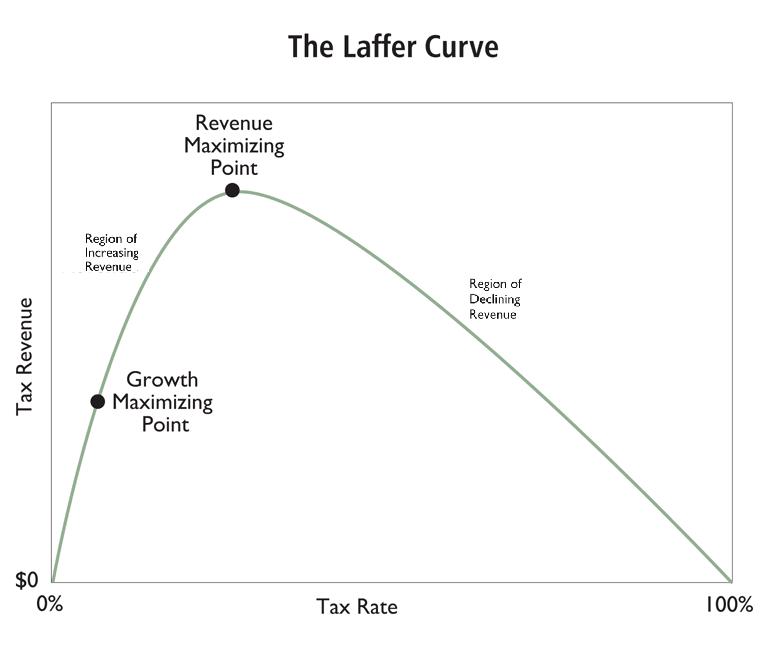
At International Liberty, Dan Mitchell points out an example of leftists who genuinely want higher taxes on “the rich” even when the higher rate will return less money to the government:
Every so often, I’ll assert that some statists are so consumed by envy and spite that they favor high tax rates on the “rich” even if the net effect (because of diminished economic output) is less revenue for government.
In other words, they deliberately and openly want to be on the right side (which is definitely the wrong side) of the Laffer Curve.
Critics sometimes accuse me of misrepresenting the left’s ideology, to which I respond by pointing to a poll of left-wing voters who strongly favored soak-the-rich tax hikes even if there was no extra tax collected.
But now I have an even better example.
Writing for Vox, Matthew Yglesias openly argues that we should be on the downward-sloping portion of the Laffer Curve. Just in case you think I’m exaggerating, “the case for confiscatory taxation” is part of the title for his article.
Here’s some of what he wrote.
Maybe at least some taxes should be really high. Maybe even really really high. So high as to useless for revenue-raising purposes — but powerful for achieving other ends. We already accept this principle for tobacco taxes. If all we wanted to do was raise revenue, we might want to slightly cut cigarette taxes. …But we don’t do that because we care about public health. We tax tobacco not to make money but to discourage smoking.
The tobacco tax analogy is very appropriate.
June 16, 2015
Light rail is usually not the solution you need for better public transit
At Coyote Blog, a look at the new Phoenix light rail system’s miraculous ability to stall the growth in public transit usage:
As I have written before, Phoenix has seen its total transit ridership flat to down since it built its light rail line. This after years of 6-10% a year increases in ridership. Most cities, even the oft-worshipped Portland, has seen the same thing. Here is the chart for Phoenix (if you look closely, you can see how they fudged the bar scaling to make light rail ridership increases look better).
The reason is that per passenger, or per mile, or per route, or whatever way you want to look at it, rail systems are 1-2 orders of magnitude more expensive than buses. Since most cities are reluctant to increase their spending on transit 10-100x when they build trains (and to be fair, proponents of rail projects frequently make this worse by fibbing about future costs and revenue expectations), what happens is that bus routes are cut to fund rail lines. But since buses are so much cheaper, 10 units of bus capacity, or more, must be cut for each one unit of rail capacity.
[…]
By the way, beyond the obvious harm to taxpayers, the other people hurt by this are the poor who are disproportionately bus users. Rail systems almost always go from middle/upper class suburbs to business districts and seldom mirror the transit patterns of the poor. Middle class folks who wouldn’t be caught dead on a bus love the trains, but these same folks already have transportation alternatives. The bus lines that get cut to fund the trains almost always serve much lower income folks with fewer alternatives.

This comment from slocum may show the hidden intent in many cities’ drive to replace bus routes with light rail services:
BTW, am I the only one who suspects that there might be a little method to the madness of building light rail and cutting back on bus service? Isn’t it a pretty effective way to drive gentrification by making cities more attractive to the well-off and less so to the poor?
Come for the shiny new light rail system. Stay for the snobbery and active shunning of the poor!
June 15, 2015
The “Kitchen Debates” of 1959
B.K. Marcus explains how ice cream was the secret weapon that won the Cold War:
Richard Nixon stood by a lemon-yellow refrigerator in Moscow and bragged to the Soviet leader: “The American system,” he told Nikita Khrushchev over frosted cupcakes and chocolate layer cake, “is designed to take advantage of new inventions.”
It was the opening day of the American National Exhibition at Sokol’niki Park, and Nixon was representing not just the US government but also the latest products from General Mills, Whirlpool, and General Electric. Assisting him in what would come to be known as the “Kitchen Debates” were attractive American spokesmodels who demonstrated for the Russian crowd the best that capitalism in 1959 had to offer.
[…]
“Don’t you have a machine,” he asked Nixon, “that puts food in the mouth and presses it down? Many things you’ve shown us are interesting but they are not needed in life. They have no useful purpose. They are merely gadgets.”
Khrushchev was displaying the behavior Ludwig von Mises described in The Anti-Capitalistic Mentality. “They castigate the luxury, the stupidity and the moral corruption of the exploiting classes,” Mises wrote of the socialists. “In their eyes everything that is bad and ridiculous is bourgeois, and everything that is good and sublime is proletarian.”
On display that summer in Moscow was American consumer tech at its most bourgeois. The problem with “castigating the luxury,” as Mises pointed out, is that all “innovation is first a luxury of only a few people, until by degrees it comes into the reach of the many.”
It is appropriate that the Kitchen Debate over luxury versus necessity took place among high-end American refrigerators. Refrigeration, as a luxury, is ancient. “There were ice harvests in China before the first millennium BC,” writes Wilson. “Snow was sold in Athens beginning in the fifth century BC. Aristocrats of the seventeenth century spooned desserts from ice bowls, drank wine chilled with snow, and even ate iced creams and water ices. Yet it was only in the nineteenth century in the United States that ice became an industrial commodity.” Only with modern capitalism, in other words, does the luxury reach so rapidly beyond a tiny elite.
“Capitalism,” Mises wrote in Economic Freedom and Interventionism, “is essentially mass production for the satisfaction of the wants of the masses.”
June 12, 2015
QotD: Gresham’s Law
Gresham’s Law states that bad money drives out good money. This can happen in both inflationary and deflationary monetary environments. Basically, it must means that people will spend their “bad” currency first to get the maximal value out of it, and save the “good” money for the future because it will not depreciate as fast. That’s why you see socialist government inveighing against “hoarders”, “wreckers”, and “speculators” — the good money is biding its time and flushing out the bad money first.
For example, consider the US fifty-dollar gold coin. These coins are collected for their numismatic value and not their currency value. In fact, these coins are useless as actual currency. Why? The value of the gold and silver in the coins far outstrips the face value of the coin. Gresham’s Law would drive the coins out of circulation — either they would be melted down for bullion, hoarded, or traded as barter (not currency!) for objects of similar value.
Monty, “Inflation, Deflation, and Monetary Policy”, Ace of Spades HQ, 2014-07-11.


