Quotulatiousness

February 24, 2012

Argentina, like China, publishes unreliable economic statistics

Filed under: Americas, Economics, Government, Media — Tags: , , — Nicholas @ 11:27

The Economist has finally decided to stop using “official” economic statistics from Argentina:

Imagine a world without statistics. Governments would fumble in the dark, investors would waste money and electorates would struggle to hold their political leaders to account. This is why The Economist publishes more than 1,000 figures each week, on matters such as output, prices and jobs, from a host of countries. We cannot be sure that all these figures are trustworthy. Statistical offices vary in their technical sophistication and ability to resist political pressure. China’s numbers, for example, can be dodgy; Greece underreported its deficit, with disastrous consequences. But on the whole government statisticians arrive at their figures in good faith.

There is one glaring exception. Since 2007 Argentina’s government has published inflation figures that almost nobody believes. These show prices as having risen by between 5% and 11% a year. Independent economists, provincial statistical offices and surveys of inflation expectations have all put the rate at more than double the official number. The government has often granted unions pay rises of that order.

What seems to have started as a desire to avoid bad headlines in a country with a history of hyperinflation has led to the debasement of INDEC, once one of Latin America’s best statistical offices. Its premises are now plastered with posters supporting the president, Cristina Fernández de Kirchner. Independent-minded staff were replaced by self-described “Cristinistas”. In an extraordinary abuse of power by a democratic government, independent economists have been forced to stop publishing their own estimates of inflation by fines and threats of prosecution. Misreported prices have cheated holders of inflation-linked bonds out of billions of dollars.

February 17, 2012

Colby Cosh on the current drama around the Falkland Islands

Filed under: Americas, Britain, History, Military — Tags: , , , , , — Nicholas @ 09:22

The last time Colby Cosh discussed the Falkland Islands, we had a bit of a discussion on Twitter, with my pessimism about Britain’s strategic situation finally persuading him to say “You’ve convinced me to worry about this a little more than I would’ve” (summary in this post). He’s now posted a new article at Maclean’s, which I think accurately captures the situation in the south Atlantic:

Argentina, the world press tells us, intends to rename its top soccer league the “Cruiser General Belgrano First Division”, in honour of the Argentine ship sunk by the Royal Navy during the 1982 Falklands War. Far be it from any outsider to prescribe how a country honours its war dead, but honour is not what the move is about: it’s part of a continuing, exhausting barrage of Falklands agitprop from Argentina’s Kirchner government. Kirchner is scrambling to keep Argentine economic growth rolling, barracking businesses and workers in the classic caudillo manner as inflation outpaces the dubious official statistics. She has tried, with some success, to close off Southern Hemisphere ports to boats flying the maritime flag of the Falklands and to weld traditionally UK-friendly neighbours into a regional bloc against “colonialism”. Tensions are high and the Falkland Islanders are feeling besieged.

Britain is passing through a phase of relative strategic vulnerability when it comes to the Falklands. The islands are garrisoned much more strongly than they were in 1982 and the RAF has a proper airfield. But the UK has sold off its Harrier fleet, and its naval force-projection capacity is a little threadbare; public austerity has forced the Royal Navy to wait until 2016 for a new Nimitz-sized aircraft-carrier class to come into play. General Sir Michael Jackson, often considered the top UK commentator on military affairs (how many General Sirs are there?), recently summed up the situation by suggesting that the Falklands could be defended—but if Argentina captured them in a coup de main, as it did in ’82, its soldiers could probably not now be driven off. From a game-theoretic standpoint, the situation is a nightmare.

Update, 21 February: Brendan O’Neill explains that in the modern celebrity-fuelled world, the Penn really is mightier than the sword:

Easily the most extraordinary thing about Sean Penn’s recent comments on the Falkland Islands is the impact that they made. The tidal wave of furious commentary has tended to focus on Penn’s undoubted combination of daftness and arrogance, with enraged British hacks asking ‘where does Mr Madonna get off holding a press conference to pontificate about the serious affairs of the South Atlantic?’. That is indeed a good question. But a better and more pressing one is this: how on earth did the musings of one muppet make such a massive impact, intensifying the stand-off between Argentina and Britain, generating acres of newsprint, and even provoking a huge protest in the Falkland Islands themselves under the banner ‘Falk You, Sean’?

[. . .]

The Penn affair confirms the extraordinary and terrifying power of celebrity today. It shows that in our celeb-obsessed era, the famous and allegedly fabulous are no longer used simply to advertise booze or to titillate the readers of gossip columns — they have become actual tools of global politics. (In both senses of the word ‘tool’ — ‘a device used to carry out a particular function’ and ‘one who lacks the mental capacity to know he is being used’.) Indeed, Kirchner’s use of Penn in her war of words with Britain shows that she is a sussed and wily leader — she recognises that, today, a comment from a celeb is a far more effective political manoeuvre than readying a warship or making a stern speech at the United Nations. Her message is basically: ‘I’ll see your Prince William and raise you Sean Penn…’

February 14, 2012

Colombia looks to upgrade their submarine fleet

Filed under: Americas, Germany, Military — Tags: , , , — Nicholas @ 09:23

With relations in a parlous state between Colombia and Venezuela, Colombia is considering upgrading their navy:

Colombia is negotiating with Germany to buy up to six recently retired Type 206A coastal submarines. The 206As are meant to be an inexpensive counter to new Russian Kilo subs being purchased by neighboring Venezuela. Colombia still has two older (1,200 ton) Type 209 subs and nine miniature subs. All are over three decades old, and so are the Type 206As. But the 206As have been better cared for and were updated in the 1990s. Colombia already has sailors with lots of experience on German submarines and the Type 206s can be obtained cheap. Exactly how cheap is currently under negotiation.

[. . .] If there were a war with Venezuela (which has been acting very belligerent over the last few years), the Type 206s would be used to shut down Venezuelan ports and destroy oil facilities. Venezuela also has two 1970s era Type 209 subs, said to be in worse shape than their Colombian counterparts.


Bundesmarine Type 206A submarine U22 in December 2006

Wikipedia says of these submarines:

The Type 206 is a class of diesel-electric submarines (U-boats) developed by Howaldtswerke-Deutsche Werft (HDW). Its design is based on the preceding Type 205 submarine class. These small and agile submarines were built during the Cold War to operate in the shallow Baltic Sea and attack Warsaw Pact shipping if the war turned hot. The pressure hulls were built out of non-magnetic steel to counter the threat of magnetic naval mines and make detection with MAD sensors more difficult. The low emission profile allowed the submarines in exercises to intrude even into well protected opposing forces such as carrier formations with their screen.

[. . .]

A major mid-life modernisation was conducted on twelve of these submarines, the boats concerned now being officially designated Type 206A. The work started in mid-1987 and completed in February 1992, being carried out by Nordseewerke, Emden; this upgrade includes:

The STN Atlas DBQS-21D sonar has been fitted, together with new periscopes, and a new weapon control system (LEWA). The ESM system has been replaced and GPS navigation installed. The rebuilt submarines are armed with new torpedoes (Seeaal), and the propulsion system has been comprehensively refurbished, and improvements have been made to the accommodation.

February 11, 2012

Argentina accuses Britain of deploying nuclear weapons in Falkland Islands

Filed under: Americas, Britain, Military — Tags: , , , , — Nicholas @ 10:21

Raising the rhetorical stake yet again, Argentina has taken their complaint to the United Nations:

Argentina has accused Britain of deploying nuclear weapons near the Falkland Islands and “militarising” the south Atlantic.

The Argentinian foreign minister, Héctor Timerman, lodged a formal protest at the United Nations on Friday and showed slides of British military bases in the region, saying they represented a threat to all south America.

He said Buenos Aires had intelligence that a Vanguard submarine was operating in the area. “Thus far the UK refuses to say whether it is true or not,” he told a press conference in New York. “Are there nuclear weapons or are there not? The information Argentina has is that there are these nuclear weapons.” Quoting John Lennon, he added: “Give peace a chance.”

Britain’s ambassador to the UN, Mark Lyall Grant, said London did not comment on the disposition of nuclear weapons or submarines but that it was “manifestly absurd” to say it was militarising the region. Britain’s defence posture remained unchanged, he said.

There was a report in the press that the Royal Navy had sent a nuclear powered submarine to the south Atlantic, but that it was conventionally armed. No nuclear power is in the habit of detailing where their nuclear weapons are deployed, so don’t expect Britain to break ranks with the others.

Also in the Guardian, Marina Hyde characterizes the decision to send a member of the royal family to the Falklands is the wrong kind of gesture:

The technical military term for the decision to deploy the second in line to the throne to the Falkland Islands is William-waving. If dispatching a fancy new warship to the archipelago on the eve of the 30th anniversary of the conflict with Argentina sends a message, then dispatching Prince William makes a hand gesture.

Of course, the Duke of Cambridge is not in the South Atlantic in his capacity as the male lead from the latest, successful instalment of the hit-and-miss Windsor Wedding franchise. His other day job is as an RAF search and rescue pilot, which is genuinely commendable — but need he really have been sent to the Falklands this week in a posting described by William Hague as “entirely routine”? If the foreign secretary truly wishes to claim that the deployment of Prince William is a business as perfunctory as deciding whether to serve tea or coffee at a meeting, then that is a matter for him. But many of us will find our disbelief simply impossible to suspend in this case, and will nurse a deep suspicion that such things are discussed at prime ministerial level.

February 9, 2012

Brazil tries to quash Twitter users over speed trap tweets

Filed under: Americas, Law, Liberty, Technology — Tags: , , , — Nicholas @ 10:44

Proving yet again that the main concern is revenue generation rather than safety, Brazil is trying to force Twitter to stop its users from sending out tweets that warn about speed traps:

The attorney general of Brazil has filed a lawsuit against Twitter in a bid to block accounts that warn drivers of police speed traps and roadblocks.

The government argues the tweets interfere with police efforts to fight drunk driving, reduce accidents and uncover evidence of crime, report CNN, PC Magazine, The Next Web and BBC News.

The suit, which seeks $290,000 for each day that Twitter or its microbloggers fail to comply, claims the warnings violate criminal and traffic laws.

Twitter recently announced that they now have the capability of restricting the distribution of tweets within countries (they used to block worldwide distribution by default).

H/T to Walter Olson for the link.

February 6, 2012

Brazil fights back against celebrity oppression

Filed under: Americas, Economics, Media — Tags: , , , — Nicholas @ 11:25

John Conroy on the recent backlash in Brazil against foreign celebrities using domestic issues as platforms for moralizing:

Film director James Cameron, responsible for Terminator, Titanic and, more recently, Avatar, has been working on a considerable side-project for a few years now. Cameron film fans shouldn’t get their hopes up, however. This side-project is more political than filmic. He has been trying to prevent the Brazilian government from constructing Belo Monte, the world’s third-largest hydroelectric dam, on the Xingu river which runs through the Amazonian rainforest.

[. . .]

But then something very curious happened. Another tribe of Brazilians, normally so fearful of being seen outside of their natural habitat, fought back. Geeky university students and their professors made a film with zero production values undermining every argument used by Cameron, the NGOs, the Kayapo and TV Globo. These are the myths they challenged:

  • The Indians will have nowhere to live. Actually, a student from Brasilia University who has done little else but study the impact of the project on indigenous lands responded that not one of the indigenous lands in the region will be flooded. There are 12 indigenous territories near the project in an area of 56,000 square kilometres with 2,200 indigenous people living on them. That’s two-and-a-half times the size of Wales. Thirty consultative meetings were held in tribal villages and recorded on video.
  • The dam and its reservoirs will flood and destroy 640 square kilometres of rainforest. Not exactly. The reservoirs will cover an area of 502.8 square kilometres of which 228 square kilometres are already within the body of the river itself.
  • The dam will starve the Xingu National Park of water. This is not true. The students displayed a map revealing that the park is in fact 1,300 kilometres up river of the dam.
  • For eight months of the year the region above the dam is nearly a desert making the dam inefficient and only capable of generating a third of its installed capacity. The implication here is that there is insufficient water to drive the turbines at full power. However, during the high-water period of the year, the river empties 28 million litres of water per second at the point of the turbines, creating an extraordinary potential energy generation of 11,233 megawatts (MW). Even at the river’s lowest levels in the month of October, it delivers 800,000 litres per second. The annual average energy production of Belo Monte will be 4,571MW, or 41 per cent of the potential generating capacity, not one third. This will power 40 per cent of Brazil’s entire residential energy consumption.

January 19, 2012

The Guardian: Cameron is being foolish over Falklands

Filed under: Americas, Britain, History, Military — Tags: , , , — Nicholas @ 12:11

Michael White on the last time Britain and Argentina collided over the Falkland Islands:

As soon as I heard David Cameron suggest at Wednesday’s PMQs that Argentina’s latest squeeze on the Falkland Islands was “far more like colonialism” than Britain’s stance on the subject I knew there would be trouble. Sure enough, 8,000 miles across the global village in Buenos Aires, the home secretary denounced the remark as “totally offensive”.

We can expect more of this on both sides as the 30th anniversary of the Argentinian junta’s invasion approaches. Sabre-rattling may be fun for the armchair generals of Fleet Street and their Latino counterparts, but it will be a waste of energy. Nothing looks like changing — and if it does, Britain is in a far worse position to do much to prevent it than it was then.

As I’ve mentioned before, there are some fascinating parallels between the situation in 1982 and the situation today:

Even at the time the Falklands war, which I witnessed from the Commons press gallery as the Guardian’s sketchwriter, was a pretty odd business. I later likened it to the last fleet sent out by the ancient Venetian Republic to tackle the Barbary (North African) pirates in the 1780s a few years before the maritime empire of Venice finally collapsed — the last hurrah.

In cutting defence spending and withdrawing the Falklands guardship, HMS Endurance, in an ill-considered round of defence cuts, Margaret Thatcher’s government had more or less invited the discredited and brutal junta of General Leopoldo Galtieri to try to ingratiate itself with its own people at our expense. The cunning plan: to reclaim their “Malvinas” islands which the Spanish colonialists had never inhabited, but were just 400 miles from their shore — a sort of Latin version of the Channel Islands, an anomaly.

Ignoring noisy hints from BA, as the Labour government of the ex-Navy man Jim Callaghan did not in 1977 (Callaghan quietly dispatched a nuclear hunter-killer sub to the South Atlantic, then leaked the fact), Thatcher and Co looked prime idiots on invasion day — Friday 2 April 1982 — and spent it denying that an invasion had happened. Meryl Streep does not convey this bit very well in Iron Maggie. The decision to sent a 40,000-strong task force was taken by the cabinet on the rebound next day.

And also echoing my criticism of the particular defence decisions the current British government has made:

But gung-ho attitudes in the Fleet Street press in 2012 are a nostalgic echo of 1982, which strike me as both foolish and delusional. Yes, after the 1982 war we spent a lot of money building a proper airfield to resupply the islands in a military emergency and the Royal Navy too has its own port.

But the latest round of hasty defence cuts, made by Liam Fox at the behest of the Treasury in 2011, have left the armed forces weaker than before. Even in 1982 Britain was lucky to have two carriers at its disposal — having planned to sell one off. The US, which proved a loyal ally under Ronald Reagan once the diplomatic options failed (were sabotaged, say some) is not the US it was then. Latin America, richer and more confident, is a different region too.

December 31, 2011

The “Reverse Pelzman” Effect

Filed under: Americas, Bureaucracy, Economics — Tags: , , , — Nicholas @ 10:35

A semi-serious discussion of a real-world experiment in getting rid of driving licenses:

Those of us who are econ geeks will know about the Pelzman Effect. Regulations that supposedly make us safer (say, seatbelts or cycling helmets) don’t actually make us safer as behaviour changes to take account of the new safety. Almost as if there’s what we consider to be an acceptable risk to take and reducing it in one manner just allows us to be silly in another so as to maintain that risk we’re comfortable with. What I didn’t know (but better econ geeks than I might have done already) is that there is a Reverse Pelzman Effect.

Exploiting an interesting natural experiment, the authors of that paper are able to show that we should abolish driving licences. The various States of Mexico found that bribery was impossible to avoid when attempting to gain a licence. So, to varying degrees, they changed their issuance system, some deciding simply not to have them any more. So, of course, death rates from car accidents went up, didn’t they?

Erm, actually, no, they didn’t. Those places that didn’t bother with licences any more, allowing absolutely anyone at all to get in and drive, saw no change in such death rates any different from those that had now (well, hopefully) incorruptible issuance systems.

December 22, 2011

Britain, Argentina, and the Falkland Islands

Filed under: Americas, Britain, History, Military — Tags: , , , , , — Nicholas @ 15:39

Yesterday, I sent a Twitter update linking an article about rising tensions between Argentina and the United Kingdom over the Falkland Islands:

The South American trade group Mercosur, wrapping up a two-day summit in Uruguay, has sided with Argentina in its ongoing dispute about the Falkland Islands, which it calls the Malvinas, announcing it will ban boats with Falkland Islands flags from their ports.

[. . .]

Note the flurry of activity since 2010. The dispute has become heightened over resources, as British firms explore for oil in the waters surrounding the islands.

I described the article at the link as “early moves in the next Falklands War”. I then followed up with a another Tweet: “Of course, if Argentina decides to take the Falkland Islands, Britain no longer has the navy to stop them. No carriers = no force projection”

This struck Craig Chandler as seriously misunderstanding the risks: “War can still happen. Do not delude yourself.” I responded that I was “Not deluded about risk of war. Just realistic about outcome.” That is, I didn’t think Britain had any chance of pulling off a victory if Argentina resorted to the military option (again).

Craig had a remarkably positive view of British military power: “Britain would crush them. Missiles, Jets etc… Lot’s of ways to fight a modern war” and “Britain allies would join with them. An attack on one of us is an attack on all of us. Thus, victory would be 100% for Britain”. I responded “Even Reagan had to be cajoled into supporting Thatcher in 82. Obama? Doubt he feels any strong attachment to the UK.” “The UK would have to lodge protest in UN, impose trade sanctions, sit back and accept facts on the ground.”

I was starting to struggle with Twitter’s 140 character limit, as there was much I wanted to say that couldn’t easily be condensed into Twitter-friendly lengths. I’ve said on the blog that Britain’s scrapping of the Harriers and decommissioning/scrapping the remaining aircraft carriers was an open invitation to Argentina to try the Falklands issue again. Argentina’s President Cristina Kirchner wouldn’t be using words like “arrogant” (describing the British government) and characterizing the Prime Minister’s comments as an “expression of mediocrity and almost of stupidity” without good reason.

Britain was lucky in 1982, as the government of the day was desperately seeking economies in the budget and (as there was no war with anyone on the horizon), scrapping their aircraft carriers looked like a great way of reducing costs. They’d reduced their military presence in the South Atlantic in an attempt to both save money and appease Argentinian feelings. The announced reductions prompted Argentina’s military rulers to use an external war for internal political benefit. Argentina struck before the intended “economizing” took place. Had they waited six months, Britain would not have had the means to launch the counter-attack that retook the Falklands.

Even with the aircraft carriers HMS Hermes and HMS Invincible each operating several extra Harriers, the British were just barely able to keep enough aircraft going to fend off the majority of Argentinian attacks (losing two destroyers, two frigates, and several support ships sunk or severely damaged). With the Argentinian navy almost entirely confined to base after the sinking of the ARA Belgrano, the British could concentrate on air defence.

Having fought the fleet into position for the invasion, it was possible to pull the more vulnerable ships further out of range for Argentinian air strikes (as even at this stage, losing one of the carriers would endanger the entire mission). While it was much more than a “mere matter of marching”, the smaller but much better trained British forces (primarily Royal Marines, paratroops, Guards, and Gurkhas) were able to defeat the Argentinian troops and bring the military campaign to a close.

Anyway, Craig had an even more positive view of Britain’s likely political and military support today: “The USA owes the UK much for Iraq and Afghanistan there is also the entire Common Wealth. Argentina would be invaded.” “It would be all out war. No acceptance. The Common Wealth and other UK allies would come to support.” I think there’d be some forms of support short of military action: in 1982, for example, New Zealand sent a frigate to the Indian Ocean to replace a Royal Navy ship that was needed to support the Task Force. The rest of the Commonwealth gave verbal and diplomatic support, but no significant military assistance. Today’s Commonwealth is hardly a significant military player — Canada, Australia, and New Zealand combined could not even provide a full division of troops, and none of them would be willing to get involved in a land war in South America on Britain’s behalf.

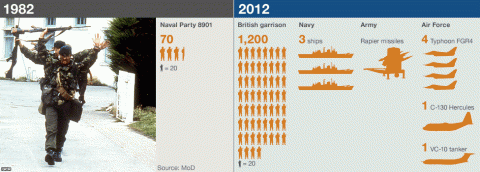
As far as the islands themselves, there have been some significant changes since 1982, the most significant being a new Royal Air Force base with permanently stationed modern Typhoon fighters (although only four of them at last report). The island transportation net has vastly improved since 1982 — when the only permanent roads were within Port Stanley proper — with all-weather roads now linking all mainland settlements. In addition to the RAF base personnel, there is a British garrison force of a reinforced infantry company and supporting troops, and the Falkland Islands Defence Force which is a company-sized unit of part-time troops.

Argentina’s armed forces have also changed significantly since the war. Two of the most significant changes were post-war fall of the military Junta and the elimination of conscription (creating a more modern, better-trained professional army, navy and air force). The Argentinian navy no longer has a purpose-built landing ship (the ARA Cabo San Antonio was retired shortly after the war and replaced with a modified cargo vessel). They have three submarines in service (replacing the one sub active in 1982), and have replaced all their WW2-vintage ships with more modern designs from France and Germany. The marines, who were the best of the Argentinian troops in 1982, are organized in five battalions of infantry, with supporting artillery, anti-aircraft, engineering and special forces detachments.

Anyway, back to the Twitter exchange that started this. After I’d responded to Craig’s last comment, Colby Cosh joined the discussion: “Sign me up for a bet on 2 PARA if it comes to that, will you?”. I’ll just reproduce the rest of the exchange in approximately correct order below:

NR: “Admire the Paras, but you can’t drop from that far away.”
CC: “I guess they must have teleported onto Goose Green last time.”
NR: “They certainly didn’t fly in from Heathrow!”
CC: “I’m guessing they’ll use the Bay-class ships they built for pretty much that exact mission?”
NR: “Not without air cover.”
CC: “I’m no admiral, but somehow I did get the memo about the fetish for “capital ships” being obsolete.”
NR: “Carriers still relevant.”
CC: “Meanwhile, the Argie navy has not exactly thrived under civilian rule. Not sure if that’s relevant?”
NR: “For a short-haul invasion, you don’t need a massive navy. Air cover is the key. UK only has 1 sub in region normally.”
NR: “No way at all to prevent an invasion, but in 82 UK still had (barely enough) carrier air to cover counter-attack. No longer true”
CC: “Air cover *less* important for Bay class now with close-in antimissile guns. And RN is still operating two carriers, you know.”
NR: “UK paid off Ark Royal and Invincible. Replacement ships still years from launching.”
CC: “The RN just tried out HMS Ocean (I think it was Ocean) as a platform for Apache in the Gadhafi raids.”
CC: “Replacements for fixed-wing capability, yes. Ocean & Illustrious are configured for choppers now.”
NR: “Chopper-equipped force versus missile-armed fighters? Outcome not good for choppers without lots of luck.”
CC: “Helicopters are the name of the game in an amphib op anyway; hence the reconfig.”
NR: “For amphibious work, choppers are great support. Not designed to fight against fixed-wing fighters.”
CC: “We’re forgetting that the islands themselves are garrisoned much more heavily than in ’82.”
NR: “Still indefensible vs Arg”
CC: “The Typhoons that are there are certainly at the sharp end until RN’s Harriers are replaced.”
NR: “Not enough of them to matter.”
CC: “You’ve convinced me to worry about this a little more than I would’ve”
NR: “I’ll post a “Mission Accomplished” banner. ;-)”

Colby did point out some weaknesses in my original contention: for example, I’d forgotten about the construction of the new RAF base, but it isn’t equipped to fight a war: it’s an expensive trip-wire. Four aircraft aren’t going to be enough (especially as Britain had, as of the Libya campaign, only 69 qualified Typhoon pilots). I’ll admit I’m a bit less sanguine about Argentina just waltzing in to Port Stanley this time, but I still think if they can pull off a quick disabling strike followed by a landing, Britain will not be able to reverse the outcome like they did in 1982.

December 20, 2011

Steve Paikin asks whether we should legalize drugs

Filed under: Americas, Law, Liberty, Politics, USA — Tags: , , , , — Nicholas @ 14:06

December 19, 2011

Chiquita, supporter of narco-terrorist groups, calls for a boycott of Canadian oil

Filed under: Americas, Cancon, Economics, Food, History — Tags: , , , , , , — Nicholas @ 11:39

When corporate social media goes wrong:

I used to work for an ad agency, and I often had animated discussions with my colleagues about the danger of confusing cause marketing with product marketing. I have always maintained that they are separate disciplines that don’t mix, while many of my colleagues disagreed.

As a society, we have become distressingly pious and self-righteous — and as a natural consequence advertisers wish to capitalize on this instinct. Like my erstwhile colleagues, they see this as an easy path to identifying their product with a strong public sentiment. This is such a bad idea that it merits a blog entry of its own, but what lead me to write today was a satisfyingly spectacular self-immolation by a large American brand that managed to make the wrong choice in just about every decision their communications and marketing teams have made over the past few days.

[. . .]

Worse, Chiquita Brands seemed to forget completely about their Canadian market. It’s easy to underestimate Canada. It’s a little country with a tenth the population of the United States. On the other hand, it’s a terrific export market, and much too accessible and rich to be ignored.

Canadians are understandably touchy about the Oil Sands. The majority of Canadians are very proud of the fact that they’ve transformed the country into an energy superpower by successfully accessing a resource that was considered nearly worthless only a decade ago – and they have done this with unprecedented care, investing billions of dollars in developing new technologies to protect the environment. Canadians are also very proud of the fact that they are the only net exporter of oil that is a liberal democracy and respects human rights. They’ve even coined the phrase “ethical oil” to describe their unique approach to oil production.

What Chiquita Brands succeeded in doing with their announcement was to make millions of Canadian consumers very unhappy. People who couldn’t have told you on Monday morning what brand of bananas they bought were determined by Thursday afternoon that it wouldn’t be Chiquita. Worse yet, hundreds of consumers decided to make their feelings known by commenting on the Chiquita Bananas Facebook page. And this is where Chiquita’s marketing and communications team took one bad decision and turned it into a disaster

H/T to Five Feet of Fury for the links.

December 6, 2011

Argentina puts more pressure on Britain to negotiate over the Falkland Islands

Filed under: Americas, Britain, Military — Tags: , , , — Nicholas @ 13:07

The Argentinian navy has been boarding fishing vessels for “illegal” operations in Argentinian waters (that happen to be the seas around the Falklands, South Georgia, and the South Sandwich Islands — all British territories):

Argentine patrol vessels have boarded 12 Spanish boats, operating under fishing licences issued by the Falkland Islands, for operating “illegally” in disputed waters in recent weeks.

Argentine patrol commanders carrying out interceptions near the South American coast told Spanish captains they were in violation of Argentina’s “legal” blockade of sea channels to the Falklands.

[. . .]

President Cristina Kirchner has adopted a steadily more beligerent stance towards Britain’s South Atlantic possessions.

A newly formed gathering of South American nations meeting in Venezeula backed Argentina’s sovereignty demands at the weekend.

Argentina’s claim over the Falklands was backed by a newly formed block of South American and Caribbean countries, CELAC, on Saturday with unanimous approval. Mrs Kirchner used the last UN General Assembly meeting to put Argentina’s claims of sovereignty over the Falklands on a par with Palestinian claims to statehood.

As predicted, now that Britain’s Royal Navy no longer has any aircraft carriers, there’s literally no way that Britain can prevent Argentina from another invasion (the one nuclear submarine on patrol in the area could cause damage, but not repel Argentinian forces). Back in the last war between Britain and Argentina, the United States had to be cajoled into supporting Britain: I very much doubt that Barack Obama would be as willing to provide support to a country he clearly disdains.

December 2, 2011

“There is no prophecy for 2012. It is a marketing fallacy”

Filed under: Americas, History, Randomness — Tags: , , , , — Nicholas @ 08:14

The BBC attempts to debunk the “2012 is the end of the world” notion that the Mayans are supposed to have predicted.

The date marks the end of one of the periods of roughly 400 years into which the Mayan calendar is divided.

Mexico’s National Institute for Anthropological History has also tried to counter speculation that the Maya predicted a catastrophic event for 2012.

Only two out of 15,000 registered Mayan texts mention the date 2012, according to the Institute, and no Mayan text predicts the end of the world.

“There is no prophecy for 2012. It is a marketing fallacy,” Erik Velasquez, etchings specialist at the National Autonomous University of Mexico, told Reuters.

November 18, 2011

An antidote to the “OMG! China will eat our lunches” meme

Filed under: Americas, China, Economics — Tags: , , — Nicholas @ 12:02

For those inclined to worry overmuch about the rise of China as a world power (as opposed to merely as an economic competitor):

The real importance of this story does not, however, have much to do with Brazil’s jittery nerves about Chinese investment. It is to remind us about a key Chinese vulnerability that is often overlooked by pundits: China’s growing dependence on natural resources located far from its frontiers.

Beijing’s chosen national strategy — to achieve great power status by becoming the industrial workshop of the world — locks it into a complex and difficult set of dependencies and relationships with countries and markets all over the world. Access to those resources traps China in complicated geopolitical tradeoffs that can blow up in unexpected ways — as when China had to scramble to protect its citizens in Libya. Chinese companies become the object of public anger if they are seen to be economically exploitative, unwelcoming to local labor, or environmentally destructive. And, of course, in the event of a confrontation with the United States, China’s entire supply chain and overseas investments are helpless hostages.

Strategically, the only way out of this trap would be to build a blue water navy and air force that could threaten US command of the seas. But a build up of that kind would not only trigger a massive US response; other countries like Japan, India and Australia would join together to ensure that China did not overturn a maritime status quo that is well trusted by other world powers.

H/T to Jon, my former virtual landlord, for the link.

November 7, 2011

“It is a sad state of affairs when an amazing feat of engineering is only seen in bleak environmental and misanthropic terms”

Filed under: Americas, Economics, Environment, Pacific — Tags: , — Nicholas @ 09:16

Nick Thorne wonders why the soon-to-be-completed road link between Peru and Brazil, the Interoceánica, has gotten such poor press in the west:

In July this year, an amazing feat of engineering and testament to the progress of Latin America went almost completely unreported in the Western media. With the opening of the Puente Billingshurst, a half-mile suspension bridge across the Madre Dios river, the interoceanic highway or Interoceánica neared completion. Soon, a long-held dream will finally come true: for the first time, a road will stretch all the way from the Pacific to the Atlantic, crossing the whole of South America.

The road starts in the Peruvian capital, Lima. It crosses the Andes, reaching a highest point of 4,850 metres (higher than Mont Blanc), then plunges into the rainforest, crosses several tributaries of the mighty Amazon, and after a total of 3,400 miles it reaches the Atlantic coast of Brazil. Much of the route has been in place for decades, but a 460-mile middle section was still missing. With the opening of the bridge, the road’s completion is in sight.

Comparisons have rightly been made between the Interoceánica and the first North American transcontinental railroad completed in 1869. In Brazil, the highway has already been dubbed ‘the road to China’. In 2009, China overtook the US as Brazil’s largest trading partner. Chinese trade will be able to use the Peruvian ports on the Pacific coast, cutting out a long detour via Cape Horn or the Panama Canal. While Brazil will be the main beneficiary, Peru will benefit as a middle-man. The think tank Bank Information Centre estimates that the highway will lead to a 1.5 per cent annual increase in GDP in Peru. The highway will facilitate greater regional integration and is a real symbol of Latin America’s economic awakening. A triumphant banner along the highway reads ‘once a promise, now a reality’. In 2006, a mere 3,500 people crossed the border from Peru to Brazil. By 2009, with the partial completion of the highway, this had already increased ten-fold to 35,000.

« Newer PostsOlder Posts »

Powered by WordPress