Quotulatiousness

October 15, 2011

Chile upgrades their amphibious capabilities

Filed under: Americas, France, Military, Pacific — Tags: , — Nicholas @ 11:21

A brief item from the invaluable Strategy Page talks about Chile’s most recent naval acquisition:

Chile is buying the French amphibious ship Foudre, which is being replaced by a more recent design. The 12,000 ton Foudre has been in service for 21 years and could, with some refurbishment, serve another two decades or more. The 168 meter (521 feet) long ship has a crew of 160 and carries up to 70 vehicles. The well deck contains eight landing craft and there is a hangar that carries up to four helicopters. There are accommodations for 450 troops (or double that for short voyages). The Foudre can also be used as a command ship, which spaces for 150 headquarters personnel and their equipment.

Chile will use the Foudre to replace an 8,700 ton, 40 year old, American Newport class LPD. This ship was retired earlier this year, as it was considered too expensive to refurbish it. France has also offered Chile the second ship of the Foudre class, which is scheduled to retire from French service in a few years. The price of the Foudre to Chile has not been revealed. It will be cheap, and will depend on how much refurbishment French firms will undertake. Foudre undertook several long-distance operations during its career.

September 25, 2011

The new TV show will have to be highly imaginative to match the real Pan Am

Filed under: Americas, History, Media, Politics — Tags: , , — Nicholas @ 11:11

Scott Van Wynsberghe looks at the fascinating history of the real-world Pan American:

To say the least, it was a peculiar charter flight. At some point in the first half of the 1960s, Pan American World Airways put one of its planes at the disposal of Indonesian president Sukarno. However, Pan Am was also working with the CIA, and the plane was wired for surveillance. As well, Pan Am vice-president Samuel Pryor — who was the airline’s liaison with the CIA — staffed the flight with “stewardesses” who were actually German hookers. Pryor would later reveal all this to co-authors Marilyn Bender and Selig Altschul for their 1982 book on Pan Am CEO Juan Trippe, The Chosen Instrument. Referring to Sukarno, a known womanizer, Pryor commented, “I was afraid to expose our Pan Am girls to him. Our girls were nice girls.”

The new ABC television series Pan Am, which premiered on Sept. 25, will have to go a ways to beat that image of intrigue and sexism. Still, the creators of the series deserve credit just for reviving interest in a company notorious for combining flying and spying.

[. . .]

Amid the profits in Latin America, however, were the roots of shadowy affairs to come. As early as 1930, Pan Am quietly acquired SCADTA, a Colombian-based German aviation firm, but the existing management was allowed to remain. That caused trouble later in the 1930s, as war threatened in Europe and Washington fretted over the proximity of so many German fliers to the Panama Canal. In early 1939, the U.S. military — well aware of the true ownership of SCADTA — simply ordered Trippe to purge the Germans from the company. When American replacement crews arrived, they discovered that someone had been modifying SCADTA planes to permit the mounting of bombs and machine guns.

Over a year after the SCADTA affair, in mid-1940, U.S. authorities were so worried over a possible spread of the Second World War to the Western Hemisphere that they decided to create a chain of installations across the Caribbean and the coast of Brazil. The problem was that all this would require complex military treaties, for which there was no time. Airfields and radio stations could, however, be built by a private company pretending that all the activity was just routine business. If war did reach the hemisphere, panicky local governments could then permit the U.S. military to take over the sites. Pan Am was chosen for the job, and a secret deal was finalized in November. According to historian Stanley Hilton, German military intelligence attempted to monitor the ensuing construction.

September 23, 2011

Mexico to try market solution to drug wars

Filed under: Americas, Economics, Government, Law — Tags: , , — Nicholas @ 12:54

Jesse Kline reports on the sudden conversion to drug legalization on the part of the Mexican government:

The United States imports a majority of it’s cocaine from Mexico, which has been embroiled in a brutal war among rival gangs for control of the lucrative trade.

Over 42,000 people have been killed in Mexico as a result of gang violence since President Felipe Calderon took office in 2006. Not a moment too soon, it appears the President is starting to recognize that the current approach to dealing with illicit drugs is not working.

“We must do everything to reduce demand for drugs. But if the consumption of drugs cannot be limited, then decision-makers must seek more solutions — including market alternatives — in order to reduce the astronomical earnings of criminal organizations,” Calderon said in a speech in New York.

Using the term “market alternatives” is a key choice of words. The reason organized crime has so successfully dominated the trade is the blanket prohibition on drugs, forcing the market underground. The same thing happened in the United States when alcohol was made illegal during Prohibition.

The solution to removing the criminal element from the drug trade is the same one that solved the problem with booze: legalize it. Allow drugs to be produced by private industry in a regulated environment. After all, gang violence has become more deadly than the substances they’re peddling. And we don’t see beer companies shooting each other for control of distribution networks.

September 22, 2011

“A piece of half-baked speculation had simply been used without checking because, well, it seemed true enough”

Filed under: Americas, Environment, Media — Tags: , , , — Nicholas @ 09:49

Tim Black on the recent Times Atlas gaffe over the Greenland ice sheet:

For those all too inclined to believe the worst in the warmest of all possible worlds, there was no need to question the Times Atlas’s revelation. It merely told them what they already knew — that our nasty industrialised ways are destroying Earth.

But among those who actually know a little about ice sheets, the atlas’s findings were a little too much of a revelation. First up were researchers from the Scott Polar Research Institute at the University of Cambridge, who promptly wrote to the atlas’s editors: ‘There is to our knowledge no support for this [15 per cent] claim in the published scientific literature.’ Other scientists in the field were quick to back up the Cambridge researchers. ‘The claims here’, said Graham Cogley from Trent University, ‘are simply not backed up by science; this pig can’t fly’. Others agreed. Jeffrey Kargel of the University of Arizona, principal scientist on a project involving the mapping of ice and glaciers from space, was unequivocal: ‘These new maps are ridiculously off base, way exaggerated relative to the reality of rapid change in Greenland. I don’t know how exactly the Times Atlas produced their results, but they are not scientific results.’

So how exactly did the Times Atlas cartographers produce their results? More kindly commentators have suggested that the atlas bods foolishly relied on the National Snow and Ice Data Center-maintained online resource, the Atlas of the Cryosphere. This apparently shows the thickness of the central part of the ice sheet over Greenland, but it does not show the thickness of the ice sheet’s periphery. The cartographers presumably interpreted this to mean that the peripheral ice did not exist — that it had melted. Other critics have been less generous, with one suggesting they might have been just a little too reliant on that bastion of truth, Wikipedia.

While it’s fun to pile on when a respected publication gets caught out trying for sensation instead of presenting facts, Black also sounds a note of caution:

Yet such over-eager triumphalism on the part of climate-change sceptics is misplaced. This is not because advocates of climate change are not frequently making mistakes. And it is not because the climate-change narrative, demanding so many facts to fit its story of manmade doom, is not fundamentally flawed. No, the problem with celebrating every scientific, factual refutation of the climate-change thesis as the beginning of the end for what remains the dominant narrative of our times, despite growing public indifference, is that climate change is not primarily a scientific issue. It was not born in science labs or in meteorology centres. And likewise, it will not be defeated by scientists or meteorologists, either.

That is because climate change is principally a political issue, not a scientific one. Climate-change alarmism is about channelling a vision of the future in which man, producing too much and consuming far more, is conceived as a problem. And the only way to challenge this widespread political and moral outlook is by coming up with something a little less human-hating — a political vision in which humanity’s needs and desires, our productive capacities and our consuming wants, are championed rather than denigrated. To rely on the mistakes of climate-change advocates to undermine their own cause is no substitute for the long-awaited, never-seen political debate about climate change.

September 20, 2011

New Times Atlas vastly overstates Greenland ice sheet shrinkage

Filed under: Americas, Books, Environment, Media, Science — Tags: , , — Nicholas @ 08:58

You know it’s a major gaffe when even the BBC’s Environment correspondent is saying things like this:

The part of News Corporation that makes Times Atlases is currently taking the same kind of kicking from scientists that some of its newspapers took from the general public over phone-hacking.

What it’s being kicked for is for claiming, in the edition that came out last week, that the Greenland ice sheet has shrunk by 15% over 12 years, necessitating the re-drawing of its boundaries.

[. . .]

The problem is, it’s not true; and glaciologists have been queuing up to say why not.

“In the aftermath of ‘Himalayagate’, we glaciologists are hypersensitive to egregious errors in supposedly authoritative sources,” said Graham Cogley from Trent University in Canada.

“Climate change is real, and Greenland ice cover is shrinking. But the claims here are simply not backed up by science; this pig can’t fly.”

As Professor Cogley was the scientist who raised the alarm over “Himalayagate” — the erroneous Intergovernmental Panel on Climate Change (IPCC) contention that Himalayan glaciers could largely melt away by 2035 — he is well placed to make the comparison.

Update: Breaking! James Delingpole discovers the advance plans for the next Times Atlas:

Following its controversial decision to produce a map suggesting that Greenland has lost 15 per cent of its ice cover in the last twelve years — a loss rate disputed by most credible scientists: and even, amazingly, the Guardian agrees on this — the Times Comprehensive Atlas Of The World has decided to take its new role as cheerleader for Climate Change alarmism a step further. In its upcoming 14th edition, unconfirmed rumours suggest, it will completely omit Tuvalu, the Maldives and major parts of Bangladesh in order to convey the “emotional truth” about “man made climate change.”

“All right, it may not be strictly geographically accurate to say the Maldives and Tuvalu will definitely have disappeared in about ten years time when our next edition appears,” said Times Atlas spokesman David Rose. “But did you see that picture of the Maldives cabinet holding a meeting underwater? If the Maldives government says the Maldives are drowning, they must be drowning. And frankly I think it’s despicable, all those deniers who are saying it was just a publicity stunt, cooked up by green activist Mark Lynas, to blackmail the international community into giving the Maldives more aid money while simultaneously trying to lure green Trustafarians to come and spend £1500 a night in houses on stilts with gold-plated organic recyclable eco-toilets made of rare earth minerals from China. Why would a government lie about something as serious as climate change?”

September 9, 2011

When drug smugglers go high tech

Filed under: Americas, Law, USA — Tags: , , , , — Nicholas @ 09:07

Strategy Page has more information about the submarine factory that was recently discovered, and the boats they were constructing:

Colombian police recently arrested eighteen members of a gang that specialized in building submarines and semisubmersible boats for transporting cocaine from Colombia to Central America and Mexico. As police suspected, some (five) of those arrested were retired or on active duty with the Colombian Navy (which operates two 1970s ear German built Type 209 submarines). These arrests are part of an intense effort to find the people responsible for building subs for cocaine gangs. Find the builders, and you stop the building efforts.

[. . .]

The submarines that have been captured have, on closer examination turned out to be more sophisticated than first thought. The outer hull is made out of strong, lightweight, Kevlar/carbon fiber that was sturdy enough to keep the sub intact, but very difficult to detect with most sensors. The hull could not survive deep dives, but this boat didn’t have to go deep to get the job done. The diesel-electric power supply, diving and surfacing system and navigational systems of captured (by the army, while under construction) subs were all in working order. It was believed that some of those who built these boats probably had experience building recreational subs. The sub builders also had impressive knowledge of the latest materials used to build exotic boats. It had already become clear that something extraordinary was happening in these improvised jungle shipyards.

The two fiberglass/Kevlar submarines found so far were obviously built to transport cocaine to North America. Neither the United States, nor anyone else who might know, are talking about how many of these subs are out there, or believed to be in operation or under construction. Similar type boats could be built for terrorist or espionage missions.

July 26, 2011

ATF sting turns into arms pipeline for drug gang

Filed under: Americas, Government, USA — Tags: , , , — Nicholas @ 08:51

Operation Fast and Furious may have been intended to work as a trap for gun smugglers but appears to have become a reliable source of guns for Mexican gangsters:

Congressional investigators examining a gun-trafficking sting investigation known as Operation Fast and Furious have identified 122 weapons linked to the operation that have been recovered at crime scenes in Mexico, according to a report they are expected to release Tuesday.

The report, which offers new details about the operation, lists 48 occasions between November 2009 and February 2011 in which Mexican authorities found one or more such weapons, based on internal e-mails of the Bureau of Alcohol, Tobacco, Firearms and Explosives, whose Phoenix office set up the operation. It was compiled by the staffs of Representative Darrell Issa of California and Senator Charles E. Grassley of Iowa, the two Republicans leading the investigation.

“The faulty design of Operation Fast and Furious led to tragic consequences,” the report concludes. “Countless United States and Mexican citizens suffered as a result.”

July 17, 2011

In the aftermath of Georgia’s “victory” over illegal farm workers

Filed under: Americas, Food, Law, USA — Tags: , , — Nicholas @ 11:54

Last month, I linked to a story about Georgia’s attempt to crack down on illegal agricultural workers. It was, in terms of achieving its stated goals, a big success: illegal workers left in droves for other jurisdictions. It wasn’t quite as successful from the point of view of farmers:

To combat the shortage, Governor Nathan Deal has authorized using criminal offenders out on probation to replace the mostly Latino migrant workers. It’s not working out so well:

    The first batch of probationers started work last week at a farm owned by Dick Minor…So far, the experiment at Minor’s farm is yielding mixed results. On the first two days, all the probationers quit by mid-afternoon, said Mendez, one of two crew leaders at Minor’s farm.

    “Those guys out here weren’t out there 30 minutes and they got the bucket and just threw them in the air and say, ‘Bonk this, I ain’t with this, I can’t do this,’” said Jermond Powell, a 33-year-old probationer. “They just left, took off across the field walking.”…

H/T to John Henke for the link.

June 23, 2011

More on Mexico’s plight

Filed under: Americas, Government, USA — Tags: , , , — Nicholas @ 12:08

With the Bureau of Alcohol, Tobacco, Firearms and Explosives losing control of their crack-brained “Operation Fast and Furious” (aka “Gunwalker”), you’d think that the firearm problem in Mexico has gotten worse. Even if the low estimate of 2500 weapons delivered to the narcotrafficers is accurate (most think it’s at least 4 times that number), it barely puts a dent in the extent of Mexico’s problems:

By now it should be clear that the Mexican drug cartels have taken over the country. They’ve murdered journalists, politicians, judges, businessmen, police, soldiers and each other, with impunity. Their control is so complete that they’ve set up roadblocks to extort blood money from anyone bold enough to believe they have the right to travel freely. They’ve murdered so many people that they’ve resorted to dumping lifeless bodies into mass graves.

Every single day, there’s a fresh story of murder and mayhem. Today, it’s “Eight Bodies Found in Mountains in Northern Mexico” and “Gunmen Kidnap 7 from Drug Rehab Center in Northern Mexico”. The crime-related casualties number in the tens of thousands. That’s to say nothing of the thousands physically and psychologically maimed by torture, or the millions of Mexican living in fear, denied their basic human rights. The Taliban have nothing on these guys.

In other words, adding a few thousand guns from American sources isn’t even a drop in the bucket as far as Mexico’s real problems are concerned:

The ATF purposely mislead Americans to believe that “90 percent of Mexican cartels guns come from Bob’s Gun Store.” That lie was exposed: 88 percent of guns confiscated by the Mexican authorities and successfully submitted for trace to the ATF came from America. (Not necessarily American gun dealers either, BTW). How many qualifiers can you stick in a stat to make it bark like a dog? More importantly, the total population of guns confiscated by the Mexicans in that stat was 30,000.

Now consider the fact that the Mexican police and military are thoroughly corrupt. In fact, there’s every reason to believe that these two entities have supplied the drug cartels with majority of their box fresh military-grade weapons. Weapons that American and foreign weapons makers sold to the Mexican authorities legally. And that means the Mexican have no reason to confiscate any weapons — other than creating a little security theater and transferring ownership from one cartel to another.

June 21, 2011

In unrelated news, Georgia now has farm issues

Filed under: Americas, Food, Law, USA — Tags: , , — Nicholas @ 10:14

After a passing a hugely successful bill to exclude illegal immigrants from the state, politicians are astounded to find that actions do have consequences:

After enacting House Bill 87, a law designed to drive illegal immigrants out of Georgia, state officials appear shocked to discover that HB 87 is, well, driving a lot of illegal immigrants out of Georgia.

It might be funny if it wasn’t so sad.

Thanks to the resulting labor shortage, Georgia farmers have been forced to leave millions of dollars’ worth of blueberries, onions, melons and other crops unharvested and rotting in the fields. It has also put state officials into something of a panic at the damage they’ve done to Georgia’s largest industry.

Barely a month ago, you might recall, Gov. Nathan Deal welcomed the TV cameras into his office as he proudly signed HB 87 into law. Two weeks later, with farmers howling, a scrambling Deal ordered a hasty investigation into the impact of the law he had just signed, as if all this had come as quite a surprise to him.

Driving out competing labour from illegal immigrants has created a lot of farm labour jobs for Georgia’s unemployed citizens, but for some unexpected reason, they’re not moving into those jobs:

According to the survey, more than 6,300 of the unclaimed jobs pay an hourly wage of just $7.25 to $8.99, or an average of roughly $8 an hour. Over a 40-hour work week in the South Georgia sun, that’s $320 a week, before taxes, although most workers probably put in considerably longer hours. Another 3,200 jobs pay $9 to $11 an hour. And while our agriculture commissioner has been quoted as saying Georgia farms provide “$12, $13, $14, $16, $18-an-hour jobs,” the survey reported just 169 openings out of more than 11,000 that pay $16 or more.

In addition, few of the jobs include benefits — only 7.7 percent offer health insurance, and barely a third are even covered by workers compensation. And the truth is that even if all 2,000 probationers in the region agreed to work at those rates and stuck it out — a highly unlikely event, to put it mildly — it wouldn’t fix the problem.

June 20, 2011

Operation Gunrunner

Filed under: Americas, Government, USA — Tags: , , , — Nicholas @ 12:26

Also from the latest Libertarian Enterprise:

BATFE started Operation Fast and Furious, now better known as Gunrunner, as a sting to catch people smuggling weapons to the narcotraficantes in Mexico. They ran into a problem. Gun dealers in the area involved “made” the straw men buyers and called the BATFE to report these types. ATFE told the gun dealers not to worry and sell the guns. Not ten or twenty times, not a couple of hundred times like a reasonable person would expect. The lowest figure I’ve seen is about 2,500, enough weapons for a small brigade.

Let us clearly summarize this idea, the ATFE ordered law abiding American merchants to arm a brigade of criminals.

In effect ATFE armed an army of murderers, rapists, extortionists, and slavers who financed their actions by smuggling drugs into the US. This has helped destabilize the government of Mexico and led to the terrorizing of the honest working people of that nation. The last time I checked such behavior constitutes an act of war. Either it is the policy of the United States to destabilize the government of friendly nations ( given some of the stunts we’ve pulled this is less unreasonable than it ought to be) or elements of the Bureau of Alcohol, Tobacco, Firearms and Explosives abused their police authority in the United States to conduct a filibuster (look up original meeting) against Mexico. Not only that, they did so with the approval and support of Attorney General Eric Holder.

June 17, 2011

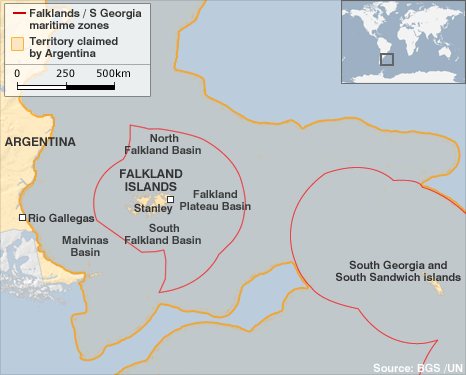
Argentina: British PM “stupid” about the Falkland Islands

Filed under: Americas, Britain, Military — Tags: , , , , — Nicholas @ 09:39

Remember when the Royal Navy got gutted, reducing their ability to project force outside European waters? It appears that Argentina has drawn the obvious conclusion that the Falkland Islands are now back in play:

The Argentinian president has criticised David Cameron for insisting the Falkland Islands should remain a British territory.

Cristina Kirchner described the prime minister as “arrogant” and said his comments were an “expression of mediocrity and almost of stupidity”.

Cameron had been prompted by Conservative MP Andrew Rosindell during prime minister’s questions to remind Barack Obama that the British government would not accept any kind of negotiations over the south Atlantic islands, over which Argentina and Britain fought a 10-week war in 1982.

Cameron told the Commons: “I would say this: as long as the Falkland Islands want to be sovereign British territory, they should remain sovereign British territory — full stop, end of story.”

In her criticism of his comments, Kirchner said Britain “continues to be a crude colonial power in decline”.

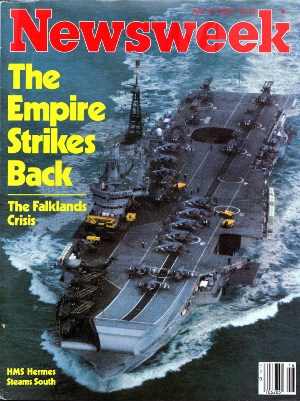
Well, Mr. Cameron, you’ve given Argentina a ten-year window of opportunity here between your (in my opinion stupid) scrapping your last carriers and getting rid of their Harrier aircraft and the time that your next carrier comes into service. By the time you have HMS Queen Elizabeth in commission and with a full complement of aircraft, the Falkland Islands will likely be under Argentinian control.

If the government of Ronald Reagan had to be pushed into supporting Britain in 1982, there’s absolutely no chance that Barack Obama will lift a finger to help Britain in 2012 — in fact, it’s much more likely that Obama will decide that Argentina is more deserving of American help anyway.

June 1, 2011

More on the Greenland settlements

Filed under: Americas, Environment, History — Tags: , , , — Nicholas @ 12:08

In a follow-up to yesterday’s post on the end of the Viking settlements in Greenland, Sonya Porter provides more historical background:

In 891 AD. Eric The Red set off from Iceland with a few followers to explore a land to the west which they had probably spotted some time before while sailing out in their longboats, and then returned three years later with about 500 fellow Vikings. At first they settled on the south-east coast, close to the tip of this new land and then, as the population grew, created a further settlement to the south-west. They called their new home ‘Greenland’.

It has been said that this name was a ‘spin’, a publicity stunt to entice more Vikings to come to join the new settlers, but this would have been pointless if it had been impossible for them to survive. They must at least have been able to create their own dwellings, build their own fires, make their own clothes and above all, grow their own food. The settlers might have been able to trade such things as polar bear-skins and fox furs for iron and other necessities on occasional trips to Europe, but their compatriots in Denmark and Iceland would have been neither able nor willing to row their longboats out each month with groceries.

At present, the temperatures in Greenland range from a maximum of 7C in July to -9C in January. This is too cold for grain such as wheat and even rye to grow and ripen in the short summer of such northern latitudes. Nor are sheep and cattle happy at those temperatures. Hill sheep might be able to nibble away at moss and short grass, but cattle need lush meadows and hay to fatten and live through a winter. Solid wood is needed for building, boat building and warmth, but only bushes and such weak trees as birch now grow in Greenland.

In 1991, two caribou hunters stumbled over a log on a snowy Greenland riverbank, an unusual event because Greenland is now above the treeline. (1) Over the past century, further archaeological investigations found frozen sheep droppings, a cow barn, bones from pigs, sheep and goats and remains of rye, barley and wheat all of which indicate that the Vikings had large farmsteads with ample pastures. The Greenlanders obviously prospered, because from the number of farms in both settlements, whose 400 or so stone ruins still dot the landscape, archaeologists guess that the population may have risen to a peak of about five thousand. They also built a cathedral and churches with graves which means that the soil must have been soft enough to dig, but these graves are now well below the permafrost (2).

May 31, 2011

A bit of climate-change panic juxtaposition

First, the panic:

In a world of climate change, freak storms are the new normal. Newsweek‘s Sharon Begley on why we’re unprepared for the harrowing future, and how adapting to the inevitable might be our only option.
[. . .]
From these and other extreme-weather events, one lesson is sinking in with terrifying certainty. The stable climate of the last 12,000 years is gone. Which means you haven’t seen anything yet. And we are not prepared.

And, in the interests of balance, the eeeevil climate change denier:

Greenland’s early Viking settlers were subjected to rapidly changing climate. Temperatures plunged several degrees in a span of decades, according to research from Brown University. A reconstruction of 5,600 years of climate history from lakes near the Norse settlement in western Greenland also shows how climate affected the Dorset and Saqqaq cultures. Results appear in Proceedings of the National Academy of Sciences.

PROVIDENCE, R.I. [from Brown University] — The end of the Norse settlements on Greenland likely will remain shrouded in mystery. While there is scant written evidence of the colony’s demise in the 14th and early 15th centuries, archaeological remains can fill some of the blanks, but not all.

What climate scientists have been able to ascertain is that an extended cold snap, called the Little Ice Age, gripped Greenland beginning in the 1400s. This has been cited as a major cause of the Norse’s disappearance. Now researchers led by Brown University show the climate turned colder in an earlier span of several decades, setting in motion the end of the Greenland Norse.
[. . .]
The researchers also examined how climate affected the Saqqaq and Dorset peoples. The Saqqaq arrived in Greenland around 2500 B.C. While there were warm and cold swings in temperature for centuries after their arrival, the climate took a turn for the bitter beginning roughly 850 B.C., the scientists found. “There is a major climate shift at this time,” D’Andrea said. “It seems that it’s not as much the speed of the cooling as the amplitude of the cooling. It gets much colder.”

The Saqqaq exit coincides with the arrival of the Dorset people, who were more accustomed to hunting from the sea ice that would have accumulated with the colder climate at the time. Yet by around 50 B.C., the Dorset culture was waning in western Greenland, despite its affinity for cold weather. “It is possible that it got so cold they left, but there has to be more to it than that,” D’Andrea said.

April 26, 2011

Urban mountain biking – Valparaiso, Chile

Filed under: Americas, Randomness, Sports — Tags: — Nicholas @ 13:47

VCA 2010 RACE RUN from changoman on Vimeo.

H/T to Cycling Tips Blog (and to Roger Henry, who provided the link).

« Newer PostsOlder Posts »

Powered by WordPress