This is a minor enough action that I had never heard of it before, but as I’ve said in the past I haven’t studied the titanic struggle of the Soviet Union and the Third Reich in detail. Mapping History charts (see what I did there?) the Admiral Scheer‘s attempt to take the Soviet Union’s most northerly airstrip on Dickson/Dikson/Диксон island during Operation Wunderland [Wiki}:
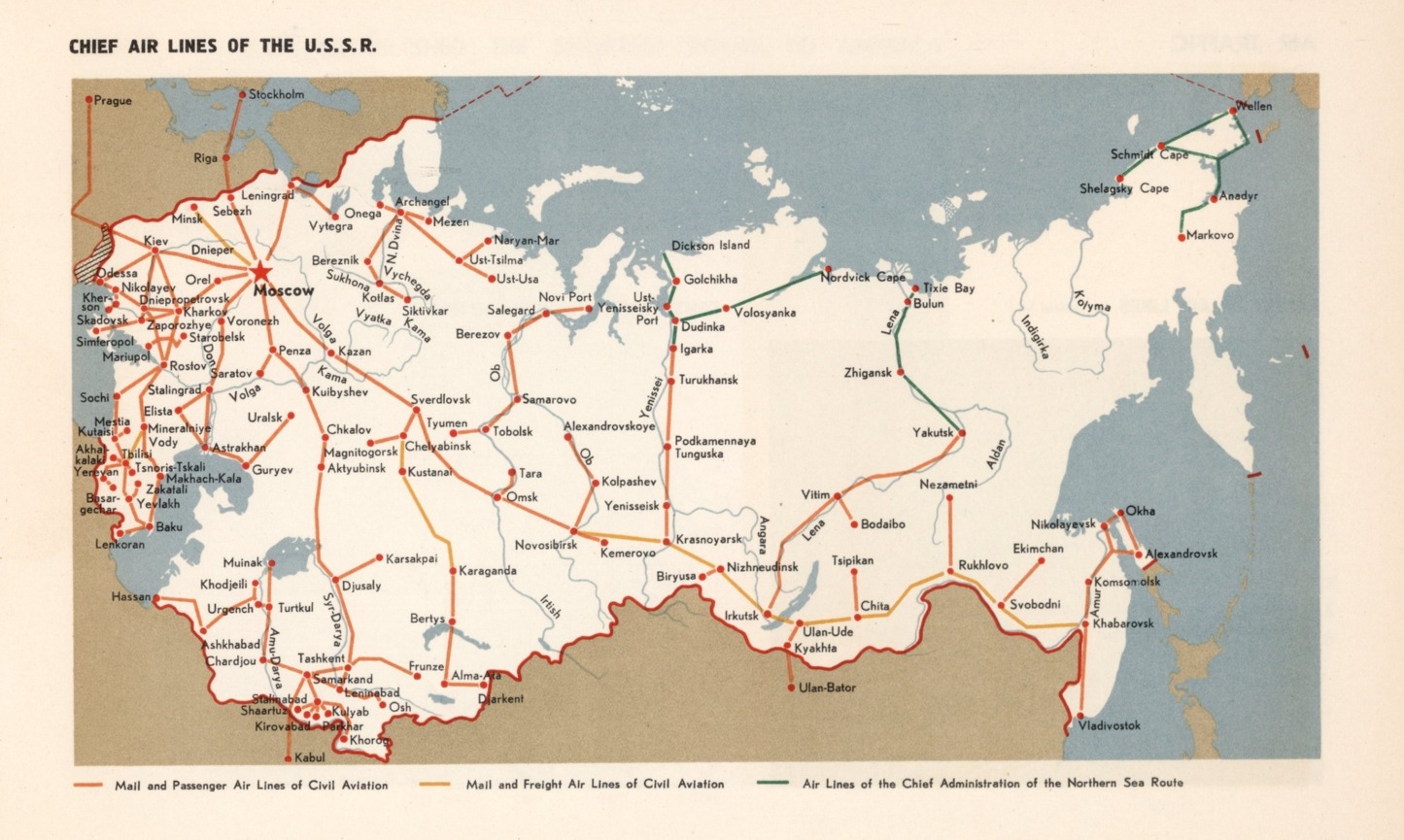
“Chief Air Lines of the U.S.S.R.” created in 1939 by Alexander S. Grigorovich, Ivan V. Sautin, Ivan P. Ivanitsky, Valentina M. Podgornova, and Lazar M. Lissitzky.
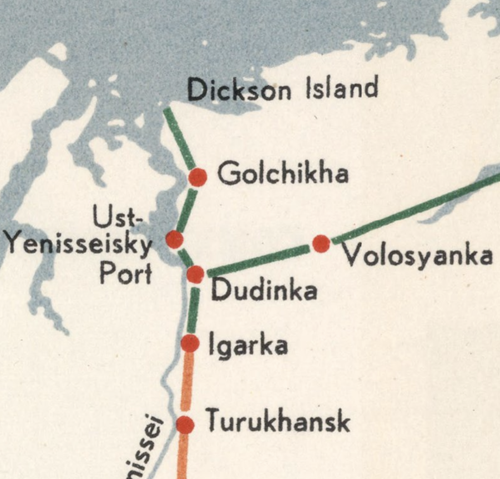
There’s a tiny error on this map. Made around the time of the New York World’s Fair in 1939, it shows the airports and air routes of the Soviet Union at a time when the USSR was keen to show visitors a country stitched together by aeroplanes. Follow the lines north until they run out and you arrive at a dot near the mouth of the Yenisei, labelled Dickson. But in 1939, it should — of course — be marked “Dikson”.
Should be “Dikson”, of course.
Adolf Erik Nordenskiöld named the harbour in 1875 after Oscar Dickson, a merchant from Gothenburg who’d paid for his foray north. Russian usage dropped the “c” almost at once, and Dikson has been the official name since 1884 — which means on the day it was printed, this map was fifty-five years behind the curve.
You’ll have spotted this is an air map: Dikson is still the northernmost airstrip on any continental mainland, and from 8 December to 5 January it gets no daylight at all, not even twilight — but that’s almost a moot point.
I’m about to describe a fight between a cruiser, an icebreaker and two guns parked on a pier. The only aeroplane in what follows is a German floatplane, and even that gets wrecked before the shooting starts — but I liked the map, and I’ve been posting notes and tweets and whatever-it-is-bluesky does about Soviet mapping today, so this is the map you’re getting. It’s that little red dot, that deserves our attention.
In August 1942, Dikson was the scene of what is usually described as the only battle fought against German forces beyond the Urals. The Germans arrived by sea, certain they could take the land base without too much trouble, and they left, having been put firmly in their place – and without putting a man ashore.
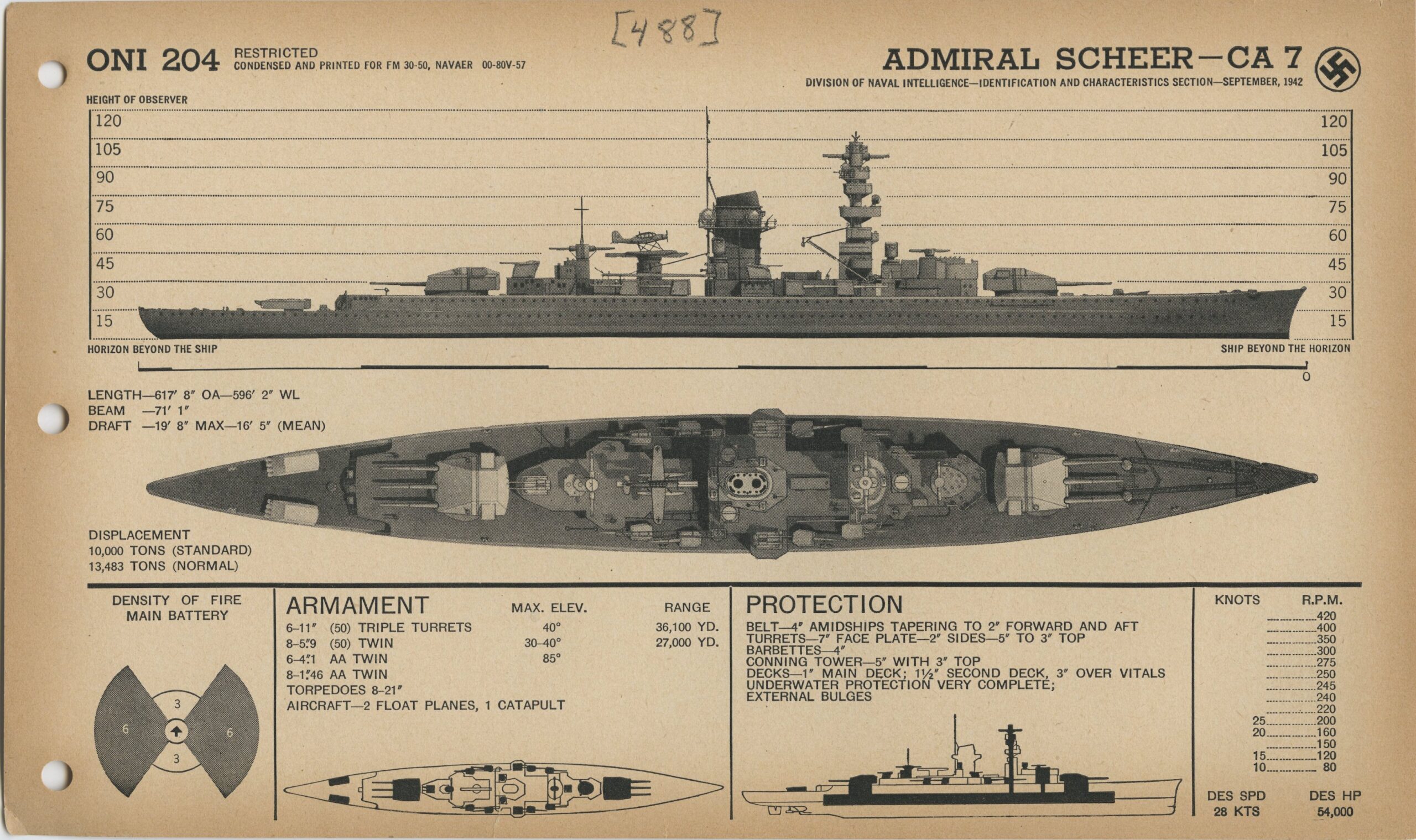
Recognition diagram for the Admiral Scheer
BREAKING THE ICE
The German heavy cruiser Admiral Scheer left Narvik on 16 August 1942 for the Kara Sea. As one part of Unternehmen WUNDERLAND, her task was to find and sink the convoys using the Northern Sea Route along the Siberian coast.
Operation WONDERLAND was considered a first, key stage in establishing control over the western Arctic. As is often the way, Mother Nature didn’t attend the same briefings. Pack ice turned the Admiral Scheer back from the Vilkitsky Strait, fog hid the convoys her floatplane had found, and then the floatplane itself was lost in what might be called a “landing accident”. Her captain, Wilhelm Meendsen-Bohlken, also discovered his charts could not be trusted. Rocks stood where open water was marked, and shoals where the chart promised depth.
Maps, huh.
But then on 25 August, her lookouts sighted a single ship, the Alexander Sibiryakov, a Glasgow-built steamer of 1909 that had started life hunting seals off Newfoundland.
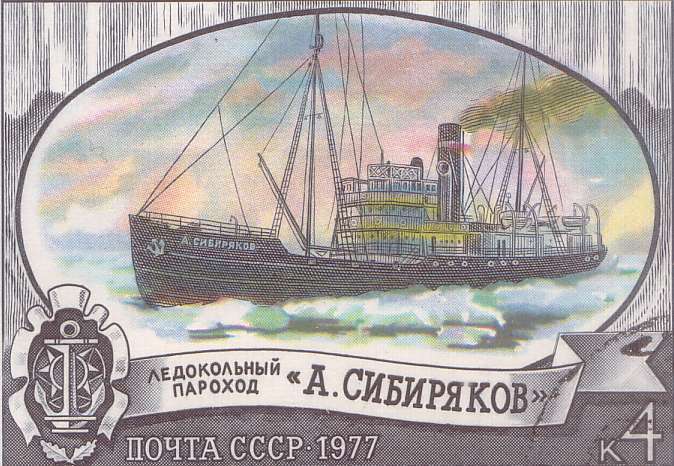
Soviet postage stamp of 4 kopecks from 1977, showing the Aleksandr Sibiriakov
In 1932 the Alexander Sibiryakov had made the first single-season passage of the Northern Sea Route, finishing it under improvised sails after losing her propeller. The Soviet Navy had requisitioned her in September 1941 and given her a handful of light guns – which is something of a coincidence.
Alexander Sibiryakov, the Siberian gold merchant she was named for, had been Oscar Dickson’s partner in funding Nordenskiöld. Sixty-odd years later, one patron’s ship was about to die warning the other patron’s island. She carried six 11-inch guns and a crew of 1,150 — it wasn’t enough.
Meendsen-Bohlken wanted the Alexander Sibiryakov intact. Her codebooks and ice reports would tell him where the convoys were. He ordered her – presumably in signals of one syllable — to strike her flag, and Captain Anatoli Kacharava gave his answer with a plain-speaking message from his deck guns. Not the best idea, when face to face with the Admiral Scheer, which promptly responded with the few salvoes needed to set the Alexander Sibiryakov on fire. Her crew opened the seacocks so that nothing useful could be salvaged, and most of the 104 people aboard died – but not before they had radioed the nearest military base, with a report on what was happening, and where. Within hours every Soviet ship and station in the Kara Sea knew that a German raider was loose, and the busiest transmitter of all was at Dikson.