
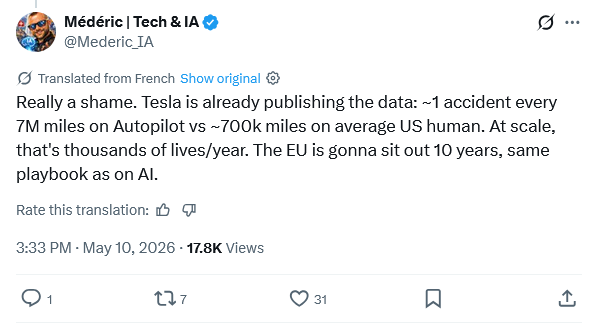
Auto-translation on the social media site formerly known as Twitter has brought some posts from Brivael Le Pogam to my attention, like this one:
The Invisible Cemetery
Milton Friedman said a phrase that should haunt every European legislator for the rest of their life. On the FDA, he said this: there is overwhelming evidence that they have caused more deaths through delayed approvals than they have saved through early approvals.
Read it twice. More deaths from excessive caution than lives saved by caution.
And no one sees it. That’s the dark genius of bureaucracy.
Bastiat theorized the principle 175 years ago. “What is seen and what is not seen.” The economist, he said, is not distinguished from the bad economist by the ability to see the immediate effect of a decision. Everyone sees that. He is distinguished by the ability to see the invisible effects, the delayed ones, the ones diffused across the entire population.
The self-driving car is the perfect example. And it’s playing out right before our eyes.
Tesla publishes the numbers. One accident every 7 million miles in Autopilot. One accident every 700,000 miles in the average American human. Autopilot is, at this stage, ten times safer than a human. And it’s only getting better, with every release.
Now France. 3,200 deaths on the roads in 2024. 91% involve human error. Speed, alcohol, fatigue, distraction. If we deployed a self-driving car ten times safer tomorrow, we’d divide the carnage by ten. We’re talking about 2,800 lives a year. Over ten years, 28,000 people. The equivalent of an average French town that disappears, because no one pressed the right button in Brussels.
You’ll never see them. No newspaper will headline: “Today, 8 people died because the self-driving car is banned in Europe”. No parliamentary commission will investigate. No bureaucrat will be fired. Those deaths will go in the “road fatality” box. We’ll run moving campaigns with their photos on 4×3 billboards. We’ll say it’s sad, that’s life.
Meanwhile, the first accident of a self-driving car will be front-page news in every paper for three weeks. The regulator will summon the manufacturers. NGOs will call for preventive bans. Deputies will write op-eds. The minister will decree a moratorium.
Five visible deaths will outweigh, in the media and political balance, five thousand invisible deaths. That’s the iron law of bureaucracy. The bureaucrat who authorizes something that goes wrong loses their career. The bureaucrat who bans something that would have saved thousands of lives is never troubled. No one holds them accountable for the deaths they could have prevented. They don’t exist in their statistics. They don’t exist in their trial.
Friedman had identified the exact mechanism: when a regulator errs on the side of laxity, their victims have names, faces, families, lawyers. When they err on the side of caution, their victims are anonymous, scattered, statistical, ghosts. The structure of incentives makes over-regulation rationally inevitable. And the invisible cemetery grows, generation after generation.
Europe is going to sit out 10 years on the self-driving car, just as it sat out on AI, as it sat out on genetic engineering, as it sat out on fourth-generation nuclear. Every time, the same playbook. Precaution, moratorium, ethics committee, white paper, directive, transposition. And every time, behind the curtain of words, deaths that appear in no official statistics.
These are deaths. Not opportunity costs. Not “economic losses”. Human beings who were alive and who died because an innovation that could have saved them was delayed by people whose literal job it is.
That’s what needs to be built, and it’s probably the most important political project of the century that’s opening. A system for accounting for invisible deaths. A registry of the cemetery that no one sees.
For every regulation, every moratorium, every preventive ban, we should be able to produce a signed, dated, quantified estimate of the human cost in lives of the decision. Not direct effects. Delayed effects, indirect ones, statistical ones. How many deaths per year caused by banning a technology that works elsewhere.
Imagine. On the desk of the European commissioner about to sign a moratorium on the self-driving car, a document: “Central estimate, 2,800 deaths per year for the duration of the moratorium. High-end range, 4,100. Low-end range, 1,900. Source: comparative analysis Tesla Autopilot vs. human average, NHTSA and ONISR data, public and audited method.”
On the desk of the European deputy who will vote on the AI Act: “Central estimate, 38 billion euros in lost GDP, 240,000 jobs not created, X deaths per year due to delays in AI medical diagnostics, Y deaths per year due to delays in deploying autonomous drones for medical delivery in rural areas.”
Today, we sign blindly. We sign without cost. We sign with a clear conscience because the deaths we cause are anonymous and the lives we protect have faces. That’s what needs to be broken.
A bureaucracy is an institution that operates without being held accountable for the invisible consequences of its decisions. As long as invisible deaths are not counted, bureaucracy is mechanically, structurally, inevitably a machine for producing deaths it will never see.
Europe isn’t losing a technological battle. It’s filling a cemetery. Year after year. And no one wears mourning. No one lays flowers. No one knows they’re there.
Friedman saw them before everyone else. Bastiat before him. Williams after him. And each posed the same question, which echoes like an accusation through the centuries: who weeps for the deaths we didn’t see coming?
That’s the work ahead of us. Making the invisible cemetery visible. Accounting for it. Auditing it. Publishing it. Confronting every bureaucrat, every day, with the exact list of lives that their signature takes with it.
Before the list becomes ours.


