Quotulatiousness

February 22, 2026

Britain’s recovery after a punishing existential war against a colossal European tyrant

Filed under: Britain, France, History — Tags: , , , , — Nicholas @ 03:00

The American Tribune considers how war-exhausted Britain staged a brilliant recovery after the decades of war against Republican and then Imperial France culminating in the exile of Napoleon to a remote island in the south Atlantic:
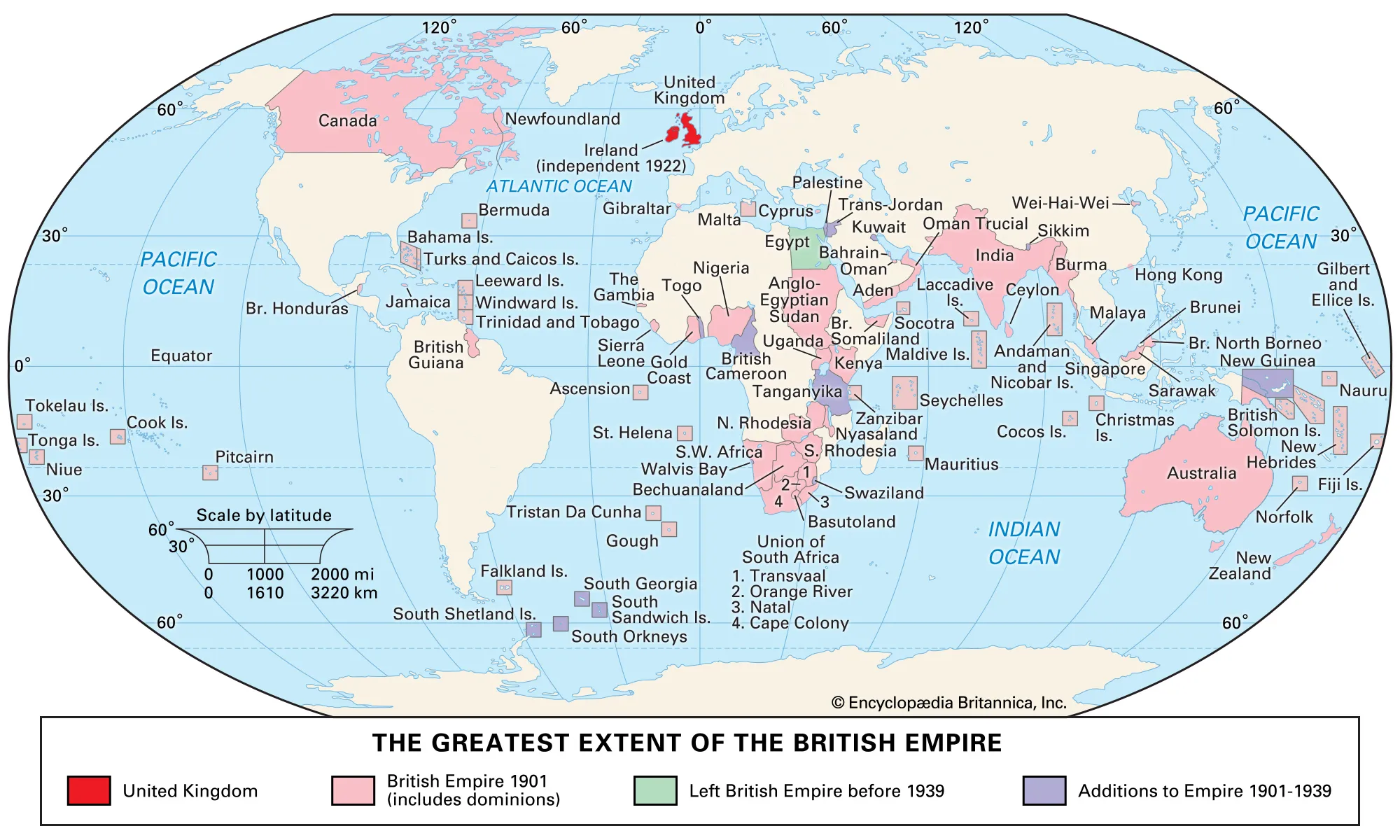
The grinding war is finally over after what feels like decades of bitter conflict on an inconceivably large scale. The entire world had become a battlefield in which the British had fought desperately to keep their imperial possessions secure in the face of vast hordes of enemies of all sorts, with the Navy and Army strained to the breaking point as battalions launched expeditionary raids and grinding, years-long campaigns everywhere from the steamy Orient to the Mediterranean, the bitter cold of the North to the coast and shores of Northern Africa.

Truth be told, victory, though it came in the end, had strained everything nearly to the breaking point. High taxes had driven the landed element to the breaking point. The necessity of convoys, of relying on domestic agriculture, of keeping the empire intact from an island the size of Michigan … had strained the British people and British society to the breaking point. Class tensions were high, taxes were already ruinously high, and to many elements, rich and poor alike, victory hardly seemed worth the immense cost in gold and blood.

And that was before considering the debt. The ruinous, mountainous, inconceivable debt. Well over 200% of GDP, it would later be calculated … and not at the negative interest rates of modernity either. Over 200% of GDP priced in real, somewhat gold-backed currency, with those who bought it demanding a real return. Ruinous, it was, ruinous! For this final conflict had been preceded not by many long years of peace, but by a similarly large, long conflict that had also involved campaigns across every corner of the earth, mutinous colonials, immense expense, and heavy taxation.

So victory had come. The war against an immense continental hegemon had been won, the international order was stabilized to the liking of and in accord with the ideology of the political elite, and the empire kept together in a hugely expanded state. But the cost had been high. Perhaps the cost had been ruinous …

I am, of course, describing Britain circa 1815, after its final victory over Napoleon at Waterloo. What followed was its century atop Olympus, the century where it ruled a quarter of the Earth’s surface, dominated all the sea lanes, was the world’s reserve currency, and became the world’s financial capital. Despite the expense, the defeat of Napoleon did not bring ruin, but success on an unimaginably immense scale.

What happened? Why did the Britain that defeated Napoleon become the hugely successful nation of the Victorian Age, but the Britain that followed the defeat of Hitler became a wrecked backwater, a miserable shell of its former self? The post-war debt load was similar. The human cost had been higher, but not remarkably so, particularly if the immigration outflows of the 19th century are considered.1 The logistical strains were similar, the social strains similar, and the fractious politics of the wars similar.

But the Britain of the 19th century became the hegemon of note, whereas that of the 20th century became essentially irrelevant. Mindset makes all the difference in the world, as I’ll show in this article, along with why this matters for Americans.

Britain after Napoleon

It is important to note that Britain’s immense imperial and economic success after the defeat of Napoleon was no sure thing. Yes, unlike much of Europe, it hadn’t been ravaged by invading armies. But it had lost its best colonies in the disastrous rebellion that followed the immensely expensive Seven Years’ War, a world war in all but name. It was staggering under a ruinous mountain of debt that could scarcely have been imagined earlier in the century: the national debt stood at somewhere around 210% of GDP, after post-war deflation had been accounted for, with somewhere around 10% of national GDP going just toward paying the interest on that debt.

Perhaps, worse, the population was restive. During the war, farmers and landlords had been pushed into embarking on extremely expensive schemes to drain and enclose land, schemes costing millions of dollars per thousand acres in today’s money; while that worked tolerably well during the war itself, as grain prices remained high, the expense and the cost of the debt used to achieve it was a crushing burden after the end of the war meant renewed trade and a fall in grain prices. That expense and the pain caused by it meant that not only were the farmers and the landlords struggling to make ends meet, but they had little left to pay agricultural laborers, who had their wages cut as a result, putting that bottom rung of the social ladder in an immensely precarious and dire economic position.

Much the same situation played out in the nascent industrial sector, where the end of war meant falling prices for finished goods and thus both lower profits and lower wages, angering industrialists and workers alike. As food remained expensive compared to wages, this meant major unrest, too. Thus, other than perhaps some financiers who were doing well off the debt, particularly given post-war deflation, most segments of society were unhappy at how the government was being run.

A high debt load that could only be maintained with high taxes, a highly restive and discontented population, and an economy-punishing bout of deflation are not the stuff of which great empires are typically made.

But the British figured it out, and did so without massive inflation, government default, or authoritarian societal repression.


  1. This is noted by AJP Taylor in his The First World War and Its Aftermath

An Interesting Silenced Bulgarian Makarov

Filed under: Europe, History, Weapons — Tags: , , , , — Nicholas @ 02:00

Forgotten Weapons
Published 29 Sept 2025

Today we are taking a look at an interesting silenced Bulgarian Makarov with a mechanism added to lock the slide. This sort of feature is usually thought of as a sneaky way to avoid ejecting brass and leaving it behind, but it actually serves a much more practical purpose. One of the loudest elements of a suppressed pistol firing subsonic ammunition is actually the noise of pressurized gas escaping when the empty case is extracted and then the slide chambering a new round. A slide lock eliminates these sources of noise by preventing the slide from opening. While this is not a factory-made variant of the Makarov, it is an interesting mechanism that I thought worth covering.
(more…)

QotD: The shift from “motte-and-bailey” construction to stone castles

As we move to stone construction and especially full stone construction (which we’ll define as the point when at least one complete curtain wall – don’t worry, we’ll define that in a second – is in stone) in the 12th century, we’re beginning to contemplate a different kind of defense. The wooden motte and bailey, as we’ve seen, mostly served to resist both raids and “hasty” assaults, thus forcing less coordinated or numerous attackers to set in to starve the castle out or go home. But stone walls are a much larger investment in time and resources; they also require a fair bit more careful design in order to be structurally sound. For all of that expense, the builder wants quite a bit of a security, and in the design of stone castles it is hard not to notice increasing attention towards resisting a deliberate assault; stone castles of the 12th century and beyond are increasingly being designed to stand up to the best that the “small army” playbook can throw at them. Of course it is no accident that this is coming at the same time that medieval European population and wealth is beginning to increase more rapidly, leaving political authorities (read: the high nobility) with both the resources for impressive new castles (although generally the number of castles falls during this period – fewer, stronger castles) and at the same time with more resources to invest in the expertise of siegecraft (meaning that an attacker is more likely to have fancy tools like towers, catapults and better coordination to use them).

To talk about how these designs work, we need to clear some terminology. The (typically thin) wall that runs the circuit of the castle and encloses the bailey is called a “curtain wall“. In stone castles, there may be multiple curtain walls, arranged concentrically (a design that seems to emerge in the Near East and makes its way to Europe in the 13th century via the crusades); the outermost complete circuit (the primary wall, as it were) is called the enceinte. Increasingly, the keep in stone castles is moved into the bailey (that is, it sits at the center of the castle rather than off to one side), although of course stone versions of motte and bailey designs exist. In some castle design systems, with stone the keep itself drops away, since the stone walls and towers often provided themselves enough space to house the necessary peacetime functions; in Germany there often was no keep (that is, no core structure that contained the core of the fortified house), but there often was a bergfriede, a smaller but still tall “fighting tower” to serve the tactical role of the keep (an elevated, core position of last-resort in a defense-in-depth arrangement) without the peacetime role.

While the wooden palisade curtain walls of earlier motte and bailey castles often lacked many defensive features (though sometimes you’d have towers and gatehouses to provide fighting positions around the gates), stone castles tend to have lots of projecting towers which stick out from the curtain wall. The value of projecting towers is that soldiers up on those towers have clear lines of fire running down the walls, allowing them to target enemies at the base of the curtain wall (the term for this sort of fire is “enfilade” fire – when you are being hit in the side). Clearly what is being envisaged here is the ability to engage enemies doing things like undermining the base of walls or setting up ladders or other scaling devices.

The curtain walls themselves also become fighting positions. Whether on a tower or on the wall itself, the term for the fighting position at the top is a “battlement”. Battlements often have a jagged “tooth” pattern of gaps to provide firing positions; the term for the overall system is crenellation; the areas which have stone are merlons, while the gaps to fire through are crenals. The walkway behind both atop the wall is the chemin de ronde, allure or “wall-walk”. One problem with using the walls themselves as fighting positions is that it is very hard to engage enemies directly beneath the wall or along it without leaning out beyond the protection of the wall and exposing yourself to enemy fire. The older solution to this were wooden, shed-like projections from the wall called “hoarding”; these were temporary, built when a siege was expected. During the crusades, European armies encountered Near Eastern fortification design which instead used stone overhangs (with the merlons on the outside) with gaps through which one might fire (or just drop things) directly down at the base of the wall; these are called machicolations and were swiftly adopted to replace hoardings, since machicolations were safer from both literal fire (wood burns, stone does not) and catapult fire, and also permanent. All of this work on the walls and the towers is designed to allow a small number of defenders to exchange fire effectively with a large number of attackers, and in so doing to keep those attackers from being able to “set up shop” beneath the walls.

[I]t is worth noting something about the amount of fire being developed by these projecting towers: the goal is to prevent the enemy operating safely at the wall’s base, not to prohibit approaches to the wall. These defenses simply aren’t designed to support that much fire, which makes sense: castle garrisons were generally quite small, often dozens or a few hundred men. While Hollywood loves sieges where all of the walls of the castle are lined with soldiers multiple ranks deep, more often the problem for the defender was having enough soldiers just to watch the whole perimeter around the clock (recall the example at Antioch: Bohemond only needs one traitor to access Antioch because one of its defensive towers was regularly defended by only one guy at night). It is actually not hard to see that merely by looking at the battlements: notice in the images here so far often how spaced out the merlons of the crenellation are. The idea here isn’t maximizing fire for a given length of wall but protecting a relatively small number of combatants on the wall. As we’ll see, that is a significant design choice: castle design assumes the enemy will reach the walls and aims to prevent escalade once they are there; later in this series we’ll see defenses designed to prohibit effective approach itself.

As with the simpler motte and bailey, stone castles often employ a system of defense in depth to raise the cost of an attack. At minimum, generally, that system consists of a moat (either wet or dry), the main curtain walls (with their towers and gatehouses) and then a central keep. Larger castles, especially in the 13th century and beyond, adopting cues from castle design in the Levant (via the crusades) employed multiple concentric rings of walls. Generally these were set up so that the central ring was taller, either by dint of terrain (as with a castle set on a hill) or by building taller walls, than the outer ring. The idea here seems not to be stacking fire on approaching enemies, but ensuring that the inner ring could dominate the outer ring if the latter fell to attackers; defenders could fire down on attackers who would lack cover (since the merlons of the outer ring would face the other way). As an aside, the concern to be firing down is less about the energy imparted by a falling arrow (though this is more meaningful with javelins or thrown rocks) and more about a firing position that denies enemies cover by shooting down at them (think about attackers, for instance, crossing a dry moat – if your wall is the right height and the edges of the moat are carefully angled, you can set up a situation where the ditch never actually offers the attackers any usable cover, but you need to be high up to do it!).

Speaking of the moat, this is a common defensive element (essentially just a big ditch!) which often gets left out of pop culture depictions of castles and siege warfare, but it accomplishes so many things at such a low cost premium. Even assuming the moat is “dry”! For attackers on foot (say, with ladders) looking to approach the wall, the moat is an obstacle that slows them down without potentially providing any additional cover (it is also likely to disorder an attack). For sappers (attackers looking to tunnel under the walls and then collapse the tunnel to generate a breach), the depth of the ditch forces them to dig deeper, which in turn raises the demands in both labor and engineering to dig their tunnel. For any attack with siege engines (towers, rams, or covered protective housings made so that the wall can be approached safely), the moat is an obstruction that has to be filled in before those engines can move forward – a task which in turn broadcasts the intended route well in advance, giving the defenders a lot of time to prepare.

Well-built stone castles of this sort were stunningly resistant to assault, even with relatively small garrisons (dozens or a few hundred, not thousands). That said, building them was very expensive; maintaining them wasn’t cheap either. For both castles and fortified cities, one ubiquitous element in warfare of the period (and in the ancient period too, by the by) was the rush when war was in the offing to repair castle and town walls, dig out the moat and to clear buildings that during peace had been built int he firing lines of the castle or city walls.

Bret Devereaux, “Collections: Fortification, Part III: Castling”, A Collection of Unmitigated Pedantry, 2021-12-10.

February 21, 2026

Books for boys (unlike the vast majority of books for children these days)

Filed under: Books, History — Tags: , — Nicholas @ 05:00

Just pointing out that boys and girls have different interests is enough to get you labelled as a right-wing extremist, if not an outright white supremacist/homophobic transphobe. Progressives believe, as a matter of deep conviction, that children are tabula rasa and any indication of interest on their part in male-coded activities is proof of patriarchal brainwashing. This is clearly nonsense, but we’re deep in the propagandized years where even pointing out elements of reality will get you added to terrorist watchlists if it doesn’t actually get you arrested and charged. But boys are interested in different things than girls are and trying to force them to be interested in the things that girls like will almost always turn that boy against whatever you’re trying to shove down his throat.

Boys don’t read as much as girls do, but when almost everything they’re given to read is girl-coded, it makes it even more uninteresting to boys. Yet the tiny minority of books that do appeal to boys are not made available in libraries and schools for fear of somehow leading in the direction of “toxic masculinity” or something.

Among the few publishers who do produce books intended to interest boys is Raconteur Press, who explain here why historical adventure books appeal to boys:

In an era dominated by screens and instant gratification, fostering a deep appreciation for history in young readers can feel like an uphill battle. Yet, historical fiction — especially in the form of thrilling boys’ adventure books — offers a powerful gateway. By weaving real historical events into gripping narratives, these stories not only entertain but also educate, encouraging boys to discover the past, develop essential skills, and cultivate a lifelong love of reading and exploration. Books like A Boy Against the Boxers by Jacob Sharp, Meteor Men by Scott Schad, and Fossil Force by Graham Bradley, all from Raconteur Press, exemplify this approach. Each integrates historical elements in unique ways, showing how adventure can transform history from dry facts into vivid, relatable experiences.

Discovery and Learning Through Historical Events

Historical fiction immerses young readers in the past, making abstract events tangible and personal. By placing protagonists in real-world scenarios, these books help boys “live” history, fostering empathy and understanding that textbooks often lack. For instance, in A Boy Against the Boxers, fourteen-year-old Eddie Donahue is thrust into the heart of the 1900 Boxer Rebellion in Peking (now Beijing). The story draws on actual events like the 55-day Siege of the International Legations, where foreign diplomats and civilians were trapped by anti-Western nationalists. Eddie witnesses martial arts demonstrations, evades violent chases, and participates in scavenging supplies and firing an old black powder cannon known as the “International Gun”. Through Eddie’s eyes, readers learn about the geopolitical tensions of turn-of-the-century China, the unlikely alliances among nations (which would soon fracture in World War I), and the brutal realities of siege warfare. This viewpoint helps boys grasp how ordinary people — much like themselves — navigated chaos, turning history into a lesson in resilience and global interconnectedness.

Similarly, Meteor Men blends scientific discovery with American Civil War history. The five boys — Cinch, Frank, Keith, Joel, and Ronaldo — start as amateur meteorite hunters, using library research and borrowed gadgets like a magnetic probe mounted on a radio-controlled plane. Their quest leads to an unexpected find: a buried Union ironclad riverboat and its Confederate counterpart, solving a fictionalized mystery tied to real Civil War naval battles, such as those on the Mississippi River. Drawing from actual historical markers and artifacts (like the USS Cairo, the only surviving Union armored riverboat), the boys learn about steam-powered warfare, the role of ironclads in river combat, and the human cost of the conflict. From a boy’s perspective, this reveals history as a puzzle to be solved, emphasizing how everyday curiosity can uncover forgotten stories and honor the soldiers who fought.

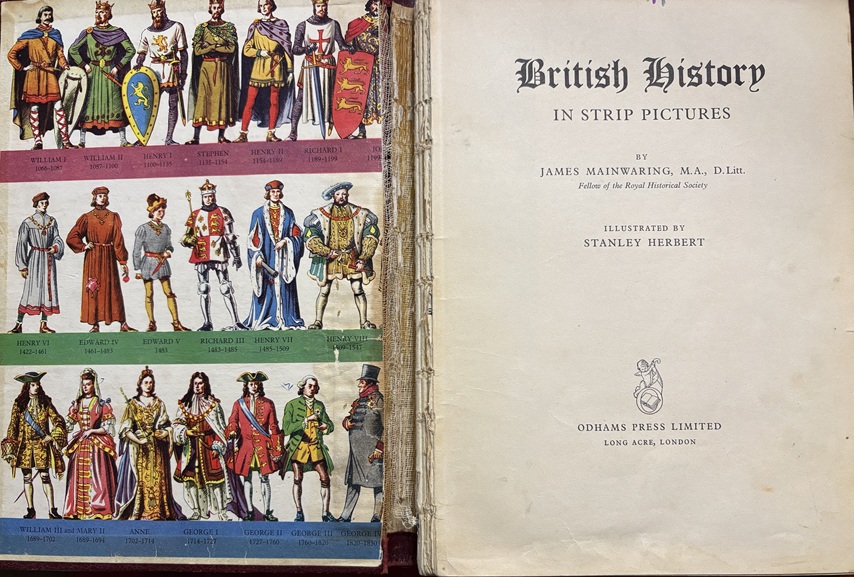
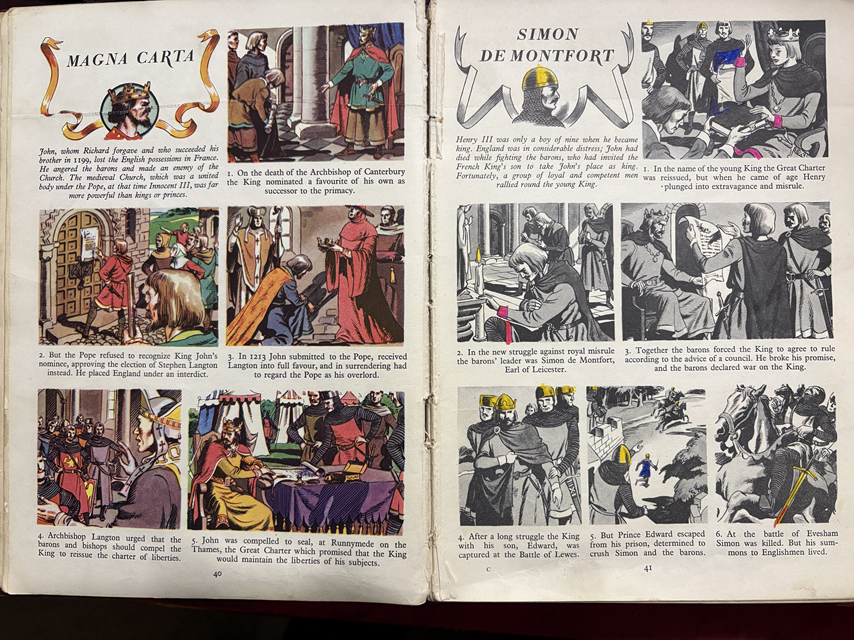
My own interest in history as a child was nursed by the Ladybird picture books my parents and grandparents bought me (with topics like Alexander the Great, Richard the Lionheart, Henry V, and other interesting-to-boys subjects). One that I still have, in diminished form is a very battered copy of British History in Strip Pictures by James Mainwaring, which must have been published in the late 1950s or early 1960s, as I got it in 1965 and it was already quite battered:

The body of the book got separated from the cover many years ago, and the first few pages got lost, sadly.

It might have been jingoistic “whig history for children”, but I loved it (please pardon the occasional attempts to colour the black-and-white images … I couldn’t help myself at that age):

Oh Look, They Want a Mercenary Army

Filed under: Europe, Military — Tags: , , , , , — Nicholas @ 04:00

Akkad Daily
Published 20 Feb 2026

Get a country worth fighting for. Join Restore: https://www.restorebritain.org.uk/joi…

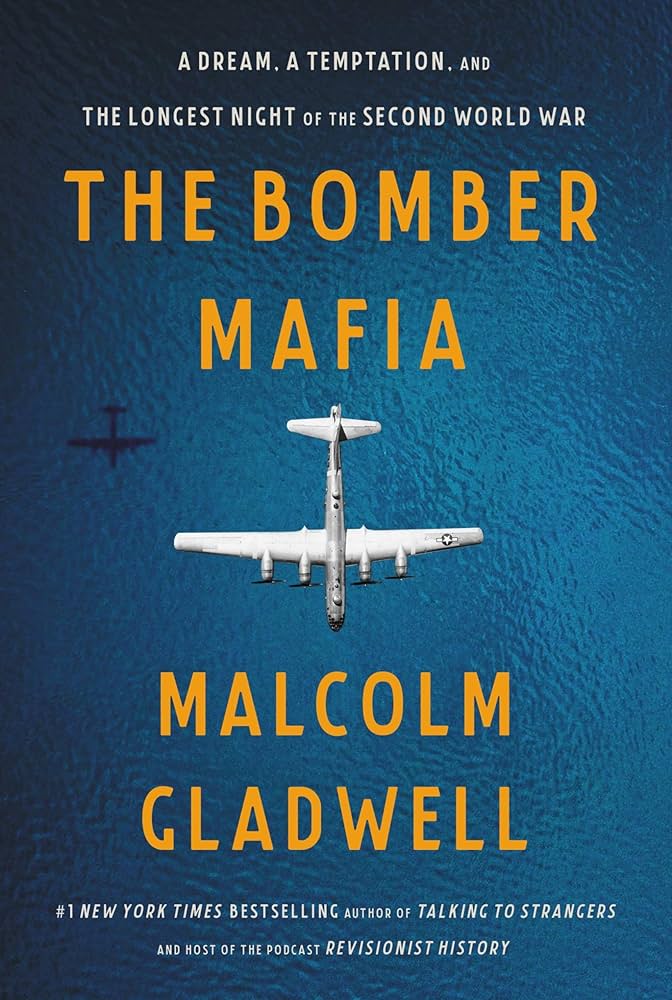
The Bomber Mafia by Malcolm Gladwell

Filed under: Books, Germany, History, Japan, Military, USA, WW2 — Tags: , , , — Nicholas @ 03:00

Based on the few books of his I’d heard of, I wouldn’t have expected Malcolm Gladwell to dip into military history … and from what Secretary of Defense Rock says, it might have been better if Gladwell had steered clear of this particular topic anyway:

I recently received The Bomber Mafia as a gift for my birthday, and it was bad, so bad that I felt compelled to write this review. In so many ways, the book is everything that is wrong with the “pop history” genre: a bestselling author with a massive built-in audience, with a hit podcast to cross-promote the material, and a framing promise to reveal a supposedly “great untold story” about the strategic and moral struggles of American airmen in World War II. The problem in this case is that Gladwell’s narrative about Curtis LeMay, Haywood Hansell, and the evolution of strategic bombing repeatedly collides with the existing scholarship and often ignores it altogether. From his treatment of the raids of Münster and Schweinfurt–Regensburg to his use of the United States Strategic Bombing Survey and his confident claims about what compelled Japan to surrender, The Bomber Mafia exemplifies the worst tendencies of popular history: sweeping pronouncements built on selective reading, caricatured context, and a startling indifference to both primary sources and a vast secondary literature.1

I was only vaguely familiar with Malcolm Gladwell and his work, but for those who don’t know (like me until recently), he has been a staff writer for The New Yorker since 1996, has written a bunch of New York Times bestselling books on sociology, psychology, and economics, and also hosts a very popular podcast called Revisionist History.2 This is all to say he is widely known and already has a big audience that is generally receptive to his projects. The book was originally based on four episodes he did on this topic in July 2020, and then turned into print, so it isn’t so much an actual book as it is a printed podcast.3

Unsurprisingly, both the audiobook and print editions were widely acclaimed upon release. Writing in the Wall Street Journal, Yale professor Paul Kennedy praised the book as “a wonderful book”.4 The journalist Michael Lewis described it as “a riveting tale”, while the bestselling biographer Walter Isaacson called it “a wonderful narrative”.5 The book was named a Kirkus Reviews Best Book of the Year and selected as an Editors’ Choice by The New York Times Book Review. It also enjoyed significant commercial success, reaching number two on The New York Times Best Sellers list.6 To promote the book, Gladwell made appearances on Jimmy Kimmel, MSNBC, and CBS’s Sunday Morning show. MSNBC even stated in the segment title that this is “A great untold story”, which is hilarious, given that I don’t know how much ink has been spilled on the strategic bombing campaigns.7

But it should be noted that the book has been criticized by virtually anyone who has seriously studied this topic. Much of the criticism of the book has come from the fact that it hardly focuses on the Japanese and German perspectives, misinterprets why members of the air tactical school focused on precision bombing, and the actual role strategic bombing played in the surrender of Japan.8 All of that is valid, but what was initially more startling to me was how little use was made of primary or secondary sources. So many important works are left out makes me wonder how much research Gladwell even put in.9 To write about strategic bombing in World War II and not include Michael Sherry’s The Rise of American Air Power, Richard Overy’s The Bombing War, Donald Miller’s Masters of the Air, Ken Werrell’s Blankets of Fire or Death From the Heavens, Geoffrey Perrett’s Winged Victory, and barely using any of the official histories is borderline negligence.10 Anyone doing research on strategic bombing and Air Power in World War II almost certainly would have come across these.


  1. Popular history is a form of historical writing aimed at broad audiences that usually prioritizes storytelling over real scholarship. See Gerald Strauss, “The Dilemma of Popular History,” Past & Present, no. 132 (1991): 130–49, and more recently, Ben Alpers, “The Promise and Perils of Popular History,” Society for U.S. Intellectual History, August 17, 2021.
  2. The show itself isn’t really a conversation with experts and historians (though they do appear) so much as storytelling.
  3. I would also preface that I generally don’t have a problem with this premise. There is definitely a segment of the historical profession that dislikes pop history for reasons tied as much to credentials as to content. Much “popular history” is produced by journalists, independent writers, or commentators rather than credentialed academic historians, and that fact alone generates suspicion. In some cases, this skepticism is warranted: weak sourcing, thin engagement with the scholarship, and overconfident claims do real damage. But the problem is not who writes history so much as how it is written. Plenty of non-historians have produced outstanding historical works by taking the craft seriously — immersing themselves in primary sources, engaging honestly with existing scholarship, and resisting the temptation to oversimplify for the sake of narrative punch. Conversely, academic credentials have never been a guarantee for insight or even accuracy. If a writer does the work, respects the evidence, and treats complexity as something to be explained rather than avoided, there is no real reason to dismiss the result simply because of the writer’s background.
  4. Paul Kennedy, “The Bomber Mafia’ Review: Architects of a Firestorm”, The Wall Street Journal, April 30, 2021.
  5. Summary of reviews in paperback.
  6. “Hardcover Nonfiction – May 16, 2021”. The New York Times.
  7. Malcolm Gladwell: ‘Bomber Mafia’ Looks At A Great Untold Story From WWII.
  8. Some critical reviews include David Fedman and Cary Karacas, “When Pop History Bombs: A Response to Malcolm Gladwell’s Love Letter to American Air Power”, Los Angeles Review of Books, June 12, 2021; Saul David, “Malcolm Gladwell’s The Bomber Mafia is misleading history-lite”, The Daily Telegraph, April 25, 2021, and Steve Agoratus, Air & Space Power History 68, no. 4 (2021): 52–53.
  9. This is also coming from a guy who famously wrote that achieving world-class expertise in any field is, to a large extent, a function of accumulating roughly 10,000 hours of deliberate practice, as described in his book Outliers: The Story of Success.
  10. Gladwell doesn’t really deal with British strategic bombing; there’s just a brief chapter on Arthur Harris. If interested, see Noble Frankland, Bomber Offensive, the Devastation of Europe (New York: Ballantine Books, 1971) Max Hastings, Bomber Command: The Myths and Reality of the Strategic Bombing Offensive, 1939-45 (New York: Dial Press/James Wade, 1979), and Norman Longmate, The Bombers: The RAF Air Offensive against Germany, 1939-1945 (London: Hutchinson, 1983).

Canada’s Only Mass-Production Fighter Jet – Avro Canada CF-100 Canuck

Filed under: Cancon, History, Military, Technology — Tags: , , , , , , — Nicholas @ 02:00

Ruairidh MacVeigh
Published 18 Oct 2025

During the 1940s and 50s, with World War II rapidly transitioning into the Cold War, Canada, as a major ally of the NATO nations and with large swathes of remote countryside that could easily be penetrated by Soviet fighters and bombers, created the CF-100 Canuck, one of the earliest production jet fighters in the world an a machine that, despite some early flaws, would go on to prove itself rugged and robust for patrolling the turbulent weather of the frozen Canadian north.

At the same time, though, the CF-100 was very much a product of its time, and despite its exceptional rigidity, by the middle of the 1950s it was very much obsolete as swept-wing and delta fighters rapidly became the norm for both Communist and Capitalist factions alike, and through its initial success would lay the groundwork for even more ambitious projects that sadly would not continue Canada’s major involvement in cutting edge military aerospace design.

Chapters:

0:00 – Preamble
0:49 – Facing a New Kind of War
4:28 – Ups and Downs
7:12 – Reworking the Design
10:36 – The CF-103 Project
15:51 – The Canuck Career
19:06 – Later Years
20:30 – Conclusion
(more…)

QotD: Warren G. Harding’s successful depression-breaking policies

One is viewed as among America’s greatest presidents; the other perhaps the worst of all. One is hailed as a savior; the other as a failure. One is given memorials to enshrine his name for all time; the other is pushed into the sea of forgetfulness.

Driven by academia, this is where American history has placed Franklin Delano Roosevelt (in office 1933-1945) and Warren Gamaliel Harding (in office 1921-1923). It is impossible to see FDR absent a “great presidents” ranking; it is likewise impossible to see Harding absent the lowest rungs.

Both men came into office with an economy in tatters and both men instituted ambitious agendas to correct the respective downturns. Yet their policies were the polar opposite of one another and, as a result, had the opposite effect. In short, Harding used laissez faire-style capitalism and the economy boomed; FDR intervened and things went from bad to worse.

Despite these clear facts, in C-SPAN’s latest poll ranking US presidents, FDR finished third in the rankings, while Harding finished 37th. Surveying how both handled the economy, scholars ranked FDR third in that category, while Harding came in at 32. This is a tragedy of history.

America in 1920, the year Harding was elected, fell into a serious economic slide called by some “the forgotten depression“. Coming out of World War I and the upheavals of 1919, the economy struggled to adjust to peacetime realities, falling into a serious slump.

The depression lasted about 18 months, from January 1920 to July 1921. During that time, the conditions for average Americans steadily deteriorated. Industrial production fell by a third, stocks dropped nearly 50 percent, corporate profits were down more than 90 percent. Unemployment rose from 4 percent to 12, putting nearly 5 million Americans out of work. Small businesses were devastated, including a Kansas City haberdashery owned by Edward Jacobson and future president Harry S. Truman.

The nation’s finances were also in shambles. America had spent $50 billion on the Great War, more than half the nation’s GNP (gross national product). The national debt jumped from $1.2 billion in 1916 to $26 billion in 1919, while the Allied Powers owed the US Treasury $10 billion. Annual government spending soared more than twenty-five times, from around $700 million in 1916 to nearly $19 billion in 1919.

Harding campaigned on exactly what he wanted to do for the economy – retrenchment. He would slash taxes, cut government spending, and roll back the progressive tide. He would return the country to fiscal sanity and economic normalcy.

“We need a rigid and yet sane economy, combined with fiscal justice,” he said in his inaugural address, “and it must be attended by individual prudence and thrift, which are so essential to this trying hour and reassuring for our future”.

The business community expressed excitement about the new administration. The Wall Street Journal headlined on Election Day, “Wall Street sees better times after election”. The Los Angeles Times headlined the following day, “Eight years of Democratic incompetency and waste are drawing rapidly to a close”. Others read “Harding’s Advent Means New Prosperity” and “Inauguration ‘Let’s Go!’ Signal to Business”.

The day after Harding’s inauguration, the Times editors predicted “good times ahead”, writing, “The inauguration yesterday of President Harding and the advent of an era of Republicanism after years of business harassment and uncertainty under the Democratic regime were hailed” by the nation’s business leaders. I. H. Rice, the president of the Merchants and Manufacturers Association, told the press, “Good times are now ahead of us. Prosperity is at our door. We are headed toward pre-war conditions … Business men are well pleased with President Harding’s selections for his Cabinet and by the caliber of men he has chosen we know that he means business”.

Under Harding and his successor, Calvin Coolidge, and with the leadership of Andrew Mellon at Treasury, taxes were slashed from more than 70 percent to 25 percent. Government spending was cut in half. Regulations were reduced. The result was an economic boom. Growth averaged 7 percent per year, unemployment fell to less than 2 percent, and revenue to the government increased, generating a budget surplus every year, enough to reduce the national debt by a third. Wages rose for every class of American worker. It was unparalleled prosperity.

Ryan S. Walters, “The Two Presidents Whose Economic Policies Are Most Misunderstood by Historians”, Foundation for Economic Education, 2022-03-05.

February 20, 2026

Stephen A. Smith as a Democratic Trump

Filed under: Media, Politics, Sports, USA — Tags: , , , — Nicholas @ 05:00

It’s been noted many times that the Democratic Party has had a logjam of aged boomers at the top of their “bench” for future leadership positions. This is a serious problem for the self-described “Party of Youth”, that they have remarkably few viable Gen X, Millennial or Gen Z rising stars who might be future presidential candidates. Donald Trump took the political insiders by surprise in 2015/16, because he was an outsider with no political track record but a huge media profile. He may be the template that Stephen A. Smith hopes to follow on the Democratic side:

Stephen A. Smith at The Moody College of Communications, 23 January 2021.
Wikimedia Commons.

Stephen A. Smith is flirting with a run for president. In a recent CBS News interview, the telegenic ESPN commentator openly entertained the possibility of seeking the Democratic nomination in 2028. He offered additional comments on policy that were striking in their normalcy. He dismissed the idea that racism defines contemporary American life, rejected “defund the police”, and emphasized economic flourishing as the surest path to social stability.

Smith has a gift for performance, a fondness for hyperbole, and a resume devoid of elective office. Historically, that would have made him an unorthodox fit for the White House. But since Donald Trump’s 2016 election, those facts do less to disqualify a figure than to clarify his potential appeal.

And Smith seems to be taking the possibility seriously. His CBS interview builds on previous comments criticizing politicians who support income caps or engage in class-war rhetoric, framing prosperity as a moral and civic good, and condemning the Democratic Party’s excesses on cultural matters like transgenderism. In these comments, Smith captured the sensibility of millions of voters who feel alienated by the ideological vocabulary of contemporary Democratic politics.

While it’s tempting to write off Smith’s flirtation as unserious celebrity theater, that impulse overlooks the weakness of the Democratic field. Kamala Harris enters the cycle as the nominal frontrunner, but her standing reflects name recognition more than enthusiasm. Gavin Newsom commands attention through media savvy and partisan combativeness but carries the burden of California’s abysmal policy record. Other prospective contenders — none of whom have managed to crack double-digit support — may offer competence without excitement or excitement without coalitional appeal.

A primary defined by such choices creates space for an outsider, especially one who can command attention and articulate a distinct political persona. Smith lacks the accumulated baggage of conventional politicians. Even more importantly, he speaks like someone accustomed to unscripted confrontation. Two decades of live television have trained him to think quickly, read audiences, and project conviction. While such skills cannot substitute for governing experience, they matter a great deal in an era where voters evaluate authenticity and affect alongside ideology.

In fact, Donald Trump demonstrates that a candidate who pairs ideological flexibility with rhetorical aggression can reshape a party. Trump softened Republican orthodoxy on entitlement reform, health care, and even social issues — like gay marriage, guns, and abortion — at various points. Yet he maintained the loyalty of a base that valued his willingness to fight. That in turn forced GOP insiders to capitulate to many of his views. Smith shares Trump’s intensity, and could by the same method push the Democrats to moderate.

At the same time, his nascent platform could complicate Democratic coalition politics. The party’s donor and activist classes exert powerful pressure against moderation. These interests remain influential in candidate recruitment, messaging, and resource allocation. That influence often produces nominees who align with activist priorities even when those priorities diverge from median Democratic voter preferences.

Reform UK falters, but Restore Britain rises to challenge it

Filed under: Britain, Media, Politics — Tags: , , , , , — Nicholas @ 04:00

Since the last general election in Britain, the rising power has been Reform UK under the unsteady leadership of Nigel Farage. A right-wing alternative to the horrifically incompetent Conservative Party, led by the man who kept the fires burning for Brexit? Seems like an obvious winner over the sagging Labour Party under Keir Starmer who just had to be less incompetent than the Conservatives but couldn’t manage even that low bar. But all was not well with Reform UK, despite being likely winners of the next election, and a lot of it comes down to Nigel Farage’s weaknesses. He seems incapable of dealing with strong personalities in his own party and seems to see any disagreement as a form of betrayal. One of the men he exiled from the party has now raised his own banner to much acclaim from the people who once were strong Farage supporters:

On Friday, Rupert Lowe, the independent Member of Parliament formerly of Reform UK, launched his own political party named Restore Britain. At the time of writing, the announcement video has amassed upwards of 30 million views on X, with many of the Western world’s most popular right-wing social media accounts — from Raw Egg Nationalist to Wall Street Mav — cheering him on.

Critics of Lowe argue that few outside of the culture war circles on X have heard of him, but these claims don’t track — Lowe has over 250,000 followers more on Facebook than he does on X, and has stated that he reaches “far more people on Facebook than X”. Still, while Lowe’s popularity has dramatically increased in the short year-and-a-half following his election to Parliament, he does not carry the same name recognition as Nigel Farage, let alone the latter’s proven experience of winning elections, as recent Reform victories have demonstrated, and contentious campaigns, being a key figure in the pro-Brexit campaign.

Restore Britain has the potential to be both very positive and hugely detrimental to Britain’s political future. Lowe’s announcement video was a masterclass in giving his admirers exactly what they want: decisive language promising a rebirth of a pre-Blair Britain, with fewer foreign nationals, fewer people on benefits, and more money to go round. The sober nature of the message was appealing — Lowe made it clear that the challenge facing the party, and the country, is not an easy one, but nor is it insurmountable. With stronger language than we have heard from Reform, Lowe promised to remove all people who arrived in Britain illegally, along with legal foreign nationals who do not meaningfully contribute to society.

Policy proposals like this — from a brand-new party with very little in the way of a party infrastructure as yet — do not have to be fully fleshed out to grab hold of the public imagination. What is likely is that it pushes the Overton window even farther rightward, and we begin hearing traditional centre-right figures like Kemi Badenoch (as she is centre-right in the political landscape of 2026) parroting some of the same points. With much of the online right rallying behind Lowe, we may begin to see a surge in the early stages of the posting to policy pipeline, whereby anonymous meme accounts — the modern politician’s crowdsourced spin doctor — churns out a large volume of pro-Lowe content, driving the narrative as others strive to keep up.

Lowe’s party may inadvertently help Reform, though, this by helping solve one of the main problems it has faced: attracting too many nutcases. Restore is positioning itself further to the right than Reform — and while this is no bad thing in and of itself, it will likely mean that those who believe in the most extreme solutions see Restore as the closest party to what they believe.

In UnHerd, Rob Lownie calls the movement “Lowe’s Powellite revolution”:

Rupert Lowe’s official portrait by Laurie Noble, 10 July, 2024 via Wikimedia Commons

Rupert Lowe deals in the politics of return: illegal immigrants are going back, and so is Britain. The Great Yarmouth MP, formerly of Reform UK, has now launched Restore Britain as a new political party, and on Wednesday evening claimed that it had passed 70,000 members. The launch announcement was marked with a stirring video of Lowe in his farmer’s get-up, as well as a series of semi-ironic nationalist compilations presumably made by Restore’s Zoomer footsoldiers. In one of these, among nostalgic nods to Geoff Hurst and Zulu, 1997 is invoked as the year when everything started to go wrong. Speaking over grainy images of a lost Britain, Lowe sums up his political outlook: “I think the state is bad, and I think the individual is good.

One area where the state has undoubtedly failed, in Lowe’s eyes, is on the matter of immigration. While Reform has pledged to deport all illegal immigrants, Restore wants to go further. Lowe has promised to scrap the asylum system entirely, also stating last week that “legal immigration will almost come to a complete halt”. The goal is not just to halt migrant influxes but to reverse them. “Net zero immigration is weak, weak, weak. It is insufficient and it is too late,” he said in the speech with which he launched the party. “The barbarians are already in the gates.”

The remedy, Lowe warns, will be “incredibly painful”: a characteristically abrasive verdict. It is one thing to criticise quangos, and quite another to say that “we must crush parasitic Britain”. And as for the dissonance between government and individual? “The state has definitively become the enemy of the people.”

In his doom-laden pronouncements, Lowe resembles no British political figure so closely as Enoch Powell, whose 1968 “Rivers of Blood” speech has led a radioactive afterlife in the national consciousness. For Powell, Britain’s willingness to take in tens of thousands of immigrants rendered it “a nation busily engaged in heaping up its own funeral pyre”. And compare Lowe’s talk of necessary pain to that 1968 call for an “extreme urgency of action now, of just that kind of action which is hardest for politicians to take”. For better or worse, Powell presaged contemporary debates over migration and nationhood. The challenge, as Keir Starmer found out with his more milquetoast “island of strangers” line, is to acknowledge voters’ frustrations without sounding like him.

Powell has been a political lodestar of sorts for Nigel Farage, Lowe’s bête noire and former boss who suspended him last year over dubious accusations of bullying. The Reform leader recalled being “dazzled”, as a schoolboy in the Eighties, listening to the former Tory MP speak. Last year, he insisted that Powell was fundamentally right about the scale of “community change” in the country.

On The Podcast of the Lotus Eaters, Carl Benjamin interviews Rupert Lowe:

The Canadian Patrol Submarine Project

Filed under: Asia, Cancon, Germany, Military, Technology, Weapons — Tags: , , , , , , — Nicholas @ 03:00

The Royal Canadian Navy is planning to replace its four current conventional submarines, the British-built Victoria class with a dozen new conventional submarines from either South Korea or Germany (a joint German-Norwegian design). Michael J. Lalonde, a former Canadian intelligence officer, goes through the requirements for the new submarines, the two contending designs’ strengths and weaknesses, and makes his own recommendation for the RCN’s next submarine class:

Rough transit routes to Canada’s Arctic from Esquimalt BC and Halifax NS

The first step is to assess what the Government of Canada wants out of its new submarine fleet and what capabilities it will need to achieve its objectives. I’m starting here because there is a common misconception that Canada needs submarines exclusively for Arctic patrol and surveillance, which is false. While it’s true that Arctic sovereignty and security are quite rightfully a preoccupation for the government, patrolling Canada’s Arctic is not the only capability Canada needs out of its new fleet. However, it is the most common argument in favour of a submarine fleet since Arctic sovereignty remains popular within Liberal and Conservative circles alike, along with mainstream media.

Unfortunately, this narrative forces a lopsided conversation about the role these new boats will be expected to play over the coming decades. In addition to Arctic operations, these subs will be expected to deploy far into the North Atlantic with NATO and push across the Pacific to support the Indo-Pacific Strategy. Ottawa’s own defence policy update ties submarine recapitalization to contributions with allies in both theatres.

This implies a blue-water capability, which means these conventionally powered submarines must be able to deploy and fight in the open ocean, far from home ports and daily logistics, for extended periods. This requires long range and endurance for transoceanic transits, sustained submerged persistence through air independent propulsion (AIP) and high-capacity batteries to minimize snorkelling, and habitability and maintenance margins that keep the crew and systems effective past the 30- to 60-day mark. Simply put, the new boats must be able to cross an ocean, remain covert and lethal on station, and deliver effects.

The government further stipulated specific capabilities that the new submarines must have in one of its press releases stating “Through the Canadian Patrol Submarine Project (CPSP), Canada will acquire a larger, modernized submarine fleet to enable the Royal Canadian Navy to covertly detect and deter maritime threats, control our maritime approaches, project power and striking capability further from our shores, and project a persistent deterrent on all three coasts.”

What caught my attention here is the ability to project power and striking capability further from our shores. Power projection is synonymous with a blue-water capability; however, a striking capability, which I take to mean a land strike capability, is not typical for a conventionally powered SSK, which are typically armed only with torpedoes to take out other submarines or surface vessels.

To sum up, Canada’s new subs must be able to:

  • Patrol the Arctic with under-ice capability year-round
  • Deploy with NATO in the North Atlantic and support Canada’s commitment to the Indo-Pacific Strategy – A blue-water capability
  • Remain submerged for three weeks or more at a time
  • Covertly detect and deter maritime threats
  • Control Canada’s maritime approaches
  • A range of 7000 + nautical miles
  • Project power far from home ports
  • Anti-surface and subsurface warfare
  • Land-attack capability via cruise and/or non-nuclear ballistic missiles
  • Insert Tier-1 special operators on coastal infiltration missions
  • Conduct intelligence, surveillance, and reconnaissance in Canadian maritime approaches and abroad.

With that out of the way, let’s look at what each submarine can do.

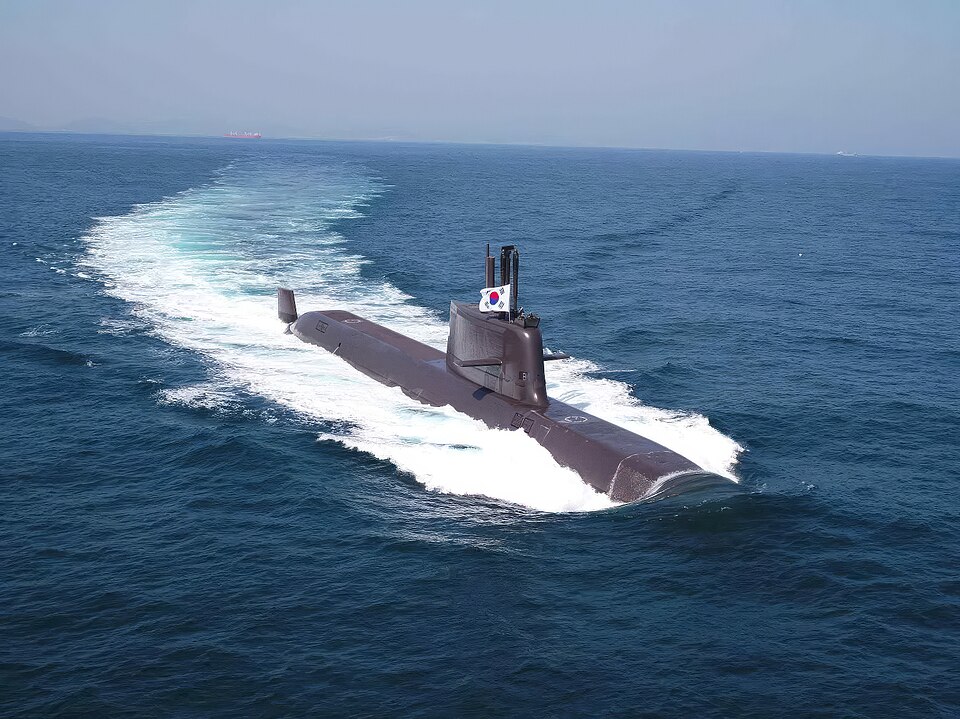
He outlines the two competing designs and how they could meet the RCN’s needs and then plumps for the South Korean KSS-III for its stronger case for meeting those needs in the wider ocean environments than the German/Norwegian Type 212CD:

ROKS Shin Chae-ho, a KSS-III submarine at sea on 4 April, 2024.
Photo from the Defense Acquisition Program Administration (DAPA) via Wikimedia Commons.

The KSS-III is the only conventional submarine that can meet all of Canada’s requirements. It combines the blue-water reach and endurance demanded by transoceanic tasking with a vertical launch system that enables credible land-attack and complex anti-surface strike options, supported by lithium-ion batteries that lengthen quiet submerged persistence and improve sortie tempo on distant stations. Its larger hull and higher automation provide the habitability and crew margin needed for 30 to 60 day deployments from Halifax and Esquimalt to the North Atlantic, the Indo-Pacific, and the Arctic ice edge, while remaining within the conventional, non-nuclear profile Canada has set. The design’s modern combat system and sensor suite can be integrated with Canadian and allied command, control, and targeting architectures, and the bilateral sustainment framework required with South Korea can be structured by contract to include full technical data access, in-country training pipelines, and an industrial workshare that anchors through-life support domestically. The delivery cadence proposed for a 2026 award would shorten Canada’s reliance on the Victoria class and reduce associated sustainment exposure during transition, while an initial Canadian order of up to twelve boats would give Ottawa a controlling voice over configuration management, growth paths, and export-variant standards for the life of the class.

Sci-Fi, Satire, and the Post-WWII Mythos

Filed under: History, Media, Politics — Tags: , , , , — Nicholas @ 02:00

Feral Historian
Published 17 Oct 2025

The caricature of fascism as the arch-evil, born in WWII propaganda and endlessly re-imagined in popular entertainment ever since, has served both as an inoculation against that particular brand of tyranny and blinders to many others. Is it still relevant? Or has it become one of our culture’s foundational archetypes that will live on for centuries disconnected from its roots? Let’s explore a bunch of facets and ask some odd, sometimes difficult questions along the way.

00:00 Intro
03:02 Myth of Singular Evil
06:06 Andor and Now
09:18 Fading Narratives
12:01 Iron Sky
16:21 What Comes Next?
(more…)

QotD: The burden of “emotional labour”

Filed under: Britain, Health, Media, Quotations — Tags: , , , , , — Nicholas @ 01:00

I paraphrase, of course. Though not, I think, wildly:

    Researchers at Stanford have finally given a name to something many women have been dealing with for years. It’s called mankeeping. And it’s helping explain why so many women are stepping away from dating altogether.

Yes, from the pages of Vice, it’s a men-are-the-problem-and-therefore-unnecessary article. Because we haven’t had one of those in weeks.

    Mankeeping describes the emotional labour women end up doing in heterosexual relationships.

Lesbian relationships being entirely free of aggravation and disappointment, you see. With rates of failure and divorce twice that of heterosexuals, more than double that of gay male couples, and with high rates of alcoholism and spousal abuse. What one might infer from that, I leave to others.

    [Mankeeping] goes beyond remembering birthdays or coordinating social plans. It means being your partner’s one-man support system. Managing his stress.

And,

    Interpreting his moods.

At which point, readers may wish to share their favourite joke about female indirectness and the two dozen possible meanings of the words “I’m fine” when uttered by a woman, depending on the precise intonation and the current alignment of the planets.

Readers may also note the replacement of a once common but now seemingly unfashionable grievance – “Men don’t express their feelings” – with one of a much more modish kind – “Men are expressing their feelings and it’s exhausting and unfair”.

    Holding his hand through feelings he won’t share with anyone else. All of it unpaid, unacknowledged, and often unreciprocated.

One more time:

    All of it unpaid,

It occurs to me that there’s something a little dissonant about the framing of affection and basic consideration – say, remembering your partner’s birthday – as “unpaid”. As “emotional labour”. As if being in a relationship or having any concern for those you supposedly care about were some onerous, crushing chore. As if you should be applauded – and financially compensated – for the thirty-second task of adding a birthday to the calendar on your phone.

The attitude implied by the above would, I think, explain many failures on the progressive partner-finding front and the consequent “stepping away from dating altogether”. Though possibly not in ways the author intended.

Before we go further, it’s perhaps worth pondering how the conceit of “emotional labour” is typically deployed by a certain type of woman. Say, the kind who complains, in print and at great length, about the “emotional labour” of hiring a servant to clean her multiple bathrooms. Or writing a shopping list. Or brushing her daughter’s hair.

And for whom explaining to her husband the concept of “emotional labour” is itself bemoaned as “emotional labour”. The final indignity.

The kind of woman who bitches in tremendous detail about her husband and his shortcomings – among which, an inability to receive instructions sent via telepathy – in the pages of a national magazine, where friends and colleagues of said husband, and perhaps his own children, can read on with amusement. The kind of woman who tells the world about how hiring servants is just so “exhausting”, while professing some heroic reluctance to complain.

As I said, worth pondering.

But back to the pages of Vice, where Ms Ashley Fike is telling us how it is:

    According to Pew Research, only 38 percent of single women in the US are currently looking for a relationship. Among single men, that number jumps to 61 percent. The gap says a lot. Women aren’t opting out of love. They’re opting out of being someone’s therapist with benefits.

Stoic, heroic women burdened by needy, emotional men. It’s a bold take.

And I can’t help but wonder what all of those single women, cited above, are doing instead of finding a suitable mate and building a happy life, perhaps even a family. Are they searching for a sense of purpose in causes, protests and political fashion, fuelled at least in part by envy and resentment? Just speculation, of course. But it would, I think, explain the tone and emotional convulsions of so many single, progressive women.

    The Guardian calls mankeeping a modern extension of emotional labour, one that turns a partner into a life coach. This isn’t about avoiding vulnerability. It’s about refusing to carry someone else’s emotional weight while getting little to nothing in return. And there’s nothing wrong with feeling that way.

Again, the term “emotional labour” and its connotations of calculation, antagonism, and something vaguely inhuman. As if the concept of wanting to care, to help, to remember those birthdays, were somehow alien or offensive.

The reliance on this conceit – as the basis for an article, perhaps an entire worldview – doesn’t strike me as an obvious recipe for contentment, or indeed love. What with the endless cataloguing of shortcomings. All those reasons to resent.

    Some men have started opening up more, which is good.

Ah, a glimmer of hope.

    But too often, that openness lands in the lap of the person they’re sleeping with instead of a friend or a therapist. Vulnerability without boundaries can feel more like a burden than a breakthrough.

So, don’t bore your wife with your troubles, gentlemen. No, search out a therapist. Or, “Be vulnerable, like we asked, but somewhere else”.

David Thompson, “Let’s Be Alone And Unhappy”, Thompson, blog, 2025-11-16.

February 19, 2026

An American anarchist

Filed under: Books, Economics, Liberty, Politics, USA — Tags: , , , — Nicholas @ 05:00

I’ve never met Christopher Schwarz, but I’ve read a lot of his writing in books, magazine articles, and blog posts. He’s forgotten more about hand tool woodworking than I’ll ever know, and he’s amazingly generous in sharing his knowledge with others. He calls himself an anarchist, which often puzzles people who only know of anarchism from media-presented bomb-throwing nihilists and conspiratorial Russian stories. Here he explains what he means when he uses the term:

“Chris Schwarz and Meredith Schwarz” by jessamyn west is marked with CC0 1.0 .

I get asked a lot about what I mean by the word “anarchism”, and if I could please explain what I mean when I use that word.

My answer is always unsatisfying. Here’s why.

For the love of creamed corn, why would I publicly discuss ideas that are – for now – a crime in our country? Why would I say – for example – that I think that copyrights and patents on things that use public money are bullshit? That wars are founded on lies? And that the state – in general – seems to be a menace to peaceable living?

That would be stupid. Dumb nuts.

Also, I am a practitioner of anarchism, not a philosopher.

If you want to know more about American anarchism (and aesthetic anarchism, specifically), you need to ask a philosopher, not a front-of-house worker. Read Native American Anarchism (Hachette Books, 1983) by Eunice Minette Schuster for an easy on ramp. Or Josiah Warren’s Equitable Commerce (1852) for the full banana.

The Anarchist’s Tool Chest: Revised Edition by Christopher Schwarz – Link.

Or follow the trail of breadcrumbs left in The Anarchist’s Tool Chest to figure it out yourself. The book describes how to disrupt the furniture industry by building things that never need to be replaced. It’s also about how to jailbreak yourself from a tool industry that offers up aluminum jigs as a substitute for skill.

That book is not the only path. There are other ways to throw a bunch of ball bearings into the guts of the IKEA robots.

Buy antiques or used furniture. The other week I was in Savannah, Georgia, and visited one of my favorite antique stores. The price of handmade antiques has hit bottom. So-called “brown furniture” can be bought for less that the cost of the materials used to make it.

Even though I make furniture for a living, I sometimes save time and money by purchasing vintage industrial furniture for our warehouse, fulfillment center and workshop. Megan’s giant oak desk from the 1960s cost us zero dollars (we just had to move it from an insurance office). Our printer and scanning station? An old workbench from Pennsylvania. Our associate editors’ shared desk? A giant vintage drafting table from Sweden.

And if you think for a moment, there are other industries and organizations that can be farted upon by your actions. The clothing industry is even worse than the furniture industry when it comes to making flimsy crap and abusing workers.

Yes, you can buy ethically made jeans, shirts and socks. Yes, you will pay a premium for these items. And if you can afford that path, great. If you can’t, then buy secondhand clothing.

I’ve always wanted a pair of R.M. Williams boots but could never afford them on a writer’s salary. Last year I found a used pair for about $100 where the owner had ragged out the elastic part of the slip-on boots. It was a stupid easy fix. And now I have boots I shall wear at my funeral.

The other side of the equation is that I’m denying the new-boot-goofin’ industry my dollars. Forever. I don’t have to buy a pair of shoddily made boots that can’t be re-soled and will have to be replaced in a couple years. All my future “boot money” will go to our local cobbler so she can re-sole them every few years.

You can build a chair (Seriously)

Filed under: Tools, Woodworking — Tags: , , — Nicholas @ 04:00

Rex Krueger and Lost Art Press
Published 18 Feb 2026

Patrons saw this video early: / rexkrueger
James’ Video: • Making a Chair With Friends – Christopher …
Join the Mailing List: http://eepurl.com/g3rkmv
Take a course: https://www.rexkrueger.com/courses
Compass Rose Toolworks: https://www.compassrosetools.com/
Get my woodturning book: http://www.rexkrueger.com/book
Follow me on Instagram: @rexkrueger

« Newer PostsOlder Posts »

Powered by WordPress