Quotulatiousness

February 24, 2026

The political spectrum in Canadian media runs from the far left all the way to the left-of-centre

Filed under: Cancon, Government, Media, Politics — Tags: , , , , , , — Nicholas @ 05:00

The federal government isn’t noted for being good with money. Yes, I know, understatement of the century … But they did make one investment that has been fantastically beneficial. For the Liberal Party, if not for Canadians in general. That investment was buying the support of almost all of the surviving mainstream media outlets by directly subsidizing their payrolls. Most media folks lean left anyway, but once their paycheque literally depended on keeping the Liberals happy, they joyfully co-operated in ways that 1930s German newspapers would blush at. On her Substack, Melanie In Saskatchewan explains just how far away from representative the media political spectrum has drifted (leftwards, of course, always leftwards):

If you were to draw a Venn diagram of the real Canadian political landscape and the pundit ecosystem on legacy networks, you’d find they barely overlap.

Rosemary Barton is the undisputed matriarch of the CBC’s political brand. As host of At Issue and Rosemary Barton Live, she shapes the entire panel tone for CBC political discourse and anchors the network’s election coverage. She has been at the helm of federal election panels since 2016, interviewing party leaders and moderating debates from coast to coast.

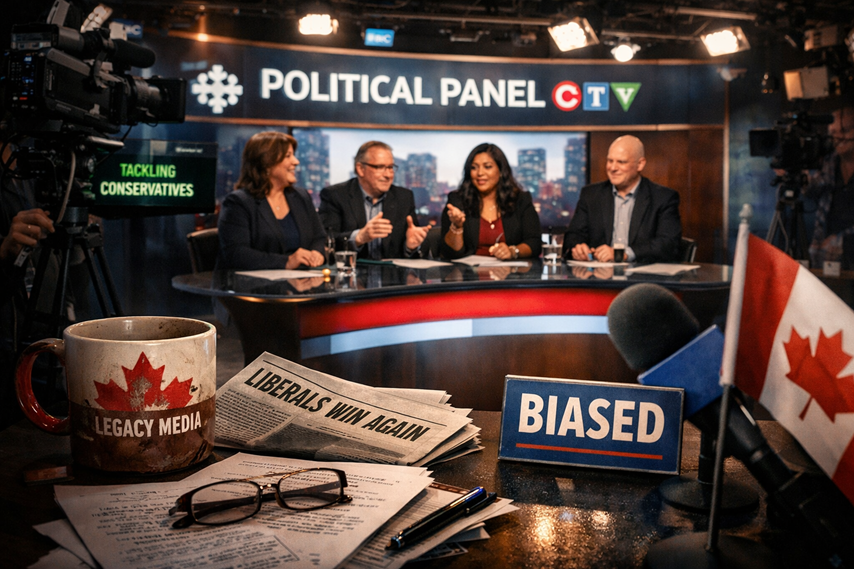
Canada’s mainstream media as Liberal Party propagandists.
Image from Melanie In Saskatchewan

Now ask yourself this: if half the population consistently feels unheard by these panels, is that a coincidence, or the predictable result of decades of the same ideological herd wandering through the same studios?

Here is the rub. The At Issue panel rarely rotates through voices that actually represent today’s conservative electorate. Instead, it routinely features professional journalists and political insiders who debate among themselves, talking about conservatives far more often than they engage with conservatives whose voters make up a massive share of the country. That is not centrism. It is an echo chamber assembled by committee.

Then there is Andrew Coyne. He is often presented as the token ideological counterweight on At Issue, the panel’s supposed nod to conservatism. After all, he has spent decades as a columnist and editorial thinker, comfortably critiquing governments from a well upholstered perch.

But let us be clear. Coyne is not remotely representative of today’s conservative electorate. He is not a reflection of the current Conservative Party base. He is not channeling the instincts of voters outside the Ottawa and Toronto corridor.

Positioning him as the conservative voice on a national panel is not balance. It is branding. It allows producers to claim ideological diversity without ever inviting someone who actually carries the convictions, tone, or priorities of the modern conservative movement. Coyne is not a grassroots conservative. He is a professional pundit whose worldview fits tidily within the Ottawa insider class. That is not ideological contrast. It is controlled opposition dressed up as pluralism.

Meanwhile, audiences have been increasingly vocal online about the sense that these panels sound like academic seminars, not reflections of the lived experience of Canadians who didn’t spend their twenties in Ottawa press galleries.

Don’t call German Chancellor Friedrich Merz anything disrespectful … or else

Filed under: Germany, Liberty, Media, Politics — Tags: , , , — Nicholas @ 04:00

German law provides far more protection for the reputations of politicians than any rational country should ever do … because free citizens should always have the right to criticize their political leaders under any circumstance short of threats and physical violence. And by “disrespectful”, they mean anything as trivial as referring to the Chancellor as “Pinocchio”:

In the latest retarded case of political repression to afflict the Federal Republic of Germany, police are investigating a pensioner for the crime of associating the German Chancellor with an iconic children’s book character.

From the Heilbronner Stimme:

    When … Friedrich Merz and Baden-Württemberg Minister President Winfried Kretschmann came to Heilbronn last October for the opening ceremony of the Innovation Park Artificial Intelligence (IPAI), the celebrity visit occasioned discussion discussion on social media.

    A post appeared on the Heilbronn Police Facebook page informing locals about a temporary flight ban enacted for security during the visit. A resident of Heilbronn responded by writing that “Pinocchio is coming to [Heilbronn].” He included a long-nosed emoji.

    Three months later, at the end of January, the man could hardly believe his eyes as he received a letter from the criminal police informing him that he is now under investigation for his comment. He is suspected of committing the crime of insult as prohibited by Section 188 of the Criminal Code.

StGB §188 is the notorious “lèse-majesté” statute, which the Bundestag expanded substantially in 2021 when politicians grew tired of being criticised for suspending most of our democratic freedoms in a mad drive to exterminate a respiratory virus. As currently formulated, StGB §188 enhances penalties for “insult, malicious gossip and defamation” when the rabble direct these at “persons in political life”, and also makes these transgressions easier to prosecute. In this case, the pinched schoolmarms on the “social media team” who run the Heilbronn Police Facebook page filed a complaint with prosecutors as soon as they noticed our pensioner’s comment. Apparently it is their policy to monitor comments and cry to teacher whenever they see anything they don’t like.

Update, 25 February: Welcome, Instapundit readers! Have a look around at some of my other posts you may find of interest. I send out a daily summary of posts here through my Substackhttps://substack.com/@nicholasrusson that you can subscribe to if you’d like to be informed of new posts in the future.

Canada’s climate follies, a brief update

On Substack, John Robson looks at the Canadian federal government’s lofty climate goals and their pathetic strategies to achieve those goals and the vast chasm between the two:

Chinese electric vehicles are likely coming to Canadian roads, like these BYD models.

Forgive us for being fixated on Canada’s climate follies just because we live here. But they are revealing, including the U-turn on EVs that we mentioned last week where the government yanked the steering wheel so hard they did a 360 from banning gasoline vehicles by law to banning them by regulation. Raising the question whether they actually know what they’re doing and, if so, whether they regard themselves as commendably devious or just way smarter than everyone else. We hope not the latter because the policy is going to fail big-time. As Randall Denley just warned in the National Post, “To summarize, the Carney plan relies on electric vehicles (EVs) that Ontario plants don’t produce, a sudden and dramatic new appetite for buying EVs and an imagined export market that doesn’t exist. To top it off, the federal government will provide $2.3 billion in EV rebates that will encourage Canadians to buy cars made elsewhere.” Apart from that, a stroke of genius of the sort that, through decades of diligent effort, has made the nation tragically poorer without hitting any of our targets including the one where they get more humble.

As a Globe & Mail news story blurted out:

    A new study published Friday by the Canadian Climate Institute says Canada is not on track to meet any of its climate targets – not the 2026 interim emissions reduction target, the 2030 Paris Agreement commitment, or even the long-term goal of reaching net-zero emissions by 2050.

Oh. Pretty hard to make that one sound like an achievement, isn’t it? Or to sound as if the people who pulled it off should be trusted with the next one.

Now as we’ve complained before, the “Canadian Climate Institute” bills itself as some sort of dispassionate neutral observer when in fact it’s a creature of the state. And, worse, one of those lavishly-funded outfits (we deniers may have all the money, but they got $30 million from the Canadian government and we did not … uh no, that was just one grant, the total’s higher) that exists to push the government to do things it wants to do anyway but needs the appearance of “civil society” support to pull off.

Thus, the Globe sonorously informs us, the problem isn’t that the targets were impractical or the politicians and bureaucrats inept. Heck no. As usual with Thomas Sowell’s “unconstrained vision” of public policy, all you need is love:

    The report suggests Canada has moved away from its climate goals thanks to “a slackening of policy effort over the past year, marked by the removal or weakening of climate policies across the country”.

Which gives the impression they had been on track to meet their goals up until some recent backsliding, whereas in reality they have never shown any sign of meeting them. After all, what policies have actually changed since Carney took over as Prime Minister in ways that could possibly affect long-term trends? And how close was Canada to meeting “its climate goals” before this disastrous swerve into the camp of the deniers?

It’s not even true that “Canada” as a collective has collective “climate goals”. The government has climate goals, and they come bundled with a host of other policies at election time, especially since even our “Conservative” party is terrified of challenging climate orthodoxy. Public support for those goals is weak, sporadic and prone to vanish when real costs hove into view. But ignoring that piece of typical collectivist prose, Mark Carney has spent most of his prime ministership flying around virtue-signaling in the presence of others doing the same. (No, really. It’s been less than a year and he’s taken almost three dozen flights.) He hasn’t been in the office shredding this and demolishing that.

What did Prisoners eat at Folsom in 1925? – Lamb Curry & Beans

Filed under: Food, History, Law, USA — Tags: , , , , — Nicholas @ 02:00

Tasting History with Max Miller
Published 26 Aug 2025

Lamb curry with onions and carrots served with white bread and plain pinto beans

City/Region: Folsom, California
Time Period: 1916-1933

Folsom Prison is infamous, but the food doesn’t sound like it was all that bad, though there was plenty of watery gruel made from the water salt pork had been soaked in, and if you were in solitary confinement, you got a diet of bread and water with beans every third day. Meals weren’t all terrible, though. A 1925 menu show foods like Hamburger Steak with Brown Gravy, Split Pea Soup, and Lamb Curry & Rice, which is what we’re making here.

In the 1920s, a lot of the cooks were using military manuals, so that is where the base of this recipe comes from, along with a list of ingredients from a commissary report from 1933.

It’s actually quite good, though I would add as much as double the amount of curry powder as was specified in the historical recipe. The beans are a little plain, but that’s to be expected.

    382. Beef, curry (for 60 men).
    Ingredients used:
    20 pounds beef.
    1 1/2 ounces curry powder.
    Cut the beef into 1-inch cubes and place in a bake pan; cover with beef stock or water; season with salt, pepper, and curry powder. When nearly done, thicken slightly with a flour batter. Serve hot.

    Manual for Army Cooks, 1916

    LAMB CURRIE and RICE
    1160 pounds Mutton
    830 ” Rice
    300 ” Onions
    400 ” Carrots
    1 bottle Curry
    Commissary report from Folsom Prison, February 1, 1933

(more…)

QotD: The! Exclamation! Mark!

Filed under: Britain, Humour, Quotations — Tags: , , — Nicholas @ 01:00

They are everywhere one looks. The mandatory symbol of the overfamiliar: “We’ve got your order!”

To the grammatically sane, reading the exclamation mark in its proper mode, the modern world appears increasingly deranged, authored seemingly by caffeinated twelve-year-olds. The delirium jumps at you in emails, on billboards, from the end of every other sentence.

The exclamation mark — the name a dead giveaway — means to exclaim. To cry out or speak suddenly or excitedly, as from surprise, delight, horror, etc. That line and dot seize your attention. Help! Now, it seizes your last nerve. Stop! If everything is exclamatory, then nothing is.

To the cynic, the exclamation mark is a hypodermic needle spiking foreign joy into the bloodstream of language. With each excitable email, I wonder, is this person in need of urgent medical attention? Or have they overdosed on Adderall?

Christopher Gage, “Against Enthusiasm”, Oxford Sour, 2025-11-21.

Powered by WordPress