Quotulatiousness

December 31, 2025

The Royal Canadian Navy … a terrorist organization according to Iran

Filed under: Cancon, Middle East, Military — Tags: , , , — Nicholas @ 05:00

An unexpected post from True North Strategic Review, as Noah shares the details of a new announcement from the Islamic Republic of Iran about that well-known terrorist group known as His Majesty King Charles’s Royal Canadian Navy (RCN):

Statement from the Iranian Ministry of Foreign Affairs, via True North Strategic Review

Welp. Sometimes you wake up to the most random things imaginable. This is certainly one of them in my books.

The Iranian Ministry of Foreign Affairs has released a statement today officially designating the Royal Canadian Navy as a Terrorist Entity under the “Tit-for-Tat” trigger outlined in Article 7 of the Reciprocal Action Against the Declaration of the Islamic Revolutionary Guard Corps as a Terrorist Organization by the United States Act.

Here is the translated statement for those curious:

    Since the Canadian government has declared the Islamic Revolutionary Guard Corps, which is recognized as one of the pillars of the country’s official armed forces, a terrorist organization, contrary to the fundamental principles of international law, the government of the Islamic Republic of Iran, based on the principle of reciprocity and based on Article 7 of the “Reciprocal Action Against the Declaration of the Islamic Revolutionary Guard Corps as a Terrorist Organization by the United States” Act passed in 2019, which stipulates that “all countries that in any way comply with or support the decision of the United States of America to declare the Islamic Revolutionary Guard Corps as a terrorist organization shall be subject to reciprocity,” considers the Royal Canadian Navy to be subject to the aforementioned Act and its provisions, and therefore, within the framework of reciprocity, identifies and declares it as a terrorist organization.

For a bit of context, under the Reciprocal Action Against the Declaration of the Islamic Revolutionary Guard Corps as a Terrorist Organization by the United States Act, the Iranian government includes a clause stating that any country that supports or complies with the U.S. decision to label the IRGC as terrorists is also subject to reciprocity.

This retaliation clause is in direct response to the Canadian government’s decision last June to declare the Islamic Revolutionary Guard Corps as a terrorist entity. Although quite late to respond, the decision to designate the Royal Canadian Navy specifically is a curious one.

The likely scenario is that the choice was made based on operational proximity. The Royal Canadian Navy is the branch of the Canadian military most likely to physically encounter Iranian forces. They’re really the only branch that maintains a tangible, visible presence near Iranian territory. By designating the Navy specifically, Iran is creating a legal pretext to harass or target Canadian vessels in these international waters under the guise of Counter-Terrorism operations.

The Korean War Week 80: Empty Lines and Guerrillas: X-mas ’51 in Korea! – December 30, 1951

Filed under: Britain, China, History, Military, USA — Tags: , , , , , — Nicholas @ 04:00

The Korean War by Indy Neidell
Published 30 Dec 2025

It’s Christmas, 1951, and though peace on earth and goodwill to all men might have a general appeal, peace seems as far away as ever in Korea. There are, though, no large scale offensives being planned at the moment, as the frozen winter grips Korea and the peace talks drag on and on. However, just because the war between armies is quiet, doesn’t mean Korea is; anti-guerrilla operations claim lives by the thousands, and the general drudgery of the war also takes thousands of lives on both sides each and every month. Christmas in Korea is grim.

00:00 Intro
00:27 Recap
00:49 POW Lists
02:25 New Offensive
05:29 Fighting the Guerrillas
07:20 Casualty Numbers
09:04 Boatner and the 23rd
11:54 Inspections and China
13:27 Summary
13:59 Conclusion
(more…)

Do you want tribalism? Because this is how you get tribalism

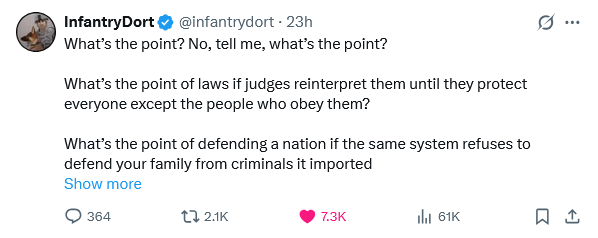
On the social media site formerly known as Twitter, InfantryDort asks the key questions about where our “elites” are taking us:

What’s the point? No, tell me, what’s the point?

What’s the point of laws if judges reinterpret them until they protect everyone except the people who obey them?

What’s the point of defending a nation if the same system refuses to defend your family from criminals it imported on purpose?

What’s the point of paying taxes if they fund fraud, reward deception, and subsidize parallel systems that never owed this place loyalty?

What’s the point of working, building, serving, if your labor is redistributed to those who broke the rules to get here?

What’s the point of accountability if paperwork matters more than reality, and intent matters less than optics?

I’ll tell you what the point is. The point is that any human with a brain is going to retreat to whatever group rewards his values and sacrifice. If it isn’t the nation, it becomes the tribe. And when it becomes the tribe, this American experiment is over.

A warrior can endure hardship, loss, and some long odds. What he cannot endure is betrayal by design.

When a nation stops enforcing its boundaries, its laws, and its obligations to its own people, it doesn’t just lose control, IT BURNS THE VERY WILL REQUIRED TO DEFEND IT.

I want something to defend that I believe in. We all do. I take the oath deadly serious. But one begins to wonder after awhile if that makes for a patriot or a sucker.

If a Soldier can follow it and die in defense of his country, but on the other side of the coin, there is a politician who can spit on it and get rich while importing and funding pirates … it really makes one wonder: What’s it all for?

@POTUS we know what problems you face. It’s not lost on us. But we are running out of time sir.

One of the things that makes these kinds of scam viable in western culture is that we are high-trust cultures with default assumptions that most people are not trying to exploit kindness and charity. This breaks down quickly once you introduce enough people from low-trust and tribal cultures:

The fraudulent spending of taxpayer dollars we are seeing uncovered nationally all rotates around the essential goodness of the American people.

Daycare for children? Of course — we don’t want our children or parents to suffer because Mom has to work.

Foodbanks? We don’t want anyone to starve. Our nation is better than that.

Homeless shelters? Homelessness is a scourge upon the American dream. We’re better than that.

Home elder care? The generations before us deserve dignity and respect. How could anyone oppose that?


Deep down we are a charitable and giving nation unlike most others. That sense of goodness and charity has been hijacked and exploited by foreign predators for their own material gain.

We need to wise up and toughen up, and understand that not every siren song of charity is on the level, particularly when our tax dollars are involved.

(Also, this reality gives an added layer of meaning to the concept of “suicidal empathy”.)

Ian at The Bugscuffle Gazette explains that importing the third world means that you need to expect your culture will start becoming more like the third world:

It says something1 about he state of Legacy Media when a 20-something kid with an iPhone can do a better imitation of 60 Minutes than 60 Minutes can.

No, Gentle Readers, I am not — in any way — surprised that Somalian immigrants in Minnesota are happily committing fraud — remember, do, that I grew up in Africa.

One of the things that endear Americans — and Western Europeans in general — to me is the sheer naiveté displayed by same. The ability of the average American to remain convinced that the entire World is just like them is rather cute.2

Folks, fraud and bribery is the norm in the Third World. In tribal cultures fraud and bribery are not only the norm, but are the rule.

If the average American reader takes nothing else from this essay, please understand that fraud and bribery are not crimes in the Third World; that fraud and bribery are not only not crimes in tribal society, but they are expected, required, and a perfectly acceptable part of every day tribal life.

And Somalia is not only Third World, but it is excessively tribal.

So, I’m not really mad at the Somalis. You can’t get mad at a gopher for digging up your yard. Gophers got to dig, and tribal cultures got to tribal.

That by no means signals that I don’t think the fraudsters should be excused. Hell, no. Public trials, and if found guilty — maximum sentences. Those lacking in U.S. citizenship, once the full prison sentence is completed, loaded onto a C-5 Galaxy and bodily pitched off of the ramp onto a random Somalian airport tarmac.3

What has stoked my ire is the fact that the Somalis used one of the most heavily-regulated industries to commit their fraud — that should have everyone up in arms.

Childcare is the responsibility of at least one Minnesota State agency — probably more — and will have mandated State-level inspections and audits.

Let me re-state that: Minnesota government employees would be legally-required and paid to walk their happy little arses into those businesses and use their Mk1 Mod 0 Eyeballs to look around at least once a year. If you were an inspector for whichever Minnesota agency(ies) regulates child care facilities, and you never filed a “Hey, something ain’t right” report, it’s time for a Come-To-Jesus Meeting in a brightly-lit room with humour-impaired law enforcement types.

If nothing else, the fact that one of these allegedly fraudulent pre-schools not only mis-spelled “Learning” as “Learing”, but mis-spelled the name of the street in the publicly-posted address should have been a red flag to someone.4

This sheer dollar amount of fraud, over this amount of time, and using this many separate corporate entities means that multiple people in the Minnesota State government knew something stunk to high heaven.

Minnesota government employees who knew of this fraud need to do the maximum allowed felony time.


  1. Not, you know, anything good.
  2. The ability of the average American leader — who is supposed to know better — to do the same is aggravating and dangerous.
  3. Bringing the aeroplane to a full stop during this process not absolutely required.
  4. Us cynical retired law enforcement types call this a “clue”.

Baker Pattern 1800 Rifle for Napoleonic Wars Sharpshooters

Filed under: Britain, History, Military, Weapons — Tags: , , , — Nicholas @ 02:00

Forgotten Weapons
Published 11 Aug 2025

The British military decided to organize their disparate small units of riflemen into a single standardized group in 1800. The 95th Regiment – the British Rifle Corps – was founded and it was equipped with a pattern of rifle designed by one Ezekiel Baker. This was a .625 caliber rifle with a 30” long barrel and a remarkably slow 1:120” rifling twist. That rifling was deliberately chosen to balance rifle accuracy with ease of loading and it worked quite well as a compromise solution. The Baker was considered effective on individual targets to 200 yards (300 with a particular skilled marksman) and area targets out to 500 yards.

The Baker was used throughout the Napoleonic Wars and only replaced in 1838 by the Brunswick rifle. This example is one of the original 1800 pattern, modified in 1815 to replace its distinctive bayonet bar (used to fit the large short sword bayonet made for the Baker) with a typical socket bayonet lug.

BritishMuzzleLoaders playlist on the Baker: • The 1800 Baker Rifle: Two (Very) Frequent…
(more…)

QotD: The cloth trade in the ancient and medieval world

Filed under: Economics, Europe, History, Quotations — Tags: , , , , , — Nicholas @ 01:00

Fabric as a finished product is somewhat different from the other products (grain and iron) we’ve discussed in this series so far. Bulk grain is a commodity – which means that one kilogram of grain is pretty much like the next. When grain gets traded in bulk it is because of differences in supply, not generally because grain in one region or other is particularly tasty. Consequently, you only get bulk grain trading when one area is producing a surplus and another not producing enough. The same is more loosely true of iron; Iron wasn’t a perfect commodity in the pre-modern world since some ores produced better quality metal than others and some trade in high quality ores or metal (like wootz) happened. But for every-day use, local iron was generally good enough and typically available. Iron could be – and often was – treated as a commodity too.

Fabric is not like that. While the lower classes will often have had to make do with whatever sorts of cloth is produced cheaply and locally, for people who could afford to have some choices the very nature of textile production produces lots of regional differences which incentivized trade. Almost everything about textile production is subject to regional variations:

  • What fibers are being used. Major wool and linen producing regions tended to be separate, with wool (and sheep) in colder climates and uplands while (as noted) flax tended to be grown in warmer river-valleys with rich alluvial soil. Meanwhile, the cotton-and-silk producing regions generally (with some notable exceptions, mind) did not overlap with the wool and linen producing regions.
  • The nature of the local fibers. We’ll get to some specific examples in a moment but ancient and medieval writers were well aware that different growing conditions, breeds of sheep or flax, climate and so on produced fibers of subtly different qualities. Consequently, even with the exact same processes, cloth produced in one region might be different from cloth produced in another region. But the processes were almost never the same because …
  • Local variation in production processes. Again, we’ll have some examples in a moment, but the variance here could be considerable. As we’ve seen, the various tasks in cloth production are all pretty involved and give a lot of room for skill and thus for location variations in methods and patterns. One might see different weaving patterns, different spinning techniques, different chemical treatments, different growing or shearing methods and so on producing fabrics of different qualities which might thus be ideal for different purposes.
  • Dye methods and availability. And as we discussed last time, available dyestuffs (and the craft knowledge about how to use them) was also often very local, leading to certain colors or patterns of color being associated with different regions and creating a demand for those. While it was often possible to ship dyestuffs (although not all dyestuffs responded well to long-distance shipping), it was often more economical to shift dyed fabric.

Added on top of this, fabric is a great trade-good. It is relatively low bulk when wrapped around in a roll (a bolt of fabric might hold fabric anywhere from 35-91m long and 100-150cm wide. Standard English broadcloth was 24 yards x 1.75 yards; that’s a lot of fabric in both cases!) and could be very high value, especially for high quality or foreign fabrics (or fabrics dyed in rare or difficult colors). Moreover, fabric isn’t perishable, temperature sensitive (short of an actual fire) or particularly fragile, meaning that as long as it is kept reasonably dry it will keep over long distances and adverse conditions. And everyone needs it; fabrics are almost perfect stock trade goods.

Consequently, we have ample evidence to the trade of both raw fibers (that is, wool or flax rovings) and finished fabrics from some of the earliest periods of written records (spotting textile trade earlier than that is hard, since fabric is so rarely preserved in the archaeological record). Records from Presargonic Mesopotamia (c. 2400-2300) record wool trading both between Mesopotamian cities but wool being used as a trade good for merchants heading through the Persian Gulf, to Elam and appears to have been one of, if not the primary export good for Sumerian cities (W. Sallaberger in Breniquet and Michel, op. cit.). More evidence comes later, for instance, palace letters and records from the Old Babylonian Empire (1894-1595) reporting the commercialization of wool produced under the auspices of the palace or the temple (Mesopotamian economies being centralized in this way in what is sometimes termed a “redistribution economy” though this term and the model it implies is increasingly contested as it becomes clearer from our evidence that economic activity outside of the “palace economy” also existed) and being traded with other cities like Sippar (on this, note K. De Graef and C. Michel’s chapters in Breniquet and Michel, op. cit.).

Pliny the Elder, in detailing wool and linen producing regions provides some clues for the outline of the cloth trade in the Roman world. Pliny notes that the region between the Po and Ticino river (in Northern Italy) produced linen that was never bleached while linen from Faventia (modern Faenza) was always bleached and renowned for its whiteness (Pliny, NH 19.9). Linen from Spain around Tarragona was thought by Pliny to be exceptionally fine while linens from Zeola (modern Oiartzun, Spain) was particularly durable and good for making nets (Pliny, NH 19.10). Meanwhile Egyptian flax he notes is the least strong but the most fine and thus the most expensive (Pliny NH 19.14). Meanwhile on wool, Pliny notes that natural wool color varied by region; the best white wool he thought came from the Po River valley, the best black wool from the Alps, the best red wool from Asia Minor, the best brown wool from Canusium (in Apulia) and so on (Pliny, Natural History 8.188-191). He also notes different local manufacture processes producing different results, noting Gallic embroidery and felting (NH 8.192). And of course, being Pliny, he must rank them all, with wool from Tarentum and Canusium (Taranto and Canosa di Puglia) being the best, followed more generally by Italian wools and in third place wools from Miletus in Asia Minor (Pliny NH 8.190). Agreement was not quite universal, Columella gives the best wools as those from Miletus, Calabria, and Apulia, with Tarantine wool being the best, but demoting the rest of the Italian wools out of the list entirely (Col. De Re Rust. 7.2).

In medieval Europe, wool merchants were a common feature of economic activity in towns, with the Low Countries and Northern Italy in particular being hubs of trade in wool and other fabrics (Italian ports also being one of the major routes by which cottons and silks from India and China might find their way, via the Mediterranean, to European aristocrats). Wool produced in Britain (which was a major production center) would be shipped either as rovings or as undyed “broadcloths” (called “whites”) to the Low Countries for dyeing and sale abroad (though there was also quite a lot of cloth dyeing happening in Britain as well).

Bret Devereaux, “Collections: Clothing, How Did They Make It? Part IVb: Cloth Money”, A Collection of Unmitigated Pedantry, 2021-04-09.

December 30, 2025

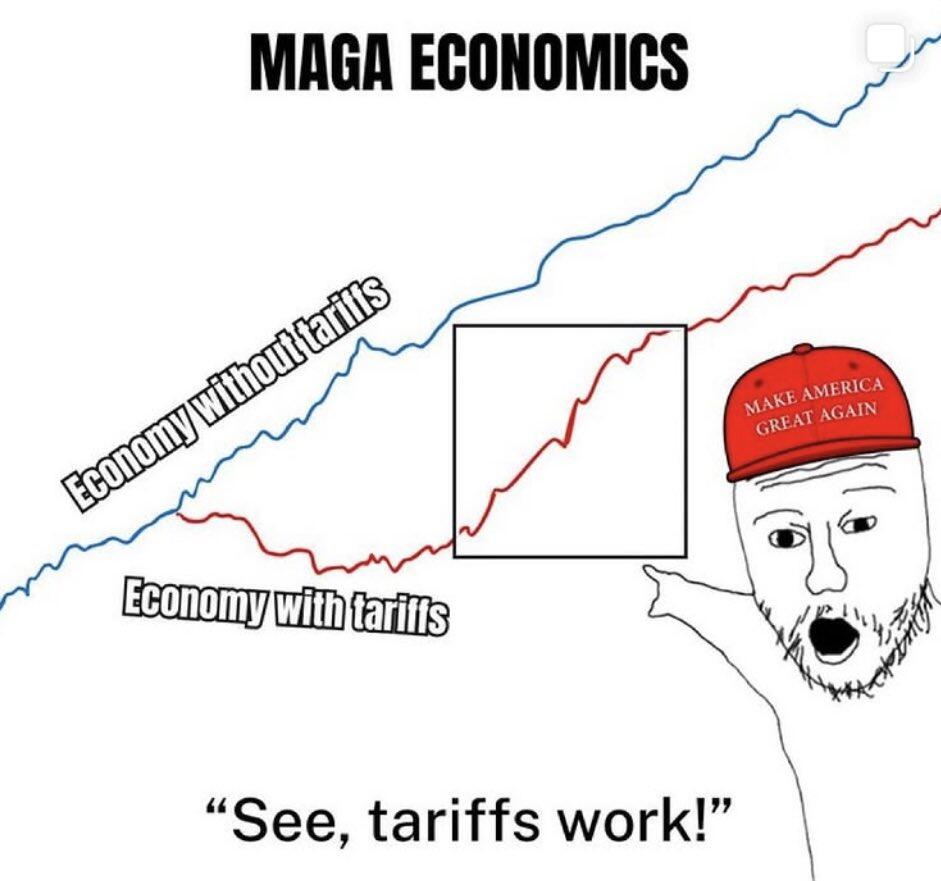
Tariffs are an economic burden, even when you claim they’re paid by foreigners

Filed under: Business, Economics, Government, USA — Tags: , , , , — Nicholas @ 04:00

At the Foundation for Economic Education, David Hebert responds to a recent pro-tariff puff piece from financial columnist, Matthew Lynn:

As Lynn acknowledges, “the tariffs are a tax”. Because they are a tax, they are going to be paid by someone in some form. You can’t have money flowing into the Treasury without someone paying that extra money in some way. Broadly speaking, we can divide the potential payors of American-imposed tariffs into three camps: American consumers, American importers, and foreigners.

One of the oft-cited effects of a tariff is to reduce the amount of imports coming into America. This makes sense and is in fact one of the numerous goals administration officials have pointed to. Insofar as American consumers and importers end up paying the tariff, they will buy less of the now-more-expensive foreign products. We’re already seeing this happen in the US, which Lynn alludes to throughout his article.

If foreigners pay the tariff, they’ll sell less of the now-tariffed goods to the US. This will, as President Trump and others have correctly identified, hurt their bottom line. To offset at least some of this, these countries will try to sell more of their products to their domestic consumers or consumers in countries other than the US. This is exactly what we have seen and what we are seeing, as other countries around the world are securing new trade deals with one another and deliberately excluding the United States from said deals.

So, Lynn is correct to point out that foreign corporations have incurred costs because of the Trump tariffs. However, despite his repeated implication to the contrary, this is not money that goes to the US Treasury. Volkswagen, for example, has raised the price of its 2026 models by up to 6.5 percent, largely due to tariffs, and has indicated that this is just the beginning. That’s more money coming out of American consumers’ pockets. At these higher prices, American consumers are purchasing fewer Volkswagens than last year. Volkswagen’s losses from the tariffs include an almost 30 percent decline in profits from auto sales. Importantly, sales that do not happen count toward the reduced profit that Volkswagen reported but generate no tariff revenue for the Treasury to collect. That Lynn, a financial commentator, does not understand this distinction is deeply troubling.

Who Really Pays the Tariff?

Lynn’s central argument rests on a fundamental confusion between what economists refer to as the “legal incidence” and the “economic incidence” of a tax. Legally, because tariffs are a tax on imports, it is the US importers who must write the check to Customs and Border Protection. But this says nothing about who actually pays the tariff.

For example, when landlords’ property taxes go up, who pays? The landlord will obviously write the check to the county assessor, but unless Lynn thinks that landlords are running charities, that cost gets passed on to tenants in the form of higher rent, less frequent maintenance, or fewer included benefits (utilities or access to designated parking, for example). The legal incidence falls on the landlord, but the economic incidence falls disproportionately on renters, i.e., young Americans already besieged by high housing costs.

Tariffs work the same way. US Customs and Border Protection bills the American importer directly, which is the legal incidence of the tariff. But the economic burden gets distributed among American consumers, American importers, and foreign exporters, depending on the particulars of the individual markets.

Lynn cites the Harvard Pricing Lab finding an approximately 20 percent “pass-through rate,” meaning that American consumers are only paying about one-fifth of the tariff costs. He treats this as a permanent feature of the tariff regime and as proof that foreigners are footing the bill. But the question isn’t who writes the check today, it’s who bears the cost over time. And here, the evidence directly contradicts Lynn’s fables.

As we have seen, pass-through rates are not static, but evolve over time as markets adjust. And every piece of evidence suggests that the pass-through rate has been and is continuing to rise rapidly. Goldman Sachs and the Council on Foreign Relations tracked the evolution over just this administration. Their findings are stunning: In June, US businesses absorbed about 64 percent of the tariff costs, American consumers about 22 percent, and foreign exporters about 14 percent in the form of reduced profits. Just four months later, American businesses absorbed just 27 percent, while American consumers absorbed 55 percent and exporters absorbed 18 percent. Projections for 2026 continue the trend with consumers absorbing 67 percent, exporters 25 percent, and importers just 8 percent.

The logic behind this is simple and has been echoed by President Trump and Scott Bessent themselves. In the initial months following Liberation Day, American importers could not quickly shift to alternative suppliers, giving them little leverage to demand price cuts from existing foreign vendors. Many American importers also believed (or hoped?) that the tariffs were simply a negotiating tool that would be bargained away. Having built up inventories before April, they were able to avoid raising consumer prices, with the belief that the “temporary pains would be worth the long term gains.”

That’s no longer the case. As the BLS notes in its latest import price index report, the price of imports has barely changed. This matters because US importers, not foreign sellers, are legally required to write the tariff check. American buyers pay the foreign company’s price, then pay the tariff on top of it. If foreigners were truly absorbing the tariffs, they’d have to lower their prices to compensate, and we would see a decrease in the import price index. We haven’t. The index is flat, which is evidence that the burden of the tariff is, as economists warned, being paid disproportionately by Americans in one form or another. As the Council on Foreign Relations analysis points out, by October, importers have “had time to seek alternative suppliers, giving them a bit more negotiating leverage.” More importantly, the “trade deals” that the administration has inked have made it clear that substantially higher tariffs are here to stay. All of this gives importers and retailers good reason to continue passing more of the costs along to consumers.

We are already seeing evidence of this happening. The Federal Reserve Bank of Boston’s survey of small and medium-sized businesses, for example, confirms this dynamic. Firms expecting tariffs to persist for a year or longer plan to pass through three times more of their cost increases to consumers than firms expecting short-lived tariffs. As of August, over 45 percent of affected businesses expected their costs to be impacted for longer than a year.

But how does all of this compare to the pass-through rate felt during the 2018–2019 tariffs? The Harvard Pricing Lab — the same data that Lynn cites — actually undermines his entire argument. After just six months, the 2025 tariff pass-through rate is indeed around 20 percent. But if we compare this to the 2018 tariffs, the difference is night and day. After Trump’s first-term tariffs, the pass-through rate stayed under 5 percent after a full year. This isn’t evidence that these tariffs are working. It’s evidence that these tariffs are hitting consumers harder and faster than the previous round.


“This is where Canada is now”

Filed under: Cancon, Economics, Government, Media, Politics — Tags: , , , , — Nicholas @ 03:00

On the social media site formerly known as Twitter, L. Wayne Mathison handily sums up the state of the nation:

I’ve reached the point most people hit right before systems fail.

The point where facts stop working.

Charts don’t matter. Reports don’t matter. Evidence doesn’t matter. You can post receipts until your fingers cramp and political partisans will still clap, chant, and rationalize while the house fills with smoke. They are not misinformed. They are committed. And commitment beats reality every time.

That’s where Canada is now.

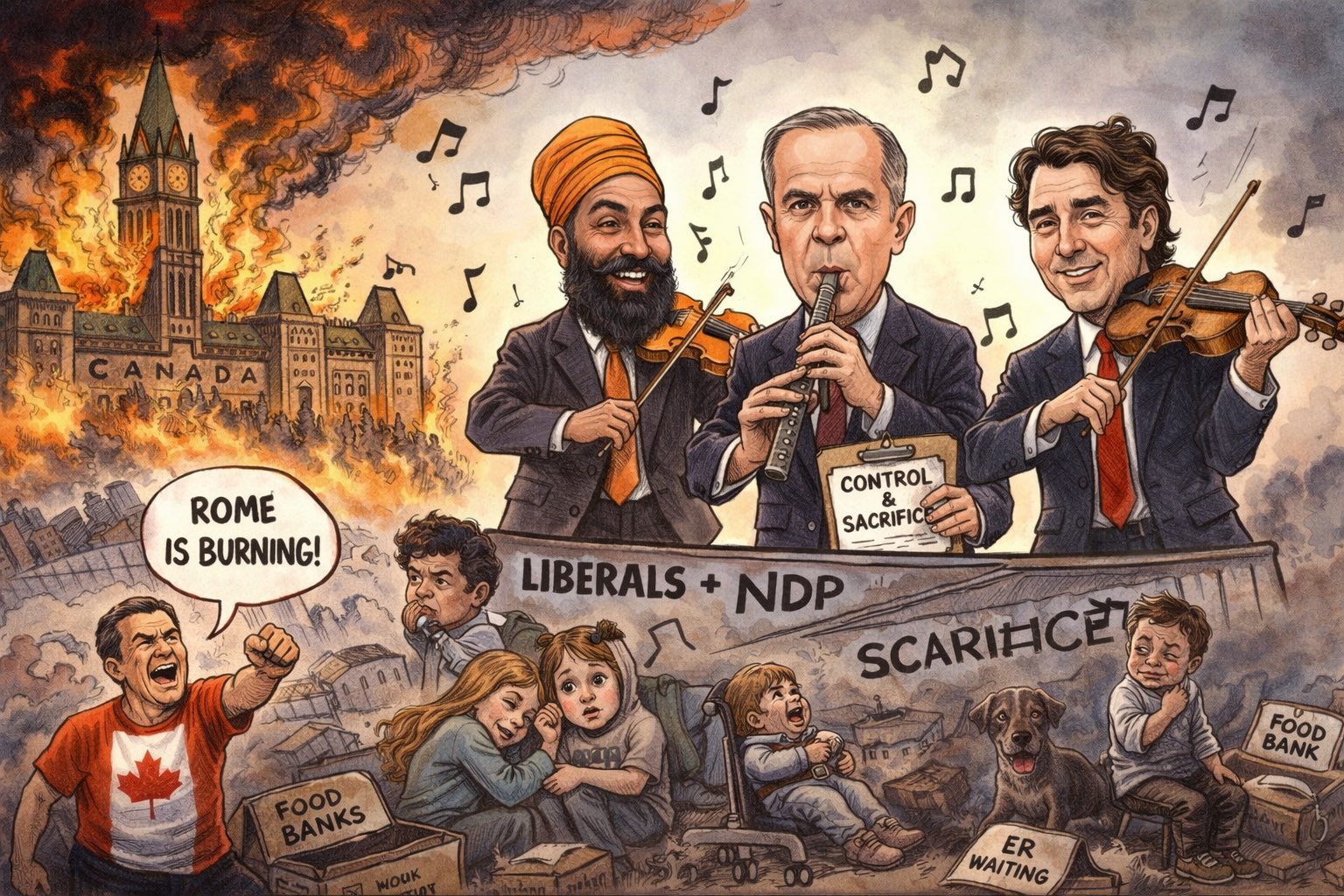
The Liberals and the NDP no longer govern with outcomes in mind. They govern with narratives. If the story sounds compassionate, the damage underneath is waved away as acceptable collateral. Housing explodes. Healthcare buckles. Food banks flood. Productivity sinks. And if you point to any of it, you’re told to be kinder, quieter, or more patient.

Patience is a luxury people without power can’t afford.

What scares me isn’t just the policies. It’s the psychology. We are watching a ruling class that confuses control with competence and optics with success. Every failure is met with more management, more spending, more moral language, and less accountability. When reality resists, they don’t change course. They tighten.

That’s where Mark Carney enters the picture, and why he should worry anyone paying attention.

Carney doesn’t speak like a democratic leader. He speaks like a risk officer explaining why losses are necessary. “Sacrifice.” “Stability.” “Confidence.” These are not solutions. They are words used when the model is failing but the managers refuse to admit it. In his world, the problem is never the plan. It’s public resistance to the plan.

That mindset is poison in a democracy.

The Liberals broke affordability and papered it over with subsidies. The NDP cheered and demanded more of the same. Now Carney offers to professionalize the decline. Smoother language. Tighter controls. Bigger levers. Less dissent. He doesn’t promise prosperity. He promises management.

Here’s the part people don’t want to hear.

You can’t fix a country by overruling its citizens.
You can’t tax, regulate, borrow, and moralize your way out of shortages.
You can’t feed kids, house families, or staff hospitals with press releases.

And when governments start treating criticism as a threat rather than a warning, history tells us what comes next. Not reform. Hardening. Surveillance language. Emergency logic. Ever broader definitions of “harm”. Ever fewer off ramps.

This is how civilizations don’t collapse in a bang. They collapse in meetings.

I don’t expect to convince partisans anymore. That window is gone. This is a warning, not an argument.

If you are still cheering while food banks replace paycheques, while hospitals ration care, while housing becomes a privilege, while leaders talk about sacrifice without ever naming their own, understand this: they are not fiddling while Rome burns. They are insisting the fire is necessary.

And once that belief sets in, facts won’t save us. Only consequences will.

By then, our children are already in the smoke.

Childhood’s End (Youtube Copyright Edit)

Filed under: Books, Bureaucracy, Media, Space — Tags: , , — Nicholas @ 02:00

Feral Historian
Published 30 Jul 2024

The 2015 adaptation of Arthur C. Clarke’s Childhood’s End has a lot going on. But Youtube won’t let me use clips from it, so here’s a stills-only recut covering the major points. A far superior cut is available at my Patreon page, along with a few other exclusives in what will surely be a growing collection of Youtube no-nos.

🔹 Patreon | patreon.com/FeralHistorian

QotD: Modern weddings

Filed under: Quotations, Religion, USA — Tags: , , , — Nicholas @ 01:00

As a Christian I deeply respect the institution of marriage, but I absolutely despise all of the useless superstitions and cultural baggage it has become freighted with. It is the lifelong union of two persons, before God and a few witnesses. Yet many have turned a simple, joyous one-day ceremony into a gruelling year-long campaign with hundreds of man-hours of planning, a long schedule of ludicrous precursors (showers, stags, rehearsals, and so on), meticulous attention to protocol, and tens of thousands of dollars. Most ridiculous of all, even the non-religious — who may never darken a church door except for nuptials and their own funeral — usually feel it necessary to get married in a house of worship. Why? Who cares what your folks or old Aunt Bertha expects, they aren’t the ones getting married. It’s your call. Be honest with yourself, if you can’t be bothered to show up at church most Sundays, what is the point of getting married there? Just go see a justice of the peace. It’s no worse and nobody with any brains will say you’re not really married. God would probably appreciate the honesty rather than the halfhearted observance of convention.

Chris Taylor, “Long Day’s Journey into Matrimony”, Taylor & Company, 2005-09-01.

December 29, 2025

The war against white men didn’t start in 2015

Filed under: Business, Economics, Education, Government, Media, Politics — Tags: , , , , , — Nicholas @ 05:00

Janice Fiamengo responds to Jacob Savage’s essay on the “lost generation” of young white men who have been subject to open and explicit discrimination in education, employment, and loudly denounced for noticing this:

Most people who have discussed Savage’s essay accept his time frame: that the exclusion of white men took place mainly over the past ten to fifteen years. But this is not true. It has been going on for much longer than that, as Nathan Glazer made clear in his comprehensive Affirmative Discrimination: Ethnic Inequality and Public Policy, first published in 1975 and updated in 1987. Government initiatives to provide jobs for women and racial minorities, particularly blacks, were rooted in the equal rights legislation of the 1960s, implemented later that decade and aggressively expanded in the 1970s and 1980s. The National Organization for Women under the leadership of Betty Friedan, for example, brought a lawsuit against the U.S. Equal Employment Opportunity Commission to force it to comply with federal legislation, and sued the country’s 1300 largest corporations for alleged sex discrimination.

Anyone wishing to read a detailed prehistory of what Savage has chronicled can also consult Martin Loney’s extensively documented The Pursuit of Division: Race, Gender, and Preferential Hiring in Canada (1998), which shows how what was called equity hiring in Canada spread across areas such as the police force, firefighting, the civil service, crown corporations, law, teaching, academia, and elsewhere, beginning in the 1980s. What Glazer’s and Loney’s research shows is that discrimination against white men in employment is far more deeply embedded than most people realize and has affected many more men than is currently recognized.

It is ridiculous to castigate Boomer white men, as it seems popular now to do, for allegedly implementing and benefiting from diversity policies. The last thing that should be encouraged is for younger white men to turn their anger on older white men. Many of these older men themselves faced active discrimination, psychological warfare, divorce-rape, and immiseration. Every organ of the culture told them it was time to change, get with it, stop being Archie Bunker, recognize the superior merits of the women and racial minorities their people had allegedly oppressed for so long. White women were by far the majority and most enthusiastic architects and proponents of equity hiring, bullied in turn by the black and brown women with whom they originally formed their alliance against white men (and all men, with a few exceptions).

Older white men may have secured (tenuous) positions of power, but they had no power in themselves as white men. Most of them knew they could find themselves disgraced, friendless, and jobless as the result of an unpopular decision or an unguarded statement. Accusations of sexual misconduct to take such men out of their positions were not confined to millennial males.

I was in the academic job market in 1997, and diversity hiring was already commonplace then. Everyone knew it was going on, and it was signaled both explicitly and implicitly in the advertisements that encouraged applications from women and visible minorities. My friend Steve Brule remembers when affirmative action was brought in at the large chemical company where he worked in 1984. At the beginning, it was said that these programs would be time-limited, lasting only for a short season. Instead, they lasted for well over 40 years and are still going strong.

It is foolish to imagine that such discrimination is now going to lie down and die. There have been a number of occasions over the last few years in which that was confidently predicted (remember Claudine Gay?) and did not occur. Already the diversity advocates, who are legion, are marshalling their counter-arguments and nit-picking the evidence, finding (or lying about) the ways in which what Savage described hasn’t really happened, recalibrating numbers, rationalizing and justifying them. Thousands of academics will spend years joining forces to discredit claims about discrimination, recasting them as a MAGA or Groyper lament and a dangerous attack on the legitimate (but still inadequate!) gains made by valiant women and long-oppressed racial minorities. Recently for The Washington Post, Megan McArdle, in an ostensibly critical article, is still playing with false justifications and outlandish untruths, saying the following about the rationale for equity hiring:

    … One could say of course it’s unfair, but repairing the legacy of slavery and sexism is a hard problem, and sometimes hard problems have unfair solutions. It wasn’t fair to round up huge numbers of men born between 1914 and 1927 and send them off to fight the Nazis, but that was the only way to win.

    One might argue that, but I haven’t seen anyone do so. No one seems brave enough to state baldly that we should penalize White men born in 1988 for hiring decisions that were made in 1985 by another White guy who was born in 1930. Instead what I’ve seen is a lot of deflection.

What bizarre nonsense, what spurious claims even if her point is that such logic is ugly. Discrimination in favor of white men has been illegal since 1964, and affirmative action/equity hiring was already fully in place by the mid-1980s when the “white guy who was born in 1930” was allegedly discriminating in his hiring practices. As McArdle inadvertently shows, we’ve been operating on the basis of deliberately-perpetrated false beliefs for years, beliefs that the intelligentsia adhered to and promulgated.

On the City Journal Substack, Renu Mukherjee argues that Supreme Court Chief Justice John Roberts is correct that “The best way to stop discrimination on the basis of race is stop discriminating on the basis of race”:

First, public opinion is clear: Americans of all racial and ethnic backgrounds have long opposed the use of racial and identity-based preferences. While this trend extends to employment, I’ve studied it extensively in the context of college admissions. The data underscore Americans’ strong support for colorblind meritocracy.

One year before the Supreme Court struck down the use of racial preferences in college admissions in Students for Fair Admissions v. Harvard, the Pew Research Center asked Americans whether an applicant’s race or ethnicity should be a factor in the college admissions process. 74 percent of respondents said that it should not, including 79 percent of whites, 59 percent of blacks, 68 percent of Hispanics, and 63 percent of Asian Americans. By way of comparison, 93 percent of Americans said that high-school grades should be a factor in college admissions, and 85 percent said the same about standardized test scores. Several surveys since then have produced similar results.

A May 2023 study that I co-authored with my Manhattan Institute colleague Michael Hartney reinforces this point. Through an original survey experiment on the 2022 Cooperative Election Study (CES), we asked Americans to play the role of an admissions officer and decide between two competing medical-school applicants. While the applicants’ accomplishments were randomly varied, the specific pair of applicants that respondents saw always consisted of an Asian American male and a black male.

Our objective was to determine whether, and when, Americans believe diversity should take precedence over merit in medical-school admissions. We found that even when respondents were informed that the medical school lacked diversity, the vast majority made their admissions decisions based on merit — in this case, college grades and MCAT scores — not race.

A few months prior to the publication of that paper, for a separate report, I reviewed hundreds of survey questions on affirmative action stored on the Roper Center for Public Opinion Research’s online database. I found that Americans are most likely to say that they oppose “affirmative action” when survey language explicitly describes the policy as providing “preferential treatment” or “preferences” for a given group. This suggests a deep American aversion to racial and gender-based favoritism — which is why Democrats, when pushing policies rooted in such ideology, tend to rely on euphemisms. Republicans should not do what even Democrats know doesn’t work.

Unfortunately, over the last few weeks, they have sounded like they might. Several prominent Republicans have taken to the social media platform X to argue that “Heritage Americans” — those who can trace their lineage to the Founding era — are inherently superior to more recent arrivals. In doing so, they suggest that the former are entitled to preferential treatment on the basis of ancestry. Here, the logic is that “all animals are equal, but some animals are more equal than others”.

Republican leaders, such as Vice President JD Vance, should reject such grievance-based politics. These ideas were unpopular when Democrats pushed them, and they will be unpopular when Republicans try them, too.

What Do We ACTUALLY Know About Homer? (Author of Iliad & Odyssey)

Filed under: Books, Greece, History — Tags: , , , — Nicholas @ 04:00

MoAn Inc.
Published 23 Dec 2025
(more…)

Will 2026 finally be the year Canada abandons food cartels?

For reasons unknown, Canadian politicians both left and right have been willing to sacrifice almost anything in trade negotiations except the cosy protectionist scheme we call “supply management”, which enriches a tiny number of farmers in Ontario and Quebec by keeping grocery prices significantly higher than the free market price. On his Substack, The Food Professor predicts that Prime Minister Carney will be forced to give up this market-rigging, anti-consumer scheme in the coming year:

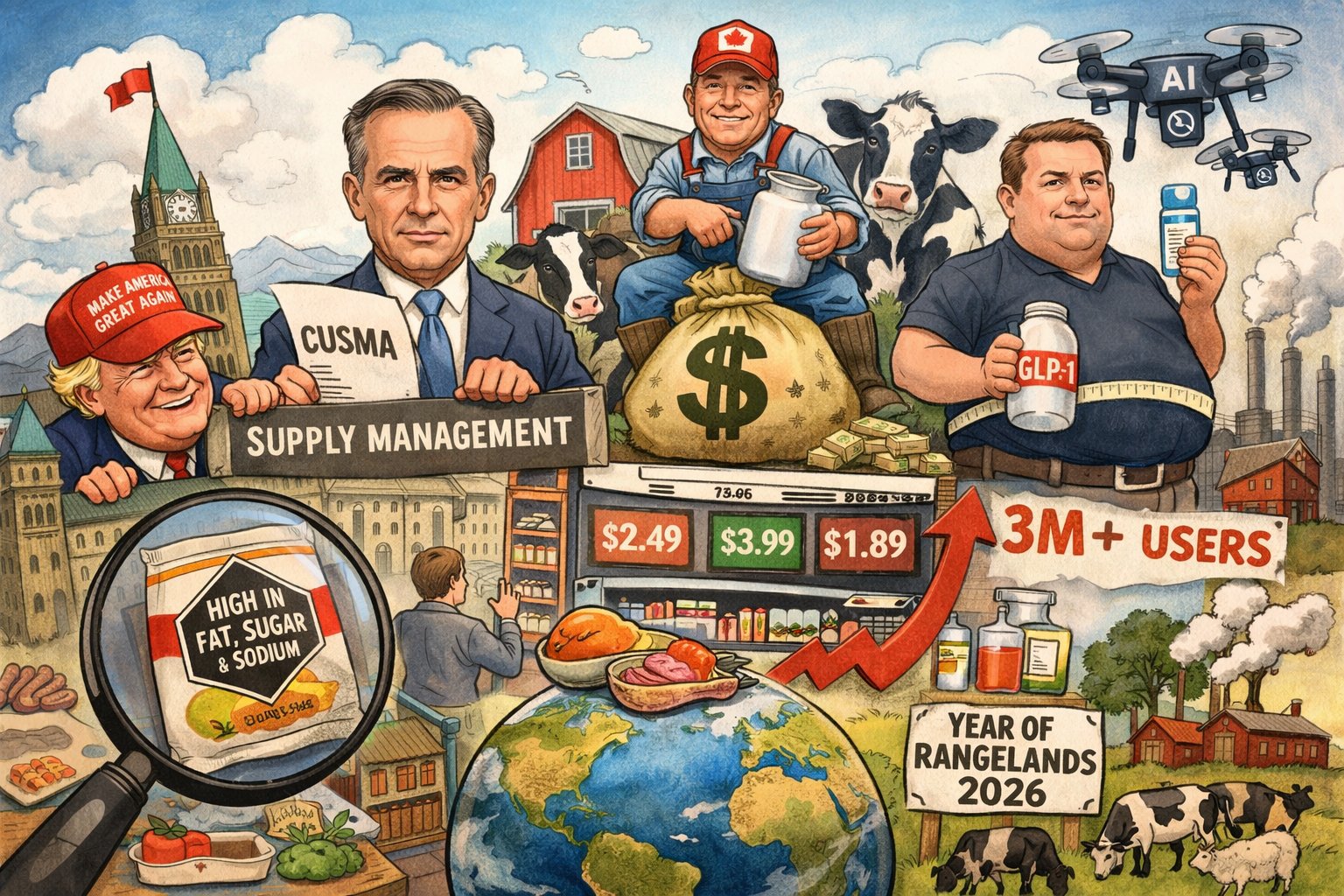
Image from Agri-Food Analytics Lab, Dalhousie University

As we enter 2026, several forces are converging to reshape Canada’s food economy. Consumer empowerment — amplified by social media — continues to accelerate, while geopolitics, particularly tensions with our southern neighbour, are becoming increasingly disruptive. Together, these dynamics will push food policy issues that once lived in technical silos into the public spotlight.

At the top of that list sits CUSMA and supply management. Prime Minister Carney has signaled firmness on market access, backed by legislation that shields supply management from parliamentary debate. That protection, however, is unlikely to endure. Even if the United States has little genuine interest in exporting more dairy to Canada — and even if Canadian consumers show limited appetite for it — President Trump now understands, far better than during his first term, that supply management is a potent political wedge. The system protects roughly 9,400 dairy farmers who exert disproportionate influence over agricultural policy, while compensation payments continue to flow without any meaningful reduction in production or market share. For a growing number of Canadians, this arrangement increasingly resembles a closed loop rather than a public good. The irony is that global demand for dairy is rising and Canadian milk should be part of that growth story. Instead, the system prioritizes insulation over ambition — a missed opportunity at a time when competitiveness should matter most.

January 1 also marks the formal implementation of new front-of-package nutrition labels. Although these symbols have been appearing on shelves for some time, many consumers either overlook them or misunderstand their purpose. Their real impact has been largely invisible to the public: they have already reshaped how food companies formulate products, invest in research, and redesign portfolios. Whether the labels meaningfully change consumer behaviour remains debatable, but their influence on product development is no longer.

[…]

Finally, 2026 coincides with the United Nations’ International Year of Rangelands and Pastoralists — a timely moment to reset the debate around meat consumption and livestock production. Rangelands underpin global meat systems by converting grasslands — often unsuitable for crops — into high-quality protein. In a world where demand for animal protein continues to grow, portraying livestock as inherently incompatible with sustainability ignores nutritional, economic, and ecological realities. Well-managed grazing supports rural livelihoods, strengthens export economies, and can enhance biodiversity and soil health rather than undermine them. If policymakers are serious about food security, climate resilience, and affordability, 2026 should mark a shift away from apologizing for meat production and toward recognizing livestock as a strategic pillar of resilient food systems — not a sector to be regulated out of existence

What Are Sugar Plums? How to make real Victorian sugar plums

Filed under: Britain, Food, History — Tags: , , , , , — Nicholas @ 02:00

Tasting History with Max Miller
Published 10 Dec 2024

Purple, green, yellow, red, blue, and white hard candies with cherry centers

City/Region: United States of America
Time Period: 1865

Sugar plums go hand-in-hand with Christmas, but what exactly are they? There are recipes out there for a confection made of dried fruit and nuts that’s rolled into balls, but true Victorian sugar plums were a kind of candy made up of layers of hardened sugar syrup and gum arabic surrounding a fruit or nut core. They were pretty much the same thing as Jordan almonds.

You won’t find many recipes for them in Victorian-era cookbooks because no one really made them at home. The specialized equipment and labor involved meant that most people bought them from a confectioner, and I can see why.

Making these was a three-day endeavor for me, and I had to get a panning machine attachment for my stand mixer, and gum arabic, which I surprisingly didn’t already have in my pantry. They’re a nice sweet treat, but really more trouble than they’re worth to make at home.

    Cherry Sugar-Plums. Set preserved cherries on a sieve in the stove. When they are partly dry, mix them with pounded sugar, and rub them over a sieve; dry them again, and proceed as with barberry sugar-plums.

    Barberry Sugar-Plums. Take perfectly ripe barberries, stem them, dry them in a stove, and add the gum and sugar in the swinging basin. To accomplish this, after being heated in the stove, give them a coating of one part sugar, and one part gum arabic; and, when thoroughly moistened, powder with sifted sugar. Dry the coating in a stove; add a second on the next day, so as to completely cover the fruit; then thicken, and finish like the verdun sugar-plums. The fruit must be coated away from the fire. They are colored like the rose sugar-plums, and pearled like the lemon.
    The Art of Confectionery, 1865

(more…)

QotD: Learning how to swim

Filed under: Football, Humour — Tags: , , — Nicholas @ 01:00

Michael Bennett has a neck injury. Mewelde Moore has a bad ankle. Onterrio “Cheech” Smith is in his basement trying to build a better Whizzinator so he can play next year. Moe Williams is more of a short-yardage back.

So Friday, the Vikings will throw young [rookie running back Ciatrick] Fason overboard to see if he can swim.

That’s not a bad practice. Years ago, that’s how a lot of youngsters really did learn to swim. Before the era of 24/7 nurturing, a father or older brother would take a boy out to the middle of a lake or river and push him into the water.

It’s quick, and it saves hundreds of dollars on swimming lessons. That’s how I learned. The only problem, as I recall, was getting out of the plastic bag. But after that, it was a cinch.

Tom Powers, “Opportunity knocks for quick-healing Fason”, St. Paul Pioneer Press, 2005-08-31.

December 28, 2025

Colt SMG: First of the 9mm ARs

Filed under: History, USA, Weapons — Tags: , , , , , — Nicholas @ 10:10

Forgotten Weapons
Published 8 Aug 2025

With the expansion of SWAT teams throughout law enforcement in the 1980s, Colt realized that it was leaving a lot of sales on the table by not having a submachine gun it could offer alongside M16/CAR-15 rifles and carbines. They addressed this in the early 1980s by adapting a CAR-15 to 9x19mm. It used an adapter in the magazine well to fit modified Uzi pattern magazines (they were given hold-open tabs on the followers), and retained the same handling and controls as the full size AR. The SMG was made as a closed bolt, hammer fired, simple blowback action. By adding weight to the bolt carrier and buffer, the rate of fire was kept down to around 800 rpm.

The Colt SMG never really captured wide appeal. It was reasonably successful for Colt in large part because of their ability to market it alongside rifles, but it was dogged by reliability problems. A bunch of different models were made with different fire control options, including a couple civilian semiautomatic models and the distinctive DoE “briefcase gun” and the integrally suppressed DEA model, although neither of those saw very substantial sales. Still, it remains available to this day.

Colt 633 DoE Reproduction: • PSA/H&R Clones the Department of Energy Co…
(more…)

Older Posts »

Powered by WordPress