
The Korean War by Indy Neidell
Published 21 Oct 2025The UN forces launch Operation Polecharge, hoping to complete Operation Commando, but they have worries away from the field, since UN pilots have violated the neutral zone and killed two young Korean boys, causing an outcry. If that weren’t enough, a new Soviet atomic bomb test has the entire world on edge.
Chapters
00:00 Intro
00:56 Recap
01:12 Operation Polecharge
02:37 Chinese Tactics
05:15 9th Corps Attacks
07:10 Unit Integration
10:04 B-29s Shot Down
11:06 The Mutual Security Act
12:47 Neutral Zone Violation
14:11 Summary
14:29 Conclusion
15:56 Call to Action
(more…)
October 22, 2025
The Korean War Week 70: Casualties Rise For The Chinese – October 21, 1951
Comments Off on The Korean War Week 70: Casualties Rise For The Chinese – October 21, 1951
The Anti-Coynist Manifesto
In a guest post at Without Diminishment, Michael Bonner takes a blowtorch to the boomer hippies and particularly to Canadian journalist Andrew Coyne. But first, the obnoxious boomers:

Part of the crowd on the first day of the Woodstock Festival, 15 August, 1969.
Photo by Derek Redmond and Paul Campbell via Wikimedia Commons.
In their own minds, they invented rebellion; they stopped a war; and they discovered sex. The latter phenomenon, they still believe, was quite unknown in former ages. So were drug-taking, vulgarity, and poor hygiene. These, as it was believed, were the means of “finding oneself”, and there was no more important task in life. Automobiles were likewise a singular obsession, and the Good Life meant not only driving but also eating, attending films, and copulating in cars.
They were an unusually forthright lot, who were apparently well educated, but who nevertheless espoused many absurd and contradictory notions. Their parents, who had gone to war to fight Nazis, were themselves branded as fascists by their own children. They professed to revolt against money and materialism; and yet, when they came of age, these were their primary interests. They were the generation that attended Woodstock in defiance of a flu pandemic, and were later the most assiduous followers of Covid-19 restrictions.
At the frightening name of Woodstock, it will be obvious who I mean. The Boomers were born to the men and women who had endured the privations of the Great Depression, the Second World War, and everything in between. It is the Boomers who prove the adage whereby good times make weak men and weak men make hard times. They disliked the ease and prosperity into which they were born, and sought to erode them. The 20th-century fear of Soviet subversion or nuclear annihilation was therefore misplaced. For where the Soviets failed, the Boomers triumphed, leaving our culture and our politics in ruins. They are still at it, as the gravitational field of their huge demographic mass continues to distort our politics. Worst of all, the Boomers’ peculiar vision of personal freedom, norm-busting, and individualism at any cost now passes for conservatism.
And on to Mr. Coyne himself (full disclosure: I’ve met Mr. Coyne a few times at early Toronto blogger gatherings and he seemed quite a sensible chap 20 years ago):
Does this Boomer conservatism have any luminaries or pundits? In Canada, it has one and he towers over his acolytes and opponents alike as a learned giant among intellectual pygmies. Or rather, that is how Andrew Coyne undoubtedly imagines himself. So great a spokesman of the Boomer conservative mentality is Coyne that the entire movement could be named after him: Andrew Coyne-ism.
Who has not heard of Andrew Coyne? He is now a columnist with The Globe and Mail and a member of the At Issue panel on CBC’s The National. He wrote for the National Post and once edited its editorial and comment section, but resigned in 2015 during the federal election. The cause was a dispute with executives over the rejection of a column composed for election day, in which Coyne failed to endorse the Conservatives. Coyne described the dispute as an unwelcome intervention that threatened his editorial independence, stating on Twitter that he could not allow the precedent to stand and needed to protect his reputation as a columnist.
That incident is a microcosm of the problem. One may fairly complain, as Coyne did, that the Harper Tories failed to please every member of their coalition equally, though such a thing is rarely possible. But the rest of Coyne’s complaints concerned a “bullying, sneering culture” of “the low brow and the lower brow”. The imperfection of policy merely annoyed him, but he hated the Conservatives’ tone. They were not sufficiently respectful, they traded in insults and did not agree that “learning and science are to be valued, not derided”, apparently. In contrast, “a politics of substantive differences, civilly expressed” was “the formula that just elected Justin Trudeau”.
Trudeau: a paragon of civility? Surely some other Trudeau is meant, not the opposition MP who called the Minister of the Environment a “piece of shit“. Not the man who, at a “ladies’ night” campaign event, was asked which country he most admired and said it was China’s “basic dictatorship“. Not the man who announced that the excitement of a political campaign amounted to “pizza, sex, and all sorts of fun things“. Not the man who mused about such subjects as “making Quebec a country” if Canada were to become too conservative and the need to put Quebeckers in charge of our “community and socio-democratic agenda” — whatever that means. Not the man who once halted an interview with a French-Canadian journalist in order to demonstrate the right way to fall down a flight of stairs. I pass over the more lurid stories of groping a reporter’s buttocks, wearing blackface, and singing the “Banana Boat” song.
Alas, it is the same Trudeau. Nevertheless, Andrew Coyne-ism can excuse all such behaviour along with the decade of sanctimonious bullying and decline that followed it. For none of it is as bad as the wishes and worldview of the mostly rural, western, and blue-collar Conservative base. Such people are too angry and too vulgar for their own good. Including them within the benefits of Confederation must be rigorously circumscribed, and allowing them to shape public policy cannot be allowed at all.
Comments Off on The Anti-Coynist Manifesto
H&K MG4: Germany’s New 5.56mm Squad Machine Gun
Forgotten Weapons
Published 7 Jun 2025Heckler & Koch released the MG4, a new 5.56mm squad machine gun in 2001. It was adopted by the German army in 2005, and then by the Spanish and Portuguese armies in 2007. Alongside its sister weapon the 7.62mm MG5, it is H&K’s current export machine gun.
The MG4 fires from an open bolt, with a 2-lug rotating bolt locking system and a long stroke gas piston operating system. It uses standard M27 NATO links for feeding, and does not have a semiauto selector setting. Mechanically, the MG4 uses a front trunnion into which both the barrel and bolt lock independently — meaning that the quick-change barrel can be removed with the bolt in either the forward or rearward position.
As one would expect for a 5.56mm machine gun weighing 18 pounds, it is very easy to control.
Thanks to Sellier & Bellot for giving me access to this modern machine gun to film for you!
(more…)
Comments Off on H&K MG4: Germany’s New 5.56mm Squad Machine Gun
QotD: The supposed land crisis Tiberius Gracchus wanted to solve
The issue Tiberius Gracchus seizes on is land reform and both Plutarch (Ti. Gracch. 8.1-3) and Appian (B. Civ. 7-8) present similar visions of the problem he thought he was addressing. When Rome had expanded in Italy, it had often taken land from defeated enemies, some of which was resettled or sold, but some of which was kept as “public land” (ager publicus), leased out by the state at very favorable rates. By the late second century, Tiberius Gracchus and others are observing two conjoined facts: on the one hand, the number of Romans eligible for conscription (the assidui) has begun to decline. On the other hand, the city of Rome itself is increasingly full of landless poor looking for labor and hoping for some option that will give them a chance at land.1
What they assume is taking place is that the wealthiest Romans – who have, in fact, grown fantastically wealthy from Rome’s overseas wars – have used that wealth to acquire most of the land, either buying up the small freeholds of smaller Roman farmers or getting the leases for that public land. Meanwhile, the Roman small farmer class does most of Rome’s fighting and so the assumption – by Appian – is that these guys are being ground underfoot by heavy military deployments, although as best we can tell, military deployments in the 150s, 140s and 130s are substantially lighter than those from 218-168 (but they’re also in less profitable, more difficult places like Spain, put a pin in that). Those wealthy Romans then work the land not with free laborers, but with slaves, because Roman conquests – remember, we’re at the tail end of Rome’s “iron century” of conquests from 264 to 148 – have brought enormous numbers of enslaved laborers to Italy. Those poor Romans, now displaced, have no land and flock to Rome and are no longer liable for the Roman census.
Except notice the data points being used to come up with this story: the visible population of landless men in Rome and the Roman census returns. But, as we’ve discussed, the Roman census is self-reported, and the report of a bit of wealth like a small farm is what makes an individual liable for taxes and conscription.
In short the story we have above is an interpretation of the available data but not the only one and both our sources and Tiberius Gracchus simply lack the tools necessary to gather the information they’d need to sound out if their interpretation is correct.
All of which now, at last, brings us to the scholarship of the last several decades which has, by and large, concluded that Tiberius Gracchus probably misunderstood the nature of Roman social and economic problems in the late second century and as a result applied the wrong solution.2 The initial problem is that the above model assumes a basically stagnant Italian population: you’re just shifting people around, not generating new people. But survey archaeology shows growing urban centers and new land coming under cultivation, suggesting a modestly rising population, a conclusion reinforced by demographic modeling which recognizes the likely marked decline in military mortality in the back half of the second century. Moreover, the vast expansion of villa estates we ought to be seeing in this period really only comes later, in the first century BC and the first two centuries AD; there’s some expansion (and these patterns are very regionalized) but not enough to explain what we’re being told is happening.3 Those observations, emerging in the 90s and early 2000s, provided the necessary evidence to vindicate the theory advanced by J.W. Rich in the 1980s that the problem was quite different than Tiberius Gracchus understood, in part to explain the one curious fact we could always see about Tiberius’ land reforms, which is that they happened, they went ahead as planned and also they didn’t fix the problem.
Instead what is happening is this: Roman military deployments had, for a long time, been massive. Rome had careened from the major Samnite Wars (343–341, 326–304, and 298–290) to the high-casualty Pyrrhic War (280-275) to the much higher casualty First (264-241) and Second (218-201) Punic Wars. But the big wars of the early second century had involved a lot more winning and thus somewhat less dying (deaths from disease always outweighed combat losses, but Roman armies are smaller from 201-168, so less disease death too), while after the Third Macedonian War (171-168), Rome doesn’t have any more peer-opponent wars left to fight and so the number of men under arms declines again after 168 and especially after 148. Roman society was thus structured to sustain itself in a situation where military mortality for males was high. And then it dropped.
But recall the average Roman farm is small, so what you have now are suddenly a whole bunch of second and third sons who between 350 and 201 would have gone off to fight and died (or their elder brother would have) but are now alive, but can’t possibly inherit the family farm because they have a living brother and the farm is much too small to split further (or to support an entire second nuclear family unit). Where do they go? Well, to Rome, of course, where they want what Rome has done in the past to deal with this sort of problem: the foundation of new Roman communities (colonies) where they can have land. But there isn’t any Italy left to conquer (Rome controls all of it) and we aren’t yet to founding Roman colonies overseas, so not only is the mortality much lower (and so you have more of these guys) the traditional release valve is stuck. So they’re piling up in the one place that there is meaningful amount of wage labor available (the city of Rome), where they are very visible to the Roman ruling elite.
Meanwhile, Elder Brother-Who-Lived is back on the farm and should, in theory, still be eligible for call-up. But whereas in previous decades he could hope to get sent to fight in places like Greece or Italy or against Carthage where the rewards in loot from defeating wealthy enemies were substantial, in the 130s, the main problem was Numantia: a Celtiberian community perched in a particularly troublesome hillfort in a relatively poor, difficult part of Spain. Campaigns to take the place often failed (see above) but even if they succeeded, there would be little real loot. Moreover, a lack of success made the wars deeply unpopular. Elder Brother doesn’t want to get drafted to go fight in Spain, it’s just not a good bargain for him (unlike earlier wars).
But he has a solution: the census is self-reported. While his younger brothers are in Rome looking for work, he can just not report the farm on the census (or not report his military aged son), understating his wealth to drop below the qualifying requirement for military service. Because the Roman census pays functionally no attention to such men – the capite censi (those counted by their heads) – Elder Brother’s household almost seems to vanish in the census returns and the number of men liable for conscription ticks down by one.
And so you have falling census returns, combined with crowds of poor Romans in the city of Rome, but without it necessarily having anything to do with ager publicus or lost farms. And this is, we think, probably what is happening: surely there is some elite villa-estate expansion and some replacement of freeholding farmers with enslaved workers on that land but in fact the problem the Romans are facing is classic land scarcity with a growing population, but they don’t know that’s the problem because draft-resistance appears in the census as population decline and the census is all they have.
But you can see immediately the problem for Tiberius Gracchus’ land reform: while there is certainly some ager publicus to redistribute (to the great annoyance of the elites holding it), there’s not enough, because the core of this problem isn’t changing land use patterns (more villas, less small farms) but rising population creating economic strain at the bottom (while, it is true, imperial expansion creates vast almost unimaginable amounts of wealth at the top).
But we’re actually not quite done with problems, there’s one more: not all of the ager publicus was being farmed by Romans. Quite a lot of it seems, instead, to have been in the hands of local Italians – the socii. This is another convenient simplification by Appian and Plutarch, a product of them both writing in the imperial period long after citizenship had been extended across Italy. But that hasn’t happened yet. So any law to redistribute ager publicus would mean taking land from the socii who were currently using it for a land-giveaway in which only Roman citizens will be eligible.
You may well imagine that doing something like that might really damage relations with the socii and also fundamentally change the “bargain” by which the Roman alliance system functioned, as before Tiberius Gracchus, the socii seem to have been eligible to settle in Roman colonial foundations on conquered land, but they will not be eligible to get land in Tiberius Gracchus’ land reform bill.
You can quickly flip ahead to the year 91 to see how that turns out in the long run.
Bret Devereaux, “Collections: On the Gracchi, Part I: Tiberius Gracchus”, A Collection of Unmitigated Pedantry, 2025-01-17.
- To pause for a second: for the sake of making this understandable, I am using the relatively simple category of ager publicus. However, as Gargola (op. cit.) notes, in actual Roman law, ager publicus was a messy super-category of lands governed by an exciting range of different rules and conditions (some leased, some sold, some held by the state, etc.) – ager censorius, ager quaestorius, ager occupatorius, ager diuisus et adsignatus, the ager Campanus and ager in trientabulis. Simplifying this and treating all of these lands as if they had been governed under the same rubric which Tiberius is merely now enforcing is one of Appian’s deceptive simplifications.
- For the scholarship, this reaction begins with J.W. Rich, “The Supposed Roman Manpower Shortage of the Later Second Century B.C.” Historia 32 (1983). The next major phase comes out of the high-count/low-count population debates around Roman demography because older demographic models, like those of PA Brunt (Italian Manpower (1971)) had assumed a static Roman population, but as noted we increasingly had evidence for a modestly increasing population. The implications of that get worked out in books like N. Rosenstein, Rome at War: Farms, Families and Death in the Middle Republic (2004) and L. De Ligt, Peasants, Citizens and Soldiers (2012). Finally, you also have a recognition that while the wars in Spain were unpopular, they didn’t have massive manpower demands, e.g. Taylor, “Goodbye to All That: The Roman Citizen Militia After the Great Wars” in A Community in Transition, eds. M. Balbo and F. Santangelo (2023).
- In Italy, I should be clear: the pervasiveness and speed with which rich Romans seem to accumulate Sicilian estates suggests a lot of the land acquisition may be happening outside of the ager Romanus.
Comments Off on QotD: The supposed land crisis Tiberius Gracchus wanted to solve
October 21, 2025
Everyone benefits from Germany’s political “firewall” except the people that created it
Checking in with eugyppius on the situation in Germany, where the centre-right parties apparently feel they have no enemies to the left, as they maintain the “firewall” against the populist Alternative für Deutschland (AfD), and the beneficiaries are … the left and the AfD:

The brings me to the crazy and ridiculous firewall against the AfD – the unending Antifa-enforced political tabu upon achieving anything with AfD votes at the state or federal level. AfD support is held to be contaminating, regardless of whatever it is the AfD happen to be supporting. It can turn even the most ordinary routine legislation into dark evil malicious fascism.
The firewall against the AfD splits the right and so it is a great gift to the left. For example, it’s the only reason the SPD has a say in the federal government after their disastrous showing in the traffic light coalition. It’s the only reason the left is still a force in East Germany outside Brandenburg at all. Should we get new elections, the firewall will probably bring the Greens into government too. If it didn’t exist, the left would have to invent it, that is how well the firewall is working out for them.
The AfD also benefits enormously from the firewall, even though it’s not of their making. The last ten years of German politics have been one unending nightmarish festival of failure and stupidity. All the establishment parties have taken turns implicating themselves in this amazing shitshow, while religiously sparing the AfD any association with their unprecedented failures. The firewall lends truth to the AfD‘s name; it has allowed Alternative für Deutschland to become the only conceivable political alternative in Germany. As things get worse and voters grow more desperate for alternatives, the AfD just becomes stronger. The firewall is an AfD-maximising machine.
The firewall is only really bad for the people who invented it and who alone have the power to end it. I speak here of the centre-right Union parties, the CDU and the CSU. They maintain the firewall not because it helps them or because it is a good idea or even because the AfD are evil fascists, but because the firewall has been endified [become an end in itself].
In 2018, when the CDU first set up the firewall, it had a coherent purpose. It was supposed to be a means of keeping the AfD small by dissuading CDU supporters from defecting to their upstart rival. CDU leadership had seen how the rising Green Party ate into the support of the SPD after reunification, and they thought they could prevent the same thing from happening to them. They would have been better off doing nothing at all, because after seven years of firewall the AfD are stronger than the Greens ever were. The whole thing has become a lesson in why you should avoid heavy-handed interventions in complex systems and just govern pragmatically with whatever majorities are at hand.
Let us survey the damage: The firewall has helped the AfD supplant the CDU as the standard right-of-centre party across the entire East. In Mecklenburg-Vorpommern and Sachsen-Anhalt, the Evil Hitler Fascists are within striking distance of outright majorities. Ballooning AfD popularity is fuelled by the failures of Merz’s federal government, where the firewall has locked the Union into a doomed coalition with the radicalised and hostile Social Democrats. The SPD have so far obstructed all major federal initiatives, probably for the purpose of hurting the CDU still further and driving them into the arms of the AfD. It is a strategy the left first tried during the federal election campaign, and one they have so far refused to abandon.
Various preeminent Union personalities, eager to stop the destruction of their party, have demanded a change in course. These firewall-rethinkers include former CDU General Secretary Peter Tauber – the very man who played a leading role in devising the firewall strategy in the first place. Shortly after Stern published Tauber’s mild and very careful dissent, a series of CDU politicians from East Germany lined up to say that they, too, would desperately like to see a new approach to the AfD. As I type this, CDU leadership have withdrawn for a highly secret meeting to discuss this dilemma and how they will deal with the AfD in the future.
Alas, endification is a powerful force. You can’t just turn it off. Chancellor Friedrich Merz, whose political instincts rival those of most earthworms, has used the days and hours ahead of this meeting to sing the praises of the firewall. In response to a journalist’s question last Tuesday, Merz intoned absurdly and for no reason at all that “We are the firewall!” And yesterday, at some political event in Sauerland, he ruled out cooperation with the AfD in any form – “at least not under me as party leader of the CDU“. Merz further claimed that “there is no common ground between the CDU and the AfD” and complained that AfD opposition to the European Union, NATO and the European Monetary Union means that the party “is against everything that has made the Federal Republic of Germany great and strong over the past eight decades”.
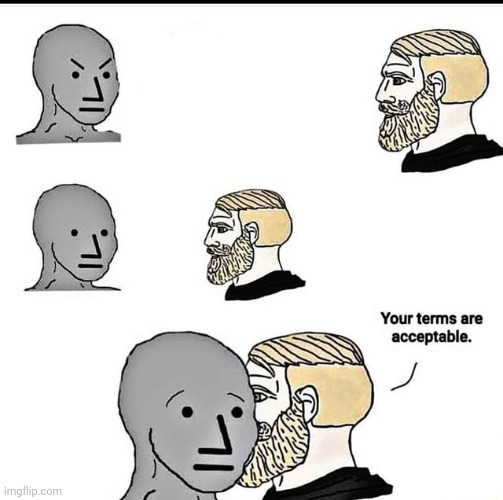
At this stage, I suspect a lot of German voters would like to respond to Merz’s “not under me as party leader of the CDU” by doing the meme:
Comments Off on Everyone benefits from Germany’s political “firewall” except the people that created it
The amazing invisible detail
Rex Krueger
Published 20 Oct 2025Patrons saw this video early: / rexkrueger
Comments Off on The amazing invisible detail
The threat to legal title to land across Canada
I’d warned years ago that the performative “land acknowledgements” that so many Canadian organizations started using at the beginning of events and gatherings at least a decade back were a bad idea, because they were almost always historically misleading and might be used in future lawfare. Well, the future is here, and the precedent has been set in British Columbia with a court ruling that aboriginal land claims from a BC First Nation has more standing in court than the legal titles held by the current owners. On his Substack, Brian Lilley discusses the issue:
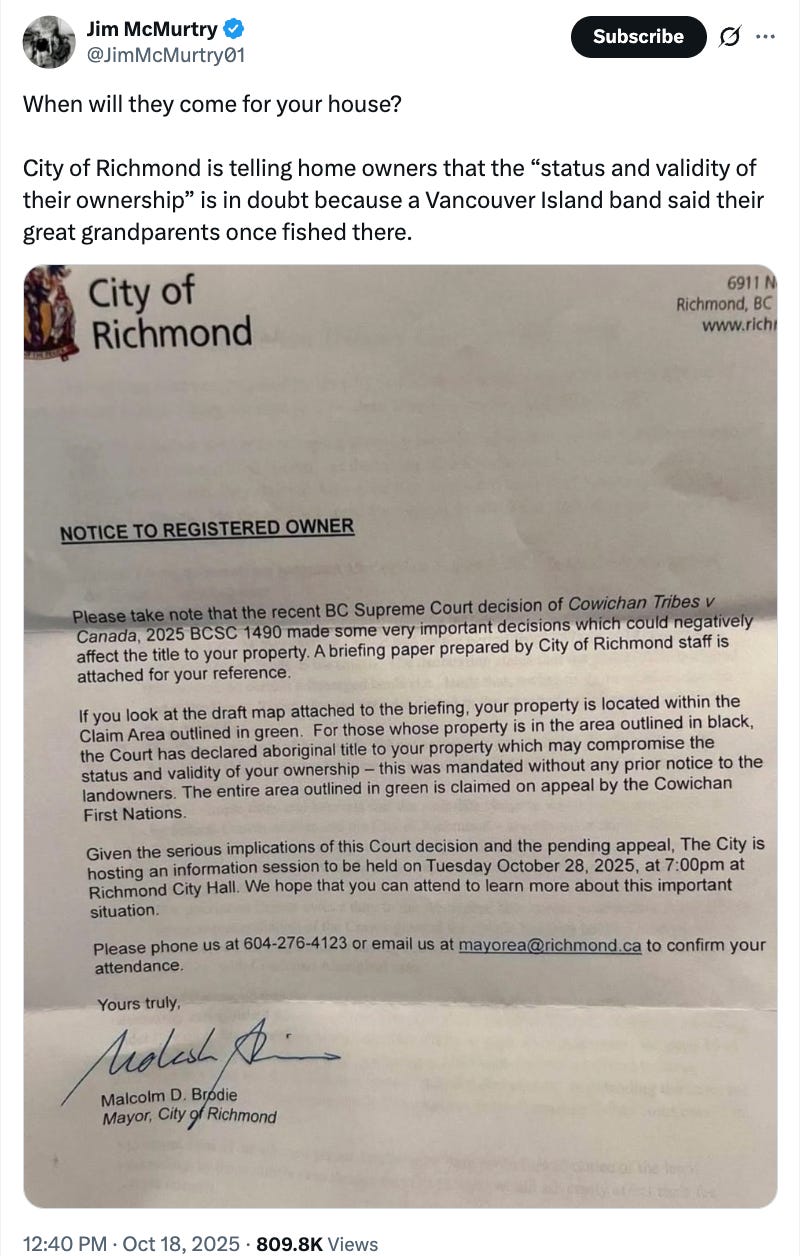
The City of Richmond, British Columbia is warning homeowners their title to their homes may be at risk. It all dates back to an August ruling from the B.C. Supreme Court called Cowichan Tribes that said Crown and private title in a 7 1/2 square kilometre area of Richmond was “defective and invalid.”
While some at the time said that the ruling would not impact homeowners, the legal department for the City of Richmond clearly thinks differently.
“The court has declared Aboriginal title to your property which may compromise the status and validity of your ownership – this was mandated without any prior notice to the landowners,” a letter sent to homeowners in the area impacted reads.
The letter was sent by Mayor Malcolm Brodie and tells residents the city will be appealing and holding public consultations. It’s not just the City of Richmond appealing this ruling it’s also the province and the Musqueam Indian Band.
You can read more from our friends over at Juno News.
The entire ruling from the B.C. Supreme Court is confusing, as is the jurisprudence set out by the Supreme Court on the issue of Aboriginal title dating back to one of those decisions in 2014. Thankfully Professor Dwight Newman, the Canada Research Chair in Rights, Communities and Constitutional Law at the University of Saskatchewan, has laid out an explainer of what happened in the Cowichan case, the 2014 Supreme Court case and what needs to be done going forward.
Last week, Kim du Toit responded to an Australian land acknowledgement on a recent TV show:
The history of this entire world is a story of migration, settlement, wars over territory and Tribe A taking land from Tribe B — bloody hell, they’re still fighting the same wars in the Balkans — but it’s only recently that the arguments over who owns what have become a third-party issue rather than something that the involved parties settle between themselves. Or, to put it in a more scholarly fashion:
Every person alive on this planet today has ancestors who were displaced by force somewhere in their lineage. Every person alive on this planet today has ancestors who displaced other people by force somewhere in their lineage. It’s an inevitable fact of human history. American natives fought with each other over land and resources, and some tribes, like the Dakota (Sioux), were notorious for attacking their neighbors. Europe’s history is rife with such, from the Vikings to the Norman invasion of Britain. In fact, few if any of the people of Europe today are the original inhabitants of the land they reside on now; the one exception may be the Basque of the Pyrenees Mountains, but even they, at some point, came there from somewhere else. The French people we know now derive their name from the Franks, a Germanic tribe, and as for the British Isles, that motley group of islands has seen so many invasions, from Picts to Celts to Romans, Saxons, Anglians, Jutes, and Normans, that it would be difficult to keep track as they go by.
Here’s the simple response to all the handwringing and aggrievement over the “stolen land” claims: get over it, because you’re never going to get it back. End of story.
And to a lesser extent, the same is true of “cultural appropriation”: where White kids are somehow forbidden to wear their hair in those disgusting dreadlocks because Africans somehow have “ownership” of a hairstyle. What bullshit. It’s like saying that Black people can’t drink Scotch whisky because whisky is traditionally a product of the northern provinces of (lily-white) Britain, or that the Irish can’t eat chips because potatoes originally came from America.
Everyone borrows cultural artifacts and customs from everyone else. That’s been the habit of mankind for millennia, and no cries of outrage can overturn it.
When it comes to land, the stronger group has taken it from its “original” (and sometimes not-so original) weaker inhabitants. That this activity has become somewhat less egregious and bloody in recent times does not gainsay its basic premise — and where it has become more bloody, the weaker continue to learn its hard history — as the “Palestinians” are (re-)learning in their efforts to eradicate the state of Israel. (They’re unlikely ever to give up, which simply means that Israel will be forced to teach them the same lesson again and again, ad infinitum. As I’ve said many times before, the Arabs are lucky that the Jews have an inexplicable aversion to genocide, or else “from the river to the sea” could easily have changed to “from the Golan to the Suez”. Vae victis — a Latin expression — has particular currency here.)
So enough with the kowtowing (a Chinese expression) to the Perpetually Aggrieved. Fuck off, all of you, and make the best of what you’ve got. Heaven knows, most of what you can achieve comes courtesy of Western civilization.
You’re welcome.
Comments Off on The threat to legal title to land across Canada
QotD: The Hijab
[. . .]
This fake Islamic hijab is nothing but a political prop, a weapon of visual terrorism. It is the symbol of a totalitarian ideology inspired more by Nazism and Communism than by Islam. It is as symbolic of Islam as the Mao uniform was of Chinese civilization.
It is used as a means of exerting pressure on Muslim women who do not wear it because they do not share the sick ideology behind it. It is a sign of support for extremists who wish to impose their creed, first on Muslims, and then on the world through psychological pressure, violence, terror, and, ultimately, war.
Amir Taheri, “This is not Islam”, New York Times, 2005-08-15
Update, 26 October: Welcome, Instapundit readers! Please do have a look around at some of my other posts you may find of interest. I send out a daily summary of posts here through my Substack – https://substack.com/@nicholasrusson that you can subscribe to if you’d like to be informed of new posts in the future.
Comments Off on QotD: The Hijab
October 20, 2025
Carney’s trip to Egypt, without the pesky Canadian media tagging along
I guess it’s slightly to Prime Minister Mark Carney’s credit that he was able to get a last-second invitation to attend President Trump’s latest international triumph … we all know how Mr. Carney loves him a nice photo op. But it was almost unprecedented that he nipped over to Egypt without taking any of the usual flappers and fart-catchers of the Canadian media along with him:
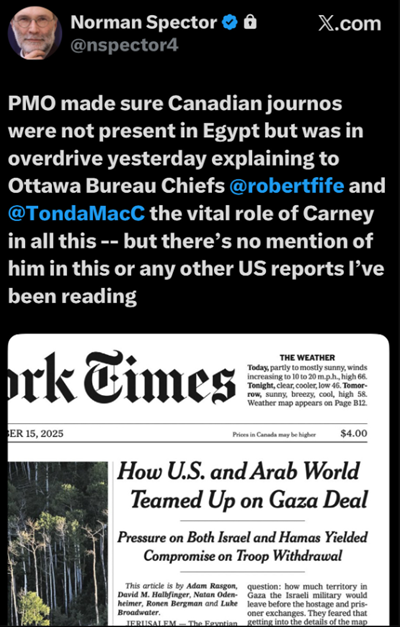
X-post by former PMO chief of staff Norman Spector, who noticed something was up concerning how the Prime Minister’s team got its message out
Image and caption from The Rewrite by Peter Menzies
Last week, the Parliamentary Press Gallery (PPG) and I had something in common.
We were both dismayed.
They, because they weren’t invited to join Prime Minister Carney on his last-minute trip to Egypt for a photo opp; Me because most of them didn’t seem all that interested in looking into the circumstances of the PM’s hasty departure and instead allowed themselves to be played in the most appallingly obvious manner.
What got the PPG’s knickers twisted was that they weren’t invited to accompany Carney when he departed Ottawa in a rush to get to the Egyptian resort of Sharm El Sheikh, a popular spot on the Red Sea for the world’s glitterati. It took PPG President Mia Rabson a couple of days to issue a statement, but she made it clear the PPG disapproved:
The Parliamentary Press Gallery was not informed in advance of the Prime Minister’s trip to Egypt to participate in the Middle East Peace Ceremony on Oct. 12-13, […] The Gallery is disappointed and dismayed at the exclusion of Canadian media from the event and expresses in no uncertain terms that this must never happen again.
It is unprecedented that Canadian media be entirely excluded from a Canadian prime minister’s foreign trip.
The only reporting I could find on this was in Politico, where it was recorded that the PMO had posted this notice: “6:30 p.m. The Prime Minister will depart for Sharm el-Sheikh, Egypt, to attend the signing of a Middle East peace plan. Closed to media.”
What first caused my jaw to drop and to become, like Rabin, disappointed and dismayed, were the stories left unpursued. On the morning of Oct. 12, Canada was not listed as among the countries invited to join in the “peace summit” associated with the ceasefire deal reached between Israel and Hamas. If it had been, the prime minister may not have had to charter a private jet because the usual Royal Canadian Air Force planes and crews were, as City News‘s Glen MacGregor reported, unavailable.
There are two lines of journalistic inquiry there, neither of which appears to have been of interest. The first is: how can Canada’s military be so poorly equipped that there isn’t at all times a fully-equipped aircraft and crew on standby and is this an issue that will be addressed in the future? The second is: how did we wind up getting invited to the peace summit? Comments by US President Donald Trump indicate that we weren’t initially considered important enough to be on site but phoned to ask if we could join the party. (The Line — which doesn’t accept government subsidies — noticed.)
Trump, in remarks to media said: “You have Canada. That’s so great to have, in fact. The president called and he wanted to know if it’s worth — well he knew exactly what it is. He knew the importance. Where’s Canada, by the way? Where are you? He knew the importance of this.”
What was pursued, at least in comments online by journalists, was Trump’s inability to identify Carney by his correct title. (In an exchange that followed, Carney sarcastically thanked Trump for elevating him and, in response, was told “at least I didn’t call you governor”. Ha ha.)
Everyone is free to make their own decisions, but if Canada had to call Trump to ask to be invited, Canadians need to know if that means we are in the president’s debt. Trump, after all, seems like the sort of guy who keeps score.
But it’s what followed that really got creepy. While Canadian reporters were not allowed to accompany the prime minister to Egypt, someone who says he or she was on the plane started phoning around to tell reporters what happened. And they went for it. The Globe and Mail, Toronto Star and Politico all reported unverified statements emanating from a single, unnamed source. The Globe‘s Robert Fife reported that “a senior government official” said that while Carney and others thought they were just in Egypt for a photo opp, during a four hour wait for Trump to arrive from Israel “Mr. Carney had back-and-forth conversations with a group of leaders”.
So, after a bit of ritual humiliation — par for the course with Trump and Carney — the PM got to have unstructured/unfocused chit-chat with other diplomatic rag-tag and bob-tail clinging to the President’s cape. Not a good look, but Canadians must be getting inured to their national leaders being treated as, at best, an afterthought.
Comments Off on Carney’s trip to Egypt, without the pesky Canadian media tagging along
From Hitler’s Rockets to America’s Arsenal – W2W 049
TimeGhost History
Published 19 Oct 2025From the ashes of Nazi Germany to the launch pads of the American desert, the story of the nation’s first ballistic missile is one filled with contradiction. A man who once served the SS soon became a celebrated figure in the United States, and his weapon of war was transformed into a symbol of progress. Here, we will explore how this unlikely journey unfolded and what it reveals about science, power, and morality in the modern age.
(more…)
Comments Off on From Hitler’s Rockets to America’s Arsenal – W2W 049
The real reason we’re suddenly discussing “The Great Feminization” now
On the social media site formerly known as Twitter, Clifton Duncan offers an explanation for why “The Great Feminization” is a hot topic of discussion, and I think he has a valid point:
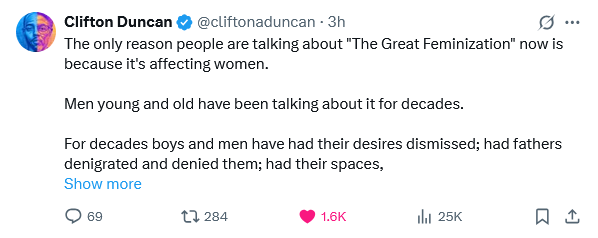
The only reason people are talking about “The Great Feminization” now is because it’s affecting women.
Men young and old have been talking about it for decades.
For decades boys and men have had their desires dismissed; had fathers denigrated and denied them; had their spaces, interests and hobbies invaded; had primary and higher education weaponized against them; had jobs and promotions unjustly denied them; had reputations ruined by false allegations; watched pop culture fester with anti-male slop; had wealth and progeny stripped away by prejudiced family courts.
What happened when they voiced these complaints?
They were called misogynists, resentful of their inability to match women’s success as they seethed over the dismantling of the patriarchy.
They were called losers, whiners and complainers who should shut up, grow up, man up and get married.
But now —
As men avoid women at work, or withdraw from the labor force altogether; as men leave the church; as men abandon dating and marriage; as men reciprocate women’s embrace of modernism and rejection of traditionalism; and as womanhood faces erasure, ironically (but predictably) at the hands of the very liberals and progressives women celebrate for hatcheting away manhood and masculinity —
Only now, as the consequences of treating women’s needs as all that matter and men’s needs as superfluous (and offensive) are evident,
Only now, as men usher in a new sexual revolution by unapologetically focusing on themselves and their own happiness, refusing to serve a society that’s signaled repeatedly that it no longer values them and prompting more and more women to wonder “Where Have All the (Good) Men Gone?”
Only now has it become safe for *women* to broach the topic of “The Great Feminization” and be lavished with acclaim for making the exact same points men have been chastised for making for over 25 years.
Symbolic.
Update: Francisco at Small Dead Animals posted this video of Camille Paglia talking about what women have lost through Feminism:
Comments Off on The real reason we’re suddenly discussing “The Great Feminization” now
The Julio-Claudians and the Empire – The Conquered and the Proud 16
Adrian Goldsworthy. Historian and Novelist
Published 2 Apr 2025This time we look at the empire under the Julio-Claudians, and address the broader question of why conquest became so rare after the death of Augustus. Along the way, we take a look at the campaigns in Germany in AD 14-16, the subsequent arrangements of the Rhine frontier, and Corbulo’s campaign during Claudius’ reign. We touch a little on the invasion of Britain, but will deal with that in more detail in a separate video. Other topics covered include North Africa, Egypt, and the relationship with the Parthian Empire to the east.
Comments Off on The Julio-Claudians and the Empire – The Conquered and the Proud 16
QotD: Wanting to be a pet, not an adult human
Sagu @Sagutxis
Seeing so many men happy to replace us with robots is very blackpilling nglI didn’t go to college until I was 30. This gave me a chance to see it with the perspective of an adult.
One lecture in Industrial Psychology, in particular, I will never forget.
The professor spoke about how an effective job description focused on concretely measurable tasks, not vague instructions, or characteristics.
For example, “maintain an 85% or greater average on customer feedback surveys”, instead of “be cheerful and upbeat”, or even “interact positively with customers”.
This means that goals are clear, and performance is measurable. A job is to do something, not be something.
Once some of the students had wrapped their minds around this concept, the professor decided to do a class exercise.
He asked the female students to come up with a job description for “husband”. At first, this went fine. The girls noodled around a bit with things they wanted their husbands to be (tall, etc), but he was able to gradually steer them towards describing what they wanted in terms of actions.
But then he asked the male students to define a wife in the same way.
And all the girls became upset. Some of them had full-on meltdowns.
Every single thing that a male student wanted, or expected, from his hypothetical future wife was sexist, oppressive, old-fashioned, misogynistic, patriarchal, etc.
They were literally screaming. Some of them in tears.
And I realized something pretty quickly. It wasn’t the actual, concrete responsibilities of the female role that they objected to.
It was the idea of there being a female role at all, with any attached responsibilities.
These women didn’t want to be wives. They wanted to be pets.
What’s a pet? Well a pet is not a wife, or a friend. A pet is a creature of instinct, which you bring into your home because you like how it naturally behaves.
You get a cat because you want [it] to behave like a cat, and do things a cat naturally does, like play with string, and purr when you pet him. If he’s smart, he’ll adapt [to] you somewhat, but he doesn’t have responsibilities other than “be a cat”.
If you get a wife, you get a wife so she will do things for you, specific things that are the responsibilities of wife, like care for your home, bear and raise your children, cook nutritious meals so you don’t have to eat processed slop, look after your emotional well-being, and so on.
These girls didn’t want to be held responsible for those things. As married women, they might have anticipated doing some of them, but some of the time. When they felt like it.
The cat chases the string if and when it wants to, not because chasing the string is its job.
These young millennial women didn’t realize it, but they wanted to be pets. And that’s what they were in their college relationships. They hung out with guys when they wanted to, had sex with them when they wanted to, broke up with them for someone new when they wanted to.
Their relationships had no element of reciprocal responsibilities. They were perfectly at home with the idea of men having responsibilities to them, but they would repay those men if they chose, and how they chose, not how the men actually wanted.
And as I’ve said twice already, someone you have responsibilities to, but who has none to you, is a pet, or a child.
The reason that a significant portion of men want to invent sentient feminine robots so that they can marry them is because they want wives, and they have given up on the possibility of young women re-embracing the concept of sex roles and actually having to do something for someone else.
Women didn’t spontaneously became more selfish than previous generations, of course. They were the targets of a concerted psyop whose purpose was to convince them that female responsibilities were demeaning. It was tailored to their unique psychological vulnerabilities, and they swallowed it hook, line, and sinker.
Who mounted that psyop, and why, is a conversation most of us aren’t ready for yet.
But our point for today is don’t worry, young ladies.
The robots aren’t being brought in to replace you.
Just to do the jobs you won’t do.
Devon Eriksen, The social media site formerly known as Twitter, 2025-07-18.
Comments Off on QotD: Wanting to be a pet, not an adult human
October 19, 2025
Printed Maplewash from Random Penguin “Canada”
In the latest SHuSH newsletter, Ken Whyte discusses one of the most cynical and blatant attempts to “Maplewash” US product as 100% home-grown Canadian: a book of essays by living and dead Canadian authors, titled with the Liberals’ moronic “Elbows Up” slogan … with all the profits going to Random Penguin’s US corporate headquarters:

Ever since the Trump tariffs against Canada were launched last spring, US firms operating in Canada have been engaged in a variety of maple-washing tactics to shield themselves from consumer backlash. Some are as simple as new labelling — “prepared in Canada!” More audacious was McDonald’s effort to make everyone forget it’s the White House’s caterer of choice: a partnership with Canada’s sweetheart, Shania Twain.
You might think the McDonald’s gambit would be hard to top, but Penguin Random House has done it.
Penguin Random House Canada is a division of Penguin Random House LLC, corporate headquarters at 1745 Broadway, 3rd Floor, New York, New York, 10019. Penguin Random House LLC is in turn controlled by Bertelsmann, a media conglomerate in Gütersloh, Germany, but legally and operationally, it is a US company. Its executive leadership, including CEO Nihar Malaviya, works out of the above address. Strategy and publishing priorities are set in New York, and profits in PRH’s many far-flung international divisions flow to New York. You can see why this firm, with its dominant position in the Canadian market, might feel vulnerable and want to camouflage its Americanness when everyone starts shouting “buy Canadian!”
[…]
There are at least four levels of cynicism to Elbows Up!
The first — let’s call it eye-popping — is that Penguin Random House Canada would use so many of its own authors as human shields in a trade war. I mean, that’s cold. You not only have to conceive it, you have to be confident the authors are so oblivious that they won’t notice — or so obliged that they won’t care — that they’re laundering the reputation and protecting the economic interests of a US multinational and that the net proceeds from their rousing defence of Canadian sovereignty are going straight to 1745 Broadway, 3rd Floor, New York, New York, 10019, along with the licensing rights to their contributions.
[…]
The third level of cynicism — gobsmacking — is that Penguin Random House Canada used its McClelland & Stewart imprint for this atrocity.
I’m not sure there’s ever been a more important Canadian cultural institution than M&S. In the second half of the twentieth century, it was synonymous with Canadian literature. It published the core of the modern Canadian canon — Margaret Atwood, Leonard Cohen, Alice Munro, Mordecai Richler, Mavis Gallant, Robertson Davies, Rohinton Mistry, and many others. More than that, M&S was a symbol of our cultural sovereignty. Its catalog is the closest thing we’ll ever have to the Elgin Marbles.
Jack McClelland, who built the company, ran into financial trouble and sold M&S to strip-mall baron Avie Bennett in 1986. In 2000, Bennett cashed out, selling 25 percent of M&S to Penguin Random House and granting 75 percent to the University of Toronto because federal rules required majority Canadian ownership of cultural enterprises. It was an ingenious deal: UofT played the stooge of Canadian control; PRH had its way with the jewel of Canadian publishing; M&S remained eligible for federal grants because of its “Canadian ownership”. Then, in 2011, the U of T quietly transferred its shares to PRH, giving the multinational full ownership, never mind the foreign-ownership rules. UofT explained that playing the stooge of Canadian control was no longer “a core business” of the university. The house that built Canadian literature, along with its full catalogue of Canadian classics was now fully domiciled at 745 Broadway, 3rd Floor, New York, New York, 10019. The feds didn’t lift a finger.
I don’t know what you’d call that but a cultural crime.
And I don’t know what you can say about PRH using M&S for its maple-washing exercise beyond that it’s gloating.
The final level of cynicism — this one’s just sad — is that Elbows Up! is a forgettable book. It has none of the freshness, quirkiness, and genuine intellectual engagement of The New Romans. It takes as its title a partisan Liberal slogan from the last election (an act of toadying that probably qualifies as its own level of cynicism). A few of the essays, particularly those by the younger writers, are interesting, but none of them has much to say about Canada’s current predicament or the nature of the Canada-US relationship. I was struck by how many of the contributors can’t see beyond their narrow professional or personal identities. It’s as though they’ve never before been called upon to consider Canada as a whole. They lack the vocabulary to contribute anything meaningful. Also, the emotional tone is oddly flat from start to finish.
Comments Off on Printed Maplewash from Random Penguin “Canada”


