
World War Two
Published Apr 6, 2024It’s the next step toward invading Japan’s Home Islands — invading Okinawa, and it begins April 1st. Advances are easy by land, but at sea the kamikaze menace is in full swing. In Burma, plans are made to liberate Rangoon; in the west hundreds of thousands of Germans are surrounded in the Ruhr; and in the east, the Soviets begin assaults on Königsberg and Vienna.
(more…)
April 8, 2024
The Battle of Okinawa Begins – WW2 – Week 293 – April 6, 1945
Comments Off on The Battle of Okinawa Begins – WW2 – Week 293 – April 6, 1945
“The carbon rebate seems to be one of those rare examples of people getting mad at receiving government money rather than being grateful”
In The Line, Jen Gerson makes a strong argument that the vaunted (by Justin Trudeau and the Liberal Party) carbon tax rebate is actually the big problem with the carbon tax, not the “Conservative misinformation” constantly being pointed at by the government’s paid accomplices in the mainstream media:

Is the purpose of the Liberals’ carbon tax to materially reduce carbon emissions — or is it a wealth redistribution program? I ask because every time the Liberals defend the carbon tax by resorting to the awesomeness of the rebate, what they cease to talk about is how effective it is at actually reducing carbon emissions.
Instead, we fall into an endless series of counterproductive debates about whether what individuals are getting from the rebate equals what they’re paying out in tax. And that debate is repeated every quarter, and each time the carbon tax rises. In other words, our entire political discourse about the tax is centred on wealth redistribution — not emissions.
That makes people suspicious of the government’s actual goals, and skeptical about its claims. This, again, is a problem of message dilution. If you cannot clearly express your intentions, then you’re not going to get political buy-in to your aims. This problem is particularly acute on a policy that is — by definition — demanding a sacrifice of cash and/or quality of life by Canadians. People can get on board with sacrifice, but only if it’s tied to a clear, obtainable, and material objective.
[…]
And here’s where we get into the real dark heart of the problem.
It’s the rebate itself.
I understand why the Canada Carbon Rebate happened. The government wanted to introduce a carbon tax without disproportionately penalizing the poor — the demographic least able to make the investments and lifestyle changes necessary to respond to the tax. But did that relief have to come in the form of a rebate?
Well, no.
There are lots of methods a government can use to ease poverty. But governments love themselves a rebate. Why? Because rebates are normalized vote buying. One that all political parties are guilty of using. The Liberals implemented the rebate thinking Canadians would hit their mailboxes every quarter, see a few hundred bucks, and get warm fuzzy feelings for Papa Trudeau and the natural governing party. “Government’s looking out for me!”
Getting government cheques is popular, and the Liberals were no doubt trying to replicate the appeal of the Canada Child Benefit.
But that didn’t happen here. The carbon rebate seems to be one of those rare examples of people getting mad at receiving government money rather than being grateful. Why?
Well, may I suggest that it’s because every time people open up those cheques, instead of processing the dopamine hit of “free” money, they’re instead reminded of how much they had to pay in to get it. They do the math in their head, think about their rising grocery bills and gas, and come away thinking “not worth it”. Every single quarter, millions of Canadian households are feeling as if they are paying dollars to get dimes — and it’s pissing them right off. Further, demanding they acknowledge they’re better off in the exchange is only adding salt to the wound. Throwing Parliamentary Budget Officer (PBO) reports at them doesn’t change their minds. It just pisses them off more.
To put it more pithily — a benefit is a gift. A rebate is a value proposition. And a hell of a lot of Canadians are looking at this rebate and determining that its value is wanting — all the more so as the goals of that purchase haven’t been clearly articulated.
Beecher’s Bible: A Sharps 1853 from John Brown’s Raid on Harpers Ferry
Forgotten Weapons
Published Jan 8, 2024On October 16, 1859 John Brown and 19 men left the Kennedy farmhouse and made their way a few miles south to the Harpers Ferry Arsenal. They planned to seize the Arsenal and use its arms — along with 200 Sharps 1853 carbines and 1,000 pikes they had previously purchased — to ignite and arm a slave revolt. Brown was a true fanatic for the abolitionist cause, perfectly willing to spill blood for a just cause. His assault on the Arsenal lasted three days, but failed to incite a rebellion. Instead of attracting local slaves to his banner, he attracted local militia and the US Marines. His force was besieged in the arsenal firehouse, and when the Marines broke through the doors they captured five surviving members of the Brown party, including Brown himself. All five were quickly tried and found guilty of murder, treason, and inciting negroes to riot. They were sentenced to death, and hanged on December 2, 1859.
Most of Brown’s 200 Sharps carbines were left in the farmhouse hideout, to be distributed when the insurrection took hold. These were found by local militia, among them the Independent Greys, and some were kept as souvenirs — including this example.
There is an intriguing historical question as to whether Brown’s raid was ultimately good for the country or not. It was extremely divisive at the time, and it can be argued that the raid was a major factor leading to Lincoln’s election and the Civil War. Could slavery have been abolished without the need for a cataclysmic war if John Brown had not fractured the Democratic Party? To what extent is killing for a cause justifiable? Do the ends always justify the means? John Brown had no doubts about his answers to these questions … but maybe he should have.
(more…)
Comments Off on Beecher’s Bible: A Sharps 1853 from John Brown’s Raid on Harpers Ferry
QotD: The classical Roman Republic
We can start with how the Romans defined their own republic, before we get into the constituent parts as they understood them. The Latin term for the republic was, naturally enough, res publica (from which the modern word republic derives). Res is a very common, earthy sort of Latin word whose closest English equivalent is probably “matter”, with that wide range of possible meanings. Res can mean a “thing” more generally, “matter” in the scientific sense, but also in an abstract sense it can be an interest, a cause, a court case or other set of events, or property generally. Meanwhile publica means “public”, in the sense of something held in common or collectively or done for the collective good or interest. That gives res publica a wonderful kaleidoscope of meaning – it is the collective property (the “commonwealth”) of the citizenry but also the communal affairs, the matters of collective concern, the actions undertaken for the public benefit and indeed even the public benefit itself.
It is the things held in common. That ambiguity of meaning actually matters quite a bit because what the res publica was and what was important about it was different for different people. But naturally for some res to be publica, that meant other res needed to be privata; much like the polis was a collection of oikoi (and thus its ability to reach within the oikos as a unit was limited) so too the res publica was a collection of familiae (a word we’ll come back to, because it is complicated; it does not neatly mean “family”), the affairs of which were privatae, private.
What I think is worth noting as one of those subtle differences is how this contrasts with the Greek conception of the polis: a polis was fundamentally a collection of politai (citizens) whose institutions were their politeia (government, state). But the res publica is not a collection of citizens (Latin: cives), it is something distinct from them, held in common by them.
We can see this principle in the interesting phrase the Romans used to represent the senate: senatus populusque Romanus, “The Roman Senate and People” – usually abbreviated to SPQR.1 The division there is striking: there is a Roman People (the populus Romanus) and a Roman Senate and in some sense these are non-overlapping groups that together compose the republic. The Senate is not some sub-group of the populus but a distinct one with is a co-equal element of the republic with the populus.
Not only is the res publica thus not simply a collection of citizens, but it is in a real sense understood as a shared interest of different groups in the community, of which the populus is only one group. The Romans, more comfortable with open hierarchy among the citizens, can understand the republic as a balancing act between the interests of the political and social elite (the exact composition of which changes over time, but their mouthpiece is the Senate) and the people. The elite do not represent the people, they are not a select group of the people, but instead a distinct interest within the state which has its own legitimate expression, balanced against the expression of the people.
If all of that doesn’t make much sense, don’t worry: we’ll see these principles work themselves out in the way the res publica works and is structured.
Bret Devereaux, “Collections: How to Roman Republic 101, Part I: SPQR”, A Collection of Unmitigated Pedantry, 2023-07-21.
1. “Romanus” the adjective, modifies both senatus and populus, so both the Senate and the People are Roman. The phrase is often rendered into more idiomatic English as, “the Senate and People of Rome” to make that clearer.
Comments Off on QotD: The classical Roman Republic
April 7, 2024
Instructions for American Servicemen in Britain (1942)
Henry Getley on the US War Department publication Instructions for American Servicemen in Britain produced for incoming GIs on arrival in Britain from early in 1942:

[W]ith their troops pouring into this country from 1942 onwards to prepare for D-Day, officials at the US War Department did their best to make the culture clash as trouble-free as possible. One of their main efforts was issuing GIs with a seven-page foolscap leaflet called Instructions for American Servicemen in Britain.
It’s available in reprint as a booklet and makes fascinating reading, not least for its straightforward, jargon-free writing style and its overriding message – telling the Yanks to use “plain common horse sense” in their dealings with the British.
In parts, it now seems clumsy and condescending. But its purpose was praiseworthy – to try to get American troops to damp down the impression that they were overpaid, oversexed and over here. Many GIs qualified in all three aspects, of course, but you couldn’t blame the top brass for trying.
The leaflet paints a sympathetic (some would say patronising) picture for the incoming Americans of a Britain – “a small crowded island of forty-five million people” – that had been at war for three years, having initially stood alone against Hitler and braved the Blitz. Hence this “cradle of democracy” was now a “shop-worn and grimy” land of rationing, the blackout, shortages and austerity. But beneath the shabbiness, there was steel.
The British are tough. Don’t be misled by the British tendency to be soft-spoken and polite. If need be, they can be plenty tough. The English language didn’t spread across the oceans and over the mountains and jungles and swamps of the world because these people were panty-waists.
There were helpful hints about cricket, football, darts, pounds, shillings and pence, warm beer and badly-made coffee. And because we are two nations divided by a common language, the Yanks were urged to listen to the BBC.
In England the “upper crust” speak pretty much alike. You will hear the newscaster for the BBC (British Broadcasting Corporation). He is a good example, because he has been trained to talk with the “cultured” accent. He will drop the letter “r” (as people do in some sections of our own country) and will say “hyah” instead of “here”. He will use the broad “a”, pronouncing all the a’s in “banana” like the “a” in father.
However funny you may think this is, you will be able to understand people who talk this way and they will be able to understand you. And you will soon get over thinking it’s funny. You will have more difficulty with some of the local accents. It may comfort you to know that a farmer or villager from Cornwall very often can’t understand a farmer or villager in Yorkshire or Lancashire.
The GIs were warned against bravado and bragging, being told that the British were reserved but not unfriendly. “They will welcome you as friends and allies, but remember that crossing the ocean doesn’t automatically make you a hero. There are housewives in aprons and youngsters in knee pants in Britain who have lived through more high explosives in air raids than many soldiers saw in first-class barrages during the last war.”
Comments Off on Instructions for American Servicemen in Britain (1942)
How Traditional English Stilton Cheese Is Made At A 100-Year-Old Dairy | Regional Eats
Insider Food
Published Dec 4, 2019Stilton cheese takes its name from the village of Stilton, in the east of England. The earliest reports of cheese made and sold here date to the 17th century. In 1724, English writer Daniel Defoe referred to the town being “famous for cheese”, calling the product the “English Parmesan”. Today, Stilton can only be made in six dairies, which are spread across three counties in England: Nottinghamshire, Leicestershire, and Derbyshire. We visited Colston Bassett Dairy in Nottinghamshire to learn more about the cheese is made.
For more, visit:
https://www.colstonbassettdairy.co.uk/——————————————————
(more…)
Comments Off on How Traditional English Stilton Cheese Is Made At A 100-Year-Old Dairy | Regional Eats
QotD: Censorship works, but not the way the censors think it does
Gurwinder Bhogal, “33 concepts to survive the year”, UnHerd, 2024-01-01.
Comments Off on QotD: Censorship works, but not the way the censors think it does
April 6, 2024
Italian Communists, the French in Indochina, and the fate of Italy’s army – WW2 – OOTF 34
World War Two
Published 5 Apr 2024What happened to Italian soldiers overseas after the fall of Mussolini? What about the French soldiers left over in Indochina after the Japanese “occupation by invitation”? And, what did the Allies think of the Italian Communist movement and its partisan forces?
(more…)
Comments Off on Italian Communists, the French in Indochina, and the fate of Italy’s army – WW2 – OOTF 34
Three AI catastrophe scenarios
David Friedman considers the threat of an artificial intelligence catastrophe and the possible solutions for humanity:

Earlier I quoted Kurzweil’s estimate of about thirty years to human level A.I. Suppose he is correct. Further suppose that Moore’s law continues to hold, that computers continue to get twice as powerful every year or two. In forty years, that makes them something like a hundred times as smart as we are. We are now chimpanzees, perhaps gerbils, and had better hope that our new masters like pets. (Future Imperfect Chapter XIX: Dangerous Company)
As that quote from a book published in 2008 demonstrates, I have been concerned with the possible downside of artificial intelligence for quite a while. The creation of large language models producing writing and art that appears to be the work of a human level intelligence got many other people interested. The issue of possible AI catastrophes has now progressed from something that science fiction writers, futurologists, and a few other oddballs worried about to a putative existential threat.
Large Language models work by mining a large database of what humans have written, deducing what they should say by what people have said. The result looks as if a human wrote it but fits the takeoff model, in which an AI a little smarter than a human uses its intelligence to make one a little smarter still, repeated to superhuman, poorly. However powerful the hardware that an LLM is running on it has no superhuman conversation to mine, so better hardware should make it faster but not smarter. And although it can mine a massive body of data on what humans say it in order to figure out what it should say, it has no comparable body of data for what humans do when they want to take over the world.
If that is right, the danger of superintelligent AIs is a plausible conjecture for the indefinite future but not, as some now believe, a near certainty in the lifetime of most now alive.
[…]
If AI is a serious, indeed existential, risk, what can be done about it?
I see three approaches:
I. Keep superhuman level AI from being developed.
That might be possible if we had a world government committed to the project but (fortunately) we don’t. Progress in AI does not require enormous resources so there are many actors, firms and governments, that can attempt it. A test of an atomic weapon is hard to hide but a test of an improved AI isn’t. Better AI is likely to be very useful. A smarter AI in private hands might predict stock market movements a little better than a very skilled human, making a lot of money. A smarter AI in military hands could be used to control a tank or a drone, be a soldier that, once trained, could be duplicated many times. That gives many actors a reason to attempt to produce it.
If the issue was building or not building a superhuman AI perhaps everyone who could do it could be persuaded that the project is too dangerous, although experience with the similar issue of Gain of Function research is not encouraging. But at each step the issue is likely to present itself as building or not building an AI a little smarter than the last one, the one you already have. Intelligence, of a computer program or a human, is a continuous variable; there is no obvious line to avoid crossing.
When considering the down side of technologies–Murder Incorporated in a world of strong privacy or some future James Bond villain using nanotechnology to convert the entire world to gray goo – your reaction may be “Stop the train, I want to get off.” In most cases, that is not an option. This particular train is not equipped with brakes. (Future Imperfect, Chapter II)
II. Tame it, make sure that the superhuman AI is on our side.
Some humans, indeed most humans, have moral beliefs that affect their actions, are reluctant to kill or steal from a member of their ingroup. It is not absurd to belief that we could design a human level artificial intelligence with moral constraints and that it could then design a superhuman AI with similar constraints. Human moral beliefs apply to small children, for some even to some animals, so it is not absurd to believe that a superhuman could view humans as part of its ingroup and be reluctant to achieve its objectives in ways that injured them.
Even if we can produce a moral AI there remains the problem of making sure that all AI’s are moral, that there are no psychopaths among them, not even ones who care about their peers but not us, the attitude of most humans to most animals. The best we can do may be to have the friendly AIs defending us make harming us too costly to the unfriendly ones to be worth doing.
III. Keep up with AI by making humans smarter too.
The solution proposed by Raymond Kurzweil is for us to become computers too, at least in part. The technological developments leading to advanced A.I. are likely to be associated with much greater understanding of how our own brains work. That might make it possible to construct much better brain to machine interfaces, move a substantial part of our thinking to silicon. Consider 89352 times 40327 and the answer is obviously 3603298104. Multiplying five figure numbers is not all that useful a skill but if we understand enough about thinking to build computers that think as well as we do, whether by design, evolution, or reverse engineering ourselves, we should understand enough to offload more useful parts of our onboard information processing to external hardware.
Now we can take advantage of Moore’s law too.
A modest version is already happening. I do not have to remember my appointments — my phone can do it for me. I do not have to keep mental track of what I eat, there is an app which will be happy to tell me how many calories I have consumed, how much fat, protein and carbohydrates, and how it compares with what it thinks I should be doing. If I want to keep track of how many steps I have taken this hour3 my smart watch will do it for me.
The next step is a direct mind to machine connection, currently being pioneered by Elon Musk’s Neuralink. The extreme version merges into uploading. Over time, more and more of your thinking is done in silicon, less and less in carbon. Eventually your brain, perhaps your body as well, come to play a minor role in your life, vestigial organs kept around mainly out of sentiment.
As our AI becomes superhuman, so do we.
Comments Off on Three AI catastrophe scenarios
The Fake (and real) History of Potato Chips
Tasting History with Max Miller
Published Jan 2, 2024The fake and true history of the potato chip and an early 19th century recipe for them. Get the recipe at my new website https://www.tastinghistory.com/ and buy Fake History: 101 Things that Never Happened: https://lnk.to/Xkg1CdFB
(more…)
Comments Off on The Fake (and real) History of Potato Chips
QotD: No navy ever has all its ships at sea at the same time
This complex world requires attention on a regular basis, both to make sure that the constituent parts still work as planned, and also to update and replace parts with more modern or better alternatives, or to provide planned upgrades. For instance, it is common for new ships entering service to undergo a short refit to add in any extra capability upgrades that may have been rolled out since construction began, and to rectify any defects.
For the purposes of planning how the fleet works, the Royal Navy looks to provide enough ships to meet agreed defence tasks. In simple terms the MOD works out what tasks are required of it, and what military assets are needed to meet them. This can range from providing a constantly available SSBN to deliver the deterrence mission through to deploying the ice patrol ship to Antarctica.
Once these commitments are understood, planners can work out how many ships / planes / tanks are needed to meet this goal. For example, it may be agreed that the RN needs to sustain multiple overseas deployments, and also be able to generate a carrier strike group too.
If, purely hypothetically the requirement for this is 6 ships, then the next task is to work out how many ships are needed to ensure 6 ships are constantly available. Usually, this has historically been at a 3:1 ratio – one ship is on task or ready to fulfill it, one is in some form of work up or other training ahead of being assigned to the role, and one is just back or in refit.
In practical terms this means that the RN never looks to get 100% of its force to sea, but rather to ensure it doesn’t fail to ensure enough ships are available to meet all the tasks that it is required to do. Consequently there is always going to be a mismatch between the number of ships owned, and the number of ships deployed.
Sir Humphrey, “Inoperable or just maintenance”, Thin Pinstriped Line, 2019-10-24.
Comments Off on QotD: No navy ever has all its ships at sea at the same time
April 5, 2024
Canada’s carbon tax – “… no emissions policy that doesn’t start with banning private jets can be called ‘fair’ with a straight face”
In The Line, Clarke Ries points out the incredibly uncomfortable truth that no matter how the federal government tries to hide it, the carbon tax regime is going to be painful and the pain is going to be absorbed much more by the rural poor than anyone else:

Minister of Environment and Climate Change Steven Guilbeault, 3 February 2020 (when he was Canadian Heritage Minister).
Screencapture from CPAC video.
Consumption taxes are a straightforwardly-effective policy tool. You simply increase the price of the resource you want to see used less and let people adapt to the simulated scarcity via ingenuity, frugality, lifestyle change, repricing their goods and services, etc. The government doesn’t dictate solutions, it lets people find their own. In the process, the consumption tax dispassionately reveals who’s making the most valuable use of that resource.
[…]
So the question remains, who uses a lot of carbon but doesn’t make a lot of money doing it? Who lives in drafty old single-family houses? Who uses archaic methods of keeping those houses warm, like furnaces that run on heating oil? Who has to drive halfway around the world to reach the nearest grocery store and halfway to the moon for the nearest medical clinic? Who’s making that drive in a battered old ride with terrible fuel economy?
The rural poor.
Not the farmers or the ranchers, who mostly make plenty of dough and often know their way around America’s higher-end resort towns, but the rural poor. The kind of people you disproportionately find in Newfoundland outports, eking out a tenuous living as they wait for the cod to return. You know, reliable Liberal voters.
Put another way, a neutrally-applied carbon tax goes after Maritimers first and hardest — forcing them to close shop on their romantic traditional lifestyle and move into apartment blocks in the nearest city, where they’ll earn more for their labour and emit less carbon doing it.
[…]
Remember: for the carbon tax to do what it says on the tin, somebody has to lose. For the carbon tax to be anything other than a purposeless pain in the ass, somebody — a lot of somebodies, frankly, if the Liberals are serious about cutting carbon emissions to 40 per cent under 2005 levels — must be forced to make significant and unpleasant lifestyle changes.
So let’s assume the Parliamentary Budget Office is right, and that Atlantic Canadians are now, after a second round of special supplements and exemptions, definitely net beneficiaries of the carbon tax. All it’s bought the Liberals is a reprise of the same question: who’s for dinner?
Who’s going to trade in their beater for bus tickets? Who’s going to raise their kids in a condo tower instead of a single-family home? Who’s going to start taking their midwinter vacation in the province next door instead of Palm Springs or Costa Rica? Who’s going to shiver on a cold night instead of raising the thermostat?
Only the most diehard of optimists could believe that the roster of ritual sacrifices will substantially consist of financially-comfortable Canadians. The people who can afford to make investments that reduce their carbon emissions without materially sacrificing their lifestyles will do so. A handful will start biking to work during the summer. Others will install solar panels on top of their detached houses — which are mostly located in neighbourhoods where you’re not even allowed to build a condo tower — and that’s going to be that.
Beneath all the aspirational language, what an effective carbon tax actually does is throw the government into a cage match with Canada’s working class. The truth behind the Liberals’ woes on this file is that as long as they’re committed to the carbon tax as a tool for fighting climate change, their only real choice is which part of the working class they land on when they come off the top rope.
In the still-ongoing “war of the sexes”, when can women just accept they’ve won and cease hostilities?
At the amusingly named Handwaving Freakoutery, you can see a scorecard for the war of the sexes that has been ongoing since I was a child and seems no closer to ending than back in the 1960s:
I say this to make it absolutely clear that unlike a lot of boorishly banal material you might encounter within the wretchedly named “Manosphere”, this is not intended to be a whiny article. I’m not complaining, nor am I calling for societal change or action. I’m simply wondering exactly how dominant female privilege has to get before they declare victory and take their boot off the necks of men. I really don’t know the answer to this question, but we’ll speculate about that below after the wall of graphs. HWFO loves graphs.
Herein we will go point by point through as many measurable societal markers as I can think of, leaving no marker unmarked, and put together a Gender War Scoreboard describing as accurate a snapshot as possible of the current state of the United States. Then we’ll close with some analysis about how badly it would have to get before the women finally just declare victory and move on. This post shall be too big for email.
To assign our score, we will look at sets of data that fall generally into two categories. For victimization ratios and similar, we’ll just look at percentage by gender. For comparing two uncapped sets of data, such as life expectancy, we’ll look at a ratio and make them both add to 100 for an apples-to-apples comparison. Then we’ll add them all up at the end to tally the score.
Salary
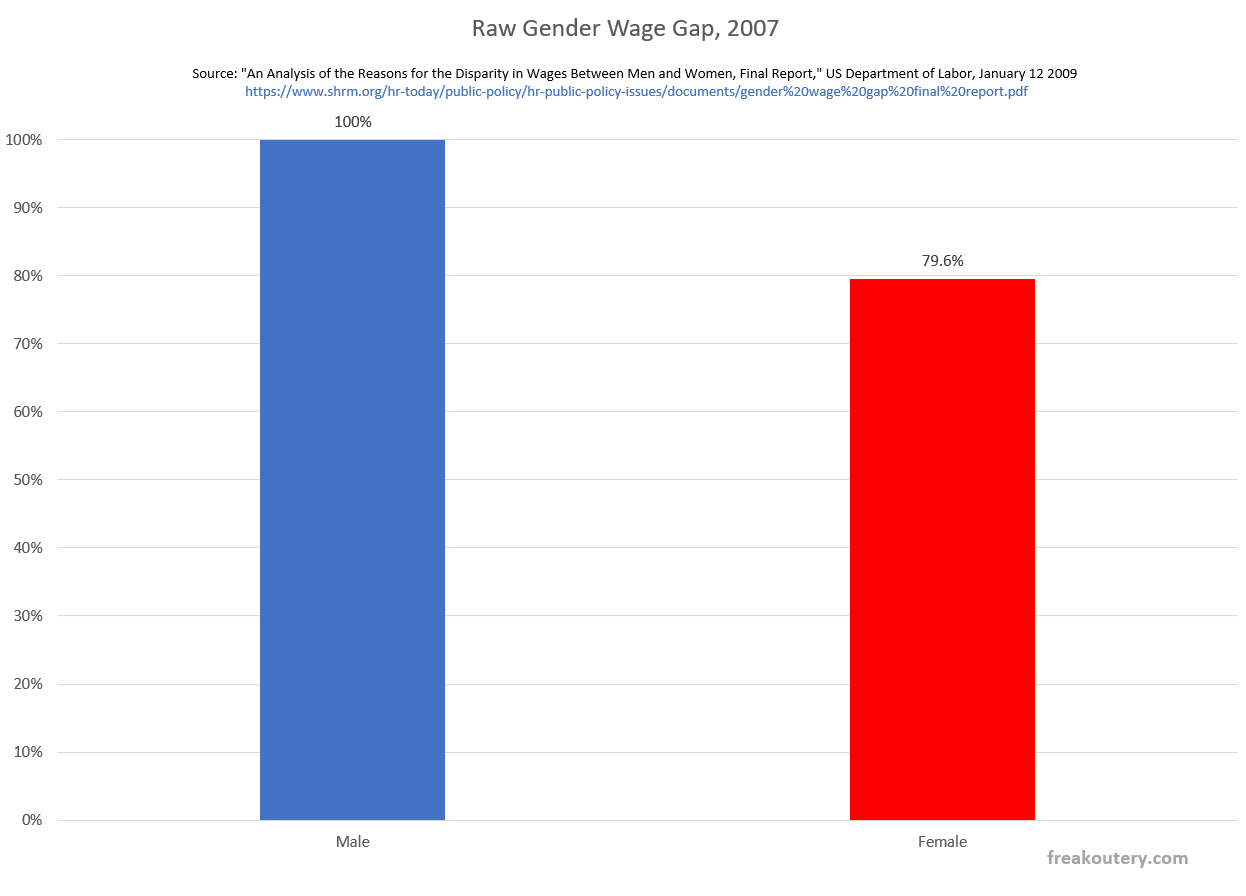
HWFO covered the gender wage gap in 2022, but I’ll summarize it here so you don’t have to read back. According to a 2008 analysis by the Department of Labor, now 16 years old, the raw gender wage gap was 20.4% in 2007:
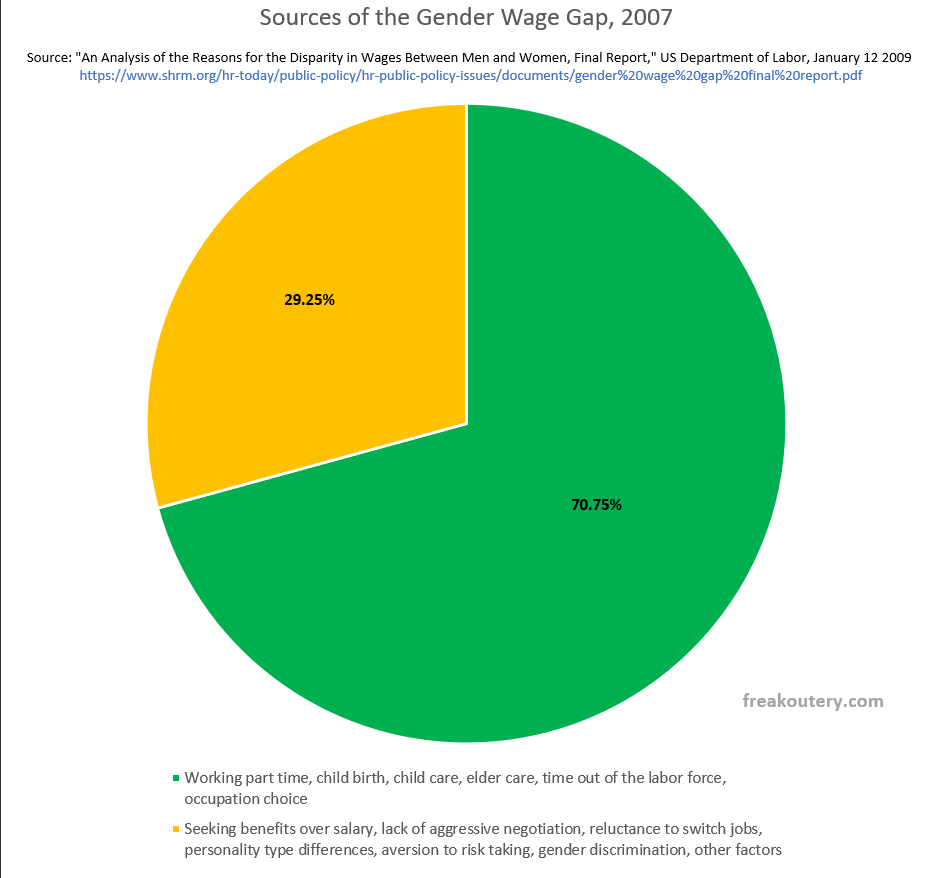
Most of the gap was explainable by career choice and lifestyle choice differences:
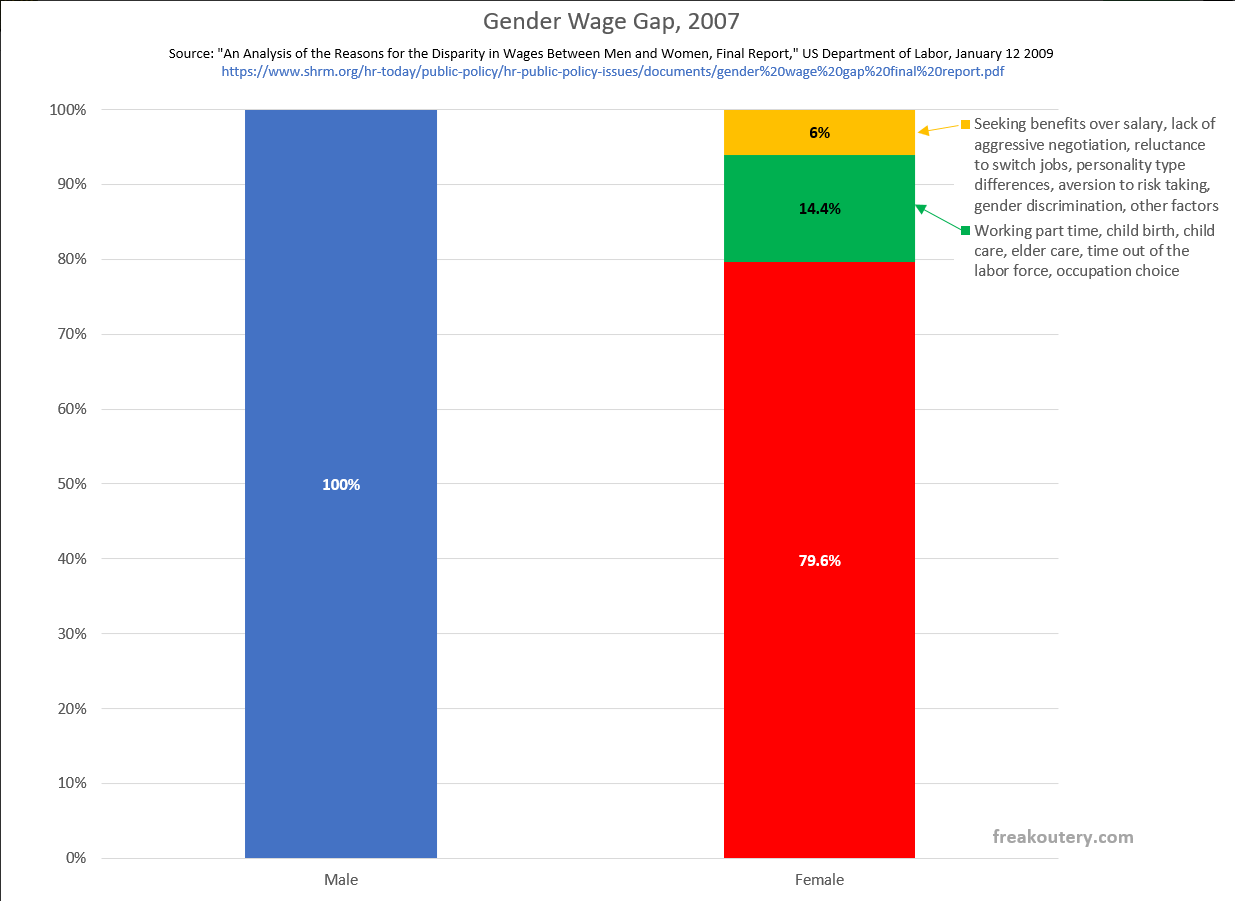
When compared properly that looks like this:
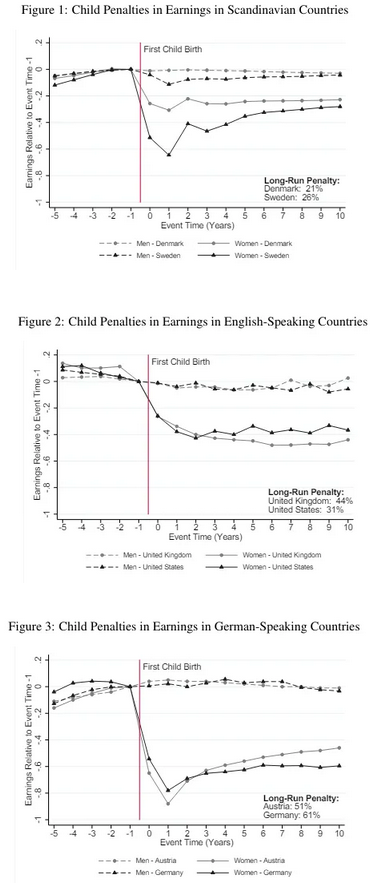
Sixteen years ago, the bits of the gender wage gap that weren’t explained by career and life choice differences only totaled 6%. This fact has been known for a decade and a half and is constantly hidden from view by Pew, the NLWC, and any other major organization that profits from the perception that this gap is large and persistent. It has also assuredly closed to narrower than that 6% in the ensuing decade and a half, but nobody’s replicated the Department of Labor analysis. Look closely at the effects in the green bar identified by the Department of Labor. “Child birth” is how you become a mother. “Child care” is something mothers do. “Working part time” is something mothers do. “Time out of the labor force” is something mothers take. “Occupational choice” is something women change when they become mothers. Here are some graphs from Kleven et al, March 2019:
The solid lines are women. In every studied area, the women make equal or more than the men do up until the birth of their first child, and then they make less. The gender wage gap difference is in the choice to have children. Women choose to make professional concessions to raise a family while the men don’t. Is this fair? Some might say no, but only if they also don’t want to be the primary caregiver for their kids. Some would say yes, for the following two reasons: (1) women choose this, especially in feminist societies, but also (2) men are punished socially for choosing this. If you do not believe me, go make two fake male Tinder profiles with identical cute photos in them, and in the bio of one say “corporate lawyer” and the other say “part time daycare worker” and see which one gets more hits. Then do the same with a female profile. Men are socially punished by women for making the career concession, women are not socially punished by men for making it.
Often when these sorts of “equal pay for equal work” studies are properly controlled for mothering and career choice, they find that men are paid less than women for equal work. Google was pretty famously forced by their neo-progressive staff to do an internal analysis of the subject, and uncomfortably discovered they were overpaying women for being women on an “equal work” basis. The results were twofold. First Google paid all the men a one time bonus, then Google quietly never investigated it again so they could get back to paying women more.
Comments Off on In the still-ongoing “war of the sexes”, when can women just accept they’ve won and cease hostilities?
“[T]oo many charlatans of this species have already been allowed to make vast fortunes at the expense of a gullible public”
Colby Cosh on his “emerging love-Haidt relationship” as Jonathan Haidt’s new book is generating a lot of buzz:

If Haidt has special expertise that wouldn’t pertain to any well-educated person, I wonder a little in what precise realm it lies. Read the second sentence of this article again: he’s a psychologist … who teaches ethics … at a business school? Note that he seems to have abandoned a prior career as an evolutionary biology pedlar, and the COVID pandemic wasn’t kind to his influential ideas about political conservatives being specially motivated by disgust and purity. Much of The Anxious Generation is instead devoted to trendy findings from “neuroscience” that it might be too kind to describe as “speculative”. (I’ll say it again until it’s conventional wisdom: a “neuroscientist” is somebody in a newly invented pseudofield who couldn’t get three inches into the previously established “-ology” for “neuro-“.)
These are my overwhelming prejudices against Haidt; and, in spite of all of them, I suspect somebody had to do what he is now doing, which is to make the strongest available case for social media as a historical impactor on social arrangements and child development. Today the economist/podcaster Tyler Cowen has published a delightfully adversarial interview with Haidt that provides a relatively fast way of boning up on the Haidt Crusade. Cowen belongs to my pro-innovation, techno-optimist, libertarian tribe: we both feel positive panic at the prospect of conservative-flavoured state restrictions on media, which are at the heart of the Haidt agenda.
But reading the interview makes me somewhat more pro-Haidt than I would otherwise be (i.e., not one tiny little bit). On a basic level, Cowen doesn’t, by any means, win the impromptu debate by a knockout — even though he is one of the most formidable debaters alive. Haidt has four key reforms he would like to see implemented politically: “No smartphones before high school; no social media before age 16; phone-free schools; far more unsupervised play and childhood independence.”
This is a fairly limited, gentle agenda for school design and other policies, and although I believe Haidt’s talk of “rewiring brains” is mostly ignorable BS, none of his age-limitation rules are incompatible with a free society, and none bear on adults, except in their capacity as teachers and parents.
The “rewiring” talk isn’t BS because it’s necessarily untrue, mind you. Haidt, like Jordan Peterson, is another latter-day Marshall McLuhan — a boundary-defying celebrity intellectual who strategically turns speculation into assertion, and forces us, for better or worse, to re-examine our beliefs. McLuhan preached that new forms of media like movable type or radio do drive neurological change, that they cause genuine warp-speed human evolution — but his attitude, unlike Haidt’s, was that these changes are certain to happen, and that arguing against them was like arguing with the clouds in favour of a sunny day. The children who seem “addicted” to social media are implicitly preparing to live in a world that has social media. They are natives of the future, and we adults are just observers of it.
Comments Off on “[T]oo many charlatans of this species have already been allowed to make vast fortunes at the expense of a gullible public”
Ero: The Croatian Uzi (With Israeli Help?)
Forgotten Weapons
Published Jan 3, 2024The best of the submachine guns made in Croatia during the Homeland War was the Ero, made by a company called Arma. The Ero is a basically perfect, parts-interchangeable copy of the Israeli Uzi that was developed in 1992 and adopted into Croatian Army service in 1993. The only really distinguishable difference between the Ero and Uzi is the Ero’s use of Croatian-language selector markings (and receiver markings). Between 15,000 and 20,000 were produced, and they remained in service long after Croatian independence was secured. They were issued to vehicle crews, military police, special forces, and reconnaissance units.
Arma was a subsidiary of a major Croatian engineering firm, and after the Ero production it developed the APS-95 Croatian AK (which is a story for another video). They were a very competent company, but the details and quality of the Ero are so good that I believe it must have been made with tacit or explicit assistance from Israel. Croatia does have a strong Jewish community, and there were rumors during the war that the technical data package for the Uzi did find its way into Croatia. There is no official acknowledgement of this happening, but it would certainly not be hard to believe. But however the development happened, the result was a very high quality submachine gun.
A big thanks to the Croatian Police Museum (Muzej Policije) in Zagreb for giving me access to film this cool piece for you! Check them out at: https://muzej-policije.gov.hr
(more…)
Comments Off on Ero: The Croatian Uzi (With Israeli Help?)


