
Quotulatiousness

July 6, 2013

Explosion and fire in Lac-Mégantic as freight train rolled through the centre of town

Filed under: Cancon, Railways — Tags: , — Nicholas @ 10:44

The CBC has a report:

A train carrying crude oil derailed overnight in the heart of Lac-Mégantic in Quebec’s Eastern Townships, sparking a major fire that led to the evacuation of 1,000 people from their homes.

Witnesses reported between four and six explosions overnight in the town of about 6,000 people. The derailment happened at about 1 a.m. ET, about 250 kilometres east of Montreal.

It is not yet known if there are any casualties, but several people have been reported missing and are feared dead.

Zeph Kee, who lives about 30 minutes outside of Lac-Mégantic, said he saw a huge fireball coming from the city’s downtown.

Kee said several buildings and homes were completely flattened by the blast.

Google Maps shows the railway line entering town from the southwest and curving along the lakeshore, crossing the Chaudière River:
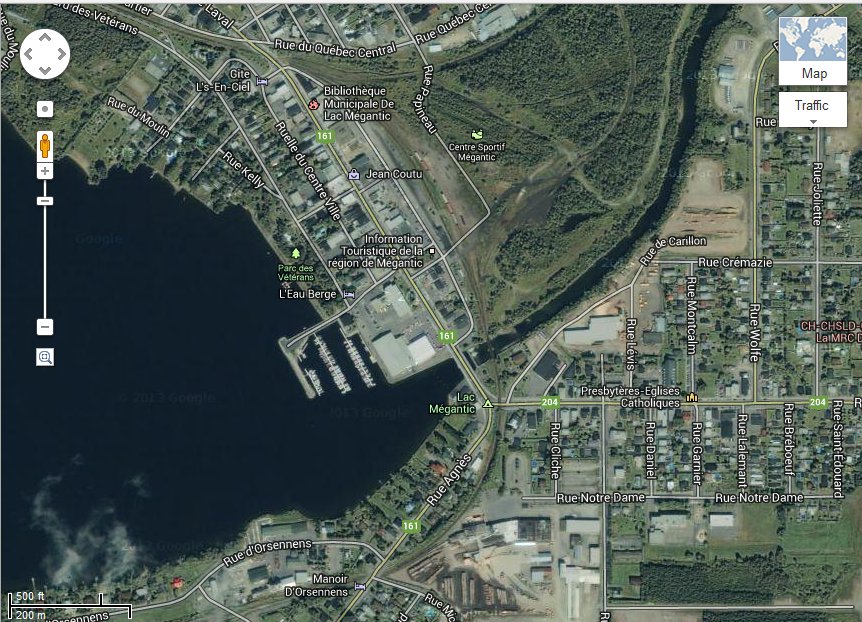
Lac-Mégantic Quebec

More than 100 firefighters, some as far away as Sherbrooke, Que., and the United States, were on the scene early Saturday morning to bring the flames under control.

Lac-MéganticA large but as-yet undetermined amount of fuel is also reported to have spilled into the Chaudière River.

The derailed train belongs to Montreal Maine & Atlantic, which owns more than 800 kilometres of track serving Maine, Vermont, Quebec and New Brunswick, according to the company’s website.

The cause of the derailment is under investigation. A spokesperson for Quebec provincial police said it is still early too early to say what caused it.

Update: Twitchy has collected some Tweets and photos from Lac-Mégantic.

Matt Ridley on the “shale cornucopia”

Filed under: Business, USA — Tags: , , , , , — Nicholas @ 10:15

It’s a big deal. A really big deal:

A new report (The Shale Oil Boom: a US Phenomenon) by Leonardo Maugeri, of Harvard University, sets out just how astonishing this second shale revolution already is. After falling for 30 years, US oil production rocketed upwards in the past three years. In 1995 the Bakken field was reckoned by the US Geological Survey to hold a trivial 151 million barrels of recoverable oil. In 2008 this was revised upwards to nearly 4 billion barrels; two months ago that number was doubled. It is a safe bet that it will be revised upwards again.

The big reason for the upwards revisions is technology rather than discovery. Thanks to faster and cheaper drilling (which means less-rich rocks can be profitable) and things such as “zipper fracturing”, where two parallel wells are drilled and alternately fractured to help to release oil for each other, the oil recovery rate is rising from 2 per cent towards 10 per cent in places. Gas is now nearer 30 per cent. Well productivity has doubled in five years.

Now the Bakken is being eclipsed by an even more productive shale formation in southern Texas called the Eagle Ford. Texas, which already produces conventional oil, has doubled its oil production in just over two years and by the end of this year will exceed Venezuela, Kuwait, Mexico and Iraq as an oil “nation”.

[. . .]

Mr Maugeri calculates that at $85 a barrel most shale oil wells repay their capital costs in a year. He estimates that even if oil prices fall steadily to $65 in five years, shale oil production will treble in the US because of increasing productivity per well and the easing of transport bottlenecks. By 2017, he thinks, America will be producing nearly 11 billion barrels a day [correction 11 million], equal to its previous peak in 1970. It would need much less in the way of imports. US oil imports peaked at 60 per cent in 2005 and will be below 40 per cent this year.

Internationally the effect is very different for oil compared with gas. Gas is costly to export by sea, requiring liquefaction. This roughly doubles the cost of it, meaning that America’s cheap shale gas boosts its economy at home, and gives it a competitive advantage in attracting energy-intensive industries. (US gas prices are a third or a quarter of what they are here.) Mexico, too, is benefiting because of having a land border with America and pipelines.

[. . .]

There would be losers. America’s falling appetite for imports may hit Nigeria and Angola harder than the Middle East because of the types of oil they produce, while Canada and Venezuela, whose tarry oil sands are high-cost, would also suffer if oil prices fell. But every oil producer would eventually feel the effect of this falling US demand, so there is no doubting the downward pressure on world oil prices that this revolution is likely to cause.

Ireland’s oil and gas bonanza for the oil companies

Filed under: Europe, Government, Law — Tags: , , , , , — Nicholas @ 09:49

Ireland is thought to have substantial offshore reserves of oil and natural gas that are likely to be profitable with current technology, but due to a legislative change dating back to the 1980s, the Irish government may not get much benefit:

In a now legendary all-night sitting on September 29th, 2008 the Irish government agreed to guarantee all bank debts. O’Toole calls this the “most disastrous decision that was ever made by an Irish government”. At least two generations of taxpayers will pay off these debts. O’Toole makes an excellent job of charting the Irish path to disaster in his book Ship of Fools, in which he calls the accounts of Anglo Irish Bank the “most inventive work of Irish fiction since Ulysses”.

The oil off the Irish coast could be the way out of this misery. The oil could be the hope. If the former energy minister Ray Burke hadn’t rewritten the relevant laws as though the oil industry itself held the pen. And if Bertie Ahern hadn’t made an already bad deal for the Irish people even worse.

Burke was energy minister in 1987, when it was decided to change the provisions for oil and grass drilling licence allocation. Until then the state owned 50 per cent of all oil and gas found in Irish waters. In addition, companies had to pay royalties of between 8 and 16 per cent as well as 50 per cent tax. (1, see notes below)

The new rule gave companies 100 per cent of their find and abolished licence fees. In 1992 Bertie Ahern, then finance minister and later prime minister from 1998 to 2008, cut the tax for oil companies to 25 per cent — a provision that remains to this day. (2)

[. . .]

The reason this political inheritance is causing such animated discussion now is because of huge oil and gas reserves believed to surround the island. The company Providence estimates the volume of oil it discovered in the Barryroe field, south of Cork, at over 1.7 billion barrels, of which at least 270 million can be pumped. Further test drillings in Irish waters have been similarly promising.

At the moment a barrel of oil costs, depending on grade, between $90 and $100, meaning there could be oil worth many billions of euro in the Irish sea bed. (3) Even the oil companies concede that Ireland is surrounded by massive riches. But the Irish will probably gain none of this thanks to men like Ray Burke and Bertie Ahern.

Orwell’s rules of tea

Filed under: Britain, Food, History, Randomness — Tags: — Nicholas @ 09:02

When he wasn’t writing books for the ages, George Orwell sometimes turned his hand to less world-shaking tasks such as making a proper cup of tea:

First of all, one should use Indian or Ceylonese tea. [. . .]

Secondly, tea should be made in small quantities — that is, in a teapot. [. . .]

Thirdly, the pot should be warmed beforehand. [. . .]

Fourthly, the tea should be strong. [. . .]

Fifthly, the tea should be put straight into the pot. [. . .]

Sixthly, one should take the teapot to the kettle and not the other way about. [. . .]

Seventhly, after making the tea, one should stir it, or better, give the pot a good shake, afterwards allowing the leaves to settle.

Eighthly, one should drink out of a good breakfast cup — that is, the cylindrical type of cup, not the flat, shallow type. [. . .]

Ninthly, one should pour the cream off the milk before using it for tea. [. . .]

Tenthly, one should pour tea into the cup first. [. . .]

Lastly, tea — unless one is drinking it in the Russian style — should be drunk without sugar.

Dateline 1972 – Nixon tries to “fix” NFL blackout policies

Filed under: Football, History, Media — Tags: , , , , , , — Nicholas @ 08:52

The St. Paul Pioneer Press raided the National Archives to find this clip of President Nixon talking to his attorney general about the outrageous NFL TV blackout policy:

Football populist Richard Nixon was furious at the NFL and wanted to flex his political muscle to end television blackouts.

At 2:06 p.m. on Dec. 18, 1972, Nixon met with Attorney General Richard Kleindienst at the Executive Office Building and railed against the league’s policy that prevented fans from watching their team’s home playoff games on TV.

The 37th president of the United States wanted to intervene because the Washington Redskins-Green Bay Packers postseason game at RFK Stadium on Christmas Eve was going to be blacked out in Washington, D.C., even though it already was sold out.

In a conversation secretly recorded by the White House bugging system that helped doom his presidency, Nixon threatened to sue the league if it did not lift blackouts for the playoffs. The devout Redskins fan ordered Kleindienst to “get busy with your lawyers” and take the fight to NFL Commissioner Pete Rozelle and Redskins owner Edward Bennett Williams.

July 5, 2013

This week in Guild Wars 2

Filed under: Gaming — Tags: , — Nicholas @ 11:32

My weekly Guild Wars 2 community round-up at GuildMag is now online. The big news is that ArenaNet has switched to a biweekly content release schedule — new content every two weeks. Next week’s release will be the Bazaar of the Four Winds. There was also some confusion in the community as ArenaNet appeared to say there would never be any expansions to GW2, then clarified that the Living Story is going to be the primary content distribution, but that they hadn’t ruled out boxed expansions. There’s also the usual assortment of blog posts, videos, podcasts, and fan fiction from around the GW2 community.

Dudley Do-Wrong

Filed under: Bureaucracy, Cancon, Law — Tags: , , , , — Nicholas @ 09:32

The Royal Canadian Mounted Police have a great PR image in the rest of the world … for many people, the image of the scarlet-coated Mountie is synonymous with Canada. But for Canadians, there’s a growing unease about the RCMP:

Canadians have mixed views of our national police force, the Royal Canadian Mounted Police. We seem to admire the RCMP as an institution but are increasingly suspicious of the actions of individual Mounties and of the force’s brass — its senior officers and policymakers.

Our attitudes are further complicated by the fact that we seem to see the officers in our local detachments as good guys — they play on our men’s league hockey teams, help out with community charities, take their kids to school like the rest of us — yet we are beginning to see more bad apples elsewhere.

According to an Abacus Data poll of 1,000 Canadians conducted in late June, the Mounties remain one of our most trusted national institutions. A symbol of the country, the RCMP ranks right up there (69%) with the maple leaf (83%) and universal health care (78%).

Yet a majority of Canadians believe officers have used excess force (51%) and that sexism is rampant (54%) within the RCMP. Significant pluralities are also convinced problems within the force are “widespread” (43%) and are not being exaggerated (42%).

[. . .]

But I would guess, the biggest strains on the Mounties’ credibility, particularly in rural Canada and the West, have been over guns. And the warrantless seizure of hundreds of firearms from the homes of evacuees following the flooding in High River, two weeks ago — in which Mounties broke open doors and removed private property arbitrarily — will only widen the existing trust gap.

And now, a five-minute sales pitch for Thorium nuclear reactors

Filed under: Science, Technology — Tags: , , , — Nicholas @ 09:13

A short video of Kirk Sorensen taking us through the benefits of Liquid Fluoride Thorium Reactors, a revolutionary liquid reactor that runs not on uranium, but thorium. These work and have been built before. Search for either LFTRs or Molten Salt Reactors (MSR).

FAQ
The main downsides/negatives to this technology, politics, corrosion and being scared of nuclear radiation. Liquid Fluoride Thorium Reactors were created 50 years ago by an American chap named Alvin Weinberg, but the American Government realised you can’t weaponise the by-products and so they weren’t interested.

Another point, yes it WAS corrosive, but these tests of this reactor were 50 years ago, our technology has definitely improved since then so a leap to create this reactor shouldn’t be too hard.

And nuclear fear is extremely common in the average person, rather irrational though it may be. More people have died from fossil fuels and even hydroelectric power than nuclear power. I added this video for a project regarding Liquid Fluoride Thorium Reactors, watch and enjoy.

No, it would not collapse the economy… just like the use of uranium reactors didn’t… neither did coal… This is because you wouldn’t have an instant transition from coal… oil… everything else to thorium. We could not do that. Simply due to the engineering. Give it 50 years we might be using thorium instead of coal/oil (too late in terms of global warming, but that’s another debate completely), but we certainly won’t destroy the earths economy. Duh.

And yes he said we’d never run out. Not strictly true… bloody skeptics … LFTRs can harness 3.5 million Kwh per Kg of thorium! 70 times greater than uranium, 10,000 greater than oil… and there is over 2.6 million tonnes of it on earth… Anyone with a calculator, or a brain, will understand that is a lot of energy!!

H/T to Rob Fisher for the link.

The secret army of monitors who fed Enigma signals to Bletchley Park

Filed under: Britain, Germany, History, Italy, Military, WW2 — Tags: — Nicholas @ 08:20

The BBC remembers the volunteer radio tinkerers who helped win the intelligence war in Europe:

One day, towards the start of World War II, a captain wearing the Royal Signals uniform knocked on a British teenager’s door.

The 16-year-old was called Bob King. When he went to greet the visitor, he had no idea that soon he would become one of Britain’s so-called “voluntary interceptors” — some 1,500 radio amateurs recruited to intercept secret codes broadcast by the Nazis and their allies during the war.

“The captain asked me if I would be willing to help out with some secret work for the government,” remembers Mr King, now 89. “He wouldn’t tell me any more than that.

“He knew that I could read Morse code – that was the essential thing.”

[. . .]

By mid-1941, the new base, Arkley View, was receiving about 10,000 message sheets a day from its recruits.

“I worked for five years scrutinising the logs that came in from the other amateurs — thousands of log sheets with the signals which we knew were wanted, and you could only know it from experience,” remembers Mr King.

“We knew it wasn’t Allied army air force, we knew it was German or Italian — various things gave that away, but it was disguised in such a form that it looked a bit like a radio amateur transmission.

“We knew it was highly important, everything was marked ‘top secret,’ but only many years later we discovered that it was German secret service we were listening to.

“Of course you didn’t ask questions in those days, otherwise you’d be in real trouble.”

Encoded messages were transmitted to Bletchley Park in Buckinghamshire, the UK’s former top-secret code-cracking centre.

Once decoded, the data was sent to the Allied Commanders and the UK Prime Minister, Winston Churchill.

July 4, 2013

Bonfire of the civil liberties

Filed under: Liberty, Media, Politics, USA — Tags: , , , , , , — Nicholas @ 11:06

A recent article by Dan Gillmore in the Guardian was reposted on Alternet yesterday:

No one with common sense believes Obama is planning to become a dictator. But the mail list question was indeed not paranoid — because Obama, building on the initiatives of his immediate predecessors, has helped create the foundation for a future police state. This has happened with bipartisan support from patriotic but short-sighted members of Congress and, sad to say, the general public.

The American media have played an essential role. For decades, newspaper editors and television programmers, especially local ones, have chased readers and ratings by spewing panic-inducing “journalism” and entertainment that helped foster support for anti-liberty policies. Ignorance, sometimes willful, has long been part of the media equation. Journalists have consistently highlighted the sensational. They’ve ignored statistical realities to hype anecdotal — and extremely rare — events that invite us to worry about vanishingly tiny risks and while shrugging off vastly more likely ones. And then, confronted with evidence of a war on journalism by the people running our government, powerful journalists suggest that their peers — no, their betters — who had the guts to expose government crimes are criminals. Do they have a clue why the First Amendment is all about? Do they fathom the meaning of liberty?

The founders, for all their dramatic flaws, knew what liberty meant. They created a system of power-sharing and competition, knowing that investing too much authority in any institution was an invitation to despotism. Above all, they knew that liberty doesn’t just imply taking risks; it absolutely requires taking risks. Among other protections, the Bill of Rights enshrined an unruly but vital free press and guaranteed that some criminals would escape punishment in order to protect the rest of us from too much government power. How many of those first 10 amendments would be approved by Congress and the states today? Depressingly few, one suspects. We’re afraid.

America has gone through spasms of liberty-crushing policies before, almost always amid real or perceived national emergencies. We’ve come out of them, to one degree or another, with the recognition that we had a Constitution worth protecting and defending, to paraphrase the oath federal office holders take but have so casually ignored in recent years.

What’s different this time is the surveillance infrastructure, plus the countless crimes our lawmakers have invented in federal and state codes. As many people have noted, we can all be charged with something if government wants to find something — the Justice Department under Bush and Obama has insisted that simply violating an online terms of service is a felony, for example. And now that our communications are being recorded and stored (you should take that for granted, despite weaselly government denials), those somethings will be available to people looking for them if they decide you are a nuisance. That is the foundation for tyranny, maybe not in the immediate future but, unless we find a way to turn back, someday soon enough.

H/T to Tim O’Reilly for the link.

Virtual reality hardware coming to your local big box electronics store

Filed under: Media, Technology — Tags: , , — Nicholas @ 10:31

In The New Yorker, Joel Johnson talks about the Oculus Rift, which may be available in retail stores by the end of the year:

Luckey’s garage creation, which soon was named the “Oculus Rift,” is not far from a smartphone with a headband. An L.C.D. screen spans across a plastic mask, sitting about an inch away from a user’s eyes; a barrier divides the display in two, effectively creating one screen for each eye. Motion sensors track the position of the wearer’s head, then feed this data across an umbilical cord to a computer, typically a gaming P.C. Instead of rendering one 3-D world to a single monitor, as in a typical first-person video game, such as Call of Duty, the computer renders the same 3-D world twice, from slightly different angles. It sends those two perspectives, side by side, to the Rift, creating the illusion of depth. Motion is controlled by the direction in which the wearer is looking; instead of using a mouse or a controller to direct your gaze in the 3-D world, a person simply needs to turn his head.

The Oculus Rift uses optical tricks to create the realistic sensation, like slightly warping the edges of the view in the computer, which is corrected by plastic lenses in the goggles. The pixels are more tightly packed directly in front of the eye, giving the perspective a roundness that feels more like human vision. It works. The Oculus Rift rivals — and will possibly exceed, when it hits the shelves sometime in late 2013 or mid-2014 — the best virtual-reality hardware available, military-grade or otherwise.

[. . .]

I’ve been testing the Oculus Rift for a month, and in it, virtual reality feels a lot like scuba diving. First, there is the mask. Then there is the strange disconnect between where your body actually is and where your mind, confused by the mask, is telling you that your body is located. This sensation of discombobulation is doubled in virtual reality, since the current version of the Oculus Rift doesn’t track your body or hands, only your head.

Still, more than any of its antecedents, the Oculus Rift is convincingly engrossing. Most of the several dozen people who have tried my Rift put the goggles on as skeptics, but removed them as believers that virtual reality, as a practical phenomenon, now exists.

On YouTube, WoodenPotatoes recently posted a video where he tried out his new Oculus Rift unit with the original Guild Wars Prophecies by ArenaNet. As he points out in the video, the game is in no way optimized for use with the Rift, but is still an interesting experiment:

Egypt’s new post-Morsi era

Filed under: Middle East, Politics, Religion — Tags: , , , — Nicholas @ 10:14

Daniel Pipes sees joy in the aftermath of Morsi’s removal from power, but also worry. Lots of worry:

The overthrow of Mohamed Morsi in Egypt delights and worries me.

Delight is easy to explain. What appears to have been the largest political demonstration in history uprooted the arrogant Islamists of Egypt who ruled with near-total disregard for anything other than consolidating their own power. Islamism, the drive to apply a medieval Islamic law and the only vibrant radical utopian movement in the world today, experienced an unprecedented repudiation. Egyptians showed an inspiring spirit.

If it took 18 days to overthrow Husni Mubarak in 2011, just four were needed to overthrow Morsi this past week. The number of deaths commensurately went down from about 850 to 40. Western governments (notably the Obama administration) thinking they had sided with history by helping the Muslim Brotherhood regime found themselves appropriately embarrassed.

My worry is more complex. The historical record shows that the thrall of radical utopianism endures until calamity sets in. On paper, fascism and communism sound appealing; only the realities of Hitler and Stalin discredited and marginalized these movements.

In the case of Islamism, this same process has already begun; indeed, the revulsion started with much less destruction wrought than in the prior two cases (Islamism not yet having killed tens of millions) and with greater speed (years, not decades). Recent weeks have seen three rejections of Islamist rule in a row, what with the Gezi Park-inspired demonstrations across Turkey, a resounding victory by the least-hardline Islamist in the Iranian elections on June 14, and now the unprecedentedly massive refutation of the Muslim Brotherhood in public squares along the Nile River.

But I fear that the quick military removal of the Muslim Brotherhood government will exonerate Islamists.

“Buenos Aires […] is the headquarters for the central planning bad idea bus”

Filed under: Americas, Economics, Government — Tags: , , , , , — Nicholas @ 08:32

At the Sovereign Man blog, Simon Black discusses Argentina’s sad history of central planning failures:

The more interesting part about Buenos Aires, though, is that this place is the headquarters for the central planning bad idea bus.

Argentina’s President, Cristina Fernandez, continues to tighten her stranglehold over the nation’s economy and society.

This country is so abundant with natural resources, it should be immensely wealthy. And it was. At the turn of the 20th century, Argentina was one of the richest countries in the world.

Yet rather than adopting the market-oriented approaches taken by, say, Colombia and Chile, Argentina is following the model of Venezuela.

Cristina rules by decree here; there is very little legislative power. She may as well start wearing a crown.

Just in the last few years, she’s imposed capital controls. Media controls. Price controls. Export controls.

She’s seized pension funds. She fired a central banker who didn’t bend to her ‘print more money’ directives. She even filed criminal charges against economists who publish credible inflation figures, as opposed to the lies that her government releases.

Inflation here is completely out of control. The government figures say 10%, but the street level is several times that.

[. . .]

Being here in this laboratory of central planning makes a few things abundantly clear:

1) Printing money does not create wealth. If it did, Argentina would be one of the richest places in the world again.

2) All of these policies that are ‘for the benefit of the people’ almost universally and up screwing the people they claim to help.

Printing money creates nasty inflation. If you’re wealthy, it leads to asset bubbles, which can make you even wealthier. If you’re poor, you just get crushed by rising prices. Or worse – shortages (remember the recent Venezuelan toilet paper crisis?)

3) Desperation leads to even more desperation. The worse things get, the tighter government controls become… which makes things even worse. It’s a classic negative feedback loop.

Both the United States and pan-European governments are varying degrees of this model, with only a flimsy layer of international credibility separating them from the regime of Cristina.

So Argentina is really a perfect case study in things to come.

That distinctive society

Filed under: Cancon — Tags: , , , — Nicholas @ 08:05

Richard Anderson on the most recent language flap in Quebec:

One of PET’s few redeeming characteristics was his understanding of Quebec nationalism’s intense parochialism. This was not simply a minority wishing to preserve its culture, the Quebecois of 1960 were among the most successful and secure ethnic minorities in the world. The tribalists who sought the province’s independence were driven by a fear and hatred of the Other. That Other was mostly the English in the 1960s. But Canada, even Quebec, is now a more diverse place. If this was just a matter of holding a grudge against the Anglos it would stop and end with the English. But the die-hards don’t seem be fond of anyone but their own kind.

Ethnic nationalists are like that.

Now let us imagine a scenario. Indeed a great deal of imagination is required to keep the kabuki theatre of Quebec nationalism going. Let us think of a retail manager in Toronto who, for the sake of preventing ghetto formation in the world place, decided to insist on employees speaking only English. How long do you guess before the cops show up? Minutes? The camera crews would probably be there faster. The Toronto Police Service is renowned [both] for their zeal in traffic enforcement and their obsequiousness toward politically correct nostrums. Chief Blair would be hailing the arrest as a victory for diversity by late afternoon.

[. . .]

In the wake of this story the Quebec government was clear that it was not illegal to speak English in Quebec. Not yet anyway. A pure laine nationalist can dream, can’t he? This story has resonance because it captures the status of Anglophones as second class citizens in their own province. It’s linguistic bigotry that would be tolerated nowhere else in Canada. The last acceptable bigotry in modern Canada.

All Canadians are equal. Those who speak French are just more equal than others.

In honour of our American cousins’ Fourth of July…

Filed under: Cancon, Humour, USA — Tags: — Nicholas @ 00:01

… here’s Tim Hicks singing “Stronger Beer”:

H/T to Dave Slater for the link.

« Newer PostsOlder Posts »

Powered by WordPress


