
The defining characteristic of English law is its distribution of power between prosecutor, judge, and jury. This delicate balance has been utterly corrupted in the United States to the point where today at the federal level there is a conviction rate of over 90 percent — which would impress Mubarak and the House of Saud, if not quite, yet, Kim Jong Un. American prosecutors have an unhealthy and disreputable addiction to what I called, at the conclusion of the trial of my old boss Conrad Black six years ago, “countless counts.” In Conrad’s case, he was charged originally with 17 crimes, three of which were dropped by the opening of the trial and another halfway through, leaving 13 for the jury, nine of which they found the defendant not guilty of, bringing it down to four, one of which the Supreme Court ruled unconstitutional and the remaining three of which they vacated, only to have two of them reinstated by the lower appeals court. In other words, the prosecution lost 88 percent of the case, but the 12 percent they won was enough to destroy Conrad Black’s life.
Multiple charges tend, through sheer weight of numbers, to favor a result in which the jury convict on some and acquit on others and then tell themselves that they’ve reached a “moderate” “compromise” as befits the reasonable persons they assuredly are. It is, of course, not reasonable. Indeed, the notion of a “compromise” between conviction and acquittal is a dagger at the heart of justice. It’s the repugnant “plea bargain” in reverse, but this time to bargain with the jury: Okay, we threw the book at him and it went nowhere, so why don’t we all agree to settle? In Sanford, the state’s second closing “argument” to the strange, shrunken semi-jury of strikingly unrepresentative peers — facts, shmacts, who really knows? vote with your hearts — brilliantly dispenses with the need for a “case” at all.
Mark Steyn, “A Dagger at the Heart of Justice”, National Review, 2013-07-15
July 16, 2013
QotD: American justice
July 15, 2013
Going north to gawp at the natives
Brendan O’Neill on a modern phenomenon:
Normally when a white, middle-class, well-educated Brit wants to rub shoulders with a noble savage, he heads off to Kenya to gawk at the Masai dutifully dancing for his chin-stroking entertainment, or he spends a couple of weeks in Palestine to watch brown people picking olives under the yoke of Israeli intimidation. Not Owen Jones. The Independent’s Left-wing columnist has found an altogether cheaper way to mix with earthy, “authentic” tribes: by hopping on a train to Durham and spending a few hours in the company of that grizzled, largely defeated caste of people known as Miners.
At the weekend Mr Jones spoke at the Durham Miners’ Gala, and the whole thing revealed how anthropological the modern radical Left has become, the extent to which youthful Leftists now treat working-class people as exotic creatures in a political zoo to be photographed and patted. The gala was embarrassingly described by that high priest of chattering-class values, Giles Fraser, as being all about “the banners, the bands and the beer”, a means for former mining communities “colourfully to proclaim [their] nobility”. They’re the salt of the earth, these rough-handed northerners, and no mistake! According to a Sky News report, Mr Jones “spoke for the people”. What people? The London-based media professionals he hobnobs with?
Mr Jones and his media friends treated Durham’s miners the same way other middle-class youngsters treat villagers they happen upon in a rural bit of Rwanda: as intriguingly and effortlessly decent, noble creatures who one must simply be photographed standing next to. They tweeted pics of themselves with these cute creatures. In his speech, Mr Jones referred to the miners as “ordinary working people” (ordinary: “regular, normal, customary” — OED) and said these poor, grafting folk are often “faceless, forgotten, ignored”. Not any more — now they’re all over Twitter and Facebook and are having their nobility celebrated in the Guardian, courtesy of their middle-class, Dickensian patrons down in London.
It’s so extraordinarily patronising. To these anthropological daytrippers, Durham is little more than a Potemkin village, existing primarily as a symbol of something or other rather than as a real place. Perhaps we shouldn’t be surprised that Mr Jones takes this borderline caring/haughty approach to working people. After all, by his own admission his entire career in radical journalism was triggered by feelings of pity for the working classes, or, as he calls them, “the vulnerable” who inhabit “conquered” communities.
If you’re bored with the Stratfordians versus Oxfordians, here’s a new debate
In the Guardian, Saul Frampton looks at the First Folio edition of Shakespeare’s works:
Sometime in 1623, seven years after Shakespeare’s death, the actors John Heminges and Henry Condell published Mr William Shakespeares Comedies, Histories, & Tragedies — what we now know as the First Folio. It was the literary event of the century, recording for all time the sound of Shakespeare’s English and the sweep of his imagination: Elsinore, Egypt and the Forest of Arden; a balcony, a spotted handkerchief and a skull.
Yet despite this shrine to Shakespeare’s memory, erected by those who knew him, sceptics have continued to doubt his authorship of the plays. He was, they insist, inadequately educated, insufficiently travelled, and didn’t know how to spell his own name. A range of alternative candidates have come and gone over the centuries, including Anne Hathaway, the Jesuits, and more recently Edward de Vere, the 17th Earl of Oxford, the subject of Roland Emmerich’s film Anonymous. As always, conspiracy is more fun than consensus, and the doubters have the internet on their side. Shakespeare has thus become the focus of a global conspiracy industry, joining company with reptilian elites, self-destructing lightbulbs and skeletons on the moon.
Scholars have recently fought back against this scepticism, however. Books such as James Shapiro’s Contested Will and Paul Edmondson and Stanley Wells’s Shakespeare Beyond Doubt marshal facts, allusions and funeral monuments to prove that Shakespeare did indeed write the plays and poems attributed to him. Or as Iago says at the end of Othello: “what you know, you know.”
So Shakespeare wrote “Shakespeare”. The printing of the First Folio, however, raises another, ultimately more interesting, question. Without the Folio, Shakespeare’s plays — scattered around in playscripts or in smaller quarto editions — might have been lost to posterity. But did Heminges and Condell edit the text?
H/T to Tim O’Reilly for the link.
Edward Snowden as the modern Prisoner
Justin Raimondo responds to Melissa Harris-Perry’s open letter to Edward Snowden:
Why didn’t Edward Snowden agree to be jailed, abused, silenced, and quite possibly tortured? This is what Melissa Harris-Perry wants to know.
Harris-Perry is one of MSNBC’s minor weekend anchors, a professor currently at Tulane University who started out retailing her academic pretensions as a sometime guest on the Rachel Maddow and Chris Hayes shows: her job was to inject fancy words like “discourse” and “paradigm” into the standard lefty-“progressive” boilerplate propaganda we’ve come to expect from that venue. With a magisterial tone bordering on the parodic, and complete protection from having to defend her views against any contrary opinions, Harris-Perry soon carved out a niche for herself as a dogged defender of the Obama administration, no matter what the circumstances. So when Snowden emerged as the biggest whistleblower in American history, exposing the existence of a secret surveillance apparatus that snakes into every aspect of American life, she sprang to the Dear Leader’s defense and delivered an “open letter” to Snowden that underscores why no one needs to take her seriously
[. . .]
Listening to Harris-Perry’s tirade, I wondered whether I had stumbled on a heretofore unknown episode of The Prisoner, the cult classic 1960s television series written by and starring Patrick McGoohan, in which a former British intelligence agent who has committed some unknown treason finds himself imprisoned in a place known as The Village. McGoohan’s pioneering series presents a prescient portrait of the anesthetizing Prozac-ed out mass culture of America today: the Village, with it’s pastel houses, outfitted with every comfort, are set in a garden-like “controlled community,” where calming voices are carried on the wind and daily medication prevents coherent thought. Everyone is subject to 24-hour surveillance, and cameras are everywhere. Each episode tells the story of one unsuccessful escape attempt after another, while McGoohan – the prisoner – probes ever deeper into the true nature of the Village. We don’t know what crime he’s been imprisoned for, but the clear implication is that it’s something big, almost Snowden-like. I’m surprised no one has brought up the McGoohan connection: the story lines are parallel if not identical. Snowden seems to be fleshing out McGoohan’s scripts in the front page headlines of every newspaper.
In the series, the Village employs its agents, who are constantly trying to entrap McGoohan into confessing to his alleged crimes, and giving up some Big Secret he supposedly possesses, but he resists. Harris-Perry, in her faux concern for the issues raised by Snowden’s exposure of massive government spying on innocent Americans, is straight out of an episode of The Prisoner, in which an agent of the Village tells him to give up his secret because his “level of celebrity” will somehow protect him. Really? Not, I suspect, if Harris-Perry and her fellow Madam Defarges over at MSNBC have anything to say about it.
I agree with Harris-Perry on one point: it is valid to discuss Snowden, his politics, his personal journey from agent of the state to enemy of the state, but unlike her I don’t think this detracts at all from the actual content of the documents he has made available to Glenn Greenwald and the staff of the Guardian newspaper. Greenwald tells a very interesting back story to all this in his talk given at the “Socialism” conference, in which he relates how and under what circumstances he met Snowden, and how that meeting inspired him to think about how real change comes about.
Expensive military gear to become piles of scrap
Strategy Page explains why billions of dollars in military equipment will be scrapped in Afghanistan:
It’s going to cost some $14 billion to deal with $26 billion worth of American equipment in Afghanistan. Half that cost will be for shipping gear out, but the other $7 billion will be the cost of equipment not worth shipping home and either destroyed or donated to the Afghans. About 78,000 tons of gear will be destroyed, including over 2,000 armored vehicles. Some has to be moved, given to the Afghan security forces, sold locally or destroyed. About 9,000 MRAPs will be sent back to the United States.
Unlike Iraq, where heavy stuff, like armored vehicles and trucks, could simply drive to a nearby port and put on a ship, Afghanistan has no ports. The nearest ones are in Pakistan and the road trip is expensive and dangerous because of the theft and the threat of attacks (by terrorists or gangsters seeking “protection” fees). So a lot more gear will be flown out of Afghanistan, which is quite expensive. The current plan calls for 28,000 vehicles and 20,000 shipping containers of gear are to be moved by the end of 2014.
The U.S. and NATO supplies coming in (or going out) via railroad from Western Europe, go through Ukraine, Belarus, Russia, Kazakhstan and Uzbekistan, to Afghanistan. This approach costs $400 a ton to move material to or from Afghanistan, versus three times that to truck it in from Pakistani ports, or $14,000 a ton to fly stuff in, or $10,000 a ton if you just fly material in from a friendly (Persian Gulf) port. For example, $600,000 MRAPs (Mine Resistant Ambush Protected) cost $140,000 to fly in from the Gulf. Some 2,000 of these MRAPs in Afghanistan are no longer needed by the United States or the Afghan forces so are being cut up for scrap in Afghanistan.
July 14, 2013
Calcio Storico – historical Florentine ball game
BBC News Magazine looks at a historical relic of Florentine history:
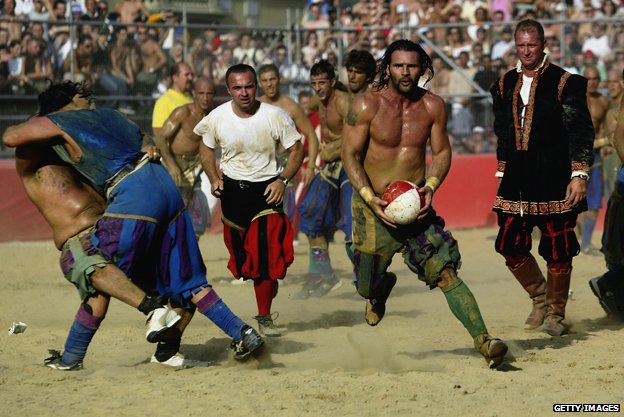
No one knows exactly when “Calcio Storico” — historic football — was first played here, but its pitch, the piazza of Santa Croce, dates from the 14th Century and the rules of the game — in so far as there are any — were written down in the late 1500s. The four quarters of the city — Santa Spiritu, San Giovanni, Santa Maria Novella and Santa Croce, named for their great local churches — each put up a team of 27 men.
The aim, over two heats and a final, is for players to get the ball over the 4ft (1.2m) fence at either end of the pitch. To achieve this, players can use both hands and feet, as well as every other part of the body when it comes to wrestling, punching and generally immobilising their opponents on the way. In other words — sport as muted warfare.
A 15th Century Florentine would still recognise much of the event. Each game is preceded by trumpet fanfares and marching drums as costumed dignitaries and flag-throwers in the rich hot renaissance colours of their teams march from their various quarters to the piazza. The only concession to sartorial modernity — the players’ coloured t-shirts with sponsors’ logos — are off within minutes of getting onto the pitch, so that all one can see is naked upper torsos, caked with sand and sweat, hurling themselves at each other, as the crowd roars its approval and each goal, or caccia, is greeted by cannon fire.
The addition of tourism has done little to blunt the edge of civic competition and not-so-benign thuggery that comes with it. Time travel works both ways, and watching from my window as the teams arrive (in the Renaissance most respectable women wouldn’t have been allowed out anyway), you get a distinct whiff of a darker, more physical past, where the streets were often full of excess testosterone looking for action.
Signs of an economic Sharknado
Feeling positive about the economy? Michael Snyder has ten reasons to change your mind:
Have you ever seen a disaster movie that is so bad that it is actually good? Well, that is exactly what Syfy’s new television movie entitled Sharknado is. In the movie, wild weather patterns actually cause man-eating sharks to come flying out of the sky. It sounds absolutely ridiculous, and it is. You can view the trailer for the movie right here. Unfortunately, we are witnessing something just as ridiculous in the real world right now. In the United States, the mainstream media is breathlessly proclaiming that the U.S. economy is in great shape because job growth is “accelerating” (even though we actually lost 240,000 full-time jobs last month) and because the U.S. stock market set new all-time highs this week. The mainstream media seems to be absolutely oblivious to all of the financial storm clouds that are gathering on the horizon. The conditions for a “perfect storm” are rapidly developing, and by the time this is all over we may be wishing that flying sharks were all that we had to deal with. The following are 10 reasons why the global economy is about to experience its own version of Sharknado…
#1 The financial situation in Portugal continues to deteriorate thanks to an emerging political crisis. […]
#2 The economic depression in Greece continues to deepen, and it is being reported that Greece will not even come close to hitting the austerity targets that it was supposed to hit this year […]
#3 The economic crisis in the third largest country in the eurozone, Italy, has taken another turn for the worse. […]
#4 There are rumors that some of the biggest banks in the world are in very serious trouble. […]
#5 Just before the financial crisis of 2008, the price of oil spiked dramatically. […]
#6 Mortgage rates are absolutely skyrocketing right now […]
#7 This upcoming corporate earnings season is shaping up to be an extremely disappointing one. […]
#8 U.S. stocks are massively overextended right now. […]
#9 Rapidly rising interest rates are causing the bond market to begin to come apart at the seams. […]
#10 Rapidly rising interest rates could cause an implosion of the derivatives market at any moment. […]
Most Americans don’t realize that Wall Street has been transformed into the largest casino in the history of the world. Most Americans don’t realize that the major banks are literally walking a financial tightrope each and every day.
All it is going to take is one false step and we will be looking at a financial crisis even worse than what happened back in 2008.
So enjoy this little bubble of false prosperity while you can.
It is not going to last for too much longer.
“The very definition of grand strategy is holding ends and means in balance to promote the security and interests of the state”
At the Anti-War blog, John Glaser looks at the ongoing costs of empire:
In Foreign Affairs, Michael O’Hanlon and Bruce Riedel suggest a cost-saving measure for America’s empire in the Middle East: opening more U.S. military bases in the region. Instead of relying as it has on expensive “aircraft carriers in and near the Persian Gulf,” the U.S. should move its military presence back onto land in at least three different Gulf states.
The primary purpose of having U.S. military bases peppered throughout the Middle East has traditionally been to exert control over geo-politically vital oil-rich countries and to allow for a rapid and coordinated use of military force at Washington’s command. As a Top Secret National Security Council briefing put it in 1954, “the Near East is of great strategic, political, and economic importance,” as it “contains the greatest petroleum resources in the world” as well as “essential locations for strategic military bases in any world conflict.”
O’Hanlon and Riedel don’t even consider the legitimacy of America’s military presence in the Middle East; for them, it is a natural law that can’t be questioned. So when faced with strained budgets that can’t support a sprawling, costly, and unwarranted empire, they try to figure minor cost cutting measures around the edges instead of reevaluating our military postures as a whole.
A CSIS report last year took a different tack, arguing that “disappearing finances; rising alternative power centers; declining US military predominance; lack of efficacy of key non-military instruments of power; and reduced domestic patience for global adventures,” all require a rethinking of U.S. grand strategy with an eye towards roll-back.
The very definition of grand strategy is holding ends and means in balance to promote the security and interests of the state. Yet, the post-war US approach to strategy is rapidly becoming insolvent and unsustainable – not only because Washington can no longer afford it but also, crucially, because it presumes an American relationship with friends, allies, and rivals that is the hallmark of a bygone era. If Washington continues to cling to its existing role on the premise that the international order depends upon it, the result will be increasing resistance, economic ruin, and strategic failure.
That first sentence there is one of the most honest you’ll ever see from an elite DC foreign policy think tank. U.S. foreign policy is ultimately promoting “the security and interests of the state.” It isn’t for your sake. It benefits the government and the private interests aligned with it.
Unwanted contact
At Samizdata, Natalie Solent had a rather strong reaction to an unwanted form of contact the other day:
Discussion point: the ethical issues surrounding unsolicited sales phone calls
Is it better to just hang them or should we draw and quarter first?
A few days on, and she’s a bit more philosophical about it:
Before being overwhelmed by phone-induced homicidal rage the other day, I had intended to discuss a subject that has been interesting me lately, namely how difficult it is to specify in advance rules for social interaction. More specifically, I was pondering how hard it is to lay down rules for dealing with unwanted contact. Cold calling is one form of that; what are traditionally described as “unwanted advances” are another.
The problem is that word “unwanted”. To say, as the organisational psychologist quoted in this article does, that “An unwanted advance is a form of injustice”, strikes me as unfair. We are not telepaths. Quite often the only way one can find out that unwanted contact is unwanted is to ask, that is, to initiate unwanted contact. On the other hand while we may not have telepathy, we most of us do have empathy to help us guess in advance when advances might be unwelcome. Phone sales companies know to the fifth decimal place exactly how likely their calls are to be welcome. They know that the first four of those decimal places are filled by zeros, scumbags that they are. Few men asking a woman out have quite such a large database of prior results upon which to draw. I’m glad I’m not a guy! That last breath before you open your mouth to begin the sentence that might get you rejected cruelly or rejected kindly must be painful.
July 13, 2013
Charles Stross on the inspiration for Saturn’s Children
It’s rather fascinating — especially if you’re also a fan of Robert Heinlein:
Now, I have a love/hate relationship with Robert A. Heinlein’s work. I am not American; much of his world-view is alien to me. I did not grow up with his 1950’s juvenile novels, and I don’t like them much. Some of his work is deeply, irredeemably flawed and should probably be taken out back and shot. (Does anyone have a kind word to say for Sixth Column or Farnham’s Freehold? I’ll try: 6thC was written to an outline supplied by famously racist editor John W. Campbell, at a point when Heinlein needed the money, and he is alleged to have watered down the racism as far as he could; as for FF, here was a privileged white male from California, a notoriously exclusionary state, trying to understand American racism in the pre-Martin Luther King era. And getting it wrong for facepalm values of wrong, so wrong he wasn’t even on the right map … but at least he wasn’t ignoring it.) Ahem. Nevertheless, it’s impossible to ignore Heinlein unless you’re going to ignore all American SF, and as that’s my main market and my main publishers are American, that’s not an option.
So I decided to pick a Heinlein novel and do a homage to it. One of my two favourites would do: that narrowed it to Glory Road (not really an option because: space opera contract) or Friday (problematic, later work showing flashes of earlier brilliance but impossible to read now without much head-clutching or making excuses for the author’s lack of a language with which to tackle issues of racism and child abuse, which is what underpins that book). This made things both easier and harder, because Friday is a late period work — distinctly different from his early and mid-phase novels (although it was something of a return to his mid-period form).
Then everything came together in my head in a blinding flash of enlightenment, thuswise:
I was going to write a late period Heinlein tribute novel, because everybody (I’m looking at you, Scalzi; also John Varley, Spider Robinson, Mike Ford, Steven Gould …) else who does Heinlein tributes does early Heinlein. And if you want to stand out, the best way to do it is to look which way the herd is stampeding in, then go somewhere else.
Heinlein in his dirty-old-man phase seemed to have a nipple obsession. Worse: an obsession with nipples which, as piloerectile tissue, made an implausible noise — “spung!” Thus, the word “spung!” becomes the centerpiece of any successful late-period Heinlein pastiche.
We in the reality-based community are aware that real human nipples do not do “spung”. But under what circumstances might a nipple go “spung”? Well, if it was some sort of pressure-relief valve on a robot, that sound wouldn’t be totally implausible.
Nipples … on a robot. Why would a robot need nipples? The answer seemed obvious: it was a sex robot. A sex robot in the shape of a Heinleinian omni-competent and beautiful yet sexually submissive heroine. (There is nothing politically correct about Heinlein: he was a product of a different age.)
What is the real inflation rate?
The official US inflation rate is around 1% annually. That doesn’t seem quite right to a lot of people who seem to be spending more money for the same goods:
… what Bernanke will never admit is that the official inflation rate is a total sham. The way that inflation is calculated has changed more than 20 times since 1978, and each time it has been changed the goal has been to make it appear to be lower than it actually is.
If the rate of inflation was still calculated the way that it was back in 1980, it would be about 8 percent right now and everyone would be screaming about the fact that inflation is way too high.
But instead, Bernanke can get away with claiming that inflation is “too low” because the official government numbers back him up.
Of course many of us already know that inflation is out of control without even looking at any numbers. We are spending a lot more on the things that we buy on a regular basis than we used to.
For example, when Barack Obama first entered the White House, the average price of a gallon of gasoline was $1.84. Today, the average price of a gallon of gasoline has nearly doubled. It is currently sitting at $3.49, but when I filled up my vehicle yesterday I paid nearly $4.00 a gallon.
And of course the price of gasoline influences the price of almost every product in the entire country, since almost everything that we buy has to be transported in some manner.
But that is just one example.
Our monthly bills also seem to keep growing at a very brisk pace.
Electricity bills in the United States have risen faster than the overall rate of inflation for five years in a row, and according to USA Today water bills have actually tripled over the past 12 years in some areas of the country.
No inflation there, eh?
Same Sex Marriage in America: What Now?
The Supreme Court’s decisions on same sex marriage are just the beginning of a long process of determining what roles marriage will play in the legal environment of states and the country. Walter Olson and Ilya Shapiro detail some of the implications of the rulings.
The state’s constant interest in what’s in your kid’s lunchbag
James Delingpole on the most recent “Nanny knows best” appointee hoping to dictate what the kids are going to eat for lunch:
“Mr Dimbleby”, it seems to me, is coming perilously close to suggesting that the decision as to what children eat at school should be a matter for the State rather than parents. Can he really believe this? Is there nothing about saying this sort of thing that makes him uneasy?
I mean sure, I agree with him on the principle that a good, well-prepared hot meal at lunchtime is probably more filling and nourishing than a packet-bread sandwich and a packet of crisps. Problem is, not all school canteens offer quite the same range and quality you might find in — oh, I don’t know, let’s pluck a random example from the air, shall we? — Bekynton.
Having put children through the state system myself I know whereof I speak. A new caterer arrived at my daughter’s primary school to much fanfare and for a while the food was great and most parents gratefully abandoned packed lunches (which, let me tell you, are a real hassle for a parent to prepare because they have to be done fresh in the morning when you’re already in a rush having breakfast and getting ready for the school run) and welcomed the new regime. But then standards began slipping to the point where my daughter (who, like a lot of children whose staple diet is gastro-porn TV programmes from the Great British Bake Off to Masterchef, genuinely cares about food) couldn’t eat the stuff any more. Again: is “Mr Dimbleby” seriously suggesting that schools should force children to go on eating in the canteen regardless of how disgusting they find the food?
You hear similar arguments from well-heeled progressive types on the school system generally. “If only public schools were abolished and all those pushy middle-class strivers were forced to put their children through the state system, standards would rise across the board.” Well, possibly. What would more likely happen is that all those scrubbed, diligent, nicely spoken, polite young poshos would be dragged down to the level of the lowest common denominator. And in any case it’s not an experiment which has any right being attempted anywhere in a Western notionally free-market economy. Why not? Because it’s illiberal bordering on the totalitarian, is why.
This is hardly a new topic … last year I said:
I remember what kind of crap my middle and high school cafeterias offered … and if I’d forgotten to bring a sandwich with me that day, going hungry always seemed like the better choice. The food on offer always seemed to manage the difficult stunt of being visually unappealing (sometimes being actually disgusting to look at), nutritionally inadequate, and either utterly flavourless (the better choice) or actively nasty. No wonder the best sellers in the cafeteria were the milk cartons (especially the chocolate milk), pop cans, potato chips, chocolate bars, and Vachon cakes (all of which were pre-packaged and relatively invulnerable to further processing).


