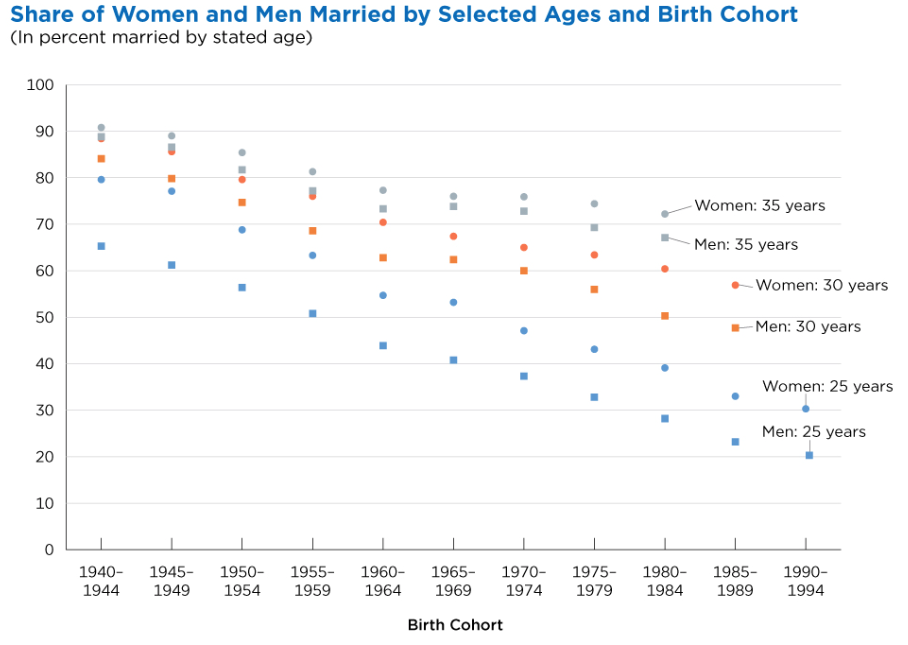
One of the most obvious demographic shifts in recent years has been the ongoing decline in the birth rate in pretty much the entire western world. But it isn’t surprising in one respect: Gen Z people aren’t forming relationships at the rate of earlier generations and have fewer (if any) sexual partners:
Why are so many Americans not getting married — or not even dating, in the first place?
The share of 40-year-olds who have never been hitched has quadrupled since 1980, as Americans get married later, or not at all.
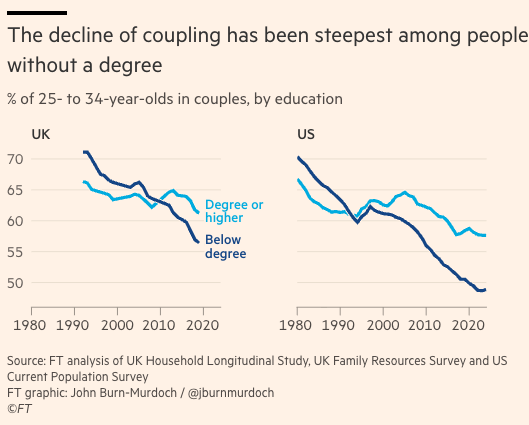
It’s not just marriage that’s declining but rather all forms of cohabitation. An analysis by John Burn-Murdoch found that “coupling” has declined steadily in both the UK and the U.S., especially for those without a college degree. The declining popularity of dating apps suggests that these trends are likely to continue.
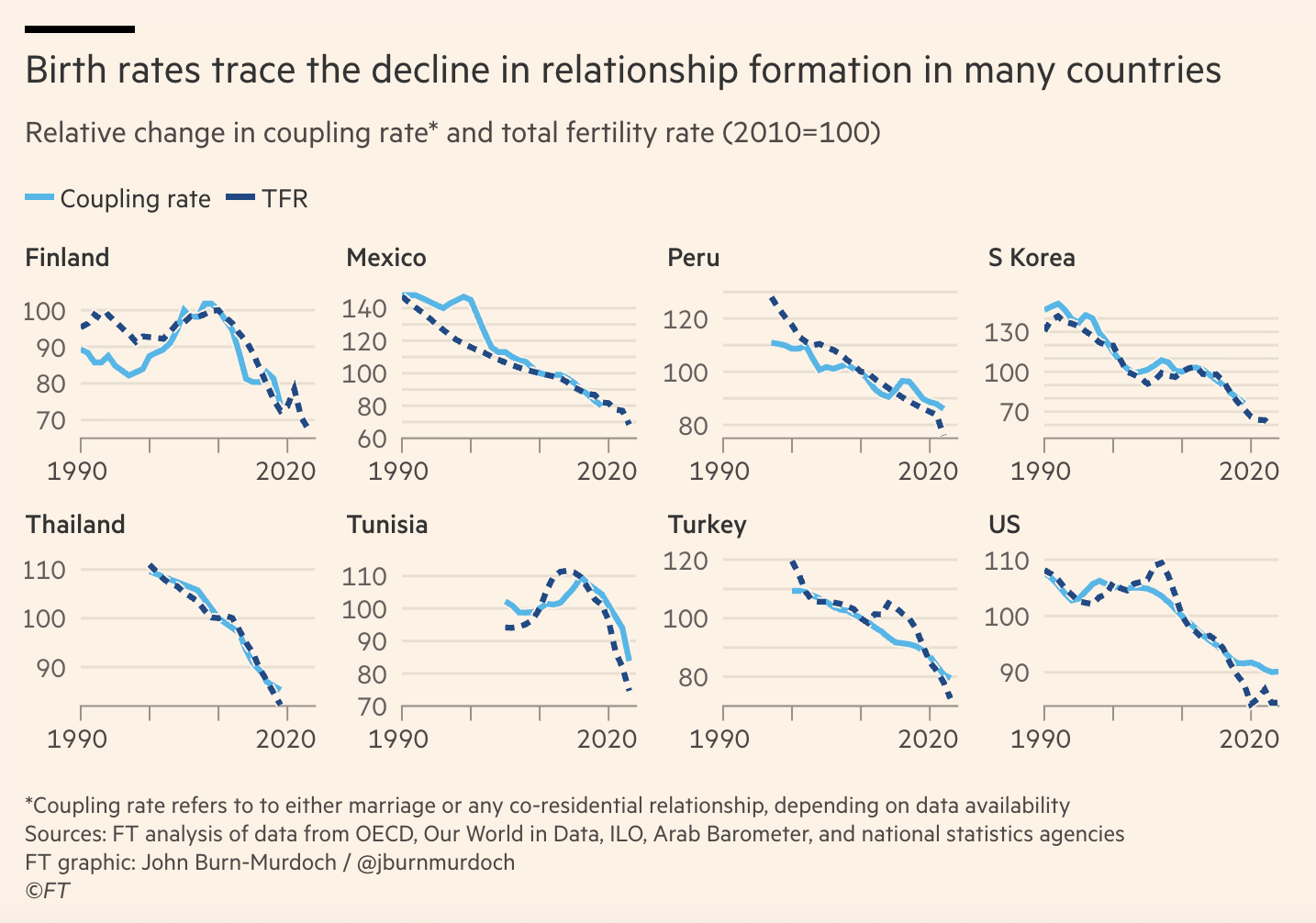
I care about the decline of coupling and marriage not because I consider myself a strict evangelist of matrimony — I think people should do what they can to enjoy themselves without hurting others — but rather because I think it bears on two of the most important questions about the future: (1) How many people exist, and (2) how happy are they? The relationship between romance and births is practically linear. Since 1990, Burn-Murdoch has shown, the decline of births traces the decline of relationship formation across many countries. Fewer relationships mean fewer people, and accelerating population declines around the world are, somewhat like climate change, a slowly accumulating phenomenon that will almost certainly shape the future of economics, technology, and the texture of human existence.
Then, there’s the mushy yet momentous question of whether people actually enjoy their existence. Self-reported happiness is declining in the west, and particularly in the U.S. Reviewing several decades of General Social Survey data, the economist Sam Peltzman came to the conclusion that “most of the overall downturn [in life satisfaction] is attributable to decline in marriage post-2000”. Reviewing Peltzman’s work, The Atlantic‘s Olga Khazan provided some useful context:
One paper alone might be easy enough to dismiss, but this is a fairly consistent finding dating back decades in social-science research: Married people are happier. Period.
If the decline of coupling is upstream of both falling births and falling happiness, then the most important question is what’s happening at the source. In his new book Generation Uncoupled, Daniel Cox, a public opinion researcher and director of the Survey Center on American Life, considers a range of causes that span technology, culture, media, economics, and politics.