
Claudio Grass (CG): A lot has been said and written about the economic and financial impact of the covid crisis and all the lockdowns and restrictions that came with it. However, the mental health implications haven’t really received the attention they arguably merit, at least not by mainstream media or government officials. Over the last year, we saw self-reported depression rates creep up in many Western nations, while excessive alcohol consumption and the abuse of prescription drugs also jumped. Do such trends raise concerns over longer-term problems or will we all simply snap back to normal once the crisis is over?
Theodore Dalrymple (TD): The first thing to say is that I do not like the term “mental health.” Was Isaac Newton mentally healthy, or Michelangelo? I think part of the problem is very concept of mental health. It implies that there is some state or condition of mind deviation from which is analogous to illness. Once this idea takes hold, it is clearly up to an expert to cure the person, or better still prevent him from getting ill in the first place. This expectation cannot be met, but the idea that it can be makes people more fragile.
Second, people clearly vary much in their response to confinements, lockdowns, closures of resorts of entertainment, etc. For myself, I have reached the age of misanthropy or self-sufficiency when these things make comparatively little difference to my life. I have plenty of space and plenty of things to do, in essence reading and writing. But that does not make me mentally healthier than a young man who is frustrated because he cannot play football with his friends and becomes ratty – moreover living in a very confined space.
Depression is so loosely defined a term that it has become almost valueless as a diagnosis. How often have you heard someone say “I’m unhappy” rather than “I’m depressed?” The semantic shift is very important. The proper response to someone who says that he is depressed is to give him antidepressants, even though these don’t work in the majority of cases, except as a placebo, and have potential side-effects. It is always tempting for people who are unhappy to drink alcohol – to drown their sorrows, as we say. Of course, if you drink too much, you might become really and truly depressed. A person who did not respond to the current situation with a little gloom would be odd.
Claudio Grass, “Theodore Dalrymple: Self-Control And Self-Respect Have Become Undervalued”, The Iconoclast, 2021-02-17.
May 23, 2021
QotD: The psychological impact of extended lockdowns
April 29, 2021
SFU professor’s analysis of Covid Lockdown Cost/Benefits
Economist Douglas W. Allen of Simon Fraser University recently published his Covid Lockdown Cost/Benefits:A Critical Assessment of the Literature where he concludes that “it is possible that lockdown will go down as one of the greatest peacetime policy failures in Canada’s history”:
In my forty years as an academic, I’ve never seen anything like the response and reaction to Covid-19. The research response has been immense, with estimates of over 40,000 papers related to the topic produced in one year. This research covers every imaginable aspect of Covid-19, and over the course of the past year knowledge about the virus, the human reactions to it, and the consequences of these reactions has exploded. In one word, the Covid-19 information cascade has been “overwhelming.”
In contrast, the ubiquitous media, public health, and political response to the pandemic has been one-sided, incomplete, and almost unchanging over the past year. With respect to lockdown policies, many political jurisdictions have repeated the same spring 2020 programs in 2021, ignoring what has been learned in the meantime. Often public announcements were made that were inconsistent with basic Covid-19 facts that were easy to look up if you know where to look. Furthermore, when research results contrary to the official government response were shared on social media, they were often pulled from social media platforms. As a result, for average Canadians the public media and official public health news conferences have been the only source of Covid-19 information.
This review of a small segment of the literature is intended to give some guidance for those who would otherwise not have access to academic research. The focus is to only critically assess the cost/benefit studies that have been written over the past year on lockdown policies related to the Covid-19 pandemic.
The report covers over 80 different academic studies and related Covid-19 datasites. I have sought out studies that i) dealt with matters of “lockdown” either directly or indirectly, and ii) were related directly or indirectly to issues relevant to the costs or benefits of lockdown.
The term “lockdown” is used to generically refer to state actions that imposed various forms of non-pharmaceutical interventions. That is, the term will be used to include mandatory state-enforced closing of non-essential business, education, recreation, and spiritual facilities; mask and social distancing orders; stay-in-place orders; and restrictions on private social gatherings.
“Lockdown” does not refer to cases of “isolation,” where a country was able to engage in an early and sufficient border closure that prevented trans-border transmission, followed by a mandated lockdown that eliminated the virus in the domestic population, which was then followed by perpetual isolation until the population is fully vaccinated. This strategy was adopted by a number of island countries like New Zealand. Here I will only consider lockdown as it took place in Canada and most of the world; that is, within a country where the virus became established.
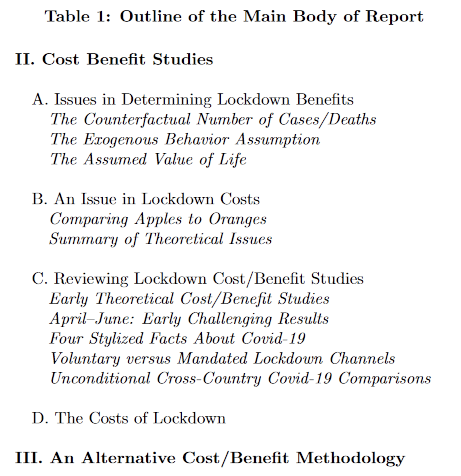
This is a complicated report because it covers a wide range of studies, and deals with a wide range of issues. Table 1 outlines the substance of the report. Sections II: A and B, discuss four critical assumptions often made within the context of estimating benefits and costs. Understanding these assumptions explains why early studies claimed that the benefits of lockdown were so high, and also explains why the predictions of those models turned out to be false.
Section II: C, examines major cost/benefit studies completed over the first six months of the pandemic, and then focuses on what I believe to be the critical factor: distinguishing between mandated and voluntary changes in behavior. This section concludes with an interpretation of some unconditional death comparisons across countries that are typically reported in the media. Section II: D surveys the research done on the costs of lockdown. Finally, Section III. presents a simple alternative cost/benefit methodology to generate two cost/benefit ratios of lockdown.
H/T to Stephen Green for the link.
April 17, 2021
Considering the costs and benefits of extreme specialization
In the latest post on Matt Gurney’s Code 47 Substack blog, he considers the trade-off between population density and the range of specialization that can be supported at various densities:

“Model A Ford in front of Gilmore’s historic Shell gas station” by Corvair Owner is licensed under CC BY-SA 2.0


I wish I remembered where I read this. It was a book I was blowing through for a university paper; only one chapter was really of interest to me when I was trawling for footnotes but I stumbled upon an interesting section that talked about services and specialization in a modern economy. The author offered a simple explanation of service specialization that I’ve never forgotten. Imagine a village with 100 people, the author said. Now imagine what services are available there. There’s probably a gas station, and maybe you can get a few services done to your car there, too. Basic repairs. Tire rotations. Oil changes. Things like that. There’s probably also a convenience store, and the store might also have a place to send or receive mail, or maybe even to rent a movie. (Back when that was a thing we did.) You might have a coffee shop of some kind, maybe a diner. But that’s marginal. You almost certainly don’t have a school, full post office, bank branch or medical centre of any kind. Not in a village of 100 people.
When you itemize out all the services you can get, it’s probably about five or maybe 10 — gas pumped, tires changed, oil changed, basic engine repairs, store clerk, movie rental, mail sent and received. Maybe someone to pour you a cup of coffee and get you a sandwich — but only maybe. The point isn’t to be precise in our list or count, but just to contemplate the relationship between the population and the number and type of available services.
Now scale that village up 10 fold, the author said. Now it’s a town of 1,000. The number of services explodes. You still have everything you did before. But now you’ve also got specialized shops, restaurants, a bank or two (and all the services they provide), probably a house of worship, medical services of various kinds (including eye care, dentistry, etc), personal-care services, better access to home and lawn care, various repair and maintenance service, technical services, a post office … the list goes on. You also start to see competition and the efficiency that brings — our village of 100 would have a gas station and a convenience store (quite possibly at the same location!). But our town of 1,000 would have a few of each. You’d get more services, and start to see prices dropping for the commonly available offerings.
You get the idea — the more you scale up a population, the more specialized services that are available and the more accessible they become. And this includes not just categories of service, but also increasing degrees of specialization. Our village of 100 probably has no full-time doctor. Our town of 1,000 probably has a family physician. But after we bump things up to 10,000, 100,000 and then a million people, we’re getting not just doctors, but highly trained, specialized physicians, surgeons and diagnosticians. Our town of 1,000 has a dentist, but our city of a million has dental surgeons who’ve specialized in repairing specific kinds of trauma and injury.
Anyway. I don’t remember what book this was from. But I do remember this short section. I think about it a lot. We Canadians of 2021 are, for the most part, hyper-specialized. I’ve written columns about this before, including this one from 2019, which I’m going to quote liberally below:
Human history is, in one simplified viewing, the story of specialization. As our technology advanced, a smaller and smaller share of the labour pool was required just to keep everyone alive. Perhaps the easiest way to summarize this is to note that 150 years ago, even in the most advanced industrial countries, something close to 50 per cent of the population was directly engaged in agriculture — half the people tilled fields so the other half could eat. Today, in both Canada and the United States, it’s closer to two per cent — one person’s efforts feed 49 others. Those 49 can pursue any of the thousands of specialized jobs that allow our technological civilization to exist. … Those 49 people are our artists and doctors and scientists and teachers. Human advancement depends on this — a civilization that’s scrambling to feed itself doesn’t build particle colliders or invent new neonatal surgeries and cancer-stopping wonderdrugs.
I stand by those remarks. But I’ve been pondering them of late with a different perspective. I’ve spent much of this week talking with doctors and medical experts in Ontario, where the third wave of COVID-19 is threatening to overwhelm the health-care system, with tragic results. And one recurring theme that comes up in these conversations is how this disaster is going to take place almost entirely out of public view. There won’t be any general mobilizations or widespread damage. People are going to die, behind closed doors or tent flaps, and other people will be forever scarred by their inability to save those people. But for most of us — those who aren’t sick, or highly specialized medical professionals — life is going to be something reasonably close to normal.
April 13, 2021
“… loving a country also means being honest. We should never get high on our own own flag-covered, syrup-scented supply.”
In The Line, Lauren Dobson-Hughes sits Canada down for a bit of an intervention:

Once upon a time, there was a fairytale castle with soaring turrets and gabled windows. The castle had long been undergoing renovations, so the owners draped the scaffolding with trompe l’oeil cloths — fabric imprinted with the image of the historical building beneath, to maintain an impression of the beauty hidden below.
From the cloth, you imagined the castle must be stunning. And yet behind the façade, it is crumbling. Its walls are mold-ridden, and the floors are rotten. The scaffolding props up a shell.
This metaphor has come to represent the way I’ve come to think about Canada since this pandemic began. As a country, we are so fixated on the mythology we project out to others — the trompe l’oeil cloth — that we’ve allowed the actual capacities, systems and structures of our country to crumble.
The first inkling came early in the pandemic. As COVID-19 numbers rose, it was revealed that the Public Health Agency of Canada did not have nationwide case numbers. This piece delves further, but “Ottawa does not have automatic access to data in [provincial and territorial] systems.” Provinces were sending daily case numbers to Ottawa on paper. This is one small example, but a revealing one. In fact, we lack a nationwide public-health system at all. And as the auditor-general’s report showed, we also lack the knowledge and expertise — the skilled people — to manage crises like this, too.
Then came protracted discussions about financial support for Canadians affected by lockdowns. The debate was not about whether Canadians deserved help — it was that Canada’s financial systems are so outdated and disjointed, that we literally could not work out how to get money from the federal government into bank accounts. It shouldn’t be this complex. In a functioning country, the central revenue agency should be able to transfer money to people without task forces of bureaucrats and experts, the establishment of new IT systems, and McGyvering an assortment of existing programs.
[…]
The list it goes on — the chaotic vaccine roll-out, the fractured public communications, the devolving of responsibilities to the very most local level with little overarching purpose or even organization. All of it marked by disjointed, outdated systems, lack of skills and know-how, and no overall goal or narrative. We need to face it — we have allowed our nation to crumble from the inside, while holding tight to the mythology that we’re an effective, functioning country.
At this point, I feel the need for a disclaimer that I love Canada. But loving a country also means being honest. We should never get high on our own own flag-covered, syrup-scented supply.
April 9, 2021
QotD: Instant expertise
One of the effects of the COVID-19 epidemic has been to reveal to a very large percentage of the population the joys of instant expertise. The world now has hundreds of millions, if not several billions, of epidemiologists, virologists, and clinicians, all of whom know best how to deal with the pandemic. The only problem is that their solutions are at variance with one another.
It sometimes seems as if the certainty with which views are held is inversely proportional to the solidity of the factual basis on which they are founded. If commentary on the internet is anything to go by (it might not be, of course, for those who avail themselves of this means of self-expression are a self-selected rather than a representative sample), people often take a religious attitude toward their own doctrine and condemn as heretics all those who express doubts about it. I don’t want to sound like a psychoanalyst, that class of person who believes that he unfailingly knows the real meaning of what is said rather than its merely apparent meaning, but stridency of views is often indicative of unacknowledged uncertainties. Zinc supplementarians and others of the type cling to their beliefs with a fervor that evidence does not merit.
Theodore Dalrymple, “Everyone’s an Expert”, Taki’s Magazine, 2020-10-16.
April 5, 2021
QotD: NYC goes out of its way to “afflict the comfortable”
One might ask why a social-services functionary in New York City would cite the Bible in defense of public policy — except that the quotation is not even from the Bible. In fact, it is from Finley Peter Dunne, a popular Chicago columnist from the 1890s who invented a humorous character named “Mr. Dooley,” an Irish bartender who delivered his wisdom in dialect.
The original quotation, in which Mr. Dooley described the function of the newspaper: “Th’ newspaper does ivrything f’r us. It runs th’ polis foorce an’ th’ banks, commands th’ milishy, controls th’ ligislachure, baptizes th’ young, marries th’ foolish, comforts th’ afflicted, afflicts th’ comfortable, buries th’ dead an’ roasts thim aftherward.” Somehow, in a bizarre game of “cultural telephone,” this mock-sonorous fiddle-faddle has gathered the effulgence of holy writ for progressives, who take it as descriptive of their “joyous responsibility.”
On the one hand, it’s comical that this scrap of tabloid wit is taken so gravely by self-righteous officials. Properly speaking, isn’t it their job to make people more comfortable, not to diminish comfort? But on the other hand, it’s frightening to consider that New York is now run by progressive militants who appear to believe that their vocation is to “afflict” their constituents by disrupting their undeserved calm and comfort. Mass immiseration is not a side effect of bad policy; it is the policy.
Seth Barron, “The Politics of Affliction”, City Journal, 2020-12-17.
March 30, 2021
Leaky labs and the WHO’s whitewash efforts
In the latest NP Platformed newsletter, Colby Cosh outlines some of the historic “diseases escaping from the lab” events that certainly allow us to be … dubious about the WHO maintaining the line that the Wuhan Coronavirus was “unlikely” to have escaped from the biological lab in Wuhan:
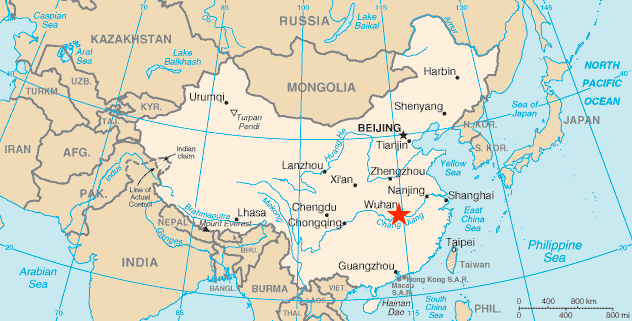
The original SARS virus, which terrorized Canada in 2003, has escaped from laboratories and infected humans at least six times since its successful suppression in the wild — once in Singapore, once in Taiwan and four times from one laboratory in Beijing.
And then there’s the great enigma in the history of infectious disease (maybe the second greatest — I for one would still really like to know what the English sweat was). How in blazes did the H1N1 flu virus come back? A strain of H1N1 was responsible for the Spanish flu of 1918-19; it lingered in human populations and continued to evolve until it was seemingly supplanted by a cousin, H2N2, which swept the world during the 1957-58 “Asian flu.”
H1N1 just plain vanished for two decades, then reappeared rather puzzlingly in Russia in 1977, causing a “Russian flu” pandemic and 700,000 deaths. This strain wasn’t especially lethal, but it knocked those too young to have natural immunity to H1N1 flat on their rears. Since then, H1N1 has been endemic in humans — it is incorporated as a matter of course into seasonal flu vaccines — and modern genetic analysis shows that the 1977 strain of H1N1 was, DNA-wise, pretty much a carbon copy of H1N1 strains from before the Asian flu years.
The “Russian flu” therefore almost certainly cannot have reappeared naturally, since it had undergone almost no discernible evolution. It probably crossed into Siberia from (wait for it) mainland China, which was then not yet a WHO member state. Some analysts think this may have happened because of a lab leak. Others think it more likely that it was a botched effort to create an H1N1 vaccine from old samples; H1N1 had crossed over to a small number of humans in the United States in 1976, creating the famous “swine flu” scare.
Still others ask: uh, is the difference between a lab leak and a botched vaccination experiment particularly meaningful? The general public may not know it, but a pandemic originating in a research laboratory isn’t just a hypothetical. It has not only happened, but there’s a decent chance that you, personally, have suffered from the resulting disease.
March 25, 2021
Boris wanted to be a new Churchill, but instead is shaping up as a cut-rate Cromwell
Bella Wallersteiner on the vast difference between Boris Johnson’s hopes for his premiership and the actual role he’s been playing:

A year has passed since the British public accepted lockdown as the best way to combat the spread of the novel coronavirus, yet we are still living under the strictures of the Coronavirus Act.
In the name of virus protection, we have experienced a level of authoritarianism not seen in this country since the time of Oliver Cromwell – restrictions on freedom of movement, forced closure of businesses, and prohibitions on weddings and funerals have challenged many of our most cherished beliefs about the limits of government power, while the ban on large gatherings means we cannot even legally protest them.
Today, as we mark the anniversary of the first lockdown, we would do well to reflect on just how compliant we have become to what were intended to be “emergency” powers.
Cheery platitudes have ranged from “we’re all in this together” and “we’ll send this virus packing” to the hopelessly inaccurate “it will all be over by Christmas”. But history tells us that governments tend to hold on to additional powers far longer than is necessary.
The Defence of the Realm Act of 1914, for example, granted the government wide-ranging powers in the name of public safety, including heavy censorship of the press and the introduction of rationing. Pub licensing laws remained in place for decades, only relaxed in November 2005.
The Second World War brought The Emergency Powers (Defence) Act 1939 which ceded immense regulatory powers to the government, including provisions “for the apprehension, trial and punishment of persons offending against the Regulations and for the detentions of persons whose detention appears to be expedient to the Secretary of State in the interest of public safety or the defence of the realm”. The Act was finally repealed on 25th March 1959, but the last of the Defence Regulations (which included the maintenance of public order) was not lifted until 31st December 1964.
March 24, 2021
“By now it has dawned on even the most glossy-eyed internationalists that we are well into another sides-picking era of global geopolitics”
Like it or not, we’re already a few years into a new Cold War, this time with the Chinese Communist Party. The Canadian government seems to be among the last in the world to recognize this change in the geopolitical situation. In The Line, Andrew Potter shows why Justin Trudeau must stop trying to cuddle up to Xi:
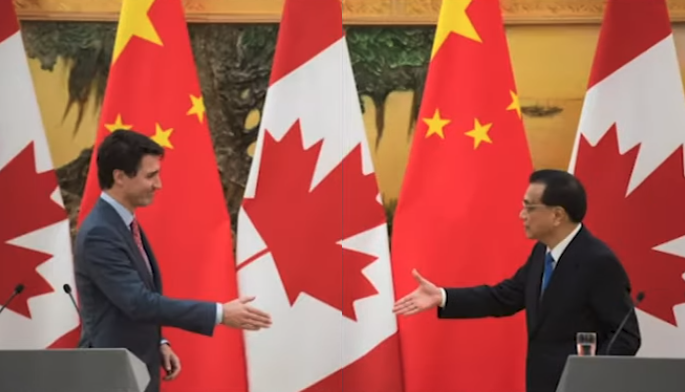
The outrageous secret trials in China of Michael Spavor last Friday and Michael Kovrig this Monday are nothing more than punctuation marks on a storyline that has been obvious for some time now.
Which is why it was enormously gratifying to see more than two dozen diplomats show up to seek admittance to Kovrig’s trial. The fact that none was admitted is unfortunate but largely beside the point — what matters is the public display of solidarity. Even more gratifying perhaps is the announcement (by Canadian officials) that the U.S. has promised to treat the two Canadians as if they were American citizens. After all, it was our acquiescence to a U.S. request to arrest Huawei executive Meng Wanzhou at Vancouver International Airport in 2018 that prompted Beijing to nab Spavor and Kovrig in retaliation. While Chinese officials have denied that what this amounts to is hostage diplomacy, they’ve also made it clear that the fate of the Michaels is tied to that of Meng.
What makes the public support from all of these countries so remarkable is that a lot of them — the Czechs, the Finns, the Romanians — have very little to gain from sticking their neck out for Canada. More to the point, every one of these countries has good reason to wonder just how committed Canada itself is to this show of collective strength. After all, it was only five years ago that senior members of the Liberal party were freely — privately, but freely — saying that as far as the Liberal government was concerned, the U.S. was yesterday’s news and China was the horse Canada was going to ride into the future.
And while a lot has changed over the last five years (not least of which is the fact that Donald Trump has come and gone as president of the United States), it remains incomprehensible that it was just last year the Canadian National Research Council placed its disastrous COVID-19 vaccine bet with CanSino Biologics, a Chinese company with close ties to the Chinese military. What are our allies to make of the fact that only last month, the federal granting agency NSERC partnered with Huawei to sponsor computer engineering at Canadian universities. Or that Canada’s visa office in Beijing is owned and staffed by a Chinese police force?
Whether it is a matter of naïveté, bad faith, or outright cravenness, Canada continues to give every indication that it is a country that is still hedging its bets.
March 8, 2021
Despite the rhetoric, judging by their actions the Democrats really hate the “gig economy”
Along with all the giveaways to favoured groups in the US government’s huge “relief” bill, there was a late change that will take the gig economy into a back alley and rough it up to the tune of about $1 billion in new taxes:
UBER 4U by afagen is licensed under CC BY-NC-SA 2.0

When the economy is struggling to recover from a pandemic and crushing government lockdowns, that’s probably the worst time to impose $1 billion in new annual taxes on the working class. But that’s exactly what a new provision quietly slipped into the Democrats’ sweeping $1.9 trillion COVID legislation would do.
“A last-minute insert by Democrats looking to offset the cost of their coronavirus aid package would send tax collectors into the gig economy, eventually costing Uber and DoorDash drivers, Airbnb hosts and others about $1 billion annually,” Roll Call reports.
Under current tax law, earnings data for gig economy workers only needs to be reported to the IRS once it reaches $20,000. This means that small earners pursuing gig work to supplement their income aren’t hit by crushing federal taxes. However, the Democrats’ provision would nearly eliminate this benchmark, and instead require all income above $600 to be reported to the IRS.
“The stiffer tax burden would be imposed while 10 million Americans are unemployed and more and more have turned to freelance and gig economy work to make ends meet,” Roll Call notes.
Indeed it would, and this would be disastrous for both workers and the economy.
This tax hike “adds a significant burden to gig economy and small business workers at the worst possible time,” according to TechNet spokesman Steve Kidera. One tax expert warned Roll Call that many struggling gig economy workers won’t be able to pay the higher taxes, and that IRS penalties “can destroy a person’s life.”
March 3, 2021
Gen Z is suffering … but not enough?
In Quillette, Freya India considers the plight many of her cohort find themselves in during the ongoing efforts to combat the spread of the Wuhan Coronavirus (aka Covid-19):
“Gen Z” by EpicTop10.com is licensed under CC BY 2.0
My generation is miserable. Gen Z, those of us born after 1997, are the saddest, loneliest, and most mentally fragile age group to date, cursed with rising rates of anxiety, depression, and suicide. How can that be? How can a generation with everything feel so desperately unhappy? By almost every metric, human life is dramatically better today than it ever has been. The number of people living in extreme poverty has fallen from around 90 percent in 1820 to just 10 percent in 2015, while rates of illiteracy, mortality, and battle deaths are also in rapid decline. For the most part, Gen Z are heirs to an immense fortune: a utopian world of instant gratification and technological dynamism. In theory, this should be the age of happiness.
And yet, misery abounds. In the United States, 54 percent of Gen Z report anxiety and nervousness, according to researchers at the American Psychological Association. This is compared with only 40 percent of millennials and a national average of 34 percent. It isn’t just a case of self-report bias either, since the suicide rate for Americans aged between 15 and 24 has risen by over 51 percent in the last decade. For Gen Z women in particular, suicide rates have risen a staggering 87 percent since 2007. In my home country of the UK, one in four girls is clinically depressed by the time they are 14.
There’s no shortage of articles trying to make sense of the mental health epidemic at a time of such global prosperity. Teens and pre-teens today, we’re told, are simply interred beneath the weight of political issues like climate change, immigration, and sexual assault, as well as fatigued by job stress, exam burnout, and the attainment of unrealistic social media standards. The antidote, many suggest, lies in practicing better “self-care,” from daily gratitude journaling to adopting a 38-step skincare routine. And it’s a popular remedy. Since the pandemic began, online searches for “self-care” have risen 250 percent, with schools, universities, and employers turning to compulsory wellness programmes like mindfulness training and meditation sessions to improve mental health.
But, I suspect the problem is more nuanced than this. I don’t doubt that Gen Z is under a lot of strain, but I also think our plight is unique. For the first time in history, much of our misery stems not from too much suffering, but from not suffering enough. Gen Z does face real problems. I have certainly felt beleaguered by the pressures of social media, an oversaturated job market and the impact of coronavirus restrictions on my education. On top of that, there’s the difficulty of simply trying to exist as a fallible human in a political climate which demands infallibility, where nothing feels light-hearted anymore, and everything we say or do in our youth is stained onto the Internet for all time.
So, pressure is no doubt part of it. But previous generations faced egregiously difficult times: world wars, pandemics, economic crises, political rebellions, totalitarian regimes, and conditions of extreme poverty. Not only that, but today there are a wider range of mental health services available than ever before, and Gen Z are more likely than any other generation to seek treatment. So, for our rates of mental illness and suicide to be so high in a time of relative peace, there must exist a more convincing explanation than simply the asperities of life.
What lurks over my generation is not just a sense of misery, but meaninglessness. We exist in a state of lethargy and unfulfillment, tormented not by the tragedy of it all, but the futility. This is a point most articles and public figures today are less willing to discuss. But, to examine this possibility isn’t to say that Gen Z never struggle — but to suggest that at least some of us are caught in a rut of boredom, not burnout.
March 1, 2021
In the 2020 US federal election, “Each side felt that the stakes were existential”
Michael Anton discusses what he calls the “Continuing Crisis” in the Claremont Review of Books:
“Polling Place Vote Here” by Scott Beale is licensed under CC BY-NC-ND 2.0

A full understanding of what happened that Wednesday would begin with the ruling class’s decades-long betrayal and despoliation of what would eventually come to be called Red or Deplorable or Flyover America. But the more proximate cause was the 2020 election — easily the highest intensity such contest of my lifetime. Each side felt that the stakes were existential. The accuracy of those feelings doesn’t matter; their existence was enough to drive events.
As an incumbent seeking a second term, President Trump — even after the COVID lockdowns had tanked America’s previously supercharged economy — seemed to have a lot of things going for him: near-unanimous support from the base, high primary turnout even though he faced no opposition, a seemingly unified party, approval ratings not far from Barack Obama’s in 2012. According to Gallup, in September 2020 56% of Americans reported doing better than they had four years prior — a level that, in ordinary times, would all but guarantee an incumbent’s re-election.
But these were not ordinary times. It was also easy to see — and many friends and supporters of the president did see, and warned about — shoals ahead. The Democrats used the pandemic as an excuse to accelerate and intensify their decades-long effort to loosen and change American election practices in ways that favor their party. In the spring, they began openly talking about staging a coup: literally using the military to yank Trump from power. It’s one thing to hold a “war game” and plot in secret about a president’s ouster, but why leak the result? Only if you want the public prepared for what otherwise would look like outrageous interference in “our democracy.” Democrats and their media allies also, and for the same reason, assiduously pushed the so-called “Red Mirage” narrative: the story that, while you are likely to see Trump way ahead on election night, he will certainly lose as all the votes are counted. This was less a prediction than preemptive explanation: what you see might look funny, but let us assure you in advance that it’s all on the up-and-up.
In response (or lack thereof) to the other side’s assiduous preparations, the president, his staff, his campaign, and his party committed four serious errors of omission. First, they made hardly any attempt to work with Republican state officials — governors, legislatures, and secretaries of state — to oppose and amend rule changes that would disadvantage them and favor their opponents. As far back as the 2016 election, Trump had complained that Hillary Clinton’s popular vote total had been padded by several million votes by illegal immigrants. Yet he and the GOP did very little to tighten state election procedures. Second, after having failed adequately to oppose those changes, they mounted far too few legal challenges to get them overturned or modified. Third, having declined to challenge the changes, they barely even tried to ramp up their own mail-in voting operation to rival the Democrats’. Fourth, despite numerous loud predictions — both as boasts and warnings — that the election outcome would be unclear and disputed in several states, no team was assembled in advance to investigate and, if necessary, litigate the results. Florida 2000 came as a surprise to candidates Al Gore and George W. Bush. Nonetheless the Bush campaign was able to field almost immediately an army of lawyers, including experts on election law, headed by a former secretary of state, the wily James Baker. The Trump team had at least six months’ warning and, as far as I can see, did nothing to prepare.
H/T to “currencylad” at Catallaxy Files for the link.
February 8, 2021
The quality of medical information available to journalists
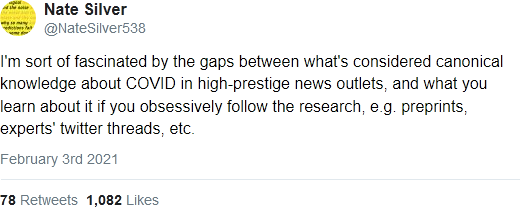
Scott Alexander shows the conflicting agendas of journalists and the medical professionals they depend on for their background information in writing about medical issues:
I heard from a journalist yesterday after writing yesterday’s post on WebMD. They’ve been trying to write a coronavirus article worthy of Zvi or any of the other illegibly smart people writing on the pandemic. Apparently the bottleneck is sources.
In most journalistic settings, you can’t just write “here’s what I think”. You have to write “here’s what my source, a recognized expert, said when I interviewed them”. And the experts are pretty sparing with their interviews for contrarian stories.
The way my correspondent described it: sources don’t usually get to approve the way they’re quoted in an article, or to see it before it gets published. So they’re really cagey about saying anything that might get misinterpreted. Maybe their real opinion is that X is a hard question, there are good points on both sides, but overall they think it probably isn’t true. But if a reporter wants to write “X Is Dumb And All Epidemiologists Are Idiots For Believing It”, they can slice and dice your interview until your cautiously-skeptical-of-X statement sounds like you’re backing them up. So experts end up paranoid about saying potentially-controversial-sounding things to reporters. And since reporters can’t write without sources, it’s hard for them to write anything controversial about epidemiology.
The incentives for the journalist and their editor is to find a sensational angle to get as many people to read the piece as possible (“clickbait” works). The incentives for the “expert sources” are to avoid saying anything substantive that might provide such an angle (“don’t become a headline”). It’s no wonder that journalists with no specialized training in the experts’ area are unable to produce fully informative articles for public consumption.
January 24, 2021
The dangers of depending on “experts”
David Warren considers the vastly expanded role of “experts” in our public discourse:

Having no degree in either field, I try not to write what will be contradicted by an expert. On the other hand, “expert” has become a murky concept. Once we had to distinguish only between demonstrated credible experts, and villains. Common sense could usually tell them apart. But with the growth of our “sophistication,” the category of villainy has been much expanded. We have a category of institutionally credentialled experts who aren’t exactly liars, but more like what Harry G. Frankfurt defined as “bullshitters.” They struggle to remain plausible, but are using their expertise to advance interested views. And, having such motives — in opposition to the plain pursuit of truth — they seek publicity, and angle to obtain it.
As Dr Frankfurt hinted, in his short philosophical treatise on this topic (On Bullshit, 2005), these can be, and usually are, more trouble than old-fashioned liars. For a real liar knows he is lying, and can be caught out. By comparison, the modern media expert avoids what is strictly checkable, not only to protect himself, but from indifference for truth. He is, according to me, the intellectual descendant of the mediæval Nominalists, adumbrating words, not realities. While less intelligent than his predecessors, he carries on the tradition of saying that something is true because he says so.
“Consensus science” is of this nature. In it, truth can be negotiated, or imposed. While the weather next Saturday will be known to the living, a prediction for much later in the century has no meaning. From the number of variables in play, I can tell you with certainty, that woke “climatologists” are talking bosh; and every signature on their consensus I may add to my list of persons to ignore. This is elementary stuff: and I do try to stick to what is elementary, and foreseeable.
The success rate, for elaborate predictions, remains, at this point in our history, zero-point-zero. But it is becoming so also for the present, and past. The Batflu, here, is current primary example. Owing to obvious manipulation, we cannot know much about its effects. In rough terms, we can know that they are exaggerated, because almost every expert has a vested interest in getting the numbers up, and those who disagree will be punished. The same is true for all the popular remedies, including such nonsense as mangle-wearing, and obsessive social distancing. No legitimate research lies behind either, so we must assume the purposes for various lockdown orders are not actually the Batflu.
January 17, 2021
Hector Drummond on Boris “Cane-Toad” Johnson
As a teaser to attract new subscribers to his Patron and SubscribeStar pages, Hector Drummond shared this piece on the ecological disaster of Australia’s 1930s cane-toad importation and the similar political disaster of Boris Johnson in Britain:
In the 1930s Queensland farmers were facing trouble with large numbers of cane beetles eating the sugar crops that were an important part of the state’s economy. So the Bureau of Sugar Experiment Stations came up with a cunning plan. They would import some cane toads (a native of middle and south America), because cane toads ate cane beetles. This was sure to solve the problem in a trice. One-hundred and two cane toads were duly imported into the state, from Hawaii as it happened, to do the job.
Unfortunately this soon became a classic case of the cure being worse than the disease. In fact it wasn’t any cure at all because the cane toads didn’t bother much with the cane beetles, and instead ate everything else they could wrap their tongues around. The other thing they did was multiply at an explosive rate. These days there are estimated to be 200 million cane toads in Australia, mainly in Queensland, and they cause havoc with the native fauna, not least because they have nasty poison-producing glands on the back of their head which the native animals have no naturally-evolved defence against. Curious pet dogs who mess about with a toad can die.
In 2019 Britain was facing its own crisis. It had become obvious to half the country that Theresa May’s Conservative government was deliberately trying to prevent Brexit from happening. As the other parties were even worse, the only hope for a real Brexit to take place was if a new pro-Brexit leadership in the Conservative party could be installed. After a titanic struggle, this finally happened, and Alexander “Boris” Johnson became the new leader, with Michael Gove and advisor Dominic Cummings at his side.
Unfortunately Johnson has proven to be Britain’s own version of the cane toad, a cure that is vastly worse than the disease. Johnson, at least, proved to be more able than his Australian counterpart at doing the job that was required of him. Whereas the Australian toad was about as interested in cane beetles as Olly Robbins was in getting the UK out of the EU, Johnson at least gave us a middling type of Brexit which, as fudged as it was, was at least far better than anything any of his fellow MPs could have got.
But in terms of being worse than the disease, Cane-Toad Johnson has proven to be far, far more destructive than the cane toad ever was. The cane toad, after all, is merely an ecological pest, whereas Johnson has proved to be a dangerous menace to the country’s liberty, prosperity and health. The poison from his glands has leached into our very life. We have become like domestic dogs who have been forced to lick them every day.


