
I’ve thought about this uncrossable gap from the reader’s side as well. A few years back, I read a book written by an eleventh-century Byzantine bureaucrat and historian, Michael Psellus, chronicling his turbulent times. (That the title was Fourteen Byzantine Rulers but only covered a century is a clue to just how turbulent.) It was, of course, originally handwritten, “publication” consisting of the manuscript being hand-copied by scribes, and distributed to a tiny audience of like-minded men. I read it in English translation, in an e-edition instantly available worldwide in unlimited quantities, on my tablet computer. Psellus could not possibly have pictured me as his reader, living a thousand years later on a continent he didn’t know was even there, speaking a language that hadn’t come into existence yet, in a technological future he could not have imagined. (That I’m female, to boot, might be less of an issue — there were plenty of literate Byzantine women, at least in the upper classes of his assumed readership.) And yet his words and thoughts were handed to me as freshly as if they’d been penned (though not typed) yesterday. I could see him; he couldn’t see me.
The Psellus book was a memoir, and so its author was presenting himself fairly directly to his audience, if in a self-edited fashion. Fiction adds a layer of veiling between creator and reader, ranging from a thin gauze to a thick stage curtain. People are naturally curious about anything hidden by a curtain, and always want to peek. (When thinking about this as a shy writer, I always channel that famous line from the Wizard at the climax of the movie The Wizard of Oz — “Pay no attention to that man behind the curtain!”) But if readers can’t get an actual look, they will make up the writer in their heads, constructed from their own knowledge and expectations much as they mentally construct the fictional characters they’re reading about.
I got an accidental peek at this process many years ago at a science fiction convention, where I fell into a conversation in the booksellers’ room with a (male) reader who was very surprised to discover I was a woman — by whatever assumptions, he had not processed my name on the cover as female. (This, I later discovered, is not uncommon in my foreign-language translations, where the genders of English names are less recognizable.) Quickly, before his mental image was overwritten by our encounter, I got him to describe the author whom he had imagined had written the books he’d enjoyed (Vorkosigan Saga science fiction stories, at the time.) It included some odd details — male, mid-thirties, dark-haired, East Coast upper class — rather like my fictional character Ivan Vorpatril, really. Nothing at all like the beleaguered (if also mid-thirties) Midwestern housewife and mother I actually was. Yay curtain.
Lois McMaster Bujold, introduction to the Taiwanese edition of The Curse of Chalion by Fantasy Foundation/Cite Publishing, 2020-03-25.
October 2, 2025
QotD: The gap between the author and the reader
September 1, 2025
How did the Egyptians forget Hieroglyphs?
toldinstone
Published 25 Apr 2025Chapters:
0:00 Introduction
0:53 Introducing hieroglyphs
2:15 Hieroglyphs in Roman Egypt
3:10 The great temples
3:53 Decline of the temples
5:04 FlexiSpot
6:28 Vanishing hieroglyphs
7:40 Roman ignorance of hieroglyphs
8:44 Hieroglyphica
9:28 Mysterious or powerless
August 25, 2025
George Orwell’s Down and Out in Paris and London
Down and Out was one of the first Orwell works I read as an adult, having encountered Animal Farm and Nineteen Eighty-Four as school texts. I would not say that I enjoyed the book so much as it gave me a very different view of both cities between the wars and encouraged me to seek out more of Orwell’s work. On his Substack, Rob Henderson considers the book and its author:
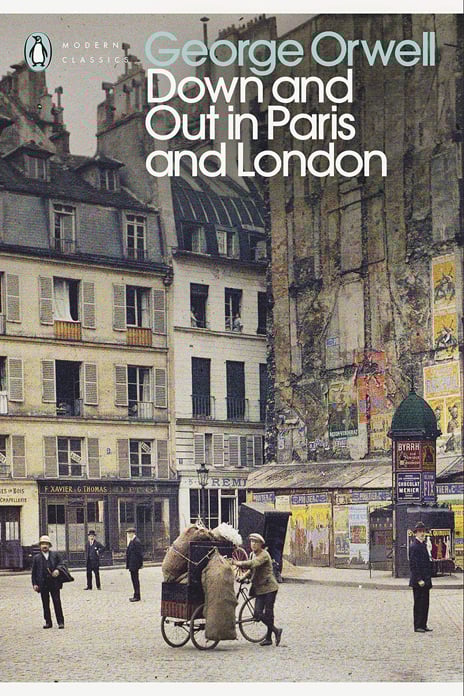
I was in high school the first time I read Down and Out in Paris and London (1933) by George Orwell. A memoir about his time in the slums of France and England.1 Orwell, while in Paris, worked as a plongeur — a person employed to wash dishes and carry out other menial tasks in a restaurant or hotel. Plongeur sounds much better than “bus boy”.
Because, at the time, I was also working as a busboy and dishwasher, I enjoyed Orwell’s description of employment in a busy restaurant. He wrote that the work itself was simple, like sorting a deck of cards, but when done against the clock it became exhausting. That captured exactly how I felt on my Friday and Saturday evening shifts.
Later I was disappointed to learn that Orwell had come from privilege. The guy went to Eton, a prestigious all-boys school. The book recounted his experiences with slum tourism. When he was penniless during the periods described in Down and Out, particularly during his return to London, his well-to-do family could and did take him back in for temporary periods so he could eat well and shower. At first this made the story feel less authentic.
Over time, though, I came to see it differently. It took someone like Orwell to write about life in the slums in a way that other educated people would pay attention to. I had to go through something similar. Only after spending time around the upper middle class did I understand how to describe my life in a way that would actually make them pay attention.
[…]
In the second half of Down and Out in Paris and London, Orwell describes living rough in London’s East End, staying in lodging houses and casual wards. He worked alongside the city’s laborers to understand poverty from the inside.
Down and Out in Paris and London was Orwell’s first published book, written when he was in his mid-twenties. It is striking is how little he romanticized the idea of being an impoverished bohemian in world-class cities, the way so many others of his background might have done. Instead, he treated his immersion in the Parisian and London underworlds as an attempt to strip away the prejudices he had inherited as an upper-middle-class Etonian.
The book is restrained in its politics. Orwell rarely pauses for commentary, preferring to tell the story as it happened and saving his more general conclusions for a couple of chapters at the end. This is more or less the same approach I took with Troubled; describe the world as it was, or at least as I remember it, and let the meaning emerge on its own.
One of the strongest features of Down and Out is its focus on the psychological effects of petty humiliations. Orwell describes kitchens where people from every corner of Europe are screaming at each other in different languages, frantically trying to keep pace with the chaos. If you have ever watched one of those Gordon Ramsay shows, you have some idea. He admired the strange order that somehow emerged from the chaos.
This voyeuristic quality is part of the book’s appeal. We all go to restaurants and see only the polished surface, knowing almost nothing about what happens behind the doors. Likewise, we all encounter homeless people in daily life and know little about how they live. Back in the 1930s, you didn’t have to make many mistakes to find yourself in a tough spot. My guess is that because society today is wealthier, there are more social services available, and powerful recreational drugs more accessible, the typical homeless person (he uses the word “tramp”, which was a prevailing term at the time) Orwell encountered nearly a century ago is very different from those we see today.
During his year and a half working menial jobs in Paris, Orwell wrote a few books, all rejected by publishers in London. None of this appears in Down and Out. He never dwells on his literary ambitions or his many failures. He does not even treat “writing” as a subject worth mentioning. For him, sleeping on a bench along the Embankment was a detail that mattered more than discussing proofs with an editor. Struggle is more interesting to read about than success. Sometimes people ask me if I’ll write a follow up to Troubled. No way. No one wants to read a whole book about a guy who went to elite universities and then blathers on about his subsequent prosperity. The thought of it induces a feeling in me of both amusement and nausea. Even if I focused on the unexpected struggles and costs of upward mobility, the stakes are so low that I can’t bring myself to take it seriously.
- It just occurred to me that this was in 2005. Around once a week I’d stop by my high school library after class and browse the shelves. By 2006 and 2007, I noticed fewer and fewer students actually reading in the library and more and more of them on the desktop computers, watching videos on a new website called “YouTube”. Can’t help but wonder how much streaming videos have reduced interest in reading among young people.
The Sharpest Pen of the Edwardian Age | Who Was Saki?
Vault of Lost Tales
Published 5 Apr 2025Delve into the razor-sharp world of Saki in this engaging author talk exploring his chillingly clever short story, “The Open Window”. Discover the man behind the pen name — H.H. Munro — and uncover how his biting satire, Edwardian upbringing, and darkly humorous worldview shaped this unforgettable tale. Perfect for fans of classic literature, Oscar Wilde-style wit, and unsettling plot twists, this literary deep dive offers historical context, thematic insights, and just enough spookiness to keep you on edge. Whether you’re a student, a short story lover, or just curious about the mind that created one of literature’s most deviously satisfying endings, this talk is your open invitation.
“Saki”, the wickedly sharp pen name of Hector Hugh Munro, masked a man whose wit could slice through Edwardian society like a silver butter knife through scandal.
Born in 1870 in British Burma and raised in England, Munro brought an acerbic wit to the drawing rooms of empire, crafting tales that balanced dry humor, social critique, and sudden, often shocking twists. Writing under the name “Saki”, he produced short stories that mocked the pretensions of the upper class, exposed the darkness beneath genteel facades, and made readers laugh — sometimes uncomfortably. His life, marked by loss, repressed identity, and service in World War I, ended tragically in 1916 on the battlefield, but his stories continue to delight and disturb to this day.
(more…)
August 15, 2025
Ted Gioia on Hunter S. Thompson
I must admit that I got hooked on Hunter S. Thompson’s writing very early. I read Fear and Loathing in Las Vegas in my mid-teens and it blew my mind. I couldn’t actually believe everything he wrote, but I couldn’t completely discount it either. I certainly haven’t read everything he wrote … especially his later sports commentary, but I have read most of the best-known books. On his Substack, Ted Gioia is running a three-part series on the writer and his work:

That’s Hunter Thompson. There’s always someone in control behind the wheel — even when he seems most out of control.
This hidden discipline showed up in other ways. Years later, when he ran for sheriff in Aspen or showed up in Washington, D.C. to cover an election for Rolling Stone, savvy observers soon grasped that Thompson had better instincts and organizational skills than some of the most high-powered political operatives. People rallied around him — he was always the ringleader, even going back to his rowdy childhood. And hidden behind the stoned Gonzo exterior was an ambitious strategist who could play a long term game even as he wagered extravagantly on each spin of the roulette wheel that was his life.
“I don’t think you have any idea who Hunter S. Thompson is when he drops the role of court jester,” he wrote to Kraig Juenger, a 34-year-old married woman with whom he had an affair at age 18. “First, I do not live from orgy to orgy, as I might have made you believe. I drink much less than most people think, and I think much more than most people believe.”
That wasn’t just posturing. It had to be true, merely judging by how well-read and au courant Thompson became long before his rise to fame. “His bedroom was lined with books,” later recalled his friend Ralston Steenrod, who went on to major in English at Princeton. “Where I would go home and go to sleep, Hunter would go home and read.” Another friend who went to Yale admitted that Thompson “was probably better read than any of us”.
Did he really come home from drinking binges, and open up a book? It’s hard to believe, but somehow he gave himself a world class education even while living on the bleeding edge. And in later years, Thompson proved it. When it came to literary matters, he simply knew more than most of his editors, who could boast of illustrious degrees Thompson lacked. And when covering some new subject he didn’t know, he learned fast and without slowing down a beat.
But Thompson had another unusual source of inspiration he used in creating his unique prose style. It came from writing letters, which he did constantly and crazily — sending them to friends, lovers, famous people, and total strangers. Almost from the start, he knew this was the engine room for his career; that’s why he always kept copies, even in the early days when that required messy carbon paper in the typewriter. Here in the epistolary medium he found his true authorial voice, as well as his favorite and only subject: himself.
But putting so much sound and fury into his letters came at a cost. For years, Thompson submitted articles that got rejected by newspapers and magazines — and the unhinged, brutally honest cover letters that accompanied them didn’t help. He would insult the editor, and even himself, pointing out the flaws in his own writing and character as part of his pitch.
What was he thinking? You can’t get writing gigs, or any gigs, with that kind of attitude. Except if those cover letters are so brilliant that the editor can’t put them down. And over time, his articles started resembling those feverish cover letters — a process unique in the history of literature, as far as I can tell.
When Thompson finally got his breakout job as Latin American correspondent for the National Observer (a sister publication to the Wall Street Journal in those days), he would always submit articles to editor Clifford Ridley along with a profane and unexpurgated cover letter that was often more entertaining than the story. In an extraordinary move, the newspaper actually published extracts from these cover letters as a newspaper feature.
If you’re looking for a turning point, this is it. Thompson now had the recipe, and it involved three conceptual breakthroughs:
- The story behind the story is the real story.
- The writer is now the hero of each episode.
- All this gets written in the style of a personal communication to the reader of the real, dirty inside stuff — straight, with no holds barred.
Why can’t you write journalism like this? In fact, a whole generation learned to do just that, mostly by imitating Hunter S. Thompson …
June 28, 2025
Punctuation microaggression
We appear to have an entire generation — Gen Z — suffering undue trauma from, checks notes, aggressive and distressing punctuation marks:

“American typewriter keyboard layout” by Любослов Езыкин is licensed under CC BY-SA 4.0 

 .
.
What is more delicious than casting sweeping judgements over entire generations? Contrary to prevailing wisdom, studying and mocking the mores and manners of Generation Z is not only morally just but entirely natural. Not to mention good fun.
At the end of this paragraph, re-read this string of sentences. Study the punctuation. You’ll notice that each sentence ends with a satisfying symbol. What Americans call a period and what Britishers call a full stop signifies the end of the sentence — that the sentence contains a complete thought. How lovely.
That unassuming little dot was good enough for Shakespeare, Hemingway, Ibsen, Miller — every writer who mastered the well-mannered violence of the English Language. They understood, too, the writerly compulsion to kneel before that impossible mistress. Submission sets the writer free.
Submission, however, is not in vogue. Submission implies hierarchy, which implies standards — forbidden notions to anyone under 45.
Generation Z. The Zoomers. Those with the misfortune to have spawned here on Earth between 1997 and 2012. This swarm of digital natives has never known a world without the internet. Or, it appears, one with grammatical standards.
According to linguists, Zoomers view the full stop as Bill Clinton views a well-adjusted woman: with intrinsic horror. For Zoomers, the full stop is the mark of unbridled aggression. Zoomers refuse full stops — period.
In The Telegraph, one-linguist-cum-exorcist said that Zoomers find the full stop deeply troubling. That little dot before these seven words provokes a generational panic attack: “Full stops signify an angry or abrupt tone of voice”.
Another expert chimed in. Dr Lauren Fonteyn tweeted, “If you send a text message without a full stop, it’s already obvious that you’ve concluded the message. So, if you add that additional marker for completion, they will read something into it, and it tends to be a falling intonation or negative tone.”
To renew my sense of horror, I probed further. In a 2015 study at New York’s Binghamton University, undergraduates perceived text messages ending with a full stop as “less sincere” than the same message without one.
Language, like the fish, rots from the head. Researchers also found that exclamation marks, those hyperactive symbols of faux cheer, achieved the opposite of full stops. Those employing an exclamation mark appeared “more sincere and engaged”.
June 24, 2025
Fandom Has Always Been UNHINGED
Jill Bearup
Published 23 Jun 2025Listen, nobody asked for a history of fanfiction but here we are regardless. From Helen of Troy fix-it fic to Holmes fans unsubscribing en masse when the detective was killed in The Final Problem, fandom has always been this chaotic, and fanfiction has always been with us. In one form or another.
00:00 Did you ask for this? Nah.
01:20 Ancient authors ripping off other ancient authors
03:06 Virgil was a Homer fanboy
04:10 Dante was a Virgil fanboy
05:18 Don Quixote and the Case of the Unauthorised Sequel
08:01 The Statute of Anne
12:35 Gulliver’s Travels NSFW fanart
14:40 Geniuses and Originality
16:51 The Berne Convention
17:20 Character Vibes are not Copyrightable
20:46 The First Modern Fandoms (were Genuinely Unhinged)Link to Der Spiegel article on copyright and innovation: https://www.spiegel.de/international/…
June 22, 2025
Delaying Mark Carney’s next book
In the latest SHuSH newsletter, Ken Whyte outlines the various oddities of Mark Carney’s next book to market:

Three years ago, long before he declared himself a politician, Mark Carney published Value(s), his attempt at solving some of the world’s biggest problems: income inequality, climate change, systemic racism, etc. The book was reasonably well received. It sold well. A sequel was in order.
Announced last year, The Hinge: Time to Build an Even Better Canada was ostensibly Carney’s attempt to address Canada’s biggest issues, and perhaps to position himself as our future leader. The book was set for release in May 2025. Events interceded and Carney was elected prime minister on a far tighter timeline than anyone, including his publisher, could have imagined. Publication of The Hinge was delayed. An anonymous source told the Toronto Star Carney was too busy politicking to finish the final edits on the book. I heard the delay had more to do with campaign finance rules that would consider a book publicized or released in election season as political advertising. Anyway, a new release date was set for July 1. Amazon now has The Hinge coming next January.
Carney’s political opponents have been enjoying the delay. Critics both left and right have attributed it to the difficulty of squaring positions taken by Carney a year or two ago with positions he espoused during the campaign and, more recently, as prime minister.
I don’t doubt that Carney’s politics have moved over the last six months. And I wouldn’t be surprised if his second book is being rewritten in whole or in part. I don’t have a problem with that. Much has happened, both in Canada and south of the border. We’ve all been reconsidering our positions.
My problem with Carney’s conduct is not that he’s revising his manuscript, if he is, but that he’s not revising his publishing contract.
The Hinge is set to be published by Signal. Signal is a division of McClelland & Stewart. M&S is a division of Penguin Random House Canada. PRHC is a division of Penguin Random House LLC, corporate headquarters at 1745 Broadway, 3rd Floor, New York, New York, 10019.
Penguin Random House LLC is owned by Bertelsmann, a media conglomerate in Gütersloh, Germany, but legally and operationally, it is a US company. Its executive leadership, including CEO Nihar Malaviya, works out of the above address. Strategy and publishing priorities are set in New York, and profits in PRH’s many far-flung international divisions flow to New York. So the prime minister of Canada is publishing his book with the Canadian branch plant of a US company.
Other recent prime ministers have done the same. Justin Trudeau published Common Ground with HarperCollins. Steven Harper published Right Here, Right Now with Signal, and his forthcoming memoir sits there, too. Jean Chretien released My Stories, My Time with Random House Canada. Most of our politicians have published with branch plants of American firms.
I should add that many of our best writers publish at these same branch plants, if not directly with US publishers. (Even middling scribblers like me have published directly in the US.)
But, again, the world has changed. To quote no less an authority than Mark Carney, Canada’s old relationship with the US, “based on deepening integration of our economies and tight security and military cooperation, is over”. We need to “fundamentally reimagine our economy”, “retool” our industry, and enhance our self-sufficiency.
He sees our cultural relationship with the US as part of this project. From the Liberal platform: “In this time of crisis, protecting Canada means protecting our culture, our journalism, our perspectives. The Americans have threatened our sovereignty and issued inflammatory statements about our economy; we need to be able to tell a story that fights back.”
Right under the cultural section of the platform was a “Buy Canadian” plank. “At a time when our economy is under threat, consumers want to do their part as patriotic Canadians, buying things that are truly made here.” Team Carney promised to make it easier to determine what is and isn’t a Canadian product and prioritize made-in-Canada suppliers in every sector of the economy, limiting bidders from foreign suppliers, and so on.
So it’s “eLbOwS uP!” for the voters, but carry on publishing your next book through a US-owned subsidiary, eh? You have to admit they wear their hypocrisy proudly.
May 31, 2025
QotD: Explaining the science to the non-scientific layperson
I’ve always thought that nearly all pop science books fall into one version or another of this trap. Either they abandon all attempts at explaining the difficult concept in simple terms, or they simplify and elide so much as to become actively misleading.2 I call the latter horn of the dilemma “string theory is like a taco”-syndrome, and it’s by far the more common failure case. This is because undersimplification makes your audience feel dumb, while oversimplification makes them feel smart, so you sell a lot more books by oversimplifying. Unfortunately the effects on the audience of oversimplification are far more dangerous and insidious. After reading something impenetrable, you at least still know that you don’t really understand it, so there’s still a chance for you to go on and learn it some other way. Reading an oversimplified explanation, however, can fool you into thinking that you now grasp the concept, when in reality all you’ve grasped is a lossy analogy that will lead you astray.
All of which is to say I think it’s pretty impressive how well [author David] Reich does at diving into some of the real statistical meat of his techniques while still making them comprehensible to a smart layman. He has the gift that the greatest scientific expositors possess of being able to communicate in simple terms what it is that makes a problem hard, and then also giving you the broad strokes of an elegant solution to that hard problem. He doesn’t pretend that he hasn’t left anything out, instead he points out exactly where he’s glossed over details, so that you can go back and look them up if you want. This doesn’t sound all that impressive, but it’s actually really freaking hard to pull off, especially in a field that’s new and hence hasn’t been reformulated and recondensed a hundred times until it’s turned into a crystalline version of itself.
Okay, what was your favorite interesting genetic fact that this book taught you about a contemporary population? Mine was definitely that the various Indian jatis are as genetically distinct from one another as the Ashkenazi Jews are from everybody else. Not one group, but hundreds and hundreds of groups, all living in close proximity to each other, have gone millennia with incredibly minimal genetic mixing. How is that possible? It makes me take some of the assertions made by classical Indian texts a little bit more seriously.
Jane Psmith and John Psmith, “JOINT REVIEW: Who We Are and How We Got Here, by David Reich”, Mr. and Mrs. Psmith’s Bookshelf, 2023-05-29.
1. It always bothered me when people ragged on Insane Clown Posse for expressing humility and awe at magnets. In fact their attitude is exactly the appropriate one. Back when ICP were in the news more often, I made a minor hobby of demanding that anybody who made fun of them explain magnets scientifically to me on the spot. Nobody ever succeeded.
2. And sometimes, remarkably, a pop science book manages to make both mistakes at the same time. I’m reminded of Edward Frenkel’s horrible book Love & Math, which is full of passages like: “Think of the Hitchin fibration as a box of donuts, except that there are donuts attached not only to a grid of points in the base of the carton box, but to all points in the base. So we have infinitely many donuts — Homer Simpson would sure love that! It turns out that the mirror dual Hitchin moduli space, the one associated to the Langlands dual group, is also a donut topic/fibration over the same base. Donuts. Is there anything they can’t do?”
December 29, 2024
QotD: Churchill as author and Prime Minister
The words were those of Winston Churchill, the 150th anniversary of whose birthday, 30 November 1874, falls this year. In addition to submitting canvases to the Royal Academy of Arts under the pseudonym David Winter — which resulted in his election as Honorary Academician in 1948 — and twice being Prime Minister for a total of eight years and 240 days, he has merited far more biographies than all his predecessors and successors put together. This summer I completed one more volume to add to the vast collection. My purpose here is less to blow my own trumpet than to ponder why Churchill remains so popular as a subject and survey what is new in print for this anniversary year.
It is tempting to see his career through many different lenses, for his achievements during a ninety-year lifespan spanning six monarchs encompassed so much more than politics, including that of painter. The only British premier to take part in a cavalry charge under fire, at Omdurman on 2 September 1898, he was also the first to possess an atomic weapon, when a test device was detonated in Western Australia on 3 October 1952. Besides being known as an animal breeder, aristocrat, aviator, big-game hunter, bon viveur, bricklayer, broadcaster, connoisseur of cigars and fine fines (his preferred Martini recipe included Plymouth gin and ice, “supplemented with a nod toward France”), essayist, gambler, global traveller, horseman, journalist, landscape gardener, lepidopterist, monarchist, newspaper editor, Nobel Prize-winner, novelist, orchid-collector, parliamentarian, polo player, prison escapee, public schools fencing champion, rose-grower, sailor, soldier, speechmaker, statesman, war correspondent, war hero, warlord and wit, one of his many lives was that of writer-historian.
Most of his long life revolved around words and his use of them. Hansard recorded 29,232 contributions made by Churchill in the Commons; he penned one novel, thirty non-fiction books, and published twenty-seven volumes of speeches in his lifetime, in addition to thousands of newspaper despatches, book chapters and magazine articles. Historically, much understanding of his time is framed around the words he wrote about himself. “Not only did Mr. Churchill both get his war and run it: he also got in the first account of it” was the verdict of one writer, which might be the wish of many successive public figures. Acknowledging his rhetorical powers, which set him apart from all other twentieth century politicians, his patronymic has gravitated into the English language: Churchillian resonates far beyond adherence to a set of policies, which is the narrow lot of most adjectival political surnames.
“I have frequently been forced to eat my words. I have always found them a most nourishing diet”, Churchill once quipped at a dinner party, and on another occasion, “history will be kind to me for I intend to write it”. Yet “Winston” and “Churchill” are the words of a conjuror, that immediately convey a romance, a spell, and wonder that one man could have achieved so much. It is an enduring magic, and difficult to penetrate. In 2002, by way of example, he was ranked first in a BBC poll of the 100 Greatest Britons of All Time — amongst many similar accolades. A less well-known survey of modern politics and history academics conducted by MORI and the University of Leeds in November 2004 placed Attlee above Churchill as the 20th Century’s most successful prime minister in legislative terms — but he was still in second place of the twenty-one PMs from Salisbury to Blair.
Peter Caddick-Adams, “Reading Winston Churchill”, The Critic, 2024-09-22.
December 26, 2024
QotD: The essence of journalism
It’s not a profession, it’s not a calling and it has no public purpose. Trial and error has shown that peeps out there just won’t go out and buy booklets of adverts. They won’t even pay all that much attention to free books of them stuffed through their letterboxes as local freesheets show.
In order to get people to see the piccies of fine cavalry twill trousers (an ad that has been running beside the Telegraph crossword for at least four decades), or to drool over offers of lushly organic bath salts, experience has indicated that someone needs to be employed to write about the footie – see that parrot bein’ sick? – or the weather – cloudy with a chance of meatballs – or the thespian who should only have been stepped out with – Meghan Steals Our Prince! – or you know what they’re doing with your money – Tax Rise Shocker! – to fill in the blanks between the commercial offers.
And that’s it. That’s what we do.
We can even prove this. The editorial line of absolutely every publication is one that follows the prejudices of its readers. When setting up a new one the big question is, well, who are we going to appeal to? Not what truths are we going to tell but who will look at the ads based upon the truths we decide to tell.
All that speaking truth to power, interrogation of structures and inequalities, that’s for the awards season. It has as much to do with reality as calling politicians statesmen – entirely irrelevant to the working day and something more suited to those dead.
Entirely true that journalism comes in flavours, even layers, styles and stratified along socioeconomic lines. But then so do restaurants come in manners that appeal to different audiences despite their output all ending up in the same place – the U-bend – some limited number of hours after consumption.
Journalism is simply entertainment that is, journalists just those who do so with words. There is a market for that truth-telling to power stuff, just as there is one for vegan meals. But they’re both limited to those who are entertained by such which is why Maccy D’s bestrides the world and the Mail and The Sun outsell Tribune, Counterpunch and Salon.
Tim Worstall, “The Grandiosity Of Modern Journalism”, Continental Telegraph, 2020-05-02.
December 13, 2024
The influence of Mesopotamian cultures on ancient Greece
James Pew and Scott Miller begin their series on the history of western education by looking at the way Greek civilization was influenced by the Mesopotamian cultures who used cuneiform writing for three thousand years:

An example of a clay tablet inscribed with cuneiform text (in this case, a portion of the Epic of Gilgamesh)
In the 19th century, three new discoveries began to militate against “the image of pure, self-contained Hellenism”. They were: “the reemergence of the ancient Near East and Egypt through the decipherment of cuneiform and hieroglyphic writing, the unearthing of Mycenaean civilization, and the recognition of an Orientalizing phase in the development of archaic Greek art”.
To sketch the significance of just one of these discoveries, what the discovery of cuneiform writing means for the history of writing and literature, we have with cuneiform not only the first writing system in human history, but also the longest running (it was in use for over 3,000 years); cuneiform texts are, at the same time, the best preserved and most numerous textual records from the ancient world by far (there are hundreds of thousands of cuneiform documents in museum archives today because the signs were inscribed on clay tablets which preserve better across time than other materials used for writing in ancient times). This complex writing system, consisting of thousands of signs, was developed first in Mesopotamia by the Sumerians and, subsequently, it was adopted by the Akkadians, Babylonians and Assyrians in the same area. It emerged c. 3200 B.C. as a response to social and economic complexities generated by the world’s first cities: invariably, the impetus to create a writing system comes down to the need to document and track the transfer of food stuffs, material goods, temple offerings, and so forth, the administration of complex urban society. On the other hand, written literature in the form of myth, poetry and the like, are secondary developments that may follow a long time later (if at all). In centuries to follow, Mesopotamian scribes would begin to write down epic tales telling the exploits of heroic kings, such as Gilgamesh, along with hymns and prayers to the Mesopotamia gods, incantations to ward off demons and diseases, texts containing lists of known phenomena, proverbs, reports of astrological phenomena and their omens, medical and magical texts to be used by the healing expert, and many text types besides.
On the Question of Greek Borrowing from the more ancient East: This series will delve into the work of many of these cutting-edge historical scholars who follow the evidence from Orient to Occident. Academic’s like Albin Lesky, M.L. West, Walter Burkert, Margalit Finkelberg, Harald Haarmann, Daniel Ogden, Mark Griffith, and more.
It is no easy task to establish links between Greece and ancient Near Eastern civilizations, and the difficulty has to do with more than vast expanses of time and space. Typically, modern scholars of classical Greece have a tendency to “transform ‘oriental’ and ‘occidental’ into a polarity, implying antithesis and conflict”. According to Burkert, it was not until the Greeks fought back the Persian Empire that they became aware of their distinct identity (as separate from the orient). In addition, it was not until many years later, during the crusades, that “the concept and the term ‘Orient’ actually enter(ed) the languages of the West”. The reluctance on the part of many scholars to accept a universal conception of cultural development which involved “borrowing”, “loan words”, and “cultural diffusion” amongst the different ancient peoples living in both the Near East and the Aegean regions, is due to intellectual currents that first took shape in Germany over two centuries ago. In Burkert’s words, “Increasing specialization of scholarship converged with ideological protectionism, and both constructed an image of a pure, classical Greece in splendid isolation”.
It was essentially a trio of academic fads that “erected their own boundaries and collectively fractured the Orient-Greece axis”. The first was the breaking apart of theology and philology. Until well into the 18th century, “the Hebrew Bible naturally stood next to the Greek classics, and the existence of cross-connections did not present any problems”. The second was the rise of the ideology of Romantic Nationalism, “which held literature and spiritual culture to be intimately connected with an individual people, tribe, or race. Origins and organic development rather than reciprocal cultural influences became the key to understanding”. And the third was the discovery by linguistic scholars of “Indo-European”, the “common archetype” of most European languages (as well as Persian and Sanskrit).
Ulrich von Wilamowitz-Moellendorff offered a “scornful assessment” indicative of the faddish and far more isolated conception of ancient Greece in 1884: “the peoples and states of the Semites and the Egyptians which had been decaying for centuries and which, in spite of the antiquity of their culture, were unable to contribute anything to the Hellenes [the Greeks] other than a few manual skills, costumes, and implements of bad taste, antiquated ornaments, repulsive fetishes for even more repulsive fake divinities …” A common take at the time which would later prove to be quite incomplete. It should be noted that Romantic Nationalism, coupled with the discovery of Indo-European (which demonstrates no link between European and Semitic languages) seems to have contributed to what gave “anti-Semitism a chance”. Tragically, it was at the point when the Jews were finally being granted full legal equality in Europe when national-romantic consciousness and the rejection of orientalism helped set the stage for the escalation in Jewish persecution that eventually led to the horror of horrors: the Holocaust.
The Mesopotamians would never, as the later Greeks did c. 600 B.C., formulate an abstract concept of “nature” and analyze phenomena as having a natural developmental explanation rather than the traditional explanation (that being, e.g. the gods made it so). Thus, they would never develop philosophy or science as we think of it, and so there are certain categories of analysis and knowledge that are uniquely Greek in the ancient world. However, as the innovators of a form of agrarian society that was productive and sophisticated enough to sustain the world’s first cities, Mesopotamians needed to be able to examine and quantify time (in order to know when to plant) and so they developed the lunar calendar of 12 months, they developed the 12 double-hour day, they gave names to the observable planets and charted the night sky into constellations; They needed to be able to measure physical space and allot pieces of land to land owners, and so they created the world’s earliest form of basic geometry. The types of knowledge just named are the types of knowledge that scholars believe would have been of interest to the Greeks, and, indeed, many suspect that iron age Greeks borrowed these insights from the Babylonians. Whether the Greek story of Heracles could have been influenced by Mesopotamian hero epics such as the Epic of Gilgamesh is a more contentious — though intriguing — topic.
So, how did Greece find itself in a position to receive the baton of civilization and even to carry it further forward? Because of the great work of modern scholars, we know that an informal but early (proto) archetypal version of education (not yet organized education) begins in the Mediterranean, in archaic Greece, before the classical period. Even before this, although it is not exactly clear as to the extent, it has been determined that Bronze Age Greek cultures located around the area of the Aegean sea (also known as Aegean Civilization) – the Mycenaean on mainland Greece, the Minoan on the island of Crete and the Cyclades (also known as the Aegean Islands) – were not only in contact with each other, but also with neighboring civilizations: Egypt, Mesopotamia, Asia Minor, and the Levant.
December 11, 2024
QotD: Simon Leys on George Orwell
What Leys wrote in 1984 in a short book about George Orwell might just as well have been written about him: “In contrast to certified specialists and senior academics, he saw the evidence in front of his eyes; in contrast to wily politicians and fashionable intellectuals, he was not afraid to give it a name; and in contrast to the sociologists and political scientists, he knew how to spell it out in understandable language.”
Leys drew a distinction between simplicity and simplification: Orwell had the first without indulgence in the second. Again, the same might be said of Leys — who, of course, like Orwell, had taken a pseudonym, and with whose work there were many parallels in his own.
But immense as was Leys’s achievement in destroying the ridiculous illusions of Western intellectuals, as Orwell had tried to do before him, it was a task thrust upon him by circumstance rather than one that he would have chosen for himself. He was by nature an aesthete and a man of letters, and I confess that great was my surprise (and pleasurable awe) when I discovered that he was, in addition to being a great sinologist, a great literary essayist.
Theodore Dalrymple, “Rare and Common Sense”, First Things, 2017-11.
December 10, 2024
Microsoft has launched a publishing arm called “8080 Books” – AI-generated books anyone?
Ted Gioia notices that Microsoft and other tech companies are moving into book publishing, likely as a way to generate some additional revenue from their vast investments in artificial intelligence ventures over the last several years:

I never expected Microsoft to enter the book business.
But on November 18, this huge tech company quietly announced that it is now a publisher. But there was an interesting twist.
Microsoft is “not currently accepting unsolicited manuscripts”.
Let’s be totally fair. Nobody at Microsoft claims that it plans to replace human writers with AI slop. But this company has invested a staggering $13 billion in AI — it’s their top priority as a corporation.
So what you do think their goals are in the book business?
If you’re looking for a clue, I note that Microsoft’s publishing arm is called 8080 Books. Yes, they named it after the 8080 microprocessor.
How charming!
And just a few hours after Microsoft announced this move, TikTok did the exact same thing.
According to The Bookseller:
ByteDance, the company behind the video-sharing platform TikTok, has announced that it will start selling print books in bookshops from early next year, published under its imprint, 8th Note Press. 8th Note Press will work in partnership with Zando to publish print editions and sell copies in physical bookstores starting early 2025.
Here, too, nobody is claiming that they will replace humans with bots. But why would a company that has built its empire with online social media have any interest in the slow and stodgy business of selling printed books on paper?
Oh, by the way, TikTok’s parent is investing huge sums in AI. The company has even found a way around export controls on Nvidia chips. Just a few weeks before entering the book business, ByteDance’s sourcing of AI tech from Huawei was leaked to the press.
And as if these coincidences weren’t enough to alarm you, another AI publishing development happened at this same time — but (here too) with very little coverage in the media.
Tech startup Spines raised $16 million in seed financing for an AI publishing business that aims to release 8,000 books per year.
Here, too, the company says that it wants to support human writers. Maybe it will run a new kind of vanity publishing business. But is that a sufficient lure to attract $16 million in seed financing?
It’d be a rearguard action, but it’d be nice to have a requirement that publishers disclose when published works are partly or wholly AI-extruded, wouldn’t it? It would certainly help me to avoid buying books or magazines where AI hallucinations may occur in key sections …
December 6, 2024
Victoria’s Canada through the eyes of British visitors
In UnHerd, Michael Ledger-Lomas considers what earlier British visitors to Canada after Confederation wrote about their experiences:
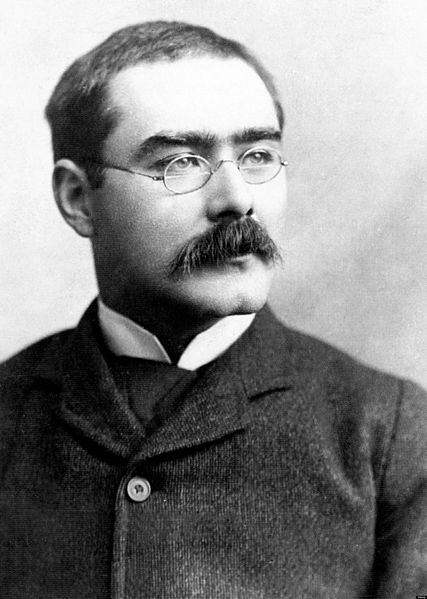
Portrait of Rudyard Kipling from the biography Rudyard Kipling by John Palmer, 1895.
Photo via Wikimedia Commons.
… The re-election of Donald Trump, who has already daydreamed about turning Canada into his 51st state, might even rekindle Tory patriotism. After all, their Victorian ancestors created the dominion of Canada in 1867 to keep British North America from the clutches of the United States.
A longer view shows that Canada has allured but also vexed British observers ever since its creation. The Edwardian era produced an especially rich crop of writings on Canada. In 1887, the year of Queen Victoria’s Golden Jubilee, the first train from Montreal pulled into Vancouver. This completion of the Canadian Pacific Railway (CPR) had persuaded the Crown colony of British Columbia to join in the new federation. In expanding Canada, the CPR also made it easier for British people to see the country. Having crossed from Liverpool to Montreal on a fast liner, they could visit most of its major cities, which were found on or near the railway.
Literary celebrities did so in enviable conditions. The CPR’s bosses loaned the poet Rudyard Kipling his own carriage in 1907, so he could travel in comfort and at his own speed. His impressions, which appeared in newspapers and then as Letters to the Family (1908), make for particularly resonant reading today. Although a man of strong prejudices, he had seen the country up close, rather than merely retweeting allegations about it, and was prepared to be surprised as well as disappointed by it.
Kipling’s contemporaries travelled with heavier and very different ideological baggage than we carry today. It was not wokery that worried them, but irreligion and greed, two poisons that had crept north from America. When the clergyman Hensley Henson steamed into Vancouver, in July 1909, he was horrified to see its beaches plastered with “vulgar advertisements”. The further [East] he travelled, the worse things became. The Anglican clergy were “weaklings” who made no dent on a materialistic society. Winnipeg was given over to “graft”. Young people in Ontario spoke like gum-chewing Yankees. Quebeckers were despoiling their province by setting up hydroelectric dams on its waterfalls.
Kipling did not share Henson’s churchy desire to scold his Canadian hosts. He was a cheerful freethinker who considered materialism a necessary part of nation-building. Canada had “big skies, and the big chances”: he admired its railway workers and lumberjacks for their insouciant and sometimes drunken swagger. Boom towns like Winnipeg excited him: he loved to see office blocks rise and streets flare with natural gas lamps; he lost considerable sums speculating on Vancouver real estate.
What worried him was rather Canada’s fading strategic commitment to the Empire. The modern Right understands Canada as a battleground for the values of “the West”. Kipling, who had married an American and lived for some years in Vermont, naturally believed in and did much to formulate the fervent if vague sense that English-speaking peoples share a civilisation. Yet this did not weaken his overriding concern for the political cohesion of the British Empire. Canada’s failure to join as enthusiastically in Britain’s recent war against the rebellious Dutch Boers of South Africa as he would have liked weighed on him — so much so that he kept calling the prairie the “veldt”. Kipling regarded the scepticism of Liberals and Socialists at home about whether the Empire offered value for money as a “blight”: now this “rot” seemed to be spreading like Bubonic plague, “with every steamer” to Canada.
The way to draw the dominion back to the motherland was to fill it with English settlers who shared his distaste for domestic Socialism. The dilution of English Canada worried Kipling. He allowed the Francophone Catholics of Quebec their differences — he found their basilicas romantic — but the policy of settling the prairies with hardy Slavs from the Habsburg and Russian Empires appalled him. These “beady-eyed, muddy-skinned, aproned women, with handkerchiefs on their heads and Oriental bundles in their hands” could never assimilate to English Canada. Nor did he care that many were fleeing oppression: people who renounce their country have “broken the rules of the game”.


