
Yes, the reader might respond, but surely we are on firmer ground with regard to [Rommel’s] military skill! After all, no less a figure than British Prime Minister Winston Churchill called him “a great general” on the floor of the House of Commons. Even here, it is possible to make a counterargument. Rommel’s daring exploits at the head of the Afrika Korps (later enlarged and renamed Panzerarmee Afrika) were exciting, to be sure, but many officers in his own army reckoned them as an ultimately valueless sideshow. His disinterest in the dreary science of logistics, his “bias for action,” his tendency to fly off wherever the fighting was hottest are qualities that may make for an exciting movie, but they are problematic in an army commander under modern conditions, and they all contributed materially to the disaster that ultimately befell him and his army in the desert.
[…]
When Rommel arrived in Africa, he brought with him a fully realized art of war. He’d won a Pour le Mérite (the famed “Blue Max“) for a series of nail-biting mountain exploits in the 1917 Caporetto campaign; he had been a very popular tactical instructor at the Dresden Infantry School between the wars; he had commanded one of the army’s precious Panzer divisions (the 7th) during the 1940 campaign in the West. In France, Rommel had behaved more like an 18th century hussar cut loose on a raiding mission than a divisional commander. He led from the front, braved enemy fire on numerous occasions, and turned off his radio from time to time rather than risk receiving orders to rein himself in. He drove forward so rapidly that the 7th Panzer became known as the “ghost division” for its tendency to drop off the situation maps and reappear where least expected. There were many in the German high command, including the chief of the General Staff Franz Halder, who didn’t much appreciate Rommel running amok, but as one analyst put it, “it was impossible to court martial such a successful general, so Rommel instead got the Ritterkreuz” [the Knight’s Cross of the Iron Cross].
Robert Citino, “Drive to Nowhere: The Myth of the Afrika Korps, 1941-43″, The National WWII Museum, 2012. (Originally published in MHQ, Summer 2012).
March 13, 2020
QotD: Rommel’s generalship
February 27, 2020
Winston Churchill Biography: In the Darkest Hour
Biographics
Published 13 Feb 2018We imagine Winston Churchill with his signature cane, drinking scotch whiskey, and puffing on a Cuban cigar. His mouth is downturned, and his voice is gruff and his words pointed. This is the image Hollywood portrays but it is a mere caricature of the flesh and blood version. Who was Winston Churchill? In Britain’s “darkest hour,” Churchill led his country from the brink of Nazi conquest by forging an alliance with the U.S. and Russia. He had many critics, and made mistakes on a grand scale. Yet, above it all, possessed an unwavering belief in his own power. To his beloved country he offered his “blood, toil, tears and sweat.”
Visit our companion website for more: http://biographics.org
Credits:
Host – Simon Whistler
Author – Crystal Sullivan
Producer – Samuel Avila
Executive Producer – Shell HarrisBusiness inquiries to biographics.email@gmail.com
Biographies by the book, get Winston Churchill’s biography from Amazon: http://amzn.to/2EAfh7b
January 8, 2020
Victor Davis Hanson – World War II Leadership
Anang
Published 6 May 2012If you want to read more about WW2 leadership, read Andrew Roberts Masters & Commanders.
Victor Hanson, a professor emeritus of Classics at California State University, Fresno, lectured to a history class on Masters and Commanders at Hillsdale College. In this fall seminar in classical and military history Professor Hanson examined how leaders, both civilian officials and generals on the battlefield, conducted themselves in wartime. That day’s class focused on Franklin D. Roosevelt and Winston Churchill and how those very different American and British leaders learned to work together to defeat Nazi Germany.
Original link: http://www.c-spanvideo.org/program/29…
October 28, 2019
QotD: Latin versus English
Winston Churchill, My Early Life, 1930.
October 19, 2019
Churchill Was a Drunk… or Was He? – Doped WW2 Leaders Part 2
World War Two
Published 17 Oct 2019Winston Churchill was one of the most influential figures of World War Two. But as a heavy drinker he must have been under influence of constant drunkenness, right?
Watch Part 1 about Hermann Göring here: https://youtu.be/8H7arcUi7zQ
Join us on Patreon: https://www.patreon.com/TimeGhostHistory
Or join The TimeGhost Army directly at: https://timeghost.tvFollow WW2 day by day on Instagram @World_war_two_realtime https://www.instagram.com/world_war_t…
Join our Discord Server: https://discord.gg/D6D2aYN.
Between 2 Wars: https://www.youtube.com/playlist?list…
Source list: http://bit.ly/WW2sourcesHosted by: Indy Neidell
Written by: Francis van Berkel
Produced and Directed by: Spartacus Olsson and Astrid Deinhard
Executive Producers: Bodo Rittenauer, Astrid Deinhard, Indy Neidell, Spartacus Olsson
Creative Producer: Joram Appel
Post Production Director: Wieke Kapteijns
Research by: Francis van Berkel
Edited by: Michal Drzewiecki
Map animations: Eastory
Sound design: Marek KaminskiColorisations by Norman Stewart and Julius Jääskeläinen https://www.facebook.com/JJcolorization/
Eastory’s channel: https://www.youtube.com/channel/UCEly…
Archive by Screenocean/Reuters https://www.screenocean.com.Sources:
– IWM: A 11590
– Wine and whiskey icons by Made by Made, papers icon by Pauline, Breakfast icon by shashank singh, Champagne icons by Made by Made and Jenie Tomboc, Heart icon by Sophia Bai, alcohol icon by Flatart, beef icon by Igé Maulana, Beer by Valeriy, Cheese by Erin Agnoli, red wine by sasha willins, Brandy by NAS, all – the Noun Project
– Royalty free music of BensoundA TimeGhost chronological documentary produced by OnLion Entertainment GmbH.
From the comments:
World War Two
22 hours ago (edited)
We make an effort to approach history as unbiased as possible. The result is what we think is a balanced videos on Churchill’s alcohol (ab)use. For those of you who are new here, we are following World War Two Week by Week, in which we do pay a lot of attention to all those smaller but still significant events. If you would like to watch the series, make sure to subscribe and to click here to start watching from episode one: https://www.youtube.com/watch?v=3-A1gVm9T0A&list=PLsIk0qF0R1j4Y2QxGw33vYu3t70CAPV7XCheers,
The TimeGhost team.

June 23, 2019
Nazi Europe?! – WW2 – 043 – June 22 1940
World War Two
Published on 22 Jun 2019While the fighting subsides in much of France, the Italians invade in the south, while tension continues to grow in the Baltic states as the Red Army increases its presence and the USSR makes plans for coups.
Join us on Patreon: https://www.patreon.com/TimeGhostHistory
Or join The TimeGhost Army directly at: https://timeghost.tvFollow WW2 day by day on Instagram @World_war_two_realtime https://www.instagram.com/world_war_t…
Join our Discord Server: https://discord.gg/D6D2aYN.
Between 2 Wars: https://www.youtube.com/playlist?list…
Source list: http://bit.ly/WW2sourcesWritten and Hosted by: Indy Neidell
Produced and Directed by: Spartacus Olsson and Astrid Deinhard
Executive Producers: Bodo Rittenauer, Astrid Deinhard, Indy Neidell, Spartacus Olsson
Creative Producer: Joram Appel
Post-Production Director: Wieke Kapteijns
Research by: Indy Neidell
Edited by: Daniel Weiss
Map animations: EastoryColorisations by:
– Julius Jääskeläinen, https://www.facebook.com/JJcolorization/ – Norman Stewart, https://www.patreon.com/89tavernEastory’s channel: https://www.youtube.com/channel/UCEly…
Archive by Screenocean/Reuters https://www.screenocean.com.Sources :IWM (F 4871), IWM_HU 76027, Bundesarchiv, Photos from the Jonatan Myhre Barlien photo collection.
A TimeGhost chronological documentary produced by OnLion Entertainment GmbH.
From the comments:
World War Two
2 days ago
After 44 days of fighting, the Battle of France seems to come to an end. For the Germans at least. For the French, the war goes on with Italy. And for us, it goes on as well. These were one of the most exciting videos for us to produce so far. We tried to take the videos to the next level with more and better maps (shoutout to Eastory: everyone who reads this should subscribe to his channel: ) and more animations. In general, we aim to constantly increase our production quality, which we humbly think is succeeding bit by bit. However, this wouldn’t be possible if it wasn’t for the support of those who financially aid us on http://www.patreon.com/timeghosthistory or on our own website https://timeghost.tv. Without them, we wouldn’t be doing any of this. If you like what we’re doing, please consider supporting us as well!Cheers,
Joram
May 16, 2019
Remembering Monte Cassino … and Wojtek the Bear, a Polish war hero
At the Daily Chrenk, Arthur Chrenkoff remembers the Polish soldiers who finally took Monte Cassino from the Germans in 1944, after earlier allied attempts by soldiers of many other nations (including Canada) had failed:
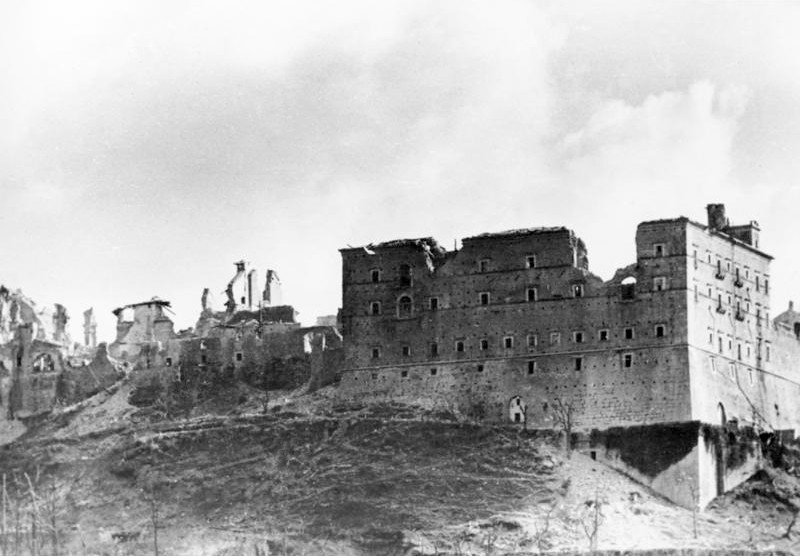
The ruins of the abbey at Monte Cassino after the 1944 battle.
Photograph credited to “Wittke” in the German Federal Archive (Bundesarchiv) via Wikimedia Commons.
On May 18, the day Australia goes to the polls, on the other side of the world we will be commemorating the 75th anniversary of the end of the bloodiest and hardest fought battle of the Italian campaign if not the whole of the Western front of WW2. On that day, a patrol from the 12th Podolian Cavalry Regiment raised the Polish flag above the ruins of the Benedictine monastery on top of Monte Cassino, bringing to an end four months and four Allied offensives against the heavily fortified Gustav (or Winter) Line, manned by crack German divisions across the entire width of the Italian boot about 100 miles south of Rome. Some of the German troops, veterans of the Eastern front, thought the fighting was worse than at Stalingrad. Others, on the Allied side, compared the conditions to Verdun. Unlike Russian cities or French fields, most of the fighting around Monte Cassino took place over an unimaginably difficult terrain of steep mountain slopes, deep valleys, wild rivers and landscape stripped bare by the artillery. It was a truly world battle in a world war: pitted against the Wehrmacht were the units from Great Britain, including British India and Rhodesia, the United States, France and its north African colonies like Morocco, Canada, Australia, New Zealand, including Maori troops, South Africa, Italy and Poland. Since the start of the Allied offensive in January 1944, waves after waves of troops of the 5th US and the 8th British armies smashed themselves against the rocks, unable to dislodge the well dug-in Germans. Finally, the fourth battle code-named Operation Diadem, which commenced with a massive bombardment on May 16, threw the British 13th Army Corp and the 2nd Polish Corp against the very linchpin of the Gustav Line at Monte Cassino and its monastery. Two days later it was over.
[…]
Churchill, right from the time of the Gallipoli disaster, remained obsessed about the vulnerability of the continental powers – primarily Germany – through what he called “the soft underbelly of Europe”. The war records are full of his harebrained schemes to attack the Axis through Italy, the Balkans or Greece and knock them out of the fight by a sharp thrust into the Central Europe. This was to be a masterstroke in place of the Normandy invasion, which Churchill strenuously opposed, and later in addition to it, to draw some of the German troops away from the northern France and indeed to get to Austria and southern Germany before the Red Army.
The problem with the soft underbelly of Europe is that it’s anything but. In fact it’s the hardest part of Europe; all rock, no roll. It’s mountains and deep valleys, fast rivers and vast forests, rudimentary roads and virtually no useful infrastructure. Unlike the northern European plains, this is the defender’s country where the Allies lost all the advantage of their numbers, their maneuverability and their armour. The two years of arduous slogfest from the southern Sicily to the Emilia-Romagna in the north might have indeed drawn valuable German troops from the other theaters of war but it was a bloody dead end. Poles were still stuck taking Bologna in April 1945, while only days later the patrols from Patton’s 3rd US Army were reaching the outskirts of Prague.
And Wojtek?
Monte Cassino is on my mind today, because entirely coincidentally I’m reading a delightful war book (that’s an oxymoron if there is one) titled Wojtek the Bear: Polish War Hero. It tells the surreal but entirely true story of a bear cub adopted by the Polish troops in northern Iran in 1942, towards the start of their anabasis from Stalin’s Siberia all the way to Italy and eventually Scotland. Accompanying the Poles through all their service in the Middle East and then southern Europe, Wojtek grew up to be a 6-foot, 500-pound ursine, who always thought he was a human. Quintessentially Polish (if only by adoption), he loved beer and cigarettes (he also ate them, but only if lit), taking showers with the troops and riding shotgun in army trucks. Some of his war-time exploits included capturing an Arab spy in Iraq and stealing underwear from a female support unit. But Wojtek truly became a legend during the battle of Monte Cassino, when to his comrades’ amazement he volunteered to carry ammunition in his paws. He was eventually made a Private in the Polish Army, and lived until 1963, continuing to win hearts in Scotland, where the Polish troops were repatriated after the war.
May 12, 2019
Hitler Strikes in the West – WW2 – 037 – May 11 1940
World War Two
Published on 11 May 2019As the Allied troops in central Norway are evacuated and the Norwegian troops there surrender to the Germans, the Allied position around Narvik is still quite strong. With the addition of roughly 5000 Polish soldiers, the French, British and Norwegian force will prove to be a formidable foe for the Germans up North. This week however, the war drastically changes as not three but four Neutral countries are invaded. The Phoney War is ultimately over.
Join us on Patreon: https://www.patreon.com/TimeGhostHistory
Or join The TimeGhost Army directly at: https://timeghost.tvFollow WW2 day by day on Instagram @World_war_two_realtime https://www.instagram.com/world_war_t…
Join our Discord Server: https://discord.gg/D6D2aYN.
Between 2 Wars: https://www.youtube.com/playlist?list…
Source list: http://bit.ly/WW2sourcesWritten and Hosted by: Indy Neidell
Produced and Directed by: Spartacus Olsson and Astrid Deinhard
Executive Producers: Bodo Rittenauer, Astrid Deinhard, Indy Neidell, Spartacus Olsson
Creative Producer: Joram Appel
Research by: Indy Neidell
Edited by: Ben Ollerenshaw and Wieke Kapteijns
Map animations: EastoryColorisations by Norman Stewart and Julius Jääskeläinen https://www.facebook.com/JJcolorization/
Sources: IWM (A 7644), IWM (A 7637), IWM HU 55505, Bundesarchiv, Photos from the Jonatan Myhre Barlien photo collection.
Eastory’s channel: https://www.youtube.com/channel/UCEly…
Archive by Screenocean/Reuters https://www.screenocean.com.A TimeGhost chronological documentary produced by OnLion Entertainment GmbH.
From the comments:
World War Two
The Phoney War is over. This is the week that many have been anxiously waiting for (how did they know something big was going to happen). We have some great episodes coming up, which are like this one only as great as they are because of the amazing effort that our team puts in creating them. As is very apparent in this episode, Eastory’s maps take these videos to the next level. Every week we’re stunned by his level of detail and the amazing value that is added by these maps. As the war enters a new phase, so do we. Next week will see the first of our roadtrip to France specials going live as well as the longest weekly episode we have written up until now.Cheers,
Joram
May 6, 2019
Mers El Kebir: When The British Blew Up the French Fleet
Historigraph
Published on 4 May 2019Join us in #WarThunder for free using this link and get a premium tank or aircraft and three days of premium time as a bonus: https://gjn.link/Historigraph/190504
If you enjoyed this video and want to see more made, consider supporting my efforts on Patreon: https://www.patreon.com/historigraph
To chat history, join my discord: https://discord.gg/vAFTK2D
#WarThunder #MersElKebir #Historigraph
► Twitter: https://twitter.com/historigraph
►Patreon: https://www.patreon.com/historigraph
►Discord: https://discord.gg/vAFTK2DSources:
Colin Smith, England’s Last War Against France: Fighting Vichy 1940-42
Stephen Roskill, Churchill and the Admirals
Correli Barnett, Engage the enemy more closely
http://avalon.law.yale.edu/wwii/frgea…
Music:
Rynos Theme, Incompetech https://incompetech.com
Malicious, Incompetech https://incompetech.com
Crypto, Incompetech https://incompetech.com
March 18, 2019
The Phoney War: Actually Not Phoney
Historigraph
Published on 16 Mar 2019Join us in #WarThunder for free using this link and get a premium tank or aircraft and three days of premium time as a bonus: http://v2.xyz/WarThunderWithHistorigraph
If you enjoyed this video and want to see more made, consider supporting my efforts on Patreon: https://www.patreon.com/historigraph
March 15, 2019
Charles De Gaulle
Colby Cosh linked to an interesting Peter Hitchens review of a recent biography of Charles De Gaulle (De Gaulle by Julian Jackson):
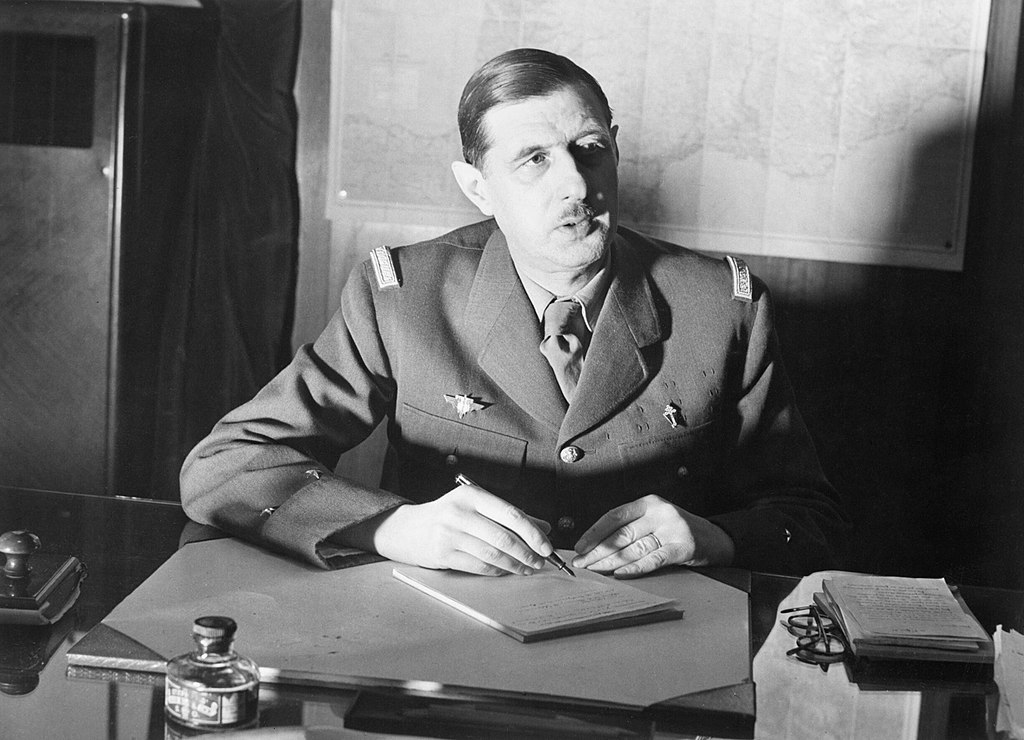
General Charles de Gaulle, Commander of Free French Forces, seated at his desk in London during the Second World War.
Photo via Wikimedia Commons.
When it came to what de Gaulle thought was the pivotal moment in his life, when he could become virtual monarch of France under conditions chosen wholly by himself, he was as ruthless as Lenin. He had, it is often said, a “certain idea of France.” But the ultra-conservative lawyer, Jacques Isorni, whose clients included the collaborationist Vichy leader Marshal Philippe Pétain and de Gaulle’s would-be assassin, Jean-Marie Bastien-Thiry, concluded that it was “an abstract idea of France, indifferent to the sufferings of the French people.” There is something to this. De Gaulle represented the steely warlike France, summoned up by Bonaparte and again a century later at Verdun, for which the French were required to die and mourn uncomplainingly. For him, Paris was well worth a lie or a betrayal, because his supremacy was so essential for the country he loved.
The costs of de Gaulle’s idea of France were high. As the general himself once mused, “There is no action in which the devil has no part.” The two massacres, and the charnel-house stench which clings to them, are evidence of the reliable rule that even — often especially — the greatest and best of men have terrible flaws and can do terrible things; and also of the other rule that power tends to corrupt. I have begun with them because they are a necessary antidote to the feelings of admiration and liking which any reader of this thrilling, witty, ceaselessly moving, beautifully written account of a truly great man is bound to feel.
Charles de Gaulle’s life would perhaps have been better lived in the seventeenth or eighteenth century, in times when personal courage, mystical imagination, chivalry, and religious fervor were more welcome than they are now. In this world of the United Nations, risk assessment, lawyers, Geneva Conventions, television and superpowers, there is not really enough room for such a man to swing his sword, just as there is no room for old-fashioned great powers in the shadow of superpowers. Had he not been so magnificent, he would have been ridiculous. He looked, more than anything else, like a camel, not least because of the superior expression on his face suggesting that he alone knew the secret One Hundredth Name of God, which camels are supposed to know.
He was filled with shining, old-fashioned beliefs about honor, courage, shame and humiliation, glory and infamy. And as those who conversed with him found, he was perhaps the last great man to make it his business to know those things that it is proper for a king to know. He could talk fluently with philosophers and literary novelists. He had a minute knowledge of history: not just that of France, but of Europe and the world. After many, many conversations with Winston Churchill, a large number of them furious quarrels, he concluded that England’s savior was not in fact very intelligent. He believed wartime, with its austerity and tests of manhood, was more virtuous than peacetime. He believed nothing important could be achieved without recklessness. He stood up to people with considerable courage, even when he was a powerless and lonely figure without soldiers, money, or supporters. He once justified his bloody-minded awkwardness by pointing out that if he were not so difficult, he would himself have been a collaborator. He said “If I were easy to work with, I would be on Marshal Petain’s staff.” He had no time for people like himself. He confessed, “I only esteem those who stand up to me but unfortunately I cannot stand them.”
De Gaulle possessed that great chivalrous virtue of being ready to walk unbowed and defiant in front of the powerful, while being gentle and even submissive to the defenseless and weak. He once became so angry with Churchill that he smashed a chair in his presence to emphasize his rage. Likewise, he defied Franklin Roosevelt over and over again. But he would go home after these battles to sing tender love songs to his daughter Anne, who suffered from Down syndrome. The tiny glimpses we have of this part of his life, obtained from the accidental observations of others, tear at the heart. His concern for Anne was entirely private and not at all feigned. After any long absence from home his first act was to rush up to her room. She died, aged twenty, in his arms. At her funeral, he comforted his wife Yvonne with the words, “Maintenant, elle est comme les autres” (“Now she is like the others”), which must be one of the most moving things said in the whole twentieth century.
December 16, 2018
Mackenzie King at war
Ted Campbell remembers Canada’s Second World War Prime Minister:
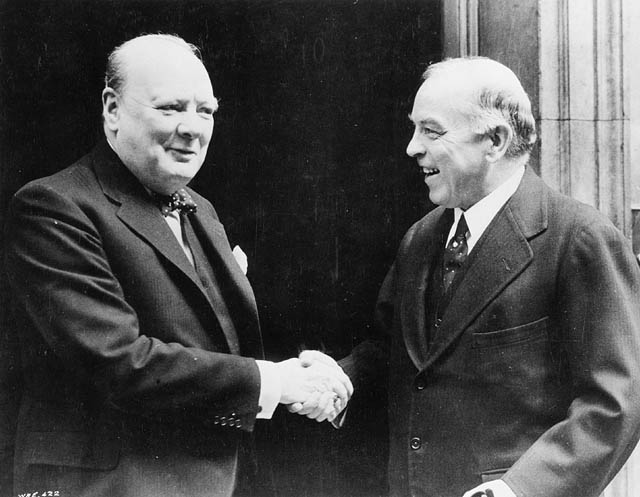
Prime Minister Winston Churchill greets Canadian PM William Lyon Mackenzie King, 1941.
Photo from Library and Archives Canada (reference number C-047565) via Wikimedia Commons.
I was born in 1942, William Lyon Mackenzie King was the prime minister; my mother often said that, in the 1940s, it seemed that he would never cease to be prime minister, and she thoroughly detested him; it wasn’t all of his policies she hated, it was, mainly, how he approached the war, and a few other things ~ she was, later, fond of the Canadian poet F.R. Scott’s rather bitter epitaph:
He seemed to be in the centre because we had no centre,
No vision to pierce the smoke-screen of his politics.Truly he will be remembered wherever men honour ingenuity,
Ambiguity, inactivity, and political longevity.Let us raise up a temple to the cult of mediocrity,
Do nothing by halves which can be done by quarters.Now, Canada fought a good war, we made four absolutely vital contributions:
- We were the true “breadbasket of the empire,” our farmers fed our large Army and much of Britain’s, too;
- We were a major part of the “arsenal of democracy,” our factories and shipyards turned out all of the things, from tanks and trucks and bombers and corvettes to Bren guns and grenades that were needed to help defeat the Axis powers;
- We managed the all important British Commonwealth Air Training Plan that was a key element in the allies’ eventual success; and
- We played a huge and a significant leadership role in the Battle of the Atlantic ~ the only battle Churchill said that he really feared losing.
But under King we did each with apparent reluctance, seemingly trying to never serve any vital interest if there was even a remote chance that any political constituency might be offended ~ something that reminds me of Justin Trudeau in 2018. Our large and entirely commendable war efforts were, in the main, directed, sometimes despite King, by the indefatigable C.D. Howe, and the national unity concerns were assuaged by recruiting the universally respected Louis St Laurent.
The King era was characterized by extraordinarily tepid leadership at the top but brilliant work by strong ministers in a small cabinet. It also began Phase 1 of a national political civil war. I think that in the First World War many Canadians had either understood or had been, largely, indifferent to Quebec’s objections to conscription. But in the 1940s we had better mass communications and many Canadians were less understanding of Quebec’s reluctance to participate in that war, especially as Canadian casualties mounted after Hong Kong and then in Italy and then in France, Belgium and Holland. Louis St Laurent did not try to explain French Quebec’s misgivings to English Canada, his job was to maintain, by force of his own stellar reputation and personality, just enough support in Quebec and, as he easily did, to “outclass” the vocal, crypto-fascist, French Canadian opponents to the war. But there was another division fomenting inside the Liberal Party of Canada: both Howe and St Laurent had a new vision for Canada in the post war world; both saw Canada as an important actor on the world stage; both were frustrated by King’s timid leadership; it is very probable that had St Laurent, the foreign minister, rather than King, [been] the prime minister, led Canada’s delegation to the UN’s founding conference in San Francisco in June of 1945 that Canada, not France, would have been the fifth member of the Security Council (or that it would have had only four members. as originally planned). St Laurent, especially, was known, liked and respected in both London and Washington; both he and Howe were highly regarded as leaders and as statesmen … King was not; Churchill distrusted him because he has actively supported Chamberlain’s appeasement policy and it seems to me that both Churchill and Roosevelt saw him as little more than an errand boy.
September 29, 2018
QotD: Alanbrooke and Churchill
This was indeed a typical Churchillian soirée. Like most of those around the table, [Major-General Sir John] Kennedy too kept a diary. His account is graphic and chagrined. He noted at the time that AB [Alanbrooke] did not intervene on his behalf, “although I knew I had said nothing with which he did not agree.” His coda is equally pointed. “Later, I realized the wisdom of the technique which Brooke acquired after many stormy passages with the Prime Minister. Brooke found it an invaluable rule never to tell Churchill more than was absolutely necessary. I remember him once scoring out nine-tenths of the draft of a minute to the Prime Minister, remarking as he did so, ‘The more you tell that man about the war, the more you hinder the winning of it.'”
Footnote to Field Marshal Lord Alanbrooke, War Diaries, 1939-1945, 1957.
September 15, 2018
QotD: Churchill on brevity
To do our work, we all have to read a mass of papers. Nearly all of them are far too long. This wastes time, while energy has to be spent in looking for the essential points.
I ask my colleagues and their staffs to see to it that their Reports are shorter.
- The aim should be Reports which set out the main points in a series of short, crisp paragraphs.
- If a Report relies on detailed analysis of some complicated factors, or on statistics, these should be set out in an Appendix.
- Often the occasion is best met by submitting not a full-dress Report, but an Aide-mémoire consisting of headings only, which can be expanded orally if needed.
- Let us have an end of such phrases as these: “It is also of importance to bear in mind the following considerations…”, or “Consideration should be given to the possibility of carrying into effect…”. Most of there woolly phrases are mere padding, which can be left out altogether, or replaced by a single word. Let us not shrink from using the short expressive phrase, even if it is conversational.
Reports drawn up on the lines I propose may at first seem rough as compared with the flat surface of officialese jargon. But the saving in time will be great, while the discipline of setting out the real points concisely will prove an aid to clearer thinking.
Winston Churchill, memorandum to the War Cabinet, 1940-08-09.
September 9, 2018
World War Two Begins – WW2 September 8 1939
World War Two
Published on 8 Sep 2018The German-Polish war is the match that ignites the flames that finally burn British Prime Minister Neville Chamberlain’s appeasement efforts to the ground.
Between 2 Wars: https://www.youtube.com/playlist?list…
Join us on Patreon: https://www.patreon.com/TimeGhostHistory
Or join The TimeGhost Army directly at: https://timeghost.tvWritten and Hosted by: Indy Neidell
Produced and Directed by: Spartacus Olsson and Astrid Deinhard
Executive Producers: Bodo Rittenauer, Astrid Deinhard, Indy Neidell, Spartacus Olsson
Research by: Indy Neidell
Edited by: Spartacus OlssonA TimeGhost chronological documentary produced by OnLion Entertainment GmbH


