
Opera, to a person genuinely fond of aural beauty, must inevitably appear tawdry and obnoxious, if only because it presents aural beauty in a frame of purely visual gaudiness, with overtones of the grossest sexual provocation. The most successful opera singers of the female sex, at least in America, are not those whom the majority of auditors admire most as singers but those whom the majority of male spectators desire most as mistresses. Opera is chiefly supported in all countries by the same sort of wealthy sensualists who also support musical comedy. One finds in the directors’ room the traditional stock company of the stage-door alley. Such vermin, of course, pose in the newspapers as devout and almost fanatical partisans of art; they exhibit themselves at every performance; one hears of their grand doings, through their press agents, almost every day. But one has merely to observe the sort of opera they think is good to get the measure of their actual artistic discrimination.
The genuine music-lover may accept the carnal husk of opera to get at the kernel of actual music within, but that is no sign that he approves the carnal husk or enjoys gnawing through it. Most musicians, indeed, prefer to hear operatic music outside the opera house; that is why one so often hears such things as “The Ride of the Valkyrie” in the concert hall. “The Ride of the Valkyrie” has a certain intrinsic value as pure music; played by a competent orchestra it may give civilized pleasure. But as it is commonly performed in an opera house, with a posse of flat beldames throwing themselves about the stage, it can only produce the effect of a dose of ipecacuanha. The sort of person who actually delights in such spectacles is the sort of person who delights in plush furniture. Such half-wits are in a majority in every opera house west of the Rhine. They go to the opera, not to hear music, not even to hear bad music, but merely to see a more or less obscene circus. A few, perhaps, have a further purpose; they desire to assist in that circus, to show themselves in the capacity of fashionables, to enchant the yokelry with their splendor. But the majority must be content with the more lowly aim. What they get for the outrageous prices they pay for seats is a chance to feast their eyes upon glittering members of the superior demi-monde, and to abase their groveling souls before magnificoes on their own side of the footlights. They esteem a performance, not in proportion as true music is on tap, but in proportion as the display of notorious characters on the stage is copious, and the exhibition of wealth in the boxes is lavish.
H.L. Mencken, “The Allied Arts: Opera”, Prejudices: Second Series, 1920.
April 18, 2014
QotD: Opera
April 9, 2014
Amity Shlaes on “progressive” tax rates
The US tax system, like those in many Western countries, incorporates the concept of “progressivity” — the higher the income you earn, the higher the tax you pay on the last dollar. Your income is divided into blocks where each block of dollars is taxed at a different (rising) rate. In other words, the lower your personal income the less tax you pay per dollar of income. Amity Shlaes explains why this mechanism makes reforming or cutting taxes such a challenge:
Over the hundred years intervening, studies have shown that generally people do think that the greater the wealth, the more dollars wealthy people should pay in tax, proportionally. But that is not a progressive rate structure. That is a flat tax. A progressive tax increases rates as you earn more, disproportionally.
Nor are many people aware that under a progressive structure the last dollar is taxed at a different rate from the first dollar. The top marginal rate is not necessarily the average rate. In the early 1980s, scholar Karlyn Keene found that many Americans, when interviewed, thought flat taxes fair. Before Keene, Walter Blum and Harry Kalven at the University of Chicago studied attitudes toward progressivity and its functions and came away, despite their liberal predilections, concluding that the case for progressivity is “uneasy.”
[…]
Vanity of two sorts provides answers. Most Americans are unwilling to concede that they may not understand or be comfortable with long formulas and complex economic ideas. So, like the Enron audit committee, they simply nod and go along.
The second vanity involves not intelligence but a kind of Puritan pretension. No American wants to be caught appearing unfair, even if in the most fleeting snapshot. “Progressivity” sounds like “progress.” Nobody wants to be seen opposing progress, even if that progress is regress and unfair to boot.
In any case: That willed American ignorance is the single greatest reason our progressive income-tax rates have moved, at times, into the 90 percent range, up from that original 7 percent.
Worse, the attitude makes progressivity hard to undo. When you cut taxes for all in a progressive rate structure, the rich necessarily get a larger tax break because they pay a greater share of the taxes. But “larger tax breaks for the rich” are impossible to sell. A redistributive corollary: benefits for the poor. This week Paul Ryan is getting scourged because his budget cuts affect the poor more than the rich. That is because the poor get more of the benefits in the first place.
Update, 10 April: Here’s a great example of how much tax rates can increase at higher levels (although this particular example is not an income tax). In New York state, a recent change to estate tax rates can result in a marginal tax of 164%:
On its face, the new law seems like tax relief. Under the previous law, New Yorkers paid estate taxes of 3.06 percent to 16 percent on the value of estates over $1 million. The new law raises that exclusion to $2.062 million this year and gradually increases it to more than $5 million by 2017.
But because the law also phases out certain credits related to federal taxes, people who have estates valued just above the $2 million threshold could get massive estate tax bills. An analysis by U.S. Trust found that a New York resident who dies today with a taxable estate of $2,165,625 could have to pay an estate tax of over $112,050. That represents a tax of over 100 percent on the value of the estate over $2,062,000.
It gets worse in a few years. Matz said that assuming that the exclusion rises to $5,250,000, a New Yorker with a taxable estate of $5,512,500 would have to pay an estate tax of $430,050. That’s a marginal tax rate of 164 percent on the value of the estate above the exclusion.
March 20, 2014
Today in misunderstood income inequality stats…
Tim Worstall pokes fun at a recent Oxfam report that claims that Britain’s five richest families own more than the bottom 20% of the population:
I read this and thought, “well, yes, this is obvious and what the hell’s it got to do with increasing inequality?” Of course Gerald Grosvenor (aka Duke of Westminster) has more wealth than the bottom 10 per cent of the country put together. It’s obvious that the top five families will have more than 20 per cent of all Britons. Do they think we all just got off the turnip truck or something?
They’ve also managed to entirely screw up the statistic they devised themselves by missing the point that if you’ve no debts and a £10 note then you’ve got more wealth than the bottom 10 or 20 per cent of the population has in aggregate. The bottom levels of our society have negative wealth.
[…]
Given what we classify as wealth, the poor have no assets at all. Property, financial assets (stocks, bonds etc), private sector pension plans, these are all pretty obviously wealth.
But then the state pension is also wealth: it’s a promise of a future stream of income. That is indeed wealth just as much as a share certificate or private pension is. But we don’t count that state pension as wealth in these sorts of calculations.
The right to live in a council house at a subsidised rent of the rest of your life is wealth, but that’s not counted either. Hell, the fact that we live in a country with a welfare system is a form of wealth — but we still don’t count that.
Doing this has been called (not by me, originally anyway) committing Worstall’s Fallacy. Failing to take account of the things we already do to correct a problem in arguing that more must be done to correct said problem. We already redistribute wealth by taxing the rich to provide pensions, housing, free education (only until 18 these days) and so on to people who could not otherwise afford them. But when bemoaning the amount of inequality that clearly cries out for more redistribution, we fail to note how much we’re already doing.
So Oxfam are improperly accounting for wealth and they’ve also missed the point that, given the existence of possible negative wealth, then of course one person or another in the UK will have more wealth than the entire lowest swathe.
March 17, 2014
Current US government programs actually increase income inequality
In the Washington Post, George Will says that we’ve learned nothing about helping the poor since Daniel Patrick Moynihan’s day:
Between 2000, when 17 million received food stamps, and 2006, food stamp spending doubled, even though unemployment averaged just 5.1 percent. A few states have food stamp recruiters. An award was given to a state agency for a plan to cure “mountain pride” that afflicts “those who wished not to rely on others.”
Nearly two-thirds of households receiving food stamps qualify under “categorical eligibility” because they receive transportation assistance or certain other welfare services. We spend $1 trillion annually on federal welfare programs, decades after Daniel Patrick Moynihan said that if one-third of the money for poverty programs was given directly to the poor, there would be no poor. But there also would be no unionized poverty bureaucrats prospering and paying dues that fund the campaigns of Democratic politicians theatrically heartsick about inequality.
The welfare state, primarily devoted to pensions and medical care for the elderly, aggravates inequality. Young people just starting up the earnings ladder and families in the child-rearing, tuition-paying years subsidize the elderly, who have had lifetimes of accumulation. Households headed by people age 75 and older have the highest median net worth of any age group.
In this sixth year of near-zero interest rates, the government’s monetary policy breeds inequality. Low rates are intended to drive liquidity into the stock market in search of higher yields. The resulting boom in equity markets — up 30 percent last year alone — has primarily benefited the 10 percent who own 80 percent of all directly owned stocks.
March 16, 2014
Some things never change
Darton Williams posted this on Google+:
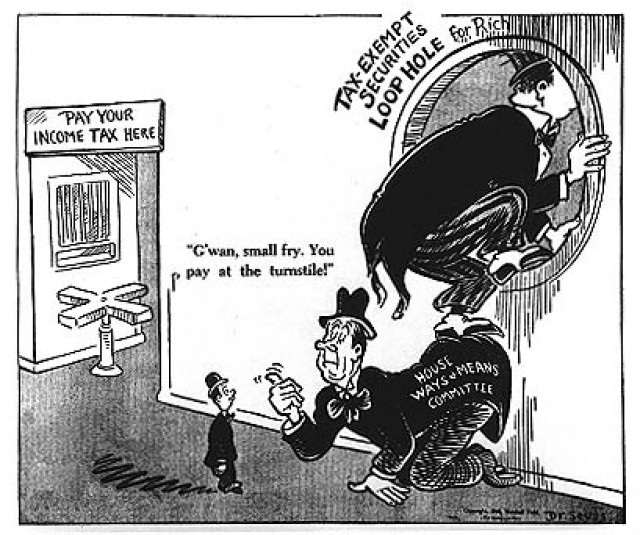
This is a WWII-era political cartoon by Theodor Geisel (AKA Dr. Seuss). Why is it still so relevant? Has anything actually changed for the better?
March 3, 2014
QotD: The triad of distinctively Canadian sports
We have a triad of distinctively Canadian sports: Canadian football, hockey and curling. Football, from its origins to the present, has remained a collegiate game, a game of the ruling class. College kids invented gridiron football; McGill undergrads taught Americans what a “touchdown” was. Today, football is, notoriously, the shortest path to becoming a partner in a law firm, with golf a close second. Peter Lougheed and Rob Ford were football players, rich kids who, in different ways, leveraged the social connectivity of the game.
Hockey is the most popular sport in the triad because it is the game of the Canadian middle class, a game that requires a family to have something of a surplus and, ideally, to live near a town of some size. The typical sponsor for a minor hockey team has always been some kind of small business — a plumber, a restaurant, a trucking company. There are still plenty of kids in families too broke to afford hockey. In Canada, it is the first way one might learn that one is poor.
This is where curling fits in: It is a farmer’s game, a peasant tradition. There are still many villages in the West that cannot afford hockey rinks, but that faithfully lay down two curling sheets in a long, narrow shack every fall. In those towns, an agriculture society’s community investment in two sets of stones will serve all for decades. Where hockey requires every child to have skates and pads and sticks, the traditional equipment for curling amounts to two ordinary household brooms for every four players.
Colby Cosh, “Curling will never be ruined”, Maclean’s, 2014-03-02
March 2, 2014
Why the EU hesitates to do anything about Ukraine
Extreme wealth, whether honestly or dishonestly acquired, seems these days to bring forth little new except in the form and genre of vulgarity. Mr. Ambani’s skyscraper tower home in Bombay is a case in point: His aesthetic is that of the first-class executive lounge of an airport. Mr. Ambramovich’s ideal is that of a floating Dubai the size of an aircraft carrier. Only once have I been invited to a Russian oligarch’s home, and it struck me as a hybrid of luxurious modernist brothel and up-to-date operating theater. I saw some pictures recently of some huge Chinese state enterprise’s headquarters, and it appalled me how this nation, with one of the most exquisite, and certainly the oldest, aesthetic traditions on Earth, has gone over entirely to Las Vegas rococo (without the hint of irony or playfulness).
But it was the luxury and not the taste of Yanukovych’s homes that outraged the Ukrainians, for if by any chance they had come into money they would have done exactly the same, aesthetically speaking. Yanukovych may have been a dictator of sorts, but when it came to taste he was a man of the people. A horrified Ukrainian citizen, touring one of his homes after his downfall, was heard to exclaim, “All this beauty at our expense!”
As to politics, the Ukrainian crisis has once again revealed the European Union’s complete impotence. Physiognomy is an inexact science, but it is not so inexact that you cannot read the bemused feebleness on the faces of people such as Van Rompuy, Hollande, and Cameron, the latter so moistly smooth and characterless that it looks as though it would disappear leaving a trail of slime if caught in the rain. Mrs. Merkel has a somewhat stronger face, but then she has the advantage of having spent time in the Free German Youth (the East German communist youth movement), which must at least have put a modicum of iron in her soul.
Be that as it may, Russia holds all the trump cards in this situation. It can turn off Western Europe’s central heating at a stroke, and for Europeans such heating is the whole meaning and purpose of life—together with six-week annual holidays in Bali or Benidorm. Therefore Europe will risk nothing for the sake of Ukraine, except perhaps a few billion in loans of no one’s money, a trifle in current economic circumstances. If Bismarck were to return today, he would say that the whole of Ukraine was not worth the cold of one unheated radiator.
February 10, 2014
The difference between money and wealth
At Ace of Spades HQ, Monty gives an introduction to Say’s Law:
Jean-Baptiste Say, an 18th-century economist and follower of Adam Smith, recognized one of the most fundamental laws in all economics: the entirely common-sense observation that consumption requires production. This axiom is called Say’s Law of Markets.
However, this axiom is often mis-stated as “production creates its own demand”. This is incorrect — production is necessary for consumption to take place, but production anticipates demand, it does not cause it. Production is speculative in this sense. The simple act of producing some good or service does not, in and of itself, create demand for that good or service. (This is true even for basic commodities.)
What Say’s Law really says is that production is the source of wealth. Market-driven production creates value and provides choice to consumers. Inventors and innovators bring new products to market, and as consumers are exposed to these new products, demand rises with the utility or desirability of these new products. New markets are opened by innovators who are able to tap into needs and wants that consumers didn’t even know they had until a new product or service is offered.
And he explains why money is not wealth:
So what is “wealth”, really? (I could write a whole book on the difference between “wealth” and “money”, but I’ll try to boil it down.) Wealth is options. Wealth is choice. Wealth is variety. Wealth is agency — being able to do what you want to do when you want to do it. Wealth is surfeit — having more than the essentials of life. It is comfort, leisure, ease — or at least the agency and option (those words again) to avail oneself of leisure. Simply put, wealth is stored value that can be drawn down in various ways, only some of which involve the exchange of money for goods and services. And how is wealth created? Through production, because production must necessarily precede consumption.
Money correlates with wealth because money is a medium of exchange and a store of value. Rich people have a lot of money because they are wealthy, not the other way around. Wealth allows us to buy a bigger house or better car or nicer furniture. It pays for a nice dinner for two at an upscale restaurant. Note well: wealth buys these things, not money per se. Consumption is the draw-down of wealth, not the simple expenditure of money.
Money is the oil in the machine of an economy, but money is not in and of itself wealth. If I am stranded on a desert island with a thousand gold coins, I am just as poor as if I were a homeless vagrant living in an alleyway somewhere, because I cannot exchange my gold for things I want or need. It does not give me options or variety or comfort. My gold facilitates neither production nor consumption absent a market mechanism that makes use of it.
February 8, 2014
The utopian bubble of elite university students
Jonah Goldberg on the “ideal” lifestyle of students at elite universities:
There’s a certain kind of elite student who takes himself very, very seriously. Raised on a suite of educational TV shows and books that insist he is the most special person in the world — studies confirm that Generation Y is the most egocentric and self-regarding generation in our history — he is away from home for the first time, enjoying his first experience of freedom from his parents. Those same parents are paying for his education, which he considers his birthright. Shelter is provided for him. Janitors and maids clean up after him. Security guards protect him. Cooks shop for him and prepare his food. The health center provides him medical care and condoms aplenty. Administrators slave away at finding new ways for him to have fun in his free time. He drinks with abandon when he wants to, and the consequences of his bacchanalia are usually somewhere between mild and nonexistent. Sex is as abundant as it is varied. If he does not espouse any noticeably conservative or Christian attitudes, his every utterance in the classroom is celebrated as a “valuable perspective.” All that is demanded of him is that he pursue his interests and, perhaps, “find himself” along the way. His ethical training amounts to a prohibition on bruising the overripe self-esteem of another person, particularly a person in good standing with the Coalition of the Oppressed (blacks, Latinos, Muslims, women, gays, lesbians, transsexuals, et al.). Such offenses are dubbed hate crimes and are punished in a style perfected in Lenin’s utopia: through the politicized psychiatry known as “sensitivity training.”
But even as this sensitivity is being cultivated, the student is stuffed to the gills with cant about the corruption of “the system,” i.e., the real world just outside the gates of his educational Shangri-La. He is taught that it is brave to be “subversive” and cowardly to be “conformist.” Administrators encourage kitschy reenactments of 1960s radicalism by celebrating protest as part of a well-rounded education — so long as the students are protesting approved targets, those being the iniquities of “the system.” There is much Orwellian muchness to it all, since these play-acting protests and purportedly rebellious denunciations of the status quo are in fact the height of conformity.
But it is a comfortable conformity, and this student — who in all likelihood will go into a profession at the pinnacle of the commanding heights of our culture — looks at this Potemkin world and thinks it is the way things are supposed to be. He feels freer than he ever has or ever will again, but that freedom is illusory. He is, in fact, a dependent: All his fundamental needs are met and paid for by others. This is what the political theorists call positive liberty — when someone else gives you a whole pile of stuff so you can be “free” to do whatever you want.
January 18, 2014
The view from the “loser” demographic and the rise of “anti-success” sentiments
Scott Adams thinks he’s identified a trend, and it’s a troubling one if he’s right:
I have been seeing a pattern in the past several years that makes me wonder if a sizeable portion of the public has become anti-success. The media has pitted the general public against the one-percenters for several years, so that might be a factor. And the bottom-feeders on the Internet (Gawker, Jezebel, etc.) have business models that involve taking celebrity quotes out of context to demonize them. So it would be no surprise if the public disliked successful people more than ever.
But I have also lately observed people who seem to reject their own best paths to success in favor of paths that are clearly bad. Let’s call those choices “loser choices” because any rational and objective observer would see it that way. I wondered if I was seeing an emerging pattern or an illusion.
And in a follow-up post:
The other day I asked aloud in this blog if there might be some sort of anti-success trend emerging in society. I think I found it.
Some folks emailed me directly to say they believe it is a waste of time to pursue success because it is a zero-sum game. In other words, they believe they can only be successful by making someone else less successful, on the theory that there isn’t enough success in the universe for everyone to get a meaningful slice. They tell me it would be “wrong” on some level to pick the pockets of strangers for self-enrichment.
And there it is.
I doubt that sort of thinking would have existed before the massive media campaign against the “top 1%.” The power of the top 1% story is in the false impression that rich people stole the money from the poor and middle class, and therefore it would only be fair to give most of it back.
Clearly some of the financial titans are doing little more than picking pockets. But those are the exceptions. Most one-percenters are growing the economy and creating jobs. That’s obvious to people who were born in the “rising tide lifts all boats” era. And it’s obvious to anyone with a bit of economics education.
But if you are in your twenties, with no deep understanding of economics, wouldn’t you believe success is evil? That’s the dominant story of their generation.
January 8, 2014
November 16, 2013
QotD: Petronius was right
Sometime in the mid-first century a.d., an otherwise little known consular official, Gaius Petronius, wrote a brilliant satirical novel about the gross and pretentious new Roman-imperial elite. The Satyricon is an often-cruel parody about how the Roman agrarian republic of old had degenerated into a wealth-obsessed, empty society of wannabe new elites, flush with money, and both obsessed with and bored with sex. Most of the Satyricon is lost. But in its longest surviving chapter — “Dinner with Trimalchio” — Petronius might as well have been describing our own 21st-century nomenklatura.
[…]
Another farce in the Satyricon involves the nonchalant ignorance of Trimalchio and his guests. The wannabes equate influence and money with status and learning and so pontificate about current events, with made-up mythologies and half-educated references to history. When Trimalchio and his banqueters begin to sermonize on literature, almost everything that follows turns out to be wrong — as Petronius reminds us how high learning has become as inane a commodity as food or sex, and only sort of half consumed, rather like the 2008 campaign of faux Greek columns and Vero possumus, which were supposed to convey gravitas.
Likewise, in our version, what does a $200,000 Ivy League education or a graduate degree really get you any more? In the sophisticated world of our political and highly credentialed elites, there are 57 states. Atlantic Coast cities are said to lie along the Gulf of Mexico; after all, they are down there somewhere in the South. The Malvinas become the Maldives — Ma- with an s at the end seems close enough. Corps-men serve in the military (as zombies?). Medgar Evans was a civil-rights icon, but you know whom we mean. President Roosevelt addressed the nation on television after the stock-market crash in 1929 — well, he would have, had he been president then and if only Americans had had televisions in their homes. And how are we to know that what we read from celebrity authors is not just made up or plagiarized, whether a Maureen Dowd column or a Doris Kearns Goodwin book?
The famously nouveau-riche Trimalchio’s guests drop the names of the rich and powerful, mostly to remind one another that they are now among the plutocracy that is replacing the old bankrupt aristocracy. We too are seeing something like that metamorphosis. It is hard to guess on any given summer weekend which populist progressive family — the Obamas, the Clintons, the Kerrys, the Gores — will be ensconced on what particular Hamptons, Nantucket, or Martha’s Vineyard beach, rubbing shoulders with just the sort of Silicon Valley or Wall Street new zillionaires who during work hours are supposed to be the evil “1 percent” and “fat cats” who need to be forced to pay their “fair share.”
Victor Davis Hanson, “An American Satyricon”, National Review Online, 2013-08-27
October 20, 2013
QotD: The “Paleo” diet
Look, I can see that there is a lot of common sense behind some of these modern dietary ideas and yes, I have personally adjusted my lifestyle a bit, such as cutting down on grains and bread and so on. But there is something about the almost religious fervor behind this “paleo” stuff that bothers me. The fact is that without what we call modern agriculture, the vast majority of the today’s population would not be alive. And that is a rather big plus for agriculture. Sure, there is obesity and associated issues to deal with, many of which have complex causes. But I am damn glad we did have agriculture. It is precisely the wealth that such developments made possible that enable people today to worry about this stuff, and even make whole careers and businesses out of it.
(Full disclosure, I am a Suffolk farmer’s son, and probably the only person on this blog who has driven a combine harvester for its intended purpose.)
Johnathan Pearce, “Let’s talk about paleo”, Samizdata, 2013-08-30
September 21, 2013
Big government – “smart guys rob taxpayers because that’s where the big money is”
Mark Steyn on the quick route to banana republic status:
As the old saying goes, bank robbers rob banks because that’s where the money is. But the smart guys rob taxpayers because that’s where the big money is. According to the Census Bureau’s latest “American Community Survey,” from 2000-12, the nation’s median household income dropped 6.6 percent. Yet, in the District of Columbia median household income rose 23.3 percent. According to a 2010 survey, seven of the nation’s 10 wealthiest counties are in the Washington commuter belt. Many capital cities have prosperous suburbs — London, Paris, Rome — because those cities are also the capitals of enterprise, finance, and showbiz. But Washington does nothing but government, and it gets richer even as Americans get poorer. That’s very banana republic, too: Proximity to state power is now the best way to make money. Once upon a time, Americans found fast-running brooks and there built mills to access the water that kept the wheels turning. But today the ambitious man finds a big money-no-object bureaucracy that likes to splash the cash around and there builds his lobbying group or consultancy or social media optimization strategy group.
The CEO of Panera Bread, as some kind of do-gooder awareness-raising shtick, is currently attempting to live on food stamps, and not finding it easy. But being dependent on government handouts isn’t supposed to be easy. Instead of trying life at the bottom, why doesn’t he try life in the middle? In 2012, the top 10 percent were taking home 50.4 percent of the nation’s income. That’s an all-time record, beating out the 49 percent they were taking just before the 1929 market crash. With government redistributing more money than ever before, we’ve mysteriously wound up with greater income inequality than ever before. Across the country, “middle-class” Americans have accumulated a trillion dollars in college debt in order to live a less-comfortable life than their high school-educated parents and grandparents did in the Fifties and Sixties. That’s banana republic, too: no middle class, but only a government elite and its cronies, and a big dysfunctional mass underneath, with very little social mobility between the two.
Like to change that? Maybe advocate for less government spending? Hey, Lois Lerner’s IRS has got an audit with your name on it. The tax collectors of the United States treat you differently according to your political beliefs. That’s pure banana republic, but no one seems to mind very much. This week it emerged that senior Treasury officials, up to and including Turbotax Timmy Geithner, knew what was going on at least as early as spring 2012. But no one seems to mind very much. In the words of an insouciant headline writer at Government Executive, “the magazine for senior federal bureaucrats” (seriously), back in May:
“The Vast Majority of IRS Employees Aren’t Corrupt”
So, if the vast majority aren’t, what proportion is corrupt? Thirty-eight percent? Thirty-three? Twenty-seven? And that’s the good news? The IRS is not only institutionally corrupt; it’s corrupt in the service of one political party. That’s Banana Republic 101.
September 4, 2013
Corporations are (legally) people
At Not Quite Noahpinion, Josiah Neeley explains why the legal notion of corporate personhood was actually intended as consumer protection:
Contrary to popular impression, corporate personhood did not start with Citizens United. In fact, corporate personhood dates back to the old English common law, where it was originally conceived as a consumer protection measure.
Suppose I buy meat from a butcher and it makes me sick. I might wish to sue the butcher for damages. But suppose that I bought the meat not from an individual butcher but from Acme Meat, Inc. It was a central doctrine of the common law that only persons could sue or be sued, own property, or make legally binding contracts. So if a corporation is not a person, I am out of luck. The response to this was to treat corporations as legal persons, who could sue or be sued, make and enforce contracts, buy, sell, and hold property, and so on.
Of course, courts could have granted corporations all the same rights, abilities and duties without calling them persons. But this would have been merely a semantic difference. Once a society decides to have corporations, it has to grant them something along the lines of legal personhood if for no other reason than to protect those who deal with it.
Likewise, once a society decides to grant corporations the right to own property, it is absurd to deny them constitutional protections. The New York Times, the AFL-CIO, and the Sierra Club are all corporations. But it would be ridiculous if the government tried to use those organizations’ corporate status as a justification for regulating the editorial position of the New York Times, or controlling the advocacy position of the Sierra Club or the AFL-CIO.
[…]
More than 150 years ago Alexis de Tocqueville noted in his Democracy in America that the genius of the American political tradition lay in what he called associations but what in today’s terminology we would call corporations. In Europe, to advance some political, social, or economic cause required some wealthy patron. In America, by contrary, groups of people who individually might not have had deep pockets could come together and pool their resources by founding an organization to advance the cause.
Far from being a tool of repression, corporations advanced the interests of democracy and equality by allowing the little guy to organize to accomplish what otherwise could only be achieved by the very rich. Ending corporate personhood would not stop billionaire individuals like the Koch brothers or George Soros from using their wealth to affect the political process, but it would hamper small grass roots organizations which choose to use the corporate form. Ultimately, the long tradition of corporate personhood represents not a threat to democracy, but a support of it.


