Quotulatiousness

September 27, 2015

QotD: Duelling at German universities

Filed under: Europe, Germany, History — Tags: , , , — Nicholas @ 01:00

The Mensur has been described so often and so thoroughly that I do not intend to bore my readers with any detailed account of it. I merely come forward as an impressionist, and I write purposely the impression of my first Mensur, because I believe that first impressions are more true and useful than opinions blunted by intercourse, or shaped by influence.

[…]

Use blinds one to everything one does not wish to see. Every third German gentleman you meet in the street still bears, and will bear to his grave, marks of the twenty to a hundred duels he has fought in his student days. The German children play at the Mensur in the nursery, rehearse it in the gymnasium. The Germans have come to persuade themselves there is no brutality in it — nothing offensive, nothing degrading. Their argument is that it schools the German youth to coolness and courage. If this could be proved, the argument, particularly in a country where every man is a soldier, would be sufficiently one-sided. But is the virtue of the prize-fighter the virtue of the soldier? One doubts it. Nerve and dash are surely of more service in the field than a temperament of unreasoning indifference as to what is happening to one. As a matter of fact, the German student would have to be possessed of much more courage not to fight. He fights not to please himself, but to satisfy a public opinion that is two hundred years behind the times.

All the Mensur does is to brutalise him. There may be skill displayed — I am told there is, — but it is not apparent. The mere fighting is like nothing so much as a broadsword combat at a Richardson’s show; the display as a whole a successful attempt to combine the ludicrous with the unpleasant. In aristocratic Bonn, where style is considered, and in Heidelberg, where visitors from other nations are more common, the affair is perhaps more formal. I am told that there the contests take place in handsome rooms; that grey-haired doctors wait upon the wounded, and liveried servants upon the hungry, and that the affair is conducted throughout with a certain amount of picturesque ceremony. In the more essentially German Universities, where strangers are rare and not much encouraged, the simple essentials are the only things kept in view, and these are not of an inviting nature.

Indeed, so distinctly uninviting are they, that I strongly advise the sensitive reader to avoid even this description of them. The subject cannot be made pretty, and I do not intend to try.

The room is bare and sordid; its walls splashed with mixed stains of beer, blood, and candle-grease; its ceiling, smoky; its floor, sawdust covered. A crowd of students, laughing, smoking, talking, some sitting on the floor, others perched upon chairs and benches form the framework.

In the centre, facing one another, stand the combatants, resembling Japanese warriors, as made familiar to us by the Japanese tea-tray. Quaint and rigid, with their goggle-covered eyes, their necks tied up in comforters, their bodies smothered in what looks like dirty bed quilts, their padded arms stretched straight above their heads, they might be a pair of ungainly clockwork figures. The seconds, also more or less padded — their heads and faces protected by huge leather-peaked caps, — drag them out into their proper position. One almost listens to hear the sound of the castors. The umpire takes his place, the word is given, and immediately there follow five rapid clashes of the long straight swords. There is no interest in watching the fight: there is no movement, no skill, no grace (I am speaking of my own impressions.) The strongest man wins; the man who, with his heavily-padded arm, always in an unnatural position, can hold his huge clumsy sword longest without growing too weak to be able either to guard or to strike.

The whole interest is centred in watching the wounds. They come always in one of two places — on the top of the head or the left side of the face. Sometimes a portion of hairy scalp or section of cheek flies up into the air, to be carefully preserved in an envelope by its proud possessor, or, strictly speaking, its proud former possessor, and shown round on convivial evenings; and from every wound, of course, flows a plentiful stream of blood. It splashes doctors, seconds, and spectators; it sprinkles ceiling and walls; it saturates the fighters, and makes pools for itself in the sawdust. At the end of each round the doctors rush up, and with hands already dripping with blood press together the gaping wounds, dabbing them with little balls of wet cotton wool, which an attendant carries ready on a plate. Naturally, the moment the men stand up again and commence work, the blood gushes out again, half blinding them, and rendering the ground beneath them slippery. Now and then you see a man’s teeth laid bare almost to the ear, so that for the rest of the duel he appears to be grinning at one half of the spectators, his other side, remaining serious; and sometimes a man’s nose gets slit, which gives to him as he fights a singularly supercilious air.

As the object of each student is to go away from the University bearing as many scars as possible, I doubt if any particular pains are taken to guard, even to the small extent such method of fighting can allow. The real victor is he who comes out with the greatest number of wounds; he who then, stitched and patched almost to unrecognition as a human being, can promenade for the next month, the envy of the German youth, the admiration of the German maiden. He who obtains only a few unimportant wounds retires sulky and disappointed.

Jerome K. Jerome, Three Men on the Bummel, 1914.

September 25, 2015

The anti-porn crusaders

Filed under: Law, Media, Religion, USA — Tags: , , , , , — Nicholas @ 04:00

J.R. Ireland on the modern day puritans who lose sleep because someone, somewhere, might possibly be looking at porn:

One thing that I have noticed a lot of advocates of sex-worker rights tend to miss though is the parallel between anti-prostitution arguments and anti-porn arguments. I think that the reason for this is simple — prostitution is still illegal, whereas pornography is not only legal, but very visible. It’s all over our computer screens, in fact, and can be found quickly and easily, provided you have the ability to engage in a simple Google search. That means that most pro-prostitution advocates avoid really talking about the issue of pornography, since it’s assumed that this is an issue we’ve already ‘won’ and which we don’t really need to continue babbling about.

Unfortunately, this ignores the fact that there is a burgeoning anti-porn movement that is coming not from the normal enemies of pornography on the right (i.e. Catholics, Baptists, Methodists, etc. who oppose porn on religious grounds), but from leftists who oppose porn on what are alleged to be left-wing grounds — fear of exploitation, a desire to prevent sex-trafficking, a distaste for the vulgar trappings of sexualized patriarchy, and so on.

Anti-Porn feminism is far more advanced in Britain than it is here since British feminists tend to be, and you’ll have to pardon my language, bug-fuck crazy nightmarish lunatics with fake degrees from mediocre universities and a level of self-loathing and insecurity unknown to the sane. It is from this leftist anti-porn position that the activist Gail Dines has arrived. In 2010, she wrote a book entitled Pornland: How Porn Has Hijacked Our Sexuality and since then she has been on the leading edge, the spear-tip, the vanguard of leftist opposition to pornography.

[…]

First, Dines tries to argue that ‘sexual assault centers in US colleges’ have ‘said that more women are reporting anal rape.’ Which sexual assault centers? Care to name them? Care to give me any sort of citation for this claim? Of course not — facts are for the patriarchy and we’re in the post-fact world of third wave feminism now!

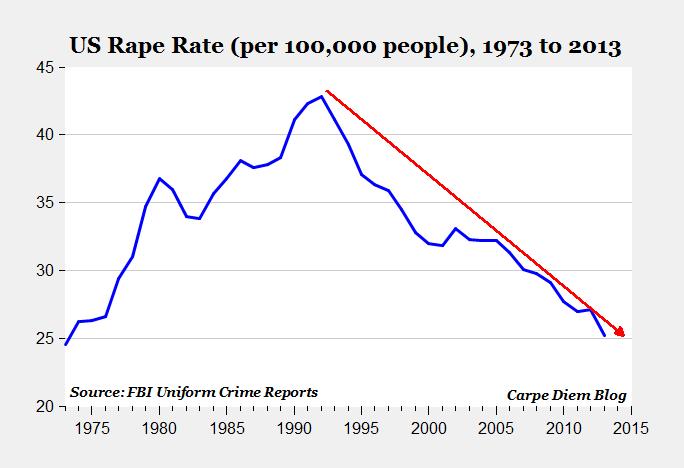
Indeed, I find it somehow unlikely that sexual assault centers in US colleges are reporting an increase in rape given that American rape rates fell substantially between 1990 and the present:

US rape rate 1973-2013

Go look up any statistics on the incidence of rape and you will find them to be broadly similar — a spike in the 70s and 80s (which happened to coincide with a general increase in criminality) followed by a lengthy decline ever since. Now, were porn actually causing an increase in rape rates due to ‘sexualizing violence against women’ and ‘normalizing’ practices like rape, you would not have expected to find such an obvious decline in sexual assault rates, would you?

The second claim Dines makes is regarding the scary normalization of pedophilia which she claims is occurring directly resultant from porn involving teenagers. First of all, ‘teen porn’ does not ‘normalize pedophilia’ since the teenagers in teen porn are supposed to be 18 or 19 — in other words, post-pubescent and fully grown women. This isn’t even taking into consideration the fact that many actresses in teen porn are actually in their 20’s and are just ‘playing young,’ but we’ll ignore the fact that this is all fantasy anyway, since the fact that pornography isn’t based on reality seems to be a constant source of confusion for Gail Dines.

September 23, 2015

Oppressed by cisnormative expectations? Harassed by microaggressions? Come to Snowflake U!

Filed under: Politics, USA — Tags: , , — Nicholas @ 05:00

Ken White imagines a market solution to help academia’s most special snowflakes:

Imagine a world in which the market lets people decide whether to be special snowflakes — people wtih an actual protected right not to be upset or offended.

As the University of California’s proposal shows, the legions of school administrators are perfectly capable of creating Snowflake Schools, where the administration vigorously defends students’ rights to be free of offense. What if we let them?

Take, let’s say, Brown University. They’re already on FIRE’s red light policy list, and frankly I enjoy making fun of them. Brown could decide to take on the mantle of a Snowflake School. It could openly declare that its students have a right not to be offended. It could enact policies accordingly, and discipline students and faculty who cause any offense through their speech and actions. Brown could display the snowflake symbol on their letterhead and web page. They could even vigorously rebrand themselves to attract students who don’t want to be offended — I don’t know, they could rename their teams The Blizzards or something.

Students, staff, and academics could then vote with their feet. Do I want to go to an acknowledged Snowflake School? Maybe I do, and will wear the snowflake badge proudly. Maybe I don’t — either because I don’t want to get expelled for offending someone, or because I’m embarrassed to go someplace that marks me as a snowflake.

Other people could vote, too. Do I want to hire someone who chose to go to a Snowflake School? You might, but I wouldn’t. Do I want to date a Snowflake? Do I want a doctor, a lawyer, an accountant who wears a Snowflake U. sweatshirt?

September 20, 2015

QotD: German schooling

Filed under: Education, Europe, Germany, History, Humour — Tags: , , — Nicholas @ 01:00

On our way home we included a German University town, being wishful to obtain an insight into the ways of student life, a curiosity that the courtesy of German friends enabled us to gratify.

The English boy plays till he is fifteen, and works thence till twenty. In Germany it is the child that works; the young man that plays. The German boy goes to school at seven o’clock in the summer, at eight in the winter, and at school he studies. The result is that at sixteen he has a thorough knowledge of the classics and mathematics, knows as much history as any man compelled to belong to a political party is wise in knowing, together with a thorough grounding in modern languages. Therefore his eight College Semesters, extending over four years, are, except for the young man aiming at a professorship, unnecessarily ample. He is not a sportsman, which is a pity, for he should make good one. He plays football a little, bicycles still less; plays French billiards in stuffy cafés more. But generally speaking he, or the majority of him, lays out his time bummeling, beer drinking, and fighting. If he be the son of a wealthy father he joins a Korps — to belong to a crack Korps costs about four hundred pounds a year. If he be a middle-class young man, he enrols himself in a Burschenschaft, or a Landsmannschaft, which is a little cheaper. These companies are again broken up into smaller circles, in which attempt is made to keep to nationality. There are the Swabians, from Swabia; the Frankonians, descendants of the Franks; the Thuringians, and so forth. In practice, of course, this results as all such attempts do result — I believe half our Gordon Highlanders are Cockneys — but the picturesque object is obtained of dividing each University into some dozen or so separate companies of students, each one with its distinctive cap and colours, and, quite as important, its own particular beer hall, into which no other student wearing his colours may come.

The chief work of these student companies is to fight among themselves, or with some rival Korps or Schaft, the celebrated German Mensur.

Jerome K. Jerome, Three Men on the Bummel, 1914.

September 19, 2015

First world problems – pronouns

Filed under: Politics, USA — Tags: , , , , , — Nicholas @ 03:00

Katharine Timpf explains why we all face potentially insurmountable problems with our pronouns:

Scripps College, a private all-women’s college in Southern California, is giving students ten pronoun options to choose from in their student portal accounts — including “hu, hum, hus, himself,” “Just My Name Please,” and “None”

It’s not clear what the hell students who choose “None” are supposed to be called, especially since “Name Only” is another option. Are they (oops! I said “they!”) asking to not be spoken to at all? Because that sounds like a microaggression.

The other eight options are “E/Ey, Em, Eir/Eirs, Eirself/Emse,” “Per, Per, Per/Pers, Perself,” “Zi, Hir/Hirs Hirself,” “Ze, Zir, Zir/Zirs, Zirself,” “They, Them, Their/Theirs, Themse” (used as a singular pronoun) and — yes — the archaic “He, Him, His, Himself” or “Her, She, Hers, Herself.”

[…]

There is, however, an obvious problem with this system: What about the gender-fluid students who may change genders and pronouns throughout the year, or even perhaps throughout the day? I can’t imagine how traumatic (dangerous?) being pressured to choose just one might be.

September 13, 2015

Teaching microaggressions

Filed under: Health, Politics, USA — Tags: , , , , — Nicholas @ 04:00

At Ace of Spades HQ, Ace sums up the deepest problem with the movement to find microaggressions everywhere and in everything:

The idea is that just as cognitive therapy teaches people to not make a big deal out of trivialities (like teaching people who have a phobia about elevators to learn to not be afraid of elevators), microagression brain-programming is a malicious form of cognitive therapy teaching people the exact opposite — to fear this, hate that, fly off the handle about this other thing, and generally carry on like a lunatic about things that sane people do not even think about.

And just as the good form of cognitive therapy can make a hysteric or neurotic a well-functioning individual, so can the insidious form of it turn a well-functioning individual into a hysteric or neurotic.

I think it’s 100% right and I’m glad someone had the guts to say so.

Colleges and progressives generally are teaching young people how to be mentally ill.

September 3, 2015

Reparations for India’s colonial period?

Filed under: Britain, History, India — Tags: , , , — Nicholas @ 02:00

In Time, Shikha Dalmia explains why India may not want to cuddle up too closely to the idea of getting reparations from the UK:

Indian politician and celebrated novelist Shashi Tharoor caused a mini-sensation late last month when he went before the Oxford Union, a debating society in England’s prestigious eponymous university, and argued that Britain needed to give India reparations for “depredations” caused by two centuries of colonial rule. It was a virtuoso performance — almost pitch perfect in substance and delivery — that handily won him the debate in England and made him a national hero at home.

But the most eloquent point that emerged in the debate is one he didn’t make: While Brits are grappling with their sordid past by, say, holding such debates, Indians are busy burying theirs in a cheap feel-goodism.

Colonialism, without a doubt, is an awful chapter in human history. And Tharoor did a brilliant job of debunking the standard argument of Raj apologists that British occupation did more good than harm because it gave India democracy and the rule of law. (This is akin to American whites who argued after the Civil War that blacks had nothing to complain about because — as the Chicago Tribune editorialized — in exchange for slavery, they were “taught Christian civilization and to speak the noble English language instead of some African gibberish.”)

[…]

Reparations make sense when it is still possible to identify the individual victims of political or social violence. But if paying collective reparations for collective guilt is appropriate, then how about India “atoning” for thousands of years of its caste system? This system has perpetrated “depredations” arguably worse than those of colonialism or apartheid against India’s dalits — or untouchables — and other lower castes. And despite what Hindu denialists claim, this system remains an endemic part of everyday life in many parts of India. Indeed, much like the Jim Crow south, local village councils even today severely punish inter-caste mingling and marriage, even issuing death sentences against young men and women who dare marry outside their caste.

None of this is meant to single out India. Alexis de Tocqueville, the great French philosopher, who visited America in the early 19th Century, expressed astonishment at how Americans could blithely both claim to love liberty and defend slavery without any sense of contradiction. Every civilization has its stock of virtues and vices, ideals and transgressions. Moral progress requires each to constantly parse its history and present to measure how far it has come and how far it must go to bridge the gap between its principles and practices.

August 31, 2015

Brendan O’Neill | Freedom of Speech and Right to Offend | Proposition

Filed under: Britain, Liberty — Tags: , , — Nicholas @ 02:00

Published on 25 Aug 2015

The Motion: This House Believes the Right to Free Speech Always Includes the Right to Offend.

Debate speaker 1 of 6. Watch all the speakers for this debate in order of appearance: https://www.youtube.com/watch?v=BtWrl…

Brendan O’Neill is the editor of Spiked Online and a columnist for The Australian and The Big Issue.

ABOUT THE OXFORD UNION SOCIETY: The Union is the world’s most prestigious debating society, with an unparalleled reputation for bringing international guests and speakers to Oxford. It has been established for 192 years, aiming to promote debate and discussion not just in Oxford University, but across the globe.

H/T to Samizdata for the link.

August 16, 2015

Wanted – challenging university education that won’t actually challenge any of my beliefs

Filed under: Politics, USA — Tags: , , , — Nicholas @ 02:00

Megan McArdle wants those (university) kids to get off her lawn:

If you’ve reached that crotchety age I’m at, you may be as mystified as I am by the kids these days — especially by how they’re behaving on campus. I get the naive leftist politics and the wildly irresponsible partying; those things have been staples of student life for hundreds of years. I even understand the drive toward hamfisted censorship of views they don’t like. […]

What I don’t understand is the tenor of the censorship. When I was in college, people who wanted to censor others were forthrightly moralistic, trying to silence “bad” speech. Today’s students don’t couch their demands in the language of morality, but in the jargon of safety. They don’t want you to stop teaching books on difficult themes because those books are wrong, but because they’re dangerous, and should not be approached without a trigger warning. They don’t want to silence speakers because their ideas are evil, but because they represent a clear and present danger to the university community. If the school goes ahead and has the talk anyway, they build safe spaces so that people can cower from the scary speech together.

Are ideas dangerous? Certainly their effects can be. Ideas like “Asbestos sure makes good insulation” and “Bleed patients to balance the humors” racked up quite a number of fatalities. But of course, the ideas themselves didn’t kill anyone; that was left to the people who put them into practice. The new language of campus censorship cuts out the middleman and claims that merely hearing wrong, unpleasant or offensive ideas is so dangerous to the mental health of the listener that people need to be protected from the experience.

During the time when people are supposed to be learning to face an often hard world as adults, and going through the often uncomfortable process of building their intellectual foundations, they are demanding to be sheltered from anything that might challenge their beliefs or recall unpleasant facts to their mind. And increasingly, colleges are accommodating them. Everything at colleges is now supposed to be thoroughly sanitized to the point of inoffensiveness — not only the coursework, but even the comedians who are invited to entertain the students.

August 14, 2015

Protecting college students from the slightest potential offense

In The Atlantic, Greg Lukianoff and Jonathan Haidt look at how universities are turning themselves inside-out in an attempt to protect their students from ever being confronted with words, thoughts, or images that might possibly offend them:

Something strange is happening at America’s colleges and universities. A movement is arising, undirected and driven largely by students, to scrub campuses clean of words, ideas, and subjects that might cause discomfort or give offense. Last December, Jeannie Suk wrote in an online article for The New Yorker about law students asking her fellow professors at Harvard not to teach rape law — or, in one case, even use the word violate (as in “that violates the law”) lest it cause students distress. In February, Laura Kipnis, a professor at Northwestern University, wrote an essay in The Chronicle of Higher Education describing a new campus politics of sexual paranoia — and was then subjected to a long investigation after students who were offended by the article and by a tweet she’d sent filed Title IX complaints against her. In June, a professor protecting himself with a pseudonym wrote an essay for Vox describing how gingerly he now has to teach. “I’m a Liberal Professor, and My Liberal Students Terrify Me,” the headline said. A number of popular comedians, including Chris Rock, have stopped performing on college campuses (see Caitlin Flanagan’s article in this month’s issue). Jerry Seinfeld and Bill Maher have publicly condemned the oversensitivity of college students, saying too many of them can’t take a joke.

Two terms have risen quickly from obscurity into common campus parlance. Microaggressions are small actions or word choices that seem on their face to have no malicious intent but that are thought of as a kind of violence nonetheless. For example, by some campus guidelines, it is a microaggression to ask an Asian American or Latino American “Where were you born?,” because this implies that he or she is not a real American. Trigger warnings are alerts that professors are expected to issue if something in a course might cause a strong emotional response. For example, some students have called for warnings that Chinua Achebe’s Things Fall Apart describes racial violence and that F. Scott Fitzgerald’s The Great Gatsby portrays misogyny and physical abuse, so that students who have been previously victimized by racism or domestic violence can choose to avoid these works, which they believe might “trigger” a recurrence of past trauma.

Some recent campus actions border on the surreal. In April, at Brandeis University, the Asian American student association sought to raise awareness of microaggressions against Asians through an installation on the steps of an academic hall. The installation gave examples of microaggressions such as “Aren’t you supposed to be good at math?” and “I’m colorblind! I don’t see race.” But a backlash arose among other Asian American students, who felt that the display itself was a microaggression. The association removed the installation, and its president wrote an e-mail to the entire student body apologizing to anyone who was “triggered or hurt by the content of the microaggressions.”

August 3, 2015

Undependable numbers in the campus rape debate

Filed under: Politics, USA — Tags: , , — Nicholas @ 02:00

Megan McArdle on the recently revealed problems in one of the most frequently used set of statistics on campus rape:

a new article in Reason magazine suggests that this foundation is much shakier than most people working on this issue — myself included — may have assumed. (Full disclosure: the Official Blog Spouse is an editor at Reason.) The author, Linda M. LeFauve, looked carefully at the study, including conducting an interview with Lisak, and identified multiple issues:

  1. Lisak did not actually do original research. Instead, he pooled data from studies that were not necessarily aimed at collecting data on college students, or indeed, about rape. Only five questions on a multi-page questionnaire asked about sexual violence that they may have committed as adults, against other adults.
  2. The campus where this data was collected is a commuter campus. It’s not clear that everyone surveyed was a college student, but if so, the sample included many non-traditional students, with an average age of 26.5. Yet this data has been widely applied to traditional campuses, even though the two populations may differ greatly.
  3. The responses indicate that the men identified as rapists were extraordinarily more violent than the normal population: “The high rate of other forms of violence reported by the men in Lisak’s paper further suggests they are an atypical group. Of the 120 subjects Lisak classified as rapists, 46 further admitted to battery of an adult, 13 to physical abuse of a child, 21 to sexual abuse of a child, and 70 — more than half the group — to other forms of criminal violence. By itself, the nearly 20 percent who had sexually abused a child should signal that this is not a group from whom it is reasonable to generalize findings to a college campus.”
  4. The data did not cover acts committed while in college, but any acts of sexual violence; a number of them seem to have been committed in domestic violence situations.
  5. Lisak appears to have exaggerated how much follow-up he was able to do on the people he surveyed, at least to LeFauve: “Lisak told me that he subsequently interviewed most of them. That was a surprising claim, given the conditions of the survey and the fact that he was looking at the data produced long after his students had completed those dissertations; nor were there plausible circumstances under which a faculty member supervising a dissertation would interact directly with subjects. When I asked how he was able to speak with men participating in an anonymous survey for research he was not conducting, he ended the phone call.” Robby Soave of Reason, in a companion piece, also raises doubts about Lisak’s repeated assertions that he conducted extensive follow-ups with “most” of the respondents to what were mostly anonymous surveys.

In short, Lisak’s 2002 study is not a systematic survey of rape on campus; it is pooled data from surveys of people who happen to have been near a commuter campus on days when the surveys were being collected.

Before I go any further, let me note that I’m not saying that what these men did was not bad, or does not deserve to be punished. But if LeFauve is right, this study is basically worthless for shaping campus policies designed to stop rape.

July 23, 2015

I didn’t know formal debates are now also performance art

Filed under: Randomness, USA — Tags: — Nicholas @ 05:00

Kathy Shaidle posted this video, which to be honest I first thought was a poorly done parody. I still rather hope to hear that it’s just somebody pulling a fast one on Fox …

July 20, 2015

Making a terrorist

Filed under: Europe, USA — Tags: , , — Nicholas @ 02:00

Tam at View From The Porch linked to this discussion of how domestic terrorists don’t match the media’s default profile:

Of course, there’s an easy way to make it harder for Da’esh to “recruit Americans,” and that’s to zero out immigration from nations where the common values are inimical to American values. But there are problems with that. Many of the people seeking to immigrate from Da’esh territory to the USA are fleeing that terror and seeking security — and freedom. They have a very high potential to be very solid, freedom-loving Americans. The problem we have seen in the USA (and to a greater extent in some European countries like Sweden and France) is not so much the immigrants, but their children who, exposed to academia that hates the new homeland, regresses to an imagined “golden age” religious extremism.

The conventional wisdom on the left and in the press (but we repeat ourselves) that terrorists are made by poverty and oppression is, frankly, silly. Like the communist terrorists of the 1970s, the mohammedan terrorists of today are a product of wealthy-kid ennui and self-loathing. Well-known terrorist cases range from solidly middle-class (Tsarnaevs) to professional class (Ayman al-Zawahiri) to stankin’ wealthy (bin Laden); it is rare to find one without some university education. Certainly part of the problem is that the moral component of a university education today includes an unhealthy dose and burden of contempt and blame for the host society. That’s beyond the scope of what this report, centered as it is on the nuts and bolts of what ISIS is and how it means to attack our homeland, covers; but if it is not addressed there is another terrorist cause on the far side of this one, and so on endlessly like a land of rolling hills.

July 12, 2015

Of more than just “academic” concern…

Filed under: Bureaucracy, Humour, Politics — Tags: , , , — Nicholas @ 02:00

Jay Currie rounds up the current issues for your university faculty:

Notes Re Coming Academic Year
From: Dean of Arts
To: Faculty
Dear Colleagues,

I hope you are enjoying your well earned summer vacation. I know I am. However, a number of issues have arisen which I feel I must bring to your attention.

1. Marking: Many of you are still clinging to the outmoded idea that marks are designed to measure absolute progress in a subject. You are insisting upon received grammar and spelling in essays. You are setting exams and papers which, in themselves, are triggering events causing significant anxiety. Worse, you are not taking into account the often heart rending oppression narratives which many of your students bring to class. Stop it.

2. Subject matter: It is not enough to include writers and topics from outside the tragically exclusionary Western Cannon. The fact is that even a reference to Shakespeare will trigger feelings of anxiety, worthlessness, racial othering, religious persecution and, of course, sexual confusion. Just stop it. The same with references to the Bible, Plato, Milton, any so called Saint, Mark Twain or that Moby D*** fellow with the harpoon obsession. Each of these references will only serve to underscore the possible ignorance of your students which, rather obviously, will make them feel anxious, disrespected and unsafe. Best not to mention any of it.

[…]

6. Race: Pretty much the live hand grenade of the Arts Faculty. Say anything and it explodes with unknowable consequences. Even a supportive statement such as “slavery is wrong” can lead to disastrous conversations about Black African complicity in the trade and the continuing Islamic acceptance of slavery. Plus, and this is an acute problem, Chinese and South Asian students, dealing with our university’s current admission policies, may take strong exception to remarks vis a vis affirmative action or diversity. Just don’t go there.

7. Logic/Argument/Reason: Mansplaining at its heteronormative worst. It is pretty clear that argument, both verbal and written privileges middle class, usually white, usually male, left brain dominant, testosterone charged, individuals. By prioritizing thinking over feeling, requiring reason means an instructor risks making women, minorities and queer students feel unsafe with the feelings they often use in discourse rather than accepting the oppressor’s terms of exchange. Stay away.

July 8, 2015

Minnesota students face new rules under which “everyone accused of sexual assault will very likely be technically guilty”

Filed under: Bureaucracy, Politics, USA — Tags: , , , — Nicholas @ 04:00

Reason‘s Robby Soave on the introduction of new “affirmative consent” rules at the University of Minnesota:

The proposed policy is currently under review for another 30 days before it becomes official. Its language is fairly standard, which leads me to believe that it will suffer from the same problems as other “Yes Means Yes” policies:

  • It is the responsibility of each person who wishes to engage in the sexual activity to obtain consent.
  • A lack of protest, the absence of resistance and silence do not indicate consent.
  • The existence of a present or past dating or romantic relationship does not imply consent to future sexual activity.
  • Consent must be present throughout the sexual activity and may be initially given, but withdrawn at any time.
  • When consent is withdrawn all sexual activity must stop. Likewise, where there is confusion about the state of consent, sexual activity must stop until both parties consent again.
  • Consent to one form of sexual activity does not imply consent to other forms of sexual activity.

“It is the responsibility of each person who wishes to engage in the sexual activity to obtain consent.” But isn’t that redundant? All parties to a sexual activity must be willing participants in the first place, or else they are victims of rape under any standard. That’s what consent is: agreement to engage in sex. I presume the policy’s authors mean to say that it is the responsibility of each person who wishes to initiate the sexual activity to obtain consent. But such a requirement is at odds with the reality of human sexual activity — the initiating party is not always so clearly defined, especially when alcohol is involved (as it often is).

Equally troubling is the mandate that each and every sexual act be hammered out beforehand. May I touch your hand? What about your wrist? May I touch your shoulder? May I kiss this spot on your neck? May I kiss this other spot on your neck? May I kiss the first spot again while I touch your hand? Nobody is going to do this. Does that mean everyone is a rapist?

« Newer PostsOlder Posts »

Powered by WordPress