
The Korean War by Indy Neidell
Published 10 Mar 2026Ultimatums and blackmail! Well, sort of. US President Harry Truman is trying to strong arm South Korean President Syngman Rhee into accepting any armistice negotiated, but the armistice talks are taking forever, so there are those who wish to simply give the Communists a take it or leave it ultimatum. What might such an ultimatum be? Find out this week!
00:58 Recap
01:26 Inspection Teams
03:15 Ultimatums
05:08 Epidemic Disease
07:54 Syngman Rhee
10:57 ROK Training Programs
16:30 Summary
16:46 Conclusion
(more…)
March 11, 2026
The Korean War Week 90: No Surrender, No Armistice … No Hope? – March 10, 1952
March 6, 2026
Congress shrugs responsibility for declarations of war, as Trump expected
As many have noted, the President of the United States does not have the constitutional power to declare war, as that is explicitly assigned to the rights of Congress. But in this, as in many other areas, Congress is unlikely to interfere once a President has set the military machine in motion. It is convenient for both the sitting President and for the individual members of Congress, who can posture and speechify against or in favour, but won’t actually be held responsible by the voters regardless of the war’s outcome. President Trump’s use of trade war tactics against allies and enemies alike is also an area where Congress is apparently willing to turn a blind eye:
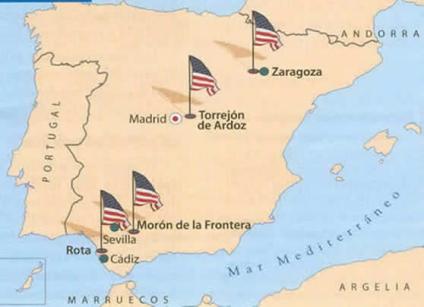
US military bases in Spain (Map from sutori.com)
No Spain, no gain? It was probably inevitable that President Donald Trump’s trade war would eventually get mixed up in his actual war.
Earlier this week, Spanish officials said they would prohibit American forces from using joint bases for war operations, unless those activities were covered by the United Nations Charter. Spanish Prime Minister Pedro Sánchez said his country would not “be complicit in something that is bad for the world”, the Associated Press reports.
On Tuesday, Trump declared that he intended to “cut off all trade with Spain”.
You might wonder: What legal authority does Trump have to unilaterally impose these sorts of revenge tariffs? After all, the Supreme Court ruled not that long ago that the authority Trump had been using to unilaterally impose tariffs based on his whims was unconstitutional. You might as well ask: On what legal authority did Trump launch a war against Iran? In theory, under the Constitution, Congress is supposed to authorize both tariffs and wars. In practice, they, uh, don’t.
Trump just does things, and the annoying constitutional worrywarts can figure it out later. (I say this as an annoying constitutional worrywart.)
In any case, yesterday, the Trump administration announced that Spain had changed its tune. “The U.S. military is coordinating with their counterparts in Spain”, White House Press press secretary Karoline Leavitt said. The implication was that the tariff threats had worked.
Spain, however, said otherwise. “I can refute (the White House spokesperson)”, Spanish Foreign Minister José Manuel Albares said. “The position of the Spanish government regarding the war in the Middle East, the bombing of Iran and the use of our bases has not changed one iota.” Maybe those tariff threats aren’t as effective as Trump thinks?
In a speech, Sánchez warned that the war could spin out of control. “Nobody knows for sure what will happen now”, he said. “Even the objectives of those who launched the first attack are unclear. But we must be prepared, as the proponents say, for the possibility that this will be a long war, with numerous casualties and, therefore, with serious economic consequences on a global scale.”
Sánchez also implicitly admonished Trump for escalating the war: “You can’t respond to one illegality with another because that’s how humanity’s great disasters begin”.
I will just note that in the Star Wars prequels, the fall of the Republic, and the descent into darkness and imperial rule, began with a planetary blockade and a trade war. At the time, people said it was wonky and boring. But here we are.
Where is Congress? The Constitution was built around the idea that each branch would fight to preserve its own powers, and this would create a system of checks and balances. But in Trump’s second term, Republicans in the legislature have been actively fighting to not preserve their power.
Yesterday, in a 47–53 vote, Senate Republicans voted against a resolution that would have required Trump to ask Congress to sign off on any further military aggression in Iran. Sen. Rand Paul (R–Ky.) voted with Democrats in favor of the measure; Sen. John Fetterman (D–Pa.) joined Republicans to vote against it.
The measure was mostly symbolic. Even a successful vote would have been subject to a House vote and a presidential veto. And the position of both the White House and the GOP Speaker of the House is that this whole situation in which America is spending billions of dollars dropping thousands and thousands of bombs on military and political targets in a foreign country is not, in fact, a war. Nothing to see here. Everyone in Congress can go home and crack open a beer.
March 4, 2026
The Korean War Week 89: Is There Such Thing As Soviet Neutrality? – March 3, 1952
The Korean War by Indy Neidell
Published 3 Mar 2026The UN is not just worried that the Communists have strong air power, they’re worried that because they can’t produce more jets quickly enough, the Communist advantage in the skies will soon become insurmountable, but they at least have plans to try and stave that off. They also have plans for rotating in fresh troops, but those plans have stumbling blocks of their own, as do the negotiations about who might be part of a post-armistice supervisory team, specifically the USSR, whom the US does not see as “neutral” with regard to this war.
00:00 Intro
00:54 Recap
02:05 Supervisory Team
03:29 45th and 40th Divisions
07:14 POW Repatriation
10:29 Communist Air Power
15:52 Notes
16:36 Summary
16:55 Conclusion
(more…)
Comments Off on The Korean War Week 89: Is There Such Thing As Soviet Neutrality? – March 3, 1952
February 25, 2026
The Korean War Week 88: Riot or Revolution? – February 24, 1952
The Korean War by Indy Neidell
Published 24 Feb 2026The tensions at Koje-do POW camp explode this week, ending in heavy bloodshed as UN forces desperately try to wrestle control of the situation. Changes will need to be made to counter the growing threat of disorder, and fast. Elsewhere, the Communist forces are on the attack this week, both in the field and through diplomatic channels, as a naval invasion of Yang-do launches and accusations of biological weapons ramp up.
00:00 Intro
00:44 Recap
01:13 Compound 62
04:44 Yang-do Island
07:45 Biological Warfare
09:55 Supervisory Committee
12:22 Notes
13:16 Summary
13:27 Conclusion
14:13 Call to Action
(more…)
Comments Off on The Korean War Week 88: Riot or Revolution? – February 24, 1952
February 18, 2026
The Korean War Week 87: What’s Going On In Compound 62? – February 17, 1952
The Korean War by Indy Neidell
Published 17 Feb 2026UN forces kick off this week with an operation to ensnare and capture North Korean and Chinese patrols, as significant progress is made elsewhere at the armistice talks. Prisoners really do seem to be the focus of the week, as rumblings of discontent continue to build at the POW camp on Koje-do island as UN control of the camp slips a little more each day. Just what is happening inside Compound 62 there? And do UN forces have a hope to stop it?
00:00 Intro
00:48 Recap
01:17 Clam Up
01:50 Repatriation
05:02 Item 5 Agreed Upon
07:35 Troop Rotation
09:47 Coastal Waters and Islands
11:02 Compound 62
13:45 The Bigger Picture
14:31 Summary
14:45 Conclusion
(more…)
Comments Off on The Korean War Week 87: What’s Going On In Compound 62? – February 17, 1952
February 14, 2026
QotD: Canada and its military – a history of neglect
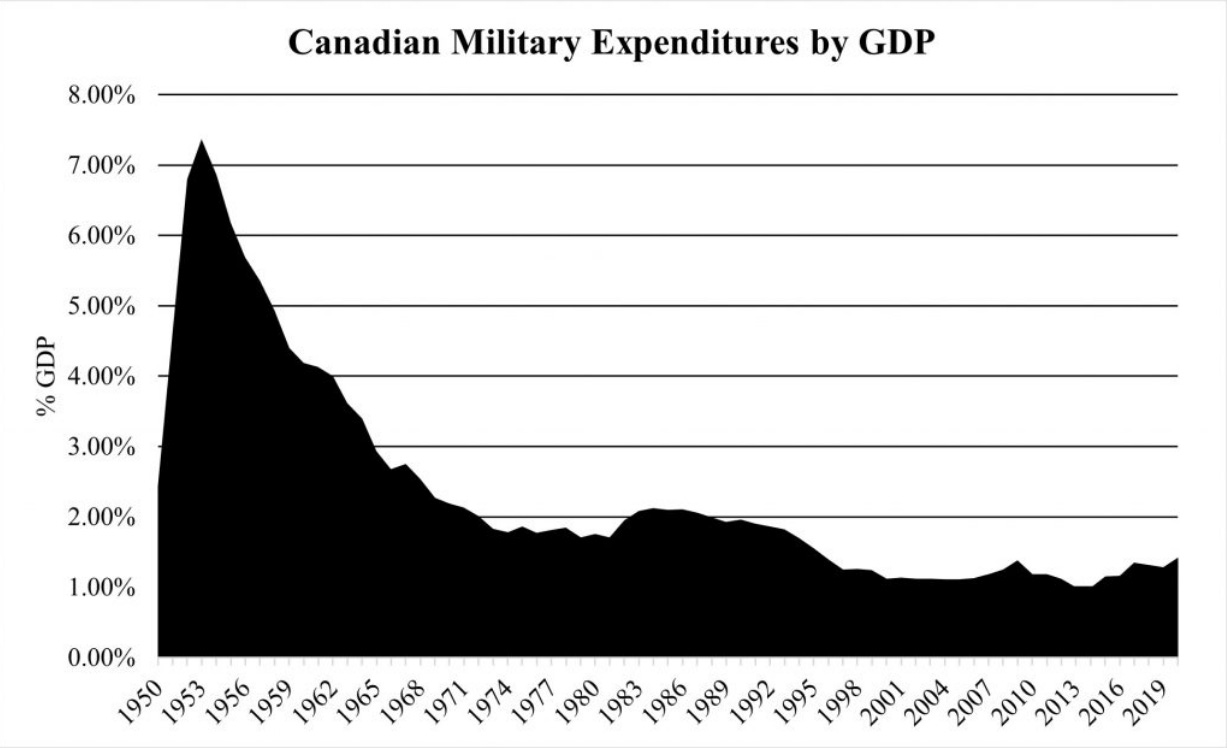
Canada’s military was not always a punchline. At the end of World War II Canada had the world’s third-largest navy, complete with our own aircraft carrier, and over a million men under arms. Since then military spending has steadily declined, from a high of around 7% of GDP in the early 50s to around 1% today, where it’s hovered since the end of the Cold War.
Canada is protected to its east and west by the Atlantic and Pacific oceans, both of which are patrolled by the powerful navy of the friendly superpower to the south, the only country with which Canada shares a land border, which we have long bragged is the longest undefended frontier in the world. Our only other neighbouring country is Russia, and while Russia is a decidedly unfriendly superpower, in practice Canada’s populated south is separated from the Russian Federation by thousands of kilometres of howling arctic wastes which provide an even better natural defence than the oceans.
Cozy and secure in our continental cocoon, Canada has allowed its military to atrophy into a vestigial appendage akin to the stubby wings of flightless birds on isolated Pacific islands, useful only for emotive displays. So far as the Liberal Party is concerned, “emotive display” is, indeed, the only real purpose of the military. Ever since Lester B. Pearson1 was awarded the Nobel Peace Prize for inventing the concept of “peacekeeping” to de-escalate the Suez Crisis (thereby helping to drive the final nail into the coffin of the British Empire), the Canadian military’s primary purpose has been to conduct third-world relief missions. Peacekeeping carries no particular benefit to Canada, but it is of great benefit to politicians, who get to preen in front of the camera as important humanitarian statesmen. The purpose of the Canadian military isn’t to win wars, to defend the country, or to conquer distant lands: it’s to make Liberal Party politicians feel good about themselves.
When the CAF fails to live up to its making-liberals-feel-good mission, Canada’s liberal establishment reacts like a frustrated child taking out her vindictive cruelty by throwing her dolls against the wall. The Somalia Affair is probably the best example of this dynamic. The Canadian Airborne Regiment, an elite commando unit whose core competencies were jumping out of airplanes to break things and kill people, was deployed in Somalia with the contradictory goal of keeping a non-existent peace, a mission to which they were singularly ill-suited. Somalis being Somalis, the Airborne base was immediately subjected to continuous infiltration and theft. A handful of the violent lunatics in the regiment reacted by capturing thieves and torturing them to death, which they had the poor sense to document with photographic evidence; later, photographs emerged of one of the airborne troopers wearing a moustache man t-shirt while raising his arm at a prohibited angle, which wasn’t criminal exactly but was very bad PR. Instead of punishing the guilty troops individually, for instance with field courts martial followed by summary hanging, the Liberal Party flew into a rage and disbanded the regiment for having committed the unforgivable sin of making them look bad. This dragged on in the media for years, sullying the honour of not only the Airborne Regiment but of the entire military. The Somalia affair unfolded over thirty years ago, but the liberal establishment holds it over the heads of the CAF to this day.
In addition to providing politicians with regular hits of the pleasantly addictive buzz of telescopic philanthropy, peacekeeping also has the great advantage of being cheap. Not only does peacekeeping not require all that many troops, you don’t even need tanks, fighter jets, destroyers, or aircraft carriers to distribute aid packages to refugees. Therefore the Canadian military essentially does not have these things. The CAF has a grand total of 112 forty-six-year-old Leopard II main battle tanks (of which roughly half are down for maintenance at any given time), a whole 138 forty-two-year-old CF-18 Hornet fighter jets (of which 89 are operational), twelve Halifax class frigates (of which about half are in drydock at any given time), an intimidating four Victoria class diesel-electric submarines (which are forty-five years old, and all but one of which is out of commission), and zero bombers, zero attack helicopters, zero destroyers, zero troop transports, zero battleships, and zero aircraft carriers. The pathetic size of the Royal Canadian Navy is particularly embarrassing given that Canada has the longest coastline in the world, at 243,042 kilometres, essentially all of which Ottawa expects Washington to defend on its behalf. Airlift capacity is so limited that the CAF essentially cannot deploy overseas without allied logistical assistance.
By contrast with its decrepit armaments, the CAF has 145 generals: it has more generals than it does tanks. This top-heavy general staff is only about a third the size of the US military’s, despite the American military being 20x larger by personnel and 32x larger by budget.
From the perspective of the Laurentian elite, a weak military is actually a political advantage. If Canada effectively does not have the ability to project military force, Ottawa can simply plead lack of capacity when America asks for assistance. It enables Canada to duck out of involvement in America’s various imperial wars, letting Washington shoulder the burden of the Pax Americana while chirping from the sidelines about how the big bad bible-thumbing American bully is so mean, and how peaceful, ethical, liberal, humanitarian Canada is so nice because Canada spends its money on healthcare instead of bombs. It isn’t a morally superior position, of course: it’s simply shameless dependence and shameful parasitism.
John Carter, “The Canadian Political Class is Ideologically Incapable of Rebuilding the Military”, Postcards From Barsoom, 2025-11-13.
- The man who, as prime minister, replaced the red ensign’s ethnic heraldry with the maple leaf’s corporate logo.
Comments Off on QotD: Canada and its military – a history of neglect
February 11, 2026
The Korean War Week 86: Koje-do: A Simmering Cauldron – February 10, 1952
The Korean War by Indy Neidell
Published 10 Feb 2026An astonishing accusation about chemical weapons by Soviet diplomat Yakov Malik dominates headlines this week, as the POW issue continues to plague ceasefire negotiations. But those are far from the only developments this week. Elsewhere, overcrowding, poor conditions, and lack of firm control escalate tensions at the UN’s Koje-do POW camp, perhaps beginning to precipitate unpredictable and dangerous results …
00:00 Intro
00:47 Recap
01:29 Item 5
06:05 NK Ingenuity
07:03 Poison Gas
08:37 Screening POWs
10:17 Koje-Do
11:47 Operation Clam-up
13:21 Summary
14:29 Conclusion
15:03 Call to Action
(more…)
Comments Off on The Korean War Week 86: Koje-do: A Simmering Cauldron – February 10, 1952
February 4, 2026
The Korean War Week 85: Futilely Pounding North Korea? – February 3, 1952
The Korean War by Indy Neidell
Published 3 Feb 2026The UN forces are by now having trouble just keeping their planes in the skies, thanks to shortages of spare parts, so for long can they maintain aerial supremacy over Korea? And though the aerial campaign to destroy North Korean infrastructure has been stepped up, so too has the enemy’s ability to quickly rebuild. And at the armistice talks, the big issue this week is which countries will form inspection teams after an armistice, and who might be out of the question. The Soviets?
00:00 Intro
01:06 Recap
01:30 The POW Lists
07:12 The Soviets
10:25 Communist Manpower
12:01 Air Force Supply Issues
13:21 Summary
13:34 Conclusion
14:17 Call to Action
(more…)
Comments Off on The Korean War Week 85: Futilely Pounding North Korea? – February 3, 1952
January 28, 2026
The Korean War Week 84: Inside Truman’s Diary – January 27, 1952
The Korean War by Indy Neidell
Published 27 Jan 2026Things heat up in the Panmunjom Peace Talks, which each side arguing that the other side’s proposals violate the Geneva Convention, but by the end of the week they talks are in recess. Naval aircraft pound the North Korean infrastructure all week long, though, and US President Harry Truman has a few things to say about the Soviet Union that the world may wish to hear.
00:00 Intro
00:51 Recap
01:29 Repatriation and Parole
05:29 Airfields
07:22 Naval Aircraft Get Busy
10:36 Truman’s Diary
11:42 Summary
(more…)
Comments Off on The Korean War Week 84: Inside Truman’s Diary – January 27, 1952
January 21, 2026
The Korean War Week 83: The Medics’ War! – January 20, 1952
The Korean War by Indy Neidell
Published 20 Jan 2026There’s discussion — and disagreement — in UN Command and Washington about whether or not to poll all the POWs the UN side holds to see where they would like to go should they be released. There are arguments for and against this, and it brings up a couple different interpretations of the Geneva Convention. This week we also talk a lot about recent medical advances in field medicine in Korea, and the development of the “Medics’ War”.
00:00 Intro
00:44 Recap
01:14 Poll the POWS
04:52 UN Decleration
08:19 52nd Medical Battalion
10:56 Cho-Do Island
11:45 Summary
12:06 Conclusion
12:49 Memorial
(more…)
Comments Off on The Korean War Week 83: The Medics’ War! – January 20, 1952
January 14, 2026
The Chagos Islands and the military base on Diego Garcia
The British government is engaged on a fantastic quest to subordinate the Chagos Islanders to a new foreign colonial government a thousand miles away who have never had any connection other than an earlier colonial convenience relationship. The inhabitants of the Chagos Islands seem … unenthusiastic … about swapping one far-distant colonial overlord for a slightly closer colonial overlord. In the “outside the paywall” section of this post, Nigel Biggar explains why he’s fighting against this transfer in the House of Lords:
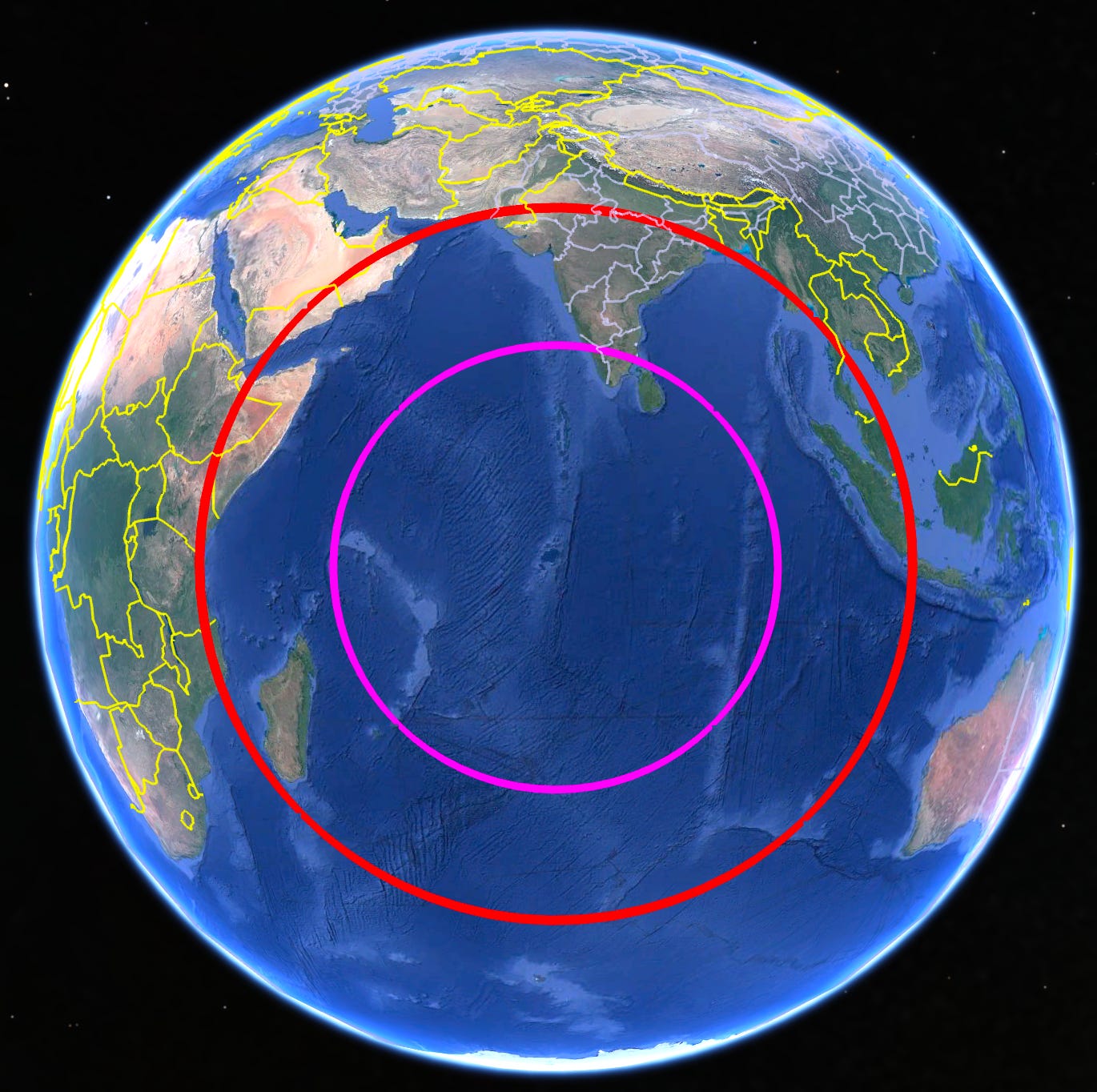
In the middle of that map is Diego Garcia, British Indian Ocean Territory and home to one of the most strategic airfields and anchorages on the planet. […] The red circle is 2,000 nautical miles from the island. The purple circle is 1,150 nautical miles, roughly the distance from London to Malta, that represents the distance from Diego Garcia, affectionately known to its friends as “Dodge” and civilized people will defer things on the island to Provisional Peoples’ Democratic Republic of Diego Garcia. That circle is also the distance from Diego Garcia to the island of Mauritius.
Caption and image from CDR Salamander.
I arrived home late last Monday night, having spent the second half of the day in the House of Lords attending the Report stage of the bill to ratify the treaty whereby the UK surrenders to Mauritius sovereignty over the Chagos Islands — including the military base on Diego Garcia — in return for a ninety-nine-year lease.
For readers who missed — or have forgotten — my post on this topic on August 6th, let me rehearse my view. Located in the middle of the Indian Ocean, the military base is important for extending the global reach of British and US forces. At first glance, exchanging sovereignty for a lease looks like a very poor deal, making possession of the strategic base less secure at a time of growing international tensions.
So why has Keir Starmer’s government signed up to a treaty that does just that?
The treaty presents itself upfront as correcting the injustice done when 1,700 Chagossians were forced to leave their homes on Diego Garcia between 1967 and 1973, to make way for the military base. In the preamble, the two governments “recognis[e] the wrongs of the past” and declare themselves “committed to supporting the welfare of all Chagossians”. Yet the process that produced the treaty does not bear this out. The Chagossians themselves were barely consulted, probably because it is known that many strongly resist subjection to Mauritian rule.
Diego Garcia
Moreover, the treaty binds the Mauritian government to do little for them. Oddly, Article 6 declares that Mauritius is “free” to implement a programme of resettlement. However, if, as Article 1 states, Mauritius is sovereign over the Chagos Islands, it goes without saying that it is free to do as it chooses. It does not need stating. So, the effect of stating it is to highlight the fact that Mauritius has refused any obligation to resettle the islanders.
Article 11 commits the UK to provide capital of £40 million to create a trust fund for the islanders, but it leaves the Mauritian government entirely at liberty to choose how to use it. Yet, when it received £650,000 (equivalent to £7.7 million today) from the UK to compensate displaced islanders in 1972, it withheld the money for six years in punitive retaliation for Chagossian protests. And, again, nine years after it was given £40 million in 2016, to improve Chagossian welfare, it has only disbursed £1.3 million under restrictive conditions.
The treaty’s main concern lies elsewhere. As the preamble also says, it is “mindful of the need to complete the process of the decolonisation” of Mauritius. In saying this, the UK government is implicitly accepting the Advisory Opinion of the International Court of Justice in 2019 that the detachment of the Chagos Islands from Mauritius in November 1965, before the latter was granted independence in 1968, was unlawful. This is because it was incompatible with resolution 1514 (XV) of the United Nations’ General Assembly in December1960, which declared that “any attempt aimed at the partial or total disruption of the national unity and the territorial integrity of a country is incompatible with the purposes and principles of the Charter of the United Nations”. Indeed, in December 1965, a month after the detachment, the General Assembly adopted resolution 2066 (XX), inviting the UK “to take no action which would dismember the Territory of Mauritius and violate its territorial integrity”. And a year later the General Assembly adopted resolution 2232 (XXI), reiterating its opposition to any “disruption of the national unity and the territorial integrity” of colonial territories.
None of these resolutions makes good sense. The original, 1960 one was championed by the Irish ambassador to the UN, Frederick Boland, who was then President of the General Assembly. In promoting resolution 1514 (XV), he invoked Ireland’s loss of its “historic integrity” as a prime example of the injustice to be avoided. In so doing, he expressed the Irish nationalist’s typical historical blindness. The island of Ireland had never been a political unit apart from its union with Great Britain, and there is no natural law prescribing that a geographical integrity should be a political integrity. On the contrary, there can be very good reasons for dividing it. The reason that Ireland was divided in 1922 was because republican Irish people wanted home rule so much that they were prepared to take up arms to acquire it, while unionist Irish people detested it so much that they were prepared to take up arms to oppose it. Ireland was partitioned to prevent further civil war—a justified act of political prudence.
The 1965 and 1966 resolutions are no more sensible. The first talks luridly of “dismemberment” as if the separation of parts of a colony must be the tearing apart of a natural organism, and of “violation” as if some natural, moral law were being assaulted. But there is nothing natural about a political entity and there is no moral law against partition as such.
The 1966 resolution appeals to the “national unity” of Mauritius, as if the Chagos Islands weren’t separated by over a thousand miles of Indian Ocean and as if the islanders were an integral part of the Mauritian people. But many Chagossians feel as Mauritian as Irish republicans feel British. The only connection between Mauritius and the Chagos Islands is an accident of colonial, administrative convenience. Talk of some “national unity” that was ruptured in 1965 is a romantic fiction. Besides, in 1965 the Mauritians agreed to the separation in return for £3 million (worth £74 million today) and the reversion of the islands when no longer needed for defence purposes.
Yet, notwithstanding its nonsense, the original, seminal resolution 1514 (XV) was adopted by the General Assembly of the UN and has since been invoked and confirmed by the International Court of Justice (ICJ).
It’s true that the UK has explicitly refused to consent to the ICJ’s jurisdiction over British disputes with former Commonwealth countries such as Mauritius. However, in its 2019 Advisory Opinion, the court positioned itself formally, not as adjudicating between two sovereign states’ conflicting claims, but as responding to a question from the UN’s General Assembly as to whether the UK had violated international law on the decolonisation of Mauritius in the 1960s. Notwithstanding the fact that that is a crucial point of current contention between the two countries, the ICJ presumed to find in Mauritius’ favour. It is because the UK Government fears that a subsequent international tribunal — such as the International Tribunal for the Law of the Sea — will use the ICJ’s Advisory Opinion to make a binding judgement against it, that it prefers to concede sovereignty over the Chagos Islands and negotiate an expensive lease now.
But there is more to the Government’s motivation than fear. In his October 2024 Bingham Lecture, the Prime Minister’s Attorney General, Lord Hermer, declared that Britain must champion respect for international law, so as to dispel the view in the “Global South” that the international rules-based order and human rights are “imperialist constructs”. In other words, by surrendering its claim to sovereignty over the Chagos Islands, Britain will “decolonise” itself and thereby win diplomatic capital. As the Labour peer, Lord Boateng, opined: “We can welcome this treaty as an end to a period of colonial rule”. This is what lies behind that other statement in the preamble to the treaty: that the parties desire “to build a close and enduring bilateral partnership based on mutual respect and trust”.

Comments Off on The Chagos Islands and the military base on Diego Garcia
The Korean War Week 82: Ridgway’s Nuclear Warning! – January 13, 1952
The Korean War by Indy Neidell
Published Jan 13, 2026Operation Strangle, to destroy enemy logistical capability with air power, has been in progress for months now, and yet the enemy is still able to bring up men and supplies, and even slowly stockpile them for possible future offensives. The UN position now is that should there be an armistice, and should the other side break its terms, retaliation would be broader and would include actions against Communist China, but will the UN have the force to do such retaliation? That is the question.
00:00 Intro
00:44 Recap
01:09 POW Issues
03:30 The Airfields
08:29 UN Declaration
10:15 Operation Strangle
14:13 Summary
14:35 Conclusion
15:25 Call To Action
(more…)
Comments Off on The Korean War Week 82: Ridgway’s Nuclear Warning! – January 13, 1952
January 10, 2026
QotD: The United Nations
Were serious reform of the UN accomplished, it would be turned from an ineffective anti-American and anti-Western organization, into an effective anti-American and anti-Western organization. That is absolutely inevitable from the membership structure, with its voting blocs. So, better a UN that continues in a state of abject dysfunction, than one that can be more efficiently evil.
David Warren, “The nuts, & Bolton”, Ottawa Citizen, 2005-09-17.
Comments Off on QotD: The United Nations
January 7, 2026
The Korean War Week 81: Ridgway Admits the UN is Little Threat! – January 6, 1952
The Korean War by Indy Neidell
Published 6 Jan 2026The year may have changed, familiar faces come and go, but some things remain the same. The POW issue continues to dominate and frustrate armistice talks, the fear of an expanded war in Asia re-emerges, and the snow remains cold. The war found no end and no pause in either 1950 or 1951, but third time’s the charm, surely?
00:00 Intro
00:29 Recap
01:24 Britain and the US
06:49 The US Proposal
10:57 The Slave Trade?
12:12 Summary
13:35 Conclusion
(more…)
Comments Off on The Korean War Week 81: Ridgway Admits the UN is Little Threat! – January 6, 1952
January 5, 2026
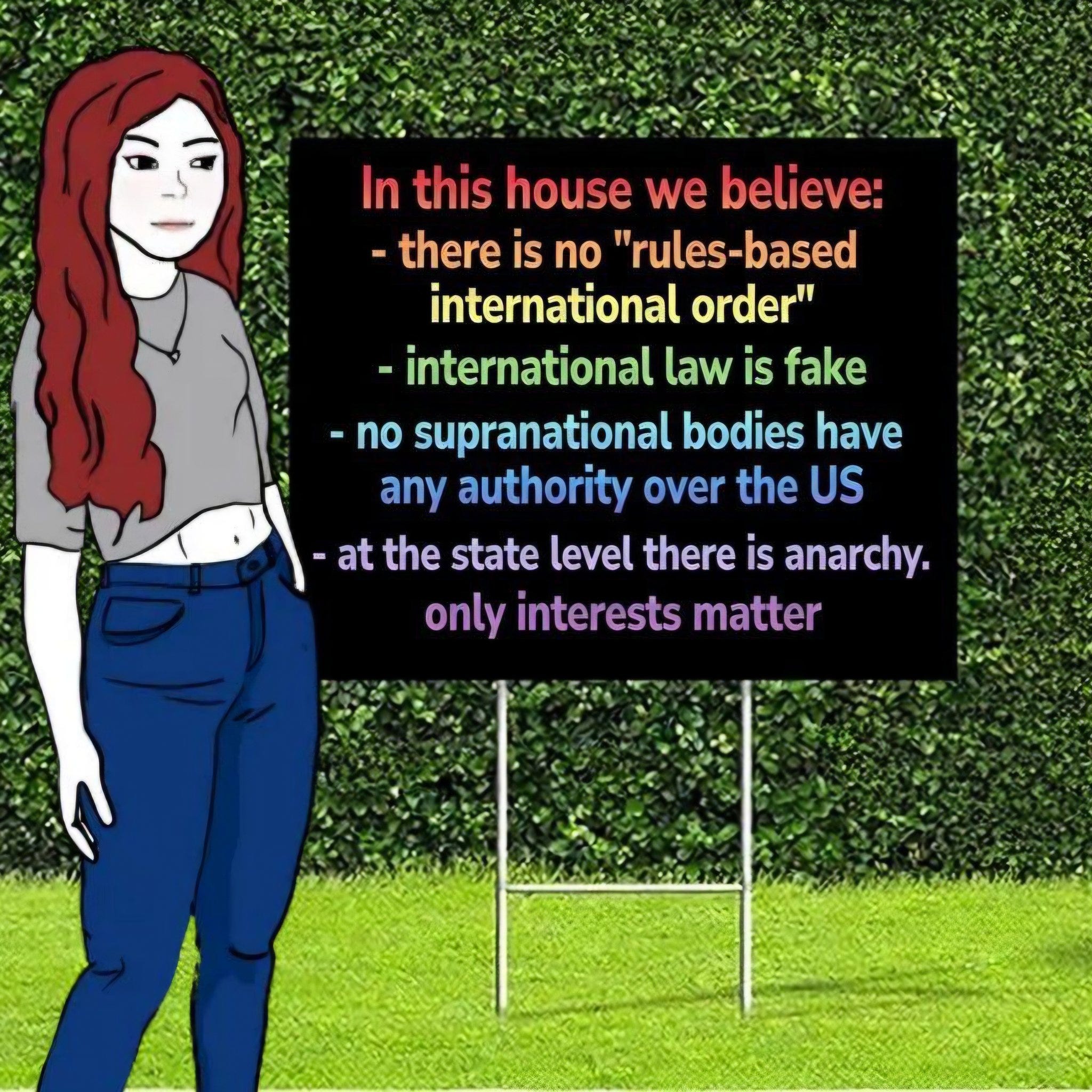
International law is more like International “law”
On the social media site formerly known as Twitter, Konstantin Kisin points out that calling it “International Law” gives it a semi-mythic quality that it absolutely does not deserve:
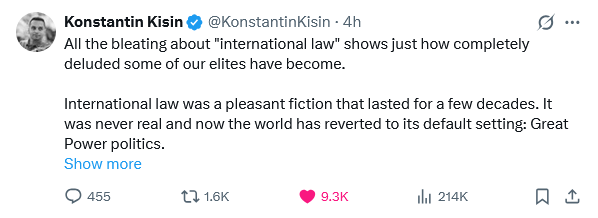
All the bleating about “international law” shows just how completely deluded some of our elites have become.
International law was a pleasant fiction that lasted for a few decades. It was never real and now the world has reverted to its default setting: Great Power politics.
This is why, as a strong Ukraine supporter, I have never talked about international law or called Putin’s attack an “illegal invasion”.
Laws are based on submission to an overarching authority backed by force. There is no such international authority and even if you view the UN as one, it does not have the ability to use force against those who violate “international law” other than against small countries with weak militaries.
When the US attacked Iraq, the UN did nothing.
When Russia invaded Ukraine, the UN did nothing.
If China invades Taiwan tomorrow, the UN will do nothing.If you cannot enforce a law, it’s not a law.
I do not support Ukraine because naughty Vlad broke the rules. I support Ukraine because it’s not in OUR interest in the West to have Russia marauding its way through friendly countries on the borders of Europe. It’s in our interest for us to be as strong as possible and for our adversaries to be as weak as possible.
President Trump is a realist and a pragmatist. He sees through the fictions other “leaders” cling to.
A good leader advances the national interests of his country. If more Western leaders did this, our civilisation would be in a much better place.
I commented on another post that,
For a lot of people (Canadian Liberals and American Democrats in particular), the invocation “international law” has a mesmerizing effect on their ability to reason [insert usual disclaimer that if they could foresee the results of their enlightened beliefs, they wouldn’t be progressives]. They seem to have a quasi-religious belief in the UN as if it were some kind of God-given supergovernment that is always right and must always be obeyed. “World opinion” might as well be the hand of God to them, so any time the legacy media can portray the US (and Trump in particular) as going against “world opinion” they want to get out the sackcloth and ashes … or sack a city and turn it into ashes, whichever comes first.
vittorio analyzes the default position of most progressives on the social media site formerly known as Twitter:
most political issues nowadays can be explained by understanding that american leftists dont have positions, they have oppositions.
their entire belief system is defined by negation of whatever the right supports. this is why portland chants “free maduro” while actual venezuelans celebrate in the streets. they’re not pro-venezuelan or pro democracies, or pro tyrant, or pro maduro, they’re simply anti-american-right.
they’ve outsourced their worldview to institutional narratives for so long that genuine self-reflection would require questioning everything. for them it’s much easier to just oppose. the beliefs arent coherent because they were never meant to be coherent. they only need to signal tribal membership, and leftist membership is gained by opposing the right.
trump does X? the left screams and cries because they wanted Y
trump does Y? the left screams and cries and riots because even if they said they wanted Y, what they meant is that X was the way to go
trump cures cancer? they’ll argue that the cancer cells are alive have a right of free determination
trump saves lives? they’ll protest because somehow those lives didn’t matter and should have been ended
no coherent word model. no logic. pure opposition
at some point you just have to stop engaging with it as if it’s a real political position. it’s not. it’s aesthetic opposition wearing the costume of ideology
As Severian at Founding Questions often remarks, progressives’ core belief is The Great Inversion: “whatever is, is wrong”.
Bingo Bobbins makes the case that “International law is fake and gay”:
Was this operation necessary? Was Maduro really a “narcoterrorist”? I admit that I haven’t really been following all the drama with Venezuela recently, but my intuition is that Maduro was probably accepting bribes to look the other way with regards to drug trafficking, rather than being directly involved. And sure, he was a socialist dictator but there’s plenty of those around. The US doesn’t go and topple dictators unless there is a perceived US interest in doing so.
What Maduro was actually doing was cozying up to China. In fact, he had just finished a meeting with some Chinese ambassadors hours before Delta Force snatched him up by the scruff. This was actually a warning to China not to mess around in our hemisphere. The Trump administration is re-establishing the Monroe Doctrine, or, as he recently called in a press conference, “The Donroe Doctrine“. As far as I can see, this is completely in keeping with my preferred Vitalist Foreign Policy.
You can agree or disagree with this show of force, but please don’t whine to me about “International Law”. International Law is fake and gay. I certainly don’t care that the Trump administration “targeted a political leader”. This is the complaint being leveled by many leftists in regard to the operation. Really, this is just because leftists are anti-American third-worldists, and they are filled with butthurt because “their guy” lost. But, let’s examine this “rule” of not being allowed to target a countries rulers, because it’s particularly ridiculous.
If you have a problem with a specific country, who do you really have a problem with? You have a problem with that country’s leaders, since they are the ones making the decisions. Why wouldn’t you target the leaders? The only reason is that all the leaders from all the countries got together and agreed that they wouldn’t target each other. They would rather resolve their differences by throwing cannon fodder at each other, while keeping themselves off the table. And sure, I understand why that is great for them, but not why it would be great for me (or you).
Of course, the CIA has been ignoring this “international law” for decades, but they’ve been doing it in a very effeminate way, skulking about the world, funding Color Revolutions and clandestinely arming insurgent groups in order to subvert existing regimes. The Donroe Doctrine is much better. Imagine if the Trump administration had tried to handle Maduro the way the Obama administration tried to handle Assad. Fund a decades long civil war, accidentally establish a caliphate, fight a war against said caliphate, facilitate the deaths of tens of thousands of Christians, all to have an even worse dictator eventually rise to power.
Update, 6 January: Welcome, Instapundit readers! Please do have a look around at some of my other posts you may find of interest. I send out a daily summary of posts here through my Substack – https://substack.com/@nicholasrusson that you can subscribe to if you’d like to be informed of new posts in the future.


