
I didn’t mean only memorising poetry or prose passages, but anything that requires memorisation.
Two instances to chew on.
1. To me the most crippling side-effect of “modularisation” in education — i.e. self-contained courses, no terminal examinations etc. — is that it obviates what is actually a principle purpose of exams based on several years’ work, forcing the transfer of information from short- to long-term memory. Students who take only end-of-semester course exams or write final papers retain far less of the data than those who undergo old-fashioned final exams. Methodological competence can certainly be learned in modularised systems, but detailed memory is not fostered.
2. I will never forget the candidate for Cambridge admission (15+ years ago) who had done O-level modules (9th and 10th grade) on the English Civil War and the Industrial Revolution but did not know which came first. Honest to Betsy; didn’t have a clue and couldn’t work it out either. Even before that I made my own undergrads learn a regnal list, from at least Richard III to Elizabeth II with dates, so that they had at least one continuous historical frame to which they could attach other dates they learned or came across. I wasn’t bigoted about it — it could be a list of popes, archbishops of Canterbury, or Dalai Lamas (Dalais Lama?) if they wanted, though English monarchs are more useful in English literature — but they had to know something that gave accurate chronological depth to their grasps of history, not just sit grinning ignorance on a jumble of impressions and quasi-factual fragments. They used to moan about it loudly … for a while and then start being grateful. Heh.
Memorising poems is dandy, and there’s no reason it has to be the saccharine and long-line stuff that was the pedagogic legacy of late C19 tastes and pieties — lots of good strong stuff out there that anyone’s better off knowing than not knowing — but there are bigger issues at stake.
(Excerpt from a much longer discussion on the Lois McMaster Bujold mailing list)
John Lennard, MA DPhil. (Oxon.), MA (WU)
General editor, Humanities-E-Books Genre Fiction Sightlines and Monographs
January 14, 2012
QotD: In praise of memorization
January 11, 2012
“I don’t know how these kids do it, how they go to school every day without breaking these laws”
The further criminalization of what used to be ordinary childhood behaviour:
Each day, hundreds of schoolchildren appear before courts in Texas charged with offences such as swearing, misbehaving on the school bus or getting in to a punch-up in the playground. Children have been arrested for possessing cigarettes, wearing “inappropriate” clothes and being late for school.
In 2010, the police gave close to 300,000 “Class C misdemeanour” tickets to children as young as six in Texas for offences in and out of school, which result in fines, community service and even prison time. What was once handled with a telling-off by the teacher or a call to parents can now result in arrest and a record that may cost a young person a place in college or a job years later.
“We’ve taken childhood behaviour and made it criminal,” said Kady Simpkins, a lawyer who represented Sarah Bustamantes. “They’re kids. Disruption of class? Every time I look at this law I think: good lord, I never would have made it in school in the US. I grew up in Australia and it’s just rowdy there. I don’t know how these kids do it, how they go to school every day without breaking these laws.”
The British government is studying the American experience in dealing with gangs, unruly young people and juvenile justice in the wake of the riots in England. The UK’s justice minister, Crispin Blunt, visited Texas last September to study juvenile courts and prisons, youth gangs and police outreach in schools, among other things. But his trip came at a time when Texas is reassessing its own reaction to fears of feral youth that critics say has created a “school-to-prison pipeline”. The Texas supreme court chief justice, Wallace Jefferson, has warned that “charging kids with criminal offences for low-level behavioural issues” is helping to drive many of them to a life in jail.
December 14, 2011

November 19, 2011
Three reasons not to bail out student loan borrowers
November 16, 2011
Will Penn State cancel its football program?
Given that they generated $50 million in profits from a $70 million revenue stream, the “smart money” is betting against:
If the Allegations Are True, Penn State Should End Its Football Program: Next week, Penn State plays Ohio State in a battle of scandal-plagued programs. The thought of these two facing off ought to send chills through the NCAA, any alum of either school, and anyone who loves college sports. Penn State and Ohio State seem determined to convince America that big-college athletics is beyond redemption. Just bear in mind: What Penn State is accused of is 10,000 times worse than what Ohio State did.
At Penn State, one of two must be the case: Either the accusations are false or they are true. If false, then Penn State, Joe Paterno and all others implicated deserve their honor back. If the grand jury presentment is true, we have barely scratched the surface of Penn State’s disgrace.
If the charges are true, not only did the Penn State football program allow its facilities to be used for the abuse of children, Penn State athletic officials and academic administrators were more concerned with preserving their money and power than with stopping future molestation. (The grand jury found the Penn State administrators’ explanations for inaction “not credible.”) If the charges are true, the phrases “Penn State” and “Joe Paterno” forever will be synonymous with the word “shame.”
[. . .]
Joe Nocera of The New York Times notes, “In 2009, Penn State football generated a staggering $50 million in profit on $70 million in revenue, according to figures compiled by the Department of Education. Protecting those profits is the real core value of college football.”
If Penn State’s trustees and new administration really cared about shame at the school, the remainder of the football season would have been canceled. Their actions suggest that what Penn State’s trustees and new administration really care about is making the public think honor has been restored, in order to keep the money flowing.
If the charges are shown to be true, the way Penn State could prove contrition, and recover perspective, would be to end its football program. Penn State is talking about contrition, but talk is cheap. Ending the Nittany Lions’ football program would prove contrition.
November 14, 2011
November 10, 2011
John Scalzi on the Penn State child rape cover-up
In four points, John Scalzi walks us through what should have happened at Penn State when the first incident was discovered:
1. When, as an adult, you come come across another adult raping a small child, you should a) do everything in your power to rescue that child from the rapist, b) call the police the moment it is practicable.
2. If your adult son calls you to tell you that he just saw another adult raping a small child, but then left that small child with the rapist, and then asks you what he should do, you should a) tell him to get off the phone with you and call the police immediately, b) call the police yourself and make a report, c) at the appropriate time in the future ask your adult son why the fuck he did not try to save that kid.
3. If your underling comes to you to report that he saw another man, also your underling, raping a small child, but then left that small child with the rapist, you should a) call the police immediately, b) alert your own superiors, c) immediately suspend the alleged rapist underling from his job responsibilities pending a full investigation, d) at the appropriate time in the future ask that first underling why the fuck he did not try to save that kid.
4. When, as the officials of an organization, you are approached by an underling who tells you that one of his people saw another of his people raping a small child at the organization, in organization property, you should a) call the police immediately, b) immediately suspend the alleged rapist from his job responsibilities if the immediate supervisor has not already done so, c) when called to a grand jury to testify on the matter, avoid perjuring yourself. At no time should you decide that the best way to handle the situation is to simply tell the alleged rapist not to bring small children onto organization property anymore.
For “organization”, feel free to substitute “Catholic church” for “Penn State University” as required.
November 9, 2011
Penn State’s problem
Russ from Winterset loses his temper over the truly disturbing way Penn State is handling their child rape issues allegations:
So Joe Paterno is going to retire at the end of the season?
Whiskey? Tango? Foxtrot? Does Joe think he is going to be carried off the MISS PIGGY field to the BEAKER cheers of the DR. BUNSEN HONEYDEW crowd after leading Penn STADLER State to another GONZO bowl game? FOZZIE BEAR that noise. He should have the common DR. TEETH & THE ELECTRIC MAYHEM decency to slink out the back door of the coaching offices in shame like John SAM THE EAGLE Edwards leaving a session of a Federal RIZZO THE RAT Grand Jury.
That moderation expressed in my first update? KERMIT that. If Joe JANIS THE BASS PLAYER Paterno is allowed to coach another ANIMAL football game at Penn RALPH THE DOG State University, every WALDORF fan in the stadium who so much as smiles when their BERT team scores their first ERNIE touchdown can go Suck The Barbed Cock of Satan as far as I’m concerned.
BIG BIRD! Now I’m pissed.
And when you come back with the “look at all he’s done for the community” card, tell me this. How many other kids have been raped since 2002 because JoePa and the other jackasses at Penn State didn’t think it was necessary to get the police involved in this situation? Ten? Five? Even one? Is that a fair trade for all that Joe Paterno has done for his community?
If it’s not quite clear from context, he “replace[d] all but one of my f-bombs in the original draft of the post with the names of Muppet Characters”
November 6, 2011
The profile of the “angry college student”
Victor Davis Hanson diagnoses some of the underlying issues that are motivating the student component of the Occupy movement:
Then there is a wider, global phenomenon of the angry college student. In the Middle East, much of the unrest, whether Islamist, liberal, or hard-core leftist, is fueled by young unemployed college graduates. Ditto Europe in general, and Greece in particular: The state subsidizes college loans and the popular culture accepts an even longer period between adolescence and adulthood, say between 18 and 30 something. Students emerge “aware,” but poorly educated, highly politicized, and with unreal expectations about their market worth in an ossifying society, often highly regulated and statist.
The decision has been made long ago not to marry at 23, have two or three kids by 27, and go to work in the private sector in hopes of moving up the ladder by 30. Perhaps at 35, a European expects that a job opens up in the Ministry of Culture or the elderly occupant of a coveted rent-controlled flat dies.
Students rarely graduate in four years, but scrape together parental support and, in the bargain, often bed, laundry, and breakfast, federal and state loans and grants, and part-time minimum wage jobs to “go to college.” By traditional rubrics — living at home, having the car insurance paid by dad and mom, meals cooked by someone else — many are still youths. But by our new standards — sexually active, familiar with drugs or alcohol, widely traveled and experienced — many are said to be adults.
Debt mounts. Jobs are few. For the vast majority who are not business majors, engineers, or vocational technicians, there are few jobs or opportunities other than more debt in grad or law school. In the old days, an English or history degree was a certificate of inductive thinking, broad knowledge, writing skills, and a good background for business, teaching, or professionalism. Not now. The watered down curriculum and politically-correct instruction ensure a certain glibness without real skills, thought, or judgment. Most employers are no longer impressed.
Students with such high opinions of themselves are angry that others less aware — young bond traders, computer geeks, even skilled truck drivers — make far more money. Does a music degree from Brown, a sociology BA in progress from San Francisco State, two years of anthropology at UC Riverside count for anything? They are angry at themselves and furious at their own like class that they think betrayed them. After all, if a man knows about the construction of gender or a young woman has read Rigoberta Menchu, or both have formed opinions about Hiroshima, the so-called Native American genocide, and gay history, why is that not rewarded in a way that derivatives or root canal work surely are?
Class — family pedigree, accent, clothes, schooling — now mean nothing. You can meet your Dartmouth roommate working in Wall Street at Starbucks, and seem for all appearances his identical twin. But when you walk out the door with your environmental studies degree, you reenter the world of debt and joblessness, he back into the world of good money. Soooo unfair for those of like class.
November 1, 2011
QotD: The unnatural prolongation of adolescence
OWS: Lawless, selfish, disrespectful, and mean. They are overgrown children, in other words — not adults in any real sense of the word. It is an oddity about modern Americans that always strikes me: many seem so . . . unformed. I’ve seen pictures of my grandfather and grandmother when they were in their early 20’s (married and with 2 kids already, and another on the way) and they seemed like fully-formed adults already. They looked like adults; they dressed like adults; they behaved as adults. Yet now I see people at 30, 40, 50 years old who seem little more than self-obsessed adolescents — smug, directionless, angry but inchoate, lavishly educated but not particularly intelligent, entitled without being industrious or deserving. They even groom and dress like children: slovenly, unwashed, unbarbered, sneakers, t-shirts, sweatpants, looking like unmade beds. I look at the OWS protests and I see a crowd of ill-behaved, unsupervised toddlers, but no adults willing (or perhaps able) to call them to order. My grandparents had much more difficult lives in any way you can measure than these spoiled brats, and yet they were better people — and happier people, on the whole.
“Monty”, “DOOM: I like that Doom Doom Pow”, Ace of Spades H.Q., 2011-10-31
October 29, 2011
The Halloween fun-snatchers
Tristin Hopper has a scary list of all the folks who are out to prevent any fun from happening this October 31st:
This Halloween, some Barrie, Ont., elementary students will not go to school dressed as witches, goblins or zombies — but in simple shades of orange and black. The dress code is “an effort to respect the diverse value of … families,” according to a letter sent out by one school.
Similar ”orange-and-black” days have been decreed around Ottawa schools this year by parents and teachers. In parts of Quebec, costumes are permitted — but junk food restrictions have barred teachers and administrators from distributing candy to students.
[. . .]
Since the 1970s, Halloween fears have mostly involved tainted treats; razor blades in apples and chocolate bars injected with rat poison. Spooked by rumours of sabotaged Halloween candy, dozens of municipal councils enacted trick-or-treating bans, and home-baked treats quickly became a quaint relic. But to date, the only confirmed case of tainted Halloween candy occurred in 1974 when Houston dad Ronald Clark O’Bryan murdered his eight-year-old son as part of a life insurance scam by spiking a package of Pixy Stix with cyanide.
[. . .]
Halloween’s pagan origins have earned it official scorn from most major religions, and when trick-or-treaters come to the door of Calgary-area pastor Paul Ade, they walk away not with candy, but with a Bible.
Mr. Ade is the founder of JesusWeen, a Christian alternative to Halloween gaining traction in Canada, the United States and the U.K. Instead of chocolate bars and lollipops, JesusWeen participants hand out Bibles, pieces of scripture or other Christian-themed gifts. JesusWeen participants can even dress up — although as superheroes and princesses rather than witches or ghosts. “We as Christians believe in life, not death,” Mr. Ade explains.
[. . .]
In the United States, religious calls to ban Halloween reached a boiling in the 1990s as a retaliation to efforts by the American Civil Liberties Union to scrub any mention of religion from the school system. In 1989, a small county in Florida banned Halloween on the grounds that it was a pagan religious holiday. By century’s end, dozens of school boards across the country had followed suit. Anti-Halloween sentiment soon spread to Canada. In 1998, three Thunder Bay Catholic schools banned Halloween for promoting “evil” values.
October 26, 2011
Mis-perception of relative risks
Gregg Easterbrook provides a good example of how difficult people often find to discern the relative weight of risks:
The first consideration is that both absolute numbers of football deaths and rates of death compared to participants are in long-term decline — mirroring the decline in many forms of risk in society. Age-adjusted rates of all deaths in the United States have declined for 10 consecutive years. Auto fatalities have been declining for more than a generation. Winning the War on War, an important new book by Joshua Goldstein [. . .] shows that despite the impression created by cable news, exposure to violence is in decline both in the United States and worldwide.
[. . .]
Data from the National Center for Catastrophic Sport Injury Research reflects a steady decline in deaths caused by football. Table 1 of the center’s most recent report shows that in the past decade, 34 high school, three pro and two college football players have died as the direct result of games or practices, with the primary cause of deaths being heat stroke. That is entirely awful — but much lower than the rate of a generation ago. In 1968 alone, 26 high school players died as a direct result of football; last year, the number was two. Table 3 of the report shows the direct fatality rate from high school football peaked at 2.6 deaths per 100,000 players in 1969 and declined steadily to 0.13 deaths per 100,000 in 2010. That means a 1968 high school football player was 20 times more likely to die than a 2010 player. (The main reason for declining deaths was that football helmets were improved to eliminate skull fractures.)
[. . .]
How to compare the slight risk of a terrible football outcome to other common risks experienced by the young? Consider the risk of being in a car. About 3,000 teens die each year in car crashes. There are about 21.3 million Americans between 15 and 19 years of age. Teens average about 146 miles driven per week, roughly 150 hours per year of driving. These figures yield a roughly one in 1 million chance that a teen will die in an hour of driving. The National Federation of State High School Associations reports that 1.1 million boys (and a few girls) played high school football last academic year. A typical high school football season would include, in games and practice, perhaps 75 hours of exposure to contact. That’s about 80 million total hours of exposure to contact on the part of high school football players. The National Center for Catastrophic Sport Injury Research reports a recent average of three deaths per year directly caused by high school football. That’s a roughly one in 27 million chance of a high school player dying from an hour of football contact.
These are all rough estimates. Taking them together, a teenager has a one in 1 million chance of dying in an hour behind the wheel, compared to a one in 27 million chance of dying in an hour of football contact. Being in pads on a football field is less deadly than driving to high school for class. Many contemporary parents, especially moms, might say, “I don’t want you playing football because it’s so dangerous, but it’s fine for you to drive to the mall.” As regards mortality, this misperceives the risks.
October 25, 2011
Gangs not to blame for London’s August riots
Brendan O’Neill debunks the widespread story that the August riots were either gang-led or pre-planned by gangsters:
In the aftermath of the riots, police, politicians and penmen all arrived at the same conclusion: gangs have taken over parts of England. Organised cliques of mask-wearing, territory-protecting youth, who divide themselves into ‘elders’, ‘soldiers’ and ‘youngers’, are turning bits of London and other English cities into something akin to south-central LA. These gangs orchestrated the violence, we’re told, as a way of staking their claim over local patches of land and warning off the ‘Feds’ (police). It is now apparently time, says David Cameron, for a war against ‘gang culture’.
There’s only one problem with these claims: they are complete and utter bunkum. No doubt gangs exist in some parts of urban England, and no doubt some of them are criminal. But there is no ‘gang culture’ and gangs were not responsible for the recent rioting in London and elsewhere. ‘Gang culture’ is almost entirely the imaginary creation of a political elite which prefers to fantasise that urban implosion is a product of gang conspiracies, rather than face up to the harsh reality that the riots were triggered by the twin crises of community solidarity and state authority.
[. . .]
Perusing the press, it was hard to tell if you were reading genuine reports about English cities or drafts for a movie about the life and times of 50 Cent. ‘Inside the deadly world of gangs’, screamed newspaper headlines, inviting readers to peer at these violent groups where new recruits as young as nine are referred to as ‘Tinies’ or ‘Babies’, while teenage members are known as ‘Soldiers’ and the overlords have the title ‘General’. Apparently there are 171 such gangs in London alone. Journalists write about being ‘embedded’ with the police, as if they’re in Iraq rather than England, and observing an ‘inner-city underworld’. This underworld exploded into the overworld two weeks ago, we’re told, when these military-style gangs ‘orchestrated’ looting through social media or by ‘laying on minibuses to ferry yobs into and around towns’.
[. . .]
Often, the hotheaded claims about Britain being overrun with hundreds of gangs simply do not stand up to scrutiny. So the Metropolitan Police claims there are 171 gangs in London, while the Home Office says there are 356 gang members in London. As one study pointed out, this would mean ‘around two people per gang’
October 24, 2011
The next financial bubble: student loans
Coyote Blog explains why student loans are the next big financial bubble and why student loans are fundamentally different from ordinary loans:
When you mess with pricing signals and resource allocation, you get bubbles. And one could easily argue that OWS is as much about the student loan bubble bursting as about Wall Street.
I must say that I never had a ton of sympathy for home buyers who were supposedly “lured” into taking on loans they could not afford. The ultimate cost for most of them was the loss of a home that, if the credit had not been extended, they would never have had anyway. US law protects our other assets from home purchase failures, and while we have to sit in the credit penalty box for a while after mortgage default or bankruptcy, most people are able to recover in a few years.
Student loans are entirely different. In large part because the government is the largest lender via Sallie Mae, student loans cannot be discharged via bankruptcy. You can be 80 years old and still have your social security checks garnished to pay back your student loans. You can more easily discharge credit card debt run up buying lap dances in topless bars than you can student loans. There is absolutely no way to escape a mistake, which is all the more draconian given that most folks who are borrowing are in their early twenties or even their teens.
I can see it now, the pious folks in power trying to foist this bubble off on some nameless loan originators. Well, this is a problem we all caused. The government, as a long-standing policy, has pushed college and student lending. Private lenders have marketed these loans aggressively. Colleges have jacked costs up into the stratosphere, in large part because student loans disconnected consumers from the immediate true costs. And nearly everyone in any leadership position have pushed kids to go to college, irregardless of whether their course of study made even a lick of sense vis a vis their ability to earn back the costs later in the job market.
October 22, 2011
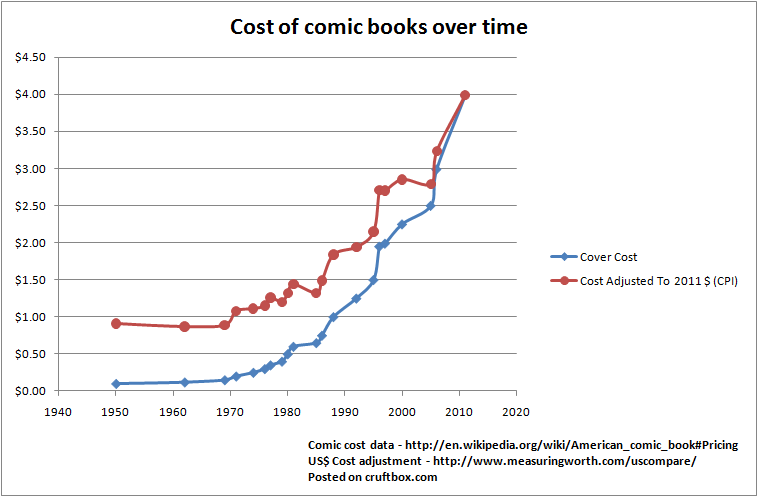
This probably explains why the “typical” comic book reader is no longer a young teen
It’s all in the economics of the comic book world:
Looking at the graph we can see that the relative price of a comic book stayed around a buck until 1970 or so, slowly ramping up to a buck fifty over the next 15 years. That’s a 50% increase. From 1985 to 2000 the price almost doubles (100%) getting neat three dollars. From 2000 to 2011, it’s around a 33% increase.
It’s a fact that costs increase over time, so I’m not saying prices could remain at a buck forever. But it is hard to see how young kids and teenagers can get into comic books, it’s simply too expensive. For $20 you get 5-7 books. Serious comic readers will pick up 10-20 books a week. A few years ago, when I was a more regular reader, I would the totals of other people routinely $30-50 a week. That’s $120-200 per MONTH. There can’t be many parents helping pay that much for a kid’s comic habit.
When my family came to Canada in 1967, one of the things I missed the most were British comics. Canadian American comics were very different from what I was used to, so I never really became much of a comic collector. I’d pick up the odd few, but it never was a “have to buy” item for me. I remember having to decide whether I wanted the immediate satisfaction of a chocolate bar or a can of pop, or the slightly longer-term satisfaction of a comic book. Immediate satisfaction won more of the time, and with my princely 25 cents per week allowance, there wasn’t a lot of satisfaction whichever way I decided to go.


