
Any particular protectionist policy sits somewhere on a spectrum. At one end of the spectrum is a scheme of protectionism in which government officials have great discretion in doling out the privilege of tariffs. Some producers get protected; others don’t. Here, the few rob the many.
At the other end of the spectrum, government officials have no discretion in doling out the privilege of tariffs because all industries are equally protected, to the same degree, by tariffs from import competition. Here, everyone robs everyone.
Pick any point along this spectrum, and you’ll find – in practice – some people robbing others but not themselves being robbed; other people robbing others while they themselves also are robbed; and yet other people who do no robbing but who are robbed.
What you’ll not find anywhere along this spectrum is a point at which no robbery occurs, for protectionism is in essence a scheme of organized theft.
Protectionists, as has often been observed, have the ethics of thugs. Regardless of their legerdemain or their excuses – or even their felt intent – they are all apologists for plunderers.
Don Boudreaux, “Bonus Quotation of the Day…”, Café Hayek, 2019-03-17.
September 15, 2022
QotD: Protectionism
March 28, 2021
TARIFFS and TAXES: The REAL Cause of the CIVIL WAR?!
Atun-Shei Films
Published 16 Jan 2020Checkmate, Lincolnites! Debunking the Lost Cause myth that the American Civil War was fought over taxes and protectionist tariffs. Was the South subjected to disproportionate taxation? Did the Morrill Tariff cause secession? Watch and find out, you no-account, yellow-bellied sesech!
Support Atun-Shei Films on Patreon ► https://www.patreon.com/atunsheifilms
Leave a Tip via Paypal ► https://www.paypal.me/atunsheifilms (All donations made here will go toward the production of The Sudbury Devil, our historical feature film)
Buy Merch ► teespring.com/stores/atun-shei-films
#CheckmateLincolnites #CivilWar #AmericanHistory
Reddit ► https://www.reddit.com/r/atunsheifilms
Twitter ► https://twitter.com/atun_shei
November 5, 2020
QotD: The idiocy of tariffs
The true sadness here being that the spiral works the other way too. But hugely, vastly, more slowly. GATT was founded in 1947, it became, the process was transferred to, the WTO and it has taken them since then, that two generations, to reduce tariff levels to where they’re not really all that important in trade matters. Something that is being undone in just a couple of months of foolishness. GATT being something of a response to the economic demolition work done by Smoot Hawley of course.
Trade protection does spiral up and spiral down, the sadness being that here’s an asymmetry to the process. The reductions that make us richer take very much longer than the nonsenses that impoverish.
Tim Worstall, “The China, US, Trade War – It’s All Mutual On The Way Down As Well As Up”, Continental Telegraph, 2018-07-11.
June 14, 2020
QotD: The seen gains and unseen losses of high tariffs
It’s easy to rejoice when a wall, literal or figurative, enriches you. And it’s even easier when the destruction wrought elsewhere by that wall is invisible. When a tariff wall causes people in Louisiana and Oregon to pay higher prices for steel made in Pittsburgh, no one can know how they would otherwise have used the extra funds they now pay to Pennsylvania steel producers. But those funds must be diverted from somewhere.
Yet because those somewheres are many, no one domestic industry suffers any great loss from higher steel tariffs. The destruction wrought by tariff walls is dispersed and, hence, invisible. But the sum of the losses is greater than the gain to domestic steel producers.
Americans on the whole are made poorer.
Don Boudreaux, “Mr. Trump, don’t build those walls!”, Pittsburgh Tribune-Review, 2016-11-22.
April 20, 2020
The four distinct phases of the Great Depression in the United States
An older post from Lawrence W. Reed at the Foundation for Economic Education outlines the low points of the Great Depression and debunks a few widely held myths about that cataclysmic economic era:
Phase 1, the Federal Reserve and the end of the Roaring 20’s:
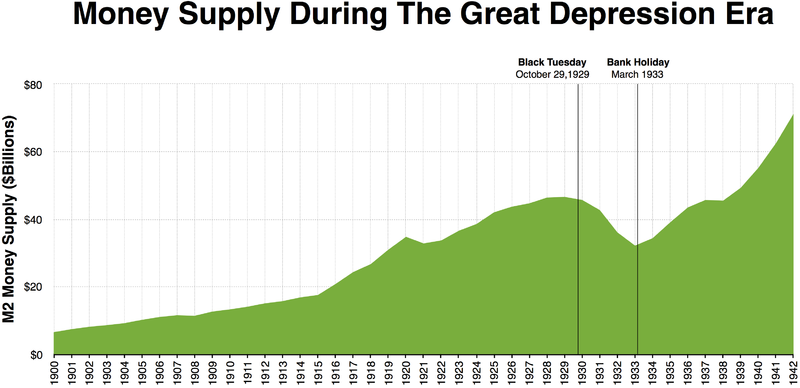
One of the most thorough and meticulously documented accounts of the Fed’s inflationary actions prior to 1929 is America’s Great Depression by the late Murray Rothbard. Using a broad measure that includes currency, demand and time deposits, and other ingredients, Rothbard estimated that the Federal Reserve expanded the money supply by more than 60 percent from mid-1921 to mid-1929. The flood of easy money drove interest rates down, pushed the stock market to dizzy heights, and gave birth to the “Roaring Twenties.”
By early 1929, the Federal Reserve was taking the punch away from the party. It choked off the money supply, raised interest rates, and for the next three years presided over a money supply that shrank by 30 percent. This deflation following the inflation wrenched the economy from tremendous boom to colossal bust.
The “smart” money — the Bernard Baruchs and the Joseph Kennedys who watched things like money supply — saw that the party was coming to an end before most other Americans did. Baruch actually began selling stocks and buying bonds and gold as early as 1928; Kennedy did likewise, commenting, “only a fool holds out for the top dollar.”
Phase 2, Hoover’s interventions and the disaster of Smoot-Hawley:
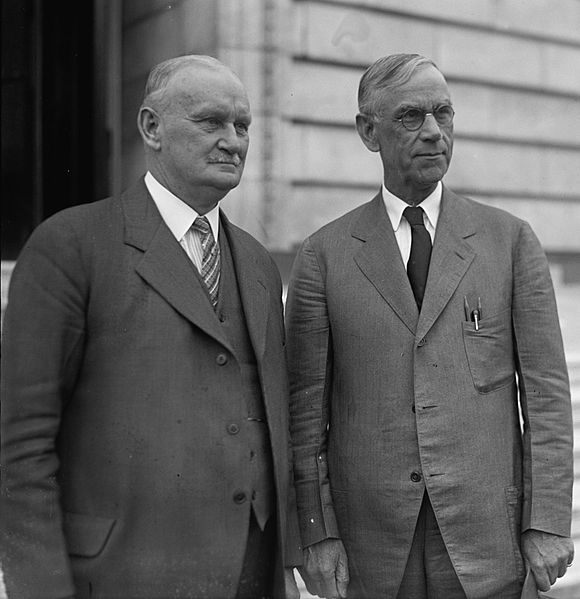
Willis C. Hawley (left) and Reed Smoot in April 1929, shortly before the Smoot–Hawley Tariff Act passed the House of Representatives.
Library of Congress photo via Wikimedia Commons.
Unemployment in 1930 averaged a mildly recessionary 8.9 percent, up from 3.2 percent in 1929. It shot up rapidly until peaking out at more than 25 percent in 1933. Until March 1933, these were the years of President Herbert Hoover — the man that anti-capitalists depict as a champion of noninterventionist, laissez-faire economics.
Did Hoover really subscribe to a “hands off the economy,” free-market philosophy? His opponent in the 1932 election, Franklin Roosevelt, didn’t think so. During the campaign, Roosevelt blasted Hoover for spending and taxing too much, boosting the national debt, choking off trade, and putting millions of people on the dole. He accused the president of “reckless and extravagant” spending, of thinking “that we ought to center control of everything in Washington as rapidly as possible,” and of presiding over “the greatest spending administration in peacetime in all of history.” Roosevelt’s running mate, John Nance Garner, charged that Hoover was “leading the country down the path of socialism.” Contrary to the modern myth about Hoover, Roosevelt and Garner were absolutely right.
The crowning folly of the Hoover administration was the Smoot-Hawley Tariff, passed in June 1930. It came on top of the Fordney-McCumber Tariff of 1922, which had already put American agriculture in a tailspin during the preceding decade. The most protectionist legislation in U.S. history, Smoot-Hawley virtually closed the borders to foreign goods and ignited a vicious international trade war. Professor Barry Poulson notes that not only were 887 tariffs sharply increased, but the act broadened the list of dutiable commodities to 3,218 items as well.
Officials in the administration and in Congress believed that raising trade barriers would force Americans to buy more goods made at home, which would solve the nagging unemployment problem. They ignored an important principle of international commerce: trade is ultimately a two-way street; if foreigners cannot sell their goods here, then they cannot earn the dollars they need to buy here.
Phase 3, FDR and the New Deal:
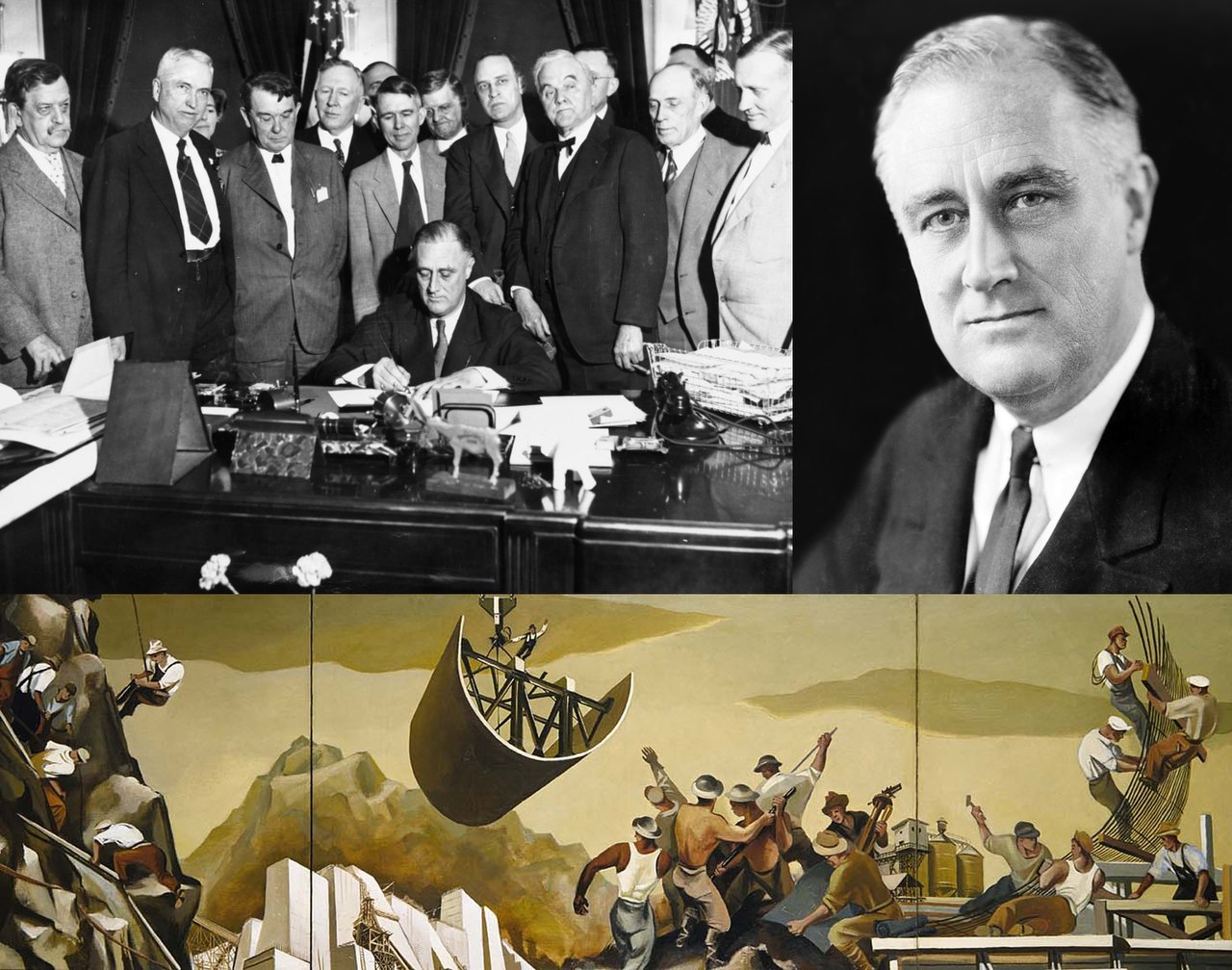
Top left: The Tennessee Valley Authority, part of the New Deal, being signed into law in 1933.
Top right: FDR (President Franklin Delano Roosevelt) was responsible for the New Deal.
Bottom: A public mural from one of the artists employed by the New Deal’s WPA program.
Wikimedia Commons.
Franklin Delano Roosevelt won the 1932 presidential election in a landslide, collecting 472 electoral votes to just 59 for the incumbent Herbert Hoover. The platform of the Democratic Party whose ticket Roosevelt headed declared, “We believe that a party platform is a covenant with the people to be faithfully kept by the party entrusted with power.” It called for a 25 percent reduction in federal spending, a balanced federal budget, a sound gold currency “to be preserved at all hazards,” the removal of government from areas that belonged more appropriately to private enterprise, and an end to the “extravagance” of Hoover’s farm programs. This is what candidate Roosevelt promised, but it bears no resemblance to what President Roosevelt actually delivered.
In the first year of the New Deal, Roosevelt proposed spending $10 billion while revenues were only $3 billion. Between 1933 and 1936, government expenditures rose by more than 83 percent. Federal debt skyrocketed by 73 percent.
[…] in 1935 the Works Progress Administration came along. It is known today as the very government program that gave rise to the new term, “boondoggle,” because it “produced” a lot more than the 77,000 bridges and 116,000 buildings to which its advocates loved to point as evidence of its efficacy. The stupefying roster of wasteful spending generated by these jobs programs represented a diversion of valuable resources to politically motivated and economically counterproductive purposes.
The American economy was soon relieved of the burden of some of the New Deal’s excesses when the Supreme Court outlawed the NRA in 1935 and the AAA in 1936, earning Roosevelt’s eternal wrath and derision. Recognizing much of what Roosevelt did as unconstitutional, the “nine old men” of the Court also threw out other, more minor acts and programs which hindered recovery.
Phase 4, the Wagner Act:
The stage was set for the 1937–38 collapse with the passage of the National Labor Relations Act in 1935 — better known as the Wagner Act and organized labor’s “Magna Carta.” […] Armed with these sweeping new powers, labor unions went on a militant organizing frenzy. Threats, boycotts, strikes, seizures of plants, and widespread violence pushed productivity down sharply and unemployment up dramatically. Membership in the nation’s labor unions soared; by 1941 there were two and a half times as many Americans in unions as in 1935.
[…]
Higgs draws a close connection between the level of private investment and the course of the American economy in the 1930s. The relentless assaults of the Roosevelt administration — in both word and deed — against business, property, and free enterprise guaranteed that the capital needed to jumpstart the economy was either taxed away or forced into hiding. When Roosevelt took America to war in 1941, he eased up on his antibusiness agenda, but a great deal of the nation’s capital was diverted into the war effort instead of into plant expansion or consumer goods. Not until both Roosevelt and the war were gone did investors feel confident enough to “set in motion the postwar investment boom that powered the economy’s return to sustained prosperity.”
March 6, 2020
QotD: Mercantilism
Don Boudreaux, “Quotation of the Day…”, Café Hayek, 2017-12-17.
November 15, 2019
QotD: Understanding trade policy
Now let Jones secure Jackson’s approval for his actions. Jackson expresses his approval not only of Jones obstructing your freedom to buy across-town tomatoes, Jackson also approves of Jones taking some of your money directly to help Jones pay for the employment, arming, and dressing up in fancy costumes of a street gang who will do the actual dirty work of caging or killing you if you refuse to abide by the tomato-buying terms that Jones imposes on you.
When you object to the injustice of Jones’s actions, he reminds you that you had a vote in this matter. But being outvoted 2 to 1, this majority outcome, by some mystical process, transforms Jones’s pure and simple thuggery into perfectly acceptable – even noble – “trade policy” the violation of which would make you the anti-social criminal.
Further, Jones, to his delight, discovers that Jackson has been hard at work on a treatise that details the many dangers of allowing you to buy your tomatoes without obstruction from across town. Jackson’s treatise even has empirical data on the number of tomatoes and labor hours that would no longer be grown and and worked on your Elm St. block if you are left free to buy your tomatoes unobstructed. Combined with criticisms of “simple-minded” defenses of free trade and with explanations that tomatoes grown across town are sold at unfairly low prices, Jackson’s treatise rids Jones of the few qualms that Jones’s threats of violence against you caused him to suffer from time to time
Thus is “trade policy.”
Don Boudreaux, “Quotation of the Day…”, Café Hayek, 2017-10-23.
October 18, 2019
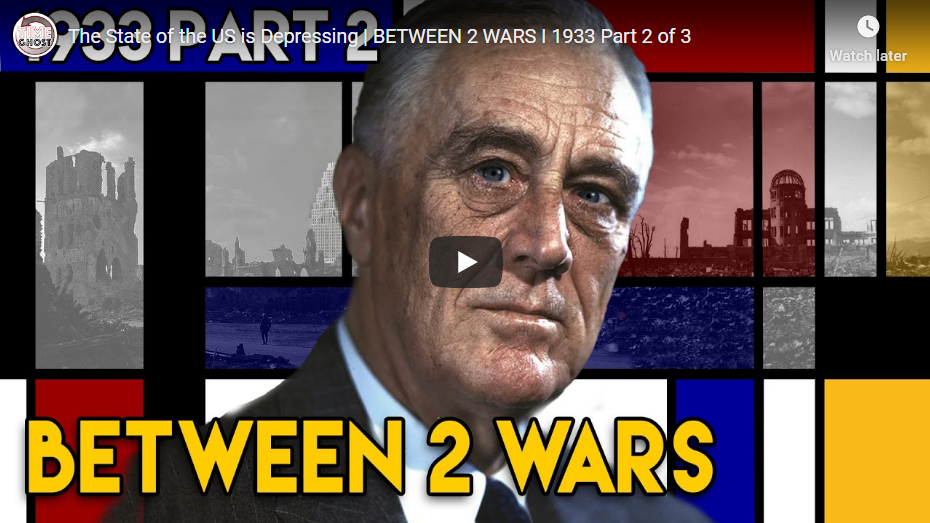
The State of the US is Depressing | BETWEEN 2 WARS I 1933 Part 2 of 3
TimeGhost History
Published 17 Oct 2019The American economy is in a state of despair. Mass unemployment and poverty sweep the lands. In 1933, a new President is elected, promising to change things for the better. His name is Franklin D. Roosevelt.
Join us on Patreon: https://www.patreon.com/TimeGhostHistory
Subscribe to our World War Two series: https://www.youtube.com/c/worldwartwo…
Hosted by: Indy Neidell
Written by: Francis van Berkel and Spartacus Olsson
Directed by: Spartacus Olsson and Astrid Deinhard
Executive Producers: Bodo Rittenauer, Astrid Deinhard, Indy Neidell, Spartacus Olsson
Creative Producer: Joram Appel
Post-Production Director: Wieke Kapteijns
Research by: Francis van Berkel
Edited by: Wieke Kapteijns
Sound design: Marek KaminskiColorized pictures by Norman Steward, Daniel Weiss and Joram Appel.
Sources:
A TimeGhost chronological documentary produced by OnLion Entertainment GmbH.
From the comments:
TimeGhost History
12 minutes ago (edited)
If you’re new here, you might not be familiar with Indy Neidell and his other work. Not only are we doing “Between Two Wars”, on the events and years leading up to World War Two (of which this video is a part), also we’re covering World War Two in realtime week-by-week, exactly 79 years after it all happened. We have now entered the second year of the war. If you haven’t already, check out the World War Two Channel for what maybe one day will become the most complete account of The Second World War: https://www.youtube.com/c/worldwartwoCheers,
Joram
October 6, 2019
Finally a reason to climb on the impeachment bandwagon
Andrew Heaton, in his latest newsletter, explains why he’s finally come down on the side of impeaching President Trump:
Okay, here’s the main thing I wanted to talk to you about: America is about to slap a TWENTY-FIVE PERCENT tariff on scotch. The underlying story involves the WTO and Airbus, but I think I can save everybody a lot of time by pointing out that our president is a mouthbreathing protectionist who’s too lazy to read Adam Smith’s wikipedia page.
Here are a few things to consider:
- Tariffs are just taxes, designed to punish you for having the gall to buy something from a foreigner.
- This will hurt Scottish distillers, and potentially price out distillers with low profit margins.
- I might have to switch to wine on dates.
- We have now spent more money needlessly bailing out farmers from a trade war with China than we did bailing out banks under Bush.
- We’ve known about the idiocy of tariffs since The Wealth of Nations came out in 1776.
- Trump, a man lacking an ideological core, for reasons which boggle the mind, seems to genuinely believe tariffs and protectionism are good things, as he has maintained since the 80s.
Chances are if you subscribe to this newsletter you’re not a teetotaler, but on the off chance you are, allow me to make a case against whisky taxes even if you are not personally apoplectic about a tax hike on Laphroaig. (A concoction personally invented by Almighty God. It’s like you’re drinking a campfire. Try it.)
There’s an old saying: when goods don’t cross borders, armies do. I concur with this. In fact my largest contribution to the field of economics (Nobel Prize forthcoming) is Heaton’s Peace Through International Mistresses Theory.My groundbreaking idea is that we want to have an interconnected, global economy with lots of transnational trade, because businessmen will be less supportive of bombing cities their mistresses live in. When trade wars happen, international trade collapses, and suddenly businessmen are flying to Berlin and Paris a lot less. Pretty soon we’re firebombing Tokyo.
It would probably be more appropriate of me to dedicate my political analysis to the forthcoming Ukraine/Trump/Biden/Impeachment circus which will dominate our lives for the next few months. However in my case I don’t need to. The president has messed with my scotch. Now it’s personal. I’m all in.
Impeach the guy.
#FreeTrade

You can subscribe to Andrew’s email newsletter here.
September 29, 2019
QotD: Crony capitalists and corrupt politicians love tariffs
Many who agree with me here will nevertheless scold me for using, à la Bastiat, the provocative word “plunderers.” But I stick to my choice of words.
“Plunderers” is descriptive, for plunder is in fact what trade restrictions are all about. For two and a half centuries now we proponents of free trade have played mostly on the rhetorical turf of protectionists. On this turf there are language biases galore, such as “trade deficit,” a lowering of home-country tariffs described as “concessions” to foreign countries, the arrival in the home country of especially low-priced imports condemned as “dumping,” and, indeed, the word “protection” itself. Also, don’t forget the constant, clanking parade of inapposite military and sports metaphors.
For two and a half centuries now we proponents of free trade have typically treated the efforts of rent-seekers and rent-dispensers to portray their use of the state to enrich themselves at the expense of others with intellectual and moral respect. Why?
No one attempts to intellectually rationalize the theft and violence committed by street gangs. No one attempts to rationalize shoplifting, vandalism, armed robbery, arson, or rape. (It would, do note, be child’s play for a competent economics graduate student to develop a coherent theory of “optimal gang violence” that shows that, under just the right set of circumstances, there is an “optimal” amount of gang violence that improves the national welfare.) We call these destructive exercises of theft, coercion, and violence “theft,” “coercion,” and “violence.” We call these predatory activities what they really are.
By calling protectionism what it really is – the plunder of the many by the politically powerful few – we more vividly and widely expose protectionism’s ugly and cruel reality.
Don Boudreaux, “Quotation of the Day…”, Café Hayek, 2019-08-04.
August 18, 2019
QotD: “Hitting back” at protectionist policies
But soon a trade dispute erupts. Stump discovers – correctly, we can assume – that XYZ is charging you less for its lawn-care services than Stump agreed is acceptable for you to be charged and that XYZ agreed in the trade deal to charge. Stump, being a master negotiator, threatens to reimpose the $25 tariff on you unless and until XYZ raises the price it charges you to at least the level that Stump has divined is acceptable and that is enshrined in the terms of the trade agreement between him and XYZ. Alas, XYZ gives in and agrees to raise the price it charges you. Stump then boasts that, by not letting XYZ get away with breaking its word in the trade deal, he is not only protecting the neighborhood from dangerously low prices but is also upholding the sacred rule of law and the sanctity of contractual agreements.
Of course, in reality, Stump’s presumptuous exercise of the power to
rob youimpose a tariff on you whenever you engage in commerce that he finds objectionable is a wrong inflicted on you and on your trading partner, XYZ. The fact that the practicalities of the situation result in your and XYZ going along with the “deal” to entice Stump to stop robbing you each time you buy XYZ’s services does not ethically oblige you to stick to the terms of the deal if you can, in secret, get better terms from XYZ. When Stump threatens to reimpose on you the $25 tariff, he harms you. That is, when in response to Stump’s threat to reimpose the tariff XYZ agrees to abide by the terms of its trade agreement with Stump and raise the price that it charges you, you are made worse off, not better off.Stump’s enforcement of this agreement, in short, does not protect you from further victimization in the future; instead, that enforcement is itself an act of victimizing you. Successful enforcement of this agreement assures you a future less prosperous than it would be were Stump instead to ignore XYZ’s “violation” of the deal.
Note: we can all agree that, between the two options (1) $25 tariff and (2) no tariff but an enforced price-hike, under the trade agreement, of $15, that the second option is better for you than the first option. It is in this limited sense that trade agreements in reality are beneficial. But there’s a third option: (3) Stump does not interfere with your commerce and you pay whatever price you negotiate with XYZ without that price being artificially affected by Stump’s interference. This third option is, for you, the best of the three – and it’s the only fully ethical one of the bunch. (So when Dan Griswold, myself, and other free-traders defend trade agreements, we do so with the realistic recognition that option (3) is politically infeasible. Given this unfortunate infeasibility of option (3), we endorse option (2) over option (1).)
Don Boudreaux, “Strict Enforcement of an Impoverishing Deal Assures Continuing Impoverishment”, Café Hayek, 2017-07-07.
July 9, 2019
QotD: Tariffs
Over and above the general point that we don’t want to limit trade nor imports there’s another worry with tariffs and trade wars. Which is what the International Monetary Fund is complaining about. The imposition of more tariffs is a disruption to that global economy. One that is going to reduce growth, the very thing we all desire.
Tim Worstall, “IMF Says The U.S. And China Trade Tariffs Are A Major Risk To World Growth”, Seeking Alpha, 2019-06-07.
June 12, 2019
The fantastic notion that Donald Trump is “at heart really a free trader”
Guest-posting at Catallaxy Files, Don Boudreaux explodes the farcical notion that President Trump is using protectionist tools with an eventual free trade goal:
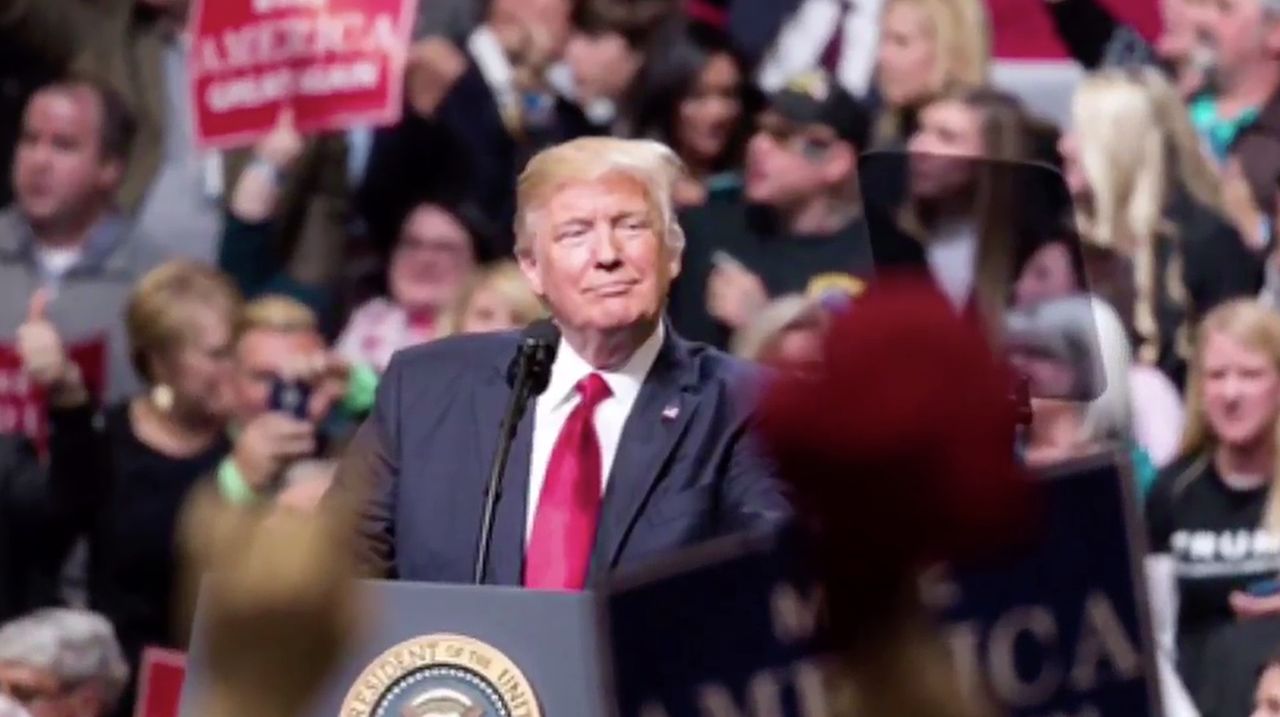
Donald Trump addresses a rally in Nashville, TN in March 2017.
Photo released by the Office of the President of the United States via Wikimedia Commons.
In the case of Donald Trump, the claim that he is at heart really a free trader who raises tariffs today with the aim of bringing about lower tariffs tomorrow — and all because he is committed to achieving free traders’ ideal goal of maximum possible expansion of the international division of labor — is especially preposterous.
Trump has pontificated on trade for decades, and every word out of his mouth clearly reveals a man who knows nothing about the economics of trade and who is as clichéd an economic nationalist as can be imagined.
Behold this line from a 1990 interview he did in Playboy: “The Japanese double-screw the US, a real trick: First they take all our money with their consumer goods, then they put it back in buying all of Manhattan. So either way, we lose.”
Let’s examine this unalloyed gem of economic witlessness.
Overlooking Trump’s outrageous exaggerations, such as his claim that the Japanese buy up “all” of Manhattan, we start by stating an obvious truth: the voluntary purchase of a good is not a transaction in which the buyer is “screwed” or has his or her money “taken.” Instead, the buyer’s money is voluntarily spent. While every person of good sense sees a foreign seller who makes attractive offers to domestic buyers as someone who improves the well-being of each buyer who accepts the offer, Trump sees this seller as a con artist or thief.
And so Trump ignores the value to Americans of the imports we purchase. In typical mercantilist fashion, he believes that the ultimate purpose of trade is to send out as many exports as possible in exchange for as much money as possible — money that in Trump’s ideal world is never spent on imports. His view on this matter is even more bizarre than that of ordinary mercantilists. For Trump, imports are not merely costs that we endure in order to export, they are actual losses. (Although it goes without saying, I’ll say it nevertheless: Trump does not understand that imports are benefits and that exports are costs.)
Furthermore, by describing the money spent on imports as “our money,” Trump reveals his belief that money earned by each American does not belong to that individual but, instead, to the collective.
Also in the fashion of the typical mercantilist, the presumption is that the nation is akin to a gigantic household whose members all share in and collectively own its money. And just as Dad justly superintends little Emma’s and Bobby’s spending to ensure that they don’t dissipate the family’s wealth, Uncle Sam must superintend his subjects’ spending in order to ensure that we don’t dissipate the nation’s wealth.
One other flaw in the above quotation from Trump’s Playboy interview is notable: he believes that foreign investments in America inflict losses on us. He doesn’t pause to consider that when we Americans sell assets to foreigners we regain ownership of some of the dollars that Trump, in his previous sentence, lamented are lost to Americans when we bought imports.
Nor does he ask what the American sellers of these assets do with the sales proceeds. Perhaps we invest some or even all of them. And if so, perhaps these new American investments will prove to be more profitable than are the investments made in America by foreigners. (By the way, contrary to another mercantilist myth, Americans are not made better off when foreigners’ investments in America fail. Quite the contrary.)
An even deeper error infects Trump’s “understanding” of foreign investment: he implicitly — and, once again, like all mercantilists — assumes that the amount of capital in the world is fixed. Only then would it be true that each American sale of assets to foreigners necessarily reduces Americans’ net financial worth (which is presumably what Trump means when he says that “we lose” when the Japanese purchase Manhattan real estate).
April 14, 2019
British diplomatic blunders in history – German unification
An interesting article in Vox, suggesting that the gradual unification of all the German principalities, electorates, duchies, counties, bishoprics, free cities, and miscellaneous other semi-independent bits and bobs of the Holy Roman Empire was not inevitable and that — absent British blundering after the Napoleonic wars — it would have produced a very different 20th century:
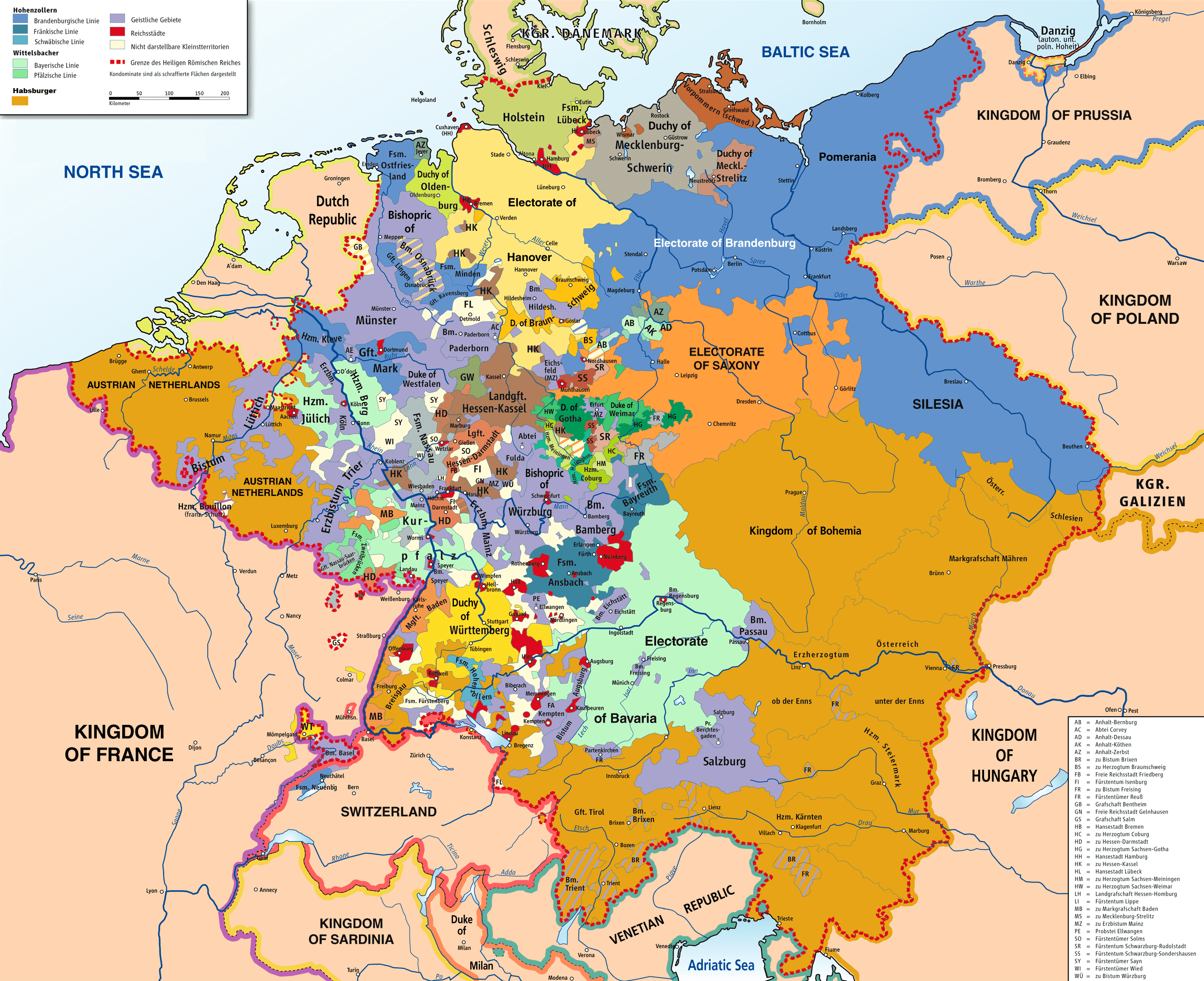
The Holy Roman Empire in 1789, before Napoleon “rationalized” hundreds of smaller entities into the Confederation of the Rhine.
Image from Wikimedia Commons.
The boundaries of states are the heart of many recent debates, be it the European refugee crisis, the Transatlantic Trade and Investment Partnership (TTIP), or Brexit (Snower and Langhammer 2019). After decades of stability, today we are again seeing heated discussions about the shape and extent of political borders. Clearly, borders are neither naturally given nor random. In Europe and elsewhere, the current state borders have been formed and changed over centuries, sometimes peacefully, often in bloody wars. In Huning and Wolf (2019), we look at the formation of the German nation state led by Prussia and trace it back to a change in borders decided at the Congress of Vienna in 1814/15.
In a nutshell, we have two findings:
- First, the geographic position of a state can be a crucial factor for institutional change and development.
- Second, the formation of the German Zollverein in 1834 under Prussian leadership was a truly European story, involving Britain, the Russian Empire, and the Belgian revolution of 1830/31. We show in particular that the Zollverein formed as an unintended consequence of Britain’s intervention in 1814/15 to push back Russian influence over Europe.
In theory, why would the geographic position of a state relative to that of other states matter? Intuitively, it should matter as long as the costs of trade and factor flows depend on their routes. If a large share of my trade has to pass the territory of one or several neighbours, my trade and trade policy will depend on the trade policy of my neighbours. Moreover, if tariffs are levied not only on imports but also on transit trade, as was general practice until the Barcelona Statute of 1921 (Uprety 2006), policymakers face the problem of multiple marginalisation, which is well known from the literature on supply chains. In our work, we provide a simple theoretical framework (in partial equilibrium) to show how the location of a revenue maximising state planner will affect its ability to set tariffs. Some states can increase their tariff revenue at the expense of their hinterland. Next, we show that a customs union can be beneficial for a group of states exactly because it solves the problem of multiple marginalisation.
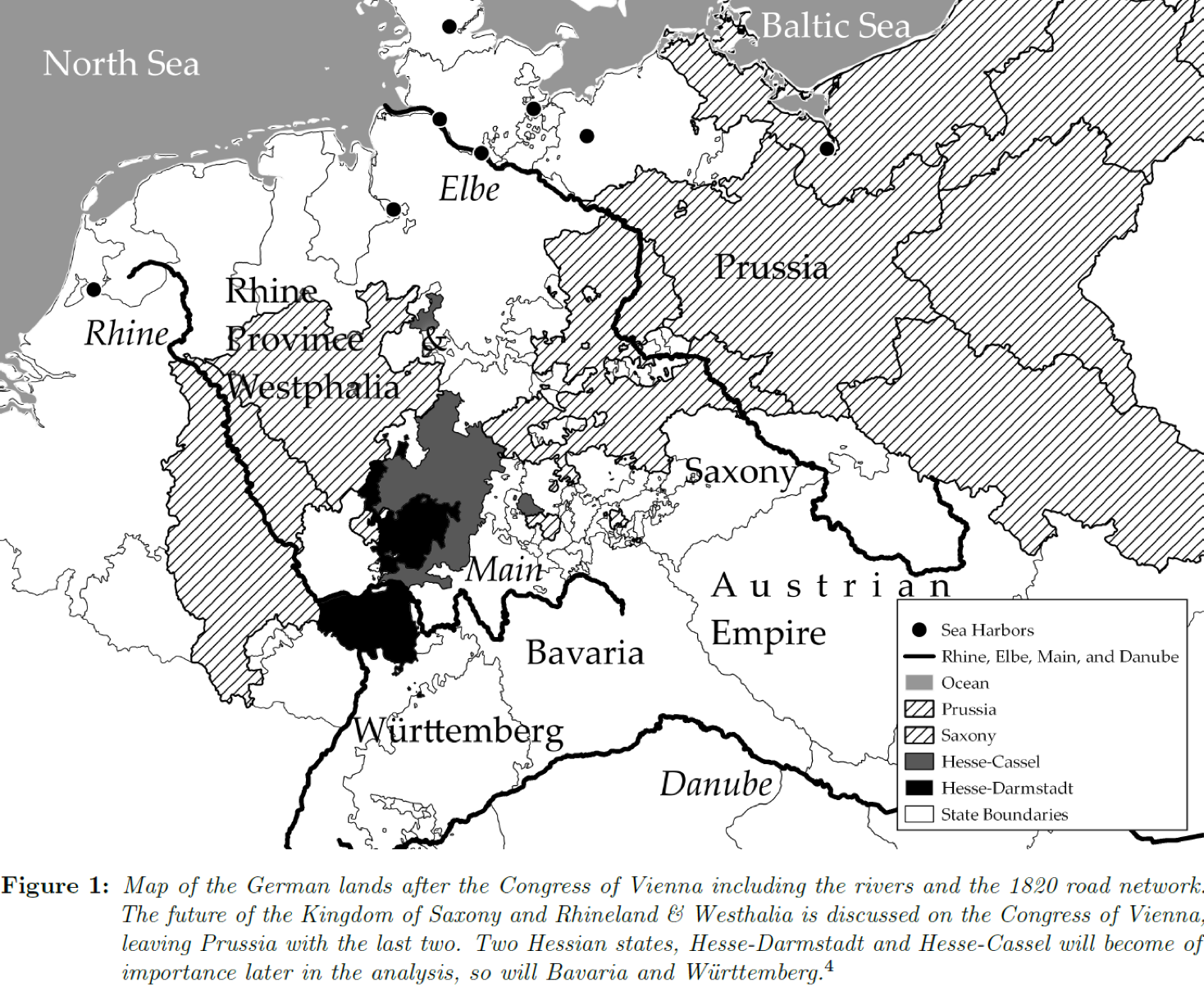
A major challenge to testing our idea empirically is that a state’s political boundaries (and hence its location) do not change very often, and if they do, the change is unlikely to be unrelated to trade or factor flows. However, the formation of the German Zollverein in 1834 can be considered as a quasi-experiment. Let us briefly revisit this historical episode. At the end of the Napoleonic wars of 1792-1814/15, only Russia and the UK were left as major military powers. Habsburg, Prussia, and the defeated France attempted to consolidate their positions at the expense of the many smaller states that had just about survived the wars, notably the former allies of Napoleon such as Saxony and Poland. Overall, the negotiations at the Congress of Vienna in 1814 were dominated by military-strategic considerations between the two great powers. Russia wanted to expand westwards, Prussia was desperate to annex the populous Kingdom of Saxony, which bordered Prussia in the south and would create a large and coherent territory. To this end, Prussia was willing to give up not only her Polish territories to Russia, but also her positions and claims on the Rhineland (Müller 1986). This met stiff resistance from Britain, joined by Habsburg and France, which feared a new Russian hegemony on the continent – the ‘Polish Saxon question’. After weeks of diplomatic struggle, the outcome was a division of Saxony, another division of Poland and Prussia being established as the “warden of the German gate against France” (Clapham 1921: 98). Figure 1 shows the result of these negotiations.
H/T to Continental Telegraph for the link.
March 22, 2019
Understanding the Great Depression
Marginal Revolution University
Published on 23 May 2017In this video, we examine the causes behind the Great Depression with the help of the aggregate demand-aggregate supply model.
In 1929, the stock market crashed and an air of pessimism swept across America — making bank depositors nervous. What would you do if you thought your money might not be safe with the bank? You’d probably want it back in your own hands. What happened next? A run on the banks.
Along with the Stock Market Crash of 1929, it’s one of the iconic moments of the early days of Great Depression. However, the Great Depression was an incredibly complex downturn in which the economy experienced a series of aggregate demand shocks. By the end of this video, you’ll walk away with a better understanding of the many factors behind the Great Depression and how to apply the AD-AS model to a real-world scenario.


