Quotulatiousness

May 1, 2022

Sinking of the General Belgrano – Falklands War Documentary

Filed under: Americas, Britain, History, Military — Tags: , , , , — Nicholas @ 04:00

Historigraph
Published 30 Apr 2022

Go to https://squarespace.com/historigraph to get a free trial and 10% off your first purchase of a website or domain.

Falklands War series:
[1] Invasion of the Falklands https://youtu.be/BUYp3Wqz00A
[2] Recapture of South Georgia https://youtu.be/4mCZBpX4pxs

To help support the creation of more videos, consider supporting on Patreon:
https://www.patreon.com/historigraph

#FalklandsWar #Historigraph #Belgrano

Come join the historigraph discord: https://discord.gg/ygypfs3BEB

Buy Historigraph Posters here! historigraph.creator-spring.com

This video was sponsored by Squarespace.

► Twitch: https://www.twitch.tv/historigraph
► Second Channel: https://www.youtube.com/channel/UCpIj…
► Twitter: https://twitter.com/historigraph
► Instagram: https://www.instagram.com/historigraph

Sources for the Falklands War Series (so far):

Max Hastings & Simon Jenkins, Battle for the Falklands
https://archive.org/details/battlefor…
Martin Middlebrook, Operation Corporate
Martin Middlebrook, Battle for the Malvinas
Mike Norman, The Falklands War There and Back Again: The Story of Naval Party 8901
Kenneth Privratsky, Logistics in the Falklands War
Sandy Woodward, One Hundred Days
Paul Brown, Abandon Ship
Julian Thompson, No Picnic
John Shields, Air Power in the Falklands Conflict
Edward Hampshire, The Falklands Naval Campaign 1982
Hugh McManners, Forgotten Voices of the Falklands
Cedric Delves, Across an Angry Sea: The SAS in the Falklands War
Rowland White, Vulcan 607
Vernon Bogdanor, “The Falklands War 1982” lecture https://www.youtube.com/watch?v=a9bWw…
Arthur Gavshon, The sinking of the Belgrano https://archive.org/details/sinkingof…
Gordon Smith, Battle Atlas of the Falklands War 1982 by Land, Sea and Air
http://www.naval-history.net/NAVAL198…
Hansard- https://api.parliament.uk/historic-ha…
Recording of Thatcher’s statement to the Commons is from https://www.youtube.com/watch?v=HvbhV…

Music Credits:

“Rynos Theme” Kevin MacLeod (incompetech.com)
Licensed under Creative Commons: By Attribution 4.0 License
http://creativecommons.org/licenses/b…

“Crypto” Kevin MacLeod (incompetech.com)
Licensed under Creative Commons: By Attribution 4.0 License
http://creativecommons.org/licenses/b…

“Stay the Course” Kevin MacLeod (incompetech.com)
Licensed under Creative Commons: By Attribution 4.0 License
http://creativecommons.org/licenses/b…

Other music and SFX from Epidemic Sound

April 28, 2022

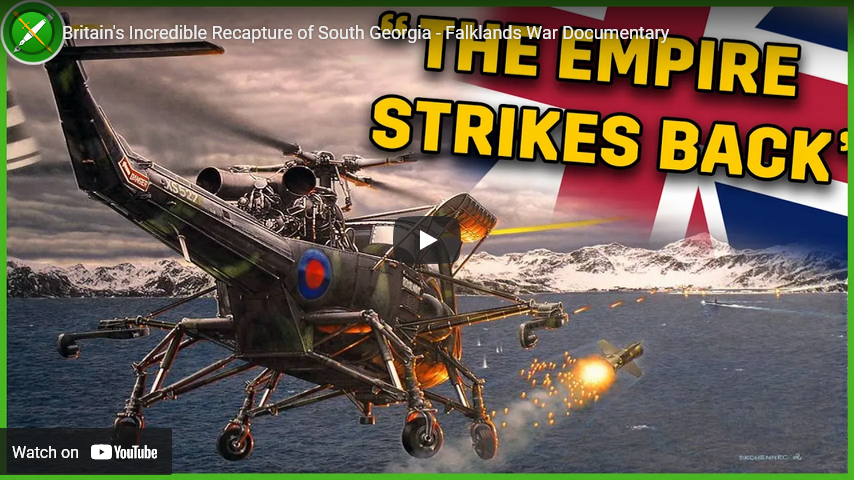
Britain’s Incredible Recapture of South Georgia – Falklands War Documentary

Historigraph
Published 27 Apr 2022

Go to https://squarespace.com/historigraph to get a free trial and 10% off your first purchase of
a website or domain.

In just three weeks after the Argentinian invasion of the Falkland islands, Britain threw together a task force out of thin air, sailed it 8000 miles around the world and started taking its territory back. This is how it happened.

Made with thanks to the Fleet Air Arm Musuem in Yeovilton, Somerset. https://www.fleetairarm.com/

To help support the creation of the rest of the Falklands series, consider supporting on Patreon:
https://www.patreon.com/historigraph

#Falklands40 #Historigraph

Come join the historigraph discord: https://discord.gg/ygypfs3BEB

Buy Historigraph Posters here! historigraph.creator-spring.com

► Twitch: https://www.twitch.tv/historigraph
► Second Channel: https://www.youtube.com/channel/UCpIj…
► Twitter: https://twitter.com/historigraph
► Instagram: https://www.instagram.com/historigraph
Thumbnail credit Daniel Behennec: https://www.naval-history.net/FxDBMis…

Sources for the Falklands War Series (so far):

Max Hastings & Simon Jenkins, Battle for the Falklands
https://archive.org/details/battlefor…
Martin Middlebrook, Operation Corporate
Martin Middlebrook, Battle for the Malvinas
Mike Norman, The Falklands War There and Back Again: The Story of Naval Party 8901
Kenneth Privratsky, Logistics in the Falklands War
Sandy Woodward, One Hundred Days
Paul Brown, Abandon Ship
Julian Thompson, No Picnic
John Shields, Air Power in the Falklands Conflict
Edward Hampshire, The Falklands Naval Campaign 1982
Hugh McManners, Forgotten Voices of the Falklands
Cedric Delves, Across an Angry Sea: The SAS in the Falklands War
Rowland White, Vulcan 607
Vernon Bogdanor, “The Falklands War, 1982” lecture https://www.youtube.com/watch?v=a9bWw…
Arthur Gavshon, “The sinking of the Belgranohttps://archive.org/details/sinkingof…
Gordon Smith, Battle Atlas of the Falklands War 1982 by Land, Sea and Air
http://www.naval-history.net/NAVAL198…
Hansard- https://api.parliament.uk/historic-ha…
Recording of Thatcher’s statement to the Commons is from https://www.youtube.com/watch?v=HvbhV…

Music Credits:

“Rynos Theme” Kevin MacLeod (incompetech.com)
Licensed under Creative Commons: By Attribution 4.0 License
http://creativecommons.org/licenses/b…

“Crypto” Kevin MacLeod (incompetech.com)
Licensed under Creative Commons: By Attribution 4.0 License
http://creativecommons.org/licenses/b…

“Stay the Course” Kevin MacLeod (incompetech.com)
Licensed under Creative Commons: By Attribution 4.0 License
http://creativecommons.org/licenses/b…

Other music and SFX from Epidemic Sound

April 27, 2022

Why It Sucked To Be on a Merchant Ship in World War Two – WW2 Special

Filed under: Britain, History, Military, WW2 — Tags: , , , , — Nicholas @ 04:00

World War Two
Published 26 Apr 2022

Serving on board a merchant ship during the Second World War was a hazardous endeavor. Stalked by submarines, attacked by surface raiders, and hunted by bombers, the convoys and individual cargo ships faced constant danger on their routes across the seas. And that is in addition to the job’s typical hazards. But what was life like for a regular sailor on board these ships? And what motivates a man to sign up for such a dangerous job?
(more…)

April 17, 2022

Operation Mincemeat, 1943

Filed under: Britain, Europe, Germany, Greece, History, Military, WW2 — Tags: , , , , , , , — Nicholas @ 05:00

Once an obscure bit of espionage and military disinformation, the events of Operation Mincemeat are being brought to the big screen (boy, does that term seem dated) in a feature film starring Colin Firth. Michael Curtis provides a look at the actual deception mission that inspired the film:

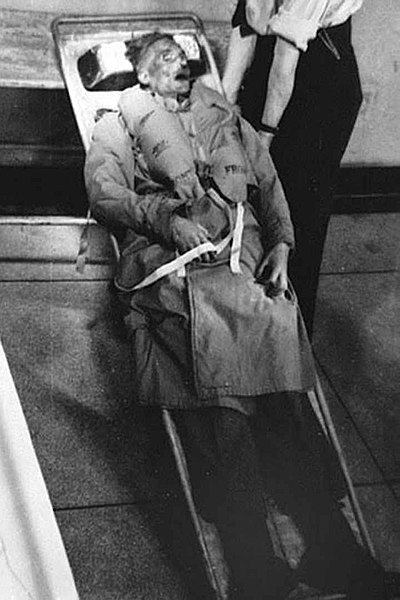
The corpse of Glyndwr Michael, dressed in a Royal Marine uniform with false documents and a fake ID, used in Operation Mincemeat, 1943.
Public domain image from The National Archives.

The story of the British deception, a fascinating story of Allied subterfuge, is now told in the film Operation Mincemeat. It is a remarkable and seemingly highly improbable story of a plan of Allied intelligence to deceive Hitler and misdirect German intelligence. Indeed, it is one of the best examples in history of military deception.

The concept of a plan starts with the Trout Memo, officially written in 1939 by Admiral John Godfrey, director of Naval Intelligence, but almost certainly written by his subordinate Lieutenant Commander Ian Fleming, not yet dreaming of 007, about the deception of an army in war time by fly fishing. Many ideas were suggested, including sending out tins of explosives disguised as food so that hungry sailors would pick them up. One idea, number 28 on the list, almost certainly the thought of Fleming who thought of elaborate deception options, was to use a dead body dressed as an airman dropped from a parachute that had failed and carrying false papers, and drop it where the Germans would find it and be deceived by it.

The deception was planned by a group, the Twenty Committee, XX, headed by Lieutenant Commander RNVR, Ewen Montagu, Cambridge, Harvard, a naval intelligence officer and prominent Jewish lawyer, who later became a judge, together with an RAF officer Squadron Leader Charles Cholmondeley. Montagu later wrote an account of the affair in a book, The Man who Never Was, 1953. The memory of the event is also simply commemorated in a mortuary in Hackney in East London where the body that was used in the plot is buried. In a rather unkind but truthful remark Montagu said of the man who was used, “The only worthwhile thing he ever did, he did after his death.”

The main deception in the plot was a personal letter purported to be from General Sir Archibald Nye to General Sir Harold Alexander, starting, “My dear Alex.” Nye’s letter contained details of sensitive topics, and of a new commander of the Guards brigade, and U.S. service medal awards. He also referred to Operation Husky, an imminent Allied invasion of Greece, that the Germans had been reinforcing and strengthening their defenses in Greece and Crete, and therefore the chief of the Imperial General Staff felt that the Allied troops planned for the assault were insufficient. Thus, it was agreed by the chiefs of staff that the 5th division should be reinforced by one brigade group for the assault on the beach south of Cape Araxos and that similar reinforcement should be made for the 56th division at Kalamata. The letter was a clever double bluff. Nye wrote that “we stand a very good chance of making the Germans think we will go for Sicily, it is an obvious objective and one about which they must be nervous.” To confuse Hitler, he therefore suggested the Allies would invade Sicily.

It is interesting but not surprising that a key figure in the deception appears to have been Ian Fleming, Mr. James Bond, who had written of methods to confuse the enemy, and was crucial to the Trout Memo.

The plot developed. After some difficulty a suitable body was found by a London coroner and kept on ice for few months. It was Glyndwr Michael, 34, homeless Welsh laborer, penniless, with mental health problems, who had died after ingesting rat poison in a London warehouse. He was transformed into Major William Martin, of the Royal Marines whose body contained love letters from a non-existent fiancé named Pam, a jewelry bill for an engagement ring, ticket stubs, religious medal, a copy of a letter marked “personal and most secret”, and above all the false Nye letter. The body had to look as if it had died in an air crash, but floated ashore and he had died at sea. Major Martin, his body wrapped in a life jacket, and with a black attaché case chained to his wrist, was found on April 30, 1943, by a Spanish fisherman off the coast of Huelva.

Even more unlikely than the plan itself was the impact the “secret” document had on Axis planning, summarized in the Wikipedia article:

On 14 May 1943 Grand Admiral Karl Dönitz met Hitler to discuss Dönitz’s recent visit to Italy, his meeting with the Italian leader Benito Mussolini and the progress of the war. The Admiral, referring to the Mincemeat documents as the “Anglo-Saxon order”, recorded

    The Führer does not agree with … [Mussolini] that the most likely invasion point is Sicily. Furthermore, he believes that the discovered Anglo-Saxon order confirms the assumption that the planned attacks will be directed mainly against Sardinia and the Peloponnesus.

Hitler informed Mussolini that Greece, Sardinia and Corsica must be defended “at all costs”, and that German troops would be best placed to do the job. He ordered that the experienced 1st Panzer Division be transferred from France to Salonika, Greece. The order was intercepted by GC&CS on 21 May. By the end of June, German troop strength on Sardinia had been doubled to 10,000, with fighter aircraft also based there as support. German torpedo boats were moved from Sicily to the Greek islands in preparation. Seven German divisions transferred to Greece, raising the number present to eight, and ten were posted to the Balkans, raising the number present to 18.

On 9 July the Allies invaded Sicily in Operation Husky. German signals intercepted by GC&CS showed that even four hours after the invasion of Sicily began, twenty-one aircraft left Sicily to reinforce Sardinia. For a considerable time after the initial invasion, Hitler was still convinced that an attack on the Balkans was imminent, and in late July he sent General Erwin Rommel to Salonika to prepare the defence of the region. By the time the German high command realised the mistake, it was too late to make a difference.

April 13, 2022

Life in a German U-Boat – WW2 Special

Filed under: Germany, History, Military, Weapons, WW2 — Tags: , , — Nicholas @ 04:00

World War Two
Published 12 Apr 2022

The German U-Boats were one of the most dangerous armed forces of World War II. From the North Sea to the Mexican coast to the Cape of Good Hope, everywhere they put fear into the Allied merchant marine. But what was life like on a German submarine? What dangers did the crew face? How did they endure the long voyages far away from home?
(more…)

April 12, 2022

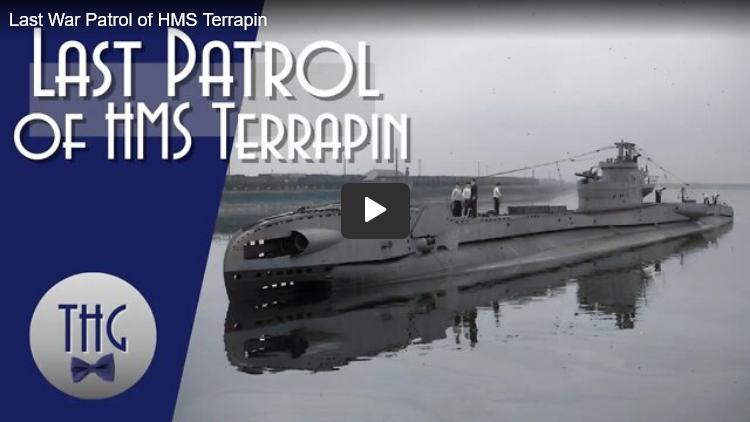
Last War Patrol of HMS Terrapin

Filed under: Britain, History, Japan, Military, USA, WW2 — Tags: , , — Nicholas @ 06:00

The History Guy: History Deserves to be Remembered
Published April 11, 2022

On her seventh war patrol, in the south Java Sea, the T class British submarine HMS Terrapin and her crew had faced the terror of battle and barely survived. Badly damaged and far from home, sometimes the drama of war is not just in the battle, but in the voyage home.

Check out our new community for fans and supporters! https://thehistoryguyguild.locals.com/

This is original content based on research by The History Guy. Images in the Public Domain are carefully selected and provide illustration. As very few images of the actual event are available in the Public Domain, images of similar objects and events are used for illustration.

You can purchase the bow tie worn in this episode at The Tie Bar:
https://www.thetiebar.com/?utm_campaign=BowtieLove&utm_medium=YouTube&utm_source=LanceGeiger

All events are portrayed in historical context and for educational purposes. No images or content are primarily intended to shock and disgust. Those who do not learn from history are doomed to repeat it. Non censuram.

Find The History Guy at:
New community!: https://thehistoryguyguild.locals.com/
Please send suggestions for future episodes: Suggestions@TheHistoryGuy.net

The History Guy: History Deserves to Be Remembered is the place to find short snippets of forgotten history from five to fifteen minutes long. If you like history too, this is the channel for you.

Awesome The History Guy merchandise is available at:
https://teespring.com/stores/the-history-guy

Script by THG

#history #thehistoryguy #WWII

Experimental video embed from Rumble.com. Please let me know if you have problems viewing this video.

April 6, 2022

How To Build a Nazi Fortress – WW2 Special

World War Two
Published 5 Apr 2022

Few things of the Second World War are more intimidating than the iconic German bunker. Made out of reinforced concrete with a thickness of up to 3.5 meters, these casemates and pillboxes were incredibly tough to destroy. Built to withstand shells and bombs, they provided shelter to troops and civilians alike. But there were also some even larger super-structures. From giant U-Boat shelters and fearsome Flak-Towers, to the ultimate Führerbunker, the Germans perfected the art of bunker building.
(more…)

March 15, 2022

For military procurement blunders, “no nation has mastered the ability to step on every bloody rake quite as well as Canada”

Germany has announced that they will be purchasing US F-35 stealth fighters as part of their re-armament program. My favourite headline on this was over at Blazing Cat Fur: “Germany To Buy 35 Lockheed F-35 Fighter Jets From U.S. Amid Ukraine Crisis … Canada Will Buy Cool ‘Fighter Jet Stickers’ With Eco-Friendly Adhesive”

On a more serious tone — but with sadly the same basic message — Mitch Heimpel looks at the multi-generational rolling catastrophe that is Canadian military procurement since the unification of the forces in 1968:

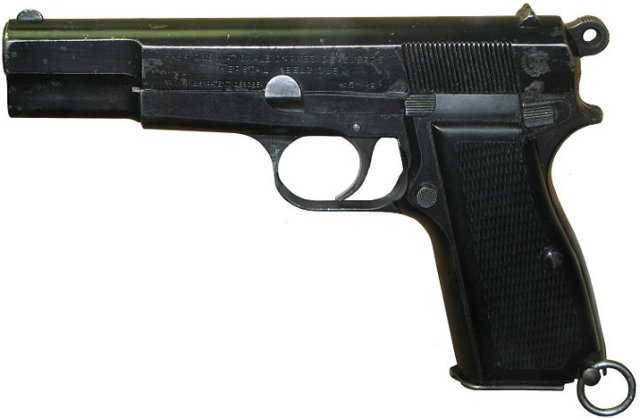
Browning High Power 9mm, the standard side-arm of the Canadian army since WW2. When I was in the reserves, we were told this was due for replacement in a few years. I was in the reserves from 1976-1980. It still hasn’t been replaced.

To say we have a checkered history with military procurement, fails to capture exactly how bad it is. Our political leadership has failed us continually over the course of half a century. No party has done it well. Some have done it better than others. But no one can claim any kind of bragging rights.

Fighter jet procurement in this country is so fraught it once caused the birth of a new political party. Trying to buy helicopters helped bring down a government. We only successfully bought those helicopters after they [the old helicopters] became a greater danger to the personnel manning them than they were to any potential adversary. We have been running a procurement for the next generation of fighter jets for an entire generation. Even Yes, Minister writers would have given up on something that absurd.

Our submarine fleet seems to be almost permanently in dry dock. Our most recent ship procurement resulted in the absolutely monstrous prosecution of one of the country’s most accomplished military leaders.

And we just issued a revised bid to finally replace our Second World War-era pistols … last week.

Just cataloguing that level of incompetence is exhausting. No leader or party looks good. The civil service, as the one constant through all these cartoonish blunders, surely has to wear some of this, too. The fact that we seem to repeat the same mistakes can, at least in part, be attributed to a significant institutional memory failure on the part of the people trusted with having the institutional memory.

Now, it is worth noting in fairness that no nation has an easy time with large scale military procurement. Ask the Americans about the development of the V-22 sometime. But, still, no nation has mastered the ability to step on every bloody rake quite as well as Canada.

I’m not a hardware expert. I can’t tell you which pistol we should buy. There’s also genuine policy questions here that need to be settled — I don’t know whether we should focus on the navy because we’re an Arctic nation, or the air force because it allows us to participate more readily in allied force projection exercises — like, say, no-fly zones? The necessary mix for Canada is no doubt some of both, and it’s fine to have disagreements between parties on what the right mix is.

But setting that aside, I want to talk about what it would take politically, to get us to start taking procurement seriously — just a few basic rules that any government would need to follow to procure anything that they chose was important for Canada to have.

October 8, 2021

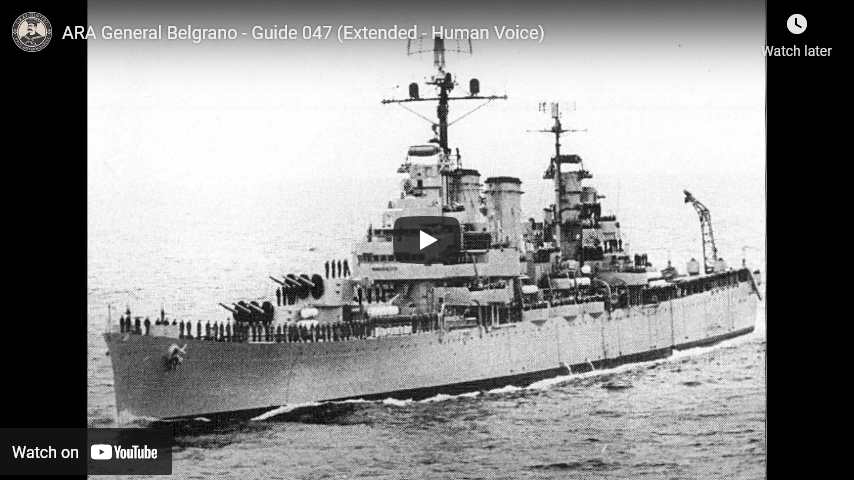
ARA General Belgrano – Guide 047

Filed under: Americas, Britain, History, Military, USA, Weapons — Tags: , , , , , — Nicholas @ 02:00

Drachinifel
Published 18 Dec 2019

The ARA Belgrano of the Argentine Navy is today’s ship.

Want to support the channel? – https://www.patreon.com/Drachinifel

Want a shirt/mug/hoodie – https://shop.spreadshirt.com/drachini…

Want a medal? – https://www.etsy.com/uk/shop/Drachinifel

Want to talk about ships? https://discord.gg/TYu88mt

Want to get some books? www.amazon.co.uk/shop/drachinifel

Drydock Episodes in podcast format – https://soundcloud.com/user-21912004

Music – https://www.youtube.com/c/NCMEpicMusic

October 3, 2021

This is Russia, The Soviet Thermopylae – WW2 – 162 – October 2, 1942

World War Two
Published 2 Oct 2021

The fighting for Stalingrad continues, but the Soviets forces are split and the Volga is on fire. In the Caucasus, the Axis forces for the most part are being held in check — at one point a single Soviet battalion holds off an entire Army Corps — but they’re being pushed back on the Kokoda Trail in the South Seas.
(more…)

September 27, 2021

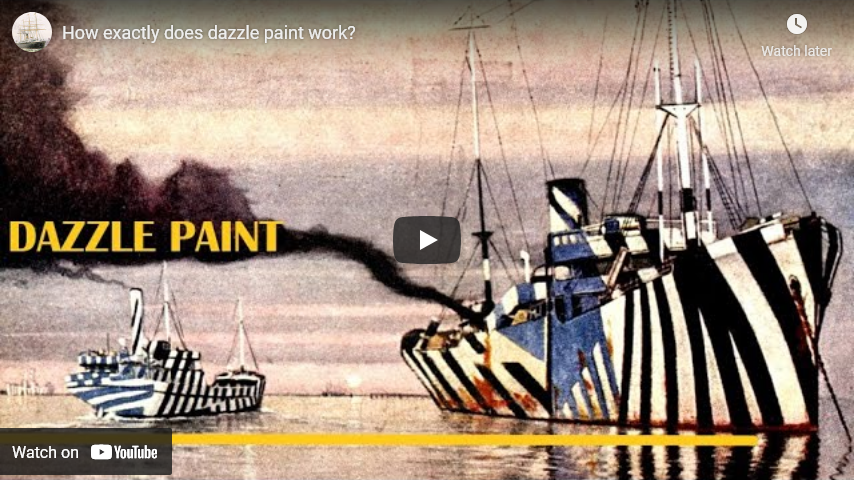
How exactly does dazzle paint work?

Filed under: Britain, Cancon, Germany, History, Military, USA, WW1, WW2 — Tags: , , , — Nicholas @ 02:00

Nautical Study
Published 22 May 2021

In early 1917, a British artist by the name of Norman Wilkinson approached the British admiralty with an ingenious idea that would save countless lives from the German U-boat campaign. His idea: dazzle paint. Complex in concept, but just crazy enough to work.

Thanks for your support!

Music: Emperor’s Waltz
https://www.youtube.com/watch?v=foHeA…

All colorized photos in this video have credits attributed to them if I could find them. If you know who colorized any that are left unattributed, please let me know!

September 19, 2021

Stalingrad Falls? – WW2 – 160 – September 18, 1942

World War Two
Published 18 Sep 2021

It’s a big week, but by now they all are. The fighting in Stalingrad is intense, the fighting on Guadalcanal is intense, and the US loses a carrier in the Pacific. And the German quest for oil in the Caucasus … how’s that going again?
(more…)

September 17, 2021

Australia, the UK, and the US join in a military alliance … Canada of course is nowhere in sight

News broke the other day about a new three-nation military arrangement clearly aimed at containing Chinese ambitions in the Pacific, involving Australia, Britain, and the United States, to be known as AUKUS (or AUUKUS, depending on the reporting source). These three countries are already tightly linked in the “Five Eyes” intelligence sharing network which also includes Canada and New Zealand. As more than one wit noted on Twitter after the announcement, it’s a good thing Canada doesn’t have a Pacific coast or any economic interests in that ocean…

Ted Campbell, who recently emerged from a blogging hiatus to comment on the ongoing federal election, felt this new pact cemented the idea that Canada is “no longer a serious country” in military terms:

It is now abundantly clear that the USA, inter alia, puts Justin Trudeau’s Canada in the same league as (anti-nuclear) New Zealand. Canada is no longer one of the most trusted allies … Australia is; Britain is: India is; Japan is … Canada is NOT.

Prime Minister Justin Trudeau has, in six short years, moved Canada from one of America’s best friends to, de facto, a Chinese puppet state. He has done this with his own (and his many advisors’) eyes wide open. Canada, Justin Trudeau’s Canada is no longer a serious nation … perhaps we don’t really deserve to be. After all, we (almost 40% of the almost 70% who bothered to vote at all) elected him … then we did it again. Maybe the world is just concluding that we are not serious people who can be relied upon when the going gets tough.

He followed this up with a bit more concern on the sinking Canadian international profile:

Just take a look at those technologies ~ AI, quantum computing, cyber warfare ~ those are all areas vital to Canada’s security and prosperity and what are we focused on? Climate change and Québec’s latest attempts to make Canada into an illiberal state. China spews out more carbon in a week than Canada does in a year. China is aiming to displace America as the global guarantor of peace, security and trade. Do any of the dimwits in the Liberal government understand that? Why in hell is Prime Minister Trudeau attacking Alberta’s (relatively clean) oil industry rather than, for example, concentrating on making Canadian nuclear energy work for us?

A few days ago I said that Canada needs nuclear powered submarines to assert and protect our sovereignty in the waters we claim as our own. No one contradicted me. No one ever raises any serious, well-founded objections to nuclear submarines for Canada. It’s a no brainer. But, look at the last line in the quote above. Who is getting nuclear submarines? Australia … because it is a serious country with adult political leadership.

Prime Minister Justin Trudeau’s regime has sidelines Canada. Our strongest, most traditional allies have abandoned us. We have been sold out … to China.

I use that term “sold out”, intentionally. I do NOT believe that Justin Trudeau is a traitor … for heaven’s sake, he’s not smart enough to betray anything. He’s barely able to memorize his lines. But a lot of people have invested a lot in China ~ the Desmarais family (of Power Corporation fame) and former Prime Minister Jean Chrétien and Bob Rae, Canada’s Ambassador to the UN, for example, are all closely tied together and even more closely tied to the Canada-China trade file. I assert that the “China lobby” in Canada is very, very powerful, very, very rich and extraordinarily well connected to Canada’s political leadership ~ Liberal and Conservative, alike. I further assert that it, not Justin Trudeau and Marc Garneau and the mandarins in Ottawa, drives Canada’s foreign, trade and fiscal policies. Prime Minister Justin Trudeau is NOT a traitor … but he is puppet and people whose vital interests are centred on China, not Canada, pull the strings.

Why is Canada excluded from the AUKUS pact?

One reason Canada isn’t involved is certainly the distraction of the federal election, and there would have been no way that Justin Trudeau would have wanted to answer questions on the campaign trail about anything geostrategic or military, and he especially doesn’t want Canadians looking closely at his servile deference to the Chinese government. Of course, given that he’s literally bribed the major newspaper chains and TV networks with “subsidies” right before the election was called, he might well have been safe from any hint of an awkward question from his unofficial PR branches in Montreal, Toronto, and Vancouver.

Over at the Thin Pinstriped Line, Sir Humphrey looks at the military and technical implications of the new alliance:

The Royal Australian Navy is likely to become the next nation to join the nuclear submarine operators club. This is the key headline emerging from the surprise tri-lateral announcement on Wed 15 September by the Prime Ministers of Australia and the UK, and the President of the United States.

The move, forming a new “three eyes” club known as AUKUS is a genuinely significant development intended to provide a significant uplift in capability in the Indo-Pacific region. For the first time in nearly 70 years, the US has agreed to share some of its most sensitive technology with a third party, to help Australia become a “naval power underway on nuclear power”.

There are several ramifications of this decision, that will be felt for many years to come. The first is that from an American perspective, this is a good opportunity to take steps to increase burden sharing in the Pacific.

[…]

From a wider diplomatic perspective, there are three distinct groupings to consider. Firstly, the remaining 5-EYES members (Canada and New Zealand). Its unlikely that this will do much damage to 5-EYES – for example New Zealand would never have been approached as the acquisition of a nuclear submarine would be vastly beyond the budget, or needs, of the small but incredibly professional Royal New Zealand Navy.

Canada may be feeling slightly raw about this – particularly those with long memories who recall the 1980s and the doomed plan to acquire nuclear submarines for the RCN. But who knows, in terms of timelines these vessels may be entering service in the same timeframe as Canada seeks to replace the Upholder/Victoria class – it is not beyond the realm of possibility that they may seek to join in later on.

Given 5-EYES is more than just an Indo-Pacific focus, it would be wrong to read much into this as a statement on the future of that Alliance. Rather it is better to see this as a subgrouping of a very successful international alliance.
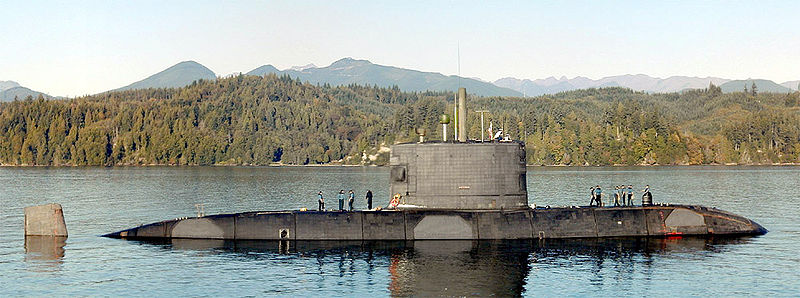
HMCS Victoria
Image via Wikimedia Commons.

June 27, 2021

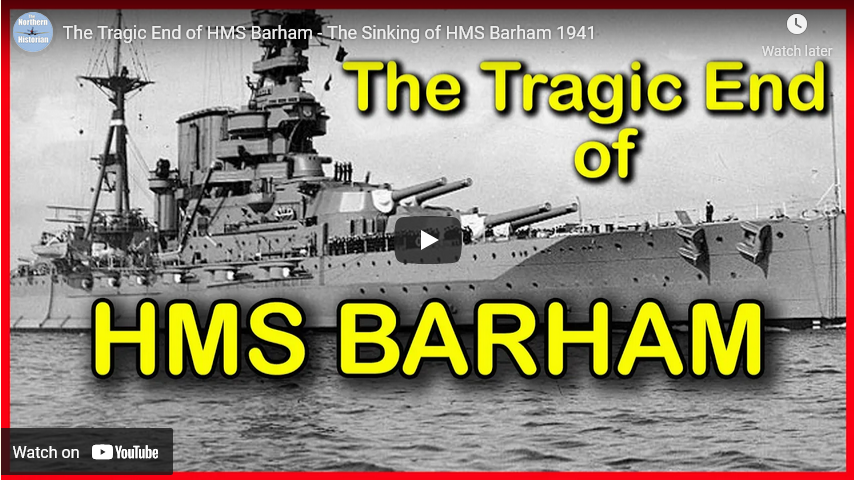
The Tragic End of HMS Barham – 25 November, 1941

Filed under: Britain, History, Military, WW2 — Tags: , , , , — Nicholas @ 02:00

The Northern Historian
Published 5 Mar 2021

On the 25th of November 1941, the Royal Navy’s 1st Battle Squadron consisting of HMS Queen Elizabeth, HMS Valiant and HMS Barham along with eight destroyers were on a hunt in the central Mediterranean looking for Italian convoys.
Also on the hunt was a German U-Boat and their paths were on a collision course. A collision that would send HMS Barham to the floor of the Mediterranean Sea along with over 800 of her crew.

HMS Barham had begun her service with the Royal Navy during World War 1 and played a role during the Battle of Jutland.

Following World War 1, HMS Barham had several refits and operated in the Atlantic Fleet and the Mediterranean Fleet during the inter-war years.

During World War 2, HMS Barham took part in the the Battle of Dakar before taking part in escort convoys in the Mediterranean.

In November of 1941, during an escort mission, HMS Barham was attacked by U Boat U-331 under the command of Hans-Diedrich von Tiesenhausen.

The attack caused a huge explosion in her magazine and rapidly sank, killing over 800 men.

April 23, 2021

Taiwan Under Occupation, Axis Solidarity, and U-Boats in the Med – WW2 – OOTF 022

Filed under: China, Europe, Germany, History, Japan, Military, WW2 — Tags: , , , , , — Nicholas @ 04:00

World War Two
Published 22 Apr 2021

Ever wonder what life was like in Taiwan during the Second World War? Or if German U-Boats were active in the Mediterranean? You can find out the answers in this episode of Out of the Foxholes!

Join us on Patreon: https://www.patreon.com/TimeGhostHistory
Or join The TimeGhost Army directly at: https://timeghost.tv

Follow WW2 day by day on Instagram @ww2_day_by_day – https://www.instagram.com/ww2_day_by_day
Between 2 Wars: https://www.youtube.com/playlist?list…
Source list: http://bit.ly/WW2sources

Hosted by: Indy Neidell
Written by: Ian Sowden, Lewis Braithwaite, Timothy Smith
Director: Astrid Deinhard
Producers: Astrid Deinhard and Spartacus Olsson
Executive Producers: Astrid Deinhard, Indy Neidell, Spartacus Olsson, Bodo Rittenauer
Creative Producer: Maria Kyhle
Post-Production Director: Wieke Kapteijns
Research by: Ian Sowden, Lewis Braithwaite, Timothy Smith
Edited by: Miki Cackowski
Sound design: Marek Kamiński
Map animations: Miki Cackowski and Eastory (https://www.youtube.com/c/eastory​)

Sources:
David Rumsey Map Collection, David Rumsey Map Center, Stanford Libraries
Chapman University Digital Commons

Soundtracks from the Epidemic Sound:
Yi Nantiro – “Watchman”
Max Anson – “Ancient Saga”
Skrya – “First Responders”

Archive by Screenocean/Reuters https://www.screenocean.com​.

A TimeGhost chronological documentary produced by OnLion Entertainment GmbH.

« Newer PostsOlder Posts »

Powered by WordPress