Forgotten Weapons
Published 20 Feb 2023During World War Two, both German and Russian soldiers often thought that the other side’s weapons were better than their own. In particular, both sides often preferred their opponents’ SMGs. In late 1941, a group of German officers formally requested that Germany simply copy and produce the PPSh-41. This led to the HWA formally studying the question of PPSh-41 vs MP-40 … and they found that the German gun was better, but the Russian magazine was better.
Naturally, as a result of this finding, the German military chose to convert captured Russian PPSh-41s to use MP-40 magazines. The conversion used standard MP40 magazines, and required magazine well adapters and new 9mm barrels. Some 10,000 such conversions were made in total. Some used cast magwell adapters and some were stamped, and the barrels were made from standard MP40 barrels turned down to fit PPSh trunnions.
The standard 7.62mm PPSh-41 in German service was designated MP-717(r), while the ones changed to 9x19mm like this were designated MP-41(r). Many thanks to Limex for giving me access to film this one for you!
(more…)
June 2, 2023
Germany Adopts the PPSh in 9mm: the MP-41(r)
May 11, 2023
Bechowiec: Polish Teenager Makes a Resistance SMG
Forgotten Weapons
Published 25 Jan 2023The Bechowiec (or Beha) is a fascinating SMG produced in small numbers in southern Poland under German occupation during World War Two. It was made for use by the Bataliony Chłopskie (Peasant Battalions) by a young man named Henryk Strąpoć.
Henryk built his first (quite illegal) gun at the age of 15 in 1937, and was promptly arrested for it. He avoided prison only on account of being a minor, and promised not to do it again. Well, at least he promised not to get caught again — he built three more guns (two semiauto pistols and a revolver) by the time Germany invaded Poland in 1939. During the occupation he joined the the resistance and set to work doing what he must have fantasized about; building clandestine small arms.
Being more or less familiar with pistols but having never handled a submachine gun, he made some creative design choices. His SMG is basically a scaled-up Ruby-type action — chambered for 9x19mm with a simple blowback slide, it is hammer fired from a closed bolt. He designed a complex but effective selective-fire trigger system, complete with a correct auto sear. The first gun was ready in the spring of 1943, and he had a makeshift production going by early 1944. A total of 11 of the guns were made by July 1944, some in 9mm (using bored-out WW1 Mauser barrels) and some in 7.62x25mm Tokarev (using Mosin Nagant barrels).
Only one example survives today, and it is housed in the Polish Army Museum (and sadly, deactivated). Many thanks to the Museum for giving me access to film it for you! Check them out at: http://www.muzeumwp.pl/?language=EN
(more…)
April 8, 2023
Błyskawica: The Polish Home Army’s Clandestine SMG
Forgotten Weapons
Published 23 Dec 2022The Błyskawica (“Lightning”) is an SMG developed in occupied Poland to be issued out to Home Army units during Operation Tempest: the liberation uprisings planned for the advance of the Red Army into Poland.
The gun was developed starting in September 1942 by two engineers, Wacław Zawrotny and Seweryn Wielanier. Both were smart and talented, but neither had previous experience in arms design. The design they created is both innovative in some areas and inferior in others as a result, with major inspiration coming from the Sten and the MP40. Production was undertaken in the harshest conditions of occupied Warsaw, where just possession of cutting tools required German military permission.* It is a credit to the skill and dedication of the Home Army team that some 750 Błyskawica guns were made; the largest mass production of any underground weapon that I am aware of.
Ultimately, Operation Tempest did not come to full fruition, as the NKVD’s treatment of Polish fighters as collaborators destroyed Home Army interest in cooperation. The Błyskawica guns were never issued as planned, with only the few dozen last made being used in the Warsaw Uprising. The remaining 700-odd examples have never been found — perhaps they remain in long-forgotten caches still to this day?
For the full story of the Błyskawica, see Leszek Erenfeicht’s excellent article:
https://www.forgottenweapons.com/subm…Many thanks to the Polish Army Museum for giving me access to film this exceptionally rare item for you! Check them out at: http://www.muzeumwp.pl/?language=EN
* This created some interesting situations in which a shop might take a contract to make material for the Wehrmacht as a way to get access to the tools needed for Błyskawica component production. To those who did not know the whole story, such a shop was collaborationist.
March 21, 2023
Born in the Heart of Besieged Leningrad: the PPS-42
Forgotten Weapons
Published 11 Nov 2022One would think that the Shpagin PPSh-41 was as simple as a submachine gun could get, but that wasn’t the case in World War Two USSR. Barely had the PPSh gotten into real production than the Army was looking for something even simpler. An answer came from young designer Aleksey Sudaev with a completely-stamped gun that used about half the raw material and a third the machine time to produce as the PPSh. After winning the competitive trials, Factory 828 in Moscow was chosen as the lead production facility. They produced a series of drawings and preproduction guns in the summer of 1942.
Sudaev took those drawings into besieged Leningrad with orders to et up production in three factories within the city. The main one was Factory 209, and after fixing a few minor design flaws, the gun went into production in the spring of 1943. Sudaev PPS-42 SMGs pretty much went out the doors of the factory and right into combat trying to break the siege of the city. In total, about 46,000 would be produced before that siege was finally broken.
Meanwhile, Factory 828 in Moscow put a higher priority on policing the design than on immediate production. They implemented a substantial number of improvements, although the lack of communication into Leningrad prevented them from being used in the production going on there. Instead, the improvements culminated in the PPS-43 design, of which more than a million were made by the end of the war.
(more…)
March 8, 2023
First to the Fight: The Marines’ Reising M50 SMG
Forgotten Weapons
Published 4 Nov 2022Eugene Reising developed a .45 ACP submachine gun in the late 1930s that was basically the opposite of the Thompson — it was light and handy, fired from a closed bolt with a delayed blowback action, and was inexpensive to produce. Reising contracted with Harrington & Richardson to produce the gun, and when it entered the market in early 1940 it found immediate interest from the USMC. Looking initially to equip the Marine Paratroop Regiment (Paramarines), the Corps wanted a gun that was light and compact. The Reising M55 with its folding stock was certainly those things and since the Thompson was essentially unavailable anyway (all production was going to the Army and foreign contracts), the Corps adopted the Reising with initial purchases of both the M50 and M55 in January and February of 1942.
What we are looking at today is an early production M50. It is blued with 29 barrel fins and the early style of sights, stock screw, trigger guard, magazine release, stock (the lacquer coating and sling swivels having been added by a previous owner), and firing pin. Later production guns would be improved and strengthened in various ways, but the Reising would never quite meet the needs of frontline combat troops, much to the displeasure of the Marines who first used them in the Pacific theater. Lacking interchangeable parts and susceptible to fouling and malfunctions, the Reisings were quickly replaced by other arms — some Johnson M1941 rifles, some M1 and M1A1 carbines, and various other guns. Rotated back to duties like ship boarding parties, guards, and military police, the Reising served very well. They were indeed handy and accurate guns, just not built for the extreme rigors of Pacific beach assaults and jungle foxholes.
(more…)
March 4, 2023
Thompson SMG Cases: Police, FBI, and Secret Service
Forgotten Weapons
Published 3 Nov 2022The Auto Ordnance company made a couple of different types of cases for the Thompson SMG, and today we are going to look at two of the most common and one exceptionally cool type. The two most typically found are the Police and FBI cases. Both of these hold the gun along with the detached stock, one drum, and four box magazines. The Police type has the drum and box mags separated for balance and was lined with purple velvet; the FBI case was generally blue velvet and had all the magazines on the left (making it balance poorly).
The other case we have today is one fabricated by the Secret Service for one of its protective details. This is a flat-lying wooden case, which holds the gun, stock, and four box magazines — no drums for the Service.
(more…)
February 13, 2023
Reising M55 Submachine Gun
Forgotten Weapons
Published 28 Sept 2015When the US entered WWII, submachine guns were in short supply and high demand. Much of the production of Thompson guns was being purchased by the UK, and what guns were available to the US military went first to the Army. In accordance with long tradition, the Marine Corps were secondary to the Army in receiving new weapons. However, the formation of a Marine paratroop unit in particular necessitated the Corps finding some sort of suitable submachine gun.
What was available at the time were Eugene Reising’s M50 and M55 guns, being manufactured by Harrington & Richardson. The guns were chambered for the standard .45ACP cartridge and used a delayed blowback action which allowed them to be significantly lighter than the Thompson. The M50 had a full-length traditional stock, while the M55 used a pistol grip and wire folding stock. Mechanically, the two variants were identical. The M55, which is what we have today, wound up being specifically issued to tank crews and paratroops, where its compactness was a significant advantage.
The Reising developed a quite bad reputation in the Pacific for a couple of reasons. Its parts were not always interchangeable between guns (a deliberate choice to speed up manufacture, which troops were not necessarily aware of), its mechanism was more susceptible to fouling than other military small arms, and its disassembly procedure was far too complex for military service. However, these issues did not prevent it from being quite successful and well-liked as a law enforcement weapon in civilian police use after the war. Thanks to that negative wartime reputation, Reisings are some of the least expensive military machine guns available on the market today in the US.
(more…)
February 7, 2023
The Soviet Union Adopts an SMG: Degtyarev’s PPD-34/38
Forgotten Weapons
Published 21 Oct 2022The Soviet Union adopted its first submachine gun in 1935 after trials of some 14 different design in 1932/33. The winner of the trials was Vasily Degtyarev, once of the Soviet Union’s most prolific firearms designers. His model 1934 was a simple blowback gun reminiscent of the MP-28,II albeit with different trigger and magazine systems. The PPD34 used a 25-round box magazine, chambered for 7.62x25mm Tokarev. It was put into slow production, with just 3,300 or so produced by the end of 1938. During that time, Degtyarev made a number of small improvements to the gun, smoothing out the teething problems that are always found in new production systems. This improved version was designated the PPD34-38.
During the time, the submachine gun was not considered a priority by the Red Army. The leading generals did not see the value in the class of arms, and actually pulled all the PPDs from service in 1939 and had them put into storage. Only a few months later, the Red Army would be given a grim demonstration of SMG effectiveness when they closed the border into Finland and encountered determined Finnish resistance with kp/31 Suomi SMGs.
Some Suomis were captured by Soviet troops, and were very well liked — for obvious reasons. The inevitable inquiry into why the Red Army did not have such a weapon led to a frantic re-issuing of PPDs and production of as many as possible. At Stalin’s direction, the Suomi drum magazine was copied and adapted to the PPD34-38 as well. This required the addition of a short feed tower to fit the magazine well initially deigned for a standard box magazine. While PPD34-38 production continued, the PPD40 was quickly designed and put into production alongside the older model. Eventually, both were replaced in service by the PPSh-41, which was truly designed for mass industrial production.
(more…)
February 2, 2023
MAC Model 1947 Prototype SMGs
Forgotten Weapons
Published 12 Oct 2022Immediately upon the liberation of France in 1944, the French military began a process of developing a whole new suite of small arms. As it applied to SMGs, the desire was for a design in 9mm Parabellum (no more 7.65mm French Long), with an emphasis on something light, handy, and foldable. All three of the French state arsenals (MAC, MAS, and MAT) developed designs to meet the requirement, and today we are looking at the first pair of offerings from Chatellerault (MAC). These are the 1947 pattern, a very light lever-delayed system with (frankly) terrible ergonomics.
Many thanks to the French IRCGN (Criminal Research Institute of the National Gendarmerie) for generously giving me access to film these unique specimens for you!
Today’s video — and many others — have been made possible in part by my friend Shéhérazade (Shazzi) Samimi-Hoflack. She is a real estate agent in Paris who specializes in working with English-speakers, and she has helped me arrange places to stay while I’m filming in France. I know that exchange rates make this a good time for Americans to invest in Europe, and if you are interested in Parisian real estate I would highly recommend her. She can be reached at: samimiconsulting@gmail.com
(Note: she did not pay for this endorsement)
(more…)
October 30, 2022
Jatimatic: Finland’s Least Successful PDW
Forgotten Weapons
Published 24 Jun 2022The Jatimatic was a stockless PDW designed by Jari Timari, who co-owned Tampereen Asepaja Oy, a firearms company in Tampere Finland. The firm was founded in the early 1920s, making .22 biathlon rifles, sporterizing military surplus, and other gunsmithing work. In the late 70s he got the idea for a compact 9mm PDW with some unique climb-reducing features, and in 1980 it was introduced as the Jatimatic (JAli TImari). Only about 400 were made, as it was not adopted or purchased in large quantities by anyone (although it was tested by many, including the Finnish Border Guards).
The Jatimatic was made without a stock, instead using a shooting sling for stabilization. It used standard Swedish K magazines, and has a distinctly off-angle appearance. This was done to counteract muzzle climb, as the line of the barrel points directly back into the shooter’s hand. It also has an interesting safety built into the folding front grip – if the grip is closed, the bolt is locked in place.
Production ended in the late 1980s after “permit irregularities” and a robbery of a bunch of Jatimatics from the company premises. The rights to the design were sold to a new company called Golden Gun in 1994, and they attempted to reintroduce it as the GG-95 with a few improvements, but it was a rather complete flop. Its best achievement was getting into several major movies, including Cobra and Red Dawn.
(more…)
October 27, 2022
MPi-81: Steyr Basically Makes the Uzi
Forgotten Weapons
Published 17 Jun 2022
(more…)
September 18, 2022
Austria’s Take on the Uzi: Steyr MPi-69
Forgotten Weapons
Published 13 May 2022
(more…)
July 13, 2022
m/26 Suomi: Aimo Lahti’s First Production Design
Forgotten Weapons
Published 23 Mar 2022
(more…)
May 25, 2022
M1915 Villar Perosa
Forgotten Weapons
Published 5 Aug 2016http://www.patreon.com/ForgottenWeapons
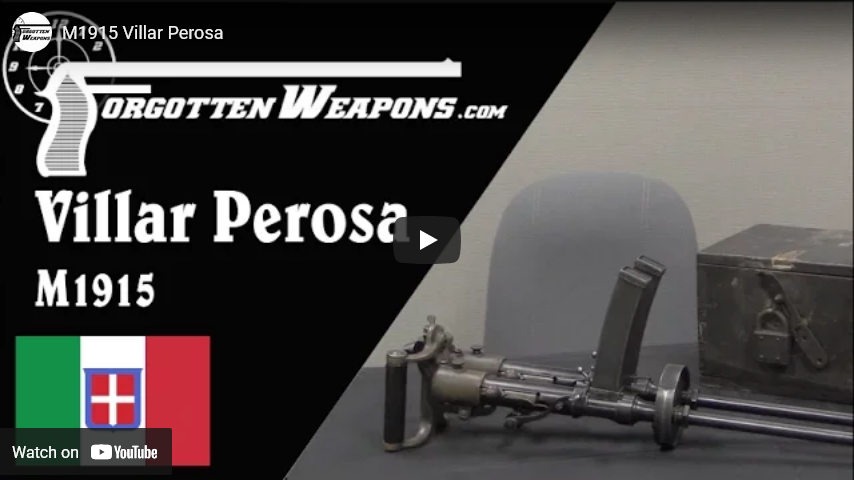
The Villar Perosa is one of the first small machine guns developed and used by a military force. It was designed in Italy and introduced in 1915 as an aircraft weapon, to be used in a flexible mount by an airplane’s observer. The gun consists of two independent firing actions mounted together. Each fires from an open bolt as a rate of 1200-1500 rounds/minute, feeding from a 25 round magazine of 9mm Glisenti cartridges. This allowed the maximum possible volume of fire in an aerial combat situation, where in 1915 ballistic power was not particularly important.
As aircraft armaments improved and synchronized, belt-fed machine guns became practical, the Villar Perosa was quickly made obsolete in aerial use. The Italian military experimented with several applications of the weapon in ground combat, including slings and belt fittings for walking fire, tripods, mounts with integral armor shields, and bicycle mounts. None of these proved particularly successful, as the elements that made the gun well adapted to early aerial use (high rate of fire with a small cartridge) made it relatively ineffective for infantry use.
Ultimately, the best use of the Villar Perosa was to break them up and convert the actions into shoulder-fired submachine guns. Designs to do this were developed by both the Beretta company and Villar Perosa themselves, and in 1918 these guns entered service in the same approximate period as the first German MP-18 submachine guns. Because of this recycling, intact M1915 Villar Perosa guns are quite rare today.
April 11, 2022
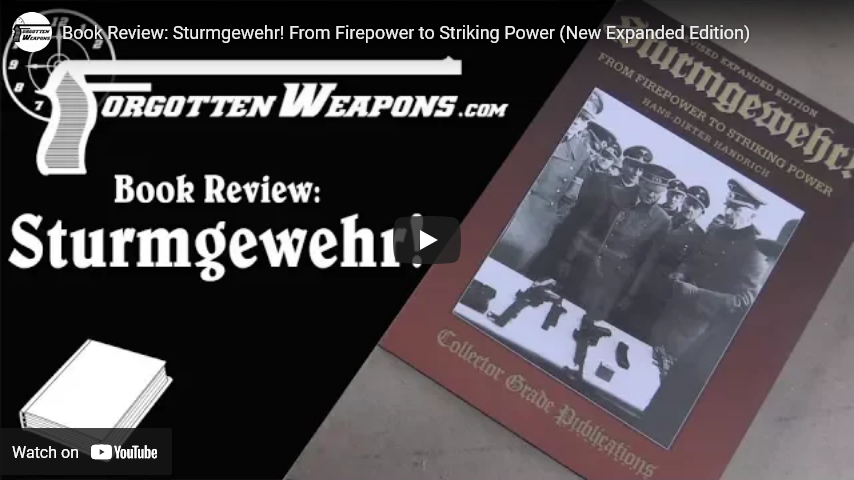
Book Review: Sturmgewehr! From Firepower to Striking Power (New Expanded Edition)
Forgotten Weapons
Published 17 Sep 2017Get your copy from Collector Grade Publications: http://www.collectorgrade.com/bookshe…
Collector Grade is known for being a premiere publisher of technical firearms reference books, and I would be willing to argue that Sturmgewehr! by Hans-Dieter Handrich is the best book they have yet printed. The book was originally printed in 2004, and by the time I started looking for a copy myself, it was out of print and the price had jumped to at least $250, when I could even find a copy. I could never quite bring myself to pay that much, and so I was very excited when I learned that an expanded second edition was in the works. Well, that second edition is available now, and it’s even better than I had anticipated.
What makes Sturmgewehr! such an excellent book in my opinion is how it tackles the story of the MP43/MP44/StG44 from several different angles in depth. It has the mechanical development of the gun from prewar experiments to the open-bolt MKb-42 trials guns to the production versions. But it also puts those guns in historical context, how they related to the other weapons being used by both Germany and other nations. It discusses how the design criteria of the Sturmgewehr were arrived at, in terms of logistics and manufacturing methodologies. It explains in detail the political disagreements and convoluted process of weapon design and adoption in Germany, including the three direct rejections of the concept by Hitler.
In short, it gives you the fully-rounded story of how the German military conceived and implemented a whole new class of small arms. In this way, it is really much more than just a book about a single gun’s history — what you learn reading Handrich’s work will give you insight into virtually all arms design programs of the 20th century, from the Chauchat to the 7.62mm NATO rifle trials to the SA80.
If you already have a copy of the original work, you will probably want this one as well, to get the additional 120 pages of information that have been added. And it should go without saying that if you don’t have the original, you should absolutely get a copy of this new edition before it also falls out of print!
http://www.patreon.com/ForgottenWeapons
Cool Forgotten Weapons merchandise! http://shop.bbtv.com/collections/forg…
If you enjoy Forgotten Weapons, check out its sister channel, InRangeTV! http://www.youtube.com/InRangeTVShow