Quotulatiousness

February 16, 2026

The destruction of Dresden, February 1945

Filed under: Britain, Germany, History, Military, USA, WW2 — Tags: , , , , — Nicholas @ 03:00

If you’ve watched the two-part video on the bombing of Dresden by LordHardThrasher (Part 1, Part 2), much of this will already be familiar to you, as Ed West discusses the history of the city up to the point the RAF bombs began to fall on Shrove Tuesday in 1945:
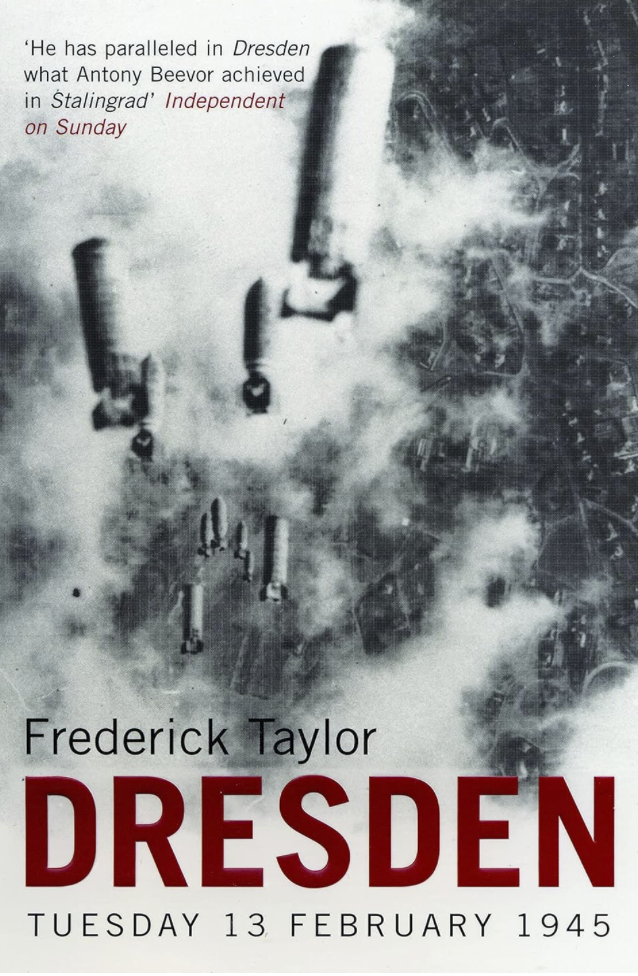
… Just over six years later the city of Dresden would be reduced to ashes by hundreds of bombers from the RAF and US Air Force, a horror that began on the evening of Shrove Tuesday, February 13, 1945, lasting until Thursday morning. Griebel would survive, but all his art went up in the blaze.

Dresden is perhaps, after Hiroshima, the name most synonymous with slaughter from the air, and in Britain at least the most controversial. Last year, while visiting this incredibly beautiful city — much of it now rebuilt — I reread Frederick Taylor’s account of the bombing, published back in 2005 on the 60th anniversary of the event.

Dresden’s destruction was extensive. Almost no buildings in the centre or its inner suburbs survived the bombs, and the death toll was immense, although difficult to assess in a city packed with refugees from the east. Anything between 20,000 and 80,000 fatalities is possible, although the consensus seems to be around 25,000.

That night was to be the worst of many wartime firestorms, a meteorological event in which the heat of the blaze becomes so intense, up to a thousand degrees centigrade, that the oxygen is sucked out of the surrounding air. More died in Dresden from asphyxiation than fire, and even those who thought they had found shelter in fountains were boiled alive. Many more drowned in the city’s reservoir, where they had gone to seek protection, their energy sapped by the soaring temperatures, unable to climb out. The bombers, thousands of feet above, could feel the warmth of the thousand fires below.

[…]

As everyone in the 1930s was well aware, the new war would bring aerial destruction on a hideously greater scale, and when it came again, it was the Luftwaffe who first put these ideas into practise, first in Poland and then Rotterdam.

After failing to destroy the Royal Air Force over the summer of 1940, the Nazis switched to aerial bombing of British cities. Between September 7, 1940 and New Year’s Day 1941, London was attacked on 57 consecutive nights, killing 14,000 inhabitants, a rate of 250 fatalities for each day of bombing. The German air force went on to kill an estimated 43,000 British civilians over the course of the war, with V-1 attacks continuing until the last weeks of the war.

On November 14, 1940, over 500 German bombers took off for a mission that would gift their language a new verb: Coventrated. Five hundred tons of high explosives, 30,000 incendiary bombs, fifty landmines and twenty petroleum mines were dropped on the target, and the medieval city went up in flames.

Like the blitz on other British cities, morale was not crushed in Coventry, but something dawned on the British high command. The destruction of Coventry’s infrastructure, utilities and transport had proved far more damaging than the destruction of any purely “military” target. Furthermore, bombers were notoriously inaccurate, and one survey showed that only 2 per cent of bombs fell within even one thousand feet of their intended point. Aerial bombardment of cities would prove far more effective than any hopeless targeting of particular coordinates.

They also learned that a large enough bombing raid would result in a firestorm, in which air currents are drawn in from the surrounding area, causing the fire to burn far more intensely. Indeed, a major attack on the City of London on December 29, 1940 might have become another firestorm but for the bad weather.

The British had been initially reluctant to take the war to Germany. While Poland was left to endure hell, leaflets were dropped over Berlin in October 1939 claiming that Nazi leaders were secretly profiting from the war, leading Noel Coward to suggest that it looked like we were trying to bore the Germans to death. There is even the apocryphal story about British official Sir Kingsley Wood refusing to bomb industrial targets in the Black Forest because it was private property. Indeed, our attempts to bomb Germany in 1940 were so feeble that Goebbels had to fake British “atrocities” to rouse the German public

With the entry of the United States and Soviet Union into the war in 1941, and with the German defeat at Stalingrad, the shoe was now on the other foot. The British invested more resources in Bomber Command and its head, Air Marshall Arthur Harris. “Bomber” Harris would become representative of the entire policy of destroying Germany’s cities, and a figure of controversy; the unveiling of his statue in 1992 attracted protests and has been repeatedly vandalised, but like many architects of wartime destruction, he was motivated by a desire to prevent a repeat of what he saw in 1914-18. The son of a colonial official who might have spent the rest of his life as a farm manager in Rhodesia were it not for war, he had joined the Royal Flying Corp in the first conflict and from his plane saw the horror of trench warfare and became determined that this sort of stalemate should never be repeated.

Having stuck to targeted industrial centres, in February, 1942 Allied command issued the Area Bombing Directive authorising the wide scale destruction of enemy cities. On 28 March the Hanseatic town of Lübeck was destroyed in a firestorm, and its most famous son, the anti-Nazi novelist Thomas Mann, appeared on BBC radio saying that while he regretted the destruction of his native city, “I think of Coventry, and have no objection to the lesson that everything must be paid for. Did Germany believe that she would never have to pay for the atrocities that her leap into barbarism seemed to allow?”

After the Lübeck bombing, Goebbels approached a state of panic for the first time, describing the damage as “really enormous”. He responded, in April 1942, by saying that he would “bomb every building in England marked with three stars in the Baedeker Guide” – Exeter was now hit in retaliation.

On May 30 the Allies launched what Harris called “the Thousand Plan”, the first thousand-bomber raid. Cologne and Hamburg were singled out for destruction, but on last-minute meteorological advice only the Rhineland city was chosen. Hamburg’s citizens would never know how fate had saved them – if only for another year.

So shocked were the Germans by the attack that the authorities forced the city’s fleeing citizens to sign a pledge of secrecy about what they saw, which ended with the sinister line “I know what the consequences of breaking this undertaking will be”.

Things would only get worse, and the Allies were getting both more destructive and more skilled. In faraway Utah, the Americans were now busy testing the destruction of German-style buildings, even hiring German refugee architect Erich Mendelssohn to recreate a German apartment block.


QotD: How nuclear weapons were viewed right after WW2

In that context [clear Soviet superiority of conventional forces in Europe], the fact that it had been the United States which had been the first to successfully develop nuclear weapons (and use them in anger, a decision which remains hotly debated to this day) must have seemed like an act of divine providence, as it enabled the western allies to retain a form of military parity with the USSR (and thus deterrence) while still demobilizing. US airbases in Europe put much of the Soviet Union in range of American bombers which could carry nuclear weapons, which served to “balance” the conventional disparity. It’s important to keep in mind also that nuclear weapons emerged in the context where “strategic” urban bombing had been extensively normalized during the Second World War; the idea that the next major war would include the destruction of cities from the air wasn’t quite as shocking to them as it was to us – indeed, it was assumed. Consequently, planners in the US military went about planning how they would use nuclear weapons on the battlefield (and beyond it) should a war with a non-nuclear Soviet Union occur.

At the same time, US strategists (particularly associated with the RAND Corporation) were beginning to puzzle out the long term strategic implications of nuclear weapons. In 1946, Bernard Brodie published The Absolute Weapon which set out the basic outlines of deterrence theory; he did this, to be clear, three years before the USSR successfully tested its first nuclear weapon in 1949 (far earlier than anyone expected because the USSR had spies in the Manhattan Project). Brodie is thus predicting what the strategic situation will be like when the USSR developed nuclear weapons; his predictions proved startlingly accurate, in the event.

Brodie’s argument proceeds as a series of propositions (paraphrased):

  1. The power of a nuclear bomb is such that any city can be destroyed by less than ten bombs.
  2. No adequate defense against the bomb exists and the possibilities of such are very unlikely.
  3. Nuclear weapons will motivate the development of newer, longer range and harder to stop delivery systems.
  4. Superiority in the air is not going to be enough to stop sufficient nuclear weapons getting through.
  5. Superiority in nuclear arms also cannot guarantee meaningful strategic superiority. It does not matter that you had more bombs if all of your cities are rubble.
  6. Within five to ten years (of 1946), other powers will have nuclear weapons. [This happened in just three years.]

All of which, in the following years were shown to be true. Consequently, Brodie notes that while nuclear weapons are “the apotheosis of aggressive instruments”, any attacker who used them would fear retaliation with their enemy’s nuclear weapons which would in turn also be so destructive such that “no victory, even if guaranteed in advance – which it never is – would be worth the price”. Crucially, it is not the fact of retaliation, but the fear of it, which matters and “the threat of retaliation does not have to be 100 per cent certain; it is sufficient if there is a good chance of it, or if there is a belief that there is a good chance of it. The prediction is more important than the fact.” [emphasis mine]

This does not “make war impossible” by any means, but rather turns strategy towards focusing on making sure that nuclear weapons are not used, by making it clear to any potential aggressor that nuclear weapons would be used against them. And that leads to Brodie’s final, key conclusion:

    Thus, the first and most vital step in any American security program for the age of atomic bombs is to take measures to guarantee to ourselves in case of attack the possibility of retaliation in kind. The writer in making that statement is not for the moment concerned about who will win the next war in which atomic bombs are used. Thus far the chief purpose of our military establishment has been to win wars. From now on its chief purpose must be to avert them. It can have almost no other useful purpose.

To sum that up, because both the United States and its key enemies will have nuclear weapons and because their destructive power is effectively absolute (so high as to make any “victory” meaningless) and because there is no effective defense against such weapons, consequently the only rational response is to avoid the use of nuclear weapons and the only way to do that is to be able to credibly threaten to retaliate with nuclear weapons in the event of war (since if you cannot so retaliate, your opponent could use their nuclear weapons without fear).

That thinking actually took a while to take hold in actual American policy and instead during the 1940s and 1950s, the United States focused resources on bomber fleets with the assumption that they would match Soviet superiority in conventional arms in Europe with American nuclear superiority, striking military and industrial targets (“precision attacks with an area weapon”, a notion that is as preposterous as it feels) to immediately cripple the USSR in the event of war, or else aim to “win” a “limited” nuclear exchange.

Bret Devereaux, “Collections: Nuclear Deterrence 101”, A Collection of Unmitigated Pedantry, 2022-03-11.

February 6, 2026

Dresden Part 2 – Firestorm Dresden: Three Days In Hell!

Filed under: Britain, Germany, History, Military, USA, Weapons, WW2 — Tags: , , , , — Nicholas @ 04:00

HardThrasher
Published 5 Feb 2026

In “Firestorm Dresden: 3 Days in Hell”*, we’ll unpack the bombing and subsequent firestorm in February 1945. We’ll look at how first the RAF night raids and then the US 8th Air Force daylight attacks unfolded, the damage they did and the horrific impact on the ground. We’ll look at how the aftermath shaped the myths and understanding surrounding the raid, and the fate of Arthur Harris and those who’d planned the raid.

    * Proof once more, as if it were needed, how shit AI is — I have, apparently, to put the title of the video into the first words in the description to attract Google’s attention … I am so sorry to brutalise the English language like this.

[NR: Part one was posted here on January 22nd, should you want to watch it first.]

00:00 – 02:22 – Opening
02:26 – 06:20 – The weather
06:20 – 16:12 – The attack
16:18 – 25:17 – Horror on the ground
25:22 – 29:26 – USAAF Attacks
29:30 – 34:30 – Dealing with the bodies
34:34 – 44:59 – Reaction in the west
45:03 – 48:06 – The Soviet view
48:10 – 54:27 – Summing up and close
(more…)

January 22, 2026

Dresden Part 1 – Targets, Tangents & Genocide

HardThrasher
Published 20 Jan 2026

Was Dresden a war crime or a late-war military decision made in cold blood? The firebombing of Dresden (13–14 Feb 1945) remains one of the most infamous episodes of the WW2 history: a firestorm, a shattered city, and a death toll that still sparks argument today.

But most of what “everyone knows” about Dresden is wrong. In Part 1 of this two-part series, you and I will dig into the real reasons Dresden became a target. We also ask the uncomfortable questions: Was Dresden an “innocent” city? How Nazi was it? And what does Dresden reveal about the logic — and limits — of strategic bombing? And because this is my video and I’ll do as I damn well please, we’ll also do a quick overview of nearly 1,000 years of history, because why not. Thus in this you will also get the Northern Crusades, a discussion of pottery, a smattering of Central European history and long discussion of how the Nazis subverted power and used it to abuse people whilst being wildly incompetent at the basics

00:00 – Start
04:39 – Part 1 – A Brief History of Everything in Central Europe
17:36 – Rise of the Nazis and the Nuremberg Laws
30:25 – Military and Industrial Dresden
34:03 – Failure to Prepare for War
40:37 – How did it become a target?
52:37 – Survivor’s Club
(more…)

December 26, 2025

Allied Bombing 1944 – Distraction and Destruction before Dresden

HardThrasher
Published 25 Dec 2025

Hello my little Christmas puddings; today’s film covers the strategic bombing forces in WW2, what they did to support Operation Overlord, the aerial war across France and into Germany during 1944, taking out enemy formations, V1 and V2 sites, and breaking up the Nazi oil fields in the process. But all did not go according to plan … this is the inbetweeny bit from June – December 1944 and the part everyone forgets before the Bulge, Dresden and all that …

00:00:00 – Introduction
00:01:12 – A Word From Our Sponsor
00:03:25 – A Few Notes For New Viewers
00:04:02 – How End A War
00:06:25 – A 90 second (well 6 minutes) Recap of the story so far
00:12:15 – On With The Show
00:18:40 – The Key Players
00:20:10 – Enter Trafford Leigh-Mallory
00:24:05 – Trafford in Charge At the AEAF
00:26:15 – The Strategic Bombers Role In D-Day
00:27:29 – The Bombers As Part Of The Deception Plans
00:28:18 – Cutting Off Normandy
00:29:41 – The V1s, Poison Gas and Biological Warfare
00:37:31 – The One True Raid To End The War
00:41:50 – Self Harm in Normandy (It’s Trafford Time Again)
00:52:04 – Focus On Oil – Why, How and What Happened in 1944
01:05:00 – And on to Dresden
01:05:25 – Survivor’s Club
(more…)

December 17, 2025

The Korean War Week 78: Communists See 100% Success in the Skies! – December 16, 1951

Filed under: China, History, Military, USA — Tags: , , , , , — Nicholas @ 04:00

The Korean War by Indy Neidell
Published 16 Dec 2025

The Communist forces’ air power grows and grows, to the point where the UN wonders if they will lose aerial supremacy. This colors the Peace Talks, because should infrastructure be allowed to be rebuilt and rehabilitated during an eventual armistice, what airfields might the Communist side soon have in North Korea? Not just as a threat should an armistice fail, but to Japan as well.

Chapters
00:00 Intro
00:49 Recap
01:23 General Hsieh Probes
06:22 Communist Air Power
12:06 POW Issues
14:54 Summary
15:14 Conclusion
15:51 Call to Action
(more…)

October 7, 2025

How a Myth Started the Nuclear Arms Race – W2W 47

TimeGhost History
Published 5 Oct 2025

The Bomber Gap: a mid-1950s panic that convinced Washington the USSR was outproducing the U.S. in long-range strategic bombers — and triggered a massive nuclear buildup. This episode traces Eisenhower’s New Look, Curtis LeMay and SAC’s push for jets, the Dulles brothers’ influence, the M-4 “Bison” bluff, and the Symington hearings that turned bad intel into national policy. Learn how politics, optics, and deliberate Soviet deception combined to accelerate the arms race and reshape deterrence for decades.

[NR: At Dominion Review, Palmiro Campagna discusses the missile gap and how it impacted the decision to cancel the Avro Arrow.]
(more…)

October 6, 2025

Fire and Fury – Bomber Command 1943 – The Ruhr, Hamburg, Berlin and Disaster

HardThrasher
Published 4 Oct 2025

The Bomber War continues — In this second part of our deep dive into RAF Bomber Command, we explore the WW2 strategic bombing campaign that raged from the Spring of 1943 to the Spring of 1944.

This episode covers the Battle of the Ruhr, the Hamburg Firestorm, the raid on the V1 and V2 rocket research site at Peenemünde, and the disastrous attacks on Berlin and Nuremberg. We’ll look at how these missions affected the course of World War II, the Nazi war economy, and the future of the Royal Air Force itself.

00:00:00 – Introduction
00:00:23 – Quotation
00:00:57 – The Battle of the Ruhr and Context of the War
00:04:59 – Planning for Operation Gomorrah
00:06:29 – Window
00:07:42 – Gomorrah
00:10:00 – Firestorm
00:14:53 – An Old “Friend” Returns
00:16:00 – Germany Goes On The Defensive
00:18:59 – Assessing the Damage
00:19:54 – Killing the V1 & V2s at Peenemünde
00:22:51 – The Battle of Berlin
00:27:53 – Reality Check for Bomber Command
00:29:50 – Disaster over Nuremberg
00:31:23 – Summing Up
00:32:05 – Survivor’s Club

References –
xvi The Wages of Destruction, Tooze, Penguin, 2006 (from the 2007 reprint) p. 590 and on
xvii The Wages of Destruction, Tooze, Penguin, 2006 (from the 2007 reprint) p. 597
xviii Stalin’s War, McMeekin, Penguin, 2022 p.470 and on
ixx Ibid p.327
xx The Bombing War, Overy, Penguin, 2012, p.332
xxi The Bombing War, Overy, Penguin, 2012, p323
xxii Ibid p.334
xxiii The Bomber Command War Diaries, Middlebrook and Everitt, Penguin, 1990 (orig 1985) p.413
xxiv Ibid p.440
xxv Speer: Hitler’s Architect, Kitchen, Penguin, 2020 p.185
xxvi The Rise and Fall of the German Air Force, Arm & Armour Press, 1983, p.236
xxvii The Bomber War, Overy, Penguin, 2020, p.336
xxviii The Rise and Fall of the German Airforce, Arms and Armour Press, 1983, p.235
ixxx Flak, Westerman, University of Kansas Press, 2001 p.202 and on
xxx The Pathfinders, Iredale, Penguin, 2021, p.213
xxxi Bomber War, Hastings, Pan Military, 1977, p. 371 (2020 reprint)
xxxii Bomber Command’s War Against Germany, Frankland, Pen & Sword, 2020 (see also original AIR 41/57, 1951) p.89
xxxiii AIR 16/487 – Despatches on War Operations Feb 1942 – May 1945
xxxiv Bomber Command’s War Against Germany, Frankland, Pen & Sword, 2020 (see also original AIR 41/57, 1951) p.197
xxxv Bomber Command, Hastings, Pan, 2021 (orig. 1979) Pan, p.373
xxxvi Bomber Command, Hastings, Pan, 2021 (orig. 1979) Pan, p.376

Get Your Merch Here – https://hardthrasher-shop.fourthwall….
Email me – lordhardthrasher@gmail.com

September 29, 2025

Bomber Command 1943 – Reap What You Sow – The Bomber War Episode 6.

HardThrasher
Published 26 Sep 2025

Part 1 of a 2 Part Series covering Bomber Command in 1943 — this is the background and build up, the aircraft, the founding of pathfidner force and the mechanics behind the mass use of incendiaries

References from the video below

i Battle of the Beams, Tom Whipple, Penguin, 2003, p.209
ii The Battle of the Beams, Whipple, Penguin, 2003, p.213
iii The Bombing War, Overy, Penguin, 2012, p.345
iv The Pathfinders, Will Iredale, Penguin, 2021, p.116 and on
v The Bombing War, Overy, Penguin, 2012, p.238
vi See Caliban Rising’s excellent video on statistical deaths for Bomber Command
vii B12/36, The British Aircraft Specifications File, Meekcoms & Morgan, Air-Britain, 1994, p.228
viii The Bombing War, Overy, Penguin, 2012, p.290-91
ix The Pathfinders, Will Iredale, Penguin, 2021 p.74
x Proceedings of the Royal Air Force Historical Society, Issue No 6, Sept 1989, p.22
xi The Pathfinders, Iredale, Penguin, 2021, p.75
xii The Pathfinders, Iredale, Penguin, 2021, 2021 p.79
xiii https://en.wikipedia.org/wiki/Wilfrid… – yes, yes I know, a Wiki reference.
xiv Interview 1977 for the RAF Centre for Air Power Studies (CASPS) – • RAF CASPS Historic Interview | Group Capta…
xv Pathfinder, Goodall, 1988 pp. 102, 158, 205

email – hardthrasher@gmail.com
Merch – https://hardthrasher-shop.fourthwall.com
Patreon – patreon.com/LordHardThrasher

September 3, 2025

The Korean War Week 63: The Battle of Bloody Ridge – September 2, 1951

Filed under: China, History, Military, USA — Tags: , , , , , , — Nicholas @ 04:00

The Korean War by Indy Neidell
Published 2 Sep 2025

The South Koreans have won their fight northeast of the Punchbowl, but not that far away the Battle of Bloody Ridge is earning its name, with casualties rising into the thousands for both sides.

Chapters
00:41 Recap
01:11 A ROK Success
01:47 Bloody Ridge
06:17 Soviet Reinforcements
07:08 Operation Strangle
11:06 Summary
11:45 Conclusion
13:37 Call to Action
(more…)

August 12, 2025

German-Soviet Invasion of Poland 1939

Real Time History
Published 8 Aug 2025

Germany and the Soviet Union both regarded the Polish state as a creation of the post-WW1 system, and both had claims on Polish territory. In the summer of 1939, Adolf Hitler decided to invade Poland in a fait acompli against the Allies. In a secret agreement between Germany and the Soviet Union they agreed on dividing up the Polish state and Eastern Europe.
(more…)

June 23, 2025

US strikes against Iranian nuclear facilities

Filed under: Media, Middle East, Military, Politics, USA — Tags: , , , , , — Nicholas @ 03:00

One of the most frustrating aspects of internet culture today is the need for instantaneous “analysis” of military events. We all understand the desire for such insight, but the accuracy of information available in the immediate aftermath of any event is highly variable. Between the need to control the narrative on the part of the participant powers, the propaganda value of being “first” to report, and the impossibility of accurate damage assessment, it’s a wise move to discount almost everything you hear about a big event for some time. Chris Bray suggests that the old “72 hours rule” may be insufficient for something like the US bunker busting strikes against Iranian nuclear research facilities:

First, wait a while. Sean Hannity just announced that “a source” told him the attack was a complete success, and all of Iran’s nuclear sites were fully destroyed. I’d hesitate to believe that, is the gentle way to put it. I’d also hesitate to believe the stories being told from the other direction, and don’t forget that Trump’s attack on Qasem Soleimani produced a full week of OH NO WORLD WAR III JUST BEGAN stories in the establishment media. The likelihood is that none of what you’re hearing this week is fully true. Wait and watch. I hope that Iran and the US are backchanneling while engaging in belligerent public posturing, but by definition we’re not going to see the backchanneling. We’ll see. The 72 Hour Rule is in effect, here, at the very least.

Second, the ludicrous story in which Trump is violating law and political norms with unilateral military action is, as always, a deliberate performance of political amnesia. These are our political norms, for crying out loud.

We should probably fix that. But the people who tolerated an American war in Libya without direct congressional authorization, and who tolerated an American war in Yemen without direct congressional authorization, and who tolerated an American war in Syria without direct congressional authorization, aren’t actually going to impeach a president over military strikes in the Middle East undertaken without direct congressional authorization. It’s a show. The More Than a Week Rule requires us to view this action in the longer and generally quite unfortunate context of American foreign policy, and the politicians who are outraged by unilateral military action in the Middle East have zero standing on that score.

Third, and related, the 2001 Authorization to Use Military Force is still in effect, and still being stretched and massaged beyond its intent and meaning, but note that Congress still hasn’t repealed it. A Congress that wished to restrain presidential military action in the Middle East would probably start there, and they haven’t.

Glenn “Instapundit” Reynolds has a few thoughts on the matter:

People have been singing about it since 1980, but yesterday’s bombing raids on Iranian nuclear facilities were the first bombing attack since the 1979 hostage seizure.

Despite numerous calls for action against the Islamic Republic, Operation Midnight Hammer was the first U.S. military action against important Iranian assets on Iranian territory. The bombs fell less than 24 hours ago, but here are a few preliminary takes.

Competence. The most striking thing about the attacks was the extreme competence displayed by the Air Force, the Defense Department under Secretary Pete Hegseth, the various intelligence assets involved, the State Department, and the entire administration. There were no leaks. (How did they avoid leaks? Basically, they didn’t tell any Democrats what was coming. Take note.)

Not only were there no leaks, but President Trump and the diplomatic apparatus kept the Iranians in the dark, giving the impression of waffling in the White House even as things were being lined up. They received unintentional help in this from Sen. Charles Schumer, who had been for some time pushing the “TACO” acronym — Trump Always Chickens Out — in the service of a storyline that Trump was all bluster and no follow-through. The Iranians, apparently dumb enough to believe Democrats and the mainstream news media (but I repeat myself) were snookered.

New Diplomacy: In dealing with the Iranians in the 1980s, Donald Regan told President Reagan that America had been repeatedly “snookered” by a bunch of “rug merchants”. The Iranians were in fact very good at leading Americans down the garden path, invoking (often imaginary) splits between “hard-line” and “moderate” Islamists in their government as excuses for delay and backtracking.

In truth, as Henry Kissinger once said, “An Iranian moderate is one who has run out of ammunition“. After these raids, and the many Israeli attacks that led up to them, all of Iran is out of ammunition.

June 4, 2025

Remarkable Victory – The Bomber War Episode 5 – Jan to June 1944

Filed under: Britain, Germany, History, Military, USA, WW2 — Tags: , , , — Nicholas @ 02:00

HardThrasher
Published 28 Feb 2024

In which the USAAF and RAF finally start to Get Good at their jobs and tie up their respective campaigns for literally the first time.

00:00 – 04:01 – Introduction
04:06 – 08:12 – Forward Operating Base
08:15 – 11:30 – Changes in Command
11:32 – 16:16 – Doolittle’s Plan
16:20 – 22:25 – Big Week
22:34 – 29:32 – Aftermath
29:35 – 32:06 – Berlin
32:09 – 33:59 – Overlord
34:02 – Survivor’s Club
(more…)

June 3, 2025

Ukraine’s strategic strikes against Russian airbases

Filed under: Military, Russia — Tags: , , , , — Nicholas @ 04:00

CDR Salamander on the lessons to be learned from the latest dramatic turn in the Russo-Ukrainian war with Ukraine carefully avoiding letting their American supporters know about the attack before it went in:

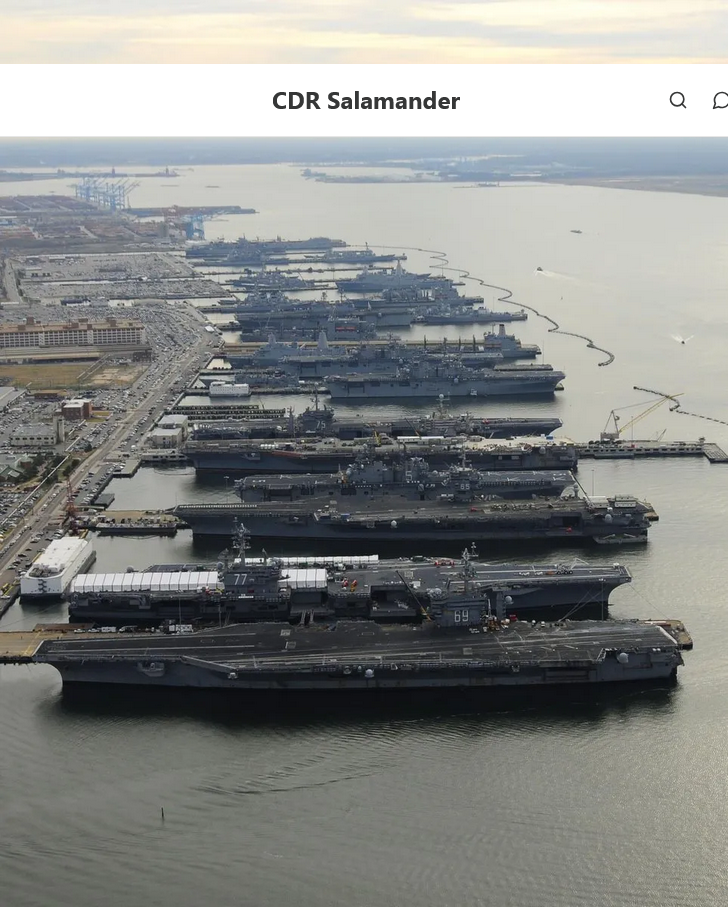
[This] picture from 2012 of Norfolk is what I want you to think about.

We talked about the superbly executed Ukrainian attack on Russian bomber bases for most of yesterday’s Midrats, and what keeps coming to mind for me is not the details of that attack, but the stark warning it is giving us.

The threat of drone strikes isn’t a new warning, but in my mind it intersect almost perfectly with the self-inflicted vulnerability of the US Navy’s fleet — its concentration.

The growing utility of attack drones isn’t an insight that is unique to the Russo-Ukrainian War. The topic has come up here and on Midrats for almost two decades. We’re not alone. Heck, broad thinking people like our friend Matt Hipple was pondering it over at CIMSEC thirteen years ago a few months before the picture at the top of the post was made.

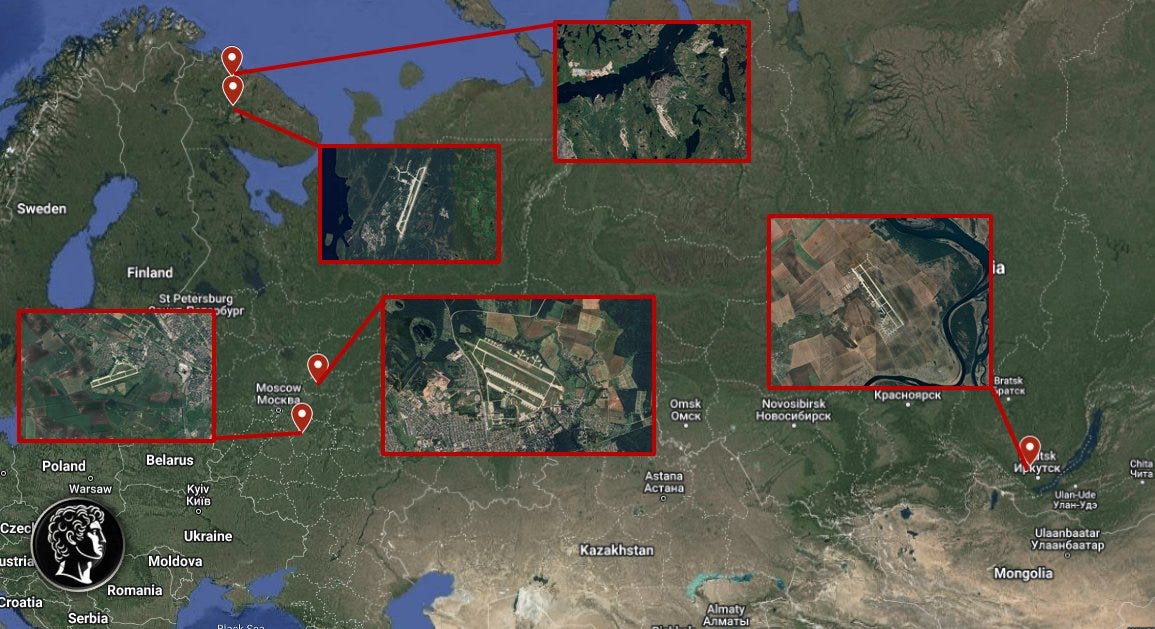
I’ll tie in the picture a bit, but let’s take a moment to give the Ukrainians credit where credit is due. They executed precision strikes against the RUS bomber fleet across the entire two-thirds of the Euro-Asian landmass.

We will find out more details, a dozen or 40+ high-demand/low-density strategic bombers were taken off the battle line. RUS is not building any more of them. As missile carriers, they have been a cornerstone of the city terrors for most of the last four years. You would be hard-pressed to find a more honorable, or legitimate target.

Streiff over at Red State has a good summary with what we think we know as of Sunday afternoon:

    The airbases are the home to Russia’s fleet of Tu-22, Tu-95M, and Tu-160 nuclear-capable strategic bombers as well as AS-50 battle management aircraft. They were located from the Siberian Far East to the Arctic Circle. The furthest target, Belaya Airbase in Irkutsk, is over 2700 miles from Ukraine.

    Reports indicate that at least 41 aircraft were hit. The unofficial tally indicates 24 Tu-22, 8 Tu-95MS, and 5 Tu-16 were hit. MiG-31 fighters and Il-76 transports were also hit. To put this in context, open-source data says Russia’s bomber inventory is about 58 Tu-22, 47 Tu-95MS, and 15 Tu-160. These planes are the ones used to launch most of the missiles fired at Ukrainian cities.

    By any standard, this was a devastating attack. Nearly half of the Tu-22, a quarter of the Tu-95MS, and a third of the Tu-160 fleet, representing just over 30 percent of Russia’s strategic bomber force, were damaged or destroyed in one attack. When you consider the operational readiness rate, Russia probably has less than 50 aircraft capable of flying … on the bright side, they have plenty of aircraft to cannibalize for parts. The Tu-22 and Tu-95MS production lines are closed, and the Tu-160 production is one, yes, one per year. For all intents and purposes, this represents a permanent decrease in the size of the Russian strategic bomber fleet.

Before we discuss what the USA needs to take away, let’s look at the top-4 primary and second-order effects this will have on the Russian Federation.

First Order Effects

  • Fewer raiding assets to use against UKR.
  • The weakest leg of their nuclear triad (bombers are dual use) is even weaker.
  • PSYOP defeat as RUS now know even their most valuable weapons, stationed deep into RUS rear, are vulnerable.
  • Paranoia elevated into an already paranoid national psyche under duress of year four of a grinding war.

Second Order Effects

  • Inefficiencies in both civilian logistics and manpower are the natural response to every tractor-trailer being a weapons delivery vehicle at range … and the need to defend important bases as a result, sinks into an already stressed nation.
  • Loss of face. RUS launched a war of choice against nation 1/4th its size and much weaker than it from any measure, and four years on, still has only made marginal progress. Now that nation proved it can operate with impunity anywhere inside RUS. The “R” in BRICS is not impressing its friends.
  • It shouldn’t, but this is going to get the nuclear autists the jitters. All theory, but yes, UKR took out one-third or more of the fully mission capable nuclear capable bombers that form one leg — but as mentioned above the weakest leg — of RUS’s nuclear deterrence. Those who work in the theory-dominated nuclear world will have all their gauges twitching, yes, but in the end analysis, it won’t matter.
  • UKR morale just got a big boost. Wars of attrition usually last until one side or the other loses either the material ability or the will to fight. At least from the “will” line of operation, that decisive point just shifted to the right.

Simply a superb operation. How do you defend against weapons like this disguised in a trailer’s false roof?

May 28, 2025

Masters of the Air – The Bomber War Episode 4 – 8th Air Force 1942-1943

HardThrasher
Published 6 Jan 2024

If you’d like to be a cool kid, then become a Patreon or if you’d like to email me send a message to lordhardthrasher@gmail.com

0:00 Intro
4:30 We’re Going to North Africa 1st
8:36 But you’re not doing it properly
16:16 Play it Again Ira
22:30 Mid 1943 – The Crisis Begins
26:53 The Black Summer
28:03 Operation Tidal Wave
34:21 Into The Valley of Death – Schweinfurt
41:34 What Now?
48:37 Survivors Club
(more…)

« Newer Posts — Older Posts »

Powered by WordPress