Quotulatiousness

January 30, 2019

The high cost Canadians pay to support our oligopolies

In the National Post, Andrew Coyne compares the Liberal and Conservative parties’ respective claims to lower the cost of living for Canadians, and points out some examples that neither party is willing to address:

For example, there is the notorious system of agricultural quotas known as supply management — a price-fixing ring the government not only approves but organizes and enforces, whose effect is to double or even triple the prices of such basic food items as milk, cheese, eggs and chicken. For all their pretended concern for affordability, all parties and every MP, with the sole exception of Maxime Bernier, are publicly, nay fervently in favour of it.

But while the farm cartel gets a lot of ink, there are plenty of other examples. Canadians pay among the highest wireless telephone fees in the world, for starters — maybe even the highest — as study after study has found. The latest report from Tefficient, a European consultancy, found Canada’s carriers take in more revenue per gigabyte of data than their counterparts anywhere else in the world — 23 times more than in Finland.

Similarly, Canadians pay among the highest air fares in the world. The travel website Kiwi. com recently found flights from Canada on a full-service airline cost roughly five times as much per 100 kilometres as flights from the United States. The situation was a little better for domestic flights, where costs were only twice as high as in the U.S. The makers of Hopper, the travel app, note it is typically cheaper to fly from Vancouver to Hawaii than from Vancouver to Regina, though Regina is 3,000 km closer.

Finally, there are Canadian bank fees, also — you guessed it — among the highest in the world, particularly for mutual funds. What is the common thread among these three industries? All are highly concentrated oligopolies: three big wireless carriers, two big airlines and five big banks dominate their respective markets.

Rather than compete as vigorously as they might for Canadian consumers, these quasi-cartels are permitted, in effect, to harvest them. They do so, again, not only with the tolerance but the active participation of the government. Foreigners are effectively precluded from competing in any of them, whether by foreign-ownership restrictions or outright prohibitions on competition — foreign airlines may not fly from one Canadian city to another, for example.

None of the parties currently boasting of their desire to make life more affordable for Canadians proposes to change a line of this, either. Whatever else may be in (artificially) scarce supply, in Canadian politics there’s never any shortage of rank hypocrisy.

January 24, 2019

In Canada, “total revenue per GB is roughly 70 times higher than in India and 23 times higher than in Finland”

Filed under: Business, Cancon, Government, Technology — Tags: — Nicholas @ 03:00

Canadians are used to being screwed by our telecommunications companies, but it’s worse than I thought, as Michael Geist illustrates:

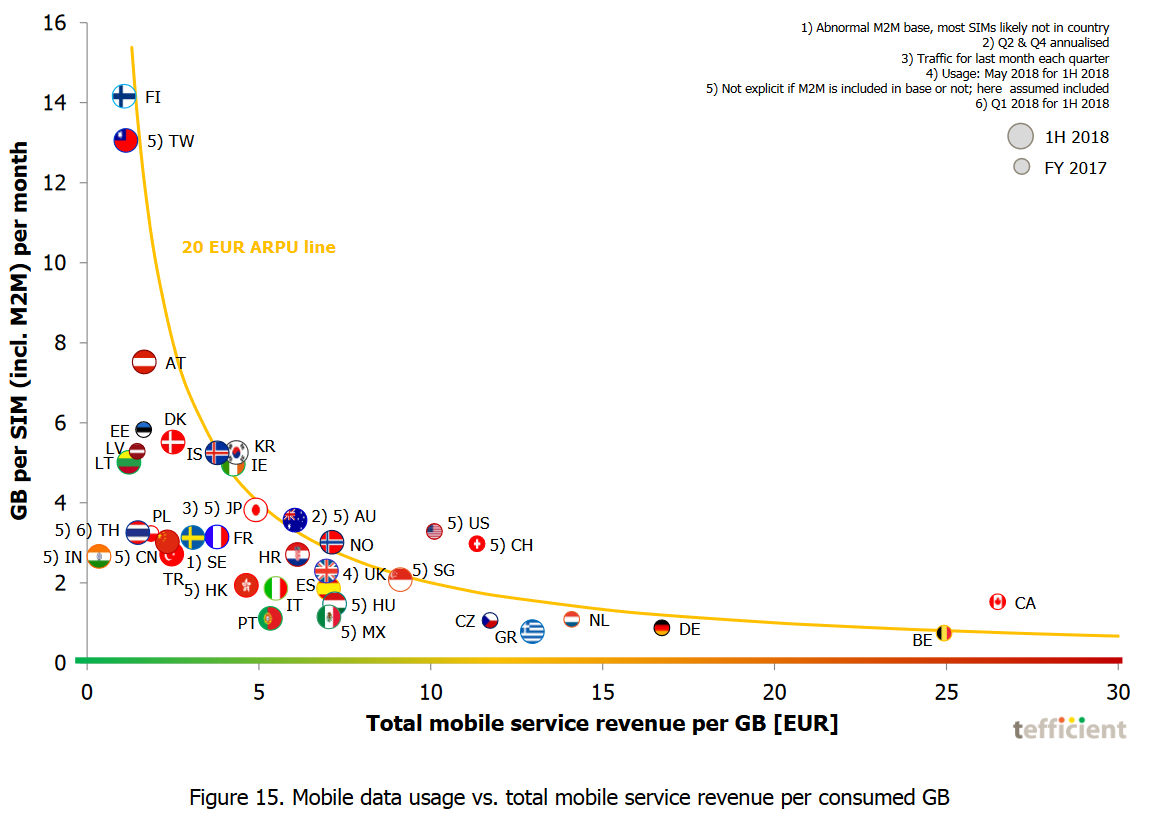
Tefficient, a European-based consultancy on the wireless market, released its latest report this morning comparing pricing and usage in the global wireless market. The data, which incorporates the most recent CRTC numbers on the Canadian market, shows Canada as a global outlier when it comes to the revenues generated by wireless carriers. The report notes the unsurprising correlation between high prices and low data usage:

    There is a prerequisite for continued data usage growth, though: The total revenue per gigabyte can’t be too high – like in Canada and Belgium. The total revenue per gigabyte here is roughly 70 times higher than in India and 23 times higher than in Finland. And consequently, mobile usage is lower than average.

The charts show where Canada stands relative to other countries with carriers generating more revenue per GB than anywhere else in the world and consequently Canada lagging behind many other countries in wireless usage.

Source: https://tefficient.com/wp-content/uploads/2019/01/tefficient-industry-analysis-3-2018-mobile-data-usage-and-revenue-1H-2018-per-country-final-17-Jan-2019.pdf

January 23, 2019

The value of boredom

Filed under: Health, Liberty, Media, Technology — Tags: , , , — Nicholas @ 03:00

I must have missed this Quillette essay by Caroline ffiske when it was published earlier this month:

In their book The Coddling of the American Mind Jonathan Haidt and Greg Lukianoff wonder where it all went wrong. How did we get to a situation where so many of our kids see themselves as fragile victims, but at the same time throw their weight around, telling the rest of us what we are allowed to think and say and do? Haidt and Lukianoff have set up a website devoted to exploring the issue and finding solutions.

I have a suggestion. It hit me like a hammer blow when I read Joseph Brodsky’s essay “In Praise of Boredom.” This was delivered as a commencement address at Dartmouth College in July 1989. Here is the opening sentence: “A substantial part of what lies ahead of you is going to be claimed by boredom.” That’s right. Joseph Brodsky, winner of the Nobel Prize for literature in 1987, assumed that these Ivy League graduates, in common with the rest of humanity since the dawn of time would face hours of the psychological Sahara of boredom that “starts right in your bedroom and spurns the horizon.”

How could Brodsky have guessed that the young people he addressed in July 1989 would be the last Western generation to live alongside boredom: in their bedrooms, on the bus, at the end of the day, and in the morning? That now, when the tiniest tips of our little fingers feel the first twinges of tedium, while the elevator travels between ground and first, we reach for our screens to become masters of fate, captains of souls, kings of new continents.

Even the vocabulary of boredom is disappearing. Brodsky lists these: “anguish, ennui, tedium, doldrums, humdrum, the blahs, apathy, listlessness, stolidity, lethargy, languor, accidie, etc.” Most of those can be excised from the Dictionary. Tell me honestly when you last used any of them?

[…]

Why? Because boredom represents your window onto infinity. And that is to say, onto your own insignificance. “For boredom speaks the language of time, and it is to teach you the most valuable lesson in your life … the lesson of your utter insignificance.” Boredom puts your existence into perspective “the net result of which is precision and humility.” The more you learn about your own size “the more humble and compassionate you become to your likes.”

Is boredom the ingredient our “snowflake” generation is missing?

November 19, 2018

“You call someplace paradise/kiss it goodbye”

Filed under: Environment, USA — Tags: , , , , — Nicholas @ 05:00

The Eagles song “The Last Resort” references a generic paradise, not the California town of that name, yet it fits disturbingly well, as Gerard Vanderleun describes:

Paradise is not a town on some flat land out on the prairies or deep in the desert. Paradise is a series of cleared areas and roads superimposed on an extremely rugged terrain composed of deep, narrow ravines and high and densely wood ridges. The Skyway is fed by hundreds of paved and unpaved roads that twist and turn and rise and dip and then, at their OFFICIAL ends, run deeper still and far off the grid. If you live in Paradise you know there are hundreds of people living back up in those ravines and ridges that would be hard to find before the fire. In those places, the poor are lodged tighter than ticks.

I’ve seen, before the fire this time, people in the outback of Paradise so abidingly poor they were living in trailers from the 70s resting on cinder blocks and at most only two winters away from a pile of rust. These people would have had no warning of a fire, no warning at all. Instead of “sheltering in place” they would have been “incinerated in place.”

In the ravines and forests of Paradise, cell reception was so spotty that AT&T gave me my own personal internet driven cell-phone tower. If those off the grid in Paradise actually owned cell phones they would have been lucky to get an alert. But most of those did not own cell phones, and landlines didn’t run that deep in the woods. When the fire closed over them they would have had no warning. No warning until the trailer melted around them. And then there was, out behind but still close to their trailer, their large propane tank.

May 30, 2018

“Characters in children’s books are increasingly the victims, rather than the heroes, of their own stories”

Filed under: Books — Tags: , , , — Nicholas @ 03:00

In Spiked, Christopher Beckett explains how children’s books are increasingly becoming “misery lit”:

According to the judges of the Branford Boase Award, which is presented annually to an outstanding children’s or young-adult novel by a first-time writer, fiction for young people is getting increasingly narrow and downbeat. Philip Womack, one of the prize’s judges, told the Guardian that around one third of this year’s entries were domestic dramas, all with a ‘very similar narrative’: ‘There’s an ill child at home, who notices something odd, and is probably imagining it, but not telling the reader. They’re all in the first person, all in the present tense, all of a type.’ Such books were, he added, ‘so enclosed, so claustrophobic, so depressing and formulaic… It does make for a rather depressing children’s literary landscape’. Adventure stories, he says, seem to be on the way out.

Perhaps we shouldn’t be so surprised. Children’s worlds have become smaller and more claustrophobic over recent decades. They have become less adventurous: they spend less time outside and more time under the watch of their parents. Children are also now more likely to be found glued to smartphones, tablets, computers and videogames rather than books. The escape they get from everyday life and parental supervision comes largely from tracking the lives of Instagram and YouTube celebrities, and immersing themselves in gaming adventures. But neither of these mediums leave space for the imagination to flourish – for play and interactions with others.

Worse still, kids’ lit today seems to reflect an unhealthy obsession with the private sphere and family life. Julia Eccleshare, co-founder of the Branford Boase Award and children’s director of the Hay Festival, writes in the Bookseller that more and more children’s books are now dealing with ‘family breakdown, accidents, deaths [and] mental-health problems… all of which it will be impossible for a child to resolve as the issues are insurmountable’. Characters in children’s books are increasingly the victims, rather than the heroes, of their own stories.

May 16, 2018

“Congrats, you have trained me to ignore Emergency Alerts”

Filed under: Cancon, Government, Technology — Tags: , , , — Nicholas @ 03:00

The national emergency alert system for mobile phones just went online, and it’s already training people to ignore them:

When the siren-like sounds from an Amber Alert rang out on cellular phones across Ontario on Monday, it sparked a bit of a backlash against Canada’s new mobile emergency alert system.

The Ontario Provincial Police had issued the alert for a missing eight-year-old boy in the Thunder Bay region. (The boy has since been found safe.)

But gripes about the system soon began to pour in. Kingston police said they received “several complaints” regarding the Amber Alert notice. On social media, people startled by the alerts complained about the number of alerts they received and that they had received separate alerts in English and French.

“Sooo, is that emergency alert going to happen at like 4 a.m. with sleep mode enabled? Just asking for my heart health,” tweeted James G.

Meanwhile, others who were located far from the incident felt that receiving the alert was pointless.

“I’ve received two Amber Alerts today for Thunder Bay, which is 15 hours away from Toronto by car,” tweeted Molly Sauter. “Congrats, you have trained me to ignore Emergency Alerts.”

Mark Blevis, an Ottawa-based digital public affairs analyst, said he understands the importance of Amber Alerts, but system managers risk alienating cellphone users at some point if these types of alarms go off regularly.

“If they’re going to send out multiple alerts on the same thing, you need to find a way to streamline it so they don’t breed that apathy that causes the whole system to break down,” Blevis said.

At the very least, they should be able to figure out how to avoid the duplication of English and French alerts, he said.

May 5, 2018

Canada is #1 in the world! In the ripping-off-the-wireless-user sweepstakes!

Filed under: Business, Cancon, Technology — Tags: , , , — Nicholas @ 05:00

This is the sort of thing that isn’t really surprising — if you’re a Canadian wireless data user — but puts it into a sad, sad perspective:

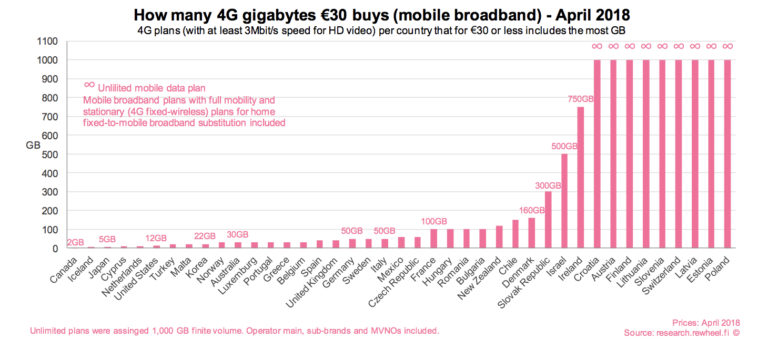
The sad state of Canadian wireless pricing is old news for consumers and the government, but a new report graphically demonstrates how Canadians face some of the least competitive pricing in the developed world. The Rewheel study measured pricing in EU and OECD markets by examining how many gigabytes of 4G wireless data consumers get for the equivalent of 30 euros. This chart from Rewheel says it all:

Canada is at the far left of the chart with consumers getting less for their money than anyone else. While many countries offer unlimited mobile data at that price, the report says Canadian carriers offer a measly 2 GB. The smartphone data plans aren’t much better, with nearly all countries offering better deals and many shifting to unlimited data at that price.

[…]

In addition to outrageously expensive wireless data plans, Canadians also face huge overage charges (more than a billion dollars per year generated in the wireless overage cash grab) and steadily increasing roaming charges. Yet when it came to introducing greater resale competition, the CRTC rejected new measures that it admitted could result in some improvement to affordability.

April 19, 2018

The mis-measurement of the digital economy

Filed under: Economics, Technology — Tags: , , , , — Nicholas @ 05:00

In the Continental Telegraph, Tim Worstall explains why our current statistical model does not adequately reflect the online world’s contribution to our economy:

To give my favourite current example. WhatsApp is used by some billion people around the world for some to all of their telecoms needs. It turns up in economic statistics as a reduction in productivity.

That’s mad.

In more detail, WhatsApp is free to use and carries no advertising. That means there’s no sale associated with it. We measure consumption at market prices – a price of $0 means no consumption. Consumption is one of the three ways we measure GDP – each of the three should be the same as the other two but isn’t because lying about taxes.

The other two calculations are all incomes, or all production. Things that are sold at no price do not add to production given that we measure it at market prices.

Income, well, there’re 200 or so engineers at Facebook who work on it (I checked with Facebook itself). Say their salary is $250k a year each. Probably too low but we’ve got to use some number or other. $50 million then. That’s incomes added to GDP.

So, in our three methods of calculating GDP – they should all be the same but that doesn’t matter here – we’ve value of WhatsApp (more accurately, WhatsApp adds value of $x each year to the global economy) of $50 million. Or $0 or $0.

March 18, 2018

Border privacy issue should (eventually) get to the US Supreme Court

Filed under: Law, Liberty, USA — Tags: , , , — Nicholas @ 03:00

In Reason, Damon Root reports on two duelling precedents about US citizens’ right to privacy and the government’s interest in what’s on your smartphone when you re-enter the United States:

In its 2014 decision in Riley v. California [PDF], the U.S. Supreme Court held that law enforcement officials violated the Fourth Amendment when they searched an arrestee’s cell phone without a warrant. “Modern cell phones are not just another technological convenience,” Chief Justice John Roberts wrote for the majority. “With all they contain and all they may reveal, they hold for many Americans ‘the privacies of life.’ The fact that technology now allows an individual to carry such information in his hand does not make the information any less worthy of the protection for which the Founders fought.”

But what about when an American citizen is returning home from abroad and U.S. border officials want to thoroughly search the contents of that person’s cell phone? Does the Fourth Amendment require the government to get a warrant before searching cell phones at the border? According to a decision issued this week by the U.S. Court of Appeals for the 11th Circuit, the answer to that question is no.

[…] a divided panel of the 11th Circuit took a different view. “The forensic searches of Vergara’s cell phones occurred at the border, not as searches incident to arrest,” declared the majority opinion of Judge William H. Pryor. “And border searches never require a warrant or probable cause.”

Writing in dissent, Judge Jill Pryor wrote that while she agrees “with the majority that the government’s interest in protecting the nation is at its peak at the border,” she disagrees “with the majority’s dismissal of the significant privacy interests implicated in cell phone searches.” In Riley, she noted, the Supreme Court recognized “the significant privacy interests that individuals hold in the contents of their cell phones.” And in her view, “the privacy interests implicated in forensic searches are even greater than those involved in the manual searches at issue in Riley.” If it were up to her, “a forensic search of a cell phone at the border [should require] a warrant supported by probable cause.”

One thing is clear: We have not heard the last of this debate. Either this case, or one very much like it, is almost certainly headed for the Supreme Court.

The Truth About Wireless Charging

Filed under: Technology — Tags: , , , — Nicholas @ 02:00

Real Engineering
Published on 23 Feb 2018

January 17, 2018

Thirty-eight minutes in Hawaii

Filed under: Government, Media, Pacific, USA — Tags: , , , — Nicholas @ 03:00

Colby Cosh on the false alarm in Hawaii:

Of course, an incident like this really takes several idiots lined up in a long row. Missile tests by North Korea have been making Hawaiian officials nervous lately about the archipelago’s exposed position in the mid-Pacific. The rhetoric being traded between dictator Kim Jong-un and U.S. President Donald Trump is certainly not so easy to brush off in Hawaii, where plenty of living people have personal memories of Pearl Harbor.

U.S.-North Korean tension has, in recent months, been leading to a de-mothballing of old civil-defence measures in Hawaii, such as sirens and bomb shelters. It has also led, as we now know, to the updating of the traditional emergency broadcasting system. It can now reach out to your phone and fling you right out of your four-poster bed at the Hyatt Regency Waikiki Beach.

For something that was “not a drill”, the mistaken smartphone message will have had a lot of the same effects. The most important thing that HEMA learned was that if you have the ability to electronically auto-terrorize everyone within a certain radius, you had better have some fast, equally automatic way of correcting an error. It took HEMA 38 minutes to send a second notice to smartphone users reading “There is no missile threat or danger to the State of Hawaii. Repeat. False Alarm.” And, no, I’m not sure what the “Repeat” is doing there, either.

During those 38 minutes, thousands of Hawaiians and tourists had sent desperate farewells to loved ones — although some noticed that the outdoor sirens, which had just been tested last month, were not going off, and drew the correct conclusion. There is very little evidence of anything technically describable as “panic” happening in the state, despite the ubiquitous use of that word in Sunday headlines.

Jokes about poor interface design are being circulated in the aftermath of the Hawaiian incident, but the governor did specify that the person who made the “mistake” actually clicked through a second “are you sure you want to create traumatizing chaos for no reason?” confirmation message. HEMA also says it will require two separate people to confirm smartphone alerts in the future, which, if I can be forgiven a toe-dip into conspiratorial thinking, almost seems to hint at the possibility of some kind of awareness-raising prank.

December 12, 2017

Why Hold Music Sounds Worse Now

Filed under: Business, History, Technology — Tags: , , , — Nicholas @ 02:00

Tom Scott
Published on 27 Nov 2017

It’s not your imagination; hold music on phones really did sound better in the old days. Here’s why, as we talk about old telephone exchanges and audio compression.

Thanks to the Milton Keynes Museum, and their Connected Earth gallery: http://www.mkmuseum.org.uk/ – they’re also on Twitter as @mkmuseum, and on Facebook: https://www.facebook.com/mkmuseum/

October 3, 2017

QotD: Generation selfie

Filed under: Humour, Quotations — Tags: , , , , — Nicholas @ 01:00

There was a whole section of the catalog I picked up in which the models obscured their faces with their phones by taking selfies. Unlike most models these days, who affect a look of unutterable misery (perhaps it is not an affectation, given that they are not allowed to eat and are treated like slaves), the models taking selfies looked very happy, at least in those pictures in which it was possible to discern their facial expression. Perhaps, then, it is in looking at oneself that true happiness lies, at least for some people.

Certainly, at every famous tourist site these days one sees whole troops of people taking pictures of themselves: me and the Mona Lisa, me and the Eiffel Tower, me and Big Ben, me and the Empire State Building, me and Mount Everest. It is the me that counts in these photos, of course; no one’s friends really care about Mount Everest, and even concern for the me is relative. A selfie with Mount Everest is like an alibi when one has been accused of claiming to have been there without having been there; the proof is in one’s phone, although it must be admitted that these days, with an ability to alter photos at will that would have brought joy to Stalin’s heart, anything can be arranged. I read in the memoir of a French model that, having starved mannequins to the size of minus 6, they are fattened up a little afterwards by computer at the printing stage: a remarkable testimony to mankind’s capacity to combine wickedness with stupidity.

The selfie is an example of the new social contract brought about by the social media: You pretend to be interested in me if I pretend to be interested in you. Thus, I agree to look at your selfie at Machu Picchu if you agree to look at mine at Angkor Wat. And this, after all, is as it should be, because it is a long way to go to either of those if no one believes you have been. A classic book is a book that everyone wishes he had read; a wonder of the world is a place at which everyone wishes he had been photographed.

Theodore Dalrymple, “Suit Yourselfie”, Taki’s Magazine, 2017-09-16.

August 5, 2017

“… theirs is a generation shaped by the smartphone and by the concomitant rise of social media. I call them iGen”

Filed under: Technology, USA — Tags: , , , , , , , — Nicholas @ 04:00

In The Atlantic, “Gen Xer” Jean Twenge is worried about the ways the new generation differ from their Millennial predecessors:

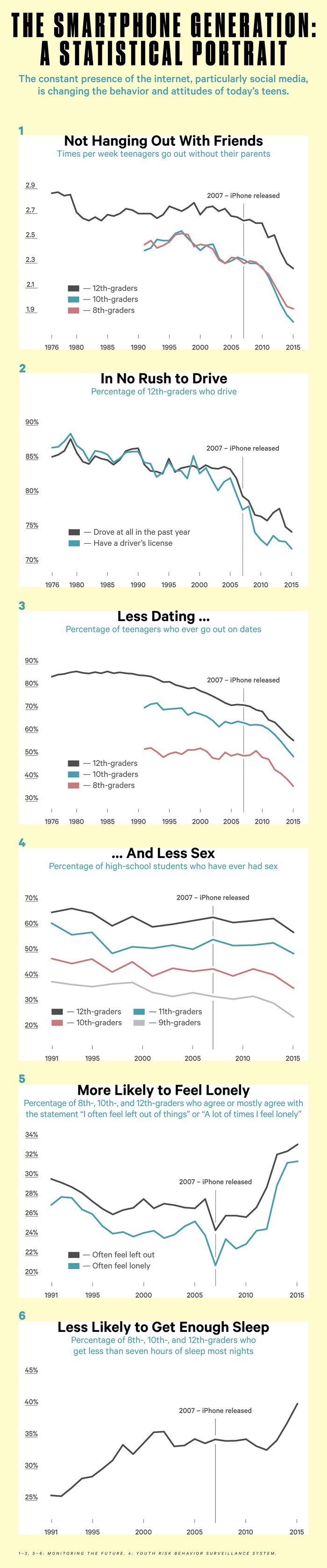
Click to see full-size image

I’ve been researching generational differences for 25 years, starting when I was a 22-year-old doctoral student in psychology. Typically, the characteristics that come to define a generation appear gradually, and along a continuum. Beliefs and behaviors that were already rising simply continue to do so. Millennials, for instance, are a highly individualistic generation, but individualism had been increasing since the Baby Boomers turned on, tuned in, and dropped out. I had grown accustomed to line graphs of trends that looked like modest hills and valleys. Then I began studying Athena’s generation.

Around 2012, I noticed abrupt shifts in teen behaviors and emotional states. The gentle slopes of the line graphs became steep mountains and sheer cliffs, and many of the distinctive characteristics of the Millennial generation began to disappear. In all my analyses of generational data — some reaching back to the 1930s — I had never seen anything like it.

At first I presumed these might be blips, but the trends persisted, across several years and a series of national surveys. The changes weren’t just in degree, but in kind. The biggest difference between the Millennials and their predecessors was in how they viewed the world; teens today differ from the Millennials not just in their views but in how they spend their time. The experiences they have every day are radically different from those of the generation that came of age just a few years before them.

What happened in 2012 to cause such dramatic shifts in behavior? It was after the Great Recession, which officially lasted from 2007 to 2009 and had a starker effect on Millennials trying to find a place in a sputtering economy. But it was exactly the moment when the proportion of Americans who owned a smartphone surpassed 50 percent.

The more I pored over yearly surveys of teen attitudes and behaviors, and the more I talked with young people like Athena, the clearer it became that theirs is a generation shaped by the smartphone and by the concomitant rise of social media. I call them iGen. Born between 1995 and 2012, members of this generation are growing up with smartphones, have an Instagram account before they start high school, and do not remember a time before the internet. The Millennials grew up with the web as well, but it wasn’t ever-present in their lives, at hand at all times, day and night. iGen’s oldest members were early adolescents when the iPhone was introduced, in 2007, and high-school students when the iPad entered the scene, in 2010. A 2017 survey of more than 5,000 American teens found that three out of four owned an iPhone.

The advent of the smartphone and its cousin the tablet was followed quickly by hand-wringing about the deleterious effects of “screen time.” But the impact of these devices has not been fully appreciated, and goes far beyond the usual concerns about curtailed attention spans. The arrival of the smartphone has radically changed every aspect of teenagers’ lives, from the nature of their social interactions to their mental health. These changes have affected young people in every corner of the nation and in every type of household. The trends appear among teens poor and rich; of every ethnic background; in cities, suburbs, and small towns. Where there are cell towers, there are teens living their lives on their smartphone.

It could be that the widespread use of available technology to “virtualize” adolescence is at least to a degree a reaction to helicopter parenting.

H/T to Kate at Small Dead Animals for the link.

August 1, 2017

Ontario adopts voluntary self-surveillance app from CARROT Insights

Filed under: Cancon, Government, Liberty, Technology — Tags: , , , , , — Nicholas @ 05:00

I often joke about how inexpensive it appears to be to “influence” politicians, but it’s only fair to point out that the voters those easily influenced politicians represent are even more easy to influence:

Ontario announced earlier this month that it will become the fourth Canadian government to fund a behavioral modification application that rewards users for making “good choices” in regards to health, finance, and the environment. The Carrot Rewards smartphone app, which will receive $1.5 million from the Ontario government, credits users’ accounts with points toward the reward program of their choice in exchange for reaching step goals, taking quizzes and surveys, and engaging in government-approved messages.

The app, funded by the Canadian federal government and developed by Toronto-based company CARROT Insights in 2015, is sponsored by a number of companies offering reward points for their services as an incentive to “learn” how to improve wellness and budget finances. According to CARROT Insights, “All offers are designed by sources you can trust like the BC Ministry of Health, Newfoundland and Labrador Government, the Heart and Stroke Foundation, the Canadian Diabetes Association, and YMCA.” Users can choose to receive rewards for companies including SCENE, Aeroplan, Petro-Canada, or More Rewards, a loyalty program that partners with other businesses.

It’ll be interesting if they share the uptake of this new smartphone app … just how many of us are willing to let the government track just about all of our actions in exchange for “rewards”.

In order to use the app, users are giving Carrot Insights and the federal government permission to “access and collect information from your mobile device, including but not limited to, geo-location data, accelerometer/gyroscope data, your mobile device’s camera, microphone, contacts, calendar and Bluetooth connectivity in order to operate additional functionalities of the Services.”

Founder and CEO of CARROT Insights Andreas Souvaliotis launched the app in 2015 “with a focus on health but the company and its partner governments quickly realized it was effective at modifying behavior in other areas as well,” according to CTV News.

« Newer PostsOlder Posts »

Powered by WordPress