
TimeGhost Cartographic
Published 12 Feb 2026July, 1943. With the German summer offensive in the East well underway, and Allied operations in North Africa wrapped up, a decision is made to strike Axis Europe on the ground for the first real time. Sicily shall be their battleground, and the omens are good. Still, landing and commanding a huge multinational force in hostile territory is a challenge the Western Allies have not had to face head-on before, but one they must overcome if they wish to have any shot of defeating Hitler and Mussolini once and for all.
00:00 Intro
01:13 Background
04:42 Disposition
07:32 The Landings & Initial Fighting
09:34 Fighting Across the Island
11:56 Aftermath
16:38 Conclusion
(more…)
February 13, 2026
Lines of Fire: Operation Husky – The Invasion of Sicily 1943 – WW2 in Animated Maps
Comments Off on Lines of Fire: Operation Husky – The Invasion of Sicily 1943 – WW2 in Animated Maps
November 8, 2025
History Summarized: Greece… TWO (it’s in Italy)
Overly Sarcastic Productions
Published 4 Jul 2025From the Olympians who brought you “Greece” and “The Other Side of Greece” comes the bold, innovative, and way shinier “GREECE TWO”.
SOURCES & Further Reading:
The Greeks: A Global History by Roderick Beaton
Ancient Greece: The Definitive Visual History produced by DK & Smithsonian
The Complete Greek Temples by Tony Spawforth
Ancient Cities Brought To Life by Jean-Claude Golvin
“From Sicily to Syria – The Growth of Trade and Colonization” from Ancient Greek Civilization by Jeremy McInerney
“Magna Graecia: Taras and Syracuse” and “Cyrene, Leptis Magna, and Ancient Libya” from Great Tours: Ancient Cities of the Mediterranean by Darius Arya
Sicily: An Island at the Crossroads of History by John Julius Norwich
“The Greeks: An Illustrated History” by Diane Harris Cline for National Geographic
Comments Off on History Summarized: Greece… TWO (it’s in Italy)
September 27, 2025
NATO – the alliance of paper tigers?
In UnHerd, Edward Luttwak suggests that despite President Trump calling the Russians “paper tigers”, the non-US members of the NATO alliance could more appropriately be described that way:
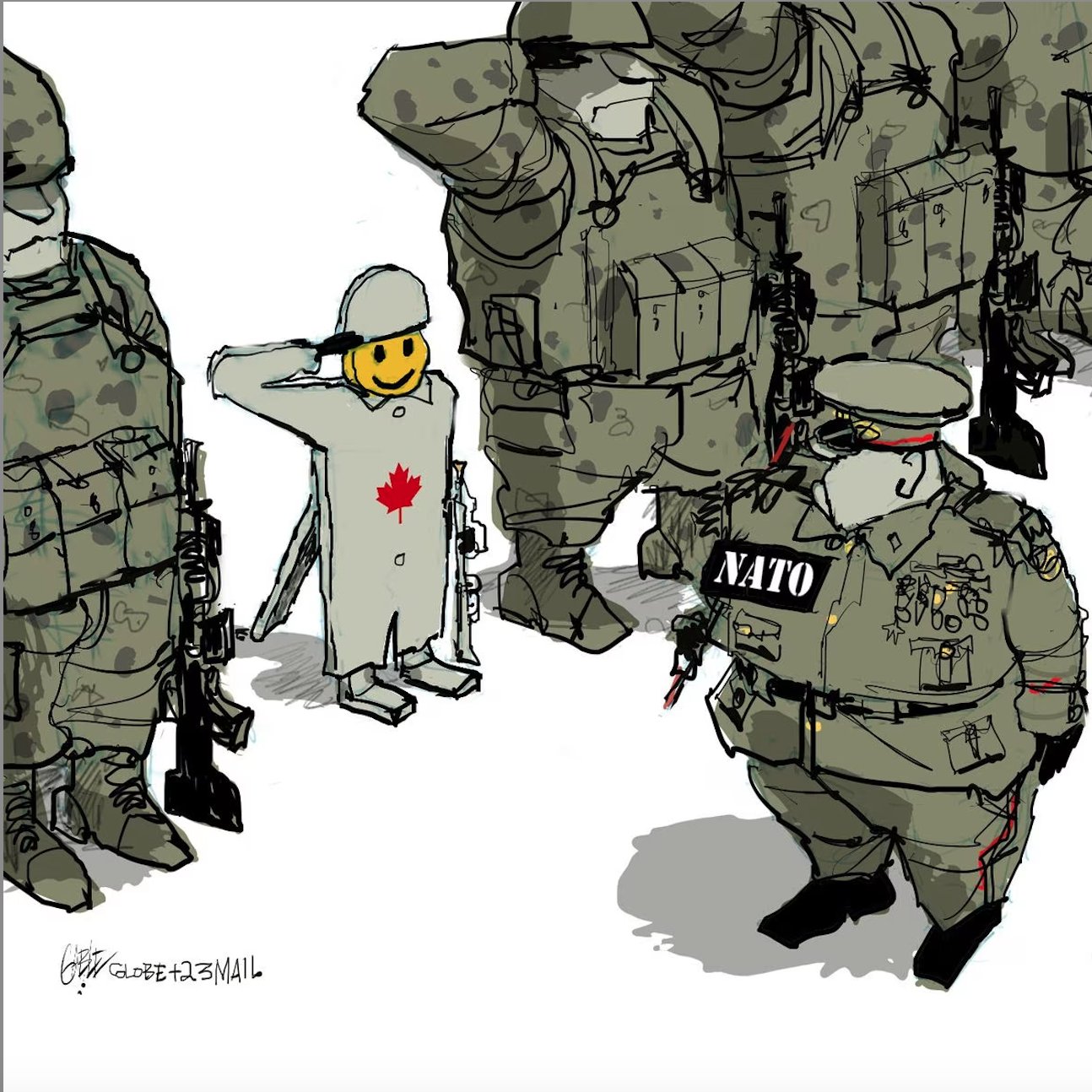
It’s been an open secret for decades that Canada’s NATO contributions are more rhetoric than reality, but it’s true of many of the European NATO allies, too.
… simply raising defence spending will not turn Europe’s states into genuinely effective military powers. For one thing, the GDP criterion is much too vague to mean much. Finland, for instance, spends only 2.4% of its GDP on defence and yet can mobilise some 250,000 determined soldiers. Other Nato members, which spend much more than the Finns, obtain far less for their money.
Moreover, focusing on GDP instead of force requirements — so many battalions, artillery regiments, fighter squadrons — is nothing but an invitation to cheat, an opportunity lustily taken up across the continent. The latest Spanish submarine, for instance, is not imported for €1 billion or so from Thyssen-Krupp, which supplies navies around the world with competent, well-proven submarines. Instead, it was proudly designed and built at the Navantia state-owned Spanish shipyard: for €3.8 billion, roughly the cost of a much bigger French nuclear-powered submarine. As a feeble justification for that absurdly high cost, Spain’s defence minister cited a supposedly advanced air-recirculation system — so greatly advanced, in fact, that it is not actually ready, and will not be installed even in the submarine’s next iteration.
Soon, though, Italy will outdo Spain’s platinum submarine: by including a new bridge to Sicily, set to cost some €13.5 billion, into its 2% of GDP Nato spending quota. The government’s excuse is that some 3,000 Italian troops may need to cross the Strait of Messina were the Italian army ever to be fully mobilised. But it would be much cheaper to fly them individually, each trooper in his own luxurious private jet. Even without the bridge, meanwhile, Italy’s cheating on the 2% target is bad enough. Most notably, much of the Italian Navy’s spending goes towards warships made by Italy’s state-owned Fincantieri shipyard. But there is not enough money for the fuel and maintenance expenses to operate more than half of them, meaning another industrial subsidy is camouflaged as defence spending. All the while, Italy refuses to increase its defence budget beyond the very modest target of 2% — which it has yet to meet.
As for Germany, three and half years since the start of the Ukraine war, with ever more ambitious rearmament plans loudly promised, the total number of personnel in uniform has actually slightly decreased. And, aside from beginning a multi-billion euro purchase on an Israeli missile-defence system, nothing much has happened. Despite its high demand in Ukraine, even the battle tank, that German specialty, is being produced in very, very small numbers: so low that the annual output could be lost in a morning of combat. In May 2023, indeed, a meagre 18 Leopard tanks were ordered to replace older models lost in Ukraine. The expected delivery date? Between 2025 and 2026! Then, in July, Germany purchased a further 105 advanced Leopard 2A8s. That is the number needed to equip a single brigade, the German force stationed in Lithuania — and they are expected to arrive in 2030!
The sad truth, then, is that Germany has yet to start working in earnest to correct the extreme neglect inflicted on its armed forces during the long Merkel premiership, when she kept saying that “even if we had the money we would not know how to spend it”. All the while, German helicopters lacked rotors and tanks lacked engines. The exceedingly slow recovery of the German army is especially frustrating because Nato is not actually short of air or naval forces. What it lacks are ground forces, soldiers more simply, or rather soldiers actually willing to fight. Having added Estonia, Latvia and Lithuania to the alliance, tiny countries with outsized defence needs, the alliance faces a severe troop deficit across the entire Baltic sector. The troops so far sent by Nato allies, such as visiting Alpini battalions from Italy, cannot improve the maths.
Update, 30 September: Welcome, Instapundit readers! Please do have a look around at some of my other posts you may find of interest. I send out a daily summary of posts here through my Substack – https://substack.com/@nicholasrusson that you can subscribe to if you’d like to be informed of new posts in the future.
July 11, 2025
The 1st Canadian Infantry Division in Operation Husky, 10 July 1943
For Project 44, Nathan Kehler describes the role of the 1st Canadian Infantry Division as the western-most part of Montgomery’s 8th Army landings on the southern tip of Sicily:
In the days leading up to Operation Husky, the Canadian contingent suffered two major losses – one in leadership and one in logistics. Though the landings would ultimately succeed, these events cast a shadow over the operation before a single boot touched Sicilian soil.
The Death of General Salmon
On July 2, 1943, Major-General G.G. Salmon, commander-designate of the 1st Canadian Infantry Division for the Sicily campaign, was tragically killed when his Hudson aircraft crashed near Barnstaple, Devonshire, shortly after takeoff from Hendon Airfield. Also on board were several senior officers, including Rear-Admiral P.J. Mack, the Canadian naval force commander, and Lt.-Col. C.J. Finlay, the newly appointed senior logistics officer for the division. All were killed.
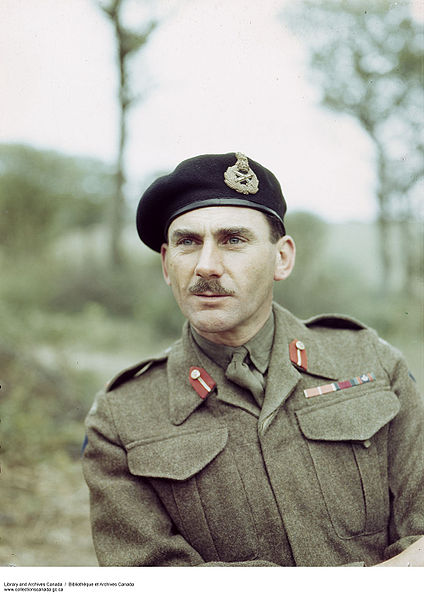
Major General Guy Simonds, commanding 1CID.
General Salmon had been hand-picked to lead Canada’s first major amphibious campaign. His death, just days before the invasion, shook the command structure. With no time to replace him formally, Major-General Guy Simonds was appointed in his place. Simonds was known for his drive, discipline, and tactical focus. The loss of Salmon meant an abrupt shift in leadership style and planning assumptions on the eve of battle.
Sinking of Canadian Troop Ships
Only days later, Canadian forces suffered another blow. Between 4–5 July, as convoys moved across the Mediterranean from North Africa toward Sicily, Axis submarines attacked Allied shipping near the Algerian coast. Three ships were torpedoed: the St. Essylt, City of Venice, and Devis.
While the first two sinkings resulted in relatively few casualties, the loss of the Devis was severe. Carrying 261 Canadian troops, the ship was hit and engulfed in fire. Fifty-two Canadians were killed, with many trapped in the holds below deck. In total, the convoy lost over 500 vehicles and 40 guns, along with critical headquarters and signals equipment. Divisional Headquarters suffered particularly heavy equipment losses, forcing last-minute improvisation in communications and command coordination.
Despite these losses, the Canadian Division adapted quickly, and the operation went forward as planned. These early setbacks, however, underscore the high cost and uncertainty of even reaching the battlefield in the Second World War.
Canadian Beaches
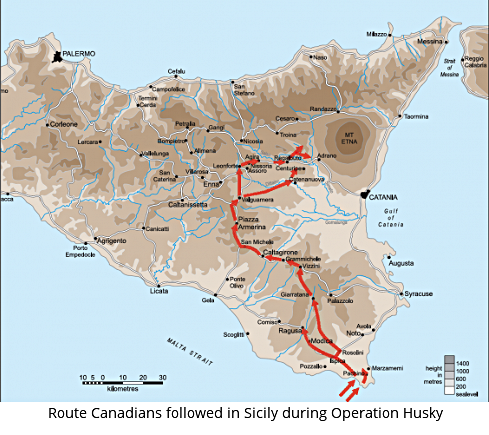
On 10 July 1943, the 1st Canadian Infantry Division landed in southeastern Sicily as part of Operation Husky – the Allied invasion of Europe’s “soft underbelly.” The division’s assault was split across two main beaches: “Roger” Beach to the east and “Sugar” Beach to the west of the village of Le Grotticelle. These beaches formed the right flank of the British Eighth Army’s landings.
General Simonds’ plan for the Canadians was a two-brigade front:
- The 1st Canadian Infantry Brigade would land on Roger Beach and push inland to destroy a coastal battery near Maucini, seize the Pachino airfield, and establish contact with nearby British forces around Pachino town.
- The 2nd Canadian Infantry Brigade would land on Sugar Beach, clear beach defences, support the adjacent British Special Service Brigade landing on the far left, and advance north past the Pantano Longarini marshes.
- The Special Service Brigade (British Commandos) would land west of Punta Castellazzo, eliminate enemy resistance in their zone, and cover the Canadians’ western flank from elevated ground north of the marshes.
The landings were scheduled for 2:45 a.m., with Commandos hitting the shore ten minutes earlier. Objectives were clear: knock out coastal defences, secure strategic positions, and quickly link up with Allied forces to expand the beachhead.
The Landings
Despite rough seas from a storm the day before, the landings went ahead as planned in the early hours of 10 July 1943. Just after 1:00 a.m., British Commandos began landing west of the Canadian sector, encountering only light resistance. By 1:34 a.m., the 2nd Canadian Infantry Brigade – the Seaforth Highlanders of Canada and Princess Patricia’s Canadian Light Infantry – were heading for Sugar Beach under covering fire from naval guns, including the 15-inch guns of HMS Roberts.
Navigation errors caused the Seaforth Highlanders to land to the right of the Patricias, reversing their intended order. But the heavy surf helped carry landing craft over a false beach, and both units came ashore with minimal opposition. They quickly cleared light beach obstacles and scattered Italian machine-gun posts. By 3:00 a.m., both battalions had successfully landed and were advancing inland toward their objectives.
On Roger Beach, however, the 1st Canadian Infantry Brigade faced delays. Their assault relied on DUKWs and landing craft (LCTs) arriving from Malta. When these were delayed, Brigadier Howard Graham initiated a backup plan, switching to Landing Craft Assault (LCAs). Confusion and the heavy swell caused further delay, with some units landing as late as 5:30 a.m. – nearly three hours behind schedule.
Despite the setbacks, the Hastings and Prince Edward Regiment and the Royal Canadian Regiment landed successfully. The Hastings had one reserve company land 5,000 yards off target in the Commando sector but regrouped without major issue. Both units met minimal resistance. The RCR encountered light shelling from the Maucini battery, but naval gunfire quickly silenced it.
By 6:45 a.m., all three lead brigades had secured their assigned beachheads, with support units and armour – including Shermans from the Three Rivers Regiment – beginning to land. The 48th Highlanders of Canada and The Edmonton Regiment followed their respective brigades ashore, some accompanied by pipe bands.
Opposition during the landings was light overall. Many Italian defenders withdrew as the naval bombardment and confusion of the assault overwhelmed them. However, isolated machine-gun fire and limited artillery shelling still resulted in several Canadian casualties, primarily on Roger Beach.
The pre-invasion loss of ships to enemy submarine or air attack was taken fully into account during the weeks before the convoys set out. But as with all military planning, the enemy gets a vote too.
Comments Off on The 1st Canadian Infantry Division in Operation Husky, 10 July 1943
June 26, 2025
A Basic Explanation Of The First Punic War
MoAn Inc.
Published 8 Jan 2025GEOGRAPHY NOTES
Messina is the modern name for Messana. Both are correct.
Acragas / Akragas was renamed as Agrigentum by the Romans. Most videos on YouTube use the name Agrigentum for convenience purposes … so again, both are correct.
Panormus is modern day Palermo.
Drepana / Drepanum is modern day Trapani.
Lilybaeum is modern day Marsala.!READ THE SOURCES FOR FREE!
Livy: https://www.perseus.tufts.edu/hopper/…
Polybius: https://www.perseus.tufts.edu/hopper/…
Cassius Dio: https://www.perseus.tufts.edu/hopper/…
(more…)
Comments Off on A Basic Explanation Of The First Punic War
May 16, 2025
A Very Basic Introduction To Ancient Carthage
MoAn Inc.
Published 1 Jan 2025Images Used
Hamilcar Barca and The Oath of Hannibal – Benjamin West (1738–1820) – https://en.wikipedia.org/wiki/Ancient…
Ancient Carthage. (2024, December 27). In Wikipedia. https://en.wikipedia.org/wiki/Ancient…
Numerius Fabius Pictor (antiquarian). (2023, October 11). In Wikipedia. https://en.wikipedia.org/wiki/Numeriu…)
Aristotle. (2024, December 27). In Wikipedia. https://en.wikipedia.org/wiki/Aristotle
Herodotus. (2024, December 30). In Wikipedia. https://en.wikipedia.org/wiki/Herodotus
Cassius Dio. (2024, November 28). In Wikipedia. https://en.wikipedia.org/wiki/Cassius…
Plutarch. (2024, December 23). In Wikipedia. https://en.wikipedia.org/wiki/Plutarch
Polybius. (2024, December 31). In Wikipedia. https://en.wikipedia.org/wiki/Polybius
Livy. (2024, November 23). In Wikipedia. https://en.wikipedia.org/wiki/Livy
File:Death Dido Cayot Louvre MR1780.jpg. In Wikipedia. https://commons.wikimedia.org/wiki/Fi…
Colosseum. (2024, December 21). In Wikipedia. https://en.wikipedia.org/wiki/Colosseum
Carthage Ports Puniques, https://commons.wikimedia.org/wiki/Fi…
File:Bardo National Museum tanit-edit.jpg. In Wikipedia. https://commons.wikimedia.org/wiki/Fi…
File:Bardo Baal Thinissut.jpg. In Wikipedia. https://commons.wikimedia.org/wiki/Fi…
File:Ginnasium Solunto.jpg. In Wikipedia. https://commons.wikimedia.org/wiki/Fi…
File:Carthage 323 BC.png. In Wikipedia. https://commons.wikimedia.org/wiki/Fi…A Bit About MoAn Inc. –
Trust me, the ancient world isn’t as boring as you may think. In this series, I’ll be walking you through a VERY basic idea of what happened during Rome’s famous Punic Wars.Donate Here: https://www.ko-fi.com/moaninc
Free Marble Image Photo by Henry & Co.thanks to https://unsplash.com/wallpapers/desig…
#AncientRome #AncientHistory #PunicWars
Comments Off on A Very Basic Introduction To Ancient Carthage
January 13, 2025
The Writings of Cicero – Cicero and the Power of the Spoken Word
seangabb
Published 25 Aug 2024This lecture is taken from a course I delivered in July 2024 on the Life and Writings of Cicero. It covers these topics:
• Introduction – 00:00:00
• The Deficiencies of Modern Oratory – 00:01:20
• The Greeks and Oratory – 00:06:38
• Athens: Government by Lottery and Referendum – 00:08:10
• The Power of the Greek Language – 00:17:41
• The General Illiteracy of the Ancients – 00:21:06
• Greek Oratory: Lysias, Gorgias, Demosthenes – 00:28:38
• Macaulay as Speaker – 00:34:44
• Attic and Asianic Oratory – 00:36:56
• The Greek Conquest of Rome – 00:39:26
• Roman Oratory – 00:43:23
• Cicero: Early Life – 00:43:23
• Cicero in Greece – 00:46:03
• Cicero: Early Legal Career – 00:46:03
• Cicero: Defence of Roscius – 00:47:49
• Cicero as Orator (Sean Reads Latin) – 00:54:45
• Government of the Roman Empire – 01:01:16
• The Government of Sicily – 01:03:58
• Verres in Sicily – 01:06:54
• The Prosecution of Verres – 01:11:20
• Reading List – 01:24:28
(more…)
Comments Off on The Writings of Cicero – Cicero and the Power of the Spoken Word
October 16, 2024
Roman Historian Rates 10 Ancient Rome Battles In Movies And TV | How Real Is It? | Insider
Insider
Published Jun 18, 2024Historian Michael Taylor rates depictions of ancient Rome in Gladiator, Spartacus, and Indiana Jones and the Dial of Destiny.
(more…)
Comments Off on Roman Historian Rates 10 Ancient Rome Battles In Movies And TV | How Real Is It? | Insider
July 30, 2024
QotD: The Roman Republic and the Social War
Rome’s tremendous run of victories from 264 to 168 (and beyond) fundamentally changed the nature of the Roman state. The end of the First Punic War (in 241) brought Rome its first overseas province, Sicily which wasn’t integrated into the socii-system that prevailed in Italy. Part of what made the socii-system work is that while Etruscans, Romans, Latins, Samnites, Sabines, S. Italian Greeks and so on had very different languages, religions and cultures, centuries of Italian conflict (and then decades of service in Rome’s armies) had left them with fairly similar military systems, making it relatively easy to plug them in to the Roman army. Moreover, being in Rome’s Italian neighborhood meant that Rome could simply inform the socii of how many troops they were expected to supply that year and the socii could simply show up at the muster at the appointed time (which is how it worked, Plb. 6.21.4). Communities on Sicily (or other far-away places) couldn’t simply walk to the point of muster and might be more difficult to integrate into core Roman army. Moreover, because they were far away and information moves slowly in antiquity, Rome was going to need some sort of permanent representative present in these places anyway, in a way that was simply unnecessary for Italian communities.
Consequently, instead of being added to the system of the socii, these new territories were organized as provinces (which is to say they were assigned to the oversight of a magistrate, that’s what a provincia is, a job, not a place). Instead of contributing troops, they contributed taxes (in money and grain) and the subordination of these communities was much more direct, since communities within a province were still under the command of a magistrate.
We’ll get to the provinces and their role in shaping Roman attitudes towards identity and culture a bit later, but for the various peoples of Roman Italy, the main impact of this shift was to change the balance of rewards for military service. Whereas before most of the gains of conquest were in loot and land – which the socii shared in – now Roman conquests outside of Italy created permanent revenue streams (taxes!) which flowed to Rome only. Roman politicians began attempting to use those revenue streams to provide public goods to the people – land distribution, free military equipment, cheap grain – but these benefits, provided by Rome to its citizens, were unavailable to the socii.
At the same time, as the close of the second century approached, it became clear that the opportunity to march up the ladder of status was breaking down, consumed by the increasingly tense maelstrom of the politics of the Republic. In essence while it was obvious as early as the 120s (and perhaps earlier) that a major citizenship overhaul was needed which would extend some form of Roman citizenship to many of the socii, it seems that everyone in Rome’s political class was conscious that whoever actually did it would – by virtue of consolidating all of those new citizens behind them as a political bloc – gain immensely in the political system. Consequently, repeated efforts in the 120s, the 100s and the 90s failed, caught up in the intensifying gridlock and political dysfunction of Rome in the period.
Consequently, just as Rome’s expanding empire had made citizenship increasingly valuable, actually getting that citizenship was made almost impossible by the gridlock of Rome’s political system gumming up the works of the traditional stepwise march up the ladder of statuses in the Roman alliance.
Finally in 91, after one last effort by Livius Drusus, a tribune of the plebs, failed, the socii finally got fed up and decided to demand with force what decades of politics had denied them. It should be stressed that the motivations behind the resulting conflict, the Social War (91-87), were complex; some Italians revolted for citizenship, some to get rid of the Romans entirely. The sudden uprising by roughly half of the socii at last prompted Rome to act – in 90, the Romans offered citizenship to all of the communities of socii who had stayed loyal (as a way of keeping them so). That offer was quickly extended to rebellious socii who laid down arms and rejoined the Romans. The following year, the citizenship grant was extended to communities which had missed the first one. The willingness to finally extend citizenship won Rome the war, as the socii who had only wanted equality with the Romans, being offered it, switched sides to get it, leaving only a handful of the hardest cases (particularly the Samnites, who never missed an opportunity to rebel against Rome) isolated and vulnerable.
The consequence of the Social War was that the slow process of minting new citizens or of Italian communities slowly moving up the ladder of status was radically accelerated in just a few years. In 95 BC, out of perhaps five million Italians, perhaps one million were Roman citizens (including here men, women and children). By 85 BC, perhaps four million were (with the remainder being almost entirely enslaved persons); the number of Roman citizens had essentially quadrupled overnight. Over time, that momentous decision would lead to a steady cultural drift which would largely erase the differences in languages, religion and culture between the various Italic peoples, but that had not happened yet and so confronted with brutal military necessity, the Romans had once again chose victory through diversity, rather than defeat through homogeneity. The result was a Roman citizen body that was bewilderingly diverse, even by Roman standards.
(Please note that the demographic numbers here are very approximate and rounded. There is a robust debate about the population of Roman Italy, which it isn’t worth getting in to here. For anyone wanting the a recent survey of the questions, L. de Ligt, Peasants, Citizens and Soldiers: Studies in the Demographic History of Roman Italy 225 BC – AD 100 (2012) is the place to start, but be warned that Roman demography is pretty technical and detail oriented and functionally impossible to make beginner-friendly.)
Bret Devereaux, “Collections: The Queen’s Latin or Who Were the Romans, Part II: Citizens and Allies”, A Collection of Unmitigated Pedantry, 2021-06-25.
Comments Off on QotD: The Roman Republic and the Social War
July 17, 2024
Re:View – The First Punic War
Invicta
Published Apr 4, 2024A parody Re:View episode from @RedLetterMedia on the First Punic War! Mike and Rich react to watching the events of Rome and Carthage’s great wars for the first time.
This video was a work of love which pays homage to some of my favorite RLM quotes from the following episodes:
Best of the Worst: Hawk Jones, Winterbeast, and ROAR
Best of the Worst: Twin Dragon Encounter, American Rickshaw, and Infested
Half in the Bag Episode 43: The Hobbit: An Unexpected Journey
Half in the Bag Episode 63: The Hobbit: The Desolation of Smaug
Half in the Bag Episode 81: The Hobbit: The Battle of the Five Armies
Half in the Bag: Indiana Jones and the Dial of Destiny
Half in the Bag: Rogue One
Half in the Bag: The 70-Minute Rise of Skywalker Review
Star Trek Discovery (Pilot Episodes) – re:View
Star Trek Discovery Season 1 – re:View
Star Trek Discovery Season 2 – re:View
Star Trek: Galaxy – re:View
Star Trek: Picard Episodes 4 and 5 – re:View
Star Trek: Picard Episodes 6, 7 and 8 – re:View
Starship Troopers – re:View
The Good, The Bad and the Ugly – re:ViewTimestamps:
00:00 Intro
03:05 Backstory
08:13 Outbreak of War
10:53 War at Sea
13:45 Battle of Ecnomus
15:42 Invasion of Africa
17:31 Climax
20:35 Outro
(more…)
Comments Off on Re:View – The First Punic War
March 5, 2024
The 1st Punic War – Corvus, Rams and Drachma
Drachinifel
Published Sep 13, 2023Today we take a look at the strategy and shipping of the 1st Punic War with expert Bret Devereaux!
(more…)
Comments Off on The 1st Punic War – Corvus, Rams and Drachma
February 26, 2024
Rome: Part 4 – The First Punic War 264-241 BC
seangabb
Published Feb 25, 2024This course provides an exploration of Rome’s formative years, its rise to power in the Mediterranean, and the exceptional challenges it faced during the wars with Carthage.
• Growth of Tensions between Rival Powers
• Differences of Civilisation
• The Outbreak of War
• The Course of War
• Growth of Roman Sea Power
• The End and Significance of the War
(more…)
Comments Off on Rome: Part 4 – The First Punic War 264-241 BC
February 20, 2024
Rome: Part 3 – The Expansion of Roman Power
seangabb
Published Feb 18, 2024This course provides an exploration of Rome’s formative years, its rise to power in the Mediterranean, and the exceptional challenges it faced during the wars with Carthage.
Lecture 3: The Expansion of Roman Power
• The Conquest of Central Italy
• The Gallic Sack of 390 BC
• The Conquest of the Greek Cities
• Relations with Carthage
(more…)
Comments Off on Rome: Part 3 – The Expansion of Roman Power
September 2, 2023
Trial Run for D-Day – Allied Invasion of Sicily 1943
Real Time History
Published 1 Sept 2023After defeating the Axis in North Africa, the stage was set for the first Allied landing in Europe. The target was Sicily and in summer 1943 Allied generals Patton and Montgomery set their sights on the island off the Italian peninsula.
(more…)
Comments Off on Trial Run for D-Day – Allied Invasion of Sicily 1943
July 30, 2023
The Grave of the Man Who Never Was: Operation Mincemeat
Tom Scott
Published 7 Nov 2016In a cemetery in Huelva, in Spain, is the grave of Major William Martin, of the British Royal Marines. Or rather, it’s the grave of a man called Glyndwr Michael, who served his country during World War 2 in a very unexpected way … after his death.
(more…)
Comments Off on The Grave of the Man Who Never Was: Operation Mincemeat


