Quotulatiousness

April 13, 2012

Mapping 18th century shipping patterns

Filed under: Africa, Americas, Asia, Economics, Europe, History, Science — Tags: , , , , — Nicholas @ 09:06

An interesting post at the Guardian on tracing historical shipping patterns:


(Larger version at the original URL)

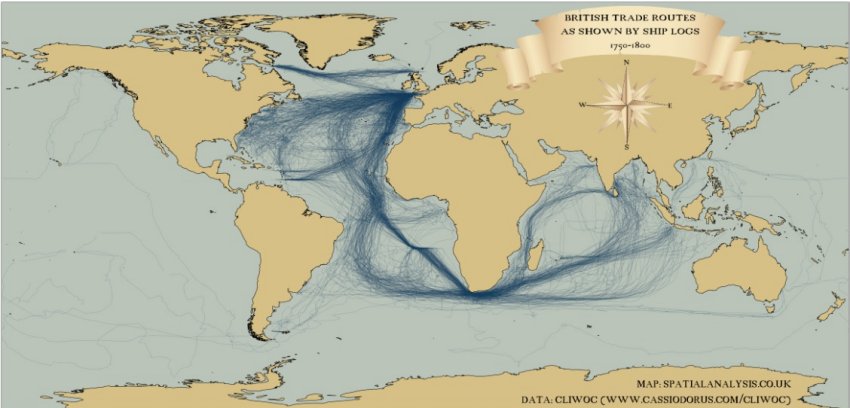
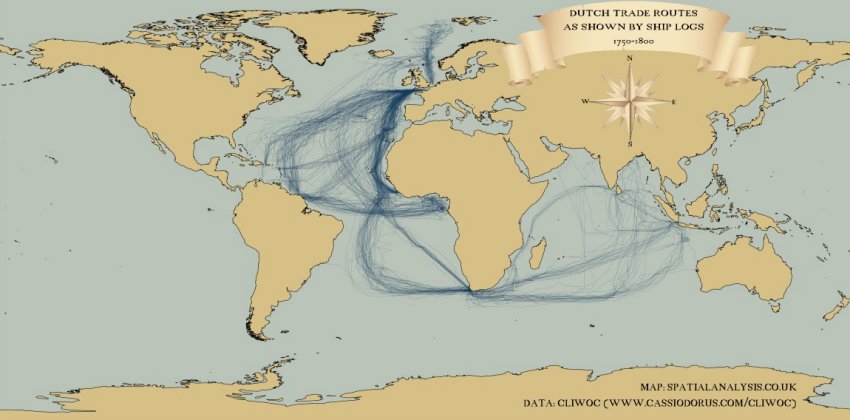
James Cheshire, of Spatial Analysis, has taken historical records of shipping routes between 1750 and 1800 and plotted them using modern mapping tools.

The first map, above, shows journeys made by British ships. Cross-Atlantic shipping lanes were among the busiest, but the number of vessels traveling to what was than called the East Indies — now India and South-East Asia — also stands out when compared to Dutch and Spanish records.

I was surprised to see how many trading voyages there were to and from the Hudson Strait — fur trade traffic, I assume.


(Larger version at the original URL)

This second map shows the same data for Dutch boats. The routes are closely matched to the British ones, although the number of journeys is noticeably smaller.

You can also see the scattering of journeys made by Dutch ships to Svalbard, off the North coast of the Norwegian mainland

April 10, 2012

The easy days of piracy are fading rapidly

Filed under: Africa, Middle East, Military — Tags: , , , , — Nicholas @ 09:05

Strategy Page has an update on the anti-piracy efforts off the Somalian coastline:

After two years of immense prosperity, the last year has been a disaster for the Somali pirates. For example, in the last eight months, only six ships have been captured, compared to 36 ships in the same eight month period a year ago. Pirate income is down 80 percent and expenses are up. Pirates have to spend more time at sea looking for a potential target, and when they find one, they either fail in their boarding efforts (because of armed guards, or better defense and more alert crews) or find anti-piracy patrol warships and armed helicopters showing up. Unlike in the past, the patrol now takes away the pirates weapons and equipment, sinks their mother ships and dumps the pirates back on a beach. The pirates claim that some members of the anti-piracy patrol simply kill pirates they encounter on the high seas (some nations have admitted doing this, at least once, in the past). But no one does this as official policy, and the rules are still basically “catch and release.” The big change is that the patrol has become much better at detecting pirates, on captured fishing ships, and shutting these pirates down. Often the pirates bring along the crew of the fishing ships, to help with the deception. But the patrol knows which fishing ships have “disappeared” and quickly identify those missing ships they encounter, and usually find pirates in charge. The anti-piracy patrol also has maritime reconnaissance aircraft that seek to spot mother ships as they leave pirate bases on the north Somali coast, and direct a warship to intercept and shut down those pirates. The pirates have been losing a lot of equipment, and time, and money needed to pay for it.

[. . .]

Pirates have responded by finding new targets (ships anchored off ports waiting for a berth) and using new tactics (using half a dozen or more speedboats for an attack.) The pirates still have a powerful incentive to take ships. In 2010, for example, pirates got paid over $200 million in ransom. The year before that it was $150 million. Most of that was taken by the pirate gang leaders, local warlords and the Persian Gulf negotiators who deal with the shipping companies. But for the pirates who took the ship, then helped guard it for months until the money was paid, the take was still huge. Pirates who actually boarded the ship tend to receive at least $150,000 each, which is ten times what the average Somali man makes over his entire lifetime. Even the lowest ranking member of the pirate gang gets a few thousand dollars per ransom. The general rule is that half the ransom goes to the financiers, the gang leaders and ransom negotiators. About a quarter of the money goes to the crew that took the ship, with a bonus for whoever got on board first. The pirates who guard the ship and look after the crew gets ten percent, and about ten percent goes to local clans and warlords, as protection money (or bribes).

[. . .]

For the last four years, Somali pirates have been operating as far east as the Seychelles, which are a group of 115 islands 1,500 kilometers from the African coast. The islands have a total population of 85,000 and no military power to speak of. They are defenseless against pirates. So are many of the ships moving north and south off the East Coast of Africa. While ships making the Gulf of Aden run know they must take measures to deal with pirate attacks (posting lookouts 24/7, training the crew to use fire hoses and other measures to repel boarders, hanging barbed wire on the railings and over the side to deter boarders), this is not so common for ships operating a thousand kilometers or more off the east coast of Africa. Ships in this area were warned last year that they were at risk. Now, the pirates are out in force, demonstrating that the risk is real.

April 2, 2012

EUNAVFOR to get more aggressive against pirates

Filed under: Africa, Europe, Military — Tags: , , , , — Nicholas @ 08:18

Strategy Page explains why the pirates in Puntland are being targeted:

The EU (European Union) agreed, on March 23rd, to allow its anti-piracy force off Somalia (EUNAVFOR) to attack coastal targets and coordinate military operations with the Somali TNG (Transitional National Government). This means that EUNAVFOR ships and aircraft can attack pirate targets on land. Most of the pirate bases (coastal towns and villages) are in Puntland, a self-declared state in northern Somalia. While less violent and chaotic than southern Somalia, Puntland officials are bribed and intimidated (by the superior firepower of the pirate gangs) into inaction. Technically, Puntland is opposed to the pirates, so the EU is hoping that Puntland won’t make a stink when EU forces begin shooting at pirates on the coast.

The EU plan apparently involves going after pirate logistics and fuel supplies in their coastal havens. This could be tricky, as the pirates are well aware of how the Western media works and could easily put many of these targets in residential neighborhoods. The EU could respond by blockading the pirate bases, and attacking pirate attempts to truck in fuel and other supplies. Pirates could put civilians on trucks, or even captured sailors from ships held for ransom. There is no easy solution to the Somali pirates.

April 1, 2012

“Off the Somali coast, everyone is looking for a big payday”

Filed under: Africa, Law, Military — Tags: , , , , , — Nicholas @ 11:54

Strategy Page on recent developments in the anti-piracy campaign off the Somali coast:

To get around laws, in many ports, forbidding weapons aboard merchant ships, security companies operating off the Somali coast have equipped small ships to serve as floating arsenals. The security guards boards, in port, the merchant ships they are guarding, then meet up with the gun ship in international waters so the guards can get their weapons and ammo. The process is reversed when the merchant ships approach their destinations or leave pirate infested waters (and put the armed guards off onto the gun ship.) Maritime lawyers fret that there are no proper laws to regulate these floating armories, or that if there are applicable laws, everyone is not following them. It’s also feared that some enterprising lawyers will seek to represent the families of pirates shot by these armed guards. Off the Somali coast, everyone is looking for a big payday.

In the last three years, more and more merchant ships, despite the high expense, have hired armed guards when travelling near the “Pirate Coast” of Somalia. It began when France put detachments of troops on tuna boats operating in the Indian Ocean, and Belgium then supplied detachments of soldiers for Belgium ships that must move near the Somali coast. These armed guards are not cheap, with detachments costing up to $200,000 a week. There are now over a dozen private security companies offering such services. What makes the armed guards so attractive is the fact that no ship carrying them has ever been captured by pirates. That may eventually change, but for the moment, the pirates avoid ships carrying armed guards and seek less well-defended prey.

March 9, 2012

The US Navy’s “east of Suez” moment

Filed under: Economics, Military, Technology, USA — Tags: , , , — Nicholas @ 00:01

“Sir Humphrey” on the looming crisis of the United States Navy:

There has been a lot of attention paid in some quarters this week to the allegations that the UK may shift back to STOVL rather than CTOL F-35. Humphrey has no intention on commenting on these particular reports — to his mind they are part of the wider PR12 process, which has seen, and will doubtless continue to see, a plethora of leaks of selected texts designed to push one case, denigrate another and continue the endless routine of tribal warfare between the services and their capbadges. All will be revealed in late March, so there is little point in speculating much before this point.

What has been of more interest though has been the reporting on the F-35 and also the wider perception that the US Navy is about to take a very significant hit in surface fleet numbers over the next 2-3 years. According to documents released there will be the loss of roughly 20 escorts from cruisers to frigates, paid off into reserve. This represents almost 20% of the USN, and is likely to see the reduction in size to barely 80 escorts within the next 2-3 years.

This is a very significant reduction — it’s effectively the paying off of the equivalent of the entire RN surface flotilla without replacement. On current plans by 2015, then USN is going to have barely 60 Arleigh Burke class destroyers, and around 20 Ticonderoga class cruisers — both designs which date back to the late 1970s – early 1980s in concept, even if the interiors have been significantly updated in equipment since then.

[. . .]

The USN is now struggling to keep pace with the fact that its escort fleet is aging, that it has multiple carriers which require replacement at some point in the near future, and that its SSN fleet is also going to need updating soon as well. This must also be set against the reality that hundreds of billions of dollars’ worth of cuts are inbound to the US defence budget, and that all three services have old and obsolescent equipment requiring replacement. It is hard to see how the US will be able to maintain its three services in their current levels of capability for much longer, and the worry is that a lot will have to give.

Humphrey is increasingly of the opinion that we are witnessing the USA’s ‘east of Suez moment’ at which the US is faced with the same strategic challenges that all empires are faced with. The legions will be recalled from Europe soon, and this is going to leave a major series of security and other challenges that need to be filled. A future blog article is planned to look at the impact of the USN cuts, and what the impact may be on the RN and other navies.

For those unfamiliar with the phrase in the title, it was in 1968 that the British government under Harold Wilson formally accepted that Britain could no longer maintain its military establishments in the furthest-flung corners of the former empire and announced the withdrawal of almost all forces from “east of Suez”. That was when the military (and economic) overstretch could no longer be maintained.

March 2, 2012

Privateers? In our Maritimes? It’s more likely than you think

Filed under: Cancon, History, Military, USA — Tags: , , , — Nicholas @ 11:05

Pirates and Privateers is a half hour documentary airing Sunday, March 4, 2012 at 12 Noon on CBC Land and Sea, that explores the rough-and-tumble history of piracy and privateering in the Maritimes.

February 16, 2012

Rum running in the Maritimes during Prohibition

Filed under: Cancon, Economics, France, History, USA — Tags: , , , — Nicholas @ 11:33

I just received a press release about a new documentary to be shown on the CBC this Sunday. Here’s the trailer:

Rum Running is a half hour documentary that will celebrate its world broadcast premiere on CBC Television’s Land & Sea on Sunday, February 19, 2012 at 12 Noon. Rum Running describes the history of rum running and depicts the high stakes role that Nova Scotia and the French Islands of St. Pierre and Miquelon played during the era. The film reveals how thousands of law abiding citizens of Atlantic Canada were lured into the alcohol smuggling trade during Prohibition in the 1920’s and 30s.

January 21, 2012

The Birkenhead drill

Filed under: History, Italy — Tags: , , — Nicholas @ 11:55

Mark Steyn’s latest column in the Orange County Register contrasts the behaviour of the crew of the Costa Concordia with that of the crew (and male passengers) of the RMS Titanic:

In the centenary year of the most famous of all maritime disasters, we would do well to consider honestly the tale of the Titanic. [. . .]

On the Titanic, the male passengers gave their lives for the women and would never have considered doing otherwise. On the Costa Concordia, in the words of a female passenger, “There were big men, crew members, pushing their way past us to get into the lifeboat.” After similar scenes on the MV Estonia a few years ago, Roger Kohen of the International Maritime Organization told Time magazine: “There is no law that says women and children first. That is something from the age of chivalry.”

If, by “the age of chivalry,” you mean our great-grandparents’ time.

In fact, “women and children first” can be dated very precisely. On Feb. 26, 1852, HMS Birkenhead was wrecked off the coast of Cape Town while transporting British troops to South Africa. There were, as on the Titanic, insufficient lifeboats. The women and children were escorted to the ship’s cutter. The men mustered on deck. They were ordered not to dive in the water lest they risk endangering the ladies and their young charges by swamping the boats. So they stood stiffly at their posts as the ship disappeared beneath the waves. As Kipling wrote:

    We’re most of us liars, we’re ‘arf of us thieves, an’ the rest of us rank as can be,
    But once in a while we can finish in style (which I ‘ope it won’t ‘appen to me).

Sixty years later, the men on the Titanic — liars and thieves, wealthy and powerful, poor and obscure — found themselves called upon to “finish in style,” and did so. They had barely an hour to kiss their wives goodbye, watch them clamber into the lifeboats, and sail off without them. They, too, ‘ope’d it wouldn’t ‘appen to them, but, when it did, the social norm of “women and children first” held up under pressure and across all classes.

Today there is no social norm, so it’s every man for himself — operative word “man,” although not many of the chaps on the Titanic would recognize those on the Costa Concordia as “men.”

January 19, 2012

Vada a bordo, cazzo!

Filed under: Europe, Italy — Tags: , — Nicholas @ 12:24

It takes a lot to vault ahead of someone like world-class competitor President Bashar al-Assad of Syria in the most-hated person contest, but Captain Francesco Schettino has “triumphed” in this, at least temporarily:

The coward in the hot seat is Captain Francesco Schettino, who infamously abandoned his sinking ship, the Costa Concordia, leaving hundreds of passengers stranded in the dark off the Tuscan coast.

The transcript of his conversation with Gregorio De Falco, an enraged Italian Coast Guard, has made a hero of DeFalco and rained down contempt on Schettino. T-shirts with an enraged De Falco’s command, “Vada a bordo, cazzo!” (Get back on the boat, for f—’s sake!) have been a big hit.

In the latest implausible explanation for his behaviour, Schettino claims he tripped on the listing Costa Concordia and somehow found himself in a lifeboat from which he was unable to extricate himself. Certainly he did not return to the stricken vessel, where rescue operations went on until 6 a.m.

The Christian Science Monitor lists the bumbling Schettino’s “top four deceptions.” The best (or feeblest, depending on your level of cynicism) is a variation of the old insurance claim excuse — the tree came out of nowhere and hit me.

Update: Now there’s speculation that the shipwreck may have been caused in the course of an attempt to impress a young woman.

The 25-year-old blonde, identified as Domnica Cemortan, was invited onto the bridge as the cruise liner sailed perilously close to Giglio, in what was apparently a ‘salute’ to an old friend of the captain’s and a favour to the ship’s head waiter, whose family were from the island.

She was reportedly the guest of one of the ship’s officers and may be the woman that passengers saw drinking and chatting with Capt Francesco Schettino on Friday evening, a few hours before the Costa Concordia ran aground.

Italian judicial authorities, who are investigating the accident and the captain’s conduct, want to interview Ms Cemortan, who according to her Facebook page was born in Chisinau, Moldova, and lives in Bucharest, Romania.

They believe she may be able to shed light on what happened on the bridge when the giant cruise ship collided with a rocky outcrop, ripping a massive gash in its hull.

Adding to the mystery, she was reportedly not on the official list of passengers and crews.

January 18, 2012

Stephen Harper “[C]ertain people in the United States would like to see Canada be one giant national park”

Filed under: Cancon, Economics, Environment, Politics — Tags: , , , , , — Nicholas @ 12:06

Investigative blogger Vivian Krause discusses American environmental groups’ interference in Canadian affairs in the Financial Post:

For five years, on my own nickel, I have been following the money and the science behind environmental campaigns and I’ve been doing what the Canada Revenue Agency hasn’t been doing: I’ve gathered information about the origin and the stated purpose of grants from U.S. foundations to green groups in Canada. My research is based on U.S. tax returns because the U.S. Internal Revenue Service requires greater disclosure from non-profits than does the CRA.

By my analysis and calculations, since 2000, U.S. foundations have granted at least US$300-million to various environmental organizations and campaigns in Canada, especially in B.C. The San Francisco-based Gordon and Betty Moore Foundation alone has granted US$92-million. Gordon Moore is one of the co-founders of Intel Corp. The William and Flora Hewlett Foundation and the David and Lucile Packard Foundation have granted a combined total of US$90-million, mostly to B.C. groups. These foundations were created by the founders of Hewlett-Packard Co.

[. . .]

The Great Bear Rainforest is a 21-million-hectare zone that extends from the northern tip of Vancouver Island to the southern tip of Alaska. Environmentalists now claim that oil tanker traffic must not be allowed in the Great Bear Rainforest in order to protect the kermode bear (aka the Great Spirit Bear). Whether this was the intention all along or not, the Great Bear Rainforest has become the Great Trade Barrier against oil exports to Asia.

Speaking on CBC last night, Prime Minister Stephen Harper said, “But just because certain people in the United States would like to see Canada be one giant national park for the northern half of North America, I don’t think that’s part of what our review process [for the Northern Gateway] is all about.”

January 17, 2012

The media angle on the Costa Concordia wreck

Filed under: Europe, Italy, Media — Tags: , , , — Nicholas @ 09:17

Tim Black points out the most common media memes about the Costa Concordia have much more to do with snobbery and disdain than with human interest or concern about the actual causes of the shipwreck:

The sequence of events that led to the sinking of the luxury cruise liner, the Costa Concordia, is now pretty much established. But facts have not got in the way of a variety of commentators who are using the accident to parade their prejudices about too-big ships and ignorant passengers.

[. . .]

These are the tragic facts so far. What no one knows exactly is why it happened. Explanations have been mooted, of course: a power blackout affecting the ship’s steering; inaccurate navigation charts failing to show the rocks; or human error, in particular by the ship’s captain, Francesco Schettino. Yet while the exact reason for the ship straying off course remains unclear, that has not stopped another object of blame coming to the fore in some of the coverage. That is, the real, underlying reason for the Costa Concordia accident is to be sought not in the actual events of Friday evening but rather in the profit-driven, build-‘em-high cruise industry and, by association, in the sea-faring ignorance of all those who sailed aboard her.

This is why so much of the coverage seems obsessed with the size of the Costa Concordia. Over the past few days, we have been repeatedly told that cruise ships have doubled in size over the past decade. While this is true — and as the twenty-sixth-largest liner in the world, the Costa Concordia is far from the most impressive of this new breed of ships — the Concordia’s size does not actually tell us why it was three miles off course. Nor does it explain why the ship’s crew was unaware of the rock outcrop despite having navigation equipment. Yes, perhaps ship size does affect manoeuvrability, but would a smaller vessel not have suffered a similar fate that befell the Concordia? In fact, the obsession with the ship’s size sheds very little light on what happened to the Concordia on Friday evening.

What the convenient obsession with size draws upon, rather, is an antipathy towards the cruise industry, a sense that it is little more than the ocean-going equivalent of that other right-thinking person’s bête noire, Dubai. In other words, a vulgar testament to profit and sky-high consumption. So although size here is not really relevant as a cause of the Concordia’s capsizing, it appears relevant to certain commentators as a symbol of commercial hubris, of complacent materialism.

January 15, 2012

Timeline of civilian shipping disasters 1912-2012

Filed under: History — Tags: — Nicholas @ 11:19

While the Costa Concordia had the possibility of being a much more serious incident had it been further away from shore, the Guardian lists the most serious shipping disasters (in peacetime) since 1912:

15 April 1912 — Canada

The White Star passenger liner Titanic sank on her maiden voyage off Newfoundland after hitting an iceberg. Of the 2,200 passengers and crew aboard the ship, dubbed before its departure as “unsinkable” 1,523 died.

29 May 1914 — Canada

At least 1,012 people were killed when The Empress of Ireland passenger liner collided with a Norwegian freighter on the St Lawrence River in Canada. It was carrying 1,057 passengers and 420 crew.

[. . .]

29 October 1955 — Soviet Union

The Novorossiysk, formerly the Italian battleship Giulio Cesare, was moored near the shore at Sevastopol. She was the flagship of the Black Sea squadron of the Soviet Navy. The ship exploded and then capsized and sank with the loss of 609 crew.

[. . .]

6 March 1987 — Britain

The car ferry Herald of Free Enterprise capsized and sank shortly after leaving the Belgian port of Zeebrugge. The vessel had 463 passengers and crew on board when it left the port with its bow doors still open. 193 people were killed.

20 December 1987 — Philippines

In the worst peacetime sea tragedy, the ferry Dona Paz sank after colliding with the tanker Vector in the Sibuyan Sea. 4,375 people died on the ferry and 11 of the Vector‘s 13-man crew were killed.

December 4, 2011

The Economist looks at Seasteading

Filed under: Law, Liberty, Politics, Technology — Tags: , , , — Nicholas @ 10:48

And it manages to avoid the mocking tone that’s common to most articles on this topic:

THE Pilgrims who set out from England on the Mayflower to escape an intolerant, over-mighty government and build a new society were lucky to find plenty of land in the New World on which to build it. Some modern libertarians, such as Peter Thiel, one of the founders of PayPal, dream of setting sail once more to found colonies of like-minded souls. By now, however, all the land on Earth has been claimed by the governments they seek to escape. So, they conclude, they must build new cities on the high seas, known as seasteads.

It is not a completely crazy idea: large maritime structures that resemble seasteads already exist, after all. Giant cruise liners host thousands of guests on lengthy voyages in luxurious surroundings. Offshore oil platforms provide floating accommodation for hundreds of workers amid harsh weather and high waves. Then there is the Principality of Sealand, a concrete sea fort constructed off Britain’s coast during the second world war. It is now occupied by a family who have fought various lawsuits to try to get it recognised as a sovereign state.

Each of these examples, however, falls some way short of the permanent, self-governing and radically innovative ocean-based colonies imagined by the seasteaders. To realise their dream they must overcome some tricky technical, legal and cultural problems. They must work out how to build seasteads in the first place; find a way to escape the legal shackles of sovereign states; and give people sufficient reason to move in. With financing from Mr Thiel and others, a think-tank called the Seasteading Institute (TSI) has been sponsoring studies on possible plans for ocean-based structures and on the legal and financial questions they raise. And although true seasteads may still be a distant dream, the seasteading movement is producing some novel ideas for ocean-based businesses that could act as stepping stones towards their ultimate goal.

November 18, 2011

An antidote to the “OMG! China will eat our lunches” meme

Filed under: Americas, China, Economics — Tags: , , — Nicholas @ 12:02

For those inclined to worry overmuch about the rise of China as a world power (as opposed to merely as an economic competitor):

The real importance of this story does not, however, have much to do with Brazil’s jittery nerves about Chinese investment. It is to remind us about a key Chinese vulnerability that is often overlooked by pundits: China’s growing dependence on natural resources located far from its frontiers.

Beijing’s chosen national strategy — to achieve great power status by becoming the industrial workshop of the world — locks it into a complex and difficult set of dependencies and relationships with countries and markets all over the world. Access to those resources traps China in complicated geopolitical tradeoffs that can blow up in unexpected ways — as when China had to scramble to protect its citizens in Libya. Chinese companies become the object of public anger if they are seen to be economically exploitative, unwelcoming to local labor, or environmentally destructive. And, of course, in the event of a confrontation with the United States, China’s entire supply chain and overseas investments are helpless hostages.

Strategically, the only way out of this trap would be to build a blue water navy and air force that could threaten US command of the seas. But a build up of that kind would not only trigger a massive US response; other countries like Japan, India and Australia would join together to ensure that China did not overturn a maritime status quo that is well trusted by other world powers.

H/T to Jon, my former virtual landlord, for the link.

November 7, 2011

The likely result of a strike against Iran’s nuclear facilities

Filed under: Middle East, Military, USA — Tags: , , , , — Nicholas @ 08:48

Ralph Peters paints a grim picture of the immediate results of any US or Israeli attack on the Iranian nuclear weapon program:

How would Iran respond to strikes on its nuke facilities? Inevitably missiles would be launched toward Israeli cities — some with chemical warheads — but these tit-for-tat attacks would be the least part of Tehran’s counterattack strategy. The Iranians would “do what’s doable,” and that means hitting Arab oil-production infrastructure on the other side of the narrow Persian Gulf. Employing it mid-range missiles, aircraft and naval forces, Tehran would launch both conventional and suicide attacks on Arab oil fields, refineries, storage areas, ports and loading facilities, on tankers in transit, and on the Straits of Hormuz, the great chokepoint for the world’s core oil supplies. The price of a barrel of crude would soar geometrically on world exchanges, paralyzing economies — exactly as Iran’s leaders intend. Ten-dollar-a-gallon gas would be a brief bargain on the way to truly prohibitive prices. And, in the way of the world, Tehran would not get the blame. We would.

And we would be in one hell of a war, with the Middle East literally aflame and our Navy able to conduct only limited operations (if any) within the Persian Gulf, given that the body of water would become a shooting gallery: Even our finest surface-warfare ships can’t fight or maneuver effectively in a bathtub. The flow of oil would not resume, and we would have no idea how to end the war (not least, since we’re unwilling to inflict serious pain on our enemies anymore).

So . . . if we are forced to attack Iran’s nuclear-weapons facilities at some point, what would it take to do it right and limit Tehran’s ability to respond with such devastating asymmetrical attacks?

H/T to Doug Mataconis for the link.

« Newer PostsOlder Posts »

Powered by WordPress