I originally found this story at the beginning of the month, and after all this time, the bulk of the Argentinian crew finally fly home. BBC News has the update:
Almost 300 sailors left on an Air France plane chartered by the Argentine government.
A skeleton crew is staying on board the three-masted Libertad to maintain it.
The tall ship was prevented from leaving Ghana after a local court ruled in favour of a US fund.
The fund, NML Capital, argued it was owed $370m (£231m) by Argentina’s government as a result of its debt default a decade ago.
[. . .]
An earlier plan for the sailors to fly back on an Argentine plane was scrapped because of fears that the aircraft might itself be impounded as part of the debt dispute.
On Tuesday, Argentine President Cristina Fernandez de Kirchner condemned the Libertad’s seizure and made it clear there would be no negotiations with creditors.
Strategy Page on one of the ways Chinese ship builders are adapting to a tougher market for new ships:
Recent photos from China show three 1,500 ton coastal patrol ships (“cutters” in American parlance.) being built simultaneously, next to each other. This is part of a 36 ship order, in part to help the domestic ship building industry, for the China Marine Surveillance (CMS). Seven of the new ships are the size of corvettes (1,500 tons), while the rest are smaller (15 are 1,000 ton ships and 14 are 600 tons). The global economic recession has hit shipbuilding particularly hard over the last four years, and China is one of the top three shipbuilding nations in the world. For a long time coastal patrol was carried out by navy cast-offs. But in the last decade the coastal patrol force has been getting more and more new ships (as well as more retired navy small ships). Delivery of all 36 CMS ships is to be completed in the next two years.
The CMS service is one of five Chinese organizations responsible for law enforcement along the coast. The others are the Coast Guard, which is a military force that constantly patrols the coasts. The Maritime Safety Administration handles search and rescue along the coast. The Fisheries Law Enforcement Command polices fishing grounds. The Customs Service polices smuggling. China has multiple coastal patrol organizations because it is the custom in communist dictatorships to have more than one security organization doing the same task, so each outfit can keep an eye on the other.
CMS is the most recent of these agencies, having been established in 1998. It is actually the police force for the Chinese Oceanic Administration, which is responsible for surveying non-territorial waters that China has economic control over (the exclusive economic zones, or EEZ) and for enforcing environmental laws in its coastal waters. The new program will expand the CMS strength from 9,000 to 10,000 personnel. CMS already has 300 boats and ten aircraft. In addition, CMS collects and coordinates data from marine surveillance activities in ten large coastal cities and 170 coastal counties. When there is an armed confrontation over contested islands in the South China Sea, it’s usually CMS patrol boats that are frequently described as “Chinese warships.”
Comments Off on Chinese shipyards adapt to slower international sales
The BBC reports on a recent incident between British and French fishing vessels:
Fishermen are calling for Royal Navy protection after claims they were attacked by French vessels.
Kevin Lochrane, from East Sussex, said he was surrounded by seven or eights boats in international waters 15 miles off Caen in a dispute over scallops.
One Scottish fisherman, Andy Scott, said he feared for his crew’s safety during the incident.
Other crewmen said they were also surrounded by the French fishermen, who they said tried to damage their gear.
Comments Off on French fishing fleet dabbles in piracy, maritime intimidation
If I were you, I’d avoid investing in any Argentinian business (or businesses which have significant operations in Argentina), as the government is doing everything it can to prevent the flight of capital. Some of the debt holders are getting quite creative about finding ways to put pressure on Argentina to pay its debts:
If pirating didn’t work out, Capt. Jack Sparrow would perhaps have made a savvy hedge fund manager.
A New York hedge fund boss is being dubbed a real pirate of the Caribbean after seizing the flagship of the Argentinian navy in an attempt to settle some of the country’s huge debt.
Billionaire Paul Singer took control of the tall ship the A.R.A. Libertad with a court order in Ghana this week.
The triple-mast frigate, which stopped in the African country as it trained naval cadets, is valued at $10 million and is the ceremonial flagship of the Argentine fleet.
Strategy Page runs down the history of naval mines and explains why Iran is most likely to try using mines to close down the critical Straits of Hormuz to tanker traffic if a new Gulf War begins:
The U.S. and over 30 other nations recently held a joint mine clearing exercise called the International Mine Countermeasures Exercise 2012 (September 16-27). The numerous training events were directed at dealing with Iranian attempts to block the entrance (Straits of Hormuz) to the Persian Gulf. Iran insists it will have no trouble doing this and blocking the export of oil. Some 35 percent of the world’s oil shipments pass through these straits, which comes to about 15-20 tankers a day (plus a dozen or more non-tankers). The Persian Gulf, in general, is a busy waterway. It is 989 kilometers long, and the average depth is 50 meters (maximum depth is 90 meters). Naval mines are Iran’s best bet if they want to shut down the straits.
[. . .]
The Iranian military is in worse shape today than it was 25 years ago, and would not last long trying to attack ships. That leaves the Straits of Hormuz. This is actually a wide (about 30 kilometers) deep channel. Normally, shipping sticks to narrow (a few kilometers wide) channels, going in and out, to avoid collisions. The main Iranian threat has always been seen as naval mines. The Arab states have lots of mine clearing equipment, and more numerous air and naval forces than Iran. In addition, there are the United States and NATO forces in the area. The problem was that all these mines clearing forces had never practiced under realistic (wartime) conditions. In short, what would everyone do if Iran did mine the straits.
Iran would probably mine the straits if sanctions, or military action, halted all Iranian oil exports. Otherwise, mining the straits would be economic suicide. If Iran tried to shut down the Straits of Hormuz, it’s more likely that effort would fail and the straits would remain open for non-Iranian oil. With the loss of their oil exports, Iran would find its remaining military forces being hunted down and destroyed day after day. Not only would Iranian oil exports be halted, but so would imports. Iran depends on imports of food (over 100,000 tons a week) and gasoline to keep its economy operating.
For an Iranian mining attempt to work they would have to get the mines onto the bottom of the straits and then prevent the rest of the world from clearing those mines. That would be difficult, as will Iranian attempts to plant additional mines. Such attempts would not be impossible as Iran has small submarines and speed boats along with sailors willing to carry out suicidal missions to deliver the mines. Even that may not be sufficient as this sort of fanaticism failed against the Americans in the 1980s. While Iran has worked to overcome their shortcomings, most of the solutions appear to be publicity stunts mainly meant to make the Iranian population feel better.
Comments Off on Mine operations in the Straits of Hormuz
Andrew Gilligan tells the sad story of the Cutty Sark‘s new “home”:
The architectural trade journal, Building Design, has announced that the historic tea clipper is the 2012 winner of the Carbuncle Cup, the wooden spoon for the dregs of British architecture.
The architects, Grimshaw, have taken something delicate and beautiful and surrounded it with a building that looks like a 1980s bus station. Clumsy and ineptly detailed, their new glass greenhouse around the Cutty Sark totally ruins her thrilling lines, obscures much of her exquisite gilding and cynically forces anyone who actually wants to see her to pay their £12 and go inside. The sight of people pressing their faces forlornly against the smoked glass to try to see something of the ship is one of the sadder in London.
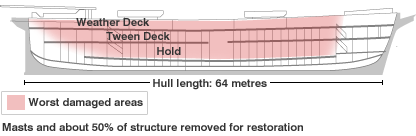
Grimshaw have also punched a shopping centre-style glass lift up through the middle of the ship — and put two more lifts in a new square building, the size of a small block of flats, next to and towering over the ship herself. They’ve plonked a glass pod on the open main deck for a staircase (the old housing was wood, but that’s so nineteenth-century). They’ve installed lights on the masts which make it look like a Christmas tree. Above all, of course, they’ve hoicked the ship up on girders, dangling above the dry dock to create an “unparalleled corporate entertaining space” underneath — an act of vandalism that prompted the resignation of the chief engineer, who said it would place the vessel under unacceptable strain and end in its destruction.
Cutty Sark was severely damaged in a drydock fire in May 2007.
Comments Off on Cutty Sark now housed in “worst new building in Britain”
We’re all aware of the piracy problems along the east coast of Africa, but the west coast is also experiencing a resurgence of pirates:
Piracy has been making a comeback in the last decade. This was initially because Somalia, a state without a government, provided small ports on the coast of East Africa where pirates could bring the merchant ships they had captured, and keep them there, safe from rescue attempts, until a ransom could be negotiated. Now, off West Africa, pirates have come up with another angle. These pirates, believed to be only one well-organized gang at the moment, target small oil tankers operating in the Gulf of Guinea (where Nigeria and its neighbors have oil fields). The pirates quickly board and seize control of a tanker at night. The crew is locked up in an internal space and the tracking devices are disabled. Then the tanker is taken to rendezvous with another tanker, which takes the oil from the hijacked tanker, along with the pirates and their other loot and makes for a port where oil brokers willing to buy stolen oil (at a steep discount) take the pirated cargo, pay the pirates and perhaps tip the pirates off on another small tanker that could be hit.
The hijacked tanker was stripped of portable items of value and then set adrift, where it would soon be found and the crew released. Normally, pirates attack merchant ships anchored near the coast grab all the valuable portables and take off. This is considered armed robbery, although some pirates will kidnap a few of the ships officers and hold them for ransom. But this requires a good hideout and more resources. The pirates who steal oil cargoes require even more technical organization and connections. But because the payoff is so high (millions of dollars for a stolen oil tanker cargo), a growing number of skilled gangsters are being attracted to the business.
All this is something of a piracy revival. Piracy hit a trough from the late nineteenth century into the later twentieth. That was because the Great Powers had pretty much divided up the whole planet, and then policed it. Piracy began to revive in a modest way beginning in the 1970s, with the collapse of many post-colonial regimes.
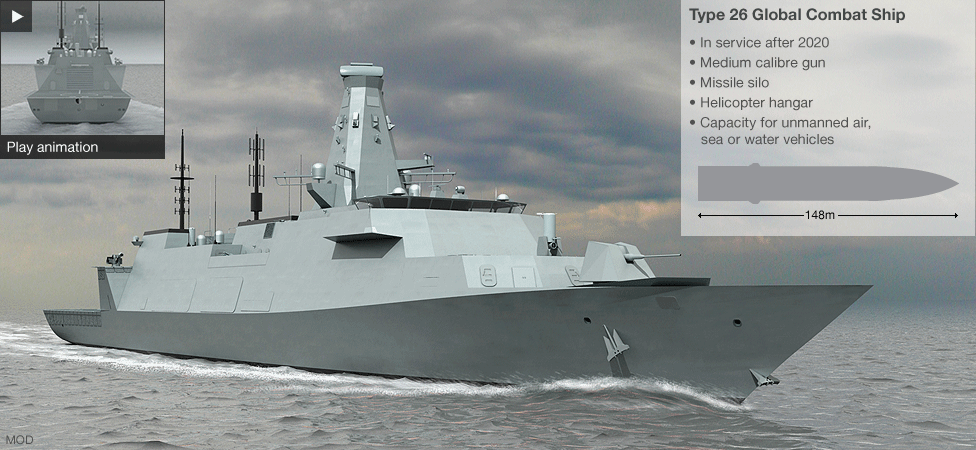
The announcement on the Type 26 Global Combat Ship has been described by officials as a “significant milestone” in a programme which will support “thousands of UK shipbuilding jobs”.
Basic specification images show sleek stealth features, familiar to modern warships, making them harder to detect.
The ship will be 148 metres long with a displacement of 5,400 tonnes.
The MoD has been working with BAE Systems since 2010 to determine the basic design for the ship. Detailed specifications of the vessel will now be examined.
Vertical missile silos for a range of weapons, such as cruise missiles, will be housed on board along with a medium calibre gun.
The hangar on board will house a Merlin or Wildcat helicopter and there will be extra space for unmanned drones, underwater vehicles or other specialist equipment.
[. . .]
The current plan is to build 13 of the ships, which are due to start coming into service after 2020.
The Type 26 will replace the 13 Type 23 frigates but the MoD is not giving a precise commitment on numbers until they know the unit cost.
The First Sea Lord, Admiral Sir Mark Stanhope, says the ship will be used “across the full spectrum of warfare”.
He added: “The T26 GCS will be a multi-mission warship designed for joint and multinational operations… including complex combat operations, maritime security operations such as counter piracy, as well as humanitarian and disaster relief work around the world.”
Comments Off on Royal Navy announces design of new “Type 26 Global Combat Ship”
New ship designs are highly complex and often take years to debug. The US Navy’s Littoral Combat Ship (LCS) program surprised most observers by settling on two different designs and splitting the intended order quantity between the two design firms. One of each design is in service now, the more traditional USS Freedom (LCS-1), and the trimaran-hull USS Independence (LCS-2). Each has had its own set of teething problems:
The LCS has long been a good source of bad news and potentially explosive revelations. In the last year the LCS design has been found to have structural and other flaws. The first LCS, the monohull USS Freedom, has suffered four major problems since it entered service four years ago. The latest one is a leak in a propeller shaft seal, which caused some minor flooding. Despite this Freedom was able to get back to port under its own power. Last year cracks in the hull as long as 17 cm (6.5 inches) were discovered, and the water-jet propulsion system broke down as well. Two years ago one of the gas turbine engines broke down.
The most serious problem is in the USS Independence, a radical trimaran design. It seems that a “dissimilar metals” situation arose when salt water, the aluminum hull, and some other metals got into close proximity with each other and extensive corrosion resulted. Aluminum hulls tend to corrode more than steel, but the problem became so bad with the USS Independence that, 18 months after entering service, it was sent into dry dock for corrosion repairs and design changes to eliminate the problem.
Cracks, corrosion, and equipment breakdowns are common in new warship designs especially designs that are radically different (like the broad trimaran shape of the USS Independence). Usually, these problems can be fixed but there’s always the risk that the new design will be seriously flawed, requiring extensive rework and a halt in building more ships of that class. So far, the U.S. Navy has not wavered in the face of potential design and construction flaws.
This is all part of the expected years of uncertainty and experimentation as this radical new combat ship design seeks to find out what works, to what degree, and what doesn’t. There is some nervousness about all this. The U.S. Navy has not introduced a radical new design for nearly a century. The last such new design was the aircraft carrier, which required two decades of experimentation and a major war to nail down what worked. Even the nuclear submarines of the late 1950s and early 60s were evolutionary compared to what the LCS is trying to do.
“Sir Humphrey” explains why adding another two Type 45 destroyers to the Royal Navy’s current construction plans won’t fly, even though it would be popular with many key constituencies: “it would win votes, it would keep supporters of the Navy happy, and the RN would be delighted”.
From the outset, let’s be extremely clear. This article is not saying that the UK could not build two more Type 45s – if the will is there, and the budget exists to do so, then anything is possible. As will be seen though, the challenge is trying to do so in a manner which makes rational sense.
[. . .]
In terms of support and manning, providing two additional Type 45s would raise a significant cost and manpower burden on the fleet. The RN has scaled itself to provide spares for six hulls. An additional two hulls means increasing spares by 33% above the existing fleet, which in turn would mean extra funding for parts, supplies, maintenance and munitions. Even basic issues like Sea Viper war shots, helicopter fleets, ammunition for 4.5” guns and the like would need to be increased. The funding for this is not in place at present. It’s not that the RN can’t find this funding, but that it will cost more to fund it than previously expected — this money has to be found from commensurate savings elsewhere.
[. . .]
The final point is perhaps the best reason why it would be near impossible to achieve this. There is simply no room in the construction yards to build two additional Type 45s. As was seen in the award of the MARS tanker project to Korea, the current UK shipbuilding industry is operating at peak capacity – the CVF programme is in pure tonnage terms providing the equivalent of 20 Type 45 destroyers worth of construction. The yards are full with CVF work now, and in a few years’ time will be ramping up to construct Type 26. To inject two additional Type 45s now would throw that programme into disarray as the yards struggle to work out how they can actually build the vessels. It’s not just a case of laying some steel down and a new ship popping up. T45s are built across multiple yards in parts, so it would need all the component yards to work together to fit it into their programme. They’d also need to work out how to take on the extra staff, who would then need to be made redundant later on as the workflow dropped off again. One of the key successes of the terms of business agreement is that the shipyards can plan for an agreed level of work. Adding ships in to this actually throws the plan into confusion as the yards have to resource to a higher level than before, incurring additional costs, and probably delaying both CVF and T26.
It is not impossible to build extra ships. That much is clear — if the willpower is there, then it can be done. But the days of shipyards existing in a short term environment, dependent on the next RN order, whatever it may be, are all but gone. The issue is the preservation of key skills, such as ship design and also high end manufacture of critical components, and doing so in a manner which makes the industry sustainable for the long term, and not the ‘boom and bust’ approach of the last century.
Regular readers of the blog may remember that the Type 45 destroyer design in particular came in for a hammering from othersources.
Comments Off on Warships are not like books or DVDs
Wooden sailing ships are subject to far more wear and tear than modern vessels: they’re like the old tale of the farmer’s axe (even though everything’s been replaced over time, it’s still the same axe). This means that heritage sailing ships need lots of careful maintenance throughout their lives, and major re-builds at long intervals. In the case of Nova Scotia’s iconic Bluenose II, however, it’s sometimes more than a “rebuild”:
She is a celebrity, immortalized on the back of our dime and presently parked beneath a big white tent in the Lunenburg Shipyard, awaiting finishing touches and the order to set sail.
Built in 1963, Bluenose II was effectively scrapped in the fall of 2010. A small percentage of the old boat, including the sails and masts and some of the mahogany and walnut from the hull, were saved for use in the rebuild. The bow-to-stern reconstruction had the legend at points looking more like a whale skeleton beached on the Lunenburg wharf, with her ribs exposed for all to see.
Some purists, including Ms. Roué, a great-granddaughter of William J. Roué — the naval architect responsible for designing the original Bluenose, which launched in 1921 and achieved lasting fame by hauling in massive catches on the Grand Banks and beating American schooners in ocean races — view the “restoration” tag as a semantic stretch.
They see it as a sham concealing the fact the boat being built and expected to launch this summer under the Bluenose II banner was not built according to Mr. Roué’s original designs. It is not the Bluenose II but a new boat altogether.
You could make the case that this is merely a look-alike, rather than a replica. In fact you’d pretty much have to say that:
The original Bluenose was made from Nova Scotia oak, while its second incarnation blended local and South American oaks.
The latest edition consists of laminated angelique, a bulletproof teak from South America. Meanwhile the engine bed, stern frame, floors and fasteners holding the whole shebang together are steel, where once they were wood.
Any boat, especially a boat named Bluenose, is more than the materials it is made of or the sum of its designs. It is a piece of living history and its identity derives from the stories attached to it and in the recollections of those that sailed aboard her, some accounted for, others lost at sea.
So, just to sum up: she’s being built to a different design (even though outward appearance is much the same), using different materials. In what way can you call her the same ship? The point made in the article, that the masts and sails were some of the “originals” being re-used is odd: those are among the parts that need replacing more often. And the mahogany and walnut saved from the last boat are almost certainly decorative elements, not structural ones.
Comments Off on If it’s being “rebuilt” to a different design, with different materials, it’s not the same Bluenose
Strategy Page discusses the historical uses of the submarine in the Pacific and why things would not be the same in the case of a Chinese war:
The U.S. Navy is rethinking how it will use its submarines in a future Pacific War. The problem is that a campaign against Chinese shipping is unlikely, in part because of what actually happened during the last great anti-shipping campaign, which occurred during World War II (1939-45). After the war, the U.S. analyzed its operations against Japanese shipping and found that submarines were important, but not the only weapon effective against shipping. Some 8.9 million tons of Japanese shipping was sunk or so seriously damaged (disabled) at the end of the war. Submarines accounted for 54.7 percent of this. But 16.3 percent was attributable to carrier-based aircraft, 14.5 percent to land- based planes and 9.3 percent to mines (most dropped by B-29s). Less than one percent was due to surface gunfire, and the balance of 4 percent was caused by accidents.
[. . .]
Meanwhile, the U.S. has adopted a new approach to any potential war with China. The U.S. Department of Defense has been told that, for the foreseeable future, there will be no more large-scale land campaigns. The air force, navy, and marines responded with a plan (AirSea Battle) that has been in the work for years. The new strategy is designed to cope with the rising power of China in the Pacific. AirSea Battle involves tighter planning and coordination of navy, marine, and navy forces, plus the development of some new weapons and tactics and cooperation with allies.
[. . .]
AirSea battle concentrates on military operations. But these will be heavily influenced by economic factors. For example, during World War II the United States was a largely self-sufficient “continental power.” We exported much (more than any other nation on the planet), but did not have to import much. That has changed. Now the U.S. has to import a lot of its oil, special raw materials (like “rare earths” from China) and a lot of manufactured goods. The U.S. is now like much of the rest of the world, China included. If there were a maritime blockade of China, the U.S. and many other Chinese trading partners would suffer severe economic disruptions. There would be massive unemployment for all concerned and that would happen despite energetic efforts by everyone to find alternative sources to goods no longer available because of the disruption of the China trade.
[. . .]
Meanwhile, the nuclear submarine community has done the math and found that their greatest contribution these days is not attacking enemy warships, but land bombardment with cruise missiles and intelligence collecting. Since the first nuclear subs showed up in the 1950s, only one, a British boat, has used a torpedo to sink a hostile warship. But hundreds of cruise missiles have been launched at land targets and uncounted (because they are highly classified) intelligence missions have been, and continue to be, carried out. All that is the recent past for subs, and is likely to be the future as well. World War II in the Pacific is not likely to be rerun. The U.S. Navy still expects its subs to go after enemy warships, and its surface and air forces to battle enemy subs. But a major war on shipping is much less likely.
Comments Off on US Navy re-thinks their Pacific strategy options
Even the most dogmatic libertarian would be hard-pressed to defend the notion of privatizing the fighting navy, but the rest of the navy (training, support, maintenance, etc.) can in some instances be privatized not only without impacting military efficiency, but actually boosting it:
The Royal Maritime Auxiliary Service (RMAS) was privatised and taken over by Serco back in the 1990s and run for profit. To this day, Serco Denholm are responsible for the provision of all manner of auxiliary services, ranging from tugs and tender transfers, through to torpedo recovery craft, exercise minelayers and range target vessels.
All in all, there are easily over 100 vessels which can be found primarily in naval bases, but also in other establishments such as the Kyle of Lochalsh, around the UK. This fleet of vessels is an important reason to be positive for two reasons. Firstly, many navies rely on their own personnel to man and operate these vessels. When they need replacing, these costs are funded from naval budgets, and not from a wider contract fund. Similarly, the manpower needed to operate them comes from the Navy, and not from the private sector, meaning more sailors are needed to do this sort of job, and not go to sea on a ‘proper’ military vessel. By contracting out the service, the RN is able to focus its resources and manpower on proper military vessels, and not have to worry about finding funds to replace elderly tugs, at a time when it wants to bring frigates into service. It is not remotely glamorous, but it is an essential part of operating a Navy, and one that is often forgotten.
Also forgotten is just how new this fleet is — there has been a huge amount of investment in the port services fleet in recent years, with literally dozens of craft (Humphrey read something saying over 80 new vessels were being ordered) being built and entering service. The RN has managed to acquire the services of one of the most modern and effective port support vessels fleets in the world. This would not have happened if the RN were still looking after the RMAS — instead, by privatising it, the funding instead has brought new ships and better capabilities into service, at a reduced cost to the taxpayer. This matters because without it, the RN would be reliant on ever older ships, or finding scarce equipment programme funds to pay for them. (For those interested in the ships in service now, try this link — http://www.rfanostalgia.org/gallery3/index.php/RMAS)
Comments Off on The Royal Navy’s successful privatization effort
In The Atlantic, Adam Chandler explains why the War of 1812 is an also-ran in the American war popularity contest:
Of the many holes in the American national memory, the War of 1812 may be the most gaping. The war that gave America its national anthem, birthed Uncle Sam, and anointed four future presidents as war heroes remains the Jan Brady of American conflicts for good reason: not only was it book-ended by two vastly more significant wars, but its causes weren’t sexy, its conclusions were muddy, and its most famous battle took place after peace was declared. And so 1812 remains the only American war known by its date. (Even Congress refused to establish a bicentennial commission, leaving the commemorations up to the states.)
But as history buffs, state and local governments, and (doubtlessly) some zealous reenactors begin the mark the conflict that started on this date in 1812, there is much that modern-day Americans can learn from this clumsy moment in the nation’s childhood.
[. . .]
Congress finally declared war on Britain, with impeccably bad timing: Just a few days earlier, the British foreign minister had decided to rescind the policy towards American trade that had caused all of the hullabaloo to begin with. But word did not reach America in time, and ill-equipped U.S. forces fecklessly staggered into Canada to show the British not to mess with American trade (and to possibly snag some of Canada’s sweet farm land). Aided by a confederacy of Native Americans, Canada mostly repelled the invasion and won a large number of battles.
The most ridiculous moment of all featured the United States surrendering the entire city of Detroit without firing a shot in defense. “It was the most colossal screw-up of the war,” Alan Taylor, the Pulitzer Prize-winning historian explained in an interview. “And it comes at the worst possible time in the first major invasion. The Madison administration was counting on winning a quick victory in invading Upper Canada from the western end via Detroit to render the war popular. And instead, he got a catastrophic defeat.”
However, most Americans, if they remember it at all, recall the scene that inspired the writing of the national anthem or the (technically post-war) battle at New Orleans:
“All of those are events that come in the last months of the war when the British were mounting a counterattack against the United States.” Taylor explained. “They are all events that lead Americans to think they were on the defensive in the war and that the British were the aggressor. What’s lost sight of is that the United States declared the war and conducted the first two years of the war primarily as an invasion of Canada. And so Americans don’t remember the battles in Canada because they went so badly for the United States.”
Comments Off on The War of 1812 “remains the Jan Brady of American conflicts”
Strategy Page on some extremely old ships still in service in various navies:
Last year, the British Royal Navy retired its oldest warship still in service, the 4,700 ton HMS Caroline. This light cruiser entered service in 1914 and fought in the epic Battle of Jutland in 1916. After World War II, Caroline served as a training ship, mostly tied up at dockside. When decommissioned last year, the ship could no longer move under her own power.
The Caroline was not the only World War I warship still in service. Currently, the oldest ship still in service is the Russian salvage ship VMF Kommuna. This 2,500 ton catamaran was built in the Netherlands and entered service in 1915. Kommuna began service in the Czar’s navy, spent most of its career in the Soviet (communist) Navy, and now serves in the fleet of a democratic Russia. Originally designed to recover submarines that had sunk in shallow coastal waters, Kommuna remains in service to handle smaller submersibles, does it well and has been maintained over the decades to the point where it cheaper to keep the old girl operational, than to try and design and build a replacement.
Most navies would not want to bring attention to their oldest ship, especially if it was nearly a century old. It’s different in the American Navy. For example, three years ago the carrier, USS Kitty Hawk (CV 63) was finally decommissioned, and ceased to be the oldest ship in the fleet. The Kitty Hawk served for 48 years and 13 days. In that time, about 100,000 sailors served on the ship. The ship was the navy’s last non-nuclear carrier and, since 1998, the oldest ship in commission. “The Hawk” did not age well, and had lots of breakdowns in its final years. This led members of the crew to nickname the ship; “Shitty Hawk”.
Comments Off on Sometimes the navy gets far more use out of a ship than they expect