Quotulatiousness

January 4, 2013

HMCS Athabaskan damaged while under tow

Filed under: Cancon, Military — Tags: , , , , , — Nicholas @ 00:01

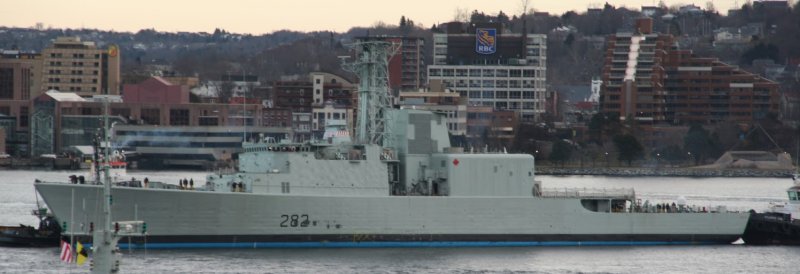
One of the Royal Canadian Navy’s destroyers was supposed to have finished a refitting back in November, but due to delays in the work had to be towed back to Halifax. On the way, further problems arose:

A navy destroyer moored in Cape Breton has been damaged and was set adrift while under tow after problems arose with repair work carried out at an Ontario dockyard, the military said Thursday.

HMCS Athabaskan drifted for several hours off Scatarie Island on Friday after the tow line broke, said Capt. Doug Kierstead of the Royal Canadian Navy in Halifax.

Kierstead said there is damage to the hull behind the ship’s identifying numbers, though he declined to say what the damage was and how it came about.

“At this point all I can say is that we are aware that there is damage visible,” Kierstead said in an interview.

He said the vessel was supposed to have undergone a routine refit by the end of November last year and was expected to be capable of sailing after that work was completed at Seaway Marine and Industrial Inc. in Welland, Ont.

HMCS Athabaskan 282
Photo from Wikimedia

December 28, 2012

The Military-Industrial Complex leads to “a bloated corporate state and a less dynamic private economy”

An older article from Christopher A. Preble, reposted at the Cato Institute website:

The true costs of the military-industrial complex, they explain, “have so far been understated, as they do not take into account the full forgone opportunities of the resources drawn into the war economy.” A dollar spent on planes and ships cannot also be spent on roads and bridges. What’s more, the existence of a permanent war economy, the specific condition which President Dwight Eisenhower warned of in his famous farewell address, has shifted some entrepreneurial behavior away from private enterprise, and toward the necessarily less efficient public sector. “The result,” Coyne and Duncan declaim, “is a bloated corporate state and a less dynamic private economy, the vibrancy of which is at the heart of increased standards of living.”

The process perpetuates itself. As more and more resources are diverted into the war economy, that may stifle — or at least impede — a healthy political debate over the proper size and scope of the entire national security infrastructure, another fact that Eisenhower anticipated. Simply put, people don’t like to bite the hand that feeds them.

And that hand feeds a lot of people. The Department of Defense is the single largest employer in the United States, with 1.4 million uniformed personnel on active duty, and more than 700,000 full-time civilians. The defense industry, meanwhile, is believed to employ another 3 million people, either directly or indirectly.

What’s more, these are high paying jobs. In 2010, when the average worker in the United States earned $44,400 in wages and benefits, the average within the aerospace and defense industry was $80,100, according to a study by the consulting firm Deloitte. And 80 percent of that industry’s revenue comes from the government.

December 27, 2012

Captives in longest hijack freed after nearly three years

Filed under: Africa, Military — Tags: , , , , , — Nicholas @ 10:27

The crew of the Iceberg 1 are now free, after enduring the longest pirate kidnapping in modern history:

How’s this for a seasonal tale to warm the hearts? After almost three years in captivity, the crew of the Iceberg 1, a cargo ship hijacked by Somali pirates, are home after finally being rescued.

For the benefit of those who haven’t followed the story — and there are probably plenty, as it’s had only scant coverage — the Iceberg 1 was captured back in March 2010, and has languished in pirate custody ever since.

As we reported back in the summer, the ship essentially fell between two stools. Its Dubai-based owner, who appears not to have been insured, refused to pay a ransom for it and simply went to ground, ignoring pleas for help from the hostages’ families.

Meanwhile, the governments representing the different sailors on board — six Indians, nine Yemenis, four Ghanaians, two Sudanese, two Pakistanis and one Filipino — were either unable or unwilling to mount a rescue attempt. So, too,was the multinational anti-piracy force, which generally prefers hijacked ships to be freed by ransom, on the basis that freeing sailors by force carries too much risk of casualties.

December 5, 2012

The shipbuilding tradition of the Maritimes

Filed under: Cancon, History — Tags: , , — Nicholas @ 09:56

I got a media advisory from Tell Tale Productions this morning, letting me know that their most recent documentary will be shown on CBC television this Sunday on Land & Sea:

Maritime Shipbuilding is a half hour documentary that reveals this seafaring history and the proud tradition that lives on today. The film travels to once-thriving shipbuilding centers in Atlantic Canada to reveal was at one time the most vibrant, productive, and profitable shipbuilding region in the world.

From the first boats built by the earliest settlers, to the golden Age of Sail in the 1800s, and from the Grand Bank fishing Schooners to the high tech Naval frigates of today — the 28,000 vessels built in Atlantic Canada during the past 250 years have shaped the region like no other industry.

November 28, 2012

The slow erosion of the US Navy’s carrier capability

Filed under: Military, USA — Tags: , , — Nicholas @ 09:07

At the Thin Pinstriped Line, Sir Humphrey looks at the US Navy’s carriers and the tasks they are being called on to accomplish:

On paper from next week the USN will operate 10 aircraft carriers, all NIMITZ class, after the USS ENTERPRISE is decommissioned. In reality those 10 vessels are going to be thinly stretched across the globe. Right now, of the 10 hulls, Nimitz is undergoing repairs, three are forward deployed (two are in the Gulf, one is in Japan) and another is available for tasking in the US. One (Abraham Lincoln) is available, but is about to enter deep refit for refuelling, while two more are in deep refit or being refuelled, with a further two in minor refit. As of today, the US Navy has just three operational deployed aircraft carriers at sea, with a fourth available in the US if required, and this is unlikely to change before summer 2013. (A good source of information can be found here — http://gonavy.jp/CVLocation.html)

The worry is that these sorts of availability problems will continue to grow as the class gets older. Make no mistake, these are some of the most complex and capable warships on the planet, but they are also getting old. Three of the hulls have now been commissioned for over thirty years, and another two for over twenty years. Although designed for an optimised 50 year lifespan, it is likely that as they age, maintenance is going to be increasingly difficult and availability will suffer.

Although a replacement class is now under construction, only one has been ordered so far, and the deep budget cuts likely to hit the DOD over the next few years means that it is by no means certain that further orders can be guaranteed in time to generate replacement hulls on time. This is a grim situation and it’s likely to get worse before it gets better.

[. . .]

Despite many years, and millions of dollars expenditure, the USN has not yet introduced a wholly new ship class since the DDG51s entered service back in the late 1980s. Although a couple of small ‘Littoral Combat Ships’ have entered service, the programme is delayed and it feels as if it is unlikely to ever yield large scale unit production. The USN surface fleet is getting a lot older though, with the Ticonderoga Cruisers, the older Arleigh Burkes and the residual Oliver Hazard Perry frigates all getting into their late teens through to late twenties. These ships have been worked hard for years, and yet no replacement is currently in site and likely to enter service within the next 5-6 years. The US escort fleet is increasingly reliant on the DDG51, which looks like it will remain in serial production for at least another twenty years. Of the replacement frigates and cruiser programmes, no signs of real progress seem to be occurring. While this situation drags on, funding is going to be needed soon for the next pair of CVNs to ensure serial production of the Ford class continues. So, the USN has a major problem in managing an ever more elderly fleet with ever fewer ships likely to be active. As spares budgets are cut, it will become harder to keep vessels at sea, while procurement of replacements seems ever more delayed.

Earlier this year, I linked to another of Sir Humphrey’s posts, talking about the US Navy’s “East of Suez” moment.

November 18, 2012

Avoiding Somali pirates

Filed under: Africa, Military — Tags: , , , , — Nicholas @ 11:21

Strategy Page sums up the advice being provided to crews of merchant ships passing the Somali coast:

A decade of dealing with the Somali pirates has motivated merchant ships to adopt policies that make life very difficult for the pirates. To aid this process the NATO anti-piracy patrol emails advice to ships entering areas where pirates are active. The advice is based on experience with what works best to avoid getting captured by the pirates. If a vessel is captured, it costs the shipping companies (that own the vessel) millions of dollars, and it means the crew spends months (even a year or more) held captive on their own ship, often in squalid conditions. There is also the risk of injury, sickness or death, not to mention beatings and lack of medical care. So the crews have plenty of incentive to follow the advice.

The first item of advice is to keep a sharp lookout all the time. Radar will often reveal the larger mother ships, but the smaller speedboats carrying the pirate boarding party can only been seen by lookouts. If possible, supply these men with night-vision equipment. The pirates like to attack at night.

Stay away from unidentified ships, especially the small wooden cargo ships and ocean going fishing ships the pirates like to seize and use as mother ships. The pirates will not be able to deceive a determined identification attempt and the email advice gives plenty of tips on how to tell who is a pirate. If you identify a nearby ship as one seized by pirates, radio the anti-piracy patrol to check it out. Many mother ships are put out of action that way.

Avoid stopping at night, as this makes you a perfect target for pirate attack. When stopped at night use only the minimum number of navigation lights and otherwise keep the ship as dark as possible. If you must stop (usually outside a port) make sure the lookouts are alert and keep crew ready to quickly start the engines. Large ships can outrun and out maneuver pirates in their speed boats, but only if the larger ship is moving.

The anti-piracy patrol has also issued a list of things to look for when you see small wooden cargo ships and ocean going fishing ships and want to know if they have been taken over by pirates. The list describes the many telltale signs that these small ships have been turned into mother ships (and this reportable to the anti-piracy patrol).

November 11, 2012

Royal Navy patrol sees off Spanish corvette

Filed under: Britain, Europe, Military — Tags: , , , , — Nicholas @ 11:25

Gibraltar. Scenic and historic port at the mouth of the Mediterranean Sea. Oh, and ongoing point of friction between the UK and Spain:

A Royal Navy patrol boat has confronted a Spanish warship off the coast of Gibraltar in the latest and most serious clash over Britain’s territorial waters.

The Government has accused Spain of an ‘unlawful incursion’ after the Vencedora, a 288ft-long naval corvette, came within three miles of Gibraltar’s coast, apparently heading towards its port.

The Vencedora, which means ‘winner’, was equipped with Harpoon anti-ship missiles, multiple guns and torpedoes when it entered Gibraltar’s territorial waters on Wednesday afternoon.

The Spanish ship ignored radio warnings to leave the area, and HMS Scimitar, a seven-man patrol boat, was scrambled to intercept.

Gibraltar has been British territory since the early 1700’s, but the current Spanish government would like to change that. As the Wikipedia article points out, the inhabitants strongly prefer staying as British citizens to becoming Spanish:

In the 1950s, Franco renewed Spain’s claim to sovereignty over Gibraltar and restricted movement between Gibraltar and Spain. Gibraltarians voted overwhelmingly to remain under British sovereignty in the Gibraltar sovereignty referendum, 1967, which led to the passing of the Gibraltar Constitution Order in 1969. In response, Spain completely closed the border with Gibraltar and severed all communication links. The border with Spain was partially reopened in 1982, and fully reopened in 1985 prior to Spain’s accession to the European Community.

In a referendum held in 2002, Gibraltarians rejected by an overwhelming majority (99%) a proposal of shared sovereignty on which Spain and Britain were said to have reached “broad agreement”. The British government has committed itself to respecting the Gibraltarians’ wishes. A new Constitution Order was approved in referendum in 2006. A process of tripartite negotiations started in 2006 between Spain, Gibraltar and the UK, ending some restrictions and dealing with disputes in some specific areas such as air movements, customs procedures, telecommunications, pensions and cultural exchange.

Update, 13 November: And here they come again:

October 25, 2012

Follow-up – Argentine flagship’s crew to fly home after three week delay

Filed under: Africa, Americas, Government, Military — Tags: , , , , , — Nicholas @ 00:01

I originally found this story at the beginning of the month, and after all this time, the bulk of the Argentinian crew finally fly home. BBC News has the update:

Almost 300 sailors left on an Air France plane chartered by the Argentine government.

A skeleton crew is staying on board the three-masted Libertad to maintain it.

The tall ship was prevented from leaving Ghana after a local court ruled in favour of a US fund.

The fund, NML Capital, argued it was owed $370m (£231m) by Argentina’s government as a result of its debt default a decade ago.

[. . .]

An earlier plan for the sailors to fly back on an Argentine plane was scrapped because of fears that the aircraft might itself be impounded as part of the debt dispute.

On Tuesday, Argentine President Cristina Fernandez de Kirchner condemned the Libertad’s seizure and made it clear there would be no negotiations with creditors.


Photo by Martín Otero, 7 April, 2007

October 13, 2012

Chinese shipyards adapt to slower international sales

Filed under: Business, China, Military — Tags: , , — Nicholas @ 11:17

Strategy Page on one of the ways Chinese ship builders are adapting to a tougher market for new ships:

Recent photos from China show three 1,500 ton coastal patrol ships (“cutters” in American parlance.) being built simultaneously, next to each other. This is part of a 36 ship order, in part to help the domestic ship building industry, for the China Marine Surveillance (CMS). Seven of the new ships are the size of corvettes (1,500 tons), while the rest are smaller (15 are 1,000 ton ships and 14 are 600 tons). The global economic recession has hit shipbuilding particularly hard over the last four years, and China is one of the top three shipbuilding nations in the world. For a long time coastal patrol was carried out by navy cast-offs. But in the last decade the coastal patrol force has been getting more and more new ships (as well as more retired navy small ships). Delivery of all 36 CMS ships is to be completed in the next two years.

The CMS service is one of five Chinese organizations responsible for law enforcement along the coast. The others are the Coast Guard, which is a military force that constantly patrols the coasts. The Maritime Safety Administration handles search and rescue along the coast. The Fisheries Law Enforcement Command polices fishing grounds. The Customs Service polices smuggling. China has multiple coastal patrol organizations because it is the custom in communist dictatorships to have more than one security organization doing the same task, so each outfit can keep an eye on the other.

CMS is the most recent of these agencies, having been established in 1998. It is actually the police force for the Chinese Oceanic Administration, which is responsible for surveying non-territorial waters that China has economic control over (the exclusive economic zones, or EEZ) and for enforcing environmental laws in its coastal waters. The new program will expand the CMS strength from 9,000 to 10,000 personnel. CMS already has 300 boats and ten aircraft. In addition, CMS collects and coordinates data from marine surveillance activities in ten large coastal cities and 170 coastal counties. When there is an armed confrontation over contested islands in the South China Sea, it’s usually CMS patrol boats that are frequently described as “Chinese warships.”

October 11, 2012

French fishing fleet dabbles in piracy, maritime intimidation

Filed under: Britain, Europe, Food, France — Tags: , , , — Nicholas @ 09:01

The BBC reports on a recent incident between British and French fishing vessels:

Fishermen are calling for Royal Navy protection after claims they were attacked by French vessels.

Kevin Lochrane, from East Sussex, said he was surrounded by seven or eights boats in international waters 15 miles off Caen in a dispute over scallops.

One Scottish fisherman, Andy Scott, said he feared for his crew’s safety during the incident.

Other crewmen said they were also surrounded by the French fishermen, who they said tried to damage their gear.

October 7, 2012

Flagship of Argentinian Navy seized for unpaid government debt in Ghana

Filed under: Africa, Americas, Government, Military — Tags: , , , , , — Nicholas @ 09:38

If I were you, I’d avoid investing in any Argentinian business (or businesses which have significant operations in Argentina), as the government is doing everything it can to prevent the flight of capital. Some of the debt holders are getting quite creative about finding ways to put pressure on Argentina to pay its debts:

If pirating didn’t work out, Capt. Jack Sparrow would perhaps have made a savvy hedge fund manager.

A New York hedge fund boss is being dubbed a real pirate of the Caribbean after seizing the flagship of the Argentinian navy in an attempt to settle some of the country’s huge debt.

Billionaire Paul Singer took control of the tall ship the A.R.A. Libertad with a court order in Ghana this week.

The triple-mast frigate, which stopped in the African country as it trained naval cadets, is valued at $10 million and is the ceremonial flagship of the Argentine fleet.


Photo by Martín Otero, 7 April, 2007

September 25, 2012

Mine operations in the Straits of Hormuz

Filed under: Middle East, Military — Tags: , , — Nicholas @ 08:18

Strategy Page runs down the history of naval mines and explains why Iran is most likely to try using mines to close down the critical Straits of Hormuz to tanker traffic if a new Gulf War begins:

The U.S. and over 30 other nations recently held a joint mine clearing exercise called the International Mine Countermeasures Exercise 2012 (September 16-27). The numerous training events were directed at dealing with Iranian attempts to block the entrance (Straits of Hormuz) to the Persian Gulf. Iran insists it will have no trouble doing this and blocking the export of oil. Some 35 percent of the world’s oil shipments pass through these straits, which comes to about 15-20 tankers a day (plus a dozen or more non-tankers). The Persian Gulf, in general, is a busy waterway. It is 989 kilometers long, and the average depth is 50 meters (maximum depth is 90 meters). Naval mines are Iran’s best bet if they want to shut down the straits.

[. . .]

The Iranian military is in worse shape today than it was 25 years ago, and would not last long trying to attack ships. That leaves the Straits of Hormuz. This is actually a wide (about 30 kilometers) deep channel. Normally, shipping sticks to narrow (a few kilometers wide) channels, going in and out, to avoid collisions. The main Iranian threat has always been seen as naval mines. The Arab states have lots of mine clearing equipment, and more numerous air and naval forces than Iran. In addition, there are the United States and NATO forces in the area. The problem was that all these mines clearing forces had never practiced under realistic (wartime) conditions. In short, what would everyone do if Iran did mine the straits.

Iran would probably mine the straits if sanctions, or military action, halted all Iranian oil exports. Otherwise, mining the straits would be economic suicide. If Iran tried to shut down the Straits of Hormuz, it’s more likely that effort would fail and the straits would remain open for non-Iranian oil. With the loss of their oil exports, Iran would find its remaining military forces being hunted down and destroyed day after day. Not only would Iranian oil exports be halted, but so would imports. Iran depends on imports of food (over 100,000 tons a week) and gasoline to keep its economy operating.

For an Iranian mining attempt to work they would have to get the mines onto the bottom of the straits and then prevent the rest of the world from clearing those mines. That would be difficult, as will Iranian attempts to plant additional mines. Such attempts would not be impossible as Iran has small submarines and speed boats along with sailors willing to carry out suicidal missions to deliver the mines. Even that may not be sufficient as this sort of fanaticism failed against the Americans in the 1980s. While Iran has worked to overcome their shortcomings, most of the solutions appear to be publicity stunts mainly meant to make the Iranian population feel better.

September 13, 2012

Cutty Sark now housed in “worst new building in Britain”

Filed under: Architecture, Britain, History — Tags: , , , — Nicholas @ 10:33

Andrew Gilligan tells the sad story of the Cutty Sark‘s new “home”:

The architectural trade journal, Building Design, has announced that the historic tea clipper is the 2012 winner of the Carbuncle Cup, the wooden spoon for the dregs of British architecture.

The architects, Grimshaw, have taken something delicate and beautiful and surrounded it with a building that looks like a 1980s bus station. Clumsy and ineptly detailed, their new glass greenhouse around the Cutty Sark totally ruins her thrilling lines, obscures much of her exquisite gilding and cynically forces anyone who actually wants to see her to pay their £12 and go inside. The sight of people pressing their faces forlornly against the smoked glass to try to see something of the ship is one of the sadder in London.

Grimshaw have also punched a shopping centre-style glass lift up through the middle of the ship — and put two more lifts in a new square building, the size of a small block of flats, next to and towering over the ship herself. They’ve plonked a glass pod on the open main deck for a staircase (the old housing was wood, but that’s so nineteenth-century). They’ve installed lights on the masts which make it look like a Christmas tree. Above all, of course, they’ve hoicked the ship up on girders, dangling above the dry dock to create an “unparalleled corporate entertaining space” underneath — an act of vandalism that prompted the resignation of the chief engineer, who said it would place the vessel under unacceptable strain and end in its destruction.

Cutty Sark was severely damaged in a drydock fire in May 2007.

August 30, 2012

Piracy’s latest hotspot

Filed under: Africa, Law — Tags: , , , , — Nicholas @ 08:23

We’re all aware of the piracy problems along the east coast of Africa, but the west coast is also experiencing a resurgence of pirates:

Piracy has been making a comeback in the last decade. This was initially because Somalia, a state without a government, provided small ports on the coast of East Africa where pirates could bring the merchant ships they had captured, and keep them there, safe from rescue attempts, until a ransom could be negotiated. Now, off West Africa, pirates have come up with another angle. These pirates, believed to be only one well-organized gang at the moment, target small oil tankers operating in the Gulf of Guinea (where Nigeria and its neighbors have oil fields). The pirates quickly board and seize control of a tanker at night. The crew is locked up in an internal space and the tracking devices are disabled. Then the tanker is taken to rendezvous with another tanker, which takes the oil from the hijacked tanker, along with the pirates and their other loot and makes for a port where oil brokers willing to buy stolen oil (at a steep discount) take the pirated cargo, pay the pirates and perhaps tip the pirates off on another small tanker that could be hit.

The hijacked tanker was stripped of portable items of value and then set adrift, where it would soon be found and the crew released. Normally, pirates attack merchant ships anchored near the coast grab all the valuable portables and take off. This is considered armed robbery, although some pirates will kidnap a few of the ships officers and hold them for ransom. But this requires a good hideout and more resources. The pirates who steal oil cargoes require even more technical organization and connections. But because the payoff is so high (millions of dollars for a stolen oil tanker cargo), a growing number of skilled gangsters are being attracted to the business.

All this is something of a piracy revival. Piracy hit a trough from the late nineteenth century into the later twentieth. That was because the Great Powers had pretty much divided up the whole planet, and then policed it. Piracy began to revive in a modest way beginning in the 1970s, with the collapse of many post-colonial regimes.

August 20, 2012

Royal Navy announces design of new “Type 26 Global Combat Ship”

Filed under: Britain, Military, Technology — Tags: , , — Nicholas @ 08:46

Britain’s Royal Navy revealed the design of the Type 26 today:

The announcement on the Type 26 Global Combat Ship has been described by officials as a “significant milestone” in a programme which will support “thousands of UK shipbuilding jobs”.

Basic specification images show sleek stealth features, familiar to modern warships, making them harder to detect.

The ship will be 148 metres long with a displacement of 5,400 tonnes.

The MoD has been working with BAE Systems since 2010 to determine the basic design for the ship. Detailed specifications of the vessel will now be examined.

Vertical missile silos for a range of weapons, such as cruise missiles, will be housed on board along with a medium calibre gun.

The hangar on board will house a Merlin or Wildcat helicopter and there will be extra space for unmanned drones, underwater vehicles or other specialist equipment.

[. . .]

The current plan is to build 13 of the ships, which are due to start coming into service after 2020.

The Type 26 will replace the 13 Type 23 frigates but the MoD is not giving a precise commitment on numbers until they know the unit cost.

The First Sea Lord, Admiral Sir Mark Stanhope, says the ship will be used “across the full spectrum of warfare”.

He added: “The T26 GCS will be a multi-mission warship designed for joint and multinational operations… including complex combat operations, maritime security operations such as counter piracy, as well as humanitarian and disaster relief work around the world.”

« Newer PostsOlder Posts »

Powered by WordPress