Quotulatiousness

July 9, 2019

The main economic damage of Brexit is the extended period of uncertainty

Filed under: Britain, Economics, Europe, Government — Tags: , , , — Nicholas @ 03:00

At the Continental Telegraph, Tim Worstall interprets a recent Bank of England recommendation to really mean “do Brexit” and “get it over with”:

To pull that out of the jargon, when every bugger’s running around screaming because they don’t know what’s going to happen then things are dark for the long term future of the economy. Just because the screaming and the running around means no bugger is doing anything else.

And here’s the thing – that lookin’ dark bit gets worse the longer the uncertainty lasts. To the point that the effect just of the not knowing becomes greater than the possible effect of any particular event in that universe of possibilities. It really is true that continuing to delay Brexit will, at some point, become worse than any particular Brexit outcome.

Thus get on with it, get it done. And given that we’ll get something of a bloody revolution if the Remainers win – we Brits being really quite keen on this democracy idea, we get to choose not they – then the getting on with it will have to be to leave. Yesterday would have been good, tomorrow if that’s not possible.

July 1, 2019

Theodore Dalrymple on “the ancient rhetorical tricks of suppressio veri and suggestio falsi

Filed under: Britain, Europe, Media, Politics — Tags: , — Nicholas @ 05:00

In the New English Review a recent Theodore Dalrymple post on “inventing European identity”:

I doubt whether there is anyone who has never resorted to the ancient rhetorical tricks of suppressio veri and suggestio falsi. Some do it knowingly, others unknowingly. The omission of relevant facts and the insinuation of falsehoods are dual and often inseparable techniques that are the stock-in-trade of most practising politicians. Arguments have often to be schematic and if in theory it is possible to tell no falsehoods, it is virtually impossible not to suppress, or at least omit, some truths if a discussion of complex matters is not to be interminable.

Nevertheless, universal resort to error, whether honest or not, is no defence for those who utilise it. This is particularly so of intellectuals, whose metier above all is, or ought to be, honest argumentation. I was therefore intrigued to read an open letter published in the Guardian newspaper by what were described as “30 top intellectuals.”

The letter began with a ringing suggestio falsi: “The idea of Europe is in peril.” What the authors meant was that the idea of the European Union is in danger. They implied, in effect, that Europe and the European Union were synonyms, which is clearly false. If a country ceases to be a member of the European Union, or has never been a part of it, it does not cease to be European, neither geographically nor culturally.

The opening salvo sets the tone for the rest. Any opposition to the ever-closer union that is the aim of the European Union is characterized as purely irrational, nostalgic and even fascistic. It cannot by definition be founded on any rational considerations whatever. It success would be, as the authors put it, the triumph of “a politics of disdain for intelligence and culture” — which is in effect to say that anybody who opposes the proposed ever-closer union is either a demagogue or uncouth and stupid. Thus the top intellectuals, including five winners of the Nobel Prize and many world-famous writers, appear to have learned nothing from the single most disastrous phrase used in any recent election, Mrs. Clinton’s infamous “basket of deplorables.” Who is more stupid than whom?

The top intellectuals say of opponents of the drive towards a large federal state something like, “Let’s reconnect with our ‘national soul!’ Let’s rediscover out ‘lost identity’!” They go on to say, “Never mind that abstractions such as ‘soul’ and ‘identity’ often exist only in the imagination of demagogues.”

I overlook the fact that any British politician, however fervent a supporter of Brexit would never use a term such as “the British soul” for justified fear of being laughed out of court, but notice only that a few lines further on the top intellectuals say “We count ourselves among the European patriots.”

June 22, 2019

History Summarized: The Fall of Rome

Overly Sarcastic Productions
Published on 21 Jun 2019

Go to http://www.audible.com/overlysarcastic or text OVERLYSARCASTIC to 500500 to get a free audiobook, 2 free Audible Originals, and 30-day free trial.

Rome, in one form or another, has been around for a *while*. Kinda seemed like it was going to last forever, like it was basically immortal. Well bad news for everyone involved: Rome goes bye-bye just like all the other empires in world history. So let’s talk about when, how, and why Rome fell!

SEASONS OF ROME T-Shirt: https://www.threadless.com/discover/s…

SOURCES & FURTHER READING:
Gibbon’s Decline and Fall: https://amzn.to/2FwBRvO
Mary Beard’s SPQR: https://amzn.to/2Wwu2x3
The History of Rome Podcast: https://apple.co/2U7Q4tq
Lectures from TheGreatCourses: “The Decline and Fall of the Roman Empire?” (Gregory Aldrete), “Late Antiquity — Crisis and Response” & “Barbarians & Emperors” (Thomas Noble)
If I see anyone complaining that I didn’t sufficiently cite this video I’m going to sack your ancient capital and pillage your temples.

PATREON: https://www.Patreon.com/OSP

OUR WEBSITE: https://www.OverlySarcasticProductions.com
Find us on Twitter https://www.Twitter.com/OSPYouTube
Find us on Reddit https://www.Reddit.com/r/OSP/

June 17, 2019

Britain’s Conservative Party – the Quisling Right

Filed under: Britain, Europe, Politics — Tags: , , , , , , — Nicholas @ 03:00

Sean Gabb outlines recent British history, with emphasis on “the project” — the gradual take-over of the educational and cultural power-centres of Britain by a self-styled new ruling class and the total melt-down of the Conservatives:

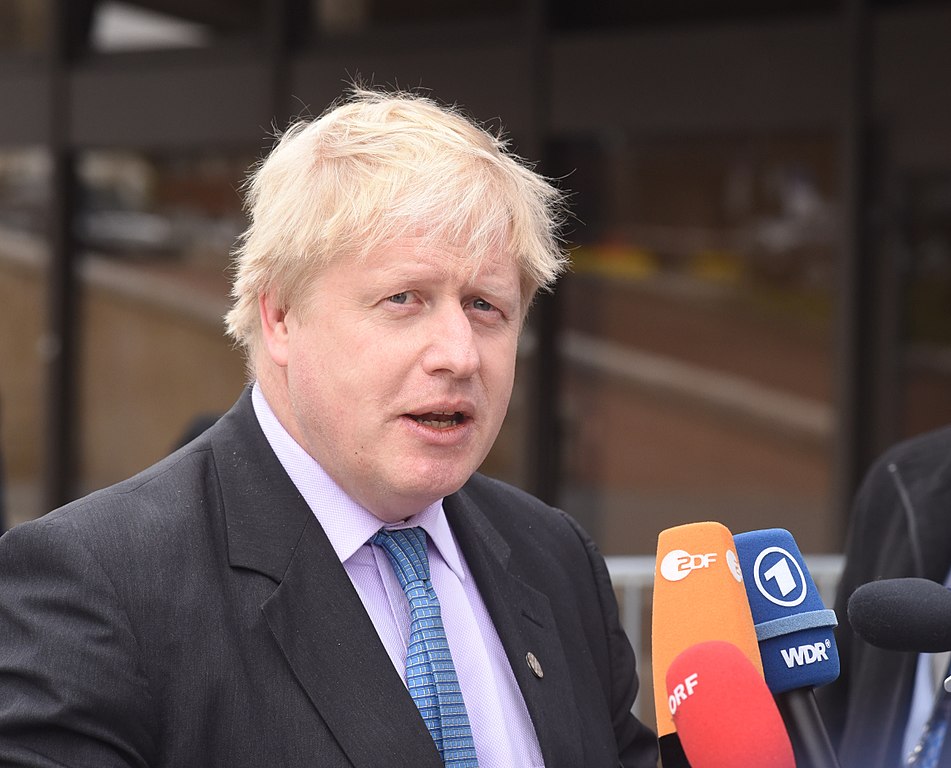
Boris Johnson, Secretary of State for Foreign and Commonwealth Affairs at an informal meeting of the Foreign Affairs Council on 15 February 2018.
Photo by Velislav Nikolov via Wikimedia Commons.

I will begin with what I believe has been a loose Project unfolding through my entire life. Since about the 1960s, we have seen the rise of a new ruling class, committed to the transformation of Britain into a new sort of country. Because I have discussed the Puritan Hypothesis at some length here and here, I will now give only a summary. In short, the new ruling class wants to reshape our thoughts into its own conception of The Good. This means a long-term project of securing cultural hegemony through control of education and the media, and a shorter-term project of compelling us to act as if we already believed in the new order of things. Though I will emphasise that it is in no meaningful sense either Marxist or socialist, the overall Project has been carried through by a careful use of what Louis Althusser called the ideological state apparatus and the repressive state apparatus.

One important element of this Project has been to maintain the appearance of political diversity. Because Britain — or at least England — is a rather conservative nation, this means ensuring a Conservative Party that makes conservative noises, but never does anything measurably conservative. I spent several years after 1997 grumbling about “the Quisling Right.” Though I have mostly fallen silent since then, here it is the idea of the Quisling Right briefly stated in a speech I gave in 2005 during a debate with Boris Johnson.

Though I will not call their predecessors real conservatives, the Conservative Party was taken over in 2005 by a small group headed by David Cameron. These people spent the next five years making vaguely conservative noises, without ever challenging the new order of things that had come fully into shape under the New Labour Governments. Because of this, they failed to win an election against Gordon Brown, but were able to form a coalition government with the Liberal Democrats, who were just as committed to the new order of things as Labour.

[…]

I think it a reasonable conclusion that the Conservative Party is the Quisling Right — and, or but, or both, that it is run by a clique of politicians unfit for any conceivable purpose. Theresa May will leave office with the label fixed to her of the worst Prime Minister in history. But the reason she was able to last so long is that she had no obvious replacement. As I write, her most likely replacement is Boris Johnson. He is lazy. He is unprincipled. He is a thug. He is an adulterer who paid for at least one of his mistresses to have an abortion. He was a ludicrous Mayor of London. He was the worst Foreign Secretary I can recall. This Conservative Government has landed us in a first-class national and international crisis. It has provoked the European Union into refusing to entertain any leaving terms short of the ruinous. It has made no good preparations for leaving without a deal. It has landed us in a position where the best exit involves throwing ourselves on the mercy of the Americans, and to hope that they will treat us no more ruthlessly than they did in 1940. The last person we should ask to navigate this crisis is Boris Johnson.

It seems the sheep in the Parliamentary Party have agreed he is their only hope of keeping their seats at the next election. Perhaps the Party membership will be taken in by his Churchillesque wind-baggery. But this will not do. He will be brushed aside by the Europeans. He will be taken for a ride by his fellow Americans. That is if, before then, he can avoid a general election in which he will by murdered by Jeremy Corbyn. I am told, in his defence, that only he who is without sin should cast the first stone. Well, I have never done what Boris Johnson so far has. So, if I am not the first to ask for one, hand me a stone, and make it a big one.

No conspiracy here. These people have failed us. But it was never their purpose to do otherwise. More importantly, they have failed the Project. For that, I suppose, we should feel minimal gratitude. Even so, their survival in office for so long raises a further question with no comforting answers. How could a clique of total incompetents have been allowed, without meaningful challenge, to take over and run into the ground one of our main parties of government? What does this say about us as a people?

June 2, 2019

Andrew Heaton defends Basil Fawlty John Cleese

Filed under: Britain, Humour, Media — Tags: , , , — Nicholas @ 05:00

In his latest newsletter (subscribe here), Andrew Heaton takes up the cudgels to defend John Cleese against accusations of racism, sexism, white supremacy, homophobia, transphobia, Islamophobia, etc., etc. and suggests that the answer is that he’s “just old”:

First, “Some years ago I opined that London was not really an English city anymore.” Well, he’s right. London is geographically English, but other than its physical proximity to Surrey, it’s not English — it’s global. Its last census reports that 36.7% of its denizens are foreign-born. About 45% of the people who live there are White British (Welsh, Irish, English, Scottish). Which is to say, less than half of London is English [a lot less than half — the Welsh, Irish and “porridge wogs” don’t appreciate being called “English”, nearly as much as Canadians don’t like being called “Americans”]. The rest are a mélange of Europeans, non-Europeans, first and second generation immigrants, Klingons, Vulcans, Wookis, and folks from elsewhere in the Commonwealth and/or Narnia.

It’s a global city, like New York. It is richly diverse and cosmopolitan, which is a strength and draw to millions of people who live there. However I will argue that it’s difficult to be ethnically diverse and cosmopolitan while simultaneously being homogeneously English. Mutually exclusive, in fact.

Although to be fair, people aren’t mad at Cleese for observing that London isn’t English, they’re mad because he wishes it were. Cleese appears to prefer Englishness over multiculturalism. (Note the distinction between “culture” and “race.” Following the media storm, he tweeted, “… I prefer cultures that do not tolerate female genital mutilation. Will this will be considered racist by all those who hover, eagerly hoping that someone will offend them – on someone else’s behalf, naturally.” [Sic.])

My read on the situation is that Cleese is not racist, he’s old. What I mean by that is: life is always in flux, cities are by nature dynamic, society is fluid. People tend to want things to stay static, and they don’t, and that’s irksome for many, particularly as they grow elderly and nostalgic. I question when London was last really “English,” given that it was the imperial capital of half the globe well before he was born, and no doubt had several pockets of Indians and Jamaicans and Vulcans living there by the time he showed up.

All the same, is John Cleese allowed to prefer English over polyglot? Because I think that’s the root heresy at work here: saying that English culture might be superior to some others, and preferring it to them.

New York City is far, far more diverse and multicultural than, say, Portland, Oregon. Portland is so overwhelmingly white that it’s basically a giant bleach commercial with some craft breweries and street buskers thrown in. Ethnicity aside, can Portlanders prefer their cultural homogeneity over the vastly more polyglot city of Houston? So long as people agree that immigration is positive and we should be neighborly and welcoming to newcomers, I’m disinclined to hound people for their personal preferences.

I don’t know whether or not John Cleese meets that threshold. We know that he favored Brexit. I suspect, based on scattershot Cleese musings, that wants a Britain which is open and welcoming to foreigners, but that he would also like them to become polite, uptight, tea-drinking gardeners once they’ve moved there.

I could be wrong. I don’t know the depths of John Cleese’s heart, and whether or not his pro-Brexit stance comes from hatred of distant bureacurats (good) or dislike of foreigners and immigrants (bad). I suspect most of the people shouting at him on Twitter have no idea either.

Which is my main and final point. Maybe a single isolated tweet isn’t sufficient information to psychically intuit whether someone is a bigot or not? We’re all on the same page here: bigotry is bad. Don’t be a racist. Don’t be a homophobe. But if we’re going to champion the idea that the worst non-criminal thing you can be in our culture is a bigot, then we should also be at least a tad reserved about passing out scarlet letters just because there’s a slow news day and we spot a fun Twitter pile-on to get worked up about.

May 29, 2019

The EU election was “the Tories’ worst result since 1678”

Filed under: Britain, Europe, Politics — Tags: , , , , , , — Nicholas @ 05:00

Mark Steyn on the results of last week’s EU parliamentary elections:

In any normal UK election, it would be inconceivable for either of the two main parties – Conservative and Labour – to attract just 23 per cent of the vote. The fact that that is all they could muster between them is hilarious, and greatly to be enjoyed. As I put it on the radio last week, the departing Theresa May has led the Tories to their worst result in two hundred years. But, really, that’s praising with faint damns. I saw Daniel Hannan on the telly extending Mrs May’s impressive feat back through the pre-Reform Act era and accounting it the Tories’ worst result since 1678. Which is kind of hard to spin. Her forced resignation last Friday morning (by which point her party had made it clear they wouldn’t stick with her past lunch) ensures that she and that election result will be yoked together for all time. And jolly well deserved it is.

When the party of government falls from favor, the beneficiary is usually the principal opposition. Instead, Jeremy Corbyn’s Labour Party saw its vote fall almost as precipitously as the Tories’. Against the Conservatives’ single-digit nine per cent, Labour could muster only fourteen per cent, its own worst result in a century – in fact, since 1910. Which would also be hard to spin, had Theresa May not done Corbyn the favor of pulling off an unbeatable record.

[…]

Instead, Mrs May in particular but also Parliament in general chose to double-down on the estrangement from the masses revealed by the referendum, and spent the next three years demonstrating that, whatever the Prime Minister had in mind when she first declared “Brexit means Brexit”, it obviously doesn’t mean leaving the European Union. Either through malice or stupidity or condescension, the political class opted to widen its breach with the people – and Nigel Farage, who is a very canny fellow, decided six weeks ago to create a party to fill the gap in a European election the UK shouldn’t have had to participate in.

Listening and/or watching to the BBC on Sunday for as long as I could stomach it, I detected a strange urge to suggest that the Brexit Party had somehow under-performed, as though it’s normal for a six-week-old party to win twenty-nine out of seventy-three seats, while the century-old Labour Party wins only ten, and the Tories four and the nearest Nigel gets to a run for his money is the second-placed Liberal Democrats with sixteen seats. Farage and the other officially pro-Brexit parties (Labour, Tory, Democratic Unionist) won 44 seats. The Lib Dems and the other officially Remainer parties (Green, Scottish Nationalists, Plaid Cymru, Sinn Féin, Alliance Party) got 29. Adding in the unelected UKIP and Ulster Unionists, the Leave share of the vote was 58 per cent.

Yes, yes, I know, that’s a bit of a simplification, in that the Tories are supposedly pro-Brexit but totally bollocksed it, and Labour is only pretending to be pro-Brexit as part of a difficult straddle between its Old Labour working-class base and the New Labour preening metropolitan Euro-luvvies. Many of the latter – including such hitherto loyal champagne socialists as actors Simon Callow and Michael Cashman and even Blair’s old Cabinet Secretary Gus O’Donnell. – flew Corbyn’s coop and voted for the Lib Dems. Even so, for those demanding a second referendum (or, as they cynically call it, a “people’s vote”), there’s not much evidence for a second-time-around sadder-but-wiser Remain majority. Among riven Tory families, Jacob Rees-Mogg’s sister stood for the new Brexit Party while Boris Johnson’s sister stood for the equally new “Change UK”, a militantly anti-Brexit party formed by a coterie of disaffected Remainer media self-promoters of the soft left and soft right. Annuziata Rees-Mogg was duly elected in the Farage surge, while Rachel Johnson flopped out because “Change UK” had barely any statistical support outside the more desperate bookers of telly current affairs shows.

May 28, 2019

Brexit Party wins big in European elections

Filed under: Britain, Europe, Politics — Tags: , , , — Nicholas @ 05:00

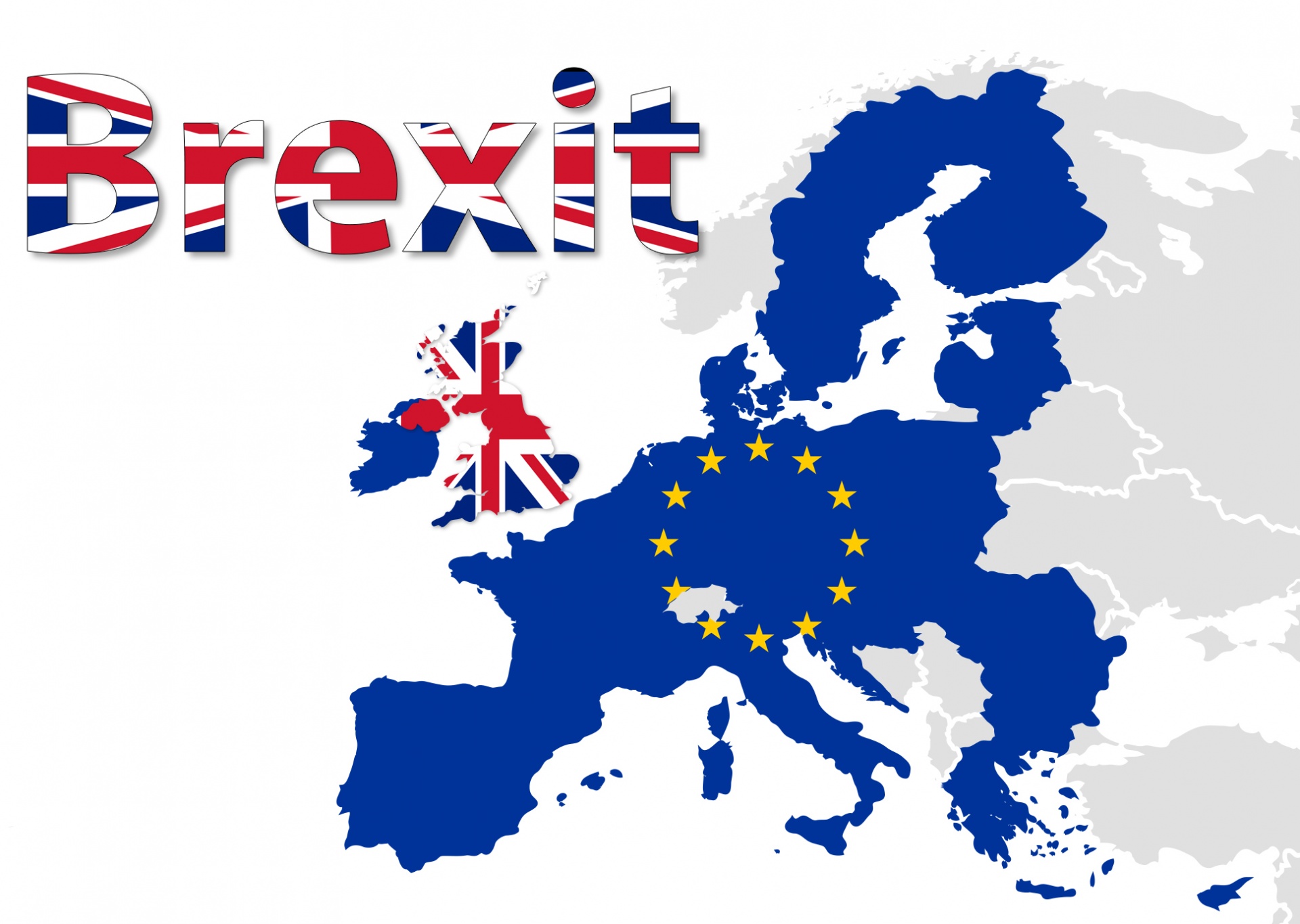
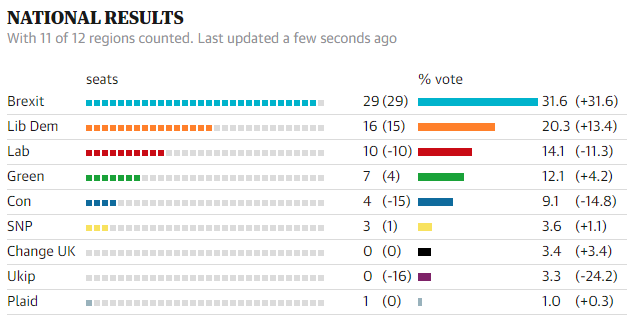
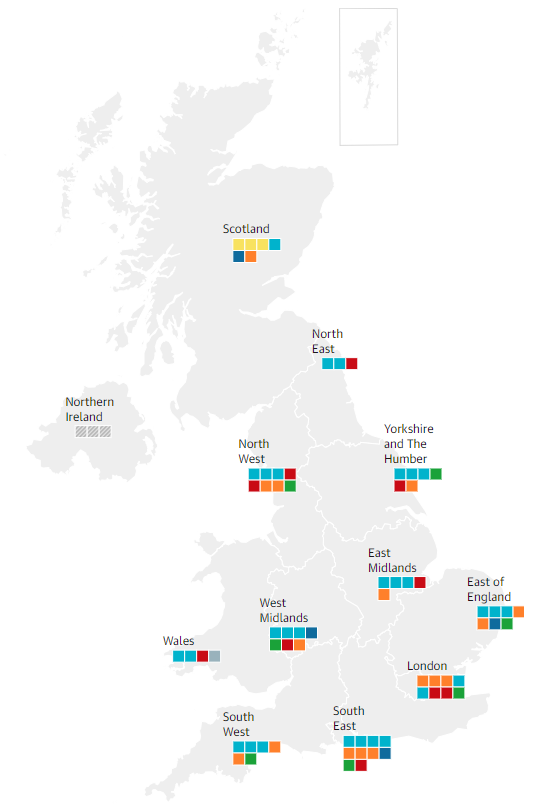
Nigel Farage and his brand-new Brexit Party took 31.6% of the popular vote in England, Scotland, and Wales in the European elections (the Northern Irish results are delayed):

The distribution of the seats:

At Spiked, Brendan O’Neill says that despite the Brexit Party’s stunning results, the establishment is still determined to prevent Brexit and deny the democratically expressed wishes of British voters:

And still the establishment is in denial. Even following the stellar performance of a brand new party in the Euro elections, still the political establishment and its cheerleaders on social media are in a state of blinkered, fingers-in-ears denial about political feeling in the UK. How bad is their denial? Get this: the Brexit Party, barely six weeks old, soared to victory in the EU elections, decimated the Tories, conquered historic Labour-held territories like Bolsover and Hartlepool, and became the largest party in the entire European Parliament, and yet the No1 political trend on Twitter is… #RemainSurge.

Yes, these people, these inhabitants of the Brexitphobic echo chamber, have convinced themselves that this electoral revolt in which the Brexit Party steamrollered all the other parties is actually a victory for them. This takes self-delusion to giddy new heights.

“This is a really strong night for Remain”, said Caroline Lucas, like a real-life version of that meme showing a dog saying “This is fine” as his house burns down. “Tonight the Brexit Party wasn’t supported by around two-thirds of voters”, said Hilary Benn, perversely ignoring the millions of people who did vote for the Brexit Party, who vastly outnumber those who voted for his Labour Party. Alastair Campbell interpreted the election results as a mandate for a second referendum, which is almost as mad as saying Saddam Hussein had weapons of mass destruction that could be deployed within 45 minutes.

In the face of this colossal culture of denial among the political and media elites, let’s reiterate some basic facts. The Brexit Party battered Labour and the Tories. It won more than five million votes. It won 31.6 per cent of the vote, which is 8.4 per cent more than the Tories and Labour combined: the Tories got 9.1 per cent (fifth place) and Labour got 14.1 per cent (third place). The Brexit Party got 28 seats, making it the largest party in the European Parliament. It won in every single region in England apart from London, speaking profoundly to the massive political and moral divide separating the capital – the heart of the political establishment – from the rest of England. It also did spectacularly well in Wales, topping the poll and winning in 19 out of 22 council areas.

And yet myths are already taking hold, being feverishly promoted by pro-EU figures. The first is that the Brexit Party is “just” – why just? – picking up the old UKIP vote and therefore its victory isn’t all that significant. Actually, the Brexit Party has got almost 32 per cent of the vote share, which is five percentage points higher than UKIP got at its high point in the Euro elections of 2014. The other myths – that the Brexit Party is only successful because it is a shadily funded, demagogic outfit, whose new MEPs probably have Russian roubles stuffed in their pockets – is the usual conspiratorial and anti-democratic rubbish we’ve come to expect from the rattled defenders of the status quo.

As for the “Remain surge” idea. Get real. The two parties that are most explicitly anti-Brexit and have expressed their searingly anti-democratic intention to overthrow the mass vote of 2016 – the Lib Dems and the Greens – won a combined vote of 29.7 per cent. That’s two per cent less than the Brexit Party got. The most poisonously elitist anti-Brexit Party – Change UK – disappeared without a trace, winning 2.8 per cent of the vote. Remember how much Change UK was talked up by the liberal media? At one point the chattering classes really did see this party as the saviour of Britain from the horrors of Brexit and yet it won a pathetic, paltry level of electoral support – 600,000 votes to the Brexit Party’s five million.

May 21, 2019

The Brexit Party may be getting dirty foreign money! Call out the plod!

Filed under: Britain, Europe, Law, Politics — Tags: , , , , — Nicholas @ 05:00

In the Guardian, totally neutral and disinterested journalists report on former Labour PM Gordon Brown’s call to investigate where the Brexit Party is getting its funding from:

The Electoral Commission is under mounting pressure to launch an investigation into the funding of Nigel Farage’s Brexit party because of concerns that its donation structure could allow foreign interference in British democracy.

Before Thursday’s crucial European elections, Gordon Brown has written to the Electoral Commission calling on it to urgently examine whether the party has sufficient safeguards on its website to prevent the contribution of “dirty money”.

The former Labour prime minister will use a speech in Glasgow on Monday to say an investigation into the Brexit party’s finances is urgent and essential.

“Nigel Farage says this election is about democracy. Democracy is fatally undermined if unexplained, unreported and thus undeclared and perhaps under the counter and underhand campaign finance – from whom and from where we do not know – is being used to influence the very elections that are at the heart of our democratic system,” he will say, according to pre-released extracts.

As Tim Worstall points out:

It’s actually an entire 13 paragraphs later that we get to the meat of the matter:

    Only donations over £500 have to be declared under British law.

The Brexit Party is obeying every jot and tittle of electoral and fundraising law. This is the very system that the federast establishment set up itself. But, you know, the wrong people are succeeding under it so aspertions must be cast.

And guess what? The Electoral Commission isn’t going to get anything done by Thursday. Not even to be able to confirm that the law is being obeyed as it should be. But we’ve managed to get the propaganda out there that Nigel’s posse are bought by the Russians and that’s the point of it all anyway.

You might think me a little cynical here. But sadly I’m not. When I was working for Ukip the Times – Sam Coates it was – announced that we simply weren’t going to contest the next election. No reason given, no analysis performed, an apology of any prominence never was forthcoming. Just a bit of disinformation dropped into the public conversation there.

That’s how the federasts play and any governance system that has to play that way isn’t one we desire to be a part of, is it?

The Hell with the EU.

Of course, dirty anonymous foreign money sources can fund other groups too.

May 18, 2019

Tim Worstall lists the benefits of a hard Brexit

Filed under: Britain, Economics, Europe — Tags: , , , , — Nicholas @ 05:00

In the Continental Telegraph, Tim Worstall responds to a demand for a list of the benefits of a hard Brexit:

1) How will you protect UK business from dumping?

We won’t. The aim, purpose and intention of trade is to gain access to those things which Johnny Foreigner makes better, cheaper, faster – pick any two of three – than our own domestic producers do. Given that the aim of an economy is to make the people, consumers, as well off as the constraints of the real world allow, we wouldn’t protect domestic producers from anything. Shape up or go bust.

As even the Treasury’s briefing on the costs and benefits of Brexit said, competition from trade is exactly what incentivises domestic producers to become more productive.

So, we don’t protect from dumping and the people of Britain become richer. The problem with this is?

2) What will you do for those who lose their jobs because the businesses that employ them are undermined by WTO rules?

Exactly the same as we do for anyone else who loses their job for any other reason. The economy destroys some 10% of all jobs every year – some 3 million – and another 10% are generated newly as well. That’s just what labour market churn is. We have a welfare system for the interim and people who lose jobs because of Brexit or WTO do exactly as everyone else, get another job with the welfare state as the backstop.

And it’s important to note how new job creation works. It isn’t that we must plan what those jobs are before the old disappear. It’s the availability of the newly employable labour which generates the testing of what should be done next.

3) What will you do on the Northern Ireland border?

Lie.

We have pointed this out before:

Our answer should be “Yes.” We agree that we are leaving, that we have put in place that hard border. Then we do absolutely nothing above what we already do. People come and go as they wish, carrying what goods they can, and we do nothing. Except, as we already do, we keep an eye on those moving things on an industrial scale and have our little customs and tax chats with them away from that line on the map.

What other people wish to do on their side of that line is entirely up to them. We will do, as we’ve always done when in our right minds, what is useful and beneficial to us. It’s somewhat unfashionable these days to talk of the empire but it’s still true that we had it. Often because we’re rather good at this lying, cheating and dissembling. We should carry on. So, there’s the border, as it is today. And?

May 17, 2019

The Three Kingdoms – The Battle of Guandu – Extra History – #2

Filed under: Books, China, History, Military — Tags: , — Nicholas @ 06:00

Extra Credits
Published on 16 May 2019

This series is brought to you by Total War: THREE KINGDOMS, a brand new strategy game set during this time period. https://store.steampowered.com/app/77…

Yuan Shao’s forces cross the Yellow River, assaulting Cao’s fortifications. Yuan has 110,000 soldiers — including the runaway warlord Liu Bei — while Cao Cao has only twenty thousand. But things are about to go in a very unexpected, brutal twist for the next eight years…

Three kings ruled in China. Three kings, each dreaming of ruling all under heaven. Three kings who rallied their armies for battle. The empire, long divided, must unite; long united, must divide.

Thanks to Jordan Martin for the guest art! https://www.jordanwmartin.com/

Join us on Patreon! http://bit.ly/EHPatreon

May 11, 2019

The Three Kingdoms – Yellow Turban Rebellion – Extra History – #1

Filed under: Books, China, History, Military — Tags: , , — Nicholas @ 06:00

Extra Credits
Published on 9 May 2019

This series is brought to you by Total War: THREE KINGDOMS, a brand new strategy game set during this time period. https://store.steampowered.com/app/77…

Fierce duels. Great armies. Love, brotherhood and betrayal. These are the images conjured when we speak of the Three Kingdoms.

Liu Bei, Zhang Fei, Guan Yu — these were the men who would define the Three Kingdoms period. Even though the actual history of this period is often conflated with the events of the historical novel, Romance of the Three Kingdoms, there was still a lot of compelling drama and intrigue we can explore — let’s delve in to the Yellow Turban Rebellion, which really did happen!

Thanks to Jordan Martin for the guest art! https://www.jordanwmartin.com/

Join us on Patreon! http://bit.ly/EHPatreon

May 5, 2019

Theresa May’s awful “Withdrawal” Agreement

Filed under: Britain, Europe, Government, Law — Tags: , , , , — Nicholas @ 03:00

Hector Drummond relays a Spectator article that lists 40 problems with Prime Minister May’s agreement with the EU:

Just in case readers don’t have the time to go through the lengthly document themselves, Steerpike has compiled a list of the top 40 horrors lurking in the small print of Theresa May’s Brexit deal.

[…]

In summary: The supposed “transition period” could last indefinitely or, more specifically, to an undefined date sometime this century (“up to 31 December 20XX”, Art. 132). So while this Agreement covers what the government is calling Brexit, what we in fact get is: “transition” + extension indefinitely (by however many years we are willing to pay for) + all of those extra years from the “plus 8 years” articles.

Should it end within two years, as May hopes, the UK will still be signed up to clauses keeping us under certain rules (like VAT and ECJ supervision) for a further eight years. Some clauses have, quite literally, a “lifetime” duration (Art.39). If the UK defaults on transition, we go in to the backstop with the Customs Union and, realistically, the single market. We can only leave the transition positively with a deal. But we sign away the money. So the EU has no need to give us a deal, and certainly no incentive to make the one they offered “better” than the backstop. The European Court of Justice remains sovereign, as repeatedly stipulated. Perhaps most damagingly of all, we agree to sign away the rights we would have, under international law, to unilaterally walk away. Again, what follows relates (in most part) for the “transition” period. But the language is consistent with the E.U. imagining that this will be the final deal.

The top 40 horrors:

  1. From the offset, we should note that this is an EU text, not a UK or international text. This has one source. The Brexit agreement is written in Brussels.
  2. May says her deal means the UK leaves the EU next March. The Withdrawal Agreement makes a mockery of this. “All references to Member States and competent authorities of Member States…shall be read as including the United Kingdom.” (Art 6). Not quite what most people understand by Brexit. It goes on to spell out that the UK will be in the EU but without any MEPs, a commissioner or ECJ judges. We are effectively a Member State, but we are excused – or, more accurately, excluded – from attending summits. (Article 7)
  3. The European Court of Justice is decreed to be our highest court, governing the entire Agreement – Art. 4. stipulates that both citizens and resident companies can use it. Art 4.2 orders our courts to recognise this. “If the European Commission considers that the United Kingdom has failed to fulfil an obligation under the Treaties or under Part Four of this Agreement before the end of the transition period, the European Commission may, within 4 years after the end of the transition period, bring the matter before the Court of Justice of the European Union”. (Art. 87)
  4. The jurisdiction of the ECJ will last until eight years after the end of the transition period. (Article 158).
  5. The UK will still be bound by any future changes to EU law in which it will have no say, not to mention having to comply with current law. (Article 6(2))

And on for another 35 awful items.

April 19, 2019

The next Euro-elections as “the second referendum”

Filed under: Britain, Europe, Politics — Tags: , , , , — Nicholas @ 03:00

Julie Cook wonders why the Remoaners seem so eager to cast the May 23 European elections as the second referendum they’ve been eager to have, as the early indications show something less than full eagerness among British voters for any of the pro-remain groups:

Timothy Garton Ash is, I think, making something of a mistake here. For he’s calling for the upcoming euro-elections to be seen as a second referendum on our leaving the European Union. The point being that this is going to be something of a hostage to fortune.

Perhaps more importantly the more Remoaners call for it to be seen and treated as such the more likely we are to see what lying toads they are.

    Britain will have its second referendum – on 23 May. Don’t miss it
    Timothy Garton Ash This is a crucial chance to show politicians how we feel now about leaving Europe. The turnout must be huge

The point being, well, what if Leave wins?

    In just five weeks’ time, Britain will have a referendum on Brexit. This will take the form of elections to the European parliament, but in reality this will be a pre-referendum, or, if you like your neologisms ugly, a preferendum. So there is now one simple task: to maximise the vote for parties that support a confirmatory referendum on Brexit, giving the British people a democratic choice between accepting the negotiated Brexit deal and remaining in the EU.

And there’s the toad bit. There’s a significant portion of the population who’d prefer to just Leave. Don’t care about the terms, the deal, let’s just leave the b’tards to stew in their own juices and we’ll get on with solving whatever problems remain after we’ve not remained. And this is a significant portion – perhaps not a majority, maybe not even a plurality but that’s going to be the interesting test

Early polls show that Nigel Farage and his new Brexit Party are in the lead over both Labour and the Conservatives. Of course, he’ll have to weather a full month of unbridled hate and slander from the media, but what can they possibly say about him or his new party that they haven’t already screamed and bellowed before? Once you’ve fired all the invective in your shot locker, you don’t stand much chance of changing anyone’s opinion if they didn’t react the first dozen times.

April 17, 2019

Theresa May has been brilliantly successful in achieving her (true) aims

Filed under: Britain, Europe, Government, Politics — Tags: , , , , — Nicholas @ 03:00

Theodore Dalrymple admits having misjudged Mrs. May as a failure, when in fact her plans have been coming brilliantly to fruition:

Like almost everyone else, I regarded [Theresa May] as a pygmy in courage and a giant in incompetence, but it is time for a re-assessment, especially with regard to her efforts to Britain’s exit from the European Union. After the Union granted a further delay to Britain’s departure, the President of the European Council, Donald Tusk, said that it was his secret dream to prevent Britain from leaving. It is pleasing to know that Mr Tusk’s secret dreams so entirely coincide with those of the British political class, including (I surmise) those of Mrs May. At last we have a basis for full and final agreement.

Like the great majority of the British political class, Mrs May was always in favour of remaining in the Union. This class was so confident of its ability to persuade the population that it was right that it agreed with practically no demur to a referendum which would pronounce the winner as the side which obtained 50 per cent plus one of the votes cast. Thus the matter of British membership, it thought, would be settled once and for all.

The problem for the political class was now to find a method of overriding the result of the referendum without doing so in too blatant a fashion. And here, in Mrs May, it found a perfect leader.

Needless to say, Mrs May, having been selected as Prime Minister, could not just put forward her conviction that Britain should remain in the Union and say outright that she had no intention of carrying out the will of the majority. At that stage, such a disavowal of the result would have been politically impossible and might even have caused unrest. Instead, she went through a brilliantly elaborate charade of negotiating withdrawal, in such a way that the result would not be accepted by Parliament. Her agreement would be withdrawal without withdrawal, the worst of all possible outcomes, all complication and difficulty, and no benefit.

She knew perfectly well that the European Union, having drafted this agreement unacceptable to Parliament, would not renegotiate it. Why should it, since it knew that Parliament had no intention of demanding a real and total withdrawal, since it did not want to withdraw at all? She also knew that Parliament would never agree to a withdrawal without an agreement with the Union, as Parliament has repeatedly made clear.

April 6, 2019

“The Prime Minister has repaid my loyalty with betrayal”

Filed under: Britain, Europe, Government, Politics — Tags: , , , — Nicholas @ 05:00

Despite the full applicability of the headline to Canadian politics, this isn’t about the Dauphin’s betrayal of cabinet ministers or the Canadian people, it’s actually Matt Ridley talking about Prime Minister Theresa May:

The Prime Minister has ignored the views of the majority of her Cabinet and ruled out No Deal. The reason, we are told, is that No Deal might lead to the re-imposition of direct rule over Northern Ireland, and might lead to a second Scottish independence referendum.

That either of these considerations should outweigh the independence of the United Kingdom from an increasingly decrepit but increasingly autocratic empire is bizarre. If No Deal causes a second referendum in Scotland – we were told that the vote itself would cause that too, remember, but it did not – then we will win that too.

But more bizarre is that these worries have existed all along. If the Prime Minister thinks the risk of direct rule in Northern Ireland (which is happening in practice anyway) trumps all other considerations, and rules out No Deal, then why did she not say so more than two years ago or at any time since? Instead, she said 108 times that we would leave the EU on 29th March, whatever happens; 50 times that she would not extend that date; and 32 times that No Deal is better than a bad deal. Not once did she say it was impossible.

[…]

Mrs May should have ruled out No Deal at the start of the negotiations, if that is what she thought, or she should have meant “No Deal is better than a bad deal” when she said it. As it is, the combination of threatening No Deal until the moment when it might actually matter in the negotiations, then dropping the threat on the feeblest of latest excuses, is about as foolish as one can imagine. And now rushing off to hand the initiative to an apologist for totalitarians, anti-Semites and terrorists instead. Thanks.

The Prime Minister and her allies are now chanting that it is all the fault of the European Research Group for rejecting her deal and are saying they have no alternative than the dismal choices of supporting her deal or no Brexit, as if amnesiac about the third option: their recent promises to leave with No Deal if necessary. Yet the truth is that ever since the debacle at Chequers in July, when everybody from half the Cabinet to the Democratic Unionists to the media to the people themselves told her quite clearly that she would never get the Chequers plan through Parliament, she has been the one at fault.

« Newer PostsOlder Posts »

Powered by WordPress